This has been a breakthrough campaign for Flavio Cobolli. He reached a major final in Paris and won enough matches throughout the year to reach #6 in the ATP rankings. He’s at the Tour Finals in Turin this week, a surprising result for someone who started the year outside the top 20.
Yet he has set a remarkable record in the process. Cobolli will almost certainly be the first top-tenner in the ATP matchstats era (since 1991) to win fewer than 50% of total points.
You probably know that it’s possible to win a match with fewer than 50% of points, or even games. Imagine a 7-6, 1-6, 7-6 contest, and you get the idea. Such a roller-coaster scoreline isn’t necessary, as long as the winner loses some games quickly but is dragged into deuces in the games they win. En route to the Acapulco title back in February, Cobolli won just 48% of points to beat Miomir Kecmanovic, 7-6, 3-6, 6-4.
But a season is a different story. Cobolli’s won-loss record entering the Tour Finals, 36-24, is weak for a top-eight guy. But it’s still a 60% win rate. It takes more than a couple of flukes like the Acapulco semi to get to a 60% match win rate with only 49.8% of points.
Here are the lowest total-points-won (TPW) rates for year-end top-tenners:
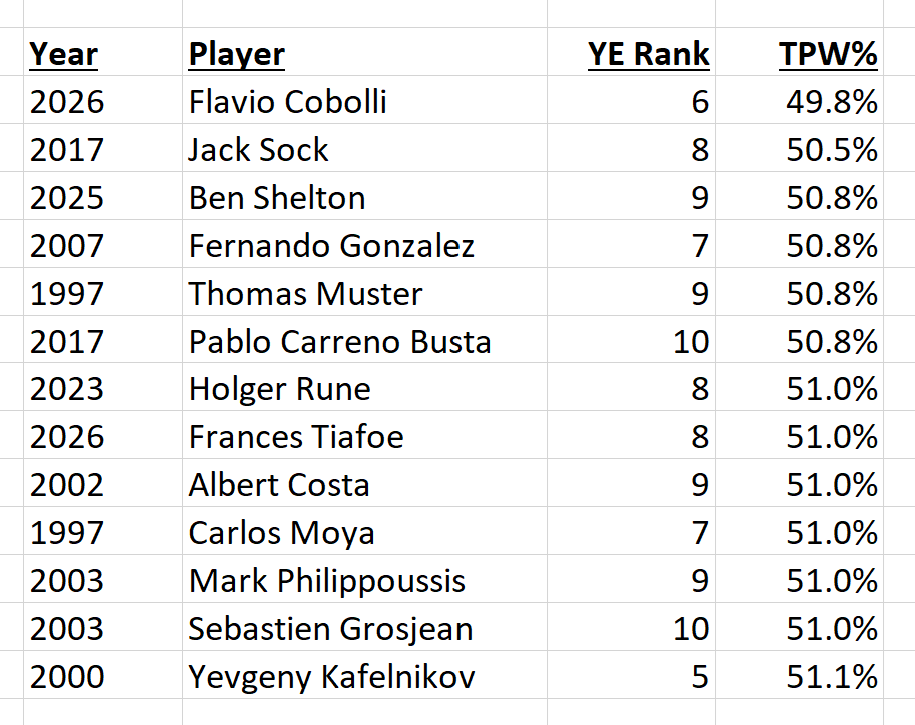
The Italian is in a class by himself. If he can win a match or two and hold off Arthur Fils to finish the year at #6, he’ll be the first top-sixer to go the full year with a TPW% under 51%, since Kafelnikov a quarter-century ago.
(Technically, Cobolli could also make this a moot point. If he wins his last two round-robin matches and ends up champion, he’d probably play around 600 more points. A 53.5% win rate for those four victories would push him up to 50.0% on the year. The odds are certainly against him, but he did win 53.8% against Tiafoe in Acapulco, and he drubbed Zverev to the tune of 57.4% in Munich. He also won 37.4% against Tiafoe at Indian Wells, so… yeah.)
Another way to put Cobolli’s season in context is to find the best years (by ranking) of players who finished with more points lost than won:
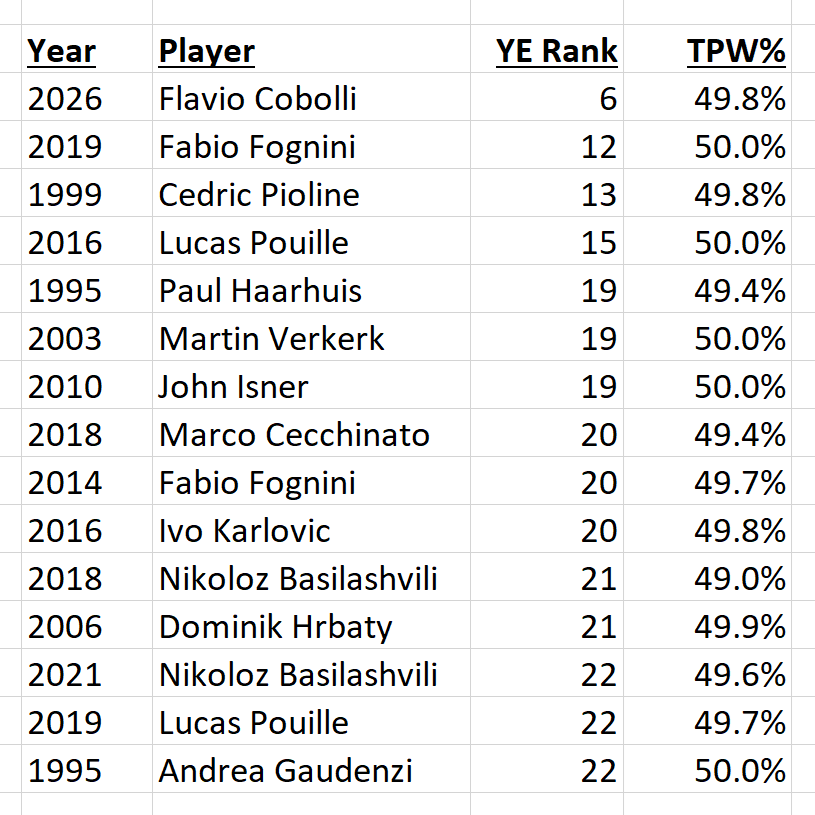
The 50.0% rates are rounded up from something just below that.
Cobolli’s #22 finish last year almost made the list. If you exclude Davis Cup, he ended 2025 just a hair below 50%. Fittingly, he polished off his season with a 1-6, 7-6, 7-5 victory over Jaume Munar, in which he won only 48% of points. But he won 58% and 52% in the previous two rounds–barely enough to end the season in the (point) win column.
How?
None of this answers the question of how the Italian got to a 60% win rate and a #6 (or #7, depending on the next few days) year-end ranking.
As for the ranking, that’s a combination of clustering wins–a full third of Cobolli’s ranking points come from the Roland Garros final–and a jam-packed field without many clear elites. In other words, the same factors that have allowed Ben Shelton to crack the top five with his own statistical quirk.
The 60% win rate comes from pulling out the close ones and losing badly more often than he wins easily. A simple way to see it is that in his wins, Cobolli earned an average of 52.8% of points. In his losses, he tallied just 44.1%. The margin in his losses was more than twice the margin in his wins. There were more victories, but not enough to pull the weighted average up over 50%.
A striking illustration is how Cobolli fared when he won between 48% and 50% of points:
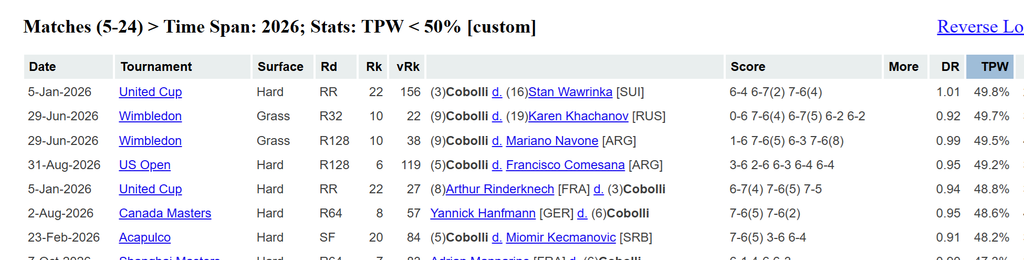
Five wins out of seven! A typical player might pick up one or two wins out of a group like that, but five is rare. And two of them–the Wimbledon third round and Acapulco semi-final–were disproportionately valuable in terms of ranking points.
Of his 36 wins, only nine were in the “comfortable” range, with at least 55% of points won:
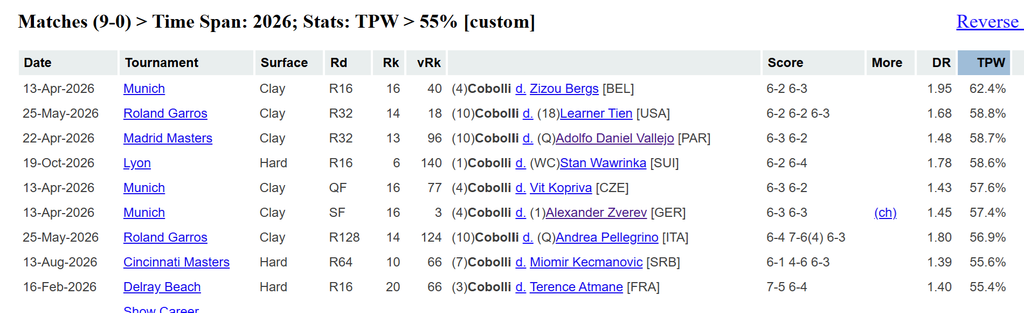
But nearly three-quarters of his losses were comfortable for the other guy:
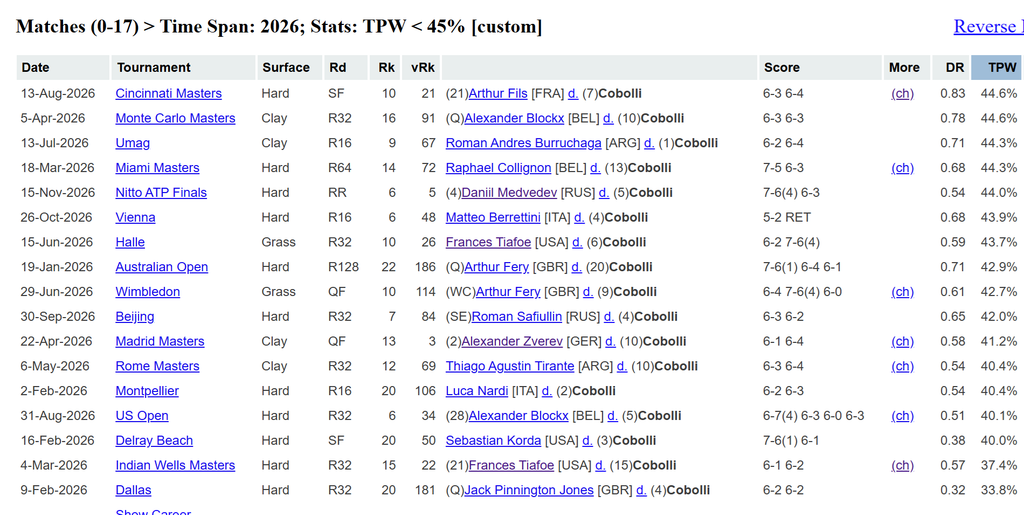
This probably isn’t sustainable. Certainly the ranking isn’t, unless Cobolli sneaks into another French Open final–or just gets a lot better. Some of this might be a real tendency, where the Italian just doesn’t feel like it on some days, so instead of losing a close one, he flops out entirely. But at the very least, he isn’t going to keep pulling out so many matches in the 48-50% range.
The funniest outcome in 2027 is also the likeliest: Cobolli will finally raise his TPW a comfortable margin above 50%, but he’ll fall back out of the top ten. He’s due for a year of boring normalcy.
In his Dartmouth Commencement speech, Roger Federer, one of the most successful tennis players ever, said his
TPW was only slightly above 50%.
French and Italian players seem very well represented in the list of best seasons while winning less than 50% of points? Are they streakier than the average tour professional?
haven’t tested by nationality, but I’m guessing it has something to do with clay specialization. A clay specialist can go deep in a couple of tournaments, earn lots of ranking points (as Cobolli did), then look bad for the other two-thirds of the season. Doesn’t apply to all clay specialists, nor does it explain everyone on the list, but I’ll bet that’s a lot of it.