September 30, 1973: Generation Gap

Roy Emerson wasn’t planning to head west for the 1973 Fireman’s Fund International in Alamo, California. But his tennis-camp schedule opened up, so he took advantage of the free time and made a quick trip to the Golden State.

At the Pacific Southwest, the first leg of his two-tournament swing, Emerson turned in a performance typical of his 37-year-old self. He won a couple of singles matches, then lost in straights to Tom Okker. In the doubles, he paired with Ken Rosewall to reach the semis. He was still one of the best doubles players around: Even as a part-timer, he had picked up five titles in 1973 alone.

A week later in Alamo, the Australian veteran played like a younger man. He battled through a three-setter against Jeff Austin in the second round. He overcame a 5-7 first-set loss to Roscoe Tanner to advance through the quarters. In the semi-finals, Arthur Ashe took another 7-5 first set, but Emerson stormed back to win, 6-2, 6-1.

“I play better when I don’t play so much,” he said. “I can concentrate and enjoy it more if it isn’t week after week.” Alamo–the site of the Round Hill Country Club, outside of Oakland–was just his second tournament since July, and the value of the time off was evident.

On September 30th, Emerson’s opponent in the final was a man nearly two decades his junior, Sweden’s Björn Borg. Everything, it seemed, was new to the 17-year-old, but his learning curve was extraordinary. He had lost first-rounders to middling opponents in his two previous outings on California cement. Here, though, he demolished the big-serving Vladimir Zednik and outlasted third seed Tom Gorman.

Borg got off to a strong start in the final, as well. Despite losing four of the first five games, he reeled off five in a row to win the first set, 7-5. For the third match in a row, Emerson dropped the opener by the same score.

“An old body takes a long time to warm up,” he said.

Emmo started returning better, and he realized that Borg’s two-handed backhand often created opportunities for his own backhand volley–the bread-and-butter shot that had won a dozen major titles for the Australian. He cruised through the second set, 6-1.

An Emerson return, at 4-all in the third, proved to be Borg’s breaking point. At deuce, Emmo ran around a weak serve, blasted a forehand, and won the point. The Swedish teen double-faulted to hand his opponent the break. The veteran served it out for a 5-7, 6-1, 6-4 victory.

Emerson owned more than 100 career singles titles, but it had been awhile. How long? “You would have to ask me a difficult question, wouldn’t you?” said the champion. “Gosh, it’s been so long, I honestly can’t remember.”

Not counting exhibitions, it had been four years. His trophy haul had been doubles-only since the summer of 1969, when he ran off three titles in a row on European clay. He wasn’t about to change his schedule, though: He wouldn’t appear on a singles court again until March.

Borg, for his part, was satisfied with his second-place finish. “I play my own game and if I lose, I lose,” he said. “Next time, I’ll beat him.”

* * *

This post is part of my series about the 1973 season, Battles, Boycotts, and Breakouts. Keep up with the project by checking the TennisAbstract.com front page, which shows an up-to-date Table of Contents after I post each installment.

You can also subscribe to the blog to receive each new post by email:
 

September 27, 1973: Năstase Hangs On

On clay, Ilie Năstase had no peer. The 27-year-old showman from Bucharest had won the 1973 French Open without dropping a set. In Rome, he disposed of Manuel Orantes–the next-best player in the Grand Prix points race–by the imperious score of 6-1, 6-1, 6-1. By September, he had already picked up eight clay-court titles; his only loss was a nailbiter to Adriano Panatta in Bournemouth.

Enough of the circuit was played on clay that Năstase‘s results made him the clear leader in the season-long Grand Prix. Heading into Chicago’s Tam International at the end of September, he had 408 points. The rest of the top six clustered between 284 (Orantes) and 233 (Jimmy Connors).

On less familiar surfaces, the Romanian was vulnerable. He lost to Sandy Mayer at Wimbledon and Andrew Pattison at the US Open. On cement at the Pacific Southwest in Los Angeles, he fell in the semi-final to Tom Okker. Now Năstase needed to contend with the fast, indoor hard courts in Chicago.

It was a surface where anybody could beat anybody. For Năstase, the threat arrived on September 27th, in the form of 23-year-old Australian Phil Dent. Dent was a promising player with many of the usual attributes of his countrymen, like a penchant for grass courts and a knack for doubles. His serve got him into plenty of tiebreaks, but it hadn’t delivered any significant winning streaks.

Though Năstase liked to clown around in the early going, he quickly learned he was in for a fight. American tennis officials had taken some of the fun out of his hijinks, too. At the Cincinnati tournament in August, Ilie spent much of the final protesting line calls, cursing the referee, and stalling in protest. When he won–Orantes, again, was the victim–the referee withheld his prize money. A USLTA disciplinary committee eventually ruled that he would be fined $4,500–half of his earnings in Cinci.

Not so long ago, the charismatic Romanian had been held up as a savior for professional tennis, a TV-friendly face and personality who could drive interest in the game. But with the rise of Stan Smith, and now Connors and Björn Borg, he wasn’t quite so indispensable. There were no shortcuts to sporting fame and fortune: He needed to keep winning.

In fairness, he never stopped doing that. He came into the Dent match with an astonishing total of 94 victories in 1973 alone.

He somehow made it 95. Dent took a close first set, 6-4. Năstase equalized by the same score. It was the highest-quality match of the tournament, perhaps the best Ilie had played on a hard court since he dueled with Connors back in March. Both men served big, returned well, and took care of the business at the net. The crowd, according to the Chicago Tribune, was left “gasping.”

The final set was the most dramatic of all. Neither man edge ahead, and the contest came down to a deciding tiebreak, the 8th of Năstase’s career. Dent couldn’t muster any more heroics, giving the Romanian the breaker and the match, 7-4. The top seed survived the scare, and the tournament kept its drawing card.

The 1973 campaign had brought Ilie down a peg, but only one. Dent, like Mayer and Pattison before him, had shown that the charismatic cad could be beaten–on a fast court, at least. Any more would-be challengers needed to hurry. However things ended in Chicago, Năstase’s next stop was Barcelona, where he would return to his beloved clay.

* * *

This post is part of my series about the 1973 season, Battles, Boycotts, and Breakouts. Keep up with the project by checking the TennisAbstract.com front page, which shows an up-to-date Table of Contents after I post each installment.

You can also subscribe to the blog to receive each new post by email:
 

September 23, 1973: Betsy and Bitsy

The Battle of the Sexes concept was so popular that, for a few months in 1973, it seemed like everyone would have a go at it. Throughout the summer, local clubs hosted their own, pitting, say, a woman teaching pro against a men’s age-group champ. In one oddball variation, the woman was seven months pregnant.

By the time Billie Jean King and Bobby Riggs settled things at the Astrodome, the public had had enough of the banter and ballyhoo. Riggs wanted a rematch, but America wanted a break.

The last gasp* of the season’s sensation came three days after the Battle itself, in Atlanta on September 23rd. Riggs had appeared at the city’s Bitsy Grant Tennis Center for a doubles exhibition with a few other prominent senior citizens the day before. The main event of the weekend, though, was an intersex matchup even more ridiculous than Billie-versus-Bobby.

* Haha, no, of course this wasn’t the last gasp.

The main drawing card in Atlanta was the facility’s namesake, Bryan “Bitsy” Grant. The 63-year-old pride of Southern tennis had first cracked the national top ten in 1930, won two matches against Australia for the 1937 Davis Cup squad, and twice reached the semi-finals at the US National Championships. Like Riggs, he was a touch artist. The nickname gave it away: He stood only five feet, four inches tall.

For a $500 prize, the eminent Georgian would take on the second-ranking woman player in the South, 19-year-old Betsy Butler. Butler had starred the previous year at Augusta College, playing No. 1 singles on the men’s team. She hadn’t yet tallied many victories on the pro tour, but just a few days earlier, she had lined up in doubles against Evonne Goolagong and aced the Australian twice in a row. Grant had never served as well as the tall teenager already could.

Chris Cobbs, the reporter who covered the match for the Atlanta Constitution, sounded like he would have rather spent his Sunday at home. Bitsy’s first serve kept missing the target, and after he forced a third set, his 63-year-old legs couldn’t keep up anymore. Butler, wrote Cobbs, “dealt another blow to male chauvinist pride and answered a few questions nobody had even thought to ask.”

Young Betsy took the “Atlanta regional” Battle of the Sexes, 6-1, 5-7, 6-3. “A man my age,” said Grant, “has to be a damn fool to play singles like this.”

He was talking about himself, of course. But he could take solace in the fact that he wasn’t the only damn fool running around in September 1973. In defiance of both common sense and Father Time, legions more were ready to cheer the old men on.

* * *

This post is part of my series about the 1973 season, Battles, Boycotts, and Breakouts. Keep up with the project by checking the TennisAbstract.com front page, which shows an up-to-date Table of Contents after I post each installment.

You can also subscribe to the blog to receive each new post by email:
 

September 22, 1973: A Great Loser

Billie Jean King was the star of the week, there was no doubt about that. Her comprehensive victory over Bobby Riggs at the Astrodome ensured that. Still, it was an awfully good run for Rosie Casals.

On September 22nd, King’s time in Houston finally came to an end. The adrenaline rush of the Battle of the Sexes sputtered out, and in the semi-finals of the Slims event at the Net Set Racquet Club, Billie Jean lost to Casals, 7-6, 6-1. Her favorite racket went missing just before the match, but that wasn’t really the issue: she was “mentally and physically exhausted.” That, she said, “and the fact that Rosie played better tennis.”

Casals had a knack for stepping up on big stages. She won the first Slims event in Houston, back in 1970, and she took the $30,000 top prize at the record-setting Family Circle Cup earlier in 1973. The five-foot, one-inch netrusher was perhaps the best doubles player of her era, winning well over one hundred career titles, including five Wimbledons with Billie Jean. The perpetual runner-up or semi-finalist in singles, she was the second-leading money winner on the 1973 Slims tour, and with King and Margaret Court absent, she picked up a title in St. Louis the week before the Battle.

From the beginning, Rosie had been one of Riggs’s most acerbic critics. She was a reporter’s dream, sitting in the locker room with beer in hand, dishing out one-liners about friends, enemies, and a certain 55-year-old who–she never failed to point out–walked like a duck. When Billie Jean requested a female voice in the Astrodome commentary booth, Casals was the obvious choice. The television producers told her to say whatever she wanted, short of profanity. She obliged.

Rosie also displayed an eerie forecasting prowess. On the telecast, she predicted a 6-4, 6-3, 6-3 triumph for King.

As she continued her run in Houston, she didn’t let up on the old man. “Bobby choked,” she said. “[Co-commentator Gene] Scott said he was a good athlete; I said he wasn’t. He’s old and out of shape–out of our league. I don’t think he could break into the women’s top ten.”

With Casals in the role of attack dog, Billie Jean could afford to be magnanimous. “I felt sorry for him,” she said. “He had tried hard and given his best. I know how that feels. I know what it means to lose. He’s been a great loser.”

That isn’t to say that Riggs was ready to make a habit of it. He was already back in action on the 22nd, joining a group of 60-somethings–including former top-tenner Bitsy Grant–for a doubles exhibition in Atlanta. He and partner Hank Crawford won in straights, and Bobby collected $100 a set.

The Battle of the Sexes had changed the world, but Riggs and King–not to mention Casals–were already back to the grind.

* * *

This post is part of my series about the 1973 season, Battles, Boycotts, and Breakouts. Keep up with the project by checking the TennisAbstract.com front page, which shows an up-to-date Table of Contents after I post each installment.

You can also subscribe to the blog to receive each new post by email:
 

September 21, 1973: What Might Have Been

Less than 24 hours after polishing off Bobby Riggs at the Astrodome, Billie Jean King was back at the Net Set Racquet Club in suburban Houston. She had won two matches at the Virginia Slims tournament on Monday, and on September 21st, she returned to play the quarter-final.

In front of about 400 fans–quite a shift from 30,000 the night before–King took apart 15-year-old Robin Tenney, 6-1, 6-1. She probably spent more time with the press, fielding the inevitable questions about a Battle of the Sexes rematch, than she did on court. Another contrast: Instead of $100,000, this victory was worth about $1,000.

In Saturday’s semi-final, Billie Jean would meet her old friend (and Battle television commentator) Rosie Casals. The two women had come a long way in just three years.

The Houston event was not one of the most lucrative or well-attended stops on the Slims circuit. But it carried a great deal of historical weight. In 1970, the top women pros objected to a insulting prize-money split at the Pacific Southwest in Los Angeles, a longstanding stalwart on the tennis calendar. Gladys Heldman of World Tennis magazine put together her own event in Houston for the same week. Nine women signed symbolic one-dollar contracts, and the Pac Southwest field was gutted. Casals won that first tour event.

The next year, King and Casals went back to Los Angeles. The prize money situation had not improved, and the ladies had a convenient target for their dissatisfaction in Jack Kramer, the tournament director and former superstar player. Kramer believed that fans didn’t want to watch women’s tennis. “Evidence” piled up as the ladies were exiled to outer courts and men’s matches entertained the grandstand crowds. A week–well, a decade–of frustration came to a head after a bad line call in the 1971 final. Midway through a first-set tiebreak, King and Casals walked out, and the match went down as a double default.

That was the last professional women’s match at the Pacific Southwest. While the Los Angeles tournament retained a prime position in the men’s Grand Prix, awarding $11,000 to its 1973 champion, the women’s event turned into a sideshow. There was no longer any prize money at all.

On September 21st, when King joined Casals, Nancy Richey, and Françoise Dürr in the Houston semis, 17-year-old Kathy May led a distinctly lesser field into the Pacific Southwest final four. The Los Angeles Times reported on the men’s matches–Jimmy Connors saved match point to squeak past Stan Smith–but the unofficial organ of the Southern California tennis world didn’t bother to mention to May or her rivals.

Kramer, Connors, Ilie Năstase, and Arthur Ashe were part of a crowd that followed the Battle of the Sexes on locker room televisions. One group of line judges abandoned their posts to join them, and Kramer had to man a line himself. When Connors and Năstase were called to play a doubles match, they didn’t budge; Kramer had to push them out the door.

As it turned out, people really wanted to watch women’s tennis.

* * *

This post is part of my series about the 1973 season, Battles, Boycotts, and Breakouts. Keep up with the project by checking the TennisAbstract.com front page, which shows an up-to-date Table of Contents after I post each installment.

You can also subscribe to the blog to receive each new post by email:
 

September 20, 1973: Madame Superstar

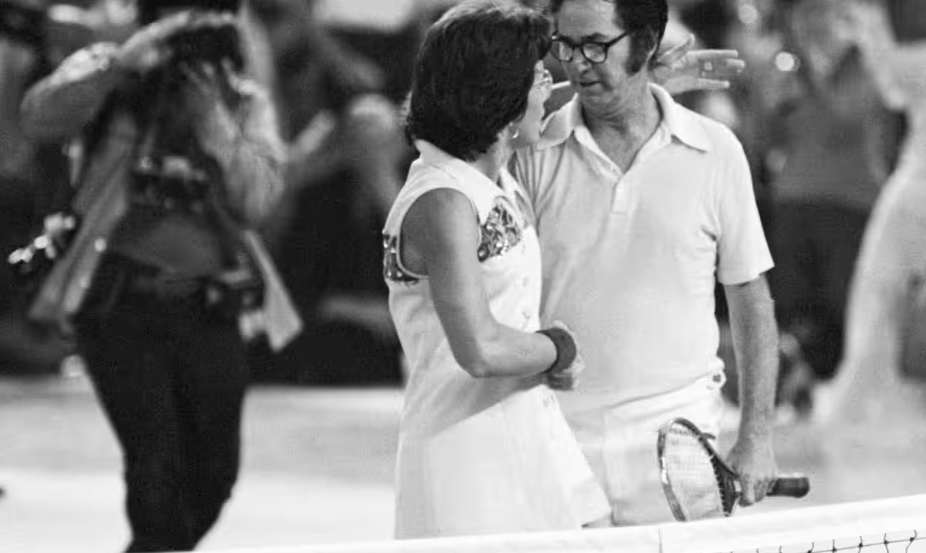
Billie Jean King and Bobby Riggs at the end of the Battle of the Sexes

After all the bluster, all the promotion, all the anticipation, Bobby Riggs laid an egg. Just as he had humiliated Margaret Court, Billie Jean King made him look like the slow-footed, powerless 55-year-old he truly was.

Until the moment the first ball was struck, most onlookers expected a Riggs victory. The man had beaten Court 6-2, 6-1, and he rarely took a bet he couldn’t win. King’s inner circle was confident, too–husband Larry predicted a straight-set win–but the majority of the 30,000-strong Astrodome crowd was ready to watch as tennis’s most famous women’s libber was put in her place.

The mood didn’t last. Billie Jean took a 40-15 lead in the first game, and back at the Los Angeles Tennis Club, 1959 Wimbledon champion Alex Olmedo proclaimed, “Bobby’s on the defensive. Billie Jean’s going to win!” Both players were nervous in the early going. Riggs broke for a 3-2 advantage, but King broke right back.

Cliff Drysdale, a veteran player watching Riggs for the first time, began to worry he would lose his bet. “He’s got no power! How can he be so mediocre?”

Drysdale’s wife, Jean, was more circumspect. She, like many in the crowd, suspected it was all part of the hustle. Back in his heyday, Riggs would lose a few games–or a set, or even two–so that a collaborator in the crowd could lay more bets at favorable odds. He had complained all week that there was no King money in Houston. Perhaps he was trying to juice his payday.

If that was the plan, it backfired miserably. Billie Jean converted the first set, 6-4, on a Riggs double fault, no less. Just an hour earlier, Bobby had arrived on court in a gold-plated rickshaw. That, wrote Bud Collins, was “his last moment of glory.”

For spectators able to see beyond the carnival, it was a quality match. Once Billie Jean settled in, she fired winner after winner. She took advantage of the fast indoor surface to get to the net, where she found that Riggs couldn’t pass her well enough to halt the attack. Madame Superstar won three straight games to close the second set, 6-3.

By then, it was clear that Bobby’s deficit was no sham. “Riggs was out of shape,” wrote former player Gene Scott. “He was a balloon. Mentally and physically.” King had run him ragged. The Happy Hustler gave ammunition to future conspiracy theorists by turning in a tactical performance as shoddy as his physical one. “He played stupid tennis,” said Marty Riessen, another pro watching in the LA Tennis Club locker room. “He never put the ball down her forehand side.”

Billie Jean kept streaking to take the first two games of the third set. After another stumble, she regained the lead, forcing Riggs to hold serve to stay in the match at 3-5. He almost did. With both players hanging on to their last nerve, they seesawed through five deuces before Bobby double-faulted and netted a backhand to gift his opponent the last two points of the match.

In the Guardian, David Gray called it a “crushing tactical, technical and psychological victory” for King. Jean Drysdale thought that the champion could “do more with the tennis ball than any other woman I’ve seen.” Arthur Ashe said, “She’s too good–she hits the ball like a man.”

Ashe’s clumsy compliment was exactly what Billie Jean was playing for. “I’ve always wanted to equalize things for us,” she said after the match. “I don’t care if this was an exhibition. A lot of non-tennis people saw it and they now know what women can do.”

Riggs, for all his bluster, knew when he was beaten. He managed one final burst of energy to hop the net for the handshake. He didn’t make excuses, though he did want a rematch. He had been so confident of victory he promised to jump off a bridge if he lost. Now he thought about which bridge it would be.

“I guess I’m the biggest bum of all time now,” he said. “She played too well…. Girls her age are tough on 55-year-old guys. I have to eat a lot of crow. I said a lot of things and I have to take them all back.”

For tennis, there was nothing to take back. Madame Superstar’s nerves of steel–and a killer backhand volley–had won another battle for the growing women’s game. Promoters saw limitless potential in the sport, even if the “Battle of the Sexes” concept was largely played out. A half-decade of controversy was forgotten–at least for the moment–in the glow of one bizarre, spectacular evening.

“This has made a lot of dreams come true for me and for tennis,” said Billie Jean King. “This is a delight.”

* * *

This post is part of my series about the 1973 season, Battles, Boycotts, and Breakouts. Keep up with the project by checking the TennisAbstract.com front page, which shows an up-to-date Table of Contents after I post each installment.

You can also subscribe to the blog to receive each new post by email:


September 19, 1973: Anticipation

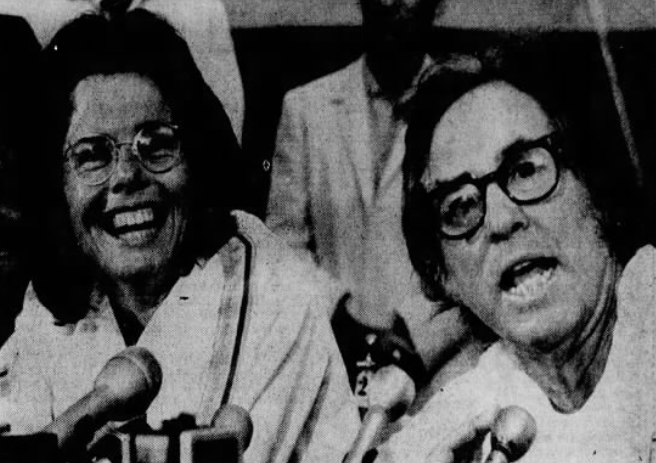
Billie Jean King and Bobby Riggs at a press conference the day before the Battle

It is hard to convey the degree to which the sports world was seized by the Battle of the Sexes. On September 19th, 1973, the day before the match, newspapers around the United States put together full-page spreads to preview the long-awaited tilt. Punters scrambled to lay last minute wagers: Bobby Riggs was a 5-2 favorite, and it was increasingly difficult to find a Billie Jean King backer to bet against.

Celebrities flocked to Houston. George Foreman would hand over the winner’s check. Bombshell Mamie Van Doren met Riggs on a talk show and became an ardent cheerleader. 69-year-old painter Salvador Dali turned up, for some reason.

“I’ve never seen anything like this,” said a Baltimore saloonkeeper. “Everybody’s talking about it. I mean people who don’t even like tennis–people who could care less about Ron Laver or whatever his name is. A serious tennis match could never get the public as excited as this thing has.”

Laver himself–Rod, not Ron–wasn’t crazy about it. He feared it was turning his sport into a burlesque.

He wasn’t wrong. But… for a gimmick, it was sure a glorious one. While the 51,000-capacity Houston Astrodome wasn’t going to sell out, more than half of the tickets were already accounted for. The Battle would set a new attendance record for a tennis match, and the television broadcast was expected to reach as many as 90 million viewers.

Rocket Rod, alas, could never.

So much of the spectacle’s success was owing to the goofy charisma of the diminutive, motor-mouthed Riggs. Even the mission-focused Billie Jean couldn’t always help herself: “I like him and I hate him. He is so ridiculous. Sometimes I laugh, but mostly I get furious.”

Bobby promoted the match–and promoted it, and promoted it some more–with a steady stream of male chauvinist patter: Women are at their best in the kitchen and the bedroom. (Billie Jean said she didn’t mind the bedroom part.) He claimed membership in WORMS: the World Organization for the Retention of Male Supremacy.

The irony was evident, even to Riggs. Women’s tennis, he said, “has come a long way, baby, and playing me isn’t hurting either…. Tennis has been the benefactor all over the world. It just happens to be good for Bobby Riggs, too, but that is only incidental.”

What made the match so compelling was that the outcome was truly uncertain. All the social relevance and celebrity appeal in the world couldn’t manufacture a must-watch out of an obvious blowout. Hundreds of the top men tennis players could beat Billie Jean, and a handful of them had done so over the years, in practice. Riggs, with his funky dink-ball game and the wildcard of his advanced age, could bewilder King–as he had Margaret Court–or could be overpowered by her.

The Court result, combined with a general faith in the savviness of the 1939 Wimbledon champion, made it tough to bet against Bobby. But several details tilted the forecast in the other direction. The Sportface surface was a low-bouncing one that would favor a dashing volleyer over a geriatric lob machine, especially over the course of a best-of-five-set match. Riggs had coasted through his preparation, chugging vitamins but letting his overall fitness sag from its Mother’s Day peak. Billie Jean had Margaret’s loss to learn from, and she’d know exactly what to expect.

Expert predictions were, well, predictable. Few pundits broke ranks with their own gender. The New York Times ran side-by-side pieces presenting each player’s case, by Neil Amdur and Grace Lichtenstein. Pancho Segura, one of the finest tennis minds in the game’s history, sided with his buddy Bobby, producing the X’s and O’s to explain why the veteran would pull through. No less a figure than Althea Gibson picked Billie Jean, who would “run Bobby’s little legs off.”

King said over and over again that it wasn’t (just) about the money. She was ready to put half of the human race on her back and carry them to victory.

Could Bobby muster the motivation to counter Billie Jean’s sense of responsibility? Long-time pal Lornie Kuhle couldn’t imagine the Happy Hustler losing what was, at its core, the greatest tennis hustle of all time. “That’s why Bobby’s going to win,” he said. “There’s really too much money on the line for him to lose.”

* * *

This post is part of my series about the 1973 season, Battles, Boycotts, and Breakouts. Keep up with the project by checking the TennisAbstract.com front page, which shows an up-to-date Table of Contents after I post each installment.

You can also subscribe to the blog to receive each new post by email:


September 18, 1973: Riggs d. King

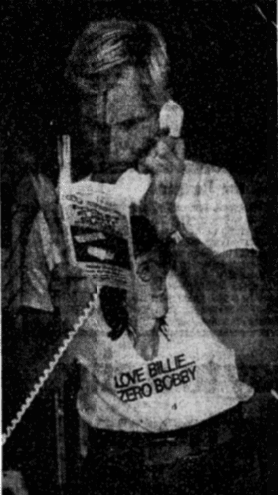
Larry King works the phones

Hold the presses–we have a final result. Riggs beat King, 6-3, 6-4. Bobby barely broke a sweat.

Okay, the victim wasn’t Billie Jean. It was her husband, Larry King. On September 18th, just two days away from the main event, Bobby Riggs hustled Mr. King for $300. Larry wasn’t much of a tennis player, though he did enter a few husband-and-wife doubles events with Billie Jean in the mid-60s. Bobby spotted him three games in the first set, four games in the second. You can do the math: The man of the hour won twelve games in a row.

In fairness, Larry was probably exhausted. The public knew him as Billie Jean’s “husband and business partner”–not necessarily in that order. He ran interference for Madame Superstar, handling travel arrangements and ferreting out business opportunities for his wife. The job was never more demanding that it was this week. Everyone wanted a piece of Billie Jean, and the woman herself was hiding out.

The Kings had spent years turning over every leaf, identifying sources of funding and promotion for women’s tennis. Now, the phone never stopped ringing. Jerry Perenchio, the producer staging the match, had taken to calling Thursday night’s spectacle a $2 million operation. Nominally, it was winner-take-all, for $100,000. In actuality, each player was guaranteed another $100,000 for broadcast rights. Sponsorships went up from there.

Way up.

“If this were a Broadway show,” wrote Grace Lichtenstein in the New York Times, “the title would be ‘Money!'”

Television advertising spots had sold out almost instantly. Billie Jean would earn $25,000 for appearing in one of them, a hair-roller commercial for Sunbeam. Riggs was getting $75,000 from Hai Karate, the official cologne of the Happy Hustler. Nabisco paid him $20,000 to flog its Sugar Daddy candy bar. The Kings got a cut of sales from the ubiquitous pro-Billie Jean pins and t-shirts.

“Don’t feel sorry for the loser,” said Perenchio.

He meant Bobby or Billie Jean, of course. But Larry King, one of Riggs’s many victims in the days before the Battle, would also do just fine.

* * *

This post is part of my series about the 1973 season, Battles, Boycotts, and Breakouts. Keep up with the project by checking the TennisAbstract.com front page, which shows an up-to-date Table of Contents after I post each installment.

You can also subscribe to the blog to receive each new post by email:


September 17, 1973: Double, Then Nothing

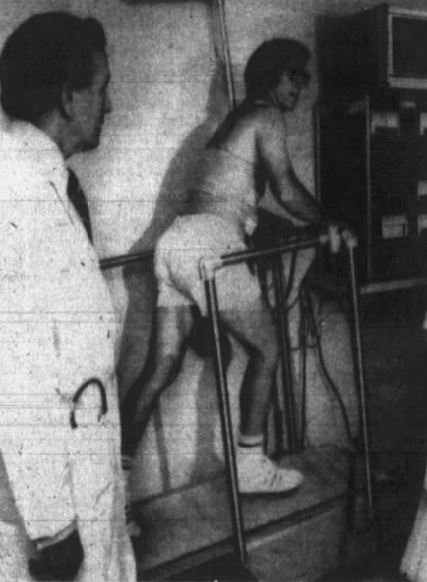
Bobby Riggs (right) getting a heart checkup ahead of his match with Billie Jean King

The Bobby Riggs–Billie Jean King spectacular wasn’t the only tennis on offer in Houston. The Battle of the Sexes was slated for Thursday. On Monday, September 17th, the Virginia Slims of Houston tournament kicked off. Billie Jean was there.

I will never cease to marvel at this. The Riggs match, for all its silliness, was enormously consequential–and King knew it. She was out to avenge her gender for Margaret Court’s loss in May, all the insulting things Bobby had said, and–oh yeah–every other slight in the history of male-female relations. She had spent part of the year injured and much of the last week in bed with a virus. Her last appearance at a major, against Julie Heldman at the US Open, had ended by retirement in a heat-induced haze.

The Slims event was little more than an anonymous tour stop. Billie Jean had every reason not to show. Yet on opening day, she not only played one match: She played two.

In the first round, she dispatched Cynthia Doerner of Australia, 6-0, 6-4. Things got a bit shaky in the second set, but the whole match took less than an hour. King came back later for a second-round tilt against 20-year-old Kris Kemmer. That one was even easier: 6-0, 6-2.

Kemmer, like most of the women in Houston, had no problem balancing competition with support for a fellow player. Wearing a pin that said “Billie Jean is No. 1,” there was no question who she’d cheer for on Thursday. “I think we’ll all die if she doesn’t win,” she told a reporter. “She just has to win.”

King was ready to do just that. “I am very healthy again,” she said after securing her place in the quarter-finals. Riggs “had better be ready to play tennis. I am very serious about this match.”

With that, Madame Superstar went into “hibernation.” She wouldn’t give any more interviews. She wouldn’t have to play the Slims event again until Friday. She would practice, she would prepare, and she would shut out the non-stop distraction machine that was Bobby Riggs.

Easier said that done. Riggs went on every Texas talk show that would have him, often several in a single day. He got a medical checkup from a noted heart surgeon, Dr. Denton Cooley. The doc visit was almost certainly just for press consumption; Bobby was more concerned about a nagging case of tennis elbow.

He practiced, too, but even that was part of the show. A bubble was set up next to the Astrodome, and Team Riggs charged five bucks to watch the old man wheeze through a workout. Even with the $100,000 spectacle on the horizon, he couldn’t help but hustle, challenging all comers to a $50 or $100 match, arranging chairs on his side of the court to slow himself down and even the odds.

“Last month was for wine, women, and song,” Bobby told a friendly hometown reporter. This month, he said, “It’s all tennis.”

Riggs and King had very different ideas of what it meant to have a single-minded focus on the game. Under the lights, in front of millions of eyes, would it matter? In three days, the world would find out.

* * *

This post is part of my series about the 1973 season, Battles, Boycotts, and Breakouts. Keep up with the project by checking the TennisAbstract.com front page, which shows an up-to-date Table of Contents after I post each installment.

You can also subscribe to the blog to receive each new post by email:


September 15, 1973: The Stormy Petrel

Yevgeniya Biryukova at the 1973 Four Roses Classic in Charlotte

On her first trip to the United States, Yevgeniya Biryukova just wanted to play tennis. Soviet authorities, she had found, were stingy with such opportunities. The 20-year-old physical education student from Baku was the reigning champion and top-ranked player in the USSR. Yet when a Soviet team left for America in March, Olga Morozova and Marina Kroshina got the call instead.

Biryukova, a member of the Stormy Petrel club in Baku, finally reached enemy territory in August. She lost a first-rounder at the US Open to Ilana Kloss, then headed to Charlotte for the Four Roses Classic. She picked up her first win on American soil against Marilyn Tesch, then waited for her highest-profile match yet, against none other than Chris Evert.

Evert was a late arrival to the tournament, having taken part in the World Invitational Tennis Classic in Hilton Head. Bed-ridden with a virus, she was in no condition to play her scheduled match on Thursday. But rain interceded, and the match was delayed.

While tournament officials watched and waited on Thursday, Biryukova earned her first batch of stateside fans. The Azerbaijani player could have asked for a default, but that was never in the cards. “She said she came here to play tennis,” the tournament director relayed, “and would be glad to play the match, no ifs or buts about it.”

Alas, Evert wasn’t well enough to play on Friday, either. Biryukova advanced to the quarters, where she dispatched Britain’s Veronica Burton in straight sets. Her first semi-final appearance against top-flight Western competition carried an extra charge. Morozova, the fourth seed in Charlotte, didn’t make it as far, losing a marathon to Martina Navratilova the same day.

On September 15th, the Stormy Petrel was in the final four, a position she would’ve considered unthinkable just a few days earlier. Evert, Morozova, and Virginia Wade were out; Navratilova and Evonne Goolagong were in the other half. Biryukova’s opponent was the equally unknown Japanese woman Kazuko Sawamatsu. The two players had met just a month earlier, at the World University Games in Moscow, where Sawamatsu picked up the victory.

But Biryukova had been paying attention. Sawamatsu’s backhand was weak, and she wasn’t the best mover. While the Soviet player liked to come forward, Sawamatsu made it difficult. Settling in for a baseline duel, Biryukova aimed to “hit to her backhand, but not every time,” as she said through Morozova, who interpreted for her.

A local reporter judged the match to be “a test of patience and endurance rather than firepower,” a contrast to the more stylish Goolagong-Navratilova semi that went the way of the Australian. Biryukova struck first, breaking serve in the seventh game and holding on to win the first set, 6-4. She played the big points better than Sawamatsu did–or, at least, not as badly. The Japanese woman double-faulted to hand her opponent a break on two occasions. Biryukova came back from 40-15 to break for 5-4 in the second, then held on for victory.

The woman from Baku was satisfied with her victory but realistic about her chances against Goolagong. “Let me rest for a while,” she said, “and then I’ll think about it.”

* * *

The Four Roses Classic was, for the most part, a Bobby Riggs-free zone. Billie Jean King had entered the Virginia Slims tournament in St. Louis, and unable to compete, she stayed in Hilton Head under a doctor’s supervision. Five days away from the nationally-televised spectacle, King remained optimistic she could play, and Riggs pronounced that she had cracked under the pressure.

Still, no self-respecting newspaperman in Charlotte could leave the question unasked. Would Goolagong consider taking on Riggs herself? As usual, she left it to her coach, Vic Edwards, to answer.

“These matches are strictly for money, and not for tennis,” he said of the Battles of the Sexes. “The less said about them, the better.”

* * *

This post is part of my series about the 1973 season, Battles, Boycotts, and Breakouts. Keep up with the project by checking the TennisAbstract.com front page, which shows an up-to-date Table of Contents after I post each installment.

You can also subscribe to the blog to receive each new post by email: