We discuss the German tennis scene before Stich arrived, how Stich was more than just another serve-and-volleyer, and the nature of Michael’s relationship with Boris Becker–not a close one, but one that allowed them to team up to win a gold medal.
We also get into the serve and volley and the strategy’s best-known current exponent, Maxime Cressy. We talk s-and-v strategy, both for guys like Cressy and for other players who might benefit from mixing it up a little bit more. Finally, we dig into the nuts and bolts of how the German tennis federation works, and how it is changing.
Thanks for listening!
(Note: this episode is about 45 minutes long; in some browsers the audio player may display a different length. Sorry about that!)
Music: Everyone Has Gone Home by texasradiofish (c) copyright 2020. Licensed under a Creative Commons Attribution Noncommercial (3.0) license. Ft: spinningmerkaba
In 2022, I’m counting down the 128 best players of the last century. With luck, we’ll get to #1 in December. Enjoy!
* * *
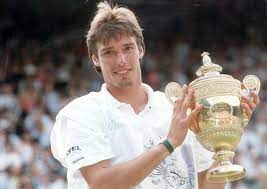
Michael Stich [GER] Born: 18 October 1968
Career: 1989-97 (9 seasons)
Plays: Right-handed (one-handed backhand)
Peak ATP rank: 2 (22 November 1993)
Peak Elo rating: 2,203 (2nd place, 1993)
Major singles titles: 1 (1991 Wimbledon)
Total ATP singles titles: 17
* * *
From the beginning of the Open Era in 1968 to the shift away from carpet at tour-level events in the mid-2000s, 13 different men won titles on all four surfaces–hard, clay, grass, and carpet–in a single season. Eight of them did it at least twice. The list is every bit as impressive as you’d expect: Bjorn Borg, Jimmy Connors, Rod Laver, John McEnroe, Ilie Nastase, Ken Rosewall, Pete Sampras… and Michael Stich.
Six of those names regularly feature in debates about the greatest of all time. Nastase doesn’t, but no one questions that he was one of the most dangerous players in the field for years. As for Stich: Be honest, how many guesses would it have taken before you put him on this list?
It’s not just a couple of fluke seasons, though Stich’s 1991 and 1993 campaigns tower above the rest of his career. He is one of only 13 men with three or more career titles on all four surfaces. Among his immediate contemporaries, only Sampras and Stefan Edberg pulled off the feat. Boris Becker never won a tournament on clay. Andre Agassi’s 1992 Wimbledon title was his only grass court triumph. Jim Courier won just a single minor event on carpet and reached only one final on grass.
For all the variety in his results, Stich was never known as a well-rounded player. He was tall, he had a huge serve, he was fast enough to serve and volley, and he was sure enough at the net for the strategy to work. In the 27 matches logged by Match Charting Project volunteers, his average rally length was 3.1 shots, equal to the numbers for Edberg and Becker and only a tick longer than those of John Isner and Reilly Opelka. 35% of his serves never came back, and he won 65% of his service points with either the serve or his second shot. 130 players have at least 20 matches in the MCP dataset, and only 10 of them won those quick service points more often than Stich did.
That game style couldn’t have been designed any better for grass. His signature title came at Wimbledon in 1991, when he beat Edberg and Becker in succession for his only major championship. He won 78% of career matches on turf, good for 15th in the Open Era among players with at least 50 matches. Among the stars of the 1990s, only Sampras, Becker, and Edberg rank higher, and if you remove a dead Davis Cup rubber from Stich’s tally, he jumps to 11th and overtakes Edberg.
It’s a mistake, though, to remember Stich simply for his grass-court exploits. He was largely impervious to surface, he won at every sort of venue, and he barely seemed to notice who stood across the net from him.
* * *
Every generation has that one player who seems to stand off to the side, unwilling to tie up their entire identity with their tennis. Michael Stich was that guy, and he filled the role at a time when the zeitgeist swung the hardest in the other direction. He was a 22-year-old adult surrounded by a teeming mass of present and former teen prodigies.
Stich was only 11 months younger than Boris Becker, and–I’m still trying to wrap my head around this one–8 months older than Steffi Graf. Becker announced the arrival of a new superstar with his Wimbledon title as a 17-year-old in 1985, and Graf ascended to the top of the world rankings two years later, before winning the golden slam in 1988.
Understandably, the presence of two young mega-stars left little attention for other German prospects. Stich said, “Most of the German players, including me, never really got the respect we deserved.” He would eventually claim his share of coverage, but it would take some time.
When Graf took over the #1 WTA ranking, Stich was only a month removed from his first match win at a professional event. He was tied for 760th on the ATP computer. His sole claim to fame was a German youth championship in 1986, and he wouldn’t turn pro until 1990, choosing to finish school first.
Stich’s ambivalence about the game wasn’t because the weekly grind wore him down. He knew from the start that he could live without tennis. Six weeks winning the Wimbledon title in 1991, he told a New York Times reporter, “Tennis is just a chapter in my life for a couple of years.” The Times dubbed him “The Reluctant Champion,” but reluctance isn’t exactly what came through in his comments at the time. While he didn’t want tennis to define him, he aimed to make the most of his time on court.
* * *
Stich did just that in his first four seasons as a professional. The first taste of success didn’t take long. He won six matches to grab the Memphis title in February of 1990, upsetting third seed Andrei Chesnokov en route. It wasn’t until the end of the season, though, that he gave a hint of what was to come. He won only 15 matches in 18 tournaments between March and October before reaching the final eight at Paris Bercy, defeating Chesnokov again as well as Brad Gilbert, his first top-ten scalp.
The results were good enough for a spot in the top 40, a respectable showing for his first full season. But it barely hinted at what he’d accomplish in another six months.
He led off the 1991 season with back-to-back finals in Australia, the first two of seven title matches he’d reach on the season. He still had a hard time against the very best, losing to Ivan Lendl in Memphis and twice to Stefan Edberg, in Miami and Tokyo. But he suffered only three first-round defeats in his first 15 events, and he rode a wide-open draw to the semi-finals at Roland Garros, where he pushed eventual champion Jim Courier to four sets.
Then, the tournament of his life, just 18 months after turning pro. At Wimbledon, Stich fought through early-round five-setters against Omar Camporese and Alexander Volkov, then straight-setted Jim Courier in the quarters. In the semi-final, Stich failed to break Edberg’s serve in any of the four sets they played, but in a battle of big serves, three tie-breaks were enough to advance, 4-6, 7-6, 7-6, 7-6.
His opponent in the final was the German golden boy, Boris Becker. Becker had already won five major singles titles, and he was playing his sixth Wimbledon final. But as usual, Stich was unfazed. Before stepping on court, he told Mark Lewis, his coach, “There’s no way I’m going to lose this match.” Whether due to Stich’s confidence or plain bad luck, Becker had an off day, and the outcome was never really in doubt. Stich won in straight sets, earning 16 break points and converting four of them.
Stich cleaned up against second-tier competition the rest of the way, winning clay, hard court, and carpet titles in Stuttgart, Schenectady, and Vienna, respectively. Despite the upsets of Edberg and Becker at the All-England Club, he still struggled against the best, losing to Lendl in the US Open quarters, Andre Agassi in the Davis Cup semi-final, and failing to win a match in the Tour Finals round robin.
1992 brought a bit of a sophomore slump. He lost in the quarters in Australia, fell to wild card Henri Leconte in the third round at Roland Garros, and dropped another major quarter-final to Pete Sampras at Wimbledon. Brad Gilbert stopped him in the second round in New York.
The early exits meant he had few opportunities to test himself against the best, playing only six matches against the top ten outside of the mid-season World Team Cup and the post-season Grand Slam Cup. The Grand Slam Cup, though, reminded fans what he was capable of. In front of friendly crowds in Munich, Stich won one tiebreak after another against Edberg, Sampras, and Richard Krajicek, then blitzed Michael Chang in the final.
Stich also posted his best doubles results that season. He partnered John McEnroe to win his only major doubles title, needing five hours to defeat Jim Grabb and Richey Reneberg in a Wimbledon final that ran to 19-17 in the fifth set. A month later, now on clay, he paired with Becker to win Olympic gold in Barcelona.
* * *
Thumbnail biographies will always focus on Michael Stich’s surprise 1991 Wimbledon title and the season that surrounded it. But his 1993 campaign–perhaps triggered by that run at the Grand Slam Cup–was in many ways even better.
Stich’s 1993 season will never be remembered as a historically great one because, for the second straight year, he failed to make a serious run at the majors. After a semi-final showing in Melbourne, he lost to Goran Prpic in the fourth round at the French, Becker in the Wimbledon quarters (where he failed to convert any of nine break points), and Henrik Holm in the first round at the US Open.
He was a whole lot better in the remaining 44 weeks of the year. He beat Krajicek to win the Stuttgart Indoor title in February. In Hamburg, he won his hometown tournament on clay, finally toppling Ivan Lendl after six losses against him. He kicked off his grass court season with a Queen’s Club title, straight-setting Becker en route. He beat Stefan Edberg five times, one of the victories securing the title on carpet at the Swiss Indoors in Basel.
Stich finished the campaign with the most impressive run of his career. He went undefeated at the Tour Finals, beating Chang, Courier, Andrei Medvedev, and Goran Ivanišević before upsetting Sampras in the final. Two weeks later, he won three rubbers to seal the Davis Cup for Germany. It was an appropriate finish to outstanding year of international play. Stich played both singles and doubles in all four of Germany’s ties, going undefeated in doubles with Patrik Kühnen and losing only a dead singles rubber to Petr Korda.
Stich doing Stich things
The German would sustain a similar level into 1994, though his results were not quite as spectacular. Injuries crept in and he was forced to play fewer events, but the two-shot attack would win him six more titles from 1994 to 1996, and he reached major finals at both the French and the US Open. He returned to the final four at Wimbledon in 1997, concluding his career with a five-set loss to Cedric Pioline.
Just as he predicted back in 1991, Stich didn’t stick around for a long career. He retired before his 29th birthday with, apparently, no regrets.
* * *
Stich’s one-dimensional attacking game made his glittering career possible at the same time that it limited his potential. Only in 1995 did he break serve more than 25% of the time, and his career average (from 1991, when stats become available) is a mere 23.4%. Pete Sampras, the best player of his era and one who used a similar style, stayed at 26% or above from 1992-95, and peaked above 29%. Pete’s return game wasn’t his strength, either, but his results on serve were far superior to Stich’s, and he still needed to win more than a quarter of return games to post his best seasons.
Still, the German’s serve was strong enough that, on a good day, he could hold serve seemingly at will. Worst case scenario, he could push each set to tiebreaks, as in the 1991 Wimbledon semi-final against Edberg. And from there, it was anybody’s game. Stich faced 69 different opponents three or more times at tour-level. With the sole exception of Andre Agassi, he beat all of them at least once. He retired with winning records against Sampras, Edberg, Courier, and Ivanišević. He beat Becker 4 times in 12 tries, and and apart from Agassi, the only player who really dominated him was Ivan Lendl.
He peaked at #2 in the ATP rankings, and my Elo ratings come to the same assessment. The official tables gave him three year-end finishes in the top ten, while Elo gives him five. Either way, it’s a short, spiky peak. It’s hard not to wonder what might have been if the German federation had recognized Stich’s capabilities earlier, or if Stich himself had felt compelled to fight his way back from injury in 1997.
But Stich didn’t look back. After retirement, he didn’t pick up his racket for five years. He remains far less of a familiar face than his one-time rival Becker, but there’s no denying his place in tennis history. When he caught his coach looking concerned about a tricky opponent, he’d say not to worry: “just a big kick serve to the backhand, easy volley, game over.” It really was that simple, and on a good day, it worked against anybody.
In 2022, I’m counting down the 128 best players of the last century. With luck, we’ll get to #1 in December. Enjoy!
* * *
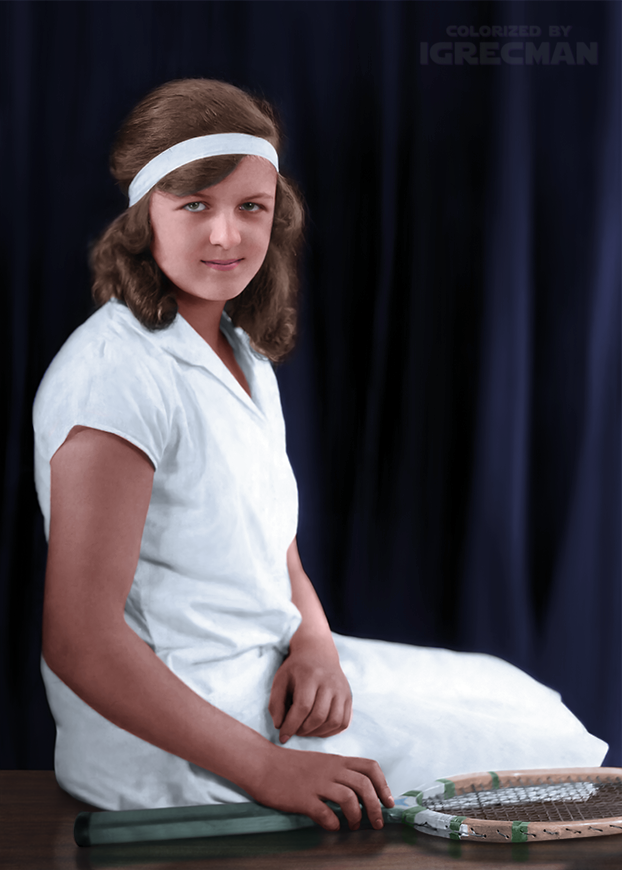
Betty Nuthall [GBR] Born: 23 May 1911
Died: 8 November 1983
Career: 1924-46
Plays: Right-handed (one-handed backhand)
Peak rank: 4 (1929)
Peak Elo rating: 2,035 (2nd place, 1931)
Major singles titles: 1 (1930 US Nationals)
Total singles titles: 16
* * *
Women’s tennis history is chock-full of stars who relied on powerful groundstrokes to overcome the handicap of mediocre serving. The young Betty Nuthall took this contrast to its extreme, yet reached a major final only a few months after her 16th birthday.
Nuthall was the last top-ranked woman to serve underarm. When she began playing juniors and adult events around England in the 1920s, older spectators could remember seeing underarm serves, but the style was already long out of fashion. Somehow, it worked. Betty’s 19th-century service was enough for the 15-year-old to win a Wightman Cup match against an up-and-coming Helen Jacobs, reach the quarter-finals at Wimbledon, and earn a place opposite Helen Wills in the title match of the 1927 US National Championships.
The word “underarm” doesn’t quite do justice to Nuthall’s technique. After the Jacobs win, the New York Times tried to describe the serve: “She stands about fifteen feet behind the service line, cuts the ball and just about gets it into play. It makes it hopeless for her to think of getting to the net.” The reporter exaggerated a bit. Jacobs described Betty’s service position as “several” feet back of the line.
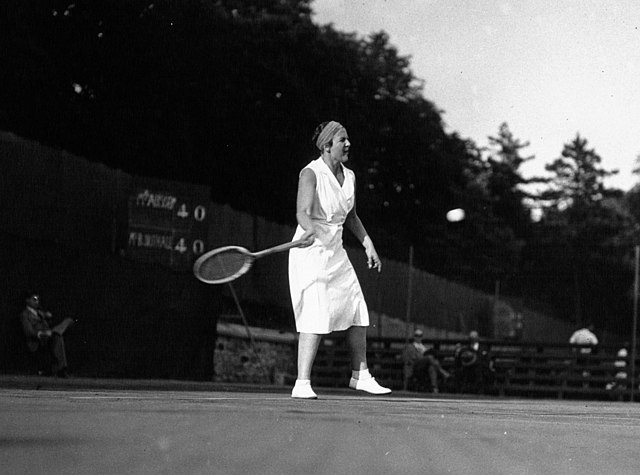
You can see her serve at 1:22 in this video clip. She’s not far back of the line, and the stroke is more like the sort of forehand you’d hit to start a warm-up rally, instead of the deceptive, drop serve used by occasional underarm servers today. It’s actually not that different from the underarm delivery used by Aryna Sabalenka when she couldn’t land her second serves in Adelaide last month.
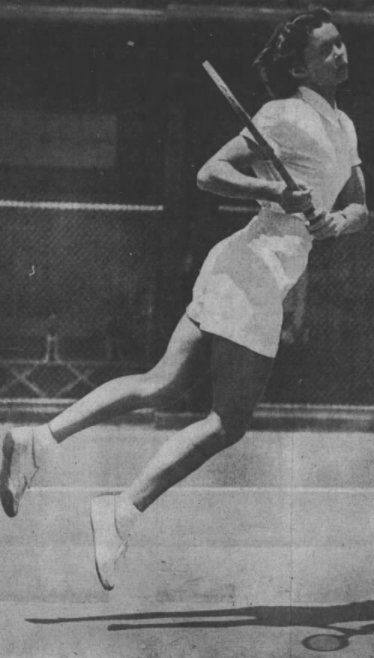
Betty in action in 1927, underarm serve and all
Whatever her exact position, she immediately switched to offense once the ball was in play. Bill Tilden watched the newcomer on her first US tour, and while he found her game “crude,” he’d never seen a woman hit a harder forehand.
This was high praise in the era of super-slugger Helen Wills. Nuthall didn’t fare well against Wills in the Forest Hills final, dropping the first set in 12 minutes and losing the match, 6-1, 6-4. But she was an extreme underdog, so onlookers tended to emphasize the positive. It was the hardest hitting–from both sides of the net–ever seen in the US National Championships. The Times described Nuthall’s signature shot as an “annihilating forehand,” and the paper of record offered what it probably considered to be the highest praise of women athletes in the 1920s: Play was “maintained at so furious a tempo as to make even most men’s tennis seem tame by comparison”
* * *
Betty Nuthall’s surprise New York run in 1927 endeared her–a Brit–to American fans, and she would return to Forest Hills six more times. More importantly, the clash with Helen Wills gave Betty a stick with which to measure her career. She didn’t come close to an upset, but once she got into the match and began to vary her game, she wasn’t wiped off the court, either.
It wasn’t an easy time to be an elite woman not named Helen Wills. Between 1927 and the final of the 1933 US Nationals, Wills didn’t lose a single match. By the time she first faced Nuthall in August 1927, she had won 36 consecutive sets, and wouldn’t drop another one for more than half a decade.* She accomplished that against the best amateur competition, albeit over a limited schedule.
* !?!?!
Nuthall’s peak almost exactly lines up with the reign of Queen Helen. But no one seems to have told Betty that the American was unbeatable.
Two years later, Nuthall and Wills met in the Wightman Cup, the annual team competition between picked squads of Americans and Brits. Betty met Helen Jacobs on the first day of the competition. Armed with a new, solid overhead service that cost her most of the 1928 season to develop, Nuthall came within a whisker of victory, losing 7-5, 8-6. Wills awaited on day two. Against the elder Helen, Nuthall did even better, losing 8-6, 8-6. Only Simonne Mathieu had come so close to taking a set from the queen in the last two years.
The fearsome Nuthall forehand
The American press was once again in awe of the plucky Brit: “Miss Wills’s large number of errors testifies to the troubles she had in handling Miss Nuthall’s strokes, but one would have had to be present at Forest Hills to appreciate the daring and guile with which the English girl deployed them. Her use of the drop shot was the most masterly demonstration of this stroke that has been seen in a woman’s match in this country since Miss Elizabeth Ryan defeated Miss Wills with the same weapon at Seabright in 1925 and 1926.”
The following year, Nuthall won the US National Championships, her only major title in singles. Jacobs was injured and Wills opted not to play. Betty was thrilled, but an interview with her mother revealed a sore spot. Betty was more interested in a rematch with Queen Helen than a title at Forest Hills.
* * *
It would be reasonable to assume that a player capable of holding her own with Helen Wills would find the rest of the field to be easy pickings. Alas, it was not so for Betty Nuthall. In the official rankings of the time, Betty topped out at 4th in the world. My Elo ratings are a bit more generous, putting her at 2nd after the Forest Hills title in 1930, and 3rd after the 1931 season. Whichever authority you prefer, she only ranked in the year-end top-ten on five occasions.
She never reached the semi-finals in 13 tries at Wimbledon. She had a career losing record in finals, despite the majority of those matches coming on home soil and most of them against British competition that would struggle to win more than a game or two against Wills.
Helen Jacobs devoted a chapter to Nuthall in her 1949 book, Gallery of Champions. She traced Betty’s limitations back to her success as a child prodigy. Nuthall’s father put a racket in her hand at age seven–quite early for the era–and she was playing tournaments two years later. She was the English girls’ champion at 13, and she won her first adult event the same year.
As Jacobs saw it, Betty was a tactician, not a strategist. She developed her game (including that old-fashioned serve) long before her physical peak. Like many dominant juniors, she failed to make adjustments when faced with tougher competition. The resulting losses then had an out-of-proportion effect on her confidence.
* * *
Maybe Betty Nuthall just played better across the Atlantic, away from the British fans who had expected great things from her based on the performances of a pre-teen. Certainly she had her share of fans in the States–she was popular enough to merit a screen test in Hollywood. After losing badly to Helen Wills in the 1931 Wightman Cup and stumbling through a shortened 1932 season without a title, Betty had one more great run in store for her American fans.
A middling English season for Nuthall in 1933 ended with a fourth-round exit to Peggy Scriven at Wimbledon. A month later, she raced to the title at the Forest Hills warm-up in East Hampton, beating 19-year-old phenom Alice Marble in the final. Marble had won 33 of 35 matches that season before Nuthall stopped her. The young Californian was already famous for her best-in-class American twist serve. It didn’t bother Betty one bit.
Nuthall carried her momentum through a Wightman Cup victory over Carolin Babcock, then met Marble again in the quarter-finals of the US Nationals. The winner would meet Helen Wills, and perhaps it was the promise of that matchup that gave Betty the push she needed to pull off one of the greatest comebacks in the history of the event.
Marble won a tight first set, 8-6, then Nuthall quickly evened it up with a 6-0 second. The contest swung back the other way in the third, as Marble built a 5-1 lead, earning two match points at 15-40 on Betty’s serve. Nuthall won four points in a row to survive, but found herself in trouble again on Marble’s serve at 5-4. Betty won the first three points, but the American grabbed the next four in a row. Marble double-faulted away what would be her final match point. Nuthall won the last eight points of the match to seal the final set, 7-5, and earn another shot at Wills.
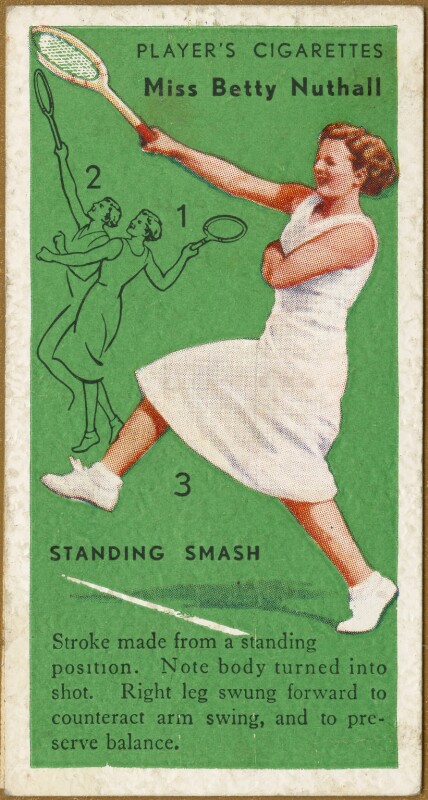
Squinting optional. 1936 John Player cigarette card. Credit: National Portrait Gallery
Queen Helen was far from 100% at the 1933 US Nationals. She was coping with a lingering back injury, and before the semi-final against Nuthall, her doctor recommended that she take six months off. Her back was slow to warm up, which helps explain how Betty took the first set, a 6-2, 12-minute special of the sort that Wills usually dealt out to others.
It was the first set Wills had lost at Forest Hills since 1925, and only the second she’d conceded anywhere since 1927.* Hobbled or not, she found her form and bounced back to 6-3 and 6-2 victories in the final two sets. Helen’s back injury would become one of the most controversial ailments in the game’s history after she retired in the middle of the third set to Helen Jacobs in the final. But by then, Nuthall’s tournament–and her run near the top of the sport–was over.
* Everyone was a bit off their game that day. Wills served two games in a row in the second set. Neither player, nor any of the 13 officials on court, recognized the error.
In 1934, Betty lost in the third round at the French Championships and the first round at Wimbledon, to long-time nemesis Eileen Bennett Fearnley-Whittingstall. She once again made the trip across the Atlantic, entering Forest Hills as the top foreign seed. But she failed to live up to the billing, winning only one match. Her 27-8 season record was padded by early success on British clay courts, and most of her eight losses came against players she would’ve beaten a few years earlier. At 23 years of age, she fell out of the top ten, and she’d never again get close.
Nuthall continued playing tournaments in Britain until World War II, and played more than her share of exhibition matches to support the war effort. She made her final appearance in the Wimbledon singles draw in 1946 and reached the fourth round.
By then, a few more generations of tennis prodigies had come and gone, and plenty of ladies now hit their forehands every bit as hard as Nuthall did. But none of them had held their own against Helen Wills.
In 2022, I’m counting down the 128 best players of the last century. With luck, we’ll get to #1 in December. Enjoy!
* * *
Li Na [CHN] Born: 26 February 1982
Career: 1999-2014
Plays: Right-handed (two-handed backhand)
Peak WTA rank: 2 (17 February 2014)
Peak Elo rating: 2,160
Major singles titles: 2
Total WTA singles titles: 9
* * *
We tend to think of Li Na as a late bloomer. She didn’t crack the top ten until she was nearly 28 years old. Her first major had to wait another year beyond that, and she only added her second when she was a month shy of her 32nd birthday. So it’s true, the best player yet to come out of China didn’t reach her potential until very late in the traditional woman’s career trajectory.
On the other hand, Li was a highly regarded star as a teen in China, winning national competitions in addition to a whopping 14 ITF singles titles before her 20th birthday. It was hardly a guarantee that the Wuhan native would eventually achieve a single-digit ranking, but it was clear that China’s strongest prospect was poised to make a dent on a wider stage.
Then she quit.
* * *
It’s tough to consider Li Na’s story from the vantage point of February 2022 without also thinking about Peng Shuai. After accusing Communist Party bigwig Zhang Gaoli of sexual assault last November, mentions of Peng’s name were censored online, and she immediately disappeared from public view. Her only public appearances since then–including with International Olympic Committee boss Thomas Bach–have reeked of government stage-management. She crossed a line that, in China, means that she may spend the rest of her life under the threat of further government retribution.
While Peng is a few years younger than Li, her doubles peak coincided with Li’s final season in 2014. In a 12-month span, Li won the Australian Open, and Peng grabbed doubles titles at Wimbledon, the French Open, and the Year-End Championships. The success of Li, Peng, and 2008 Olympic doubles medalists Zheng Jie and Yan Zi marked China as a rising force in the sport. After the Beijing games, these four women earned the unusual–for China–right to “fly solo,” managing their own careers and paying their own expenses, in exchange for keeping most of their earnings instead of kicking the majority back to the national federation. Before that, the federation controlled every detail of its players’ careers, just as other Chinese national organizations dictate things in nearly every other sport.
Last month, Chinese dissident architect Ai Weiwei offered some context for Peng Shuai’s position in China: “She is a sports person, which is like being a soldier in the army. Any person in sport is considered as property of the party.”
Li Na never fell afoul of the Party to the extent that Peng has, and one hopes she hasn’t experienced anything that would trigger an accusation as earth-shaking as Peng’s. Her iconoclasm was often embraced, even held up as an example of an emerging type of Chinese celebrity. But not for nothing did Li call her self a “bad-tempered, stubborn girl,” and lesser bursts of individualism angered both fans and functionaries. “Flying solo” or not, some degree of military obedience was expected of her.
In her late teens, Li began to recognize these limits to her freedom. At least in the eyes of the authorities, she was in fact a soldier. That wasn’t what she signed up for when a local coach spotted the aptitude of a seven-year-old girl and convinced her family that her future might lie in an unfamiliar game.
* * *
Li Na retired for the first time in 2002. With a world ranking that snuck inside the top 200 shortly after her 20th birthday, she gave up competition and went to Huazhong University to study journalism. She continued to play tennis casually, and over the next two years, her old teammates and coaches showed up more and more frequently, until she gave in to the pressure and returned to competitive tennis.
Her game barely suffered from the break. She went 34-3 with five titles on the ITF tour upon her return in 2004, including a tournament win in Mongolia on dirt (not clay–dirt) courts. All that changed was her mindset. In her telling, she began to play more for herself, and the shift worked well enough that she climbed into the top 20 within two years, setting new records for Chinese players every step of the way.
Only after a semi-final showing at the 2008 Beijing Olympics did the rules of the game change for Li. Given the rights and responsibilities of flying solo, she hired a personal coach–Thomas Hogstedt–for the first time, and she increasingly relied on medical care and rehab in Europe. Only then, at age 26, did she gain the individualized support that was taken for granted by the women ahead of her in the rankings.
Five years later, Li was a French Open champion and top-five player. Former WTA CEO Stacey Allaster called her “the most important player of this decade” in 2013, comparing her impact to that of Venus and Serena Williams. She flew solo, but the slipstream behind her was incomprehensibly vast.
* * *
It’s hard to overstate Li Na’s impact on women’s tennis. If it weren’t for her success, Wuhan would have never have hosted a major tournament–or maybe any tour-level event. Nor would there be so much of a Chinese presence on the WTA schedule that the tour’s response to the government’s treatment of Peng Shuai would make headlines around the world. At the same time, the woman swinging the racket never wanted much to do with the symbolic global celebrity.
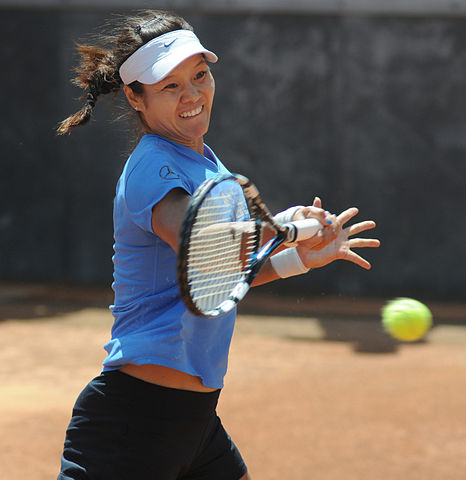
After the Roland Garros title. Credit: Mamiejeanjean
In her autobiography, Li reacted to those who proclaimed her French Open title as a triumph for China: “I can’t carry a nation … I can’t represent anyone else, nor do I want to. I only want to represent myself.”
Her on-court exploits are difficult to separate from her off-court story. There is probably no other all-time great who sat out a couple of years in her early 20s and only neared her potential at age 29. It’s worth looking closer at her record, if only to better understand what might have been.
Li’s two years at university were hardly the only span that delayed her career development. Nagging knee pain finally forced her to go under the knife in mid-2007 for the first of what would be three surgeries. Again she roared out of the gates upon her return, returning to the tour in January 2008 with a tournament win in Gold Coast, beating a teenage Victoria Azarenka in the final. But it would be 2010 before she finally felt confident in the repaired joint.
* * *
While there’s no precise moment when Li graduated from an also-ran to an elite player, a good approximation is her first grass-court title, a win in Birmingham in 2010 with a straight-set defeat of Maria Sharapova in the final. It moved her into the top ten (though she’d quickly bounce back out), and it presaged a quarter-final run at Wimbledon that ended with a credible showing against Serena Williams.
From very early in her career, there was little doubt that Li could compete with the best. Her first encounter with a top-ten player was in 2004, when she qualified in Beijing and drew world #5 Svetlana Kuznetsova. She reached match point and pushed the Russian to a third-set tiebreak. Between 2007 and 2010, she won 17 of her 35 meetings with top tenners, six of the losses going to deciding sets. By the time she won Birmingham, she had scored victories over Serena, Venus, Kim Clijsters, Caroline Wozniacki, Jelena Jankovic, and Elena Dementieva.
At the end of that span, she was 28 years old, a contemporary of multi-major winners Serena, Clijsters, and Justine Henin. Yet she had really only played one full season, in 2009.
The lack of tour experience meant that she was still learning how to bounce back from tough losses. After Wimbledon in 2010, three of her next four events ended in defeats at the hands of Klara Koukalova, Yanina Wickmayer, and Kateryna Bondarenko. She reached the Australian Open final to start 2011… then failed to win a match until April. Her title at Roland Garros that year brought an even harsher hangover. She won only seven matches in eight events over the rest of the season.
* * *
Li finally showed what she was capable of for a full season in 2012. She won just a single title–in Cincinnati–but limited herself only a pair of first-round losses. She fell victim to a particularly strong field and some bad draw luck in 2012, losing to Serena, Azarenka (three times), Sharapova (three times), Clijsters, Wozniacki, and Agnieszka Radwanska. But she rarely stopped fighting–10 of her 17 losses that year required a third set.
The Match Charting Project offers a glimpse into the strengths of the player she had become. Her serve was never a weapon, but her returns were as deep and deadly as any in the game. In the 2012 Montreal final against big-serving Petra Kvitova, nearly nine in ten of her returns landed beyond the service line, and half reached the backmost quarter of the court. When Petra served to her forehand, two-thirds of the returns came back to the deepest quarter, compared to a tour average of only 40%.
Kvitova wasn’t the only opponent whose serves triggered an immediate counterattack. Volunteers have charted 28 of her matches, including most of her finals. According to the Return Depth Index (RDI) statistic, Li ranks second only to Wozniacki among her contemporaries, evidence that she neutralized the serve as well as anyone.
Li and Vika left no ball unbattered
Li’s newfound consistency stuck with her for the remaining season and a half of her career. She also proved able to develop new skills into her 30s, working with coach Carlos Rodriguez to bring a more aggressive game to Wimbledon. At The Championships in 2013, she lost in the quarters to Radwanska, yet came to the net 71 times. Match Charting Project data indicates that she over her career, she typically did so a mere 13 times per match, only about half of those by choice.
In 2014, she won the Australian Open, and a month later ascended to a new career-best ranking of #2. Four months after that, another knee injury would knock her off the tour for good.
* * *
Li retired at age 32, nothing out of the ordinary for a tennis star. Yet it’s hard not to wonder what might have been.
Her career trajectory would make more sense if it belonged to someone five years younger. Instead of a 22-year-old clobbering ITF competition and coming out of nowhere to nearly upset Svetlana Kuznetsova, imagine a 17-year-old doing so. 23-year-olds are more likely than 28-year-olds to establish an initial beachhead in the top ten. The five-year adjustment would make Li 27 years old in 2014, winning a second major and reaching #2 in the world rankings.
That fictitious, younger player would have had surgery and come back in 2015, ready to contend for more slams. She might still be competing on tour in 2022. In all likelihood, she’d be a few dozen places higher on this list. Not only did Li Na assemble an all-time great resume, she packed it all into what was essentially a partial career.
Half a career, yet one that changed Chinese tennis, altered the geography of the global game, and introduced hundreds of millions of new fans to the sport. Quite a feat for a “bad-tempered, stubborn girl from Wuhan” who played only for herself.
In 2022, I’m counting down the 128 best players of the last century. With luck, we’ll get to #1 in December. Enjoy!
* * *
Jean Borotra [FRA] Born: 13 August 1898
Died: 17 July 1994
Career: 1920-65
Plays: Right-handed (one-handed backhand)
Peak rank: 2 (1926)
Major singles titles: 4
Total singles titles: 80
* * *
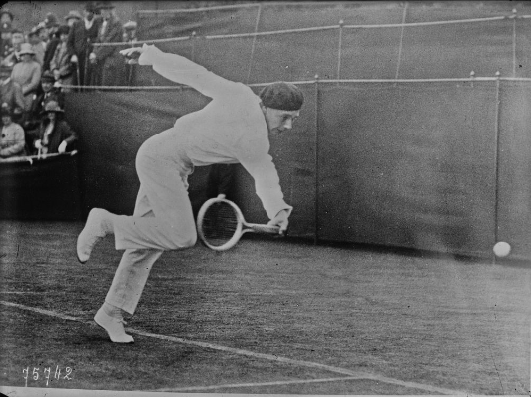
If any man physically embodied the energy of the serve and volley, it was Jean Borotra. For two decades between the World Wars, the Frenchman competed around the world and sparked his nation’s Davis Cup team while working long hours as a sales executive. His tennis commitments were carefully scheduled around his professional appointments, so he often found himself rushing to a match before he could don his trademark beret and begin charging the net.
He won Wimbledon for the second time in 1926, a year in which he spent 199 nights on a boat or a railway sleeper. He’s best remembered as one of the Four Musketeers, the elite French quartet that held the Davis Cup from 1927 to 1932, though he wasn’t quite up to the standard of Musketeers René Lacoste and Henri Cochet. The comparison attests to the absurd strength of the French contingent: Borotra’s four major singles titles rank him third among the members of the greatest Gallic generation.
Yet Borotra’s aggressive game made him one of the world’s best on wood, the speedy surface used for indoor events in Europe. For such a fierce patriot, the powers of his countrymen were more a source of pride than of frustration: the pinnacle of the sport was the Davis Cup, in which Lacoste, Cochet, and Toto Brugnon were his teammates.
To lose a grand slam final to a Frenchman, as he did four times to Lacoste and twice to Cochet, was almost as good as winning it himself. That notion was put to the test in the 1927 Wimbledon final, when Cochet appeared to double-hit a volley on Borotra’s match point. The umpire wasn’t sure, Cochet denied it, and Jean was too much the sportsman to protest. Cochet came back to win, denying Borotra his third Wimbledon title.
But all was not lost. With a personality even bigger than Centre Court, Jean would end up with the spotlight no matter how the match ended.
* * *
Everyone in European tennis from the 1920s to the 1960s had a Jean Borotra story. He spoke excellent English thanks to a year in south London as a 14-year-old, and he never missed a chance to put his language skills to use, whether intervening on behalf of the demanding Suzanne Lenglen or speaking for the French contingent at the annual Wimbledon dinner. During Jean’s first trip to Wimbledon in 1922, tournament referee Frank Burrows noticed that “he laughed so much in the middle of his own jokes that you couldn’t hear the end of them.”
Borotra was every bit as energetic and extroverted on the court. Bill Tilden called him “unquestionably the most difficult man to play against,” and not just because of the Frenchman’s precise serves and relentless forward motion. He danced back and forth across the line between entertainment and gamesmanship, wearing down opponents psychologically before unleashing his trademark overhead smashes. The American’s feelings couldn’t have been any more mixed: “Borotra was the artist and charlatan of the French; undoubtedly, the greatest showman and faker in tennis history.”
Tilden and Borotra met for the 8th time in the 1930 Wimbledon semi-finals. The American had the edge in their head-to-head, but Jean had beaten Big Bill twice that season. Borotra raced out to a 6-0 first set, then traded the next two frames, 4-6 and 6-4. Jean was well-known for coasting through a set or two to save energy for the fifth, and it was evident to everyone present that he was doing so here.
And he was moving so very slowly. Drinks, towels, new berets–it was stalling like Tilden had never seen before.* Bill could hardly contain his frustration, appealing to the umpire to insist that Borotra play to his pace. Jean–surely loving the additional delay–did his foe one better. During all the squabbling, he prepped a couple of ball boys so that he could race to the service line, ready and toweled off with ball in hand. Argument abandoned, Tilden was hardly halfway back to his baseline when he heard a familiar voice cry out, “Beel … I am waiting for you.”
* Keep in mind, this is 1930, so the set probably took 25 minutes instead of the usual 18.
The antics weren’t quite enough this time, as Tilden took the final set 7-5. It was hard to stay miffed at the Frenchman for long, as his showmanship was usually just another way of expressing his love for the game. After all, this is the man who once said, “The only possible regret I have is the feeling that I will die without having played enough tennis.”
In one doubles match with Toto Brugnon–the fourth Musketeer–he chased down a smash and crashed into the crowd. While Brugnon single-handedly kept the point going, Borotra recovered, doffed his beret, bowed to the gallery, and made it back on court in time to hit a winner.
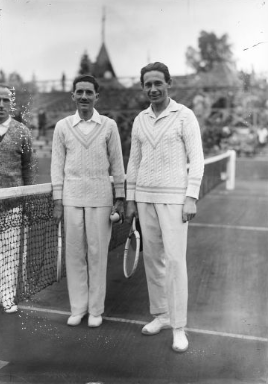
Borotra (right) with Brugnon
One more Borotra story will have to stand for the rest: In 1926, he played mixed doubles with Suzanne Lenglen in what would be her final Wimbledon. Annoyed by scheduling mixups and worn down by illness, she walked on court to jeering crowds. Lenglen was high-strung in the best of circumstances, and Jean could sense disaster looming. He served first, and with a pair of impossibly wild serves, he got the crowd laughing and allowed Suzanne to get down to business. Lenglen would withdraw from the tournament, but not before she and Borotra won their match, 6-3, 6-0.
* * *
Galling as it was for opponents to face a man known for coasting and stalling, Borotra knew exactly what he was doing. He had a reputation for charging through the first two sets, letting the next two slide, then marshaling his remaining energy for a full-on net-rushing attack in the fifth.
The Musketeers have a mythical status in tennis, but the analyst in me notices an eyebrow creeping higher and higher. Did one of the best players of all time regularly tank multiple sets to save energy? Really?
A careful look at the data says: Not exactly, but… kind of, yes!
In best-of-five matches between 1920 and 1939, one player built up a two-set lead about 70% of the time. About four-fifths of those leads–79%–became straight set victories, and more than nine in ten–92%–were finished in four. Given a two-set lead, Cochet converted the third 82% of the time, and Tilden did so 87% of the time. They took care of business by the fourth set in 95% and 98% of such matches, respectively.
Borotra, by contrast, made a career of the scenic route. He won the first two sets more often than Cochet, who had a reputation as a slow starter. But once Jean built up a 2-0 lead, he lost the third set almost one-third of the time (32%)–well above the rate of the typical player of the era and almost double that of his fellow Musketeer.
The narrative breaks down in the fourth set. Given a 2-1 lead, Borotra finished the job in the fourth 78% of the time, well above tour average (61%), better than Cochet (69%), and about the same as Tilden (77%).
Jean got his reputation from a few big matches, as is so often the case. A handful of stars dominated the era, so there wasn’t much use in saving two sets’ worth of energy against most of the middling opponents he needed to defeat. But when it mattered, it appears that the Frenchman really was prepared to drop the third and fourth sets in order to have a better chance at the fifth.
Only twelve times in the inter-war decades did the Frenchman win two sets and lose the next two. He won eight of those matches, and a selection of those victories constitute quite the highlight reel:
Year  Event        Rd  Opponent      Score
1922  Cannes       F   Morgan        7-5 6-4 2-6 3-6 7-5
1922  Metropole    F   Cholmondeley  6-1 6-3 1-6 3-6 6-3
1924  French Chps  F   Lacoste       7-5 6-4 0-6 5-7 6-2
1927  Wimbledon    SF  Lacoste       6-4 6-3 1-6 1-6 6-2
1928  Austr. Chps  F   Cummings      6-4 6-1 4-6 5-7 6-3
1930  Paris Intl   F   Boussus       6-1 6-3 1-6 5-7 6-4
The first two wins sealed the reputation of a fast-rising 23-year-old, and the next two saw him upset another all-time great on the sport’s biggest stages. Tennis has more than its share of unfounded conventional beliefs, but this time history has the right idea. When the stakes were high, Borotra knew when to take it easy.
* * *
Unlike more recent clown princes, Jean Borotra also knew when to get serious. His stunts were often just tactics in disguise, as in the Tilden match. And his occasional silliness–along with everything else–took second place when national pride was on the line.
Fred Perry once said, “Jean Borotra was always prepared to kill himself for France.” When he retired, Jean had played more Davis Cup rubbers than any other Frenchman, even though he was often relegated to doubles duty behind Lacoste and Cochet. He was also unusually committed to the twice-annual friendly International Club matches, which brought together leading players from France, Britain, and a growing number of other nations. When a business commitment forced him to send his regrets in 1968, the IC rescheduled its meeting rather than end Jean’s decades-long streak of appearances at Club matches.
Jean defeats the American challengers
For a man born in 1898, patriotism meant more than just winning trophies. He joined the army upon his 18th birthday, eventually seeing combat in World War I. He was awarded the Croix de Guerre, and superiors encouraged him to pursue a military career.
Borotra chose business instead, joining a firm that sold petrol pumps. He rose quickly, expanding the company’s international reach, a move that conveniently allowed him to travel to places such as Wimbledon London and Forest Hills New York at least once a year.
When war struck again, Jean made a choice that was defensible at the time but would haunt him when the conflict ended. He threw his support behind the efforts of his personal hero, Phillippe Pétain, and served what would become the Vichy government. When he decided, in 1942, to make a run for North Africa and join the Allied cause, the Gestapo immediately picked him up. He spent six months in a solitary cell at the Nazi prison camp in Sachsenhausen before personal connections got him transferred to cushier confinement at Itter Castle. Tennis aficionado King Gustav of Sweden had enough pull with Hitler to effect the transfer and very possibly save Borotra’s life.
Collaborationists–perceived or otherwise–were unwelcome in Britain immediately after the war. Wimbledon feared protests, so the tournament didn’t give Borotra a place in the draw again until 1948. By then, he had recouped a long-abandoned title at the 1947 French Covered Court Championships, a tournament he won ten years’ running in his prime. He played as aggressively as ever, and on fast indoor wood, even a 48-year-old Borotra was unbeatable.
* * *
It would be several more decades before Jean Borotra slowed down. He resumed his love affair with the Wimbledon gallery and continued to enter doubles events until 1964, when he won a match in the mixed with Isabelle de Lansalut. By then, The Championships included veterans’ events, so he switched over, still knocking out opponents 20 years his junior.
In 1973, his friend and biographer, Sir John Smyth, wrote that he seemed to be “still a young man in a hurry.” Aged 75, he kept a personal directory of dozens of tennis partners so that, despite his busy schedule, he could be sure to get on court several times a week. He missed a few more volleys with each passing year, but he never stopped rushing the net.
The good news: Elo ratings for tennis are popping up in more and more places, exposing an increasing number of fans to an alternate (and superior) system for ranking tennis players.
The bad news: A lot of people don’t yet understand how Elo ratings differ from the traditional points-based rankings. Many newcomers criticize either specific ratings or the system as a whole, often because they expect Elo to be just like the official rankings, only with slight tweaks to better match their own beliefs.
The purpose in one sentence: Elo ratings are designed to estimate each player’s ability level right now.
That’s it. The ATP and WTA systems are a hodge-podge of arbitrary decisions meant to balance results, willingness to play lots of tournaments, and performance in the latter stages of particular events. That doesn’t mean they are wrong–there’s often not much difference between the official rankings and the Elo list. You can devise an awful lot of methods for ranking women tennis players right now, and almost all of them will put Ashleigh Barty at the top of the list.
When the results do differ, it’s important to remember what the official rankings prioritize. In the rankings released today, Naomi Osaka is 85th on the WTA computer, against 12th in my Elo ratings. Despite the enormous gap, in a way, they’re both right. Osaka has played only seven events since last year’s Australian Open, so the WTA method treats her as a part-timer with a handful of decent results. Elo, on the other hand, recognizes that she won two of the last six grand slams. It rates her lower than it did a year ago, but Elo doesn’t simply forget about extremes of form because a magic 52-week window expires.
If you’re interested in what a player deserves (whatever that means), the ATP and WTA formulae are probably what you’re looking for. You may have some quibbles with the system, but everybody knows (approximately) how it works. If a player wants to crack the top ten, she understands what she needs to do, and at which events, to accomplish that.
If you’re interested in who will win tomorrow, Elo is almost always your better bet. The official rankings don’t even try to estimate a player’s current level. By definition, they serve as the average of a player’s performances over the last 52 weeks (unless a pandemic changes the rules), so the ranking is a decent approximation of their level five or six months ago. Osaka may not “deserve” a spot in the top 80, but most of us would be ecstatic to make an even money bet that she would beat #84 Anna Bondar or #86 Xinyu Wang. Elo’s estimate of #12 suggests a much more plausible range for how well she will play the next time she steps on court.
Just as the official rankings don’t try to estimate a player’s current form, Elo doesn’t concern itself with what players “deserve.” You might think that Gael Monfils has earned his spot in the top 20–after all, he won a tournament to start the year and followed it up with a run to the Australian Open quarter-finals. Elo had him several places lower, even before his opening-match loss to Mikael Ymer last week. Now he sits at #32. A major quarter-final is a nice achievement, but Elo recognizes that Monfils’s eight wins in Adelaide and Melbourne were against mediocre competition, including several players who were playing on their weaker surface.
Personally, I don’t care much about what players “deserve” from a system that–while adequate and widely accepted–is slapped together and incoherent. I’m more interested in who’s playing the best tennis, so Elo is exactly what I want to see. But that doesn’t mean you have to feel the same way. If you want your rankings to measure something else, that’s fine. Just don’t get mad at Elo.
We consider how Wawrinka improved so late in his career, what role Magnus Norman played in the transformation, how good the backhand really is, how he might have fared in other eras, and much more.
It’s not all Stan: we start by recapping some highlights from the Australian Open, particularly the domination of Ashleigh Barty and the difficulty of forecasting a return to form such as the one we saw from Rafael Nadal. If you’ve had enough Australian Open talk by now, feel free to skip to start of the Wawrinka discussion at the 28:15 mark.
Thanks for listening!
(Note: this episode is about 54 minutes long; in some browsers the audio player may display a different length. Sorry about that!)
Music: Everyone Has Gone Home by texasradiofish (c) copyright 2020. Licensed under a Creative Commons Attribution Noncommercial (3.0) license. Ft: spinningmerkaba
A ball is about to be obliterated. Credit: si.robi
In 2022, I’m counting down the 128 best players of the last century. With luck, we’ll get to #1 in December. Enjoy!
* * *
Stan Wawrinka [SUI] Born: 28 March 1985
Career: 2005-present (17+ seasons)
Plays: Right-handed (one-handed backhand)
Peak ATP rank: 3 (27 January 2014)
Peak Elo rating: 2,146
Major singles titles: 3
Total ATP singles titles: 16
* * *
Stan Wawrinka has played 842 tour-level matches in his career. More than one in ten have come against Novak Djokovic, Roger Federer, Andy Murray, or Rafael Nadal. He’s run into the Big Four in 13 of his 30 ATP finals–including, of course, all four of his grand slam championship matches.
No one outside of the quartet themselves has played the Big Four more often at majors than Wawrinka has. No other man has faced all four at least 20 times. Tomas Berdych tops the list of most total matches against the famous foursome–with Wawrinka a single match behind him.
The most important number for the perennial Swiss #2 reflects what actually happened in those meetings. He beat members of the Big Four 21 times, more than any other outsider. Richard Gasquet, Tommy Haas, and Gilles Simon combined for the same number of victories–and they collectively needed 53 more chances to do so.
* * *
Wawrinka was 27 years old at the close of the 2012 season. The ATP computer ranked him 17th, behind fellow 27-year-olds Berdych, Gasquet, Jo-Wilfried Tsonga, Nicolas Almagro, and John Isner. In eight years on tour, he had won three titles, all 250s, one of them a victory by retirement in the final against Djokovic. He had reached only two grand slam quarter-finals in 31 tries.
By that time, most of us had given up hope that Berdych, Tsonga, or Gasquet–or anyone else–would finally break the Big Four stranglehold and start winning majors. Even among that group, Wawrinka was an afterthought. He had lost 36 of his last 39 meetings with the Big Four, a run dating back to 2007.
Whatever he did to prepare for the 2013 season, it worked. He kicked off the campaign with a five-hour battle in the Australian Open fourth round, where he fought Djokovic all the way to 10-10 in the fifth set. He wouldn’t finally beat the Serbian until the following year in Melbourne, and he would endure another eight losses in ten meetings with the Big Four before the end of 2013. But he won 70% of matches that season for the first time in his career, battled Djokovic to another fifth set in New York, reached his first Masters final, and ascended to a new career-best ranking of #8, leapfrogging Tsonga and Gasquet and nearly closing the gap with Berdych.
Some of the credit belongs to his partnership with coach Magnus Norman, a former major finalist who joined his team in April of that year. Norman came on board after the breakthrough in Melbourne that year, but the uptick in Wawrinka’s fortunes coincides closely with the Swede’s arrival by Stan’s side. As early as November of that year, Wawrinka credited his new coach with both tactical assistance and–just as important–the tools necessary to stick with those tactics in tough matches.
In January of 2014, it all came together. Wawrinka beat Djokovic and Nadal to win his first major title, at the Australian Open. He was the first man outside the Big Four to win a slam since Juan Martin del Potro in 2009, and the first in Melbourne since Marat Safin in 2005. By the end of 2016, he had increased his grand slam tally to three, equalling Murray and making him one of only 20 men in the Open Era to win so many.
What changed? How did a man ranked as the fifth-best 27-year-old at the midpoint of his career become one of the best players of the last century?
* * *
I want to say it was the backhand, the sexy, overpowering one-hander that makes Gasquet look like an elderly coach feeding balls to a beginner.
It wasn’t the backhand–at least, it wasn’t a major improvement in the backhand. Coach and commentator Patrick Mouratoglou recently called Wawrinka’s shot “the most powerful backhand on the circuit,” while pointing out that it’s been a notable weapon since Stan was a junior. The backhand has improved as he has gotten stronger, but that doesn’t explain such a meteoric–and belated–rise.
The history of tennis is riddled with underachievers who couldn’t assemble a complete game to accompany one brilliant shot. Plus, if you’re going to build your game around one otherworldly stroke, a backhand isn’t the one to pick.
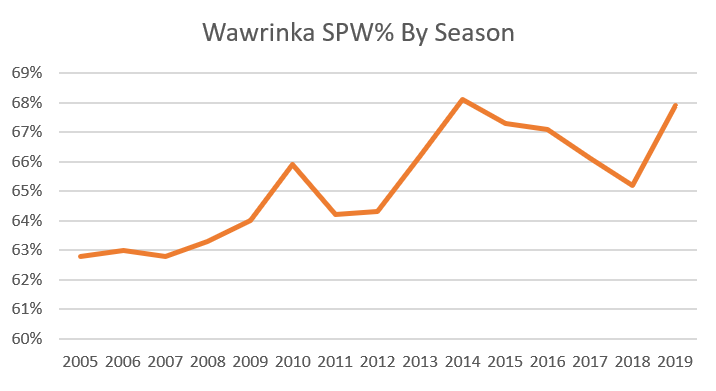
Instead, Wawrinka massively improved the effectiveness of his serve. Take a look at his year-by-year percentage of serve points won (SPW):
From a mark below 65% in 2011 and 2012, Stan improved to 68% in 2014. His career average through 2012 was below 64%, and his career average since is close to 67%.
Three percentage points might not sound like much. Yet it’s an enormous difference. Every tour player of consequence sits in the range between 60% and 70%, with the occasional exception of a monster server who creeps into the low 70s. In 2021, three percentage points was the difference between the devastating serve of Daniil Medvedev and the middling one of Pablo Carreno Busta.
It’s a good thing Wawrinka developed his serve when he did, because after the 2013 season, his return game went the other way. After breaking serve between 24% and 25% of the time from 2010 to 2013, his break rate fell to 21% in 2014 and 2015. Apart from a small bounce back in 2016, it has never recovered.
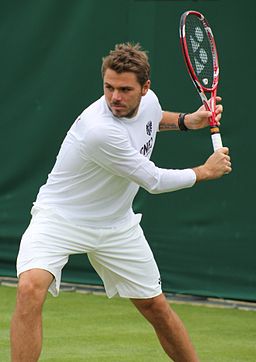
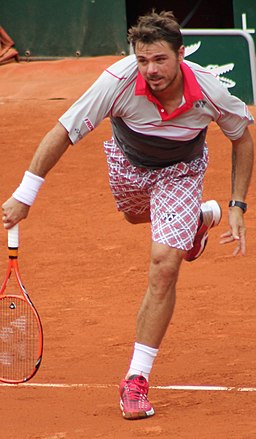
A good serve trumps terrible fashion. Credit: si.robi
Some of the return-game downturn is a mirage. Thanks to his improved results, he faced a tougher mix of opponents. Perhaps his return stayed roughly the same, while his results reflected the more challenging competition. If so, his leap in service effectiveness, against that same set of elite opponents, is all the more impressive.
It’s clear what improved as Wawrinka went from an outsider to the man who forced people to say “Big Five.” But why?
* * *
In 2014, Wawrinka hit aces like he never had before. He tallied free points at a rate around 8% until 2013, so his 2014 mark of 10.7% represented a huge step forward. He aced Djokovic 10% of the time at the 2014 Australian Open, compared to 7.5% at the same tournament the year before. And his first serve played a key role in his first major championship match, when Nadal failed to get a racket on nearly one in five of his offerings.
Yet the serve itself doesn’t tell the whole story. Since 2014, his ace rate has settled in around 9%, only a modest improvement on what came before.
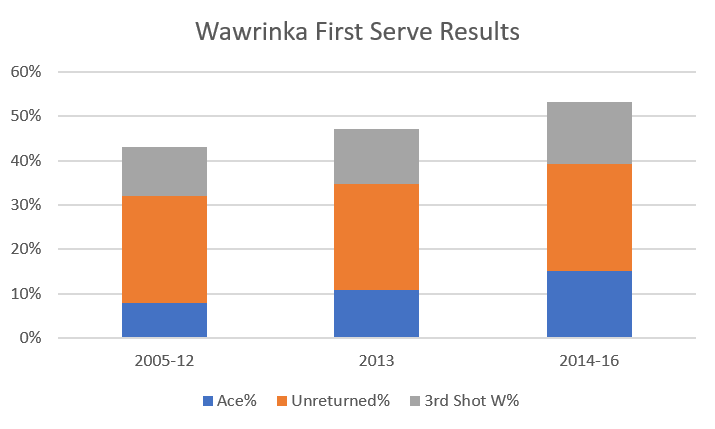
Using data from the Match Charting Project, let’s see how Wawrinka won first serve points before 2013, in 2013, and in his three peak seasons from 2014-16:
Charted matches aren’t the complete record, nor are they a purely random sample, so the ace rates don’t match the overall numbers I mentioned above. For some reason, we chose to chart a lot of Wawrinka’s best ace days in his peak years, so the blue part of each bar shows a significant improvement in ace rate.
The orange portions reflect non-aces that still weren’t returned. That percentage stayed almost the same in each phase.
The gray segments at the top of each bar show points that Stan won with the third shot of the rally–his second swing–either by hitting a winner or inducing a forced error from his opponent. That number steadily increases, from 11% up to 2012, to 12.5% in 2013, to 14% in 2014-16.
The improvement in his second shots is even more noticeable when you consider that fewer balls came back in his peak years. You can’t hit a serve-plus-one winner if the serve doesn’t come back! If we consider how often he ended the point with his second swing as a percentage of opportunities, it’s 16% from 2005-12, 19% in 2013, and 23% during his three-year peak.
Wawrinka explained his change in tactics at the end of 2013: “I don’t wait for the other player to miss.” Against the defensive capabilities of Djokovic, Murray, and Nadal, all of whom had an annoying tendency not to miss, it was really his only option.
And it was more than just a tactical shift. A year after joining Team Wawrinka, Magnus Norman weighed in: “Technically, it’s his forehand that progress is the most significant. His margin over the net is now larger, and he now has more confidence in [it]. … Stan has always had an incredible ball hit.”
The forehand is a crucial part of the serve-plus-one game. For a player already armed with an elite backhand, it was the remaining weapon with the most potential.
* * *
Once again, these percentage-point increases–16% to 19%, 19% to 23%–may seem insignificantly small. But we have to remember that the difference between a top-20 player and a top-five slam contender is itself tiny.
The evidence here suggests that Wawrinka steadily became more aggressive on the first two shots of his first serve points in the exact time frame when his results went from good to great. It worked, and he’s never gone back.
Best of all, it works against everybody. Unlike Berdych or David Ferrer, Wawrinka never thrived in the year-long grind of second-tier events, so his ranking required that he show up against the biggest guns. Even before his breakthrough, Stan wasn’t overawed by his supposed betters. He pushed Murray to five sets at Wimbledon in 2009, then beat him at the US Open in 2010. He took at least a set from Djokovic on five different occasions before 2012, and won more than half the points they played in a two-tiebreak match in 2009.
By 2013, it was obvious that no one could beat Djokovic or Murray at their own game. Unable to out-grind the grinders, Wawrinka went hard in the other direction. From 2007 until April of 2013, he lost 38 of 41 matches against the Big Four. Since clobbering Murray at Monte Carlo in 2013, he’s beaten the quartet 14 times in 46 tries, and split 18 meetings at majors.
It’s rarely so impressive to emerge from the pack just to become the fourth or fifth best player in the game. Yet to accomplish what Wawrinka did in the mid-2010s, scoring his biggest victories over one all-time great after another, sets him apart from the fifth-bests that came before him. The sexy backhand is just icing on the cake.
In 2022, I’m counting down the 128 best players of the last century. With luck, we’ll get to #1 in December. Enjoy!
* * *
Beverly Baker Fleitz [USA] Born: 13 March 1930
Died: 29 April 2014
Career: 1946-1959 (14 seasons)
Plays: Ambidextrous (two forehands; served right-handed)
Peak rank: 3 (1954, 1955, 1958)
Peak Elo rating: 2,204 (2nd place, 1955)
Major singles titles: 0 (1955 Wimbledon finalist)
Total singles titles: 60
* * *
If you know one thing about Beverly Baker Fleitz, it’s probably that she was ambidextrous, hitting forehands off both wings. If you didn’t know that, boy am I excited to be the one to tell you. One of the best players never to win a major, this Californian won the 1948 national girls’ championship, beat Mo Connolly eight times, and reached the 1955 Wimbledon final as a mother, all without a backhand.
* * *
Baker Fleitz was, to some extent, naturally ambidextrous. The young Beverly Baker (Fleitz was her married name) threw righty and wrote lefty, so when she first picked up a racket, it came easily for the tiny 10-year-old to use her left hand on what would typically be her backhand side. A couple generations later, she would’ve been a natural proponent of the increasingly popular two-handed backhand, but developing her game in the 1940s, a double-hander would’ve been just as weird as her pair of forehands.
It wasn’t completely unprecedented to play with two forehands. The Australian Davis Cup player John Bromwich was a natural lefty who served right-handed, and he would hit one- or two-handed strokes at various times from both wings. He was part of the Aussie squad that traveled to Los Angeles for the Pacific Southwest tournament in 1938 and 1939, and he won the tournament the latter year.
The example of Bromwich, well-known to tennis aficionados in Southern California, may have given her father and coach, Frank Baker, the assurance to let Beverly do things her own way. It worked: She hit both forehands hard and deep. The only drawback of her unorthodox technique showed up at the net, where it took too long to switch hands. But like most of her peers, she was content to stay back, and her game thrived.
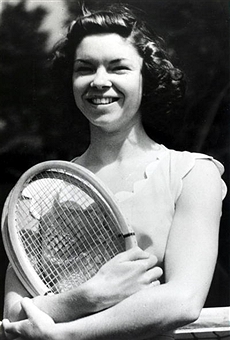
A 1949 shot of Baker switching from one forehand grip to the other
The novelty itself made life more difficult for opponents. She won the 1947 Los Angeles Metropolitan tournament before her 17th birthday and made her first trip East that summer. At the prestigious Eastern Grass Court Championships in Orange, New Jersey, she reached the final four before falling to the reigning Wimbledon champion, Margaret Osborne (later Osborne duPont), and won two matches at the national championships at Forest Hills.
Osborne’s 6-2 6-3 victory was hardly a close shave, but the veteran recognized her opponent’s potential. She described Baker as one of the game’s “coming players” and said, “Her ambidextrous style can be so confusing that at times you don’t know which way the ball is coming from.” While Osborne would win their next three meetings, Baker turned the tables when they clashed in a 1951 Wimbledon quarter-final.
The 17-year-old solidified her status as a player to watch in the fall of 1947, grabbing the title at the Pacific Southwest, the same event where the similarly unorthodox Bromwich had triumphed eight years earlier. Reigning national champion and SoCal product Louise Brough skipped the event due to illness, so it was left to the rest of the strong West Coast contingent to stop the teen with two forehands. They failed. In the final, Beverly lost only five games to top-tenner Pat Canning Todd.
As Baker’s results improved, the media quickly recognized the teen as more than a novelty act. Her small stature, at 5-foot-4 and under 120 pounds, left onlookers shocked by her power. Columnist Braven Dyer was awestruck by Baker’s performance against Todd: “Wham! How she socked home her drives, first with the right and then with the left.” Two years later, a writer for American Lawn Tennis claimed that he couldn’t recall a female player hitting harder than Beverly did.
One late-career assessment would’ve fit the young player just as well: “Her service is weak, her volleying indifferent and her overhead a chore that she shirks at all costs. She doesn’t need them. … The formula [is] simple: rifle the ball down a sideline and if it dared to come back, slam it down the other.”
* * *
Baker arrived on the American scene at a tough time for would-be stars. Brough’s 1947 Forest Hills title was the first of her six majors, and Osborne won the second of her own half-dozen at Wimbledon that year. The seemingly endless supply of elite American women would win Wimbledon and the US Nationals every year from 1938 to 1958, tacking on nine French Championships and four Australian titles in the same span.
The woman who would finally displace Brough, Osborne, and Doris Hart was still a few years away from her peak, but Baker spent the summer of 1948 getting a sneak preview of the future, facing off repeatedly against 13-year-old Maureen Connolly.
Baker and Connolly were among the small group of Californians sent to tour the West that summer. They played state and regional events in Salt Lake City, Denver, Tacoma, Seattle, and Vancouver. Baker won all five tournaments, and as Connolly also outclassed the provincial competition, Beverly and Little Mo met in a semi-final and four finals. (After the first stop in Salt Lake City, no one else made the mistake of seeding them in the same half of the draw.) While Connolly would eventually surpass her elder, Beverly remained a thorn in her side for years.
Baker went East again in 1948, winning the national junior title and excelling in adult tournaments, losing only to Brough and the now-married Osborne duPont. She reached the final again at the hometown Pacific Southwest, this time losing to a healthy Brough.
Her season tally of at least 48 wins against 9 losses was good for a national ranking of #5. My Elo ratings concur, placing her behind Brough, Osborne duPont, Hart, and Todd. In 1948, the top five Americans were all better than anyone the rest of the world had to offer.
With another decade to run on Beverly’s career, she had already nearly reached her peak. The cast of characters would shift, but she would remain a few rungs from the top.
* * *
There’s no shame, of course, in slotting in behind the likes of Brough, Hart, and Connolly. That’s particularly true for a person like Beverly Baker, who refused to let amateur tennis dominate her life.
As she ascended the ranks in early 1948, she told a reporter, “Tennis means everything to me right now, except school. So long as I’ve started playing, I want to reach the top, or as close to it as I can get, before anything else.” That included romance–a resolution that lasted barely a year.
In late 1949, she eloped to Las Vegas with Scotty Beckett, a fellow Southern Cal student and former child star from films such as “Our Gang.” Less than six months later, Baker filed for divorce, citing mental cruelty and bodily injury. She testified at trial that Beckett was “insolent, arrogant, abusive, belligerent and jealous.”
Her tennis bounced back from the ordeal. In the second half of 1950, she went 27-4, losing only to Hart and Osborne duPont. Baker didn’t sour on marriage, either. She wed John Fleitz in 1951, and the couple would have two children within five years.
* * *
After a 1951 season that included a trip abroad, a Wimbledon semi-final, nearly 100 singles matches, and six titles, family life slowed down Beverly Baker Fleitz’s playing schedule. In the amateur era, most women hung up their rackets upon their first pregnancy, and many quit as soon as they walked down the aisle. Beverly couldn’t see why: she missed less than a year for the birth of her first child, and sat out only 14 months for the second.
Between layoffs, she played the best tennis of her career. From her comeback in June 1953 to Wimbledon in 1956, when she withdrew due to her second pregnancy, she racked up 112 wins against only 6 losses, conceding defeat only to Doris Hart (twice), Louise Brough, Shirley Fry, Dorothy Knode and Barbara Breit. While she stuck close to home, playing the majority of her tennis in Southern California, she nonetheless piled up victories over the best of her peers: Connolly, Hart, Brough, Osborne duPont, Althea Gibson, and Darlene Hard.
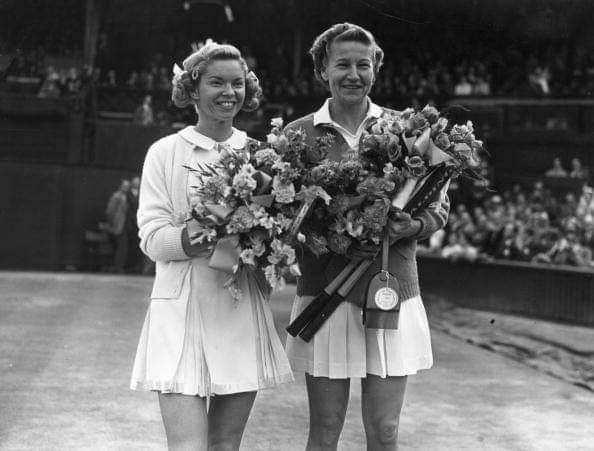
Baker Fleitz (left) with Louise Brough before the 1955 Wimbledon final
The highlight came at Wimbledon in 1955. She cruised to the final with the loss of only 21 games in 6 matches, including a 6-3 6-0 dismantling of Hart. Baker Fleitz finally upset her old nemesis, winning the last nine games in a row. In the championship match, she faced Brough, who Beverly had beaten four times since her comeback, including once on grass.
Thanks to her performance in the semis and the recent results between the two women, Baker Fleitz entered her first major final as the favorite. She very nearly lived up to the billing. Brough was forced to deploy every trick she knew, occasionally suffering through passages like Beverly’s 10 consecutive points won early in the second set.
Baker Fleitz pushed her long-time rival to the limit, finally losing serve at 5-5 in the first set, allowing Brough to take it, 7-5. Both of Beverly’s forehands were firing, while her opponent barely had the stamina to survive another long set. Finally, with Baker Fleitz serving at 6-6, Brough secured a break with the shot of the match, a lunging stop-volley winner. Six points later, the former champion lifted the trophy again, defeating the woman with two forehands, 7-5 8-6.
The runner-up didn’t dwell on the defeat. She blitzed the field at the Irish Championships the next week in Dublin, then rushed home to take her daughter Kimberley to the beach.
* * *
Baker Fleitz retired from top-level tennis at the end of 1959, though the mother of two had hardly lost a step. She departed the scene as the two-time defending champion at the Pacific Southwest, having beaten top seed Maria Bueno in her final match at that event, two months after defeating British stars Angela Mortimer and Christine Truman in Wightman Cup.
Even then, she wasn’t quite done unleashing her power on the Los Angeles tennis elite. At the Southern California Sectional Championships in 1966, she entered the mother-daughter doubles with Kimberley and the wife-husband event with John. She and Kimberley won a match before losing in the quarters. With her spouse, she did a bit better.
You might have heard of their opponents in the final: Billie Jean King and her husband Larry. It wasn’t easy, but the Fleitzes came out on top, 5-7 8-6 6-3. I can only suspect that the husbands faced the brunt of the abuse that day. Beverly’s two forehands had been too much for a generation of women on tour. Larry King didn’t stand a chance.
The podcast returns for 2022 from a long layoff to welcome back Joe Posnanski, author of the Baseball 100 and many other wonderful books. Joe covers all sports on Substack, where you can subscribe, even if he doesn’t write about tennis as much as he ought to.
We start by talking about all things Australian Open–what it means for Rafa’s case as the greatest of all time, if we’ll ever forget about the saga that kept Djokovic out of the tournament, how Daniil Medvedev stacks up against the rest of the field, whether Ashleigh Barty is pulling away from the WTA pack, and which other women we’re expecting to see emerge to challenge her.
We also dive into the general subject of Greatest-of-All-Time lists, the subject of Joe’s book, his current American football project, and my just-launched Tennis 128. We consider how tennis greatness differs from that of other sports, how to handle career gaps such as wars and injuries, and balancing algorithms with gut feelings. We wrap up by giving Joe a speed round of tennis GOAT questions, one toughie after another asking him to untangle the trickiest debates in the sport’s history.
Thanks for listening!
(Note: this episode is about 91 minutes long; in some browsers the audio player may display a different length. Sorry about that!)
Music: Everyone Has Gone Home by texasradiofish (c) copyright 2020. Licensed under a Creative Commons Attribution Noncommercial (3.0) license. Ft: spinningmerkaba