The Tennis 128: No. 37, Fred Perry

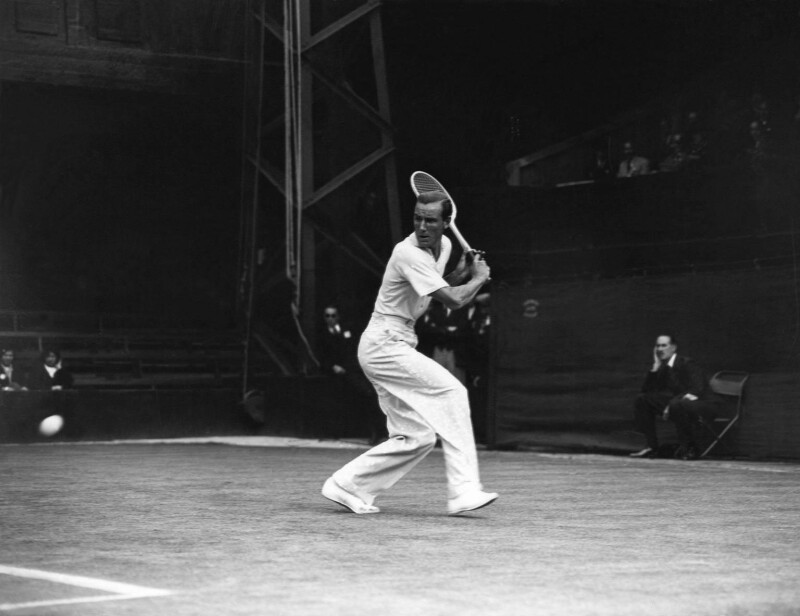
Fred Perry at Wimbledon in 1933
Credit: James Jarché / Daily Herald

In 2022, I’m counting down the 128 best players of the last century. With luck, we’ll get to #1 in December. Enjoy!

* * *

Fred Perry [GBR]
Born: 18 May 1909
Died: 2 February 1995
Career: 1929-47
Played: Right-handed (one-handed backhand)
Peak rank: 1 (1934)
Major singles titles: 8
Total singles titles: 62
 

* * *

Fred Perry fell one leg short of the Grand Slam in 1934. He beat Jack Crawford at the Australian and Wimbledon, and he outlasted Wilmer Allison at Forest Hills. The missing link was the French. While he would pick up that title the next year, an ankle injury ended his 1934 run in Paris at the quarter-final stage.

The man who benefited from Perry’s injury was Giorgio de Stefani, an ambidextrous Italian who had finished second at the French to Henri Cochet in 1932. In a newspaper column later that year, Perry described the Italian as a “perfect tennis gentleman,” one who rushed to help him up and spared him too much strain on the ankle while closing out the match.

Fifty years later, Perry would tell a different story. He wrote in his memoir that he promised de Stefani an “honorable victory”–that is, he wouldn’t default–but that he asked the Italian not to run him around any more than necessary. De Stefani spoke three languages fluently, but he didn’t get the message. He sent the gimpy Perry scampering along the baseline before polishing off the fourth set and the match, 6-2, 1-6, 9-7, 6-2.

The British champion wasn’t the sort to quickly forget a slight. After the match, he said, “Right, Giorgio, next time we play it’s going to be 6-0, 6-0, 6-0.”

The rematch occurred at the 1935 Australian Championships–ironically, just a month after Perry’s newspaper portrait of the Italian appeared Down Under. They met in the quarter-finals, and Perry delivered as promised. He won 17 consecutive games, fell to 15-40 in the 18th, then recovered to complete the whitewash.

Fred Perry was that good, and he was that confident. It wasn’t the only time he correctly predicted a score, either. Tennis lore is full of tales of the Brit’s bold forecasts. One story has him calling a 6-2, 6-4, 6-4 victory ahead of time–in a Wimbledon final!
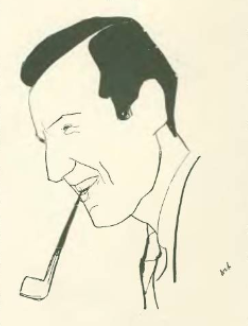
Perry, sketched in the New Yorker

Perry made a career out of doing things that just weren’t done. Players–especially British Davis Cuppers–didn’t announce the scores of their matches ahead of time. They didn’t shout “Nuts!” after missing shots–in those days, even that was considered mildly unsportsmanlike. Would-be champions weren’t supposed to come from working-class stock, and they certainly weren’t to act like they did.

The clubbable men behind the scenes at Wimbledon and the British Lawn Tennis Association could never quite hide their disdain of the son of a Labour MP. But fans were a lot more welcoming. After all, Perry did a lot of other things that set him apart. He won Wimbledon three years running. He brought the Davis Cup back to the Isles for the first time since 1912, and he helped keep it there for four years.

If it weren’t for Andy Murray, we’d still be bringing up Fred’s name every time a home hope set foot on the Wimbledon turf. The British waited a long time for a player of Perry’s caliber, and once he left the arena, they had to wait even longer for the next one.

* * *

Though Perry was often certain of victory, he was also well-attuned to the vicissitudes of high-level tennis. He told Time magazine in 1934, “In the tennis world, there are about five blokes who are as good as each other. In order to win, a bloke needs a bit of luck.”

The other blokes might have raised an eyebrow at that. Aside from de Stefani, no one but Perry had found much luck that year.

Maybe he did get some breaks, but in the Brit’s view, they were only his due. He explained to the New York Times when he arrived for Forest Hills that year:

It’s always a bit of luck that helps you win, and that’s just what has been happening to me this year. I’m not playing any better than in 1930 and 1931. Then I was losing titles in the fifth set. Now I’m winning them in the fifth.

Wait a second. Perry was an untested stripling in 1930, a 21-year-old table-tennis world champion who had only recently given his full attention to the lawn version of the game. Was this gentlemanly modesty or astonishing confidence?

With the Englishman, it was usually the latter. Still, the young Fred was awfully good. He reached the final at a 1931 clay court tournament at Queen’s Club and lost a 7-5 fifth set to Bunny Austin. He played the cannonball-serving American Ellsworth Vines four times in the United States that year. Twice he lost in five, including in a semi-final at Forest Hills. The one straight-set decision went to Vines in the final of the Pacific Coast Championships, 6-3, 21-19, 6-0. Third set notwithstanding, it was understandable if Perry remembered that one as a marathon that could’ve broken either way.

* * *

Citizens of the tennis world had their eyes on Perry by the end of 1931. In fact, many of them had lost to him personally as the British Davis Cup team romped through six rounds against Monaco, Belgium, South Africa, Japan, Czechoslovakia, and the United States. Perry went undefeated in the first five of those ties, then beat Sidney Wood and watched as Austin played the hero against the Americans.

In the Challenge Round against France, the remaining three-quarters of the Four Musketeers were too strong. Nonetheless, Perry was the story of the conclusive tie. He won a fast-paced, five-set rubber over Jean Borotra and gave Cochet a battle in the decisive match before conceding, 6-4, 1-6, 9-7, 6-3.

The tie at Stade Roland Garros gave a glimpse of both Perry’s present and his future. Borotra, the quickest man in the game, was the player who journalists would most often use as a comparison for the young Brit. Cochet, on the other hand, was Fred’s own model.
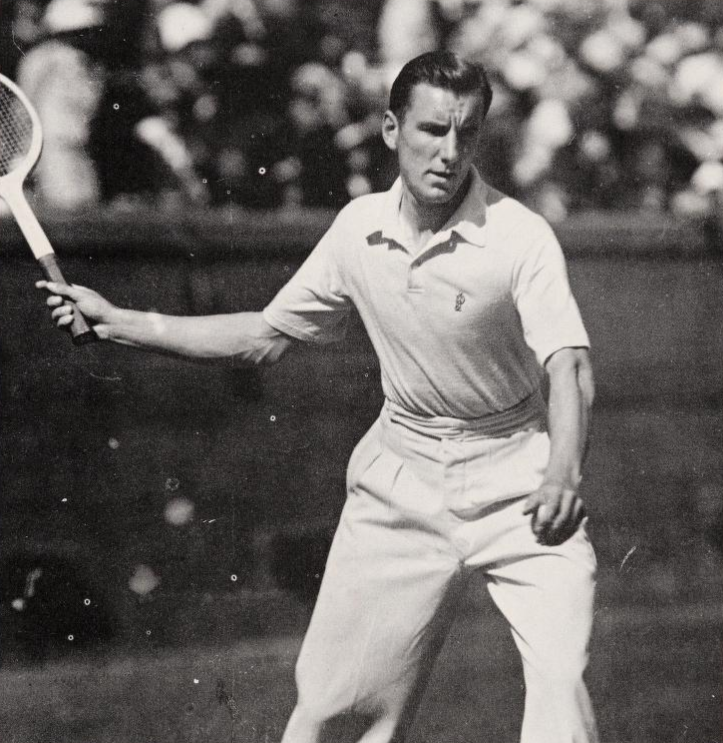
The Perry forehand

Perry’s table tennis background provided the basis of his lawn tennis game. He had only one grip, an extreme Continental that he also used to chop firewood. His table-honed reflexes allowed him to take almost every ball on the rise, especially on his forehand side. It was the Cochet game, writ larger. “[B]ecause I was bigger, stronger, and faster,” Perry wrote. “I hit the ball harder. [I was able] to carry his methods a stage further than Cochet himself.”

When Fred complained to the Times about the days when luck didn’t go his way, he might have been thinking more of his indifferent 1932 season. The British Davis Cup campaign ended three stages earlier than the year before, when the squad faced Germany in Berlin. Perry trounced Gottfried von Cramm but lost the deciding rubber to Daniel Prenn, 7-5 in the fifth.

Bad luck comes in many forms. Perry held match point on Prenn’s serve at 5-2 in the deciding set. The German hit a serve that Perry slapped back for a winner… or so he thought. But no, the baseline judge had called a foot fault on the home player. Prenn played a better point off his second serve, and the Brit never did win his sixth game.

“How could I have lost five games in a row after having had match point?” asked Perry in his autobiography. “Well, to this day, I still don’t know.”

* * *

Perry wouldn’t have many more such puzzlers in his amateur career. Once his game caught up to his bluster, opponents could only sit back and watch.

Wimbledon player liaison Ted Tinling observed that Fred “was the first Englishman to see tennis as a battle rather than a game.” In retirement, Perry was even more direct: “In any one-on-one sport–take boxing–you go into it expecting to beat the hell out of the other fellow.”

The first victim of peak Perry was, well, everyone who dared to play for the 1933 Davis Cup. In seven rounds, the number one Brit lost only singles rubber–to the pesky de Stefani–and two doubles matches. He took revenge on Cochet on the first day of the Challenge Round, then sealed Britain’s victory with a deciding rubber defeat of the young Frenchman André Merlin.

Cochet sketched the rising star in just a few words: “ruthless, full of confidence, insolent, a rough fighter.”

The 1933 Davis Cup Challenge Round

The French had held the Cup for six years; before that, the United States held it for seven. Neither one would get it back until after Perry turned pro and left the Davis Cup behind.

Confidence begat confidence. In early 1934, a reporter asked “Fearless Fred” how he rated the Americans’ chances. He replied, “Oh, they have a nice doubles team, you know, but really!”

The last domino fell at Forest Hills in 1933. Perry exited early at Wimbledon, a blemish quickly forgotten in the excitement of the Davis Cup. Meanwhile, Gentleman Jack Crawford found himself holding the titles of Australia, France, and Great Britain, raising the question of whether he could complete the newly-named Grand Slam. While the indolent Australian showed signs of fatigue, he progressed easily to the final at the United States Championships, as well. Perry awaited on the other side of the draw.

Crawford took a two-sets-to-one lead in a hard-fought title match. Allison Danzig wrote for the Times:

Even when the Australian was in the plenitude of his powers, however, it was all he could do to hold his swift-moving and sharp-hitting opponent on even terms…. So much depth did Perry have on his shots, so everlastingly was he making the chalk fly on the corners, that the Australian was desperately pressed to keep the ball in play with his more tempered and less daring strokes.

Perry summarized the match more succinctly. When the players returned from the customary ten-minute intermission to play the fourth set, he “went mad.” The Brit won the last two sets, 6-0, 6-1, in less than 30 minutes.

* * *

The match in New York was a coronation. Crawford, great as his season was, didn’t have the makings of a reigning king. Vines, the 1932 Wimbledon champion who nearly defended his title, went pro. Perry kept getting better, and there was no one on the amateur horizon to challenge him.

The British number one would play twelve major tournaments between the 1933 US Championships and the end of 1936. He won eight of them.

The 1934 Australian and Wimbledon championships solidified Perry’s domination of Crawford. The two men contested both finals, and the Englishman didn’t lose a set. At Wimbledon, Perry ran off 12 consecutive games. “If I live to be 100,” he said, “I’ll never play so well again.”
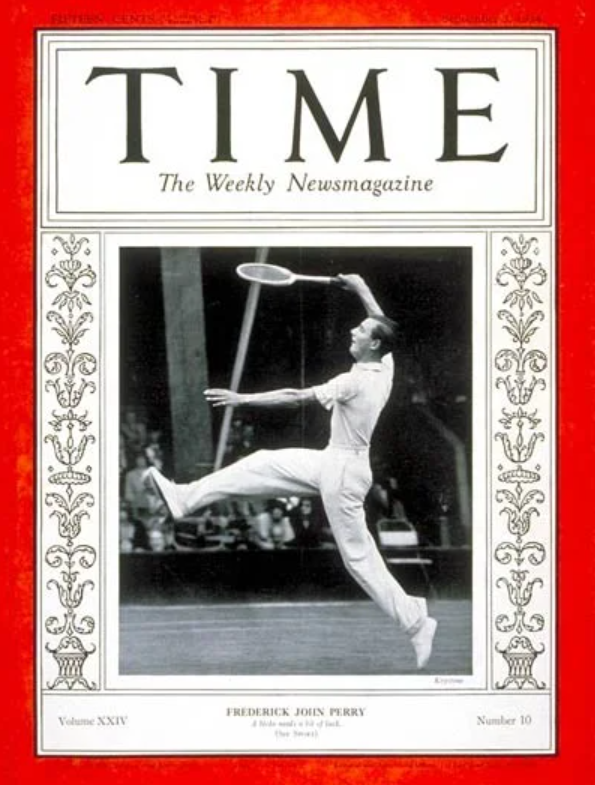
Perry on the cover of Time in 1934

The professional game beckoned. Vines and Bill Tilden were earning movie-star salaries after abandoning the amateur game, and Perry was the next logical target. Fred had no family wealth and no profession except for lending his byline to newspaper columns. His father had bankrolled his career in the early going, and the British LTA had picked up the tab since–though the organization that collected the gate receipts for the Davis Cup Challenge Round was hardly running a charity.

Reporters badgered Perry about his plans. Throughout 1934, he said he had no intention of going pro. The pay-for-play game was an increasingly acceptable option in the United States, but for a Brit, it would mean complete rejection from acceptable tennis society.

What the champion didn’t say is that he had never found English tennis society terribly welcoming. An LTA official once let slip to Fred’s father that they didn’t think of the young man as “one of us.” After his 1934 Wimbledon victory, Perry overheard a club member, Brame Hillyard, tell Crawford that the better man didn’t win that day.

In retrospect, it’s remarkable that Perry stuck it out on the amateur circuit for as long as he did.

* * *

The British number one defended his Forest Hills title in 1934, proving he could win when he was not as his best. Helen Jacobs, women’s victor at the same event, was impressed by Perry’s five-set defeat of Wilmer Allison: “Every characteristic of his temperament, though occasionally annoying to his friends, manifests the assurance of a champion.”

Perry opened the 1935 season on a down note, losing the Australian final to Crawford. Promoters in the United States pushed him to join the pro circuit, and it’s possible that their persistence–including late-night phone calls that were more appropriate for time zones Stateside than in Oz–left Fred ill-prepared to defend his crown.

The early loss didn’t slow him down for long. He won the French to complete his set of titles at all four majors, then defended his Wimbledon title. At both events, he defeated Crawford in the semis and von Cramm in the final.

The German Baron was another “better man” in the eyes of snobbier All-England Club members, but he beat Perry only once in six tries. As Allison said, “von Cramm certainly has the better strokes, but it’s the final score that counts.”

The 1935 Wimbledon final

By 1936, it was only a matter of time before the newly-married champion signed a professional contract. He reached the Roland Garros final, obliterated von Cramm for his third straight Wimbledon crown, and edged out Don Budge for the championship of the United States.

Perry was already effectively playing for money in his last major as an amateur. He had agreed to terms with the promoter (and former Davis Cup player) Frank Hunter, including a bonus if he won Forest Hills. Hunter and friends amused themselves during the final by brandishing the larger contract when Perry was winning, the smaller one when he was losing. Two rain delays and nearly three hours of paper-waving later, the Englishman won his eighth and final slam, 2-6, 6-2, 8-6, 1-6, 10-8.

* * *

Perry was only 27 years old when he turned pro. While Budge would’ve made his next Wimbledon campaign considerably more competitive, Fred’s major count probably would have reached double digits.

Instead, he played Ellsworth Vines. Over and over again.

Vines was the reigning pro champion, Perry the challenger. They made a good pair, as the American’s enormous serve and bruising groundstrokes tested Perry’s lightning reflexes and aggressive return game. Fans turned out in droves, and while Vines won 32 of their 61 meetings, the Brit’s efforts in 1937 netted him $91,000–a cool $1.8 million in today’s dollars.

The American won the series in 1938, as well, picking up 49 victories in 84 tries. Perry jokingly characterized American tennis as “B.F. and B.I.–Brute Force and Bloody Ignorance.” But on the fast indoor surfaces that made up much of the pro game, he didn’t have an answer for the more one-dimensional Vines game.

Perry and (Ellsworth) Vines in 1937

The downside of professional tennis was that it used up amateur champions as fast as Hollywood churned through leading ladies. Even in 1938, the Vines-Perry rivalry didn’t interest the press or the public as much as it had the year before. Budge joined the pro ranks in 1939, and after winning a series against Vines, he took 28 of 36 matches against Perry. The British champion would remain a dangerous competitor in professional tournaments, but when World War II began, Perry’s days as a marquee name were over.

When Wimbledon returned in 1946, the lean years had begun. British fans had waited a decade for a home-grown men’s champion. Their suffering was just beginning. When Perry wrote his autobiography in 1984, it had been nearly half a century. Fred, of course, had an opinion:

There hasn’t been a British Wimbledon men’s champion since me in 1936, and a lot of people keep wondering when we will produce another one. Well, it’s not a matter of producing anybody, to begin with. It’s a case of somebody, somewhere, who wants to succeed badly enough and is determined and bloody-minded enough to make sure he does.

In case that wasn’t clear enough, he added, “Bloody-mindedness was one of my specialities.” He never met Andy Murray, but he might as well have been talking about the man who finally ended the 77-year wait.
The Tennis 128: No. 38, Andre Agassi

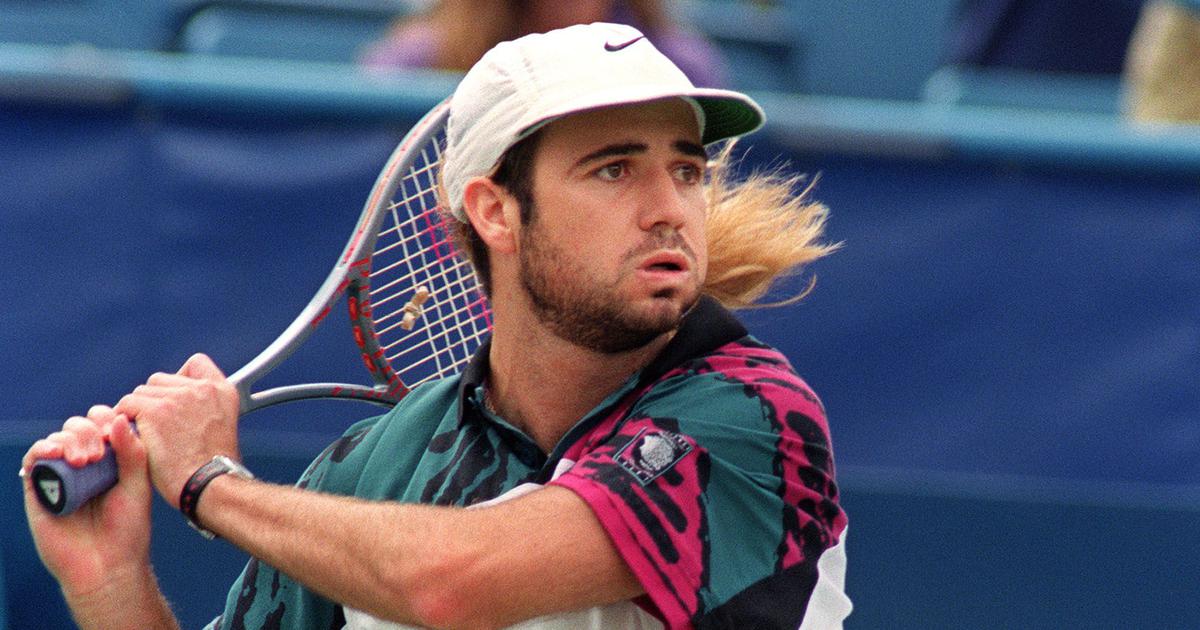
Andre Agassi

In 2022, I’m counting down the 128 best players of the last century. With luck, we’ll get to #1 in December. Enjoy!

* * *

Andre Agassi [USA]
Born: 29 April 1970
Career: 1987-2006
Plays: Right-handed (two-handed backhand)
Peak rank: 1 (1995)
Peak Elo rating: 2,282 (1st place, 1995)
Major singles titles: 8
Total singles titles: 60
 

* * *

Two images of Andre Agassi will persist for as long as people care about tennis.

One is the denim-shorted, spiky-haired enfant terrible of the late 1980s, the ball-basher who flogged Canon cameras and proclaimed that Image is Everything.

The other is the open face and bald head of the thirty-something who became the most beloved player in America by the time of his retirement in 2006. That’s the portrait on the cover of his memoir and the look that no one who watched the US Open in 2005 or 2006 will soon forget.

The two personas barely share a resemblance. It’s impossible to review Agassi’s career without marveling at his constant reinvention. In two decades, he went from teen idol to teen burnout, savior of American tennis to wasted talent, tennis-hater to comeback kid, jokester to elder statesman.

His game was less schizophrenic, but it changed plenty as well. He arrived on tour with a forehand that could split a two-by-four, one that had to be that good to hide his backhand. In time, his pinpoint backhand became the signature weapon. The mindless slugging of his early days gave way to tactical prowess of the Brad Gilbert school. He traded a fast-food diet and a casual approach to training for the teachings of strength coach Gil Reyes. He was the fittest man on the circuit after most of his peers had retired.

How did the outrageously talented kid from Las Vegas go from hair model to role model? While one match–the 1999 French Open final–is often referred to as the key turning point, the American’s saga was more roller coaster than right-turn-at-Paris. As much as his eight major titles, the winding road is what makes the Andre Agassi story so distinctive.

* * *

Tennis has always had a complicated relationship with its bad boys. Players have always been expected to behave in a manner as constrained as their all-white attire. But as the pro game went global and minted a growing number of millionaires, it became obvious that rebelliousness sold as many tickets as it did newspapers. Some pundits were ready to appoint foul-mouthed prankster Ilie Năstase as the sport’s savior almost as soon as the Open era began. Every time Năstase, Jimmy Connors, or John McEnroe dented the boundaries of proper decorum, the game’s television ratings crept still higher.

By the mid-1980s, Jimbo and J-Mac were fading. Arthur Ashe predicted in 1985 that “the bottom is going to fall out at the top of American men’s professional tennis” in two of three years.

Point is, fans and journalists alike were prepared to be understanding when Agassi and his hair–“like Cyndi Lauper’s after a fettuccine fight,” in Curry Kirkpatrick’s memorable phrase–arrived on tour. Apart from the shock at first glance, the kid didn’t seem that bad. Some watchers thought he was a throwback, a relaxed, playful competitor who would applaud his opponent’s best shots.

Embed from Getty Images

I’m sorry.

Agassi’s talent was undeniable. At Stratton Mountain in 1987, the 17-year-old upset top-tenner Pat Cash and took a set from then-number one Ivan Lendl. He won the event a year later, one of six titles he bagged in his first full season on the circuit. Jimmy Arias, himself known for a howitzer of a forehand, said, “Andre hits the ball harder than anyone else by far.”

His ability to take the ball on the rise was even more astonishing. One fellow player called his hand-eye coordination “disgusting.”

One of the earliest objections to the flashy youngster was also the most time-worn. He was a bruising baseliner who gave only the flimsiest lip service to an all-court game. Ion Țiriac, then coaching Boris Becker, said of the American, “If a player hits as hard as he can all the time, matches will turn into shooting contests and the beauty of the game will disappear. His is a limited game that has nothing to do with finesse.”

“Agassi could revolutionize the game,” said Țiriac. “But I hope he doesn’t.”

* * *

With the victories came more than the usual teenage dose of overconfidence. In a 1988 Davis Cup match against Martin Jaite in Buenos Aires, Agassi fell 0-40 down in a Jaite service game. As a stunt, he caught Jaite’s next serve out of the air. He thought it was harmless fun; Jaite, his teammates, and–especially–the Argentinian crowd disagreed.

Andre apologized, and in the days before ubiquitous PR training, he might have even meant it. But the infractions started to pile up. At the WCT Finals in Dallas the following March, he retired from a match against McEnroe despite showing no signs of injury. His handlers kept him out of Wimbledon, saying it was just another tournament. When he clapped for his opponents’ winners, the men across the net increasingly saw it as mockery.

Worse, his results suffered. It was harder to forgive the antics when his peers began to surpass him. In 1989, he lost a third-round battle of Nick Bollettieri products to Jim Courier at the French. Michael Chang–a year younger than Agassi–won the tournament. In a Davis Cup tie against West Germany, he dropped both of his singles rubbers. While one was a thrilling five-setter with Becker, the other was a faceplant against Carl-Uwe Steeb.

Agassi vs Becker later in 1989

Strangely enough, the reinvention of Andre Agassi had already begun. The teenager turned to religion, carrying a Bible with him on the road and watching his once-unchristian mouth. Jim Loehr, a sports psychologist working for the USTA, considered Agassi’s sudden shift in behavior to be unprecedented.

The born-again slugger didn’t win over the locker room, though. When he quit halfway through a Davis Cup dead rubber against Australia, Darren Cahill said, “Andre is a great player, but what comes out of his mouth is of little significance. I wouldn’t want him on [our] team.”

Ivan Lendl also remained skeptical. “I’m sad anyone can cherish Agassi,” said the man who beat the young American in their first six meetings. “The kids see him as a rebel with his earring, hair and no-shave look.”

* * *

Agassi turned 22 without a major title to his name. Chang, Courier, and Sampras got there first, sometimes at Andre’s expense. He reached three slam finals between the 1990 and 1991 French Opens, but his style-before-substance reputation made it easy to believe he was a flake who might turn out to be incapable of crossing the final hurdle.

Still, those who looked for a transformation could always find one. Sports Illustrated profiled him in May 1992, and Sally Jenkins found that his “demeanor, once that of a loud and terrible child, has softened into a gauzy uncertainty.” She continued: “He has matured into a rather gentlemanly, thoughtful guy, a polite door opener and a check grabber who has awakened to at least some of the excesses in his life.”

Agassi recognized that his incentives were all wrong. “Most people have to work really hard and win some big matches, and then they get money and popularity. For me it has been the reverse of everybody else.” He was the highest-paid endorser in tennis, picking up $300,000 appearance fees, back when that was real money. He earned $20 million from his racket sponsor alone.

The Canon ad that defined early-career Andre

His ranking fell out of the top ten at the start of 1992, and he did little to save it. A semi-final showing at Roland Garros was encouraging, but Courier stopped him again.

Agassi was no longer the savior of American tennis, and some pundits were ready to write him off entirely. Edwin Pope of the Miami Herald wrote, “If Agassi ever wins Wimbledon, I’ll eat my T-shirt. Not only has he no chance to win, but if he doesn’t pull himself together soon, he could be out of tennis in two or three years.”

What’s a good wine to pair with T-shirt? Agassi had only played Wimbledon twice before, losing a quarter-final to David Wheaton the year before. In 1992, he lucked into a manageable draw. He drew Becker in the quarters, a tough opponent but one he respected and brought the best out of him. Agassi won in five. He ended the surprise run of 33-year-old John McEnroe in the semis, then took the title with a five-set final over Goran Ivanišević.

McEnroe raved about his passing shots and Ivanišević spoke a few kind words at the net. The newly-minted Wimbledon champ and his hair were still staples of television commercials, but his conversion into a more substantial player–and human being–seemed complete.

* * *

Or not. Agassi finally got the better of Lendl in Toronto, but he only recorded one more top ten win for the rest of the 1992 season. Courier beat him again at the US Open.

1993 was a return to the same old story. Bronchitis kept him out of the Australian Open and wrist tendinitis forced him to skip the French. He fell out of the top ten again before Wimbledon, and despite a quarter-final showing–“If anyone can go on no practice, it’s me”–he didn’t come close to defending his title.

Things were so dire that his coach, Bollettieri, fired him.

Upon reaching rock bottom, what is a man to do, except reinvent himself? Agassi returned to the tour in 1994 with a healthy diet, a sleek new physique, and a fresh attitude. Courier asked, “Which attitude is this? Is this the new attitude, or is this the new attitude?”

Whatever it was, it was new. Sort of. Ranked outside the top 30, the freshly-fit Agassi reached the final in Miami, upsetting Stefan Edberg before losing to Sampras. He flailed through a mediocre season before putting things together at the US Open. In New York, he won a five-setter against Chang, bulldozed Thomas Muster, and defeated Michael Stich in the final.

Embed from Getty Images

Agassi and McEnroe at the 1994 US Open

Brad Gilbert, Agassi’s new coach and the mastermind of his new tactical soundness, was so confident that he predicted Andre would win the Australian Open, too.

He did, claiming his single victory over Sampras in a major final. After knocking off Pete again in the 1995 Miami final a few months later, he took over the number one spot in the rankings. The top spot was his almost until the end of the year, as he put together 26 consecutive wins on North American hard courts. The streak ended only when Sampras beat him in the US Open final.

* * *

At the time, the title match in New York seemed like a mere hiccup in a career-best season for a man now considered an “earnest champion.” He had lost to Pete before. Andre had more natural talent, but he brought out the best in his steadier rival.

Instead of a blip, the US Open loss started a downward spiral. Agassi took his formerly inconsistent ways to a new level in 1996. He defended his title in Miami, then lost in the second round at the French and the first at Wimbledon. He won the gold medal at the Atlanta Olympics, backed it up with a title in Cincinnati, then got himself defaulted by swearing at the umpire in Indianapolis. He finished the year with four losses and barely hung on to a place in the top ten.

1997 was even worse. His ranking fell outside the top 100. On the North American hard courts he had always dominated, he dropped decisions to the likes of Scott Draper, Justin Gimelstob, and Javier Sánchez. He began using crystal meth and failed a drug test.

Embed from Getty Images

Agassi in 1997, bereft of both hair and form

All the transformations and reinventions that got Agassi through his first decade on tour apparently didn’t stick. He still earned $14 million a year in endorsements, proving that Image–even a tarnished one–really was Everything.

Agassi turned 28 in 1998. He would later speculate that all the ups and downs, the years where tennis wasn’t his top priority, left him with more in the tank than the typical player his age. When he finally decided to rededicate himself to the game, he fully bought into the program of his longtime strength coach Gil Reyes. He might have half-assed the first ten years of his career, but this time, the former McDonald’s junkie would come back fit, fast, and focused like never before.

* * *

None of it would’ve mattered if he didn’t win. And he nearly didn’t. At the French Open in 1999, he found himself in the final despite dropping at least one set in four of six matches en route. He came within two points of a second-round loss to Arnaud Clement. Small wonder, since a shoulder injury knocked him out of Düsseldorf the week before and nearly kept him out of Roland Garros as well.

Playing for the championship, he could only watch while 100th-ranked Andrei Medvedev red-lined for two sets to take a 6-1, 6-2 lead. Agassi finally got a read on the Ukrainian’s serve, and he tightened up his errant backhand. After losing every single one of Medvedev’s first serve points in the second set, he won more than 40% of his return points the rest of the way.

The 1999 French Open final

“For me not to win today would have been devastating,” he said after the match. He might not have collapsed the way he did after the 1995 US Open, but it’s easy to imagine a scenario in which Medvedev holds on and Agassi’s celebrated second career never gets going.

Instead, the American was a hero. The French title gave him a career Grand Slam. He was only the fifth man ever to achieve the feat and just the second–after Jimmy Connors–to win a major on three surfaces.

Agassi’s second decade in the game would be even better than his first. The 1999 French was his fourth major title. He would win four more by 2003. At the 2000 Australian Open, he scored a particularly satisfying triumph over Sampras in the semi-finals. A scintillating fourth-set tiebreak shifted the momentum against his long-time rival, and the championship match against Yevgeny Kafelnikov was straightforward in comparison.

The new (new, new new) Agassi would be instantly recognizable to a fan of today’s veteran superstars. In addition to his ever-present natural gifts, he won with a combination of fitness and savvy. He rarely set a foot wrong (or put that foot in his mouth) anymore, serving as an ambassador for the game. He had the persona and performance of the late-model Big Four before there was a Big Four.

Embed from Getty Images

Agassi and Federer in 2001

When he finally gave way to age and a new generation, he did so with the grace he had come to be known for. The 2005 US Open final pitted the 35-year-old Agassi against the new king, Roger Federer. Andre gave the youngster a scare and thrilled the New York crowd, but ultimately there would be no suprises. Federer won in four.

After the match, Agassi’s three-year-old son, Jaden, asked who he played.

Dad replied, “Some guy with long hair.”

The Tennis 128: No. 39, Kim Clijsters

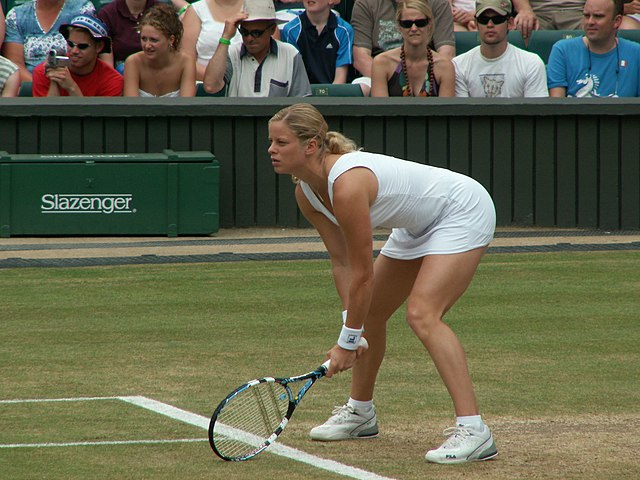
Kim Clijsters at Wimbledon in 2006
Credit: davidgold

In 2022, I’m counting down the 128 best players of the last century. With luck, we’ll get to #1 in December. Enjoy!

* * *

Kim Clijsters [BEL]
Born: 8 June 1983
Career: 1999-2012
Plays: Right-handed (two-handed backhand)
Peak rank: 1 (2003)
Peak Elo rating: 2,403 (1st place, 2004)
Major singles titles: 4
Total singles titles: 41
 

* * *

Pop quiz! I’m sure you remember that at the 2009 US Open, when Serena Williams foot-faulted, threatened a line judge, and lost her semi-final on a point penalty, the woman on the other side of the net was Kim Clijsters. Now the question: Was that the second set or the third set?

Had you asked me when the match wasn’t fresh in memory, and I might have gotten it wrong. I suspect some of you would too. It was a tense battle, and the famous call came at a particularly nervy moment. The climactic set was indeed close–Serena was serving to stay in it at 5-6 when everything went sideways–but it was the second set. We’ll never know what would have happened if Williams hadn’t foot-faulted, if the infraction hadn’t been called, or if she had kept her calm. Regardless, Clijsters had comprehensively outplayed her up to that point.

The Belgian was taking part in just her third event in two and a half years, and she had her daughter Jade in tow. Venus Williams gave her trouble in the fourth round–that match went three, by the unlikely score of 6-0, 0-6, 6-4–but Venus’s sister did not. Clijsters won 55% of the total points she played against Serena, including more than 45% of those on Serena’s own serve.

The unranked underdog used her trademark blend of defense and offense to frustrate Williams. Before the semi-final, their head-to-head record tilted heavily toward the American, 7-1, but Clijsters had usually managed to keep things competitive. Her sole win came on a huge stage, in the final of the 2002 Tour Championships. Four of their other matches went to three sets, including the 2003 Australian Open semi-final, when the Belgian couldn’t convert a 5-1 lead in the third set.

Clijsters was clearly not overawed by the powerful American. While Serena accumulated her usual share of aces and forehand winners, Kim directed the majority of her groundstrokes to the Williams backhand. Serena couldn’t hit through the challenger on that wing, striking 123 backhands and managing just one winner. Two backhand unforced errors set the stage for the foot fault and point penalty that ended the match.

“I was the one dominating the points,” said Clijsters.

Final score: 6-4, 7-5. The aftermath of Serena’s explosion monopolized the headlines, so the Belgian ended up as a footnote to her own triumph. But Kim got the last laugh, even earning a few headlines of her own. She straight-setted Caroline Wozniacki in the final to cap one of the most unlikely, remarkable comeback stories in the sport’s history.

* * *

Another trivia question. Apart from Clijsters herself, there have been 27 number ones in the history of the WTA ranking system. She faced 19 of them, from Steffi Graf and Monica Seles to Simona Halep and Garbiñe Muguruza. Setting aside the five that she faced only once, how many of the remaining 14 number ones finished their careers with a winning record against her?

You know the answer isn’t zero, because I already told you that Serena dominated their head-to-head. But there are no others. Jennifer Capriati split six meetings. No one else–not Venus, not Maria Sharapova, not Lindsay Davenport, not Victoria Azarenka–even forced a draw.

Embed from Getty Images

Clijsters and Henin after the 2010 Brisbane final, which Kim won in a third-set tiebreak

Most notably, Clijsters faced off with her countrywoman, Justine Henin, 23 times at tour level. Kim won 13. It’s something of a hollow triumph, since Henin won more than half of their finals, including all three of their clashes with major championships on the line. Still, Clijsters beat her rival on every surface, in a French Open semifinal, at home in Antwerp; point is, no one owned the Belgian on court. No one, not even Serena, could get too comfortable.

One more bit of trivia: Who are the only three women in the 2000s to reach the semi-finals in at least half of their grand slam appearances?

I can’t let things get too easy–Kim didn’t quite crack this list. The three are Serena, Capriati, and Henin. All of them just barely reached the 50% threshold. Clijsters comes in fourth. Here is the top ten:

Player             2000s Slams  SFs  SF%  
Serena Williams             74   39  53%  
Jennifer Capriati           19   10  53%  
Justine Henin               33   17  52%  
Kim Clijsters               34   16  47%  
Lindsay Davenport           25   11  44%  
Martina Hingis              17    7  41%  
Maria Sharapova             58   20  34%  
Iga Świątek                 15    4  27%  
Venus Williams              80   20  25%  
Elena Dementieva            43    9  21%

Fifty-fifty was the name of Kim’s game at majors. She made the final four about half the time she entered. (In her career, it’s 16 semis in 36 tournaments, since she played two more in 1999.) Out of 16 semi-finals, she reached eight finals. In eight finals, she came out on top four times.

* * *

It’s important to remember the gritty details of the Clijsters résumé, because the Belgian herself isn’t going to advertise them. She’s so thoroughly adored around the game–and has been, more or less since the moment she appeared on the circuit–that you’re more likely to hear about her eight WTA Sportsmanship Awards than her positive records against more ruthless competitors.

More outwardly ruthless, I should say.

Kim has never objected to the misplaced focus on her personality. “I’d rather be known as a nice player,” she said in 2003, “someone who’s good for the sport.” Mission accomplished: No recent star has a sweeter reputation, and Sharapova owns a friggin’ candy company.

The Belgian’s kindness stood out on a tour that had become known for selfishness and catty backbiting. With characters like Martina Hingis setting the standard, Clijsters might as well have applied for sainthood.

Embed from Getty Images

Clijsters stretches for a forehand at Indian Wells in 2002. Her mother was a gymnast, and few players could match her flexibility.

Problem was, those standoffish, overprivileged brats piled up an awful lot of titles. Kim first attained the number one ranking in August 2003, eight months after her collapse against Serena at the Australian Open. She was the first player to reach the top spot without holding any of the four major titles. The stories wrote themselves. Nice gals didn’t finish last, but they didn’t have what it took to be champions, either.

Most “nice” players are indeed destined to fall short. Clijsters, however, didn’t fit the mold. She was kind, she kept the game in perspective, she put family first. Yet when injuries put her determination to the test, she responded like the single-minded champion she’d soon prove herself to be.

* * *

Clijsters opened 2004 as a 20-year-old former number one, having lost her position on the ranking table to Henin. An ankle injury at the Hopman Cup derailed her Australian Open prep, though it didn’t slow her down much. She reached the Melbourne finals with six straight-set wins before losing to her countrywoman in the final. She bounced back with titles in Paris and Antwerp the following month.

Then the real injury struck. She tore a left wrist tendon and was forced to withdraw from Indian Wells. The wrist required surgery, and she missed almost a full year of tournament play.

Clijsters had to adjust her backhand to accommodate the wrist, but the new stroke was just as powerful as the old one. She rejoined the tour in February 2005 and quickly served a reminder that her kindness did not apply inside the white lines.

At just her second tournament back, Kim won Indian Wells. She dropped only two sets en route, beating Elena Dementieva and Davenport for the title. Next up was Miami, where she completed the Sunshine Double. This time she didn’t lose any sets at all. In the last four matches there, she beat four of the top six players on the WTA computer, administering a 6-1, 6-0 punishment of Amélie Mauresmo and defeating Sharapova in the final.

The 2005 Indian Wells final

She was still nice, but Jon Wertheim, for one, thought she had “developed an edge” in her time off. “You realize that one injury can end your career tomorrow, so you should just enjoy playing,” Clijsters told the press in Miami. “But you also realize that tennis is important to you, so you want to do everything possible to win.”

The Belgian was–dare I say it–ruthless the rest of the way. She lost early at Roland Garros and Wimbledon to Davenport. Elsewhere, she was well-nigh unbeatable. She entered the US Open on a ten-match win streak and her confidence level was correspondingly high. To the doubters, she said, “I know I haven’t won a Grand Slam. But, you know, I’ve won a lot of other things.”

Two weeks later, that monkey was off her back. Clijsters recovered from a set and a break down to Venus Williams in the quarters, and she held off a spirited comeback from Sharapova in the semis. A no-nonsense, 6-3, 6-1 victory over Mary Pierce in the final secured the US Open title.

* * *

Clijsters had an uncanny ability to focus on court while limiting her tennis career to a compartment of her broader plans. Only a few months into her comeback, before winning the US Open, she announced her plan to retire after the 2007 season.

She didn’t even make it that long. More injuries piled up at the start of the 2006 campaign, and a hip injury limited her to only five tournaments in 2007. Despite reaching four major semi-finals in her last four tries, she kept her word. She got out, got married, and got pregnant.

Clijsters’s record up to that point was built to be underrated. Yes, she had her major, but she had lost more finals than she won, and the title match against Pierce was hardly replay fodder for ESPN. When S.L. Price summed up the 2009 US Open for Sports Illustrated, he sketched Kim’s pre-tournament reputation: “a sweet, fragile talent who’d won one Grand Slam title (after losing three finals).”

The 2009 US Open final

You can see why she was tempted to come back. She didn’t have anything to prove, but it wouldn’t hurt to make sure.

When Clijsters returned to the tour in 2009, Sybille Bammer was the only mother in the top 100. A handful of women had tried to come back and balance pro tennis with motherhood, but most of their attempts fizzled out quickly. No woman had won a major after giving birth since Evonne Goolagong, back in 1980.

It took the Belgian only one shot, at the 2009 US Open, to add her name to that list. A year later, she’d do Goolagong one better and defend her title. Four months after that, she’d win the Australian Open as well. Fans would always think of Kim as the nice one, and now she was a standard bearer for mothers in elite sports.

Beyond the feel-good story, it was impossible–finally–to ignore what Clijsters did on court on its own terms. Roger Federer described Serena’s foot fault as one example of “[h]ow crazy tennis goes sometimes.” Still, he hastened to add, “I don’t think it should take away from what Kim has achieved. That’s the story here.”