March 29, 1973: The Coming Russians

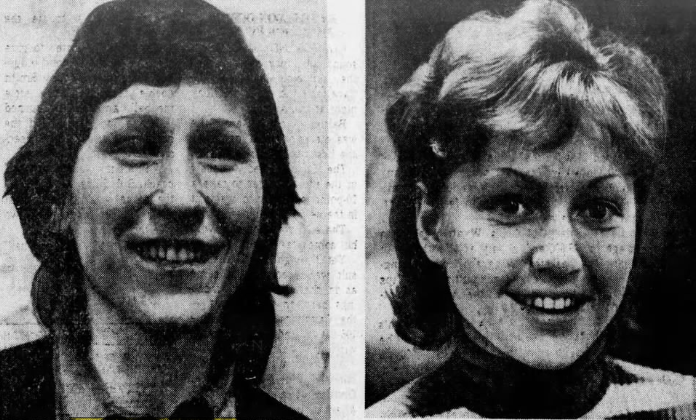
Olga Morozova (left) and Marina Kroschina

Nine countries were represented in the 16-player field of the Lady Gotham Classic, but only one of those nations made news for its inclusion. Everyone wanted to get a look at 24-year-old Olga Morozova, the first-ever top-tenner from the Soviet Union. The New York draw was particularly tantalizing: Morozova would open against her 19-year-old traveling companion Marina Kroschina. Kroschina qualified for the event by beating the previous week’s surprise star, Marita Redondo.

It was hardly the first meeting between the two women. Morozova and Kroschina had already played seven times, including once just a few days earlier, for a place in the Akron final. (Morozova won, then fell victim to Chris Evert.) They had even faced off before in the New York metro area. Both women had made the trip to the 1972 US Open, and they met in the final of a small warm-up event in New Jersey. The older woman won that one, 6-2, 6-7, 7-5, and she led the overall series, six matches to one.

Neither that matchup nor the Soviet trip to Forest Hills satisfied American interest in the visitors. Morozova was good for a feature story at every stop on the USLTA circuit. In Akron, she told a reporter that she missed her engineering-student husband back in Moscow, she liked Boston, she didn’t care for New York, she wished she had more time to see the sights of Akron, and she loved Coca-Cola. “It is the real thing,” she said.

Nor was the larger stage of New York City too big for her. Just a few days earlier, gold-medal-winning gymnast Olga Korbut had wowed the gallery at Madison Square Garden. With a temporary tennis court installed, she would compete at the same venue. Alas, there was nothing Korbut-like about her performance on the day.

Perhaps Olga’s homesickness explained her let-down on March 29th at the Lady Gotham. Kroschina, the 1971 Wimbledon girls’ champion, took advantage of the slow, high-bouncing surface at the Garden to negate her friend’s serve-and-volley game, winning 6-4, 4-6, 6-4.

Embed from Getty Images

Morozova on a happier day, at Wimbledon in 1974

Both women were disappointed that the draw had paired them up so early. A tournament official told the New York Times that it was an “oversight.” More likely–I hope–it was just bad luck. Morozova was the third seed, Kroschina was a qualifier; there was a one-in-twelve chance that a random draw would generate an all-Soviet first-rounder. At least they couldn’t complain about lost prize money. Every penny they earned went back to their federation.

Kroschina never lived up to her promise. When she wasn’t traveling for tennis, she went to school to become a sportswriter, and she ultimately spent more of her life as a journalist than she did as a competitive athlete. Morozova, on the other hand, showed the way for later generations of Russian tennis standouts. She reached the final at both Roland Garros and Wimbledon in 1974, and partnering Evert in Paris, she won the Soviet Union’s first grand slam title.

Olga was optimistic about US-Soviet relations: “I think in the future our two countries will become very good friends. I hope.” The USSR didn’t last long enough to realize her forecast. But her goals for Russian tennis were overwhelmingly satisfied. A half-century later, all-Russian first-round meetings are no longer news. Morozova’s countrywomen are so numerous on tour that it wouldn’t even occur to them to complain.

* * *

This post is part of my series about the 1973 season, Battles, Boycotts, and Breakouts. Keep up with the project by checking the TennisAbstract.com front page, which shows an up-to-date Table of Contents after I post each installment.

You can also subscribe to the blog to receive each new post by email:


Battles, Boycotts, and Breakouts: 1973 Redux

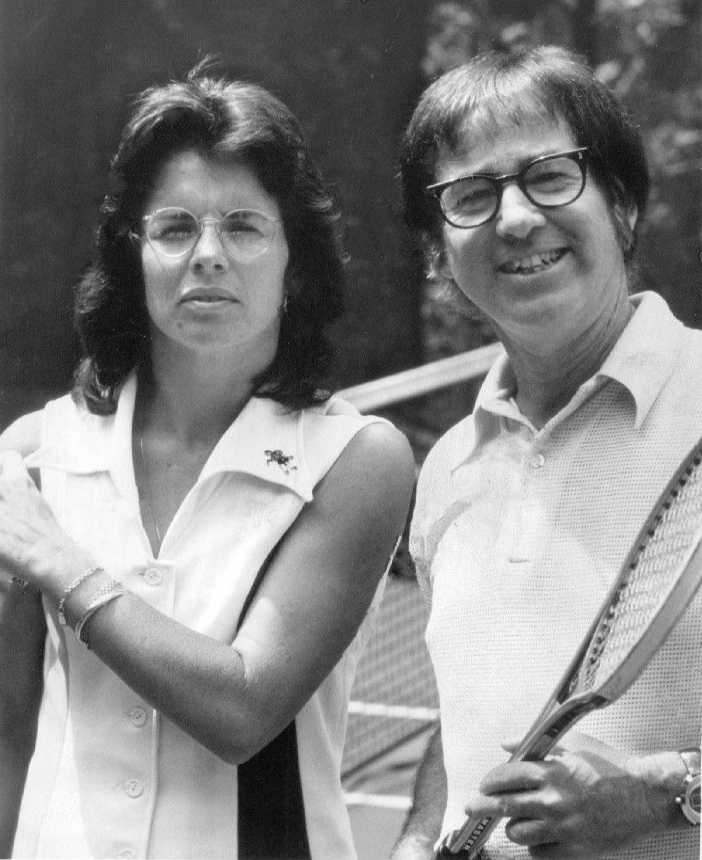
Billie Jean King and Bobby Riggs

Few seasons in tennis have been as pivotal, with effects as far-reaching, as 1973.

You already know about the Battle of the Sexes. Billie Jean King transcended the circus staged by her opponent and the media to make a resounding statement for her gender, avenge Margaret Court, and–never forget–play some great tennis. No single match has ever been so central to the culture as a whole.

The same season saw the structure of the modern professional game start to fall into place. We tend to think of the sport’s history fitting neatly into two buckets: before and after 1968. Yet the first several years of the Open era were anything but neat. Competing tours bid for players, once-powerful national federations threatened to exclude stars from majors, and the Davis Cup–until recently the absolute pinnacle of the sport–was a shell of its former self as contract pros were forbidden to take part.

Things got so contentious that a joke arose around this time: You couldn’t put on a tennis tournament without someone filing a lawsuit.

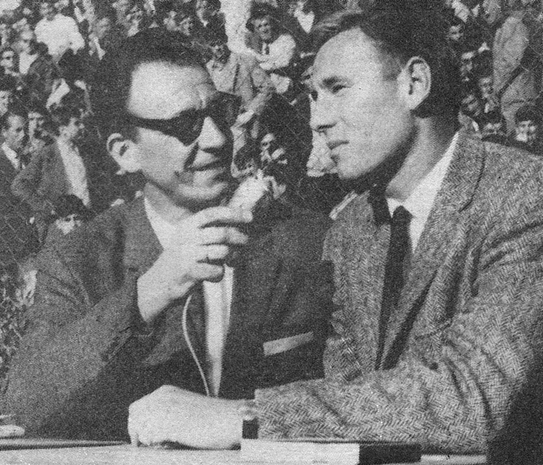
Many of the issues converged at Wimbledon in 1973. The International Lawn Tennis Federation banned Yugoslavian Niki Pilić from the tournament for allegedly refusing to play a Davis Cup tie. The nascent Association of Tennis Professionals went to bat for Pilić and threatened to boycott the Championships. Wimbledon never took the challenge seriously and didn’t negotiate in good faith. In the end, more than 80 players–including defending champion Stan Smith and most of the best men in the world–sat out the prestigious event.

Pilić (right) with journalist Mladen Delić

The situation was back to normal at Forest Hills a couple months later for the US Open–but what was normal? The ATP had a seat at the table, and players–men and women alike–had more power with every month that passed. The 1973 US Open was the first major with equal prize money, a milestone that–had the Battle of the Sexes not eclipsed it a month later–would stand as one of the most significant achievements of Billie Jean King’s career.

For all the off-court distractions, the level of tennis in 1973 was a connoisseur’s dream. Veteran Aussies Rod Laver and Margaret Court often dominated their respective tours, Court doing so with a child in tow. King, when she was healthy, was as good as ever. Smith played some of the best tennis of his career. At the same time, a new generation nipped at their heels. Lovebirds Chris Evert and Jimmy Connors cleaned up on the lower-status USLTA circuits. Björn Borg, Martina Navratilova, and Guillermo Vilas made their initial statements on tour as well, signs that the future of tennis would be a whole lot more global than its past.

* * *

2023 marks the 50th anniversary of that memorable season. This year, I’ll write a series of short essays about 1973, each one marking a notable event from that day. I started with March 22, when Evert and Navratilova faced off for the very first time.

We’ll cover the battles, the boycotts, and the breakouts, as well as any other random thing that catches my eye. You can expect a couple of these vignettes every week until December, when the first-ever truly open Davis Cup reached its conclusion.

There were winners and losers in 1973, as there always are. Thanks in large part to the revolutions that came to a head that year, the losers got a better deal than ever before. Bobby Riggs often lamented the result of his match against Billie Jean. “But, hey, a happy ending,” said the inveterate hustler. “I cried all the way to the bank.”

* * *

Keep up with this project by checking the TennisAbstract.com front page, which will show an up-to-date Table of Contents after I post each installment.

You can also subscribe to the blog to receive each new post by email:
 

March 27, 1973: The Ilie and Jimbo Show

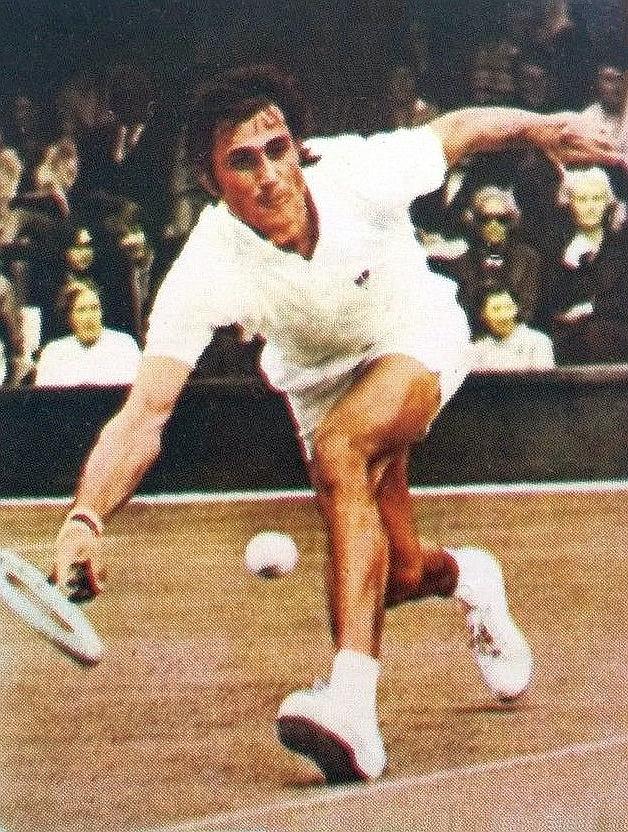
Ilie Năstase in 1973

On March 25, Ilie Năstase and Jimmy Connors faced off for the Equity Funding International title at Georgetown University. It was their third official meeting of the season. Counting exhibition matches, though, the number might have already reached double digits.

Duties discharged on the USLTA indoor circuit with the completion of the Georgetown event, Connors and Năstase made their way to Springfield, Massachusetts, where they played the first-ever tennis at the local Civic Center. The exhibition was set up as a mini-tournament. Connors won a pro set against veteran standout Clark Graebner, and Nastase defeated the 18-year-old amateur Vitas Gerulaitis.

The evening of March 27 concluded with a “final”–a standard set between Jimbo and the flashy Romanian for the title. They split twelve games and equally shared the first eight points of the tiebreak. Playing according to James Van Alen’s preferred “sudden death” rules, Connors double-faulted at 4-4 and handed Nastase the match.

The result didn’t really matter, just as it hadn’t mattered a week before in Whitefish Bay, Wisconsin, and it hadn’t mattered in Dallas a week before that. The Jimmy-Ilie exhibitions were always suspiciously close–8-6 in the third, 9-8 or 7-6 in a one-setter. The pair was in such demand not because of their rivalry, but because they always put on a show. They were reliably entertaining even when the stakes were higher. Early in the Georgetown final, Năstase missed a shot. Connors hollered, “Even a guy as great as you can’t make it all the time.” Ilie retorted, “If you stay around a while, I’ll teach you something.” The Romanian ultimately won the match in five.

Columnist Gerry Finn wrote of Năstase, “At one moment he’s a charmer, the next he’s a cad.” He was the biggest box-office draw in the game. Graebner said simply, “Tennis needs more Ilie Năstases.” Jimbo was studying hard for the role.

The USLTA indoor circuit was sometimes derided as a “Mickey Mouse” tour, as most of the game’s stars–Rod Laver, Stan Smith, Arthur Ashe, and others–played for the rival World Championship Tennis group. But the USLTA slate had its own perks. Players weren’t required to show up every week–an important provision for men who liked to pad their bank accounts with extracurricular activities as often as Connors and Năstase did. USLTA events were a bit more fun, too, largely because Ilie set the tone.

What appealed most to Connors was the level of play. He and his Romanian buddy could breeze through the early rounds every week. Jimmy racked up seven titles and over $36,000 in prize money in just three months. “I thought it’d be better for me to ease into it and get a little confidence,” said the 20-year-old rising star. “It’s worked out real well for me.”

Coached by Pancho Segura and urged on by Richard González, Jimbo would soon raise his sights. Once, in those early years, he told González that you can’t win them all. Gorgo’s response said all you needed to know about the veteran warrior–not to mention the man that Connors would become.

“Why not?”

* * *

This is the fourth installment in what I fear will be an ongoing series about 1973, perhaps the most consequential season in modern tennis history. Check back throughout the year for the latest news from, uh, fifty years ago.

March 25, 1973: Stan Smith Surges

Stan Smith at the 1973 Peachtree Corners Invitational Tennis Classic

By 1973, Stan Smith didn’t have much left to prove. He won the 1971 US Open, then took the Wimbledon crown in 1972. For five years running, he had been a key part of the USA’s champion Davis Cup team, staring down the hostile Romanians in Bucharest to cap his 1972 campaign.

But there was one thing Smith’s feats had in common: Rod Laver hadn’t been there. The Rocket skipped the 1971 US Open, and he was kept out of Wimbledon the following year when the Championships banned contract professionals. Contract pros were also excluded from Davis Cup, so the Australian team couldn’t use Laver, Ken Rosewall, John Newcombe, or Tony Roche–a foursome that would’ve made the Aussies overwhelming favorites under different rules.

In 1973, Smith himself was a 26-year-old contract pro, playing for the World Championship Tennis circuit alongside Rod. Davis Cup would finally be open to everyone, as well. Before the season began, Laver held a 5-2 advantage in the head-to-head, including wins in all three of their meetings at majors. Rocket padded his total with a victory in the Toronto semi-finals in February, then another for the Hilton Head title in March.

For more than a decade, Laver had been the man to beat. At age 34, he still was.

Both men played well to reach the Atlanta final. Each was pushed to three sets in the quarters but recovered for a dominant semi-final performance. Smith blasted past his frequent nemesis, Cliff Richey, 6-3, 6-2, and Laver, the event’s top seed, turned in one of his strongest showings of the year to shut down Cliff Drysdale, 6-2, 6-1.

Opponents lobbed the 6’4″ Smith at their peril.

The final promised to be a fitting conclusion to exciting week of tennis. The tournament announced a seven-day attendance of 47,524, a record for a WCT event. Among the crowd on Sunday was Georgia Governor Jimmy Carter and his wife. It was a far cry from the old days of barnstorming pros when Laver, Rosewall, and Richard González would stop in Atlanta for a night, lucky if they drew 3,000 fans.

Laver won many of his matches before the first ball was struck. “There’s always the danger of being psyched out by playing Rod,” said Smith after the match. “I mean you think the guy is so good and you don’t know what you have to do to beat him.”

On the other hand, Stan wasn’t the sort of player to be psyched out. Fellow players considered him confident to the point of arrogance. He also had a knack for ignoring anything that might get in his way, a particularly useful skill when he took on the eminently distracting Ilie Năstase for the 1972 Wimbledon and Davis Cup titles.

In the end, the mental game might have been beside the point. Standing six-feet, four-inches tall, Smith owned one of the biggest serves on the circuit. On this day, it was even deadlier than usual. He won 37 of 44 service points. Only once did Laver manage more than one return point in a game. The Rocket didn’t attack as much as usual behind his own serve, and Smith took the match, 6-3, 6-4.

The American was proud but realistic. Holding his $10,000 winner’s check, he said of his opponent, “He’s still the best.”

Rocket wasn’t one to argue. A little while later, he came back out on court with his old friend Roy Emerson and won the doubles.

* * *

This is the third installment in what I fear will be an ongoing series about 1973, perhaps the most consequential season in modern tennis history. Check back throughout the year for the latest news from, uh, fifty years ago.

March 24, 1973: Plimpton Falls Short

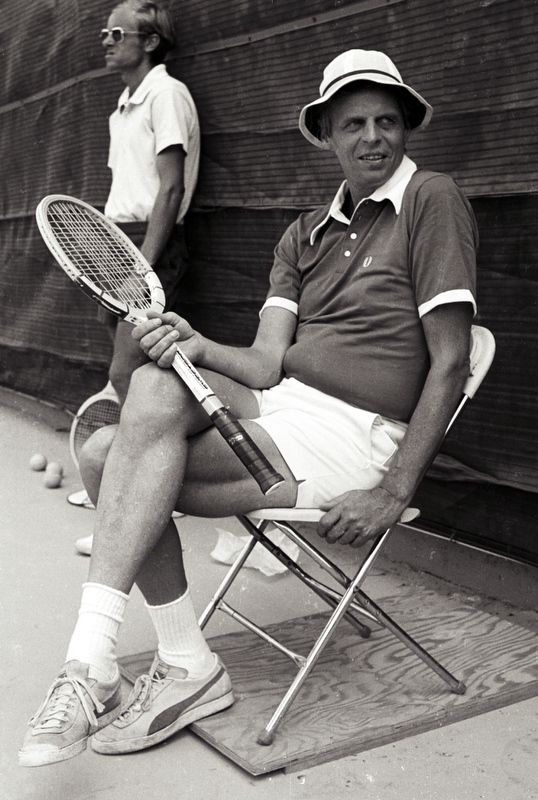
George Plimpton in 1977

We’re lucky that it was a bit of a slow news day for tennis on March 24, 1973. A few newspapers had room for this:

PHILADELPHIA–The local team of James L. Van Alen 2d and Jimmy Dunn won the United States amateur-professional handicap court tennis doubles championship today by defeating George Plimpton and Eddie Noll of New York, 6-5, 6-5, 3-6, 6-4, at the Racquet Club.

Yes, that Jimmy Van Alen. And yes–oh yes!–that George Plimpton.

Van Alen was, depending on your perspective, somewhere between a gadfly and a visionary. He invented the tiebreak and spent more than a decade badgering the rest of the US tennis establishment. Even when his brainchild became standard, he wasn’t satisfied. His ideal was a nine-point breaker: first to five, sudden death. As the first-to-seven, win-by-two variation gained popularity, he got steadily crankier about it.

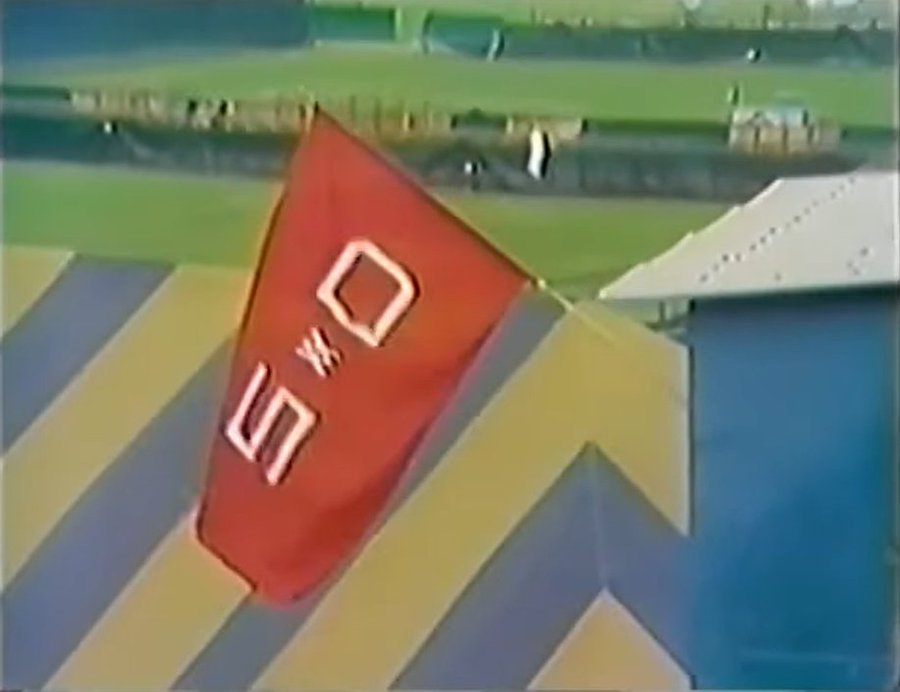
Details aside, the man loved tiebreaks. He proposed that once a set reached 6-all, a special red flag would be flown above the stadium to indicate that a tiebreak was underway. He convinced the officials at the US Open to go for it, and when he attended other events, he brought along a spare flag of his own.

A Van Alen “Sudden Death” flag flying above Forest Hills in 1971

In 1973, Van Alen was 70 years old. He was far past his prime as a lawn tennis player, and he had never been a particularly great one. (He did win a match at the 1931 US National Championships.) His pastime of choice was court tennis, the ancient sport on which lawn tennis was based. Court tennis is a more strategic game that relies less on power. Van Alen won national singles and doubles titles in his niche pursuit.

Van Alen’s prestige gave him another advantage. This was an “amateur-professional” doubles championship–that is, one of each. Van Alen the amateur chose to team up with Jimmy Dunn, the head pro at the Philadelphia host club. It always helps to choose the right partner: It was Dunn’s tenth title at this event.

* * *

Van Alen was not, however, the most interesting man on the court that day. Few characters could compete with George Plimpton in that category.

Plimpton was a journalist and occasional actor. By 1973, he was 46 years old and a minor celebrity. Despite a patrician background that could be traced back to the Mayflower, Plimpton got closer to the action than any sportswriter before him. He pitched to major-league all-stars, traded punches with Sugar Ray Robinson, and manned the net for hockey’s Boston Bruins.

He achieved his fame through dalliances in football and golf, yet when he wasn’t on assignment, tennis was his sport of choice. The writer was known as an excellent lawn tennis player, and he occasionally turned up in pro-am exhibitions. When he got married in 1968, the New York Times went with the standard line for a racket-wielder: “Plimpton Drops Singles for Doubles.” A decade later, he played alongside Vitas Gerulaitis as a headliner at a Rockefeller Center benefit match–on ice.

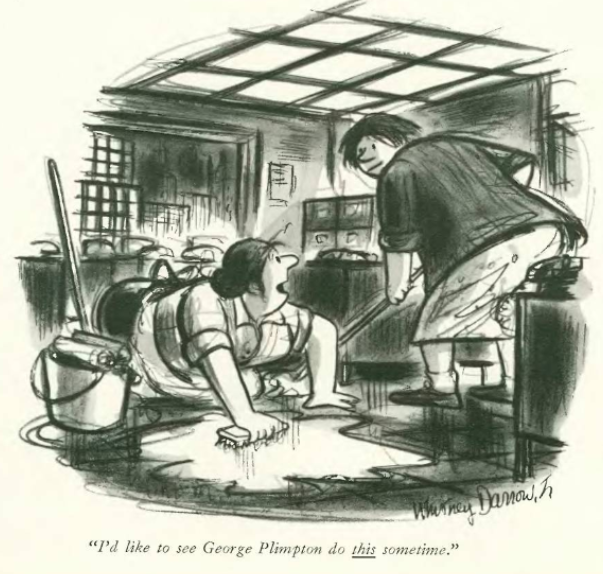
A 1971 New Yorker cartoon

Among his many stunts, he once faced off against Richard González at the Los Angeles Tennis Club. Gorgo wasn’t one to show mercy on an amateur, and the fact Plimpton was a journalist probably didn’t help either. González destroyed him.

Like Van Alen, Plimpton found a home in the small world of court tennis. He had competed at national events since at least 1961. He merged his profession and his passion in 1971 when he edited Pierre’s Book, the instructional guide written by French court tennis great Pierre Etchebaster.

Despite an advantage of more than two decades, Plimpton doesn’t seem to have been Van Alen’s equal at the royal game. In that 1973 championship match, his pro partner, Eddie Noll, had to handle three-quarters of his team’s shots.

Unfortunately for us, Plimpton never wrote much about the sport he pursued so avidly. He covered lawn tennis just once for Sports Illustrated, the publication that backed him on some of his wilder adventures. For that 1967 story, he was drawn to a series of unusual matches at Southampton and Newport–early-round tilts that refused to end, extending to 32-30, 48-46, and 49-47. Naturally, he checked in with the tournament director at the Newport Casino, Jimmy Van Alen.

“That’s nonsense out there,” said the inventor of the tiebreak. “Just nonsense.”

* * *

This is the second installment in what I fear will be an ongoing series about 1973, perhaps the most consequential season in modern tennis history. Check back throughout the year for the latest news from, uh, fifty years ago.

March 22, 1973: Evert-Navratilova I

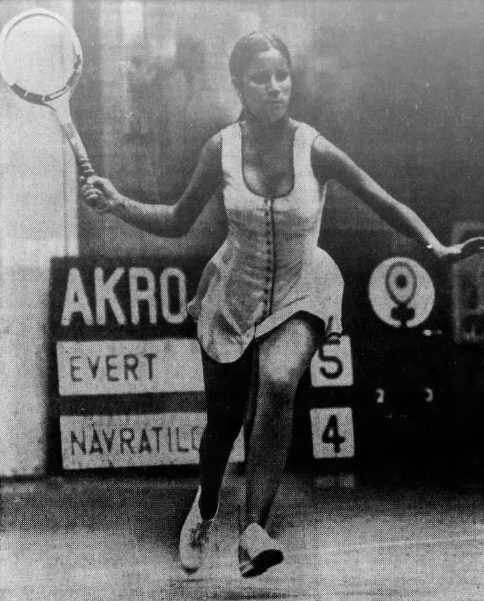
Chris Evert, en route to a first round victory at the 1973 Akron Open

It was a big day for underdogs. The Akron Beacon Journal ran with the headline, “Is Marita Next Superstar?”

Not a typo.

The story of the first round was 17-year-old Californian Marita Redondo, who came through qualifying at the Akron Open to earn a meeting with Evonne Goolagong. Goolagong had reached the final round at four of the previous five majors, and onlookers thought Redondo looked “awed” by the superstar she now faced. The Filipino-American teenager later admitted she was nervous–but she got over it. She beat Goolagong, 6-3, 7-5.

With the benefit of hindsight, the press corps would have focused a bit more on Martina, not Marita. 16-year-old Martina Navratilova was playing just her fourth tournament in the States, and her opening match was her first encounter with Chris Evert. Evert was only two years older, yet she had already reached the final four at both Wimbledon and the US Open.

They pair would go on to play 80 times, three-quarters of them in finals. Akron provided a modest stage for the women to begin what would become one of the greatest rivalries in sporting history.

At least the cameramen were well deployed for the match:

The Beacon Journal suggested that Martina was adding a ballet step to her game.

Navratilova lost, 7-6, 6-3, but it was probably the best she had played thus far as a pro. After Evert seized an early break, Martina got it back, and the Czechoslovakian even came within two points of the first set, serving at 6-5, 30-love. A decade later, on an indoor surface like this one, the match would have been over. But in 1973, Chrissie was as cool under pressure as ever, snatching four points in a row from the Navratilova serve to force a tiebreak, then winning the first-to-five breaker, 5-1.

Keeping Evert close was all that most of her peers on the USLTA circuit could manage. Chrissie had just lost a nail-biter to Virginia Wade two weeks earlier in Dallas, but Akron would kick off a run of five tournament victories in a row before Margaret Court finally stopped her at Roland Garros.

Meanwhile, Marita Redondo would have to settle for a handful of trophies on what was left of the amateur circuit. While she would compete into the early 1980s, the Goolagong upset remained her most prominent victory.

* * *

This is the first installment in what I fear will be an ongoing series about 1973, perhaps the most consequential season in modern tennis history. Check back throughout the year for the latest news from, uh, fifty years ago.

Erasing Love-40 Three Times In a Row

During last week’s marathon fourth-rounder at Indian Wells, Daniil Medvedev tucked an unusual feat inside his 6-7, 7-6, 7-5 defeat of Alexander Zverev. Starting with the 12th game of the first set, he recovered from a 0-40 deficit in three consecutive service games.

Voo de Mar noticed:

Peter asked me if this had ever happened before, so here we are. The short answer is: I’m not sure (at least at ATP tour level), because I don’t have the point-by-point sequence for every match. However, I have the sequence for enough matches to confirm that it’s extremely rare.

Theory first

Just falling behind 0-40 is unusual. ATP-level servers win about 65% of points, so a basic model would predict that 0-40 happens in 4.3% of service games. It’s actually more frequent than that–about 5.4%–partly because the tour does not consist of identical servers, and partly because there’s probably some streakiness involved.

Back to theory: “Erasing” a 0-40 deficit means winning three service points after losing the first three. The odds of that particularly six-point sequence–again, assuming the server wins 65% of points–is 1.2%.

The historical record agrees exactly. Across 18,000 tour-level matches from 2010s, I found that the server falls to 0-40 and recovers to deuce exactly 1.2% of the time.

Three in a row is a different story entirely. If there’s a 1% probability of something occurring once, there’s a 0.0001%–literally, one in a million–chance that it will happen three times in a row. On the other hand, there are a lot of matches and a lot of service games. Using some rough assumptions for the number of games in a match and the number of matches per season, my ballpark estimate is that we should see a rarity like this about once in every 10-12 ATP seasons.

The data

Like I said, I don’t have the point-by-point sequence for every match. But I do have it for over 18,000 ATP matches between 2011 and early 2019. (Much of that data, plus equivalent data for women’s tennis, is here.) In that dataset, there was only one instance when a player apparently erased a 0-40 deficit three times in a row: 2011 Kuala Lumpur, where Mischa Zverev managed it against Philipp Petzschner.

Except… I’m not so sure. In 2011, betting sites were just starting to collect and publish point-by-point data, and some of it was approximate. For this particular match, there is a suspicious number of streaks, a sign that the data wasn’t reported precisely. For instance, in all three of the 0-40 rescues, Zverev purportedly won the next five points in a row. It’s possible, but we have to leave a question mark next to this one.

We can, however, broaden the search. 6,800 ATP qualifying matches? No one managed three 0-40 recoveries in a row. 28,000 Challenger matches? Now we’re talking–I found five occasions when a player saved three consecutive 0-40 deficits. The most recent was at the 2016 Tallahassee Challenger, where Donald Young accomplished it in a losing effort against Frances Tiafoe. He won the first two of the games, but in the third, serving to stay in the match, he fought back to deuce only to double fault on match point.

I found another five cases out of over 33,000 Futures-level matches. The most recent, a 2017 match between Altug Celikbilek and Francesco Vilardo, was notable because Celikbilek recovered from 0-40 in the 6th, 8th, and 10th games–and in the 7th game, Vilardo did as well!

It’s important to keep in mind that servers do not win as many points at the lower levels of men’s tennis. (Streakiness might also generate more 0-40 scores as well.) In my 2011-2019 data, servers fell to love-40 5.4% of the time at the ATP main draw level, 5.8% in ATP qualifying, 6.4% at Challengers, and 7.7% at Futures. However, that doesn’t end up generating many more recoveries, since servers are more likely to lose those games before evening the score.

If we dump all of these results together, we get 10 occasions (or 11, if you count the Petzschner match) when a player recovered from 0-40 three times in a row, out of approximately 86,400 total matches. That rate suggests that we should see a feat like Medvedev’s once every three or four years on tour. That’s more frequent than my initial calculation, but still quite rare.

Aryna Sabalenka at One Hundred Percent

Aryna Sabalenka played her first match at Indian Wells on Friday, handily beating Evgeniya Rodina. Sabalenka won the first set 6-1, then took a 3-0 lead in the second. Commentator Mikey Perera noted that Sabalenka’s win probability had reached 100%, though he (correctly!) expressed skepticism with the number.

Win probability has steadily crept in to tennis broadcasts. Often we’re shown pre-match percentages along with the change up to the current moment in the match. The silliness of a 100% mid-match win probability has a pedestrian explanation: The numbers are usually given as integers. For most fans, there’s no important difference between 55.7% and 58%, but in extreme cases, another significant digit would come in handy.

So, was the broadcast algorithm correct?

My Elo-based pre-match forecast set Sabalenka’s chances at 94.8%. To get mid-match predictions, we need more granular stats. Sabalenka has won 65.5% of serve points and 46.7% of return points this year (including the Rodina match), and if we nudge the RPW up to 47%, those components predict a 94.7% chance of a Sabalenka victory–virtually equivalent to the Elo forecast.

Plug those numbers into my win probability model with Rodina serving at 1-6, 0-3, and Sabalenka’s chances of victory are 99.7%. Round to the nearest integer, and sure enough, you get a 100% chance of victory. It might have felt that way for Rodina.

In fact, Sabalenka crossed the “100%” (99.5%) threshold in the previous game. She cleared 99.5% at 2-0, 15-0, slipped back under the line when she fell to deuce, then reclaimed it each of the two times she gained ad-in.

So far, I’ve used a relatively simple model to forecast the remainder of the match. (And it’s certainly sufficient for these purposes.) But if we were putting money on the outcome–especially if the first ten games of the match had gone in a less predictable direction–we’d want to do something more sophisticated. I’ve assumed that from 6-1, 3-0, Sabalenka would play the way we could have predicted before the match. In this case, that’s a sound assumption. But a better method would take into account the results of the match itself up to that point.

Through ten games, Sabalenka was playing better than the initial forecast of 66.5% on serve and 47% on return. Her success rate on serve was a bit worse, at 64.4%, but she was destroying any service advantage of Rodina’s, winning nearly 55% of those points. Had we known before the match that she would play that way, our pre-match forecast would have given Sabalenka a whopping 99.4% chance of victory.

Using that pre-match forecast, our prediction at 6-1, 3-0 would have been an overwhelming 99.97% for the favorite.

As the match progressed, then, we gained more and more information that the in-match performance–whether due to the conditions, the players’ fitness or mood on the day, the matchup, or any number of other factors–would be even more lopsided. Had we taken everything into account at 6-1, 3-0, we would have calculated some mix of 99.7% (based on pre-match numbers) and 99.97% (based on in-match performance). The degree to which we should weight each of those numbers is the tough part. Determining the correct weights is a complicated questions; suffice it to say that the correct answer is somewhere in between the two.

The broadcast algorithm jumped the gun with its 100% win probability, though only a bit. No matter how lopsided a match, anything can happen–but it probably won’t.

Podcast Episode 116: Tennis 128 Wrap-Up

This year, I ranked the top 128 players of the last 100 years. I wrote long-form essays about each one, which I’ve published over the last eleven months. You can see the introduction to the project here, jump into the middle with Helen Jacobs, or skip to the end and read about the greatest player of all time, Rod Laver.

Carl Bialik joined me for a podcast episode to mark the end of the project. We solicited questions, and many of you came through–we ended up with a list of over 200 questions! Spoiler alert: Even after three hours, we didn’t get through them all. I may write something in the next couple of weeks touching on some of the questions we didn’t have time for.

We talk about the algorithm, players with controversial rankings (or no rankings at all), reactions to the project, and much, much more. The full list of questions, with time stamps, is below. Surely, though, you’ll want to listen to the whole thing. Thanks to Carl for hosting and organizing the episode, and to all of those who made suggestions.

Thanks for listening!

(Note: this episode is about 2 hours, 54 minutes minutes long; in some browsers the audio player may display a different length. Sorry about that!)

Click to listen, subscribe on iTunes, or use the feed to get updates on your favorite podcast software.

Music: Everyone Has Gone Home by texasradiofish (c) copyright 2020. Licensed under a Creative Commons Attribution Noncommercial (3.0) license. Ft: spinningmerkaba

This image has an empty alt attribute; its file name is tap_script_square-1-150x150.png

The algorithm

  • What is and isn’t your ranking system, concisely? (00:04:30)
  • Why did you settle on the three main components? (00:08:10)
  • Is the 128 your answer to the GOAT debate? (00:12:30)
  • Are there ways you’d consider improving the algorithm? (00:14:20)
  • Do Suzanne Lenglen and Bill Tilden have a disadvantage in the algorithm (compared to modern players) because there weren’t a lot of established players with “deep” Elo rankings for them to beat? (00:15:35)
  • Did you change any rankings based on what you found after you started to research players? (00:20:30)
  • You mentioned that a few players got a slight bump thanks to off-court contributions/legacy. Which players (other than Ora Washington), and how much? (00:22:45)
  • How soon will the pre-Open era men’s Elo ratings become public on the website? (And other info including all data for selecting/ranking 128) (00:25:40)
  • Do you feel different about your methodology after researching all 128 players than at the start? (00:28:25)
  •  Is it a weakness of the algorithm that the importance of the tournament and round doesn’t make a difference to the impact of a match on Elo? (00:31:40)
  • Why put men and women on the same list? (00:35:15)

Second-guessing

  • Who is the most underrated player in tennis history? (00:39:00)
  • Who is the most overrated player in tennis history? (00:41:50)
  • What do people most often get wrong when trying to rank the GOATs? (00:43:10)
  • What player ranking (either in absolute terms or relative to another player) do you disagree with the most? (00:47:40)
  • Who didn’t make the cut who most surprised you? (00:51:15)

Hypotheticals

  • From the 128 algorithm is there any indication how the level among the (1926-68) pro men’s players compared to the amateur players of the time? (00:53:40)
  • Do you think the men’s pro game served to delay the start of the open era? Or is it possible that without the pro game, tennis might never have gone open, and become like so many Olympic sports that have no money – such as skating or many track and field events? (00:57:55)
  • With the return of career length to pre-1970 levels, is it fair to say that the inability of the top players in the 1980s and ’90s to stay at the top was due to rapid changes in equipment technology? (that have since slowed down) (01:00:35)
  • Modern players have both better equipment and better coaching/training/analytics than past players did. Which do you think gives modern players a greater advantage over their past peers, equipment or coaching/training/analytics? (01:03:35)

Laver and Graf

  • What happened to Laver at Slams after 1969? (01:05:05)
  • Realistically how possible is it for Djokovic to catch up to Laver? Working on the assumption he won’t be improving on his peak metrics at this stage of his career, how many 2019-2022 type seasons does he need to put up to close the gap? (01:07:20)
  • If Monica Seles had not been stabbed, do you think Graf would still have been the top woman in the 128? (01:09:00)
  • What do you think would happen if Graf were to play Helen Wills or Suzanne Lenglen? (01:11:15)

Rankings of note (or not)

  • Michael Stich (01:13:25)
  • David Ferrer (01:15:30)
  • Pam Shriver (01:16:20)
  • Gabriela Sabatini (01:18:00)
  • Marat Safin (and Kuerten and Kafelnikov) (01:20:00)
  • Adriano Panatta (01:22:25)
  • Amanda Coetzer (01:24:00)
  • Barbara Schett (01:25:45)
  • Carlos Alcaraz (01:25:00)
  • Dominic Thiem (01:28:05)
  • Angelique Kerber (01:28:50)
  • Iga Swiatek (01:29:10)
  • Doubles specialists (01:30:25)
  • Wheelchair players (01:31:25)
  • If Ora Washington merited a spot, are there pre-integration Black men players who belong on the list as well? (01:32:35)

Essays and research

  • Which player do you think overcame the most to get to the top? (01:34:35)
  • Which match do you most wish you had attended? (01:37:35)
  • Why are there so few LGBT men in the 128? And why are the ones we know about (Tilden, von Cramm) from so long ago? (01:38:55)
  • What was your least favorite newspaper or writer or other source? (01:41:50)
  • There are only six black athletes in the 128 and another seven or so who might be identified as people of color by some standard. Does tennis have a racism problem? Is it improving? (01:44:30)
  • Why do you hate Justine Henin so much? (01:47:10)
  • Who is your favorite pre-WW1 women’s player and why? (01:51:30)
  • Which tennis era did you most enjoy researching and writing about? (01:53:45)
  • What player would you most have liked to write an essay about, but didn’t get the chance to because they didn’t make the list? (01:57:55)

Reactions

  • Do you receive a lot of criticism when fans think you’ve placed their favorite player too low? (02:00:35)
  • Which player’s placement generated the most controversy? (02:03:05)
  • Have you gotten any reactions from players themselves? (02:04:35)
  • What has been the oddest reaction to a post? (02:05:30)
  • How many people do you think have read every word? (02:06:30)
  • Have you heard from Joe Posnanski about the project? (02:08:35)

Jeff, post-128

  • Has the 128 scratched an itch and can you now stop thinking about the best of all times as much? (02:09:20)
  • What are your goals for the tennisabstract.com website? (02:12:55)
  • What advice would you give yourself in January, looking back? (02:14:40)
  • Do you foresee re-running the 128 calculation ever again? More than once? (02:20:45)
  • What number do you wish you’d done? (02:22:15)
  • How much will you miss doing the 128? (02:25:25)
  • How proud are you of the result? (02:26:50)
  • Will you publish the results and essays in a book? (02:33:25)
  • Who would you like to thank for support in this journey? (02:35:30)
  • What will you do next? (02:41:25)

The Tennis 128: No. 1, Rod Laver

Rod Laver in 1962

In 2022, I counted down the 128 best players of the last century. Past tense is my favorite tense.

* * *

Rod Laver [AUS]
Born: 9 August 1938
Career: 1956-79
Plays: Left-handed (one-handed backhand)
Peak rank: 1 (1961)
Peak Elo rating: 2,571 (1st place, 1970)
Major singles titles: 11 (8 pro majors)
Total singles titles: 200
 

* * *

Rod Laver was a superhero. A diminutive superhero with an alter ego to match.

At five-feet, eight-inches tall, the only outward sign of his athletic prowess was an oversized left arm–“the forearm of a Dungeness crab,” according to John McPhee. He certainly wasn’t going to tell you about all the titles he’d won. He never lost the backcountry humility instilled by his family of Queensland ranchers.

When Laver wasn’t competing, he embraced distractions–the more tedious, the better. The night before a match, he’d find a western on television and re-grip a pile of rackets. He cooked his own food and ran his own errands–anything to keep busy.

Friends knew when a match was approaching. That’s when he got quiet. The bloke who appeared on court wasn’t quite the same.

“The Rocket goes into a phone booth to change,” said American player Marty Riessen.

In tennis whites–or pinks, or blues, once apparel sponsors started throwing money around in the 1970s–Laver summoned all the focus he had squirreled away before he took the court. Spectators couldn’t help but notice his eyes. Other players would acknowledge fans in the gallery, give a quick smile after a good shot. Not Rod.

One onlooker caught Rocket’s eye during the 1969 US Open final. “Nothing,” he said. “Instant shutout. Two steel beads looking out of an icebox.”

When it was over, Laver would snap back just as quickly. Always a kind word at the net, always a cordial response to well-wishers. In proper Australian fashion, he was the kind of guy with whom you could play a few sets in the afternoon, then share a few beers in the evening.

But not too many. Rocket probably had another match tomorrow. He’d rather be back at the hotel, watching a western.

* * *

There were a lot of matches, a lot of hotels, a lot of westerns. Laver played competitive tennis for more than two decades, coming of age in the years of Harry Hopman’s Australian tennis dynasty and leaving the scene when the likes of Jimmy Connors and Björn Borg had turned the game into a global media spectacle.

In fact, Rod had three careers. He won an amateur Grand Slam in 1962, then turned pro. He became the top professional in the years before Open tennis arrived. Then, with amateurs and pros reunited, he won another Grand Slam in 1969.

Embed from Getty Images

Laver chats with Queen Elizabeth II after winning the 1962 Wimbledon title

Alone, any one of those three careers–1956 to ’62, 1963 to ’67, and 1968 to ’79–would merit a place in the Tennis 128.

Laver’s Slams were a big deal when he accomplished them, but the hoopla, even in 1969, was nothing compared to what the media whips up these days when a player so much as comes close. When Rocket won the 1969 US Open, Sports Illustrated–often a home for lengthy feature stories on tennis stars–relegated a tournament recap to a single page.

The cover went to college football: “Ohio State Still No. 1.”

Players of his era didn’t zero in on majors the way that we do now. To them, the limitations of the slam tally were particularly obvious. Most of the greatest-of-all-time candidates–Laver, Richard González, Ken Rosewall, Jack Kramer, even Don Budge–lost years of opportunities when they went pro. González had a good case as the game’s best ever, and he had a measly two slam titles to his name.

Rocket’s eleven majors, then, are a bit beside the point. When you chop five and a half years out of the middle of a career, it can lose some luster. With the same span removed, Novak Djokovic falls from 21 majors to 13. Rafael Nadal drops from 22 to 17. Roger Federer bids adieu to a full half of his 20.

Throughout those “missing” years, all Laver did was face a tough opponent almost every day. Barnstorming across Australia, Europe, and North America, he played over 100 matches each season, a staggering number of them against Rosewall, dozens more against González. Rod was the best pro for three, possibly four years. No one in the amateur ranks was close.

It’s a bewildering thought: At his peak, the man with the two Grand Slams didn’t play any slams at all.

* * *

But really, everything about Rocket Rod Laver defies logic.

First off, the “Rocket” tag started off as a joke. Harry Hopman liked to hand out motivational nicknames. Rosewall was “Muscles” because he was so puny. Laver was slow, so he became “Rocket.”*

* A few sources say Rod was called “Rocket” after his hometown of Rockhampton. Plausible, but boring. I say we ignore it.

Let’s review. The young Laver was short, slow, and left-handed. Playing lefty wasn’t universally considered a handicap, but at the time, it was unusual. Both Rosewall and Margaret Court were naturally left-handed, and early coaches forced both to hit their serves and forehands on the right side. Rocket’s first coach, Charlie Hollis, was a particularly useful guide for a guy who just happened to be in the neighborhood, but his greatest contribution might have been simply to let Rod hit with his dominant hand.

Early forecasts were not rosy. Rod’s father Roy thought his older son, Trevor, had a nicer game and a better chance to play competitively. “Rodney was the freak of the family,” Roy said, “the only left-hander.”

Fortunately for Rodney–not to mention generations of fans–Harry Hopman was always on the lookout for a certain kind of young man. Above a certain baseline level of skill and potential, he wanted to see a calm disposition, a fierce competitive streak, and an enormous capacity for training. Measured by that scale, Laver was the greatest prospect of all time. Other teens griped about the Hopman workload; Laver ate it up.

Embed from Getty Images

The hat of a champion, at the 1962 Australian

While Muscles Rosewall never really grew into his nickname, Rocket Laver most certainly did. John McPhee, writing in 1970, called him “the fastest of all tennis players. He moves through more square yards per second than anyone else, covering ground like a sonic boom.”

Rod also developed a game to overcome the disadvantage of his size. Hollis preached spin, spin, and more spin, commanding the young Laver so relentlessly to hit over the ball that his arm would ache for days after each lesson. The most common adjective used to describe Rod’s game over the years was “wristy.” No one else relied so much on that part of their racket arm.

“Short blokes can’t hit flat balls,” Hollis told him. “Big men don’t need spin, but the little runts like you do.”

Every serve had spin on it as well. It had to. “Even today,” he said in 1971, “if I serve as hard as I can it won’t stay in without topspin. I can’t see the baseline except through the net.” Somehow, even surrounded by lanky cannonballers like González, Arthur Ashe, and Stan Smith, Laver was often credited with the best serve in the game.

“I have found my size to be more an asset than a weakness,” Rocket once said. He served like a rhino and moved like a gazelle, so it was hard to argue.

* * *

Phase one of the Laver story kicked into gear in 1959, when he reached all three finals at Wimbledon. His personal success surprised some pundits, but it was typical that an up-and-coming Australian would reach the final. Ashley Cooper had broken through in 1958, then turned pro. Rod’s only top-class opponent en route to the singles final was American youngster Barry MacKay, who pushed him to five sets.

The 20-year-old Laver fell short against Alex Olmedo in the singles final. With countryman Bob Mark, he fell short in the doubles, as well. His first Wimbledon title came in the mixed, with Darlene Hard. Hard was only two and a half years older than Rocket, but she clearly saw him as the junior partner. “Okay,” she said to open their partnership. “I’ll serve first and take the overheads.”

In 1960, Rod picked up the Australian title with a defeat of countryman Neale Fraser. Fraser won rematches for the titles at Wimbledon and Forest Hills. Some spectators at this point considered Laver a “dullish, uninteresting fellow to watch.”

Either the detractors weren’t paying attention, or the lefty’s tennis would get a whole lot more exciting in a short span of time.

The red-headed Laver, sketched for a 1961 issue of Sports Illustrated

Laver beat American Chuck McKinley in just 53 minutes for the 1961 Wimbledon crown. While he fell to Roy Emerson in the Australian and US finals, he picked up a total of 15 tournament victories that year. One of them came at the German Championships, where he outlasted a series of opponents with considerably more experience on European clay. That, as much as anything else, was a hint of his breadth of skill and the greater things to come.

It all came together in 1962. Rocket won the Grand Slam and another 18 titles besides. The three grass-court majors were easy pickings; he knocked out Emerson in two of them and yet another Australian, Martin Mulligan, in a 52-minute Wimbledon final. Roland Garros was the tough one. He needed three five-setters in the last three rounds to get through. In the final, Emerson led two sets to love, 3-0 in the third set.

Rocket would never lose his flair for the dramatic. John Underwood wrote in 1971:

[W]hen Laver is behind, he appears to be–he is–more dangerous; when he is forced into the extremes of the court, into the corners, he has an astonishing faculty for drawing back and ripping through his best shots. There is a suspicion around that he is only at his best when he is behind and has to rally. He seems always to be making it back from 15-40, or two sets to love.

Down 0-3 to Emmo, Laver reeled off six straight games and finished the day with a 6-2 final set. That season, though, opportunities for such comebacks were rare. He was the unanimous number one amateur, and Aussie tennis fixture Sir Norman Brookes considered him the best player in the world–professional or amateur–even before Rod secured the final leg of his Grand Slam.

By that point, it was an open secret he’d be switching sides. The pro circuit needed a star, and there was nothing else left for Laver to prove. Plus, who could turn down a $110,000 guarantee?

Emerson wasn’t complaining. He joked after losing in New York: “It will be nice playing someone else in these finals.”

* * *

1963 appeared to prove Sir Norman wrong. After leading Australia to its fourth consecutive Davis Cup victory in December, Laver got his first taste of professional tennis. Facing Rosewall and Lew Hoad, he floundered.

He lost 19 of his first 21 matches against the two men. He began a punishing tour by taking just 8 of 40 decisions from Ken.

Much has been made of Laver’s tough transition. The easiest way to illustrate how the amateur and pro ranks compared in the 1950s and 1960s is to say, simply, “Even Laver struggled when he went pro.” And he did. And the overarching point is valid. Jack Kramer and later promoters signed the best players in the amateur game, so it stands to reason the pro circuit featured stronger competition.

At the same time, the transition was as much to blame as the level of play. Rod told the New Yorker in early 1963:

Competitively, the professional game is entirely different. In amateur tennis, you can take it easy during the early part of the week and conserve yourself for your top matches on Friday and Saturday. Here, every match is tough… You must raise your whole game and maintain that level.

Everybody knew it, too. No rookie professional since Kramer in the late 1940s had succeeded immediately. Rosewall said that his game improved 25 to 30 percent in his first three years as a pro. Adrian Quist, the former Australian champion turned columnist, predicted from the get-go that Laver would “settle down, and he could be the best of the lot.”

It didn’t take long for the newcomer to sort things out. 1963 was the last season in which Rosewall would get the better of their head-to-head record. Richard González returned to the circuit in 1964, and Laver took 5 of 12 decisions from him that year. The Australian soon reversed that record, too. Rocket particularly established himself at the “pro slam” events. They weren’t as prestigious as their amateur equivalents, but they did draw strong fields. Between 1964 and 1967, he reached the final of all 12 pro slams, winning 8.

Laver and González in 1964

The key to pro success was a big serve, both to keep points short and to take advantage of frequent indoor venues. Rosewall, for all the beauty of his groundstrokes, was always looking for an opening to come in. Rod didn’t need to look. Despite his height, his serve was the finest on the circuit, good enough to follow to the net every time. Only González was even in the conversation.

At the close of 1964, pundits had reason to pick either Rosewall or Laver as their pro number one. From 1965 on, there was no longer anything to debate. That applied to the amateurs as well. Emerson held sway among the traditionalists, and there was no doubt whose game had improved more since the two Aussies last met in 1962.

* * *

The transition from an amateur-pro divide to Open tennis in 1968 was no problem for Laver. It was, however, a bit rocky for the game itself. It took more than a decade for the modern tour calendar to emerge. In the meantime, stars like Rod played a schedule not entirely unlike their earlier pro circuit, just with the majors tacked back on.

Laver, Rosewall and the rest continued to sign six-figure contracts with promoters. In exchange, they agreed to participate in specific events–a lot of them. The result was that the best players followed each other around the globe, facing off constantly.

In the six years between 1968 and 1973, Rocket spent a staggering amount of time battling the strongest players in the game. He met his ten most frequent opponents a total of 205 times: 34 matches per season. (He won 154 of them.) He played Rosewall 32 times, Emerson 26, Fred Stolle 23, Tom Okker 22, and Tony Roche 20. He won his first 18 meetings with Arthur Ashe.

This, more than anything else, explains how we can say that Laver was the greatest player ever. For the first time in tennis history, all the top players duked it out. Many otherwise unremarkable tour stops had all-stars on every single line of the draw. At one middling event in 1969–right after Wimbledon, no less–Laver came out on top of an 16-player field by beating Okker, Rosewall, and John Newcombe in succession.

https://www.youtube.com/watch?v=AavCEVctpF0
The 1969 Wimbledon final

You can see how the majors posed little problem for Rocket in those years. Top-notch facilities, early-round cakewalks, days off between matches–for Rod and Muscles, this was tennis on easy mode.

Laver lost the first Open major to Rosewall, at the French in 1968. At Wimbledon, he picked up where he left off in 1962, straight-setting Ashe and Roche for his third career title there.

Then, 1969, the second Grand Slam. You have to feel for Roche, another left-hander from Down Under who played the best tennis of his career that year. Roche even beat Laver five times between January and May, just never when it mattered. At the Australian, Rocket came out on top of a 7-5, 22-20, 9-11, 1-6, 6-3 semi-final, and Roche snatched the first set of the title match at the US Open.

Roche, at least, had company. At the Australian, Laver beat Emerson, Stolle, and Andres Gimeno. At the French: Stan Smith, Gimeno, Okker, and Rosewall. Wimbledon: Smith, Cliff Drysdale, Ashe, Newcombe. Forest Hills: Dennis Ralston, Emerson, Ashe. After those easy early rounds, every one of the four slams featured four opponents who either made the Tennis 128 or rank among the first couple dozen names who missed.

* * *

There was never any mystery about why Laver won so much. He served big, he volleyed well, his groundstrokes were solid, he was fast, he could improvise, he was mentally solid… all that before he fell behind and got even better.

González told John McPhee that Rocket’s weakness was the “bouncing overhead”–a smash struck after letting the ball bounce. Presumably Gorgo was joking.

Central to Laver’s strategy was a willingness to go for winners when no one else would. Dick Crealy, an Australian who took him to five sets at the 1969 French, said, “[Y]ou make your best shot and he’ll knock it for a winner and do it with contempt.” Tom Gorman added, “Laver plays so well off other people’s power that it gets discouraging.”

Rosewall might have possessed the sturdiest mind of any of Rod’s rivals, but even he found that an impossible winner off the Laver racket could “boggle the concentration.”

That was the idea.

Rocket explained in 1971:

If I’m in trouble, I attack. It’s my game. If I have the choice—play this ball back, just dump it back or try to hit it out—I go for the winner. Why just lob it back? You’re liable to miss either way…. After a while, it can become a psychological thing. Run one down at 15-40 and make it, and you are only a point from being even. If you have hit a winner under pressure like that when the other guy thinks you wouldn’t dare, you have got something else going.

Perhaps this was another lesson from the pro circuit. Against such a towering cast of rivals, no one could win every night. You certainly couldn’t beat Rosewall by playing it safe. Laver’s superpower–though he rarely needed it–was this ability to turn desperation into a weapon.

All of the great Australians understood that, beneath it all, it was just a game. On the ropes, Laver didn’t feel like a superhero. But he never conceded an inch. What the hell, he told himself. “They can’t shoot you if you lose.”

* * *

Previous: No. 2, Steffi Graf

Next: Podcast Episode 116: Tennis 128 Wrap-Up

Subscribe to the blog to receive each new post by email: