Jeff McFarland is the proprietor of the analytics site Hidden Game of Tennis, and like me, he has tried his hand at various mathematical approaches to rank the best players of all time, in both tennis and baseball.
We start this jumbo episode by talking about Jim Courier–#107 on my Tennis 128 list–a player with a reputation that outstrips his career record, though both are outstanding. Jeff weighs in on the Courier-Chang comparison, and we talk about how Jimbo’s inside-out forehand changed the game. We consider whether the early 1990s were a deceptively weak era, how much weight the slams deserve, which current players are most like Courier, some possible limitations of Elo for GOAT rankings, and–in more than one and half hours of tennis talk–a whole lot more.
Thanks for listening!
(Note: this episode is about 103 minutes long; in some browsers the audio player may display a different length. Sorry about that!)
Music: Everyone Has Gone Home by texasradiofish (c) copyright 2020. Licensed under a Creative Commons Attribution Noncommercial (3.0) license. Ft: spinningmerkaba
In 2022, I’m counting down the 128 best players of the last century. With luck, we’ll get to #1 in December. Enjoy!
* * *
Jim Courier [USA] Born: 17 August 1970
Career: 1988-99
Plays: Right-handed (two-handed backhand)
Peak rank: 1 (1992)
Peak Elo rating: 2,256 (1st place, 1992)
Major singles titles: 4
Total singles titles: 23
* * *
Jim Courier’s forehand was so good that it made people stupid.
The book on the American was simple. Serve to the backhand. Avoid the forehand. Don’t let him set up points he can end with his forehand. Watch out, he’ll go inside-out with the forehand. And by the way, that forehand is a real weapon.
It was all true as far as it went. I love playing the contrarian, but I’m not going to try to convince you that his forehand wasn’t great. He hit a ton of them, he smacked it inside-out more often than any of his peers, and it would be silly to argue with the effectiveness of the bread-and-butter shot of a guy with four slam titles.
Except… there was a weakness buried in the strength, and his strongest rival spotted it. Courier held his own with almost every player of his era, winning 7 of 12 against Andre Agassi, taking 6 of 10 versus Stefan Edberg, and evenly splitting his 24 matches with Michael Chang. But he won only 4 of 20 encounters with Pete Sampras. Two of the victories were on clay–Sampras’s weakest surface by far–and in the other two, four of five sets were decided by tiebreak.
Sampras was good, but he wasn’t 16-and-4-against-Courier good. Pete acknowledged the Courier forehand, he praised the Courier forehand, and then he did what few of his peers would risk: He attacked the Courier forehand. In his book, The Champion’s Mind, Sampras outlines the strategy:
What I really liked to do with Jim was hit my second serve out wide to his forehand—that’s right, his fearsome forehand. You could accomplish two things by serving to Jim’s forehand–force him out of his comfort zone, and get him off balance so that you could exploit that backhand. With Jim, like Andre, you had to keep that ball out of the middle of the court, from where he could dictate with his forehand.
Returning is different from rallying, and Jim didn’t like to hit that forehand return because he had less time to wind up and tag it like he could in a rally. This was such a gem of strategy that when [Courier’s former coach] Jose Higueras agreed to work with me near the end of my career, he confessed that I had been the first player to recognize and exploit that weakness in Jim’s game.
The strategy wouldn’t have worked for everyone–few men could serve like Sampras. But there were plenty of guys on tour with the offensive weapons to do something similar, like Edberg, Michael Stich, Goran Ivanišević, and Richard Krajicek, just to name a few. Courier won 38% of return points against Edberg and Ivanišević, compared to a mere 30.5% against Pete. It was tough to think more than one stroke ahead when a weapon like that forehand sat waiting on the other side of the court.
* * *
Between 1991 and 1993, Jim Courier won two Australian Opens and two French Opens, and he held the top spot in the ATP rankings for 58 weeks. As great as the tennis was, tactics did not exactly monopolize the headlines. Courier is only a few months younger than Andre Agassi–they briefly bunked together at the Nick Bollettieri Academy–and even when Jim was winning, Agassi hogged the spotlight with his controversial comments and off-court shenanigans.
The two men faced off at Roland Garros every year between 1989 and 1992. The first time, the unheralded Courier pulled off the upset. Two years later, he was still the underdog, but Agassi had yet to figure out how to win a major final. When they met for the 1991 title, Courier won in five sets.
Writing for Sports Illustrated, Curry Kirkpatrick was apparently disappointed that he couldn’t dunk on Andre, so he transferred some of the standard complaints about Agassi to the other brash young American:
Courier kept coming from behind to win a 3-6, 6-4, 2-6, 6-1, 6-4 match that was interesting only if you appreciate unforced errors (123 total), favor baseball caps on tennis players, and possess a surly ‘tude—not to mention a dirty, disheveled shirt that’s as far out there as Courier’s emotions, which, unfortunately, he sometimes shares with the public. For instance, how did he feel after reaching the quarterfinals in a major championship for the first time? “It doesn’t suck,” said Courier.
Kirkpatrick wasn’t alone. Observers saw a confident American–like Agassi–with a baseline game–like Agassi’s–who dressed a bit shabby–like Agassi–and spoke his mind–like Agassi. Little wonder that they lumped the two men together.
But there was one critical difference. Andre gained a reputation as a guy who didn’t win the matches he was supposed to win, a once-in-a-generation talent who didn’t care enough to dedicate himself to tennis. Courier was the opposite. Agassi said, “I don’t think he has a lot of natural talent to fall back on,” but Jimbo–who reminded more than a few fans of Jimmy Connors–worked harder than anybody, and he knew how to win.
If you’re too young to remember Courier, just think of every comment you’ve ever heard about another working-class hero, David Ferrer.
Courier: “To me, tennis is trench warfare. I’m constantly digging, grinding and gutsing matches out.”
Mark Woodforde: “He won’t quit even if he’s down five-love in the final set. No one on the tour has more tenacity or a stronger will to win.”
Brad Gilbert: “He tries to the maximum on every single point of every game of every single set. He just has an amazingly high level of intensity during a match. I get the feeling he probably brushes his teeth ferociously.”
* * *
And ferociously, Courier kept losing to Sampras, the one man who wasn’t afraid of Jim’s forehand.
Match Charting Project volunteers have logged every shot of 42 Courier matches, including all of his grand slam and Masters finals and semi-finals. Put all that data together, and we have a more complete perspective on the nuts and bolts of his game than opposing players and coaches did at the time. The further we dive into the detail, the smarter Sampras looks.
In those 42 matches, opponents served to Courier’s backhand 59% of the time. That number understates their preference, because Jimbo–like any player with a preferred wing–often positioned himself to increase his chances of hitting a forehand. He would most often move away from body serves so that he could return them from his forehand side. We can’t precisely quantify that bias, but if we count only serves that were clearly aimed at one corner of the box or the other, the to-the-backhand rate increases to 62%.
When opponents served to his backhand side, Courier won 38% of the time. When they served to his forehand side, he won–wait for it–38% of the time.
Now, the analysis can’t stop here. Because Courier liked to return with his forehand, he was sometimes willing to accept a weaker return position in order to hit the shot he wanted. If he had won, say, 40% of forehand returns and 35% of backhand returns, it would’ve been smart of him to adjust his positioning to play more forehands, to move the numbers to–just tossing out hypotheticals here–39% and 36%, and so on. When players have a choice, whether between forehand and backhand, staying back versus approaching the net, or anything else, their winning percentages with the two options tend to converge. If one alternative is much better than the other, they’ll choose to take greater risks and pursue it more often until the winning-percentage gap isn’t so wide.
But there are plenty of serves that don’t offer the returner a choice. If the serve hits near the corner on the backhand side, it’s tough (though not impossible) to run around it and hit a forehand. Here are Courier’s results–across the 42 charted matches–on four categories of serves hit to the corners. I’ve included tour average winning percentages for comparison.
Direction         Courier W%  Tour W%
Deuce: Wide (FH)         29%      32%
Deuce: T (BH)            36%      31%
Ad: T (FH)               26%      31%
Ad: Wide (BH)            37%      34%
When a serve lands in either corner of the box, the returner is immediately at a disadvantage. Those average winning percentages in the low 30s are bad news. But when Courier was forced to hit a backhand, he nullified the advantage, far outperforming tour average. When opposing servers targeted the forehand corner, they got much better results.
Maybe those forehand-side numbers would’ve looked better if so many of the serves didn’t come off the racket of Pete Sampras. And perhaps Courier would’ve worked out a solution if the majority of the tour had started attacking his forehand. But Stefan Edberg, if you’re reading this: You think the 1993 Australian Open final might have turned out differently if you hit more than a quarter of your serves to Jim’s forehand?
* * *
Of course, Jim Courier has a claim to the 107th spot on my all-time list that goes beyond the ability to cover for a forehand return that was worse than people thought.
Once the ball was in play, opponents avoided the forehand for good reason. In 1989, before Courier’s name was widely known, Agassi said, “[He’s] the most powerful player on tour. He’s like, ‘I’m going to hit this as hard as I can. Then when I get a short ball I’m going to hit it harder.’ He doesn’t even think out the point.” Once a little-league shortstop, Jimbo’s backhand probably inspired more baseball comparisons than any other shot in tennis. Writing for Sports Illustrated in 1992, Franz Lidz reached beyond the sports world for his metaphor: “He attacks the ball with the vigor of a lumberjack, smacking every shot as if it were his first.”
My Forehand Potency (FHP) stat, based on Match Charting Project data, confirms the effectiveness of all that power. FHP combines winners, unforced errors, and strokes that set up winners into a single number that measures how much the forehand groundstroke contributed to a player’s success. Of the 131 players with at least 20 matches charted, Courier’s forehand ranks 7th, right behind Juan Martín del Potro and two spots above Novak Djoković. He’s a dozen places ahead of another man with a forehand that opponents prefer to avoid, Roger Federer.
Those results are due to much more than sheer power. By the time Courier won his first major in 1991, he was no longer the brainless ball-basher of Agassi’s description. At Indian Wells that year, he proclaimed, “Now I can hit and think at the same time.” Eight years later, he uttered the memorable line, “The dumber you are on the court, the better you’re going to play.” Yet his own experience doesn’t bear that out. Certainly his opponents could’ve benefited from a bit more savvy, as well.
Like Ferrer a couple of generations later, Courier proved that you could make up for a lot of things by working harder than everyone else. Lidz called his career “practically a hymn to the work ethic,” and Agassi recalls his former roommate going out for a run right after knocking him out of the 1989 French Open.
With early-career Andre as a perfect foil, Jimbo recognized that there was a lot more to tennis than natural gifts:
I’ve been reading about how I don’t have much talent. There are many different talents besides hitting a tennis ball. Having guts on the court is a talent; having desire is a talent; having courage to go for a shot when you are [down] love-40 is a talent.
Whatever word you use to describe those attributes, Courier had them, and he exploited them to the max. He even convinced some of the biggest servers in tennis history to aim their cannons in the wrong direction. What the hell, let’s call that a talent too.
In 2022, I’m counting down the 128 best players of the last century. With luck, we’ll get to #1 in December. Enjoy!
* * *
Molla Mallory [NOR/USA] Born: 6 Mar 1884
Died: 22 November 1959
Career: 1903-29
Plays: Right-handed (one-handed backhand)
Peak rank: 2 (1921-22)
Peak Elo rating: 2,178 (1st place, 1915-18)
Major singles titles: 8
Total singles titles: 100 (not including pre-1915 Norwegian titles)
* * *
My favorite origin story for a sports legend belongs to chess player Bobby Fischer. He first took up the game at age six. Soon after, he started spending time at the Brooklyn Chess Club, where his enthusiasm morphed into obsession.
He was talented, but by the sky-high standards of chess, he was no prodigy. He won a lot, but not all time. Then, as he later wrote, “When I was eleven, I just got good.” In two years, he won the US Junior Chess Championship, and he got the better of a former adult champion in a masterpiece dubbed “The Game of the Century.” At 14, he won the national title himself.
Fischer didn’t try to explain his remarkable improvement. He was working with a renowned coach and studying constantly, but there was no accounting for the sudden leap forward. While few performers in any field have improved as fast and become as great as Fischer did in that span, an inexplicable breakthrough is common enough. It’s just that most athletes–and perhaps to an even greater extent, their biographers–don’t want to admit it.
There are few sporting greats with less in common with Bobby Fischer than Molla Mallory. She was born, in Norway as Anna Margrethe Bjurstedt, sixty years before the chess savant. At age 30, she had done little to establish an international reputation. To the contrary, she was working as a masseuse in Canada, taking a forced break from tennis. Unlike Fischer, she’d never be called a genius. On the rare occasion that commentators would bestow such praise on a female tennis player, the word was reserved for Suzanne Lenglen.
Yet Molla’s rise, from a big fish in a tennis backwater to an eight-time champion at the US Nationals, is every bit as puzzling as Fischer’s transformation. She pretended that it all made sense, explaining that she shored up her backhand and worked on her serve. But when Mallory left her native country in 1914, absolutely no one could have foreseen that within a year, she’d be the best player in America, or that 13 years later, she’d still merit a spot among the world’s top five.
* * *
Molla Bjurstedt first picked up a tennis racket in 1902, at age 18. (She would become Mrs. Franklin Mallory upon her marriage in 1919.) She played her first tournament at the Oslo Tennis Club in December of that year, losing in the first round of singles and doubles. But she was a quick learner, and she had a reliable practice partner in her younger sister Valborg. In 1904, Molla won her first unofficial national championship, and she quickly ran out of competition, even beating most of the male players at her home club.
Oslo (then called Christiania) was far off the usual tennis circuits of the day, but Bjurstedt occasionally enjoyed a taste of the international game. She and her sister regularly played doubles with Sweden’s King Gustav and his son, the crown prince. In 1910, Wimbledon champion Anthony Wilding passed through. He invited Molla to lunch, where he explained the training regimen necessary to become a champion.
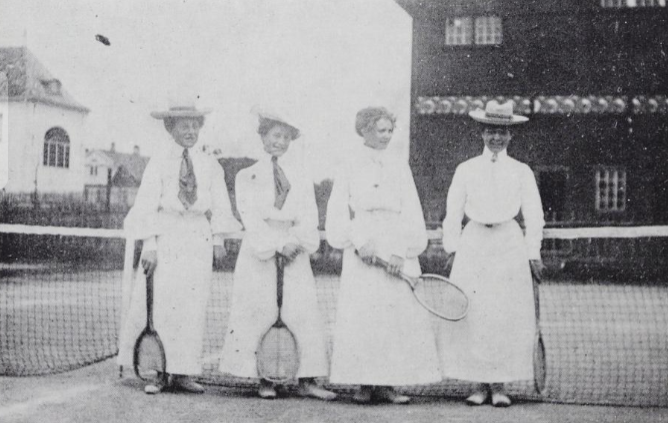
Molla (right) at Bygdøy, ca. 1910
It was several years after she began playing that Bjurstedt dipped her toe into foreign tournaments. Trained as a masseuse, she traveled to London in 1909 to practice her profession there. She entered Wimbledon and lost in her first match to Edith Johnson, the 1908 runner-up. She and Valborg traveled to Germany in 1911, where she lost a three-set final at the German Championships in Hamburg.
In 1912, she competed in the outdoor singles event* at the Stockholm Olympics. She took home a bronze, but it was hardly a breakthrough. Only twelve women entered, all from Europe, and four withdrew without hitting a ball. Molla earned her medal by winning a single match against a Swedish player, Edith Arnheim, whose main claim to fame is losing that third-place contest.
* There were separate indoor and outdoor tennis tournaments at the 1912 Olympiad. Bjurstedt wanted to enter both, but in her telling, the national association was unwilling to enter her in the indoor event because it would mean that Norway was represented solely by a woman.
After two more years of easy wins against local competition, Bjurstedt decided to follow the route of hundreds of thousands of her countrymen and try her luck across the Atlantic. In late 1914, she first headed to Canada, where she continued to work as a massage therapist. She made it to New York City a few months later.
She popped her head in at the Seventh Regiment Armory, where the men’s 1915 National Indoor Championships were held in February. She discovered that the women’s event was scheduled for the following month.
Molla entered, and suddenly, she just got good.
* * *
Molla Bjurstedt’s 1915 season was outstanding by any standard, let alone that of an unknown playing her first tournaments in the United States. At her first tournament, she won five matches without the loss of a set. She triumphed in the title match over Marie Wagner, runner-up at the 1914 national championships.
In May, she won the West Side Tennis Club Championships, defeating 1906 national champion Helen Homans McLean in the final. Already, the public was aware of the newcomer, and the gallery filled up with curious onlookers.
Molla added another title a week later at the New York Metropolitan Championships, beating McLean again in the semi-final, and dropping only four games in the final to Maud Barger-Wallach, the 1908 national champion. Only injury could stop her. Bjurstedt tacked on yet another title in May at Pelham Manor, then ran her winning streak to 19 before she was forced to retire in the quarter-finals at the Morristown Field Club.
She recovered in time to play the US National Championships, then held at the Philadelphia Cricket Club and scheduled in June. Bjurstedt met Hazel Wightman–winner at this event in 1909, 1910, and 1911–in the final. Wightman won the first set, but Molla quickly learned how to outfox yet another first-time opponent, reversing the momentum and sealing a victory, 4-6, 6-2, 6-0.
The Norwegian’s run in Philadelphia kicked off another winning streak, this one reaching 23 matches, including another victory against Wightman in the final of the US Clay Courts event in Pittsburgh. In November, she traveled to California, where she got her first taste of tennis on asphalt and her initial encounters with May Sutton Bundy. Bundy was a two-time Wimbledon champion and queen of the West Coast courts. The Californian won two of three, proof–at last–that Molla was still human.
Regardless of her performance against Bundy, Bjurstedt’s US debut campaign was a stunner. She had secured the national championship along with the national clay court and indoor titles. She won 12 tournaments in all, spanning nearly 70 singles match wins, and she proved capable of beating every player of note in the country.
* * *
For the next seven years, Molla’s dominance over American tennis would be total. She won all but one of the eight national championships between 1915 and 1922, losing only a semi-final in 1919 to Marion Zinderstein.
Zinderstein interrupted a truly astounding streak. When defeat finally came, the now-married Molla Mallory hadn’t lost a tournament match in three and a half years. She wouldn’t lose another in the United States until the 17-year-old Helen Wills overpowered her for the 1923 national title. By then, she was 39 years old, and she still had another US championship ahead of her, when Wills didn’t compete in 1926.
Mallory in action (from 2:48)
Mallory sustained such a high level thanks in part to a game style that didn’t usually require full effort. She also kept her tennis in perspective. She wasn’t unusually dedicated to training–Anthony Wilding wouldn’t have approved of her late nights and short practice sessions. Molla preferred to keep in shape with lots of match play. At one event that still retained the challenge round, which allowed the defending champion to sit out until the rest of the field had been whittled down to one, she declined the privilege and opted to “play through” instead.
Her game is more difficult to outline, because–in the words of Mallory admirer and future Wimbledon champion Helen Jacobs–she “revolutionize[d] women’s baseline tennis.” The vocabulary that described her style in 1915 had evolved beyond recognition a decade later.
In modern parlance, we’d call her “steady”–a baseliner with a powerful forehand, a reliable backhand, and the willingness to chase down every ball. But when Molla published her instructional book, Tennis for Women, in 1916, she took issue with the term:
I think that ‘steadiness’ is but a negative virtue. My first reason is purely personal; I could not play a ‘safe’ game; there is something so dull and colorless about a game in which one always does the same thing. One loses all the joy of combat in such a style–it is so insipid.
She hardly played a safe game in her first matches against Bundy. The two women, possessors of probably the two most powerful forehands in the women’s game, cheated to their backhand corners and simply clobbered groundstrokes at each other. As good a retriever as she was, the Norwegian was never passive: “I always take the game to my opponent. Attack, attack, attack!”
When Mallory first arrived in the States, such aggression was unusual. The Bundy forehand left opponents reeling, and Hazel Wightman attacked the net. But the tactics that Molla found most common were the “chop stroke”–essentially a drop shot hit with heavy spin–and what we’d now call moonballing.
Mallory did not approve of the chop:
I have never used the chop stroke or a stroke with an excessive top spin. I do not know how to play them and I do not care to learn. … I consider tennis a hard-hitting, placing game and I think speed and placement must eventually win. The player with a great repertoire of cuts may disconcert an opponent for the time being, but so would a server who turned a somersault on her delivery.
And she really did not like moonballs:
I have no patience with the gentle drives which majestically describe tall parabolas.
A lobber seldom wins unless her opponent succumbs to irritable fatigue.
Therefore I unreservedly say that one should lob only when no other play seems possible. I abhor excessive lobbing.
To Molla, “steady” meant passive. By the time she retired in 1929, there were still chop-stroke artists and more than a few moonballers, but it was possible to be both steady and powerful. You had to be, if you had any hope of outplaying Mrs. Mallory.
* * *
For all of Mallory’s dominance in the United States, she was oddly ineffective back in Europe. She traveled to Britain, with occasional trips to France, nearly every year between 1920 and 1929. She won only five tournaments, none of them major events. In nine attempts, she reached the Wimbledon final just once, and she lost badly to Suzanne Lenglen when she got there.
One common explanation was that the fast turf at Wimbledon and other British events didn’t suit her game. She also turned 40 midway through the decade. The court coverage that in the 1910s made spectators think of a panther surely must have become less cat-like.
Still, one of the greatest achievements in Molla’s career came against a European player. Suzanne Lenglen made her sole appearance at the US National Championships in 1921. Earlier in the year, the two women had met in the final of the World Hard Court Championships in Paris, where Lenglen won, 6-2, 6-3. It was closer than the score implied, however. Mallory had a break point when Suzanne was serving at 3-2 in the second set. Lenglen was struggling with blisters on her feet and made some indications that she would default, but coaxed by her father, she continued to play, saved the break point, and quickly sealed the victory.
Lenglen was the best player in the world; she hadn’t lost a singles match–not even a set–since before the war. Americans eagerly anticipated the Lenglen-Mallory clash that would likely decide the US title. But the Forest Hills draw was unseeded, and the two women would meet in the second round.
Molla was confident. After the match in Paris, she told Bill Tilden, “I can beat her! The next time I play her I will beat her.” Tilden was present for the next meeting, as well, and he tried to help her do just that. Helen Jacobs tells the story in her book, Gallery of Champions:
For an hour before the match was called, Bill Tilden, always one of Molla’s greatest friends and admirers, pinned her in a big armchair in the clubhouse. Allowing no one else to talk to her, he proceeded to remind her of all the things about Suzanne that were most annoying to Molla, who had never been at any time too fond of her opponent. He knew that if the things he told her would annoy her enough, she would beat Suzanne if she died in the attempt.
Tilden also bumped into Lenglen before the match. He told Suzanne, “No woman can beat Molla, least of all you!”
Mallory was outstanding, flashing what the New York Times called “superb and apparently unbeatable form” in a front-page story, surely one of a very few times a second-round match merited such prominence. At the same time, Lenglen played “timidly and uncertainly,” and she began to cough midway through the first set. After Molla took the opener, 6-2, they played two more points before Suzanne defaulted.
The ensuing war of words lasted far longer than the match. Tournament officials accused Lenglen of faking. The French Federation certified that Suzanne really was sick. American newspapers had the final word, giving Lenglen the nickname “cough and quit” and hailing their adopted hero like never before.
The Frenchwoman wouldn’t lose another singles match in her amateur career, a 179-match streak that included two lopsided wins over Mallory. Their next meeting came in the title match at Wimbledon in 1922. It was the shortest major final on record. Lenglen finished the job, 6-2, 6-0, in just 23 minutes.
* * *
Molla wrote in 1916: “There is no tennis age; the limit is mental.” Her book was published when she was a 32-year-old rookie sensation, and even then, she could have no idea to the extent to which she’d embody her own words.
She won nearly 200 singles matches after her 40th birthday, including the 1926 US National title. One of her last tournament victories was at the 1929 Essex Invitation in Manchester, Massachusetts, where her quarter-final victim was Sarah Palfrey, a future national champion 28 years her junior.
Like all instructional books, Tennis for Women has its share of well-worn, generic filler. She’s hardly the first, or the last, author to proclaim that age is just a number. Yet coming from Mallory, such stuff still packs a punch.
One last Molla-ism: “It is surprising what may be accomplished by well-directed ceaseless energy.”
When we’re talking about the feats of Molla Bjurstedt Mallory, surprising doesn’t even begin to cover it.
In 2022, I’m counting down the 128 best players of the last century. With luck, we’ll get to #1 in December. Enjoy!
* * *
Anita Lizana [CHI] Born: 19 November 1915
Died: 21 August 1994
Career: 1931-47
Plays: Right-handed (one-handed backhand)
Peak rank: 1 (1937)
Peak Elo rating: 2,244 (2nd place, 1937)
Major singles titles: 1 (1937 US Nationals)
Total singles titles: 52
* * *
When I started digging up contemporary accounts of Anita Lizana, I didn’t expect to see quite so many people dropping the S-word in their evaluation of the greatest player ever to emerge from Chile.
A. Wallis Myers of the Daily Telegraph, after Lizana won the 1937 US Championships: “[S]he revealed a standard of play that, for variety of stroke, speed of foot and sagacity has rarely been equaled. Santiago has provided ‘Suzanne’s’ successor.”
Five-time major winner Helen Jacobs: “[Lizana] fascinated the Wimbledon spectators for much the same reason that Suzanne Lenglen did. Her strokes were graceful, her footwork as delightful as a ballet-dancer’s. Every return she made, successful or not, showed nerve and imagination.”
Veteran journo Ned Potter: “Lizana has, it is true, much of the French woman’s grace and agility.”
The British publication, Lawn Tennis and Badminton, in 1936: “Those who visualised for Señorita Lizana a sort of Mlle Lenglen or Mrs Moody future … may be approaching respect for their foresight.”
Lizana merited a chapter of Jacobs’s 1949 book, Gallery of Champions, which closed by acknowledging that, at Anita’s peak, the same question found itself on everyone’s lips: “Was Lizana really a second Lenglen?”
Jacobs won both of her meetings with the Chilean star, including one in a Wimbledon quarter-final. But she cautiously answered her own question in the affirmative. “I still think that a possible second Suzanne Lenglen was lost to the tennis world when Anita Lizana married Ronald Ellis.”
* * *
Many of the competitors, writers, and fans watching Anita Lizana play in the late 1930s would have also seen Suzanne Lenglen, the hard-hitting, balletic Frenchwoman who didn’t lose a single match between 1922 and the end of her amateur career four years later. A comparison with Lenglen was just about the highest conceivable praise that an up-and-comer could receive.
A mere five feet tall, Lizana was probably the fastest player of her era. She loved her drop shot and hit more of them than anyone else–we’ll come back to that–but it was a mistake to underestimate the rest of her game. Her topspin backhand was a weapon in its own right. “One of the most surprising things about her game was that it could carry the pace it did,” wrote Jacobs. “[S]he could hit harder than players thirty pounds heavier than she.”
And unlike Lenglen, Lizana brought a joy to everything she did, win or lose. Lawn Tennis and Badminton called her “one of the best living losers and, now [that] she seldom loses … one of the best-mannered winners.” She was so sportsmanlike at the end of a match that she is responsible for introducing the custom of post-match handshakes with the chair umpire. She even acknowledged linesmen the same way.
Her combination of skill and charm won over British fans immediately. A teen prodigy in Chile, her abilities were so apparent that the national tennis federation put together the money to send her abroad. As a 19-year-old on her first trip to Europe in 1935, she won seven titles and lost only six matches, a stunning debut for a newcomer who didn’t speak the language (she traveled with a translator who doubled as chaperone) and faced unfamiliar conditions and opponents every week.
Lizana in action
She returned in 1936 with an even more fearsome game, having spent the offseason slimming down and shoring up a weak second serve. She tallied 83 wins against only 4 losses that year, beating every British player of note, including Dorothy Round in two out of three tries. She was seeded eighth in her second trip to Wimbledon, and she reached the quarter-final round before losing a tight three-setter to Jacobs.
Then, the banner year of 1937. Lizana opened her season on the clay courts of the French Riviera, where she struggled against the steady baseline game of Simonne Mathieu, but lost only one more match–to Round–between March and another meeting with Mathieu at Wimbledon. In her first and only appearance at the US Championships in September, she swept the field in straight sets. After dismissing five Americans, she made easy work of the heavy-hitting Polish star Jadwiga Jedrzejowska. It was the tournament that launched a thousand Lenglen comparisons, and it inspired A. Wallis Myers to place the Chilean atop his year-end rankings list.
Ten months later, Lizana was married. Another year after that, and her career was essentially over.
* * *
The most remarkable thing about Lizana’s rise to the top of the women’s game is how fast she developed as a player. Her signature move from the moment she arrived in Europe was the drop shot, but she overused it. When she came back for her second season in Britain, she had already built better tactics around the dropper, constructing points to generate openings and deploying her pet weapon less often.
Late in 1936, she played her first tournaments on covered courts–lightning-fast wood surfaces that she had never before encountered. The wood rendered her drop shots harmless, and at the National Covered Court Championships in London, she lost the first set of her first-round match to an otherwise unthreatening player named Vere King. Lizana learned quickly. She came back to win that match, and didn’t lose another set at the tournament. She won her first four matches at the next tournament in straight sets as well, before needing three to defeat Dorothy Round for the season-ending title at the Torquay Palace Hotel.
Still, she had a tendency to opt for entertainment over tactical savvy. Earlier in 1936, Lawn Tennis and Badminton wrote:
Señorita Lizana is so fond of the game for its own sake that her delight in stroke-making, which is obvious, is her primary urge, to the exclusion of the more important object of match winning. … she will sacrifice a tactical advantage for the sake of a momentary thrill shared by the spectators.
A year later, a feature titled “Drop-Shot Lady” suggested that she hadn’t entirely changed her ways. But her signature stroke was now so deadly that it didn’t matter:
Her sheer joy in life makes her deadly drop-shot, the terror of the tennis world of women, a sugar-coated pill. Other people play drop-shots, but Lizana’s are different. It is a kind of anti-climax which stops you dead in your tracks, whether you are playing or looking-on. Bang-bang-bang–and then a sudden, silent, softly-stealing gas attack. The ball comes over the net, but only just, and it dies on you.
Helen Jacobs noticed that the 20-year-old Lizana changed her strategy for each new set of their quarter-final battle at Wimbledon in 1936, ultimately settling on a drop-shot-lob-combo that was nearly good enough for a place in the semis. Jacobs was already one of the smartest players on the circuit, and she acknowledged that facing Anita “sharpened my wits.”
* * *
Chile’s “Smiling Señorita” never did beat Jacobs. They met only one more time, at the Birmingham Priory tournament in 1939, when Lizana was no longer solely focused on her tennis. But the opponent that more frequently stood in Anita’s way was the steady, indefatigable Simonne Mathieu.
Mathieu beat Lizana three times, in consecutive weeks, on the Riviera in 1937. The Chilean won a set and pushed two others to 7-5, but for a woman who had lost only four matches the previous year, it was a wake-up call. Two months later, Lawn Tennis and Badminton warned that Lizana had “yet to prove that she is invulnerable against super-steadiness and speed of shot on grass courts … the type of game exploited so successfully by [Hilde] Sperling or Mme Mathieu.”
Anita got her revenge at Bristol, winning a three-set semi-final over Mathieu two weeks before Wimbledon began. She was seeded third at The Championships, and her victory over the Frenchwoman–followed by a defeat of Sperling in the final the next day–boded well. Even Lizana would say that she thought it was her year. But she ran into Mathieu again in the Wimbledon quarter-finals, and the veteran won in routine style, 6-3, 6-3. Mathieu was “terribly accurate,” and Anita didn’t have the answers.
As we’ve seen, 1937 ended happily. Mathieu spent September on the Continent, leaving the United States open for Lizana to pile up victories. Anita had more to celebrate beyond her Forest Hills title: She became engaged to Scottish player Ronald Ellis, and on her third time of asking, she convinced her parents to allow the marriage.
The 1937 US National Championships title match
There was only one condition: The couple would wait until after Wimbledon in 1938. The delay would give Lizana another opportunity to win the coveted trophy for Chile and–incidentally–give herself one hell of a wedding present.
Alas, wedding planning was the only thing that went as intended. When the Smiling Señorita returned home as the US Champion, she was in such demand that she suffered a nervous breakdown. Back in England in April, she twisted her ankle and won only one tournament in four tries, losing at the Middlesex Championships to Mary Hardwick, a player she had beaten in straight sets in all eight of their previous encounters. The only highlight of Lizana’s Wimbledon prep was a pair of wins against Hong Kong native Gem Hoahing, a plucky 17-year-old two inches shorter than Anita herself.
The Wimbledon seeding committee reacted to her mediocre season by leaving her unprotected in the draw. Then came the final insult. Her first opponent would be the fifth seed, her old nemesis, Simonne Mathieu.
This time around, the score was a bit closer–6-4, 6-4 to the Frenchwoman–but the press coverage reads like the death knell for a career. The Daily Mail headline read, “Drop-shot Plan That Was a Failure.” Lizana’s season was a “tragedy.” The match was a “lamentable display.” She went to the drop shot more than ever, and Mathieu chased down nearly all of them. Anita’s nuptials would have to proceed without a Wimbledon trophy.
* * *
When Anita Lizana became Mrs Ronald Ellis, she was still only 22 years old. In a later era, her career would just be beginning. But she skipped the remainder of the 1938 season to get settled in at her new home in Scotland, and she played only a handful of tournaments–including a second-round loss at Wimbledon–in 1939 before becoming pregnant with her first child.
Even if a serious comeback had been in the cards, World War II wiped out British tennis for six years. In 1946, Anita won a pair of titles in Scotland, and in 1947, she returned to Wimbledon, losing again in the second round. She won a title as late as 1955, and she made her last tournament appearance in 1960.
In the end, Chile’s Smiling Señorita was not the second coming of Suzanne Lenglen. But for two magical seasons, she showed British fans just how much fun one could have on the tennis court, and just what one could achieve with a five-foot frame and a deadly drop shot.
In 2022, I’m counting down the 128 best players of the last century. With luck, we’ll get to #1 in December. Enjoy!
* * *
Frank Kovacs [USA] Born: 4 December 1919
Died: 9 February 1990
Career: 1937-55
Played: Right-handed (one-handed backhand)
Peak rank: 1 (among professionals, 1945)
Peak Elo rating: 1 (1941)
Major singles titles: 0 (1941 US Nationals finalist)
Total singles titles: 40
* * *
There are a lot of different ways that an all-time great tennis player can end up underrated. Frank Kovacs somehow combined them all.
First: Bad timing. Kovacs was born in 1919, so he was 22 years old when the Japanese bombed Pearl Harbor in 1941. He had recently reached his first major final, at Forest Hills, where he lost to Bobby Riggs. Tournament tennis survived in the US throughout the war, but playing opportunities were sharply curtailed just as Kovacs reached his peak.
Second: He turned pro early. The currency of tennis greatness is major titles, and when amateur-era players joined the professional ranks, they passed up the most important kind of record-book glory. Kovacs had tussled with the amateur authorities since he was a teen, so when he was offered $25,000 to go pro alongside Riggs at the end of 1941, he took it. Professional careers tended to be short, and even the most prestigious pay-for-play tournaments of the era are largely forgotten.
Third: He was a clown. Newspaper reports gave him credit for a backhand to rival that of Don Budge, but Kovacs’s unpredictable personality got far more coverage. Riggs called him a “likable screwball.” Time magazine called him a buffoon. He once laid down on a court, mid-match, to get a better view of a passing airplane. He liked to toss three balls in the air, then strike one for his serve. Once, he pulled that trick at match point, and hit an ace. He was a crowd-pleaser, and his antics improved the gate receipts for his pro matches. But when your reputation is that of a “court jester,” it’s tough to be taken seriously.
Fourth: His peers didn’t respect him much. The clowning didn’t help here. Jack Kramer, whose television commentary and 1979 book, The Game, made him an authority on 1940s and 1950s tennis, wrote, “Frankie never won anything … [H]e didn’t have any idea how to go about winning.” Kovacs had enormous raw talent, and even that didn’t help his case. Bill Tilden was one of many who thought that Kovacs’s backhand was second only to Budge’s, but he was disappointed by Kovacs’s lack of commitment to improve his game. Finally, the clowning often went too far, and Riggs was one of many contemporaries who thought he sometimes crossed the line into rule-breaking gamesmanship.
Fifth: He spent his entire career in the shadow of another legend, and the rival himself is underrated. Kovacs and Riggs played each other at least 64 times, including 15 as amateurs (11 of them finals), 19 at professional tournaments, and another 30 on pro barnstorming tours. Bobby got the better of the matchup, but only barely, winning 35 times to Kovacs’s 29. Riggs is underrated for some of the same reasons that Kovacs is, as he lost some of his peak to World War II and chose to turn professional early. His well-earned reputation as a hustler, blowhard, and misogynist has led history to judge him harshly. But Kramer wrote, “I guarantee you he is the most underrated champion in the history of tennis.”
All the accusations are true. And yes, Kovacs wasn’t as good as Riggs. But when you look past the reputation, the unfulfilled potential, and the biases of history, you’re left with one of the best players of his era, a man who–albeit briefly–could beat anybody.
* * *
Frank Kovacs grew up in Oakland, down the street from Don Budge. He was only four years younger than his neighbor, but by the time he got serious about tennis at 14, Budge was already a big tennis name in California. As Kovacs sprouted to 6-foot-4 and developed his own weapon of a backhand, comparisons were inevitable. He was dubbed “the second coming of Don Budge.”
Kovacs won his first tournaments as a 17-year-old in 1937, and he claimed his first of three straight California State crowns in 1938. The same year, he made his first trips east, to Florida in January, then to the Northeast for the National Championships. Nearly everything that would define his career was already present. He lost to Bobby Riggs four times that year, including a 6-4, 6-0, 6-4 drubbing at the Longwood Bowl in Boston. He crashed out of the Nationals in the third round to Gene Mako, a fellow Californian who had no patience for the youngster’s hijinks. Kovacs showed up late, played tricks with the pre-match racket toss, and hit tweeners during the warmup. Mako beat him in straights, and looking back, he had one word for the teen’s behavior: “chickenshit.”
Kovacs was also already at war with the United States Lawn Tennis Association. The federation wouldn’t support him unless he disclaimed any relationship with his coach, George Hudson. He did so, at least publicly, but Hudson sued, and the public controversy meant that Kovacs wasn’t considered for the Davis Cup team. We might throw that in as yet another reason that history underrates him. In an era when everyone wanted to play for their country, the off-kilter youngster never did.
He lost much of 1939 to an arm injury, but recovered well enough to reach the final at the Pacific Coast Championships in October and push Riggs to a fifth set in the title match. He took another step forward in 1940, winning four tournaments and getting on the board, at last, against Riggs. At the Southampton Invitation just before the National Championships, he upset his primary rival in a four-set semi-final.
By now, word was out about the clown prince of American tennis. He was one of the main attractions at Forest Hills in 1940, and the tournament wanted to be ready for him. USLTA president Holcombe Ward wrote to Kovacs: “My dear boy, your deplorable clowning on the court, which has marred the current lawn-tennis season, will not be tolerated at Forest Hills. We strongly urge you to be serious.” Kovacs responded: “My dear Mr. Ward, I will try very hard to be serious on the court during the coming tournament. But something tells me I shall not succeed.”
The Californian was right. In the early rounds, he was exiled to the outer courts in a failed attempt to keep him out of the public eye. By the quarter-finals, there was little choice but to put him in the stadium, where 10,000 fans would be watching. Just as he did in the Mako match two years earlier, Kovacs started his act before the first ball was struck, posing for photographers and ignoring his opponent, Joe Hunt, during the warm-up. By the third set, Hunt was sufficiently enraged to sit down on court, refusing to play on. Kovacs countered with a sit-down of his own, relaxing on his own baseline and pretending to knit. Play eventually proceeded, and after a few more games, Hunt secured a 6-4, 6-1, 6-4 victory.
Kovacs had yet to convert his clowning into an effective form of gamesmanship, but his results were good enough to merit a third-place ranking among American amateurs. My Elo ratings are even more positive, placing him behind only Riggs, the Australian John Bromwich, and Budge, who had turned pro. In 1941, the court jester would take another big step forward.
* * *
Two years into the European war, America was the only remaining site for top-level competitive tennis. That year, American tennis was all about Bobby Riggs and Frank Kovacs.
Kovacs opened the season with a dramatic statement, winning five titles between December and March, including four wins over Riggs. The crowning achievement of the circuit was at the US Indoor Championships in Oklahoma City. Kovacs wore out his rival with a 6-4, 17-15, 6-4 victory in the semi-finals, then seized his first national-level title with a 6-0, 6-4, 6-2 drubbing of Wayne Sabin. The New York Times said Kovacs “was never more serious in his life.”
Maybe. That year, Don Budge said, “When Kovacs forg[ets] his horseplay … there’s nobody he can’t beat.” The 20-year-old replied, “[W]hen I get grim on the court I dump the ball into the net or drive it over the fence. I can’t stand the strain of being tense. … I’ve got to have laughs to play good tennis.”
Kovacs’s search for a laugh sometimes went too far. The most egregious incident that has made it into print doesn’t quite line up with the historical record, but I can’t possibly leave it out. Tom LeCompte’s 2003 biography of Riggs, The Last Sure Thing, relays a story told by Gardnar Mulloy, a player a few years older than Kovacs and Riggs who entered many of the same tournaments in 1940 and 1941.
The rivalry between America’s top two players extended off court. After Kovacs faked an injury and quit a match early at Newport to avoid exhausting himself in the heat, Riggs wouldn’t stop needling him about it. Finally, the clown prince had had enough and worked out his revenge. According to Mulloy, at the US Indoors, Kovacs took several opportunities to express his admiration for Riggs, for his skill and his commitment to never default a match. Sure enough, Bobby came down with something the night before the final, and barely survived through the final. In Mulloy’s telling, Kovacs taunted him about a possible default throughout the match, but Riggs stuck it out, losing 6-4, 6-0, 6-2.
Kovacs later told Mulloy that he had spiked Riggs’s drink the night before. Mulloy thought it became common knowledge on tour.
It’s a memorable story, and it’s just within the range of things I’m willing to believe Kovacs would do. The only problem is that Kovacs never beat him by that score. And the one time they faced off at the US Indoors, it was a semi-final. And that semi-final was two and a half years after the Newport incident. The score that Mulloy recalled is similar to how Kovacs beat Sabin in the 1941 final. A local news story from that year’s semi-final against Riggs reports that Bobby was “so tired he could hardly lift his racquet when the third set started,” but the 17-15 second set is a much more plausible explanation for fatigue than a felony in the guise of a practical joke.
A lot of details can get lost in sixty years, so my fact-check hardly proves that nothing of the sort ever occurred. Regardless of just how vicious the off-court rivalry became, Riggs knew that he’d eventually face Kovacs with much more on the line, and he was willing to play the long game.
* * *
The big match arrived in September. At the 1941 US National Championships, Riggs and Kovacs were the first and second American seeds, atop a strong list that included defending champion Don McNeill and future titlists Ted Schroeder, Frank Parker, and Jack Kramer. Kovacs reached the final in straight sets, setting aside Kramer and McNeill, while Riggs had a more difficult time, needing four sets to beat Parker and five to escape past Schroeder in the semis.
Kovacs’s path was so routine that the New York Times reduced what must have been a typically zany semi-final performance to something that almost sounds boring: He brought “an occasional cheer with his ‘cosmic’ forehand* and super backhand and occasional gyrating exploits.”
* Anybody know what a “cosmic” forehand was? While it sounds impressive, Kovacs was better known for the backhand. The Times mentioned it on multiple occasions, but newspaper keyword searches are confounded by the contemporary racehorse, Cosmic Ray.
Whether or not Kovacs had ever drugged him, Riggs came into the final having lost four of his last five matches to the clown prince. But he was confident: Kovacs’s mental fragility was an open secret, and Bobby had been taking notes after every encounter. LeCompte writes that Bobby was “dead sure he could outthink and outfight him.” Riggs put his money where his mind was, betting all his loose cash on himself–the underdog–to win at 2-to-1 odds.
It was a windy day, and Riggs needed time to adjust to the conditions. Kovacs took the first set, 7-5, finishing the job with three straight aces. From there, things went downhill. The Times tells the story as seen from the grandstand:
[T]here was nothing cosmic any longer in the game that has invited comparison on occasion with William Tilden’s.
The outcropping of errors that had marred Kovacs’s play became epidemic as he lost three love games to start the second set. It was perceived then that there was too little real substance behind the gingerbread and tinsel that pulls in the customers, and that the calculating, concentrating young man on the other side of the net was too resourceful, too smart and too fundamentally sound in his equipment to be beaten by spasmodic eruptions of power in the raw.
That’s what the spectators saw. At court level, Riggs knew he had Kovacs on the ropes after winning the second and third sets. But there was a standard ten-minute intermission before the fourth set, and Riggs feared that if Kovacs were able to talk to his coach, he’d be able to shift tactics and make a comeback.
It was Bobby’s turn for a gentle taunt. Riggs tells the story in his book, Court Hustler:
“You look tired, Frankie,” I told him, as I toweled myself. “I guess you want to go in and lie down awhile.” Frankie flared up. “Who’s tired? Not me. Let’s go out there and finish this.” I had outpsyched the master psycher.
Skipping the intermission, Kovacs lost the fourth set and the match, 5-7, 6-1, 6-3, 6-3. It was as close as he’d ever get to a major title.
* * *
Kovacs had always been open about the under-the-table payments from tournaments that kept “amateur” players out of the poorhouse. Between those indiscretions and the on-court antics, the USLTA sprang at the first opportunity to punish the clown prince. Two months after Forest Hills, rumors swirled that Riggs and Kovacs would turn pro. The national federation struck first, suspending Kovacs in late November of 1941.
It was a pointless gesture. The deal was done: Riggs and Kovacs each accepted $25,000 to turn professional. They would make their debuts at Madison Square Garden at the end of December, in a round-robin tournament also featuring Don Budge and Fred Perry. American tennis couldn’t churn out new stars as fast as the professional ranks swept them up, so the clash of established pros and recently dominant amateurs was the tennis event of the year. Budge was still only 26 years old, three years removed from winning all four amateur majors in 1938.
For Kovacs, that first pay-for-play event would turn out to be the highlight of his career. He beat Budge in his first pro match, at one point reeling off five games in a row. He followed that up with a win against Riggs, again displaying his ability to go on a tear. Kovacs won the first 16 points of the third set. While an injury robbed him of the chance to face Perry, Kovacs won the round robin against the two best players in the world.
Kovacs vs Budge at MSG
The novelty of the pro tour, which set up shop in a new arena every few days and offered players cash rewards for victories, kept Kovacs on top for a little while. He won his first five matches against Budge. But to no one’s surprise, the youngster couldn’t keep it up. Budge won the tour, winning 52 of 70 matches. Riggs came next at 36-36, and Kovacs finished third. At the US Pro tournament in the summer of 1942, Riggs beat him in a four-set semi-final.
After a few years in the Army, the jester was back at it. He and Riggs went on tour together, and Kovacs remained a box-office draw. But the spirit of fun that made him such a popular player had faded. LeCompte writes:
The “Clown Prince” had since become more bitter and caustic, intimidating ball boys, showing up late for matches, and offering to fight heckling spectators. At the Philadelphia tournament, Kovacs swigged from a large soda bottle full of Rum Collins mix during the changeovers. When he finished the bottle, he sent a ball boy out for a refill. When the boy came back with plain soda, Kovacs held up the match while he waited for the youngster to go out and retrieve the requested libation.
Professional barnstorming tours needed new attractions, and while Kovacs held his own against Riggs, he didn’t have the drawing power to bring in crowds year after year. He continued playing pro tournaments until 1959, winning his last event in Florida in 1954. He played several epic matches against Pancho Segura, and even defeated Richard “Pancho” González in 1952.
By then, nothing Kovacs did would change the stories people told about him. Riggs once told Jack Kramer, “[D]on’t worry about Frankie. He looks great, but give him long enough and he’ll find some way to keep you in the match, and give him a little longer and he’ll find a way to beat himself.” It’s a good line, and if the stakes were high, my money would’ve been on Bobby, too.
Kovacs’s unpredictability made it easy to ignore just how good he was: very possibly the best player in the world in 1941, and a man who beat Riggs at least 29 times. Kramer called Riggs the most underrated champion. As for Kovacs, it’s hard to think of a more unsung runner-up.
Serbian-American writer Ana Mitrić joins me to discuss the latest entry in my Tennis 128, Goran Ivanišević. Ana was a Goran fan even before she took a broader interest in tennis, and she is particularly sensitive to how the breakup of the former Yugoslavia affected players on all sides of the conflict.
We talk about the state of Yugoslav tennis before the wars, Goran’s status in his native Croatia, and how his attitude to the conflict differed from older players. We also discuss how Ivanišević attracted so many fans despite a one-dimensional game that was often boring in less-mercurial hands, why his outspokenness didn’t seem to turn people off, and what he now brings to Team Djoković.
Thanks for listening!
(Note: this episode is about 69 minutes long; in some browsers the audio player may display a different length. Sorry about that!)
Music: Everyone Has Gone Home by texasradiofish (c) copyright 2020. Licensed under a Creative Commons Attribution Noncommercial (3.0) license. Ft: spinningmerkaba
In 2022, I’m counting down the 128 best players of the last century. With luck, we’ll get to #1 in December. Enjoy!
* * *
Goran Ivanišević [CRO] Born: 13 September 1971
Career: 1989-2004
Plays: Left-handed (two-handed backhand)
Peak rank: 2 (1994)
Peak Elo rating: 2,185 (3rd place, 1993)
Major singles titles: 1 (2001 Wimbledon)
Total singles titles: 22
* * *
In the late 1990s, men’s tennis was in crisis. The women’s game had the stars, the drama, and the ratings. The ATP had a bunch of tall guys hitting big serves, some clay courters who didn’t like to play on other surfaces, and the perennial question of whether Andre Agassi would make an effort this year.
Rick Reilly voiced the dilemma for Sports Illustrated after Wimbledon in 2001:
The women play amazing, long, topsy-turvy, edge-of-your-seat points. The men hit 140-mph aces nobody can see, and then ask for a towel. Everything is serve and towel, serve and towel. It’s like being at a cocktail party with Boris Yeltsin. In a third-round Wimbledon match Ivanišević had 41 aces against Andy Roddick, who had 20. It is unclear how the rest of the points were won because the official statistician fell asleep. If men’s tennis is to be saved, somebody had better start decompressing these guys’ balls. Then something has to be done about the equipment.
Ironically, Reilly’s column was printed just as the tide turned for the men’s game. That Wimbledon marked the arrival of a 20-year-old Roger Federer, who upset seven-time champion Pete Sampras in the fourth round. Roddick would live up to his potential and energize American men’s tennis. Two months later, another young star, Lleyton Hewitt, would win his first major at the US Open.
Most of all, the 2001 Championships at Wimbledon gave the sport’s biggest stage to one of its most engaging personalities. Fans could gripe about Goran Ivanišević’s one-dimensional game, but no one has ever said the man was boring. Suffering through shoulder injuries and holding a ranking outside the top 100, he needed a wild card just to enter the tournament. The Croatian turned in the best fortnight of his career, winning the title with a series of dramatic matches against some of the best of his peers.
Reilly wasn’t the only one to find Goran’s game aesthetically displeasing. But in general, the press found him to be a godsend, a colorful character with a comment on everything, and a ranking high enough to make his wacky utterances newsworthy. By the time he finally got his sole major title, he was an even better story: the ultimate underdog. He gave men’s tennis a shot in the arm when the sport needed it most.
* * *
Ivanišević was given to on-court theatrics that caused a generation of tennis fans to misjudge him. He broke rackets, cursed at line judges, and openly tanked points (occasionally entire matches) throughout his career. He was the first to recognize his own mercuriality, referring to his different in-match personas as “Good Goran, “Bad Goran,” and “Crazy Goran.” There was also “Emergency Goran,” who mediated disputes among the others.
Emergency Goran wasn’t always available. At Brighton in 2000, he smashed three of his rackets, and without another one to finish the match, he was defaulted.
The people who knew him best realized that there was nothing artificial about the antics. In 1992, his manager Ion Țiriac said, “Everybody has a certain craziness if he wants to be a superstar.” His coach, Bob Brett, added, “There’s a thin line between creativity and self-destruction.”
In the 2001 Wimbledon final against Pat Rafter, he needed four match points to finish the job. Serving at 8-7 in the fifth set, he hit two aces to reach 40-30. He clasped his hands in prayer to ask for assistance from a higher power… then he double faulted. Another unreturned serve, then another double fault. When he earned a third match point, he got down on his knees to plead even more emphatically for help. He landed his first serve, but this time it was Rafter that didn’t cooperate, ending the point with a lob winner.
Back at deuce, Ivanišević hit yet another unreturned serve, his 73rd of the match. Now with a fourth match point, he had no more gestures. Rational Goran kicked in, and after he missed his first serve, he went with a conservative second offering, trusting that his opponent was under as much pressure as he was. Rafter missed the return, and the match was over.
It wasn’t the first time Ivanišević acknowledged that he needed more than what mere earthly coaches could offer. It was one of many matches in which he failed to convert a crucial point or two. But while it’s tempting to draw conclusions from a handful of memorable anecdotes, the stats tell a different story. Goran played his best when the pressure was at its highest.
* * *
Ivanišević was one of the best servers in modern tennis history. He hit 206 aces in his first run to the Wimbledon final, in 1992, and he smacked another 213 at the tournament in 2001. Like most big servers, his return game was mediocre in comparison. For players with that sort of game style, the path to superstardom is extremely narrow, and it depends heavily on clutch play.
In 2015, I introduced a concept that I dubbed the “minimum viable return game.” Most men win between about 32% and 42% of their return points. Only the very best returners will do better, as Andre Agassi did when he won nearly 44% of his return points in 1993. A handful of players will do worse, surviving purely on serve dominance. John Isner has won only 29.6% of his career points on return.
Players can thrive at either end of that range, but for those who win less than about 36% of their return points, there’s an upper limit on how much they can achieve. In the 30-plus years for which we have match-by-match return stats, only two men have finished a season in the top five of the ATP rankings while winning fewer than 36% of return points. One of them was Pete Sampras, who ended 1996 as the world’s top-ranked player despite managing only 35.3% on return. The other was Goran Ivanišević.
The gap between 36% and, say, 39% sounds tiny. But like so many small differences in tennis, its effects are enormous. 36% means breaking serve once every five return games instead of once every four. That translates to more close sets, more tiebreaks, and more deciding sets. A big-serve, weak-return game makes it unlikely that either player dominates, so matches are more likely to turn on a few high-pressure points.
Sampras’s 1996 campaign is an example of what is possible with middling return results, but Pete himself didn’t usually depend on such narrow margins. From 1991 to 1998, he won at least 38% of his return points in seven of the eight seasons. (He probably did so in 1990 as well, but stats are incomplete before 1991.) Ivanišević, on the other hand, spent his entire career on the tightrope. His career average was only 35.1%, and he never posted a full season above 36.7%. Goran possessed the very definition of the minimum viable return game.
For Ivanišević to manage three top-five year-end ranking finishes and four Wimbledon finals with such a one-dimensional game demanded that he play well in the clutch. He did exactly that.
In 2011, researcher Amir Bachar compared every player’s number of break points won with their expected break points won, based on their winning percentage on all points. In his career from 1991, Goran played just over 6,400 break points (combining both serve and return), and he won 3,362 of them. If he had won break points at his average rate for all points, his total would’ve been only 3,229. The difference of 133 points–entirely due to exceeding expectations when returning–is greater than any of the other 430 players that Bachar considered.
Break points are worth much more than average return points, and Ivanišević became a better returner when it mattered. Another way to measure his effectiveness is to compare his return points won with his breaks of serve. Return points won don’t themselves matter, unless enough of them are bunched together to create a break of the opponent’s serve. Goran’s 35.1% career average would typically translate to breaking serve 17.2% of the time. In reality, he broke 19.2%–still far from elite, but meaningfully better. A break rate of 19.2% is roughly equivalent to winning return points at a rate of 36.2%, a number that sits (barely) on the positive side of my threshold of minimum viability.
* * *
Up to this point, I’ve used the word “clutch” to describe Ivanišević’s ability to generate better results than his return game appears to deserve. You may be skeptical that Ivanišević was reliably better under pressure, and you may even dispute that players can be consistently clutch.
The numbers don’t lie, but the explanation is hardly set in stone. A player can post Goran-like results by tanking unimportant points, as it appears that Nick Kyrgios does. And “clutch” doesn’t require constant, unwavering mental strength. Ivanišević once said, “The trouble with me is, every match I play against five opponents—umpire, crowd, ball boys, court, and myself. It’s no wonder sometimes my mind goes to the beach.”* All we’re talking about is an improvement from “bad” to “mediocre” on break points. He might have simply been less likely to go to the mental beach on obviously important points.
* Notice that he doesn’t count his actual opponent.
Goran’s big-point performance was never more important than at Wimbledon in 2001. In those seven matches, he won 31.1% of return points, by far the lowest single-tournament rate for a major winner since 1991, and even lower than the single-tournament for a major finalist. Of the 120 or so slam winners of the last three decades, only four other men won their title with a return-points-won percentage below 36.8%. Pete Sampras did it three times, and Roger Federer did it once.
As usual, Ivanišević was better when it mattered. After a routine first-round victory, the Croatian earned 34 break points in 25 sets–a miniscule number of opportunities in line with his poor return performance throughout the fortnight. Yet of those 34, he converted 14, good for a rate of 41%. Remember, anything that starts with a 4 is elite return territory. Somehow, presented with only a couple of big moments per hour on court, Emergency Goran usually convinced Good Goran to show up.
The margins were particularly tiny in the semi-final and final. Tim Henman took Ivanišević to five sets in the semi-final, winning a 6-0 third set before rain arrived, stopping the Brit’s momentum in a match that would ultimately stretch over three days. The Croatian generated a mere six break points in five sets, and he converted just two. He won only 48.5% of the 326 points they played, but when the match reached a fifth set, only one point really mattered. At break point on Henman’s serve in the eighth game, Ivanišević came up with a good-enough return to coax a volley error from his opponent. He double-faulted twice in an attempt to serve out the set, but as usual, the serve was more triumph than tragedy. At deuce, he came up with a second-serve ace out wide, and sealed the result on the next point with another unreturnable delivery.
Against Pat Rafter in the final, Ivanišević once again scraped together a mere six break points in five sets. This time, he converted three, and remarkably, the two big servers didn’t reach a tiebreak in the first four sets. Rafter also broke serve three times, but he made the mistake of bunching two of them in a single set. Goran won 153 points to his opponent’s 150, a heartbreaker for the Australian but a life-changer for Ivanišević, who would never again be referred to as the best active player without a major.
* * *
Fans have never known quite what to think of the big-hitting Croatian. Two months after his Wimbledon title, Liz Robbins of the New York Times called him “the wacky racket-kissing comedian with a cannon serve,” a description that few would challenge.
But just as Ivanišević’s on-court reputation can’t explain his results, his off-court complexities get the short shrift. He was a national hero in Croatia long before the Wimbledon title–before, in fact, his country was widely recognized as an independent nation. He insisted that the ATP identify him as Croatian when the organization still labeled him a Yugoslavian, and he turned in one of the most strenuous performances of his career to bring home two bronze medals at the 1992 Barcelona Olympics.
Goran has more recently gained credit for the tennis mind that spent so long hidden behind the clown suit. In a 1992 profile for Sports Illustrated, Frank Lidz jokingly differentiated between the energetic Mr. Goran and the quiet Dr. Ivanišević. The doctor is increasingly in demand. For nearly a decade, he has coached a series of top players: Marin Čilić, Tomáš Berdych, Milos Raonic, and now Novak Djoković. He helped Čilić to the 2014 US Open title, and he’s been part of another five slam-winning teams as a member of the Djoković camp.
Now, as in the 1990s, it’s easy to think of the big-serve, weak-return game as the most mindless version of tennis. In some hands it is, and from a fan’s perspective, it’s rarely the most compelling style to watch. Rick Reilly’s 2001 screed shows its age, but he was right about one thing–there’s nothing worse than waiting for the server to go to his towel after one swing of the racket.
But players with limited skillsets need to think that much harder to reach the top. While the ball wasn’t in play for very long in the typical Ivanišević match, that left him with a larger fraction of the match time to consider his next move. Without the natural return skills of an Agassi or Djoković, Goran needed to weigh his options and take calculated risks. For a player to show up with those limitations plus an injured serving shoulder and win the Wimbledon title–that’s a feat that deserves every bit of the celebration it has received, and more.
In 1973, New York Times reporter Grace Lichtenstein was approached to write a book, A Long Way, Baby, about the fledgling women’s professional tour. It turned out to be a pivotal season in the sport’s history, and the book concludes with an in-person account of the famous Battle of the Sexes match between Billie Jean King and Bobby Riggs.
The subtitle of the book is, “Behind the Scenes in Women’s Pro Tennis,” and Grace got to know the players–including Billie Jean–well enough to deliver exactly that. In our conversation, we talk about how the book came about, how it was received, and what press coverage was like for women’s tennis in 1973. We also discuss how Billie Jean King has changed in the last half-century, the difficulty of covering tennis in such an intimate way today, and what it would take to write a behind-the-scenes look at a contemporary player such as Serena Williams.
If you have any interest at all in tennis in the 1970s, you should read A Long Way, Baby. It is out of print, but used copies are readily available. You can also read it on the web at the Internet Archive.
Carl Bialik and I also discussed the book in Episode 112, and it was a key part of the research for my Tennis 128 essay on Rosie Casals.
Thanks for listening!
(Note: this episode is about 23 minutes long; in some browsers the audio player may display a different length. Sorry about that!)
Music: Everyone Has Gone Home by texasradiofish (c) copyright 2020. Licensed under a Creative Commons Attribution Noncommercial (3.0) license. Ft: spinningmerkaba
In 2022, I’m counting down the 128 best players of the last century. With luck, we’ll get to #1 in December. Enjoy!
* * *
Shirley Fry [USA] Born: 30 June 1927
Died: 13 July 2021
Career: 1941-57
Plays: Right-handed (one-handed backhand)
Peak rank: 1 (1956)
Peak Elo rating: 2,258 (2nd place, 1956)
Major singles titles: 4
Total singles titles: 63
* * *
At the end of the 1955 season, Shirley Fry’s long-time doubles partner, Doris Hart, turned professional. A few months past her 30th birthday, Hart had plenty to be proud of: six major singles titles, including the career grand slam; a place in the top ten dating back to 1946; and a whopping 33 major doubles titles. She would play a few professional events in the late 1950s, but she was effectively retiring from competition, trading the amateur game for a new life as a teaching pro.
Eleven of those doubles titles were shared with Fry. Shirley was just a couple of years younger, born in 1927 to Doris’s 1925, and they’d been playing singles against each other and doubles together since 1941. For a stretch in the early 1950s, the team was unstoppable: They won the French, Wimbledon, and the US Nationals in 1951, 1952, and 1953. Neither one traveled to Australia in that span, so they were unbeaten at majors for more than three years.
When Hart left the tour, Fry kept at it. Allison Danzig said of Shirley in the New York Times, “it was her fate to play second or third fiddle,” and her friend’s retirement opened up new possibilities. Fry had played her entire career in the shadow of some American “amazons”–Hart, Louise Brough, and Margaret Osborne duPont. She was not only several inches shorter than her most successful peers, but she had losing records against each. At the same time that Hart turned pro, Brough was slowing down, and Osborne duPont was predominantly a threat on the doubles court.
There were other contenders on the horizon, but 1956 was shaping up to be a good year for Shirley Fry.
* * *
One of Doris Hart’s first orders of business after stashing away her luggage was to publish an autobiography. She called it Tennis with Hart. It was a breezy recap of her career, primarily a tool to convert her newfound surfeit of leisure time into some cash.
“Tennis with Hart” is also a handy three-word summary of Shirley Fry’s first decade and a half on the circuit. Between 1941 and 1955, Fry entered 169 singles events, not counting exhibitions and team competitions such as the Wightman Cup. Of those 169 tournaments, she shared the draw with Doris 120 times. Modern-day pros typically all follow the same global tour, so it might not sound odd for a pair of players to turn up so often in the same field. Seven decades ago, it was a different story. When Shirley was in the draw, Hart was present almost twice as often as any other woman. The next most common foe at Fry’s tournaments was Louise Brough, who played 61 of the same events as Fry. Only nine other players showed up in as many as 40.
Hart and Fry frequently chose to travel together, often as the top two seeds at tournaments in the Caribbean and the American South. When they did, woe betide the third and fourth seeds. At the 120 events that they both entered, they combined for 69 singles titles. They also accounted for 63 of the runner-up showings, and they faced off in the final 46 times.
Fry (right) and Hart with the 1952 Wimbledon doubles trophy
Unfortunately for Shirley, she was clearly the junior partner of the dominant duo. She won only 12 of the 46 finals and a mere 17 of their total 64 meetings.* They met three times in major finals, splitting their two title matches at Roland Garros, while Hart clobbered her friend, 6-1, 6-0, at Wimbledon in 1951. The pair would often talk strategy, even when they were about to play each other. Later, Hart would tell author Bruce Schoenfeld, “I didn’t consider her a threat.”
* Fry’s record against Hart is 17-47 in adult circuit events. Tennis Abstract has a few other results, including junior and college matches, bringing the (probably still incomplete) career total to 18-50.
Doris was only part of Shirley’s problem in a strong era for American tennis stars. Fry reached the quarter-finals or better in every major she played in the 1950s. But the draw rarely opened up for her. In her career at slams, she lost to Hart five times, Maureen Connolly another five times, and Brough three times. To win her one singles major in the Doris Hart era, at Roland Garros in 1951, Fry needed every bit of her speed and resourcefulness to get past Osborne duPont, 6-2, 9-7 in the semi-finals, and Hart, 6-3, 3-6, 6-3 in the championship match.
* * *
By 1956, a new crop of stars were taking over. Beverly Baker Fleitz, Wimbledon finalist in 1955, was playing as well as ever. Angela Mortimer continued her dominance of fellow Brits, and snuck off with the 1955 French championship. The tall, hard-hitting Althea Gibson kept improving and looked every bit as imposing as the Amazons of the previous generation.
Shirley Fry almost didn’t last long enough to test herself against the fresh batch of rivals. A bad case of tennis elbow finally caught up with her in 1954, and after a rough season, she announced her retirement. She took a job with the Tampa Bay Times, and–in an oft-told story that is too good to omit–one of her first tasks was to send the story of her own retirement down to the composing room.
The article Shirley handled reveals that her retirement was always intended–or, at the very least, hoped–to be temporary. She compared herself both to Maureen Connolly–who she said worked as a copygirl before becoming the national champion–and Sarah Palfrey Cooke, who took most of three years off before winning at Forest Hills in 1945.
It doesn’t take a very clever reader to deduce that Shirley still had her eye on a US national title.
In the 1950s, the only cure for tennis elbow was rest. That, apparently, wasn’t Fry’s strong suit. Less than three months after her retirement announcement, she entered the Dixie Championships in Tampa. Four matches and eight sets later, she won the title.* Glamour girl Karol Fageros gave her a test in the final, and Shirley came through, 9-7, 8-6. Fry and Fageros teamed up to win the doubles.
* The level of competition was mixed at regional events like the Dixie. Fry’s first opponent was 11-year-old Sandy Warshaw. Warshaw was the under-13 state champion, but she’s better known for becoming the first female mayor of Tampa, 31 years later.
Her elbow handled the strain just fine. The next week, she played the Florida West Coast Championships in St. Petersburg, where she beat Fageros again and advanced to the final. Waiting there was old friend Doris Hart. Shirley lost, but not before making Hart fight to a 7-9, 6-4, 7-5 decision. It almost goes without saying that they put the band back together: Hart and Fry won the doubles, losing only two games in three matches.
Shirley took it easy for the rest of the 1955 season, playing two events in Florida in February, one in Havana in April, plus one warm-up ahead of the US Nationals. Before falling in the quarter-finals at Forest Hills to Dorothy Knode, she reached four finals. Twice she beat Hart, and twice Doris beat her.
* * *
Fry’s performance as a part-timer in 1955 was good enough to earn her an invitation to join the US Wightman Cup team the following year. The international competition between the US and Britain was prestigious enough on its own, but it meant more than that for Shirley: It was a free trip across the Atlantic at just the right time to enter Wimbledon.
After another off-season at the Tampa Bay Times copy desk, Shirley’s elbow was as good as new. She entered ten tournaments in the first four months of the year, and she won nine of them. Dorothy Knode was the only woman who managed to beat her, and even she rarely gave Fry much to worry about. In that four-month span, Shirley won four of their five meetings.
The first stop for the Wightman Cup team that summer was in Manchester for the Northern Championships. The visitors were the class of the field, as Fry, Knode, Louise Brough, and Althea Gibson brushed aside the local challengers and made it an all-American final four. Fry drew Gibson, setting up their first meeting since Queen’s Club in 1951.
Five years on, Gibson was a completely different player. She was in the midst of a tour that took her around the world, through India and Egypt in addition to the traditional tennis stops in France, Italy, and England. The Manchester semi-final against Fry was her 63rd match of the season (it was still June!), and she had lost only three times, all to Angela Mortimer. The win streak included triumphs at the Italian Championships in Rome and her first major singles title at Roland Garros.
The two women would face off 13 times in a span of eight months. Fry enjoyed playing Gibson–more specifically, she liked to beat her. She told a reporter in 2013, “I think I had Althea’s number. She didn’t like to play against me. Off the court, she was a very nice person. But she’s somebody you want to beat when she was on the court.” It was clear that Fry didn’t have half the natural talent that Gibson did. Shirley knew it, and Shirley knew that Althea knew it–which made her victories all the sweeter.
But in Manchester, Gibson held sway. It was a sloppy match, with Gibson evidently fatigued from her long half-season of tennis. Fry couldn’t quite pull it out, losing a 6-3, 6-8, 7-5 decision. Later, Shirley said, “I beat her when I should have,” and it’s true, the Northern meeting wasn’t one of the big ones. Those would come soon enough.
* * *
Two weeks later, Fry split her two Wightman Cup singles matches, saving a match point to beat Angela Buxton and losing to Mortimer. She partnered Louise Brough to tack on a doubles win that finished off a 5-2 victory for the Americans. The outcome was not particularly noteworthy–the Brits hadn’t won since 1930.
In retrospect, what sticks out about the 1956 Wightman Cup is the fact that Shirley Fry lost a singles match. She wouldn’t do that again for a long time.
Shirley cruised through the first four rounds at Wimbledon. It was her eighth trip to the Championships, and the opponents who had bedeviled her in the past–Doris Hart in the 1951 final and Maureen Connolly in the 1952 and 1953 semi-finals–were out of the picture. The draw didn’t do her any favors this year, though. She would face Gibson in the quarters, and defending champion Louise Brough potentially awaited in the semis.
She started off poorly against Althea. Her serve was never an asset (“I had the worst serve in tennis,” she once said), and it frequently found the net as Gibson took the first set, 6-4. In the second, Fry attacked the Gibson forehand, and inexplicably, Althea abandoned her usual aggressive game. Fry was an outstanding retriever–among the greatest of the era, according to Connolly–and Gibson wasn’t fit enough to beat her at her own game. Shirley came back to win the last two sets, 6-3, 6-4, and the only highlight left for Gibson was a deadpan joke at the post-match press-conference: “It was easier to beat small fry elsewhere than big Fry at Wimbledon.”
In the semi-finals, it was Brough who struggled with her serve. The 1955 champ was flummoxed by the wind, and Fry, even more dogged than usual, pulled out a 6-4, 4-6, 6-3 upset. The final, against 20-year-old Brit Angela Buxton, was a mere formality. Buxton had nearly beaten Fry in Wightman Cup, but the championship match was all Shirley. She pummelled the Buxton backhand until it fell apart, and she secured her long-awaited Wimbledon title, 6-3, 6-1.
Fry winning Wimbledon in 1956 (starting at ~2:30)
Fry wouldn’t lose again until November. She wouldn’t drop another set in her next 14 matches. Her first event back home was the US Clay Courts in Chicago, where she lost only ten games in her first five matches, before she straight-setted Gibson in the final. After that, it was the traditional Forest Hills warm-up in Manchester. In the title match there against Brough, she finally dropped a set, but she came out on top and headed to the US Nationals on a 22-match win streak.
* * *
The only player capable of stopping the streaking Shirley Fry was Althea Gibson. But according to Althea, “When Shirley beat me at Wimbledon I think I cultivated a complex. Every time I played her I felt that she had me.” That, right there, is your two-sentence summary of the 1956 US National Championships.
Fry had little problem reaching the final, stumbling only in a three-set victory over Margaret Osborne duPont. Gibson was even better, straight-setting her way to the championship match. With the title on the line, Althea showed flashes of the brilliance that would win her the 1957 and 1958 titles, but she couldn’t sustain her form against Shirley’s steady baseline game. Unlike the Wimbledon quarter-final, this one wasn’t even close: 6-3, 6-4 to Fry.
Fry’s success came in her 16th entry at Forest Hills. No woman had ever waited so long before finally winning this title. When Doris Hart turned pro, Shirley moved up to the top spot in the national rankings, and that, in a roundabout way, gave her some motivation: “Some people thought I hadn’t earned it, so I decided to go out and win this year. That’s what I’m doing.” How confident was the Wimbledon champ? She said that before the final against Gibson.
A New York Times profile the day after her victory teased the new titlist about her break from the game two years earlier: “She has been as unsuccessful as can be in her pursuit of retirement.” What the writer didn’t know–and perhaps Shirley didn’t, either–is that Fry was only a few months away from another attempt to say goodbye. This time, she would make it stick.
Fry and Gibson headed to Australia in November, the first trip down under for both women. Once again, Shirley had a traveling partner with whom she could dominate tournaments in both singles and doubles. The two Americans would play five tournaments, and they met in the final each time. Gibson won three of the five, plus another three exhibition matches. Althea was clearly gaining the upper hand. Even one of Fry’s victories, at the Victorian Championships in Melbourne, was marred by controversy, as Gibson was called for 21 foot faults.
Fry (right) and Gibson landing in Australia
You might recall what Fry said of the rivalry: “I beat her when I should have.” Shirley’s only other win on the tour was at the event that counts in the history books, the Australian Championships. In their match for the Southern Hemisphere’s biggest title, Gibson struggled again with foot faults, and the prominent stage may have brought back her mental block about beating Fry. Shirley matched the score from Forest Hills, winning 6-3, 6-4.
The Australian title secured the career grand slam for Fry, and by teaming with Gibson to win the doubles championship, she completed her set of majors in that discipline, as well. As if that weren’t enough for one trip, Shirley reunited with an American, Karl Irvin, now living in Australia, who moonlighted as an umpire. They married in February. When Shirley lost in the first round of a tournament in Sydney in March, she had an excellent excuse: She was pregnant.
* * *
Shirley Fry was one of the humblest of former champions. After all, she had plenty of practice. After her victory at Wimbledon, she went up to the BBC booth for an interview. First question: “How many Wimbledons have you played in, Doris?”
Althea Gibson liked to say that it was hard to get cocky when you weren’t even the best player in the front seat of your rental car. Fry spent a decade of her life sharing rides with Doris Hart, and if Doris wasn’t sitting next to her, another all-time great probably was.
Fortunately for Shirley Fry, her legacy rests in the hands of others. Billie Jean King, for one, considered her an idol. Ever self-deprecating, Shirley was ready with a response. “That flatters me, because I really wasn’t that good of a player.” Even Doris Hart wouldn’t have let her get away with that one.
Karel Koželuh in 1930. Credit: Bibliothèque nationale de France
In 2022, I’m counting down the 128 best players of the last century. With luck, we’ll get to #1 in December. Enjoy!
* * *
Karel Koželuh [CZE] Born: 7 March 1895
Died: 27 April 1950
Career: 1911-45
Plays: Right-handed (one-handed backhand)
Peak rank: 1 (1929, among professionals)
Major singles titles: 0 (4 pro majors)
Total singles titles: 15 (and probably many more)
* * *
This list is premised on the idea that you can measure players against their eras with reasonable accuracy. That isn’t the only factor that goes into a ranking–some eras are stronger than others. But certain men and women earned their status as legends because they so clearly dominated their peers.
What if they weren’t allowed to play against the best of their contemporaries? While it’s common to hear the term “Open Era,” it’s easy forget exactly what it means. Before 1968, the vast majority of tournaments were, in one sense or another, closed. Until the 1950s, almost all events in the United States were white-only. Tournaments on the French Riviera circuit were often limited to members of the hosting club, with temporary membership passes granted to any member of the social or tennis-playing elite.
And then there’s the whole basis of the “open tennis” debate: the long-lasting proscription against professionals. The men who ran international tennis considered it a game for amateurs, and a global army of bureaucrats carefully policed the ranks, ensuring that it stayed that way.
The strangest–and most infuriating–facet of this history is that a huge fraction of the players who either elected to turn professional or were kicked out of the amateur ranks never played matches for money. No, their crime was that they taught tennis and got paid for it.
Some traditionalists could speak eloquently about keeping the game free of filthy lucre, but however pure their rhetoric, the point was always exclusion. Players without family wealth who needed to earn a living were welcome–sort of–but only if they could do so in a respectable pursuit like business. Someone who could pay the bills only with their tennis racket didn’t pass the upper-class entrance exam.
This is all a long-winded way of explaining why you probably haven’t heard of Karel Koželuh.
* * *
Koželuh was born in Prague in 1895, and he didn’t take up tennis until he was 16. He was already competing in just about every other sport. Before he made his name as a tennis star, he played international ice hockey and soccer–the latter for both Austria and Czechoslovakia.
Early on, he took a job as a tennis teaching pro, thus killing any shot at a sparkling career on the amateur circuit. Before World War I, professional tournaments occasionally took place, but they were rare and little heralded. The gatherings of coaches that resulted fell far short of what we now think of as professional tennis.
Koželuh (left) with Hungarian soccer great Imre Schlosser Credit: Österreichische Nationalbibliothek
The situation didn’t change immediately after the war, either. Two things finally catapulted Koželuh into the international tennis world. First, he traveled to the Riviera, where well-heeled holidaymakers wanted to play tennis and sought out quality instruction. Second, promoter extraordinaire C.C. Pyle turned his attention to the sport and essentially invented marquee pay-for-play tennis.
Pyle convinced six-time Wimbledon champion Suzanne Lenglen to turn pro in 1926. Fans in Britain and the United States flocked to see her, and for the first time, professional tennis was played in front of thousands of fans. Lenglen didn’t last on the barnstorming circuit, and Pyle quickly moved on to other interests. But their short collaboration demonstrated that a market existed. Without an impressive amateur resume, Koželuh could never be a headlining superstar like Lenglen was, but every star needed a foil with enough skill to keep things interesting. That role was tailor-made for the Czech.
Remember the timeline. Opportunity finally arrived for Koželuh in 1928, when he was 33 years old.
* * *
Koželuh caught the eye of Bill Tilden in 1927, and his results in professional tournaments in France sealed his reputation as the best pro player in Europe. In 1928, he would take on the baby-faced American Vinnie Richards, a former Tilden protege and 1924 Olympic gold medalist who had been part of C.C. Pyle’s Lenglen tour.
Richards never reached a major final as an amateur, but thanks to a glittering junior career, a closet full of doubles trophies, and a strong all-around game, he was considered among the best players of his era. In 1927, he won the first US Pro championships, a tournament initially devised by Pyle (though never run by him) to provide a showcase for pay-for-play competition on par with the great amateur tournaments.
The Koželuh-Richards competition began with a three-match series, played in Prague, London, and New York, pitting the strongest European pro against the reigining US champ. Koželuh won all three, demonstrating a total mastery of clay-court tennis. Ray Bowers, whose book Forgotten Victories is an essential guide to this era, describes the Czech’s style of play:
Koželuh was master of the defensive game, staged from well behind the baseline using a single grip both forehand and backhand. If his opponent also stayed deep, Koželuh was usually content to deliver softish, safe shots endlessly, waiting for his opponent’s eventual mistake. His superb court speed made an opponent’s winner from the baseline achievable only at high risk. An opponent at net could expect no easy volley opportunities, and if the attacker’s approach shot was weak Koželuh’s accuracy in delivering lobs and passing shots would probably prevail.
On the flip side, his footwork was sometimes sloppy, and he hit most of his shots from the same upright position. It didn’t matter, because he was so blindingly fast. On a clay court, it was near impossible to hit one past him.
Koželuh making Vinnie Richards work hard for a single point
Unfortunately for someone looking to make it big in front of American audiences, clay courts were not as common as they were in Europe. The US Pro was played on grass, and the one-night stands that made up so much of professional tennis were often played indoors, on temporary courts of canvas stretched over cork.
Koželuh didn’t care for either surface, especially when a drizzle made the Forest Hills turf courts even slipperier during his 1928 US Pro final against Richards. The American defended his title there, but over the course of their entire series, the Czech proved himself the world’s strongest professional. He won 15 of 20 matches against Richards in 1928, only a few of them on clay.
For the first time, the 33-year-old Koželuh could get some idea of how he stacked up against the world’s best amateurs, as Richards had been one of the stronger members of that tribe only two years earlier. In a combined ranking of amateurs and pros for 1928, Bowers places the Czech fourth, behind Tilden, René Lacoste, and Henri Cochet. Such a placement doesn’t shed much light on the previous 15 years of Koželuh’s career, but a spot in the top four at a very strong moment in men’s tennis history is a good place to start.
* * *
Koželuh came back the next year and got his revenge on Richards at the 1929 US Pro, outlasting the American in a five-set final. He won five of the seven matches they played that season, inspiring one American journalist to claim that his defense would be too strong for Lacoste, the previous year’s Wimbledon champion.
Much of the money in professional tennis was concentrated in the States, so the Czech became a regular feature of the American pro circuit. He would ultimately reach the final of the US Pro seven times, winning in 1929, 1932, and 1937*, when he was 42 years old. In 1932, he held off the rising German star Hans Nüsslein in straight sets. Nüsslein, who like Koželuh did some coaching as a youngster and was never welcome in the amateur ranks, was 15 years his junior.
* The 1937 title came against Texan Bruce Barnes, who is primarily known for one of tennis’s best one-liners. After a practice session with Ellsworth Vines in 1934: “It’s hit and miss with us. When he hits, I miss.”
By then, the pro game had received a big boost. Koželuh and Richards were recognized experts, but they paled–probably in skill and definitely in box-office appeal–to Tilden, Lacoste, and Cochet, the biggest stars of the amateur game. At the end of 1930, Tilden turned pro.
Big Bill’s foil for his first pro tour would be none other than Karel Koželuh. Finally, in 1931, with both men north of 35, the Czech could test himself against the best in the world. The pair would kick off their rivalry with a nine-match series, opening at Madison Square Garden in New York City.
The crowds loved it, but Koželuh did not. Tilden beat him in 65 minutes at MSG, and the Czech didn’t win a set in their first two matches. Only in the tour’s final stop, in Omaha, did Koželuh make things interesting, pushing Tilden all the way to 10-8 in the final set. Big Bill was simply too good.
The first Tilden-Koželuh pro match
At least, Tilden was too good on indoor canvas courts. Since his first trip to the States in 1928, Koželuh had gotten plenty of practice on the surface, but he could only do so much to adapt his patient, defensive game to conditions that favored net-rushing and cannonball serves. The pair played another series in California, many of them on outdoor, asphalt courts. With more room behind the baseline to maneuver and the occasional gust of wind complicating Tilden’s overheads, Koželuh won five of eight matches on the more favorable surface.
* * *
Unfortunately for the Czech, professional tennis in the United States would remain primarily an indoor and grass-court game. The US Pro was the exception, switching surfaces until finally settling on hard courts in the mid-1950s. Koželuh’s titles in 1932 and 1937 came on clay, though he also lost finals on dirt to Nüsslein in 1934 and Tilden in 1935.
Koželuh (left) at Beaulieu in 1932, with runner-up Martin Plaa
Koželuh’s legacy, then, is based on a few years of top-level play and a long list of what-ifs. What if he had evaded the amateur tennis police as a young coach? There were prominent clay-court events for amateurs all over Europe during his prime, and he would have been a top contender for any of them. What if pro tennis’s center of gravity had been on the Continent, instead of across the Atlantic? Then many more of his battles with Richards and Tilden would’ve taken place on clay.
Does Karel Koželuh’s documented match record justify his position among the top 128 players of all time? I have no clue. I had to throw away the algorithm for this one. What is clear is that his ability–which we can only judge from his performance as a 30-something–ranked among the best players of his era. Had he offered his coaching services for free and competed in the amateur ranks, the question wouldn’t be whether he belonged on this list. You’d be asking why on earth I placed him so low.