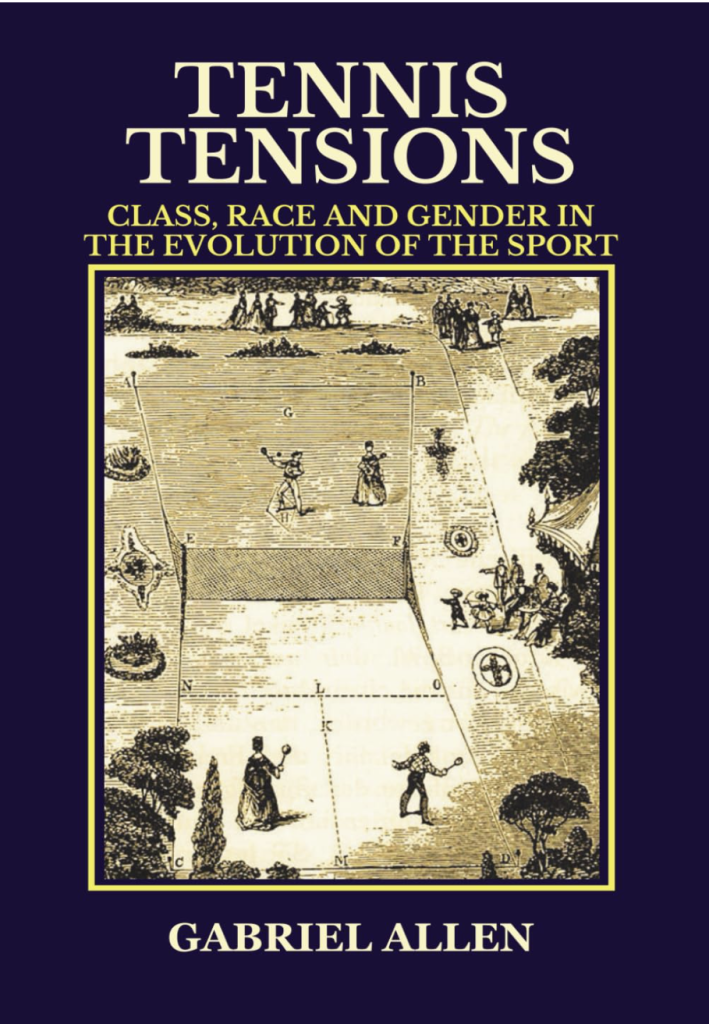
Book Review: Tennis Tensions, by Gabriel Allen

In his new book, Tennis Tensions, Gabriel Allen cites Olympic rower Anita DeFrantz: “Sport doesn’t lead society, it reflects it.”

This is closer to the truth than many people in the sports world would like to admit. For all the heroics of an Althea Gibson or Billie Jean King, there is only so much you can do with a tennis racket. More often, breakthroughs on the playing field come only when society is ready for them–and sometimes, as Gibson could attest, much later.

Allen organizes his book around the notion of a “white tennis unconscious,” a sort of privileged conventional wisdom that has influenced the sport’s rules and views since the early days of lawn tennis. (I, apparently, am one exponent.) I prefer a history of tennis that is less racially caricatured and more aware of the plethora of perspectives present at every step of the last century and a half. Still, Allen’s framework is a useful one to trace how and why Major Walter Wingfield’s “invention” of lawn tennis transformed into the game as we know it.

Wingfield’s game was a packaged product, a small set of equipment you could set up on a lawn that was already mowed for croquet. It owed a lot to badminton and a contemporary game known as “rackets.” But since badminton had come to Britain from India and rackets was associated with the lower classes, Wingfield called it something else. “Tennis” invoked real (or royal) tennis, a sport of kings, with associations that were more likely to appeal to the target market.

To his credit, the Major was a flexible man. As lawn tennis grew in popularity, practitioners and clubs began tweaking the rules. Wingfield proposed a second serve, as long as the first ball cleared the net and landed somewhere within the court; a rival set of rules axed the second serve entirely. Those who wanted a faster-paced game–one a bit less like badminton–sought to lower the net.

Allen walks us through these changes, showing how the prevailing mores of Victorian England pushed the game in certain directions. Tennis gained popularity as a game that could be played by both men and women: It was a great time for mixed doubles. The flip side, though, is that the game gained a reputation as a “sissy” sport. So the net came down … and came down some more … and came down still more, allowing for more powerful strokes. The service box was moved to mitigate the server’s advantage, but the second serve stayed, allowing physically strong players to go for broke without too much risk.

The organizers of the first Wimbledon championships imposed many of these rules unilaterally. Most revealing, not to mention galling, in Allen’s view, was what the club did to the scoring system. Wingfield’s suggestion came from rackets: First to 15 points, with points only won by the server; when the receiver won a point, they would gain the right to serve. You didn’t have to win by two, but at 13-all, the receiver could decide to play to 18, and at 14-all, the receiver could decide to play to 17. Soon after, the Marylebone Cricket Club settled on a simpler alternative of first to 15, win by two.

Maybe because of its simplicity, the scoring scheme reeked of lower-class games. Wimbledon imposed the old real tennis system: the sets, games, deuces, and ads we know today. Not everyone was pleased–even some early champions expressed their displeasure–but the traditionalists won the day. 148 years later, we’re still playing 40-point games.

Allen sees the decision as “classist” (a fair assessment) and the scoring system “beyond remedy” (more doubtful). He considers the standard rules too complex and sees it as not “equitable” that a player can win more points than their opponent and still lose the match. After rejecting several other alternatives, such as no-ad and Fast4, he introduces his own concept, the “Tiebreaker Match,” which is exactly what it sounds like. Typical tiebreak rules, but played to 60 or 100. No structural imbalances, and it’s impossible for the point-total winner to lose the match.

I don’t quite understand what’s inequitable about the scoring system: Nobody ever said the object of tennis was to win the most points, just as the goal in baseball isn’t to tally the most hits, or the ultimate object of ice hockey to minimize turnovers. It might feel unfair to the point-total-champion of the day, but it’s not some sort of insidious bias. Both sides have the same opportunity to win the match while losing on points.

More importantly, the quirky old rules work. We don’t really know why some games gain traction and stay popular while others don’t. Simplicity is rarely an advantage: Try explaining the rules of baseball, or the intricacies of the off-sides rule, then tell me that “15-30-40-game” is too much. I’m happy to grant that real tennis scoring was imposed on lawn tennis for the wrong reasons, but I don’t see that as poisoning the word “deuce” for ten generations. Had Wimbledon left the nets up high and stuck with first-to-15, we might have had another croquet on our hands. Carlos Alcaraz would be an up-and-coming midfielder for Real Madrid.

Once the scoring proposal is out of the way, Allen returns to his history. We get a useful recap of how amateurism was manipulated by the elites, peeks at couple of famous rivalries, and GOAT cases for Ora Washington and Richard Gonzalez. Tennis Tensions offers plenty of insights into how the sport has reflected society, especially in the early days, when a few Victorian men made decisions that continue to define modern tennis.
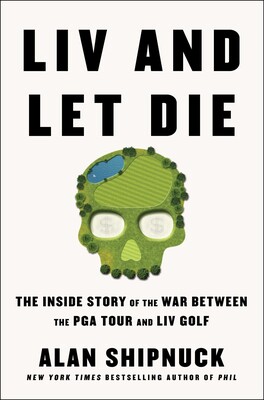
Review: LIV and Let Die, by Alan Shipnuck

Many tennis fans are worried about the arrival of money from Saudi Arabia in the game. This week marks a watershed, as the ATP NextGen Finals take place in Jeddah. It’s the first time an official tour event has been played in the Kingdom, though several star players have taken part in the Diriyah Cup exhibition, first held in 2019.

It could have been even more dramatic. For months, rumors swirled that the WTA Finals would go to Riyadh. The women’s tour has struggled to find a stable, well-funded home for its signature event, and the Saudis could solve the financial side in a single stroke. But it was too much, too soon: Enough players bristled at the idea of going to the kingdom that the proposed deal was shelved.

Apart from the fact that Saudi Arabia lacks history with the sport and has no professionals of note, the problem is the kingdom itself. Its leaders were tied to the 9/11 attacks and, more recently, ordered the murder of journalist Jamal Khashoggi. Crown Prince Mohammed bin Salman heads an authoritarian, repressive government that is particularly backwards in its treatment of women. No single one of these offenses would be enough to keep the tennis tours away–after all, the WTA recently crawled back to China, and the ATP never left. Still, the way the Saudis and other Gulf nations have used their immense oil wealth to muscle onto the world’s biggest sporting stages and attempt to “sportswash” their public images should give pause to everyone in tennis.

The loudest warning signal is the cautionary tale of the LIV golf tour. (The name is pronounced as in “live free” and represents the roman numeral for 54, the number of holes in the tour’s three-day events.) The Saudis took an existing idea for a new golf tour, then offered eye-watering signing bonuses and record prize money to the game’s stars. The resulting division left the PGA in dire financial straits, drowning in legal bills and struggling to retain sponsors. LIV launched in June 2022, and twelve months later, the rival tours reached a tentative agreement to merge, leaving the 108-year-old PGA as a junior partner.

This is the story of Alan Shipnuck’s new book, LIV and Let Die: The Inside Story of the War Between the PGA Tour and LIV Golf. A long-time golf writer, Shipnuck gives us the background on every aspect of the saga, including past disputes between the PGA and its players, the motivations of the stars who jumped (and those who didn’t), and the paths taken by various principals, from Yasir Al-Rumayyan, the golf-loving head of Saudi Arabia’s sovereign wealth fund, to PGA commissioner Jay Monahan, to former star and LIV CEO Greg Norman.

The personalities matter: The story could have turned out very differently. Al-Rumayyan is a golf fanatic, which meant that he had a personal stake in Saudi involvement in the game. Monahan, stung by the perceived threat of an earlier upstart, the Premier Golf League, saw LIV as an existential threat and refused to even speak to anyone from the Saudi-backed league, let alone seek a compromise. Norman, despite his status as one of the game’s all-time greats, has always been an outsider. Decades earlier, he had put together a proposal for a rival tour, only to be shot down by the old guard.

I approached this book with a specific question in mind: Could something like LIV happen to our sport as well? It likely could, and it probably wouldn’t even cost the interlopers quite as much money. (LIV spent well over half a billion dollars on signing bonuses alone.) At the same time, it probably won’t. As far as I can tell, the Saudis mainly want to be involved in international sport; it was only the confluence of personalities that led to their takeover of professional golf. So long as the ATP and WTA figure out a way to accept money from the kingdom–and probably host an event or three on Saudi soil–a rival tour would serve no purpose.

The Saudis seem to have two goals as they make one splash after another in the international sporting scene. Neither is new: Qatar, the United Arab Emirates, and many others have paved this path before. First, they want to clean up their image so that the international public views them as something other than a backwards, pariah nation. This is about more than just likeability: The less odious their reputation, the more likely that they can pursue international opportunities, whether that means investing in a major company or throwing a party at a famous venue.

Second, the Crown Prince realizes that oil wealth is not eternal and aims to diversify the economy. One prong of that strategy is to transform the kingdom into a major tourist destination. Sportswashing plays a role in this, but there’s more to it than just tidying an image. The nation needs destinations and events. Diriyah Cup was one, and years before LIV, there was a Saudi stop on golf’s European Tour.

Sport serves both goals. That said, a certain kind of sporting event is better than others. The key is star power. It’s one thing to become part of a major international tour, but I doubt many people have changed their view of Kazakhstan due to the ATP 250 in Astana. Much more useful is to be associated with a superstar. LIV would have been dead in the water without a few marquee names like Phil Mickelson and Dustin Johnson. The last Diriyah Cup featured Daniil Medvedev, Andrey Rublev, and Stefanos Tsitsipas. A Saudi football club offered more than $1 billion for Paris Saint-Germain star Kylian Mbappé.

Thus, the Saudis have focused on certain types of events and leagues. One of LIV’s innovations (lifted wholesale from the plans of the Premier Golf League, which never got off the ground) was to limit the number of tournaments so that the best players would face off, week after week. The PGA–like, to some extent, the tennis tours–didn’t do that, at least until LIV forced them to reconsider their calendar and rewards structure. For a promoter who wants a star-studded field, an exhibition is one solution–but it’s just an exhibition. Appearance fees are another approach: There’s a reason why ATP and WTA tournaments in Doha and Dubai tend to be stronger than the typical non-mandatory turnout.

The most straightforward solution is to host an event where the top players are required–or at least heavily incentivized–to participate. The WTA Finals fit that profile, as would an ATP Masters 1000 tournament. The LIV tour was a very expensive way of accomplishing that, as the 2023 campaign included 14 loaded fields, only one of which took place in Saudi Arabia.

If we were talking about some other oil-rich country–say, Nigeria or Norway–the solution would be simple. Local investors would buy an existing tournament license, or the calendar would be tweaked, so that a significant event would take place on home soil. That’s how Saudi Arabia got started in golf, hosting the 2019 Saudi International in King Abdullah Economic City. A women’s tournament was added in 2020, and in 2023, the prize money was raised fivefold to match the men’s purse. Saudi involvement in the Ladies European Tour is a useful template. By 2023, there was another event in Riyadh, as well as an Aramco-sponsored “Team Series” spanning five tournaments in other countries.

The question, then, is whether the negatives of Saudi involvement–primarily its human rights record–will stand in the way of tennis taking a similar path. The number of men who have flown in for the Diriyah Cup suggests that there isn’t much resistance on the ATP side. Winning over the WTA could be more complicated, but on the other hand, few leagues stand in greater need of a capital infusion.

Shipnuck, almost in passing, points out another risk of Saudi investment, and it is one that tennis should take seriously. The kingdom has enormous resources, and it is not afraid to deploy them. But its leaders are also fickle. They understand the concept of sunk costs; they are not afraid to abandon a billion-dollar project when circumstances change. This week, ATP executives will see first-hand the example of the Jeddah Tower, planned to be the world’s tallest building. Construction work was abandoned in 2018, and it resumed only two months ago.

For now, the intangible benefits and theoretical future cash flows of LIV golf outweigh the staggering costs. But it’s conceivable that at some point, the Saudis could simply walk away, leaving a fractured, diminished golf landscape in its wake like an unfinished skyscraper. Should tennis accept the kingdom’s financiers as partners, the risk might be even greater: There is presumably no tennis equivalent of golf-crazed Yasir Al-Rumayyan to keep the money flowing when logic dictates otherwise.

Fortunately, we have an advantage in that we’ve seen what Saudi money can do. By detailing how the golf world sailed off course in such a short period of time, LIV and Let Die is an essential playbook for decision-makers in tennis who would prefer to avoid the same fate.

* * *

Subscribe to the blog to receive each new post by email:


May 27, 1973: Behind the Scenes

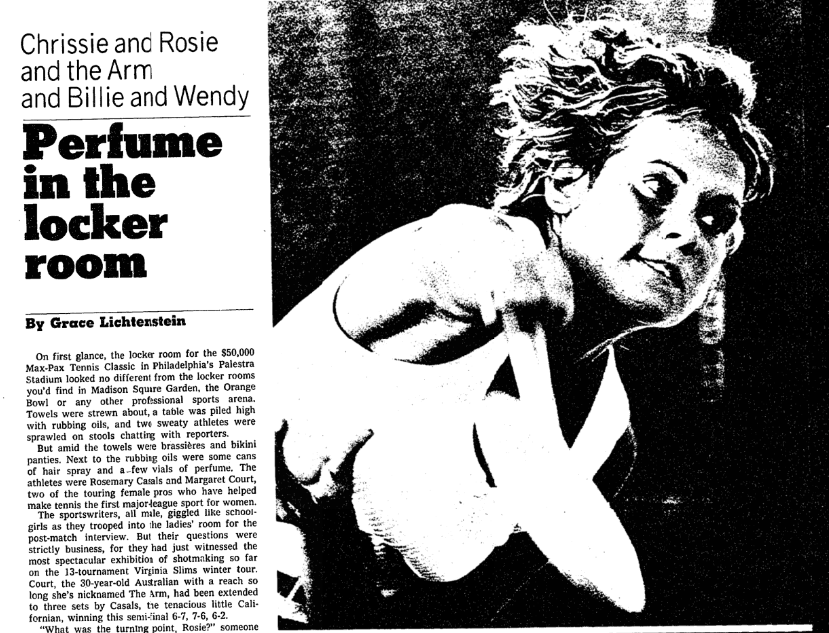
From the May 27, 1973 New York Times Magazine

The rapid growth of women’s tennis was about more than sport. Everybody knew that. The burgeoning Virginia Slims tour was dubbed “women’s lob.” Equal prize money, once unthinkable, was now a proposition that had to be taken seriously. Whatever Bobby Riggs might have to say about it, these ladies were damn good athletes, and their prominence had ripple effects across the culture.

It wasn’t just die-hard fans who wanted to know more. Press coverage of tennis had always tended toward the matter-of-fact: A recap of a notable match or two–usually between men–followed by a long list of results in microscopic print. Only in the 1960s did newspapers begin to venture the occasional feature story about a rising star or local hero of the courts. Diligent readers would learn that Margaret Court was a mother and that Chris Evert wore pigtails, but not much else.

An article in the May 27, 1973 New York Times Magazine was one of the first efforts to turn women’s tennis stars into multi-dimensional characters. Baseball had Jim Bouton’s 1970 tell-all, Ball Four, and Sports Illustrated employed a team of adventurous journalists filing features about football, basketball, and even–occasionally–men’s tennis. Grace Lichtenstein’s piece for the Times, “Perfume in the locker room,” did the same for the Slims.

Lichtenstein took the reader into the locker room after the final of the Max-Pax Classic in Philadelphia, where Rosie Casals puffed a cigarette and Court sipped a beer. She described life on the road, where players stayed with local families and some–like newcomer Martina Navratilova–struggled with the temptations of fast food.

It was easy to see athletes as a single movement. But as the article was quick to point out, “The players themselves were thoroughly individualistic.” They “never seemed to forget their dual roles as women and athletes,” even if each one handled the balance differently. The young Evert claimed, “No point is worth falling down over,” and she never took the court without makeup. Evonne Goolagong, on the other hand, earned the respect of her male colleagues with a different sort of attitude. One of them said, “she’s the only one [of the women] who wears a jock.” It was a compliment.

In this first major effort, Lichtenstein had to grapple with the relationship between the men’s and women’s games. But as she expanded the article to a season-chronicling book, A long way, baby: Behind the scenes in women’s tennis, the men–apart from husbands, boyfriends, and hangers-on–increasingly disappeared from the picture. Women’s tennis could stand alone. It was time for sportswriters to catch up, and Lichtenstein showed the way.

* * *

This post is part of my series about the 1973 season, Battles, Boycotts, and Breakouts. Keep up with the project by checking the TennisAbstract.com front page, which shows an up-to-date Table of Contents after I post each installment.

You can also subscribe to the blog to receive each new post by email:


Podcast Episode 113: Grace Lichtenstein on A Long Way, Baby and Women’s Tennis in 1973

In 1973, New York Times reporter Grace Lichtenstein was approached to write a book, A Long Way, Baby, about the fledgling women’s professional tour. It turned out to be a pivotal season in the sport’s history, and the book concludes with an in-person account of the famous Battle of the Sexes match between Billie Jean King and Bobby Riggs.

The subtitle of the book is, “Behind the Scenes in Women’s Pro Tennis,” and Grace got to know the players–including Billie Jean–well enough to deliver exactly that. In our conversation, we talk about how the book came about, how it was received, and what press coverage was like for women’s tennis in 1973. We also discuss how Billie Jean King has changed in the last half-century, the difficulty of covering tennis in such an intimate way today, and what it would take to write a behind-the-scenes look at a contemporary player such as Serena Williams.

If you have any interest at all in tennis in the 1970s, you should read A Long Way, Baby. It is out of print, but used copies are readily available. You can also read it on the web at the Internet Archive.

Carl Bialik and I also discussed the book in Episode 112, and it was a key part of the research for my Tennis 128 essay on Rosie Casals.

Thanks for listening!

(Note: this episode is about 23 minutes long; in some browsers the audio player may display a different length. Sorry about that!)

Click to listen, subscribe on iTunes, or use the feed to get updates on your favorite podcast software.

Music: Everyone Has Gone Home by texasradiofish (c) copyright 2020. Licensed under a Creative Commons Attribution Noncommercial (3.0) license. Ft: spinningmerkaba

This image has an empty alt attribute; its file name is tap_script_square-1-150x150.png

Podcast Episode 112: Carl Bialik on Rosie Casals and A Long Way, Baby

In this episode, Tennis Abstract Podcast veteran Carl Bialik joins me to talk about 1970s women’s tennis. The occasion for the discussion is the 115th player on my Tennis 128 list, Rosie Casals, and we also (sort of) bring back the book club to talk about Grace Lichtenstein’s 1974 book, A Long Way, Baby: Behind the Scenes in Women’s Pro Tennis.

Carl and I talk about whether the 2020s game would allow for such an insider’s account of a year on tour, why players seem less unique than Rosie and her peers did, and whether Casals’s reputation does her justice. We consider whether today’s game would be better off with top players who are more committed to competing week-in, week-out, whether 1970s-style barnstorming would open up new markets for tennis, and why Margaret Court got massacred on Mother’s Day when Billie Jean King straight-setted the same opponent a few months later. Also, Carl asks me a few questions about The Tennis 128 so far.

A Long Way, Baby–which I highly recommend–is long out of print, but used copies are readily available. You can also read it on the web at the Internet Archive.

Thanks for listening!

(Note: this episode is about 72 minutes long; in some browsers the audio player may display a different length. Sorry about that!)

Click to listen, subscribe on iTunes, or use the feed to get updates on your favorite podcast software.

Music: Everyone Has Gone Home by texasradiofish (c) copyright 2020. Licensed under a Creative Commons Attribution Noncommercial (3.0) license. Ft: spinningmerkaba

This image has an empty alt attribute; its file name is tap_script_square-1-150x150.png

Podcast Episode 108: Gerry Marzorati on Serena Williams and Tennis Coverage in the 21st Century

My latest episode features Gerry Marzorati, author of the new book Seeing Serena. You might also know him from the pages of The New York and Racquet magazine, as well as his earlier book, Late to the Ball.

The book follows Serena Williams throughout the 2019 season as she seeks her first grand slam title as a mother. We talk about the challenges and opportunities of getting to know players through press conferences, the role of print media when players can speak directly to their fans, and how Serena compares to other mega-icons. Gerry expands on his contention in the book that Williams is the most consequential player in tennis today–perhaps of all time–as someone that not only set records, but changed the way the game was played.

Gerry’s book is a rewarding read, a deep dive into one of the most important and fascinating figures in sports. Check it out.

Thanks for listening!

(Note: this week’s episode is about 58 minutes long; in some browsers the audio player may display a different length. Sorry about that!)

Click to listen, subscribe on iTunes, or use our feed to get updates on your favorite podcast software.

Music: Everyone Has Gone Home by texasradiofish (c) copyright 2020. Licensed under a Creative Commons Attribution Noncommercial (3.0) license. Ft: spinningmerkaba

This image has an empty alt attribute; its file name is tap_script_square-1-150x150.png

Podcast Episode 107: Book Club: Sudden Death, by Alvaro Enrigue

Episode 107 of the Tennis Abstract Podcast, with Carl Bialik of the Thirty Love podcast, is our fourth book club episode, a discussion of Alvaro Enrigue’s novel, Sudden Death.

The book is set around the year 1600, and a central feature is a real tennis match between the Italian painter Caravaggio and the Spanish poet Francisco de Quevedo. Enrigue is fascinated by the various ways tennis pops up in the documentary record of the era, a mix of high and low culture, cutting across continents and national borders.

The novel is digressive, so we follow suit and stray far afield from the contents of the book itself. Carl and I get into the advantages and difficulties of writing blow-by-blow descriptions of points, how many numbers is too many numbers, the various ways theatrical productions depict tennis, and why tennis fans seem so insecure.

Thanks for listening!

(Note: this episode is about 52 minutes long; in some browsers the audio player may display a different length. Sorry about that!)

Click to listen, subscribe on iTunes, or use our feed to get updates on your favorite podcast software.

Music: Everyone Has Gone Home by texasradiofish (c) copyright 2020. Licensed under a Creative Commons Attribution Noncommercial (3.0) license. Ft: spinningmerkaba

Book Club Selection #4: Sudden Death, by Álvaro Enrigue

The next pick for the Tennis Abstract book club is Álvaro Enrigue’s 2013 novel Sudden Death. Enrigue is Mexican, and he writes in Spanish. An English translation was published in 2017.

How could you not want to read this?

Sudden Death begins with a brutal tennis match that could decide the fate of the world. The bawdy Italian painter Caravaggio and the loutish Spanish poet Quevedo battle it out before a crowd that includes Galileo, Mary Magdalene, and a generation of popes who would throw Europe into the flames. In England, Thomas Cromwell and Henry VIII behead Anne Boleyn, and her crafty executioner transforms her legendary locks into the most sought-after tennis balls of the time.

I hope you’ll read along with us! We’re tentatively aiming to discuss in late May, just before the French Open gets underway.

Comments are open, so if you have thoughts about the book you’d like to share, or topics you think we should put on the agenda for the podcast episode about the book, please leave them here.

Past book club selections / podcast episodes:

Podcast Episode 105: Book Club: Days of Grace, by Arthur Ashe

Episode 105 of the Tennis Abstract Podcast, with Carl Bialik of the Thirty Love podcast, takes on the third pick of our book club, Arthur Ashe’s 1993 memoir, Days of Grace.

The book gives us a chance to get inside the mind of one of the most important figures in tennis history. He was the first African American man to rise to the top of the tennis world, played a leading role in the professionalization of the sport, spoke out against apartheid South Africa, captained the U.S. Davis Cup team through the turbulent Connors-McEnroe era, and ultimately used his battle with AIDS as an opportunity to educate the public and raise money to fight the disease.

Carl and I consider whether he is sufficiently remembered in tennis today, whether his game was as mercurial as he claimed, how he compares to Billie Jean King, and whether we should chill out about the latest round of changes to the Davis Cup.

Next up in the book club is Alvaro Enrigue’s novel, Sudden Death. I’ll post a bit more about that later this week.

Thanks for listening!

(Note: this week’s episode is about 64 minutes long; in some browsers the audio player may display a different length. Sorry about that!)

Click to listen, subscribe on iTunes, or use our feed to get updates on your favorite podcast software.

Music: Everyone Has Gone Home by texasradiofish (c) copyright 2020. Licensed under a Creative Commons Attribution Noncommercial (3.0) license. Ft: spinningmerkaba

Podcast Episode 103: Katrina Adams on Role Models, Grassroots Development, and Tennis Governance

This week’s episode features Katrina Adams, author of the new book Own the Arena: Getting Ahead, Making a Difference, and Succeeding as the Only One.

As a former player, coach, and commentator, and as the first African American to serve as president of the USTA, Katrina has a unique perspective on the world of professional tennis. She talks about the importance of giving proper credit to Althea Gibson and other Black tennis pioneers, why tennis is one of the best sports to help youngsters succeed off the court, how players should think about life after retirement, what the USTA can teach other national federations in and out of tennis, the underrated brilliance of Lori McNeil, and what she likes about the Dutch.

Katrina’s book is a great look at what it takes to go from a gifted junior to a top-ten doubles player to an influential executive, and I hope you’ll check it out.

Thanks for listening!

(Note: this week’s episode is about 44 minutes long; in some browsers the audio player may display a different length. Sorry about that!)

Click to listen, subscribe on iTunes, or use our feed to get updates on your favorite podcast software.

Music: Everyone Has Gone Home by texasradiofish (c) copyright 2020. Licensed under a Creative Commons Attribution Noncommercial (3.0) license. Ft: spinningmerkaba

This image has an empty alt attribute; its file name is tap_script_square-1-150x150.png