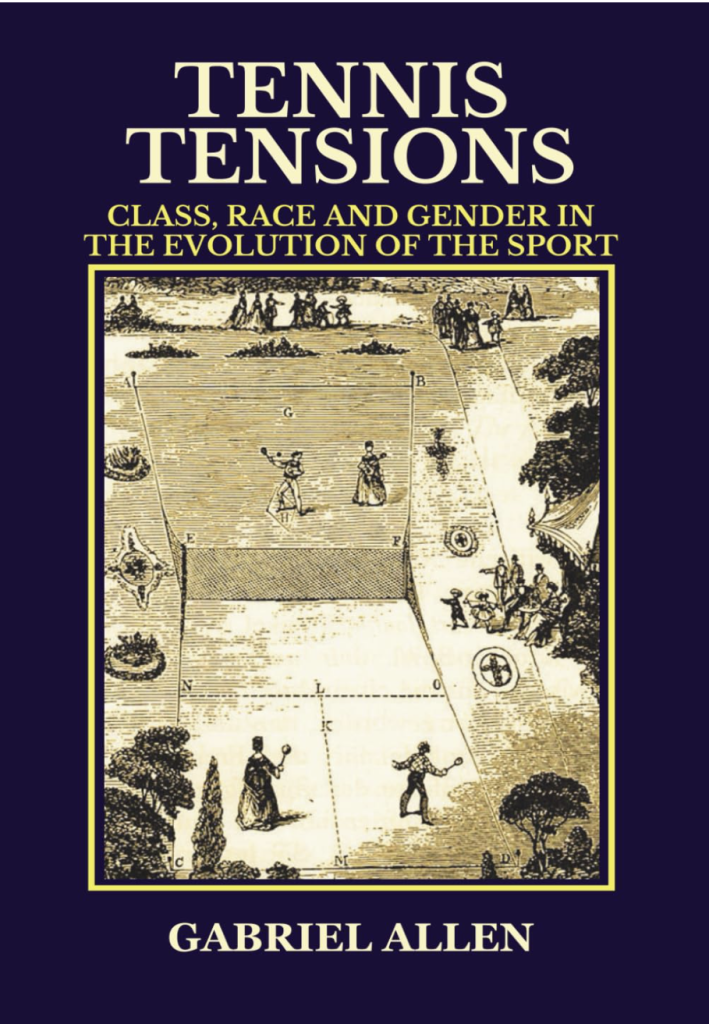
In his new book, Tennis Tensions, Gabriel Allen cites Olympic rower Anita DeFrantz: “Sport doesn’t lead society, it reflects it.”
This is closer to the truth than many people in the sports world would like to admit. For all the heroics of an Althea Gibson or Billie Jean King, there is only so much you can do with a tennis racket. More often, breakthroughs on the playing field come only when society is ready for them–and sometimes, as Gibson could attest, much later.
Allen organizes his book around the notion of a “white tennis unconscious,” a sort of privileged conventional wisdom that has influenced the sport’s rules and views since the early days of lawn tennis. (I, apparently, am one exponent.) I prefer a history of tennis that is less racially caricatured and more aware of the plethora of perspectives present at every step of the last century and a half. Still, Allen’s framework is a useful one to trace how and why Major Walter Wingfield’s “invention” of lawn tennis transformed into the game as we know it.
Wingfield’s game was a packaged product, a small set of equipment you could set up on a lawn that was already mowed for croquet. It owed a lot to badminton and a contemporary game known as “rackets.” But since badminton had come to Britain from India and rackets was associated with the lower classes, Wingfield called it something else. “Tennis” invoked real (or royal) tennis, a sport of kings, with associations that were more likely to appeal to the target market.
To his credit, the Major was a flexible man. As lawn tennis grew in popularity, practitioners and clubs began tweaking the rules. Wingfield proposed a second serve, as long as the first ball cleared the net and landed somewhere within the court; a rival set of rules axed the second serve entirely. Those who wanted a faster-paced game–one a bit less like badminton–sought to lower the net.
Allen walks us through these changes, showing how the prevailing mores of Victorian England pushed the game in certain directions. Tennis gained popularity as a game that could be played by both men and women: It was a great time for mixed doubles. The flip side, though, is that the game gained a reputation as a “sissy” sport. So the net came down … and came down some more … and came down still more, allowing for more powerful strokes. The service box was moved to mitigate the server’s advantage, but the second serve stayed, allowing physically strong players to go for broke without too much risk.
The organizers of the first Wimbledon championships imposed many of these rules unilaterally. Most revealing, not to mention galling, in Allen’s view, was what the club did to the scoring system. Wingfield’s suggestion came from rackets: First to 15 points, with points only won by the server; when the receiver won a point, they would gain the right to serve. You didn’t have to win by two, but at 13-all, the receiver could decide to play to 18, and at 14-all, the receiver could decide to play to 17. Soon after, the Marylebone Cricket Club settled on a simpler alternative of first to 15, win by two.
Maybe because of its simplicity, the scoring scheme reeked of lower-class games. Wimbledon imposed the old real tennis system: the sets, games, deuces, and ads we know today. Not everyone was pleased–even some early champions expressed their displeasure–but the traditionalists won the day. 148 years later, we’re still playing 40-point games.
Allen sees the decision as “classist” (a fair assessment) and the scoring system “beyond remedy” (more doubtful). He considers the standard rules too complex and sees it as not “equitable” that a player can win more points than their opponent and still lose the match. After rejecting several other alternatives, such as no-ad and Fast4, he introduces his own concept, the “Tiebreaker Match,” which is exactly what it sounds like. Typical tiebreak rules, but played to 60 or 100. No structural imbalances, and it’s impossible for the point-total winner to lose the match.
I don’t quite understand what’s inequitable about the scoring system: Nobody ever said the object of tennis was to win the most points, just as the goal in baseball isn’t to tally the most hits, or the ultimate object of ice hockey to minimize turnovers. It might feel unfair to the point-total-champion of the day, but it’s not some sort of insidious bias. Both sides have the same opportunity to win the match while losing on points.
More importantly, the quirky old rules work. We don’t really know why some games gain traction and stay popular while others don’t. Simplicity is rarely an advantage: Try explaining the rules of baseball, or the intricacies of the off-sides rule, then tell me that “15-30-40-game” is too much. I’m happy to grant that real tennis scoring was imposed on lawn tennis for the wrong reasons, but I don’t see that as poisoning the word “deuce” for ten generations. Had Wimbledon left the nets up high and stuck with first-to-15, we might have had another croquet on our hands. Carlos Alcaraz would be an up-and-coming midfielder for Real Madrid.
Once the scoring proposal is out of the way, Allen returns to his history. We get a useful recap of how amateurism was manipulated by the elites, peeks at couple of famous rivalries, and GOAT cases for Ora Washington and Richard Gonzalez. Tennis Tensions offers plenty of insights into how the sport has reflected society, especially in the early days, when a few Victorian men made decisions that continue to define modern tennis.
Thank you. An interesting read, as always. I’ve very much missed your regular blog entries.
There are plenty of tennis writers and journalists who have opinions. There are some who back up their opinions with proper use of data, others who back up their opinions with a deep knowledge of the history of the sport. You are a rare gem in doing both so intelligently and articulately and to such a high level.