The Tennis 128: No. 42, Althea Gibson

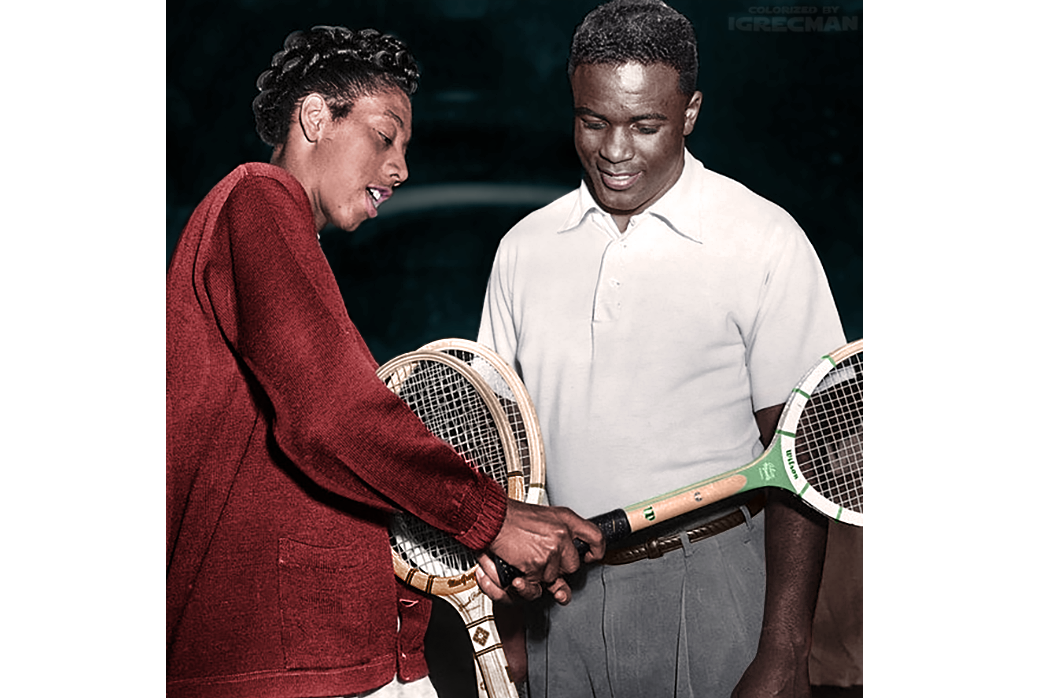
Althea Gibson and Jackie Robinson in 1951
Colorization credit: Women’s Tennis Colorizations

In 2022, I’m counting down the 128 best players of the last century. With luck, we’ll get to #1 in December. Enjoy!

* * *

Althea Gibson [USA]
Born: 25 August 1927
Died: 28 September 2003
Career: 1946-60
Played: Right-handed (one-handed backhand)
Peak rank: 1 (1957)
Peak Elo rating: 2,386 (1st place, 1957)
Major singles titles: 5
Total singles titles: 74
 

* * *

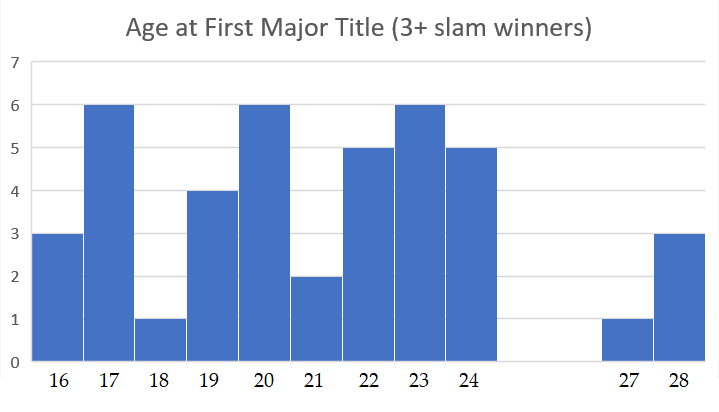
Since the end of World War I, 42 women have won three or more grand slam titles. The list runs the gamut from Suzanne Lenglen, who picked up her first in 1919, to Iga Świątek, who recorded her third victory a few weeks ago.

The average age of these superstars at the time of their first major title was 21 and a half. One in three scored their first championship when they were still in their teens. Only four were still slamless on their 27th birthday: Althea Gibson, Angelique Kerber, Margaret Osborne duPont, and Hilde Sperling.

Here’s a histogram of the age distribution, from the trio of 16-year-old first-timers to the lonely quartet of 27- and 28-year-olds:

Beginning a multi-slam career, clearly, is a young woman’s game. In one way, this is obvious. If you win a major as a teen, you have a decade or more ahead of you. In the amateur era, that might have meant 20-plus chances to win more. Today, with players entering all four slams each year, it could mean 40 or more bites at the cherry.

We can also look at this in the reverse direction. If you are the type of player who will be capable of winning a major when you’re 28, you’ll probably peak earlier–often much earlier. Plenty of women in both the amateur and Open eras have won majors at age 28 and beyond, but they are typically the same stars who racked up titles earlier in their careers.

If you manage to win three slams despite starting at such a late age, you’ve defied the aging curve. There’s often an external factor that serves as an explanation. Osborne didn’t win a major until 1946, in part because World War II limited her to one chance per season for six years before that. Sperling started late, and she wasn’t helped by Germany’s exclusion from international tennis after the first World War. She didn’t play a major until she was 21, and her first Wimbledon entry was a year after that. Kerber was just a late bloomer; she’s one of many 21st century stars to challenge the notion that tennis is a young woman’s game.

That leaves Althea Gibson. She played her first major at Forest Hills in 1950, just as she turned 23 years old. She went to Wimbledon the following year, but didn’t make her second trip until 1956, when she was 28. She entered only 15 slams in her entire career, more than half of them after her 28th birthday.

She was a late bloomer, yes. But calling her that is a bit like blaming a dying plant when you forget to water it.

Gibson, a Black woman born in the American South, pried open the doors of racial segregation in tennis at the US National Championships in 1950. Six years later, she reached the Forest Hills final; a year after that, she was the Wimbledon and United States champion and the undisputed best player in the world.

Compared to the fate of the Black players who preceded her, such as Ora Washington, Althea’s career was an unadulterated triumph. She broke new ground for her race nearly every time she stepped on court, ultimately changing the course of American tennis. But compared to what might have been, Gibson’s five major titles and her two- or three-year run at the top are just glimpses of what was possible.

As I’ve said, if a player is capable of winning a major at age 28, they were probably just as good, if not better, years earlier. Althea wasn’t, through no fault of her own. Any analysis of her accomplishments needs to keep in mind that, long after she integrated tennis, the segregated history of the sport severely handicapped her progress.

Gibson is one of the game’s all-time greats. Yet she could have–should have–achieved even more.

* * *

Young Althea started winning tournaments almost as soon as she picked up a tennis racket. She grew up in Harlem, where the local Police Athletic League gave her a taste of a variety of sports. She played paddle tennis from a young age, then fell in love with basketball. She only held her first full-size racket when she was 13.

She won her first tennis trophy when she was 14. In 1944 and 1945, she scored national junior titles at American Tennis Association (ATA) events–the unofficial championships of Black Americans. It was a smooth transition from there to the adult division of the Black game. In 1946, she won two regional events and reached the final of the national tournament, narrowly losing to veteran Roumania Peters.

Embed from Getty Images

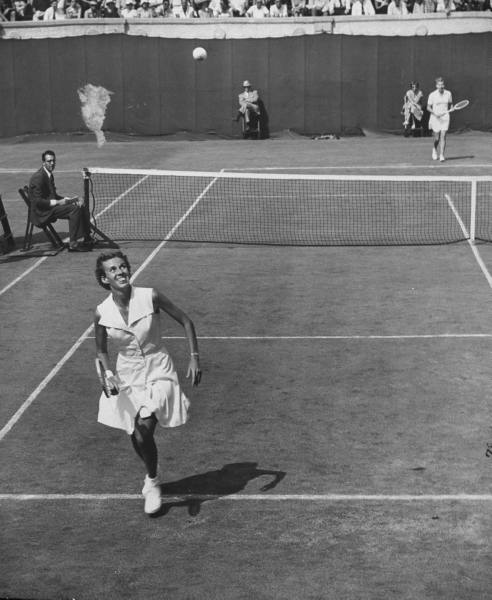
Gibson in 1950

As a 19-year-old, Gibson established herself as the best player of her race. She played a circuit of six tournaments and won the lot. While the existing records don’t cover every early-round match, there’s no evidence she lost as much as a single set. In another meeting with Peters for the 1947 national championship, she got her revenge, 7-5, 6-0.

She would play the ATA nationals every year until 1956. No one ever beat her there again.

It’s worth taking a step back here and considering the effect of her skin color on the budding star. The USLTA–the governing body of (white) tennis in the United States–was always on the lookout for prospects. Local associations would raise money to send promising teens to the national junior tournament in Philadelphia. Tournament organizers at Forest Hills liberally handed out entries to teens with little experience. Most of the youngsters crashed out early, but that wasn’t the point. Pooh-bahs of the tennis establishment got a look at the rising talent, and up-and-comers gained from the experience.

Gibson benefited from none of this. The pipeline was reserved for white girls.

Althea did have her supporters. Local sponsors in Harlem paid for her first lessons. A pair of patrons, Dr. Robert Walter Johnson and Dr. Hubert Eaton, helped her complete her education and get to tournaments beyond easy commuting distance. Johnson, Eaton, and promoters of the Black game such as Arthur Francis are unsung heroes of the integration story. They assiduously scouted for and developed the talent that could knock down the color barrier. Without them, American tennis would’ve been whites-only for another decade or more.

The one thing that Black supporters couldn’t do for Gibson was arrange matches with high-quality white opponents. Shirley Fry, an excellent junior player from Ohio, was just a few months older than Althea. In 1947, the year that the young Black star won her first ATA title, Fry made her seventh appearance at Forest Hills. When the color barrier finally came down, Gibson had a lot of catching up to do.

* * *

It’s remarkable, then, just how quickly Althea proved herself capable of competing at the highest level.

Dr. Reginald Weir became the first Black entrant at a major USLTA event in 1948, when he competed at the National Indoor tournament in New York. Althea followed a year later, winning matches at both the Eastern Indoor Championships and the National Indoor event in 1949. That was the extent of her welcome; she didn’t play another USLTA tournament until the following year.

In 1950, it was clear she belonged. She won the Eastern Indoors, progressing past five solid regional players without the loss of a set.* A month later, she finished runner-up at the National Indoors to Nancy Chaffee, a strong Californian who would be ranked fourth in the world a year later.

* Althea’s first-round opponent at the Eastern was Veronika Katilius, a former Lithuanian champion who had fled her Soviet-occupied homeland just a few months earlier. Katilius would later coach a young Vitas Gerulaitis.

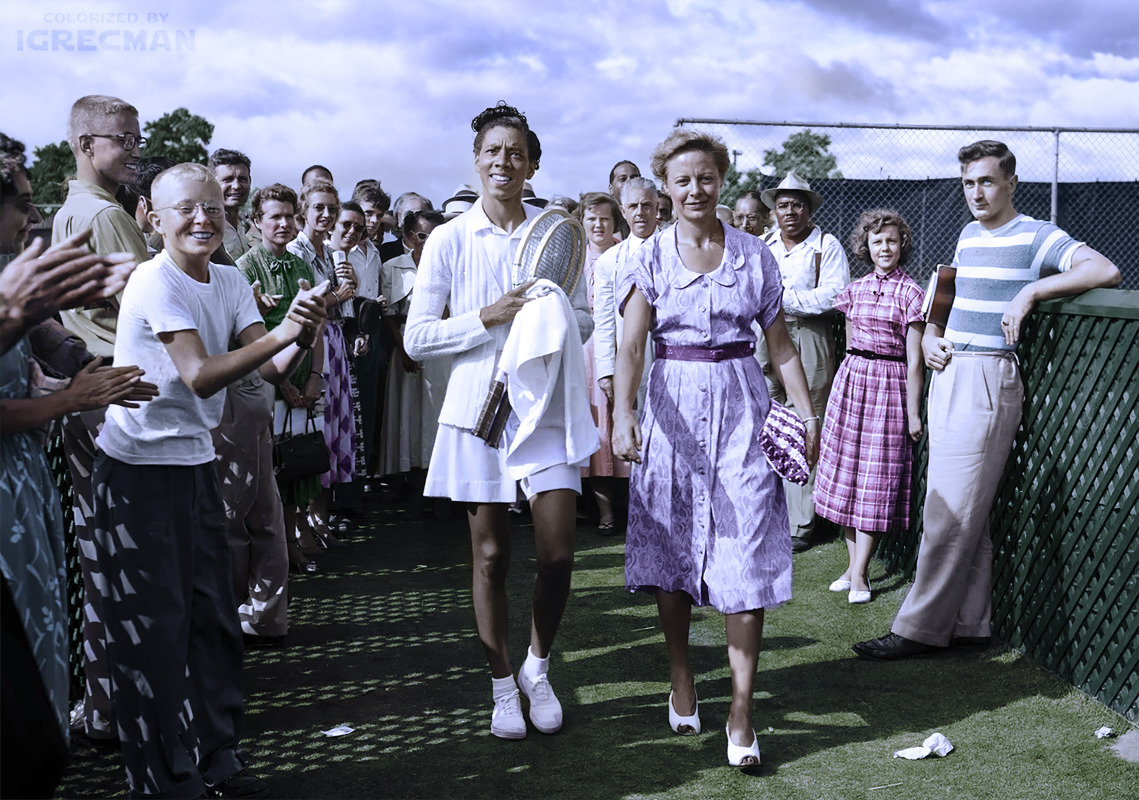
That summer, thanks in large part to the lobbying of former champion Alice Marble, Gibson was finally invited to play at Forest Hills. The national tournament was played on grass, presenting another challenge beyond the unfamiliar opponents and the gawking crowds. Sarah Palfrey offered Althea a crash course in grass-court play. Palfrey noticed that the five-foot, eleven-inch young woman struggled to get down to low balls, but “[h]er natural timing and big, catlike strides were useful for the faster pace of a grass court.”

Gibson arrives at Forest Hills in 1950 alongside Alice Marble
Colorization credit: Women’s Tennis Colorizations

Louise Brough would soon discover the same thing. Althea won her first match at Forest Hills easily, setting up a second-rounder with Brough, the reigning Wimbledon champion. Both women struggled with nerves as they split the first two sets. Gibson grappled with the pressure and the packed grandstand court, Brough with the realization that the newcomer might get the better of her. They settled into a third-set slugfest that many onlookers thought Althea would win. Stormy weather halted their progress with Gibson leading, 7-6 in the third.

These days, a player with a suspended match would race back to the clubhouse, hide from reporters, and switch on Netflix to zone out until the next day’s resumption. The old Forest Hills venue left players particularly exposed, and Althea was besieged. She came back the next day as nervous as she had been at the start of the match. Still, after Brough equalized for 7-all, Gibson fought through five deuces before conceding her own serve. The Wimbledon champ secured her victory, 6-1, 3-6, 9-7.

Outcome aside, it was clear that American tennis had a new star. It would take six long years for her to realize her full potential.

* * *

Althea posted a respectable sophomore campaign in 1951. Balancing tennis with her studies at Florida A&M University, she won five titles and got her first taste of European tennis.

Still, her results pointed back to the match experience she had missed in her early years as the queen of the Black tournament circuit. Against second-rate white competition, she never lost. Faced with a top-tenner, she barely stood a chance. She lost to Chaffee again at the National Indoors, and she dropped decisions elsewhere to Fry, Doris Hart, and Beverly Baker Fleitz. On the American grass-court circuit, she had the misfortune of running into the fast-rising Maureen Connolly–twice.

The 41 matches Gibson played in 1951 were the closest she would come to a full season until 1956. Her attempt to belatedly climb the ladder of American tennis exposed a vicious circle of the amateur era. To improve, you needed match play. To become match-hardened, you needed to go where the top players were competing. To get there, you had to have a high ranking… or some alternative source of financial support. The USLTA wouldn’t bankroll more of Althea’s travel until they thought her results justified it. (And, presumably, they held her to a particularly high standard.) The money wasn’t coming from anywhere else.

The 1957 Wimbledon final (from 0:35). Click here for extended highlights.

Lester Rodney was a journalist who covered the Black stars of integration-era baseball. He wrote of Gibson’s first appearance at Forest Hills, “In many ways, it is even a tougher personal Jim Crow-busting assignment than was Jackie Robinson’s when he first stepped out of the Brooklyn Dodgers dugout.”

Rodney was referring to the loneliness of a single competitor representing her race for the first time in an individual sport. Indeed, “lonely” is a word that comes up again and again in descriptions of Althea’s time on the circuit.

But once the color barrier was down, Gibson’s real challenge was structural, not psychological. She had to pay the bills, and the amateur-era establishment did little to help. Jackie Robinson at least got a regular paycheck. The USLTA held to a stricter definition of professionalism than other national federations, so the usual workarounds–endorsements, no-show jobs, etc–weren’t allowed. Top male players might land a flexible gig with a tennis fanatic for a boss. But in the 1950s, women who hoped to take time off for tournaments were generally stuck temping in a secretarial pool.

So Althea finished her degree, found a job at Lincoln University in St. Louis, and played a few tournaments every summer. By 1955, she was ready to quit tennis entirely.

* * *

It’s a good thing she stuck with it. A State Department tour through Asia in the winter of 1955-56 launched Gibson on one of the most extraordinary breakout seasons in history.

She played her way through Southeast Asia, India, and Pakistan, befriending her future doubles partner, Angela Buxton. The tour left her in Europe in time for the winter indoor season. In Stockholm, Cologne, Paris, and Lyon, she won three tournaments and 12 of 13 matches (at least–records may not be quite complete), easily handling the best competition on the Continent. The only woman who could beat her–the only opponent who would do so for months–was a stubborn Brit, Angela Mortimer.

When the circuit shifted to clay courts, Gibson was even better. After dropping a pair of finals to Mortimer in Egypt, she won seven straight tournaments on dirt. The streak culminated in her first major championship, a victory at Roland Garros, where she finally turned the tables on her British tormentor. She defeated Mortimer in the Paris final, 6-0, 12-10.

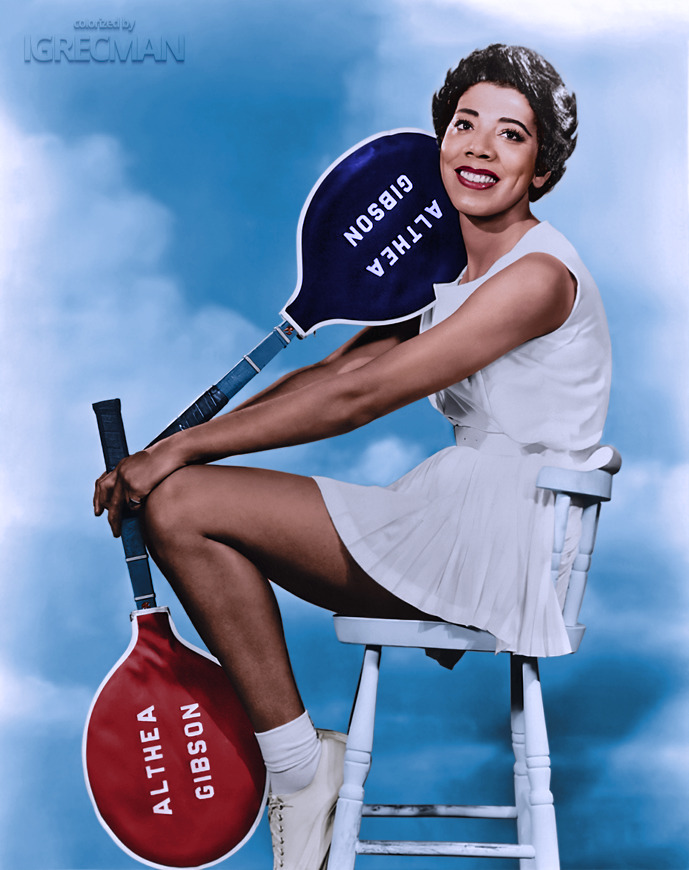
Althea in 1959
Colorization credit: Women’s Tennis Colorizations

By now, she was impervious to surface. Althea won the first three grass-court events she played in Britain, knocking out Shirley Fry and Louise Brough in back-to-back matches at the Northern Championships in Manchester. She entered Wimbledon on a 44-match win streak.

Her next seven months were even better. Between Wimbledon and the Australian Championships in January 1957, Gibson won 70 of 75 matches. She claimed titles–ten of them–on three continents. The only obstacle standing behind Althea and total world domination was Shirley Fry, the unassuming retriever who had a knack for absorbing power and grinding out tough victories. All five of Gibson’s losses in that span came against Fry–at Wimbledon, Forest Hills, and the Australian Championships.

* * *

I suspect that Althea would’ve soon figured out how to beat Fry. As it turned out, she didn’t have to. On the Australian trip, Shirley met her husband-to-be, got pregnant, and retired from tennis.

With Fry out of the picture, Gibson towered over the field to an extent that hadn’t been seen since the reign of Alice Marble in the 1930s. After the 1957 Australian final, she didn’t lose another match for the entire season. She defended her titles in England and cruised to her first Wimbledon championship without dropping a set. The young British hope Christine Truman managed just two games in the semi-final. Darlene Hard won only five in the final.

Back home, Althea sent Louise Brough into retirement as well. The two women met in four finals, and Gibson won the lot. Brough’s fearsome kick serve always threatened to keep things close, but when the stakes were high, Gibson simply dominated. She beat Louise for her first Forest Hills final, 6-3, 6-2. At the Pacific Southwest in Los Angeles a month later, she won the title match, 6-3, 6-1.

The 1958 Wimbledon final. Click here for extended highlights.

1958 was just as good. After a few blips on the Caribbean circuit–Althea lost two decisions to Janet Hopps and a third to Beverly Baker Fleitz–she was unbeatable once again. Between May and August, Gibson won 33 straight matches. She defended her Wimbledon and United States crowns, conceding just three sets in a four-month span.

When she won the 1958 Forest Hills title, Gibson had just turned 31 years old. She would finish the year as the world number one for the second straight year–third, if you go by my historical Elo ratings. She had broken every barrier there was to break in her sport.

* * *

Had she continued competing on the amateur tour, the reigning number one probably could’ve doubled her career total of five majors–at least. The years immediately after she stepped away were something of a transition period. Maria Bueno was the only star who might have challenged her before Margaret Smith (the future Margaret Court) came along in the early 1960s.

But after her 1958 triumphs, Althea was ready to move on. She told Sarah Palfrey the year before, “Let’s face it: I’ve gotta make good while the iron’s hot.” She had seen her fellow 1957 Wimbledon champion, Lew Hoad, sign a pro contract worth $125,000. She knew the bleak history of women’s professional tours, but she felt it was time for conquests that could be measured in dollars.

After playing (and winning) the 1959 Pan-American Games in Chicago, Gibson went pro. She wrote a book, went to Hollywood, tried her hand at acting, and released an album of jazz standards. She signed on for the inevitable barnstorming tour, playing against Karol Fageros as the opening act before Harlem Globetrotters basketball games. Fageros was better known for her looks than her tennis skills, and Gibson won 114 of their 118 meetings.

https://www.youtube.com/watch?v=TcwvbIP5Ml8
Althea sings

There never were any suitable job openings for a retired Black woman tennis star. Gibson joined the pro golf tour, breaking more racial barriers and setting the occasional course record, though she never approached the top of the world rankings. She wrote another memoir and attempted a couple of tennis comebacks when the professional and amateur games merged in the Open era.

Althea was, in so many ways, born too soon. Around the age that Gibson finally reached the apex of the game, most of her white peers on the circuit retired to get married, raise families, and perhaps coach a little tennis on the side. That was what was expected of them, and after their youthful forays into competitive sport, that was what they did.

Gibson had to fight for a right to play on the circuit. She struggled for years to get enough competitive match play to reach her potential. Having achieved everything an amateur tennis aspirant could hope for, she found herself back at square one, searching for a place in a world that didn’t quite know what to make of her.

It might have been little consolation to Althea in 1959, but her struggles made so much possible, for both Black stars and women athletes in general. While she never got a proper sendoff at Forest Hills herself, there’s a direct line running from her own accomplishments in the 1950s to the Serena Williams retirement party that defined the 2022 US Open.

* * *

Previous: No. 43, Guillermo Vilas

Next: No. 41, Doris Hart

Subscribe to the blog to receive each new post by email:


The Tennis 128: No. 43, Guillermo Vilas

Guillermo Vilas at Forest Hills in 1977

In 2022, I’m counting down the 128 best players of the last century. With luck, we’ll get to #1 in December. Enjoy!

* * *

Guillermo Vilas [ARG]
Born: 17 August 1952
Career: 1972-88
Plays: Left-handed (one-handed backhand)
Peak rank: litigation pending
Peak Elo rating: 2,298 (1st place, 1977)
Major singles titles: 4
Total singles titles: 62
 

* * *

Was Guillermo Vilas ever the number one player in the world?

It depends who you ask. These days, the ATP ranking formula is the only game in town. You might disagree with its priorities or its conclusions, but the ATP computer is as official as it gets. By that standard, Vilas topped out at number two. At the end of 1977, a season in which the Argentinian dirtballed his way to a 131-13 record and 16 titles, he was still number two. Jimmy Connors held the top spot.

The ATP rankings were only four years old in 1977. For decades, players and tournaments had relied on lists published by journalists, national federations, and various other panels of experts. Those tables didn’t simply go away when the player’s association unveiled its own formula. Most of the pundits looked at Vilas’s record–including championships at Roland Garros and the US Open–and decided that he, not Connors, was the left-hander who belonged at the top of the heap.

It gets even more complicated. In the early years of the computer rankings, the ATP didn’t publish an updated list every week, as they do now. Journalist Eduardo Puppo made it his personal mission to correct the record. With the help of Romanian mathematician Marian Ciulpan, he reconstructed the rankings for those missing weeks. Their work suggests that, had the association bothered to keep the table current, Vilas would have been number one for seven weeks in 1975 and 1976.

Vilas (left) striking a familiar post-match pose, with Željko Franulović in 1975

The controversy should’ve ended there. Ciulpan’s database of results is at least as complete and accurate as the ATP’s own. His effort to recreate the ranking formula of the time reflects far more diligence than the player’s body ever mustered on its own.

But no. Tennis has rarely left a potential multi-year legal battle unfought.* When Puppo and Ciulpan presented their research, the ATP didn’t refute it. They essentially ignored it. In their record books, Vilas remains outside the coveted number one club.

* The WTA set a better example. Evonne Goolagong was never recognized as number one during her career. When the organization discovered, in 2007, that she should’ve briefly held the position in 1976, they fixed the mistake and have properly celebrated the Australian’s status ever since.

The strange thing about accepting the ATP’s own measurement as gospel is that the measuring stick itself has changed. The association has tweaked its ranking algorithm continually in its 49 years of existence. The formula has changed a great deal since 1977. The current system is additive–that is, players are ranked according to the sum of the points earned in their best 18 events. (Caveat caveat caveat, of course it’s not that simple, but that’s the basic idea.) When Vilas was at his peak, the system was based on an average of points per tournament. That approach tended to favor those who played more limited schedules–and excelled at a few major events–at the expense of those who toiled for more weeks of the year.

If the current formula were applied to the 1977 season, Vilas would look much better. He won two majors, reached the Australian Open final, and won 14 other titles. We could quibble over the details of how that translates into points on the modern scale. Bottom line, it would almost definitely earn him the number one spot. Connors, with his zero-slam campaign, wouldn’t come close. Ironically, Jimbo might fall all the way to third. While Björn Borg didn’t play as much as either man, he won Wimbledon and posted a won-loss record of 75-6.

One more opinion. My historical Elo ratings–the system that comes closest to estimating how well each man was playing and how likely they were to win later matches–concur that Vilas was number one. He earned the spot for one week in 1975, then 31 more weeks between October 1977 and March 1978.

For me, the issue is settled. Vilas was the best player in the world. Knowledgeable fans have thought of the left-hander as number one for 45 years, and the ATP is doing itself a disservice by blocking the Argentine from its most elite club. All that’s left is to shift around a few bits on a database server in Florida.

* * *

All the talk about rankings obscures just how mind-blowing that 1977 season was. Vilas–known all over the world as “Willie”–is the only man in the Open era to ever win 16 titles in the same calendar year. His 131 match victories are also a record. (One source even gives him 139. That might count exhibitions. Either way: He won a lot.)

Between Roland Garros and a tournament in Aix en Provence in late September, the Argentine won 53 consecutive matches on clay courts. He lost the Aix final to Ilie Năstase–in questionable circumstances I’ll get back to in a moment–then ran off another 21 in a row to finish the season.

Reverse the result of the Năstase match, and that’s a 75-match clay court winning streak. It might have even hit 80. Willie pulled out of a Madrid tournament the week after Aix, citing an injury he picked up playing the Romanian.

The 1977 Roland Garros final

The only objection one could make to Vilas’s dominance in that stretch is that he generally managed to avoid the other best players in the world. Borg skipped the French Open because he was committed to World Team Tennis*, so the Argentine didn’t meet Borg for his entire streak. They had played twice on clay in April, and Björn won both meetings. Vilas faced Connors only once. At least the South American took that opportunity to make a statement. In the US Open final, he sent Jimbo home in four sets, finishing the job 6-0.

* Yes, WTT was so prominent (read: it paid so well) in the mid-1970s that players were willing to miss Roland Garros.

In the other 73 matches that made up Vilas’s streaks, he defeated anyone who dared show up for an event on dirt. Brian Gottfried was the closest thing the United States had to a clay court specialist. Gottfried reached the French final and took only three games from the Argentine in three sets. Sports Illustrated called him “bewildered.” The pair played two more finals that summer, and Willie didn’t drop a set. Raúl Ramírez, Eddie Dibbs, Roscoe Tanner, Harold Solomon, Wojtek Fibak, Stan Smith, Jaime Fillol… Vilas beat them all.

* * *

He beat them all, except for Năstase. I promised I’d come back to that.

Năstase played the Aix final with a “spaghetti-strung” racket, a twisted, Frankensteinian stringing job that gave its possessor catapult-like power combined with unpredictable, sometimes violent bounces. It wasn’t easy to get under control, but a player who could tame it could drive his opponents nuts.

The spaghetti stringing involved a variety of unlikely materials–nylon, fishing line, and adhesive tape. The process involved doubling the cross strings with the oddball additions. It wasn’t against the rules because at the time, there were no rules governing the nature of rackets and their strings. The evil genius responsible for this was a German horticulturist named Werner Fischer, who ultimately offered both a racket and the off-the-wall stringing job for $100 a pop. German pros generally wrote him off as an eccentric, but he caught the attention of Barry Phillips-Moore, an Australian veteran who took the racket on tour.

At first, Phillips-Moore tried to keep the details of the stringing job to himself. But Mike Fishbach, an American player from Long Island struggling to get a foothold on tour, took a good look and decided he could recreate the effect himself. 30 hours of work later, he had his own spaghetti racket. Fishbach deployed it at the 1977 US Open. He made it through qualifying, then beat Billy Martin and Stan Smith.

Mike Fishbach and the racket that earned him his 15 minutes of fame

The racket was such a sensation that it threatened to outshine the more conventional tennis elsewhere on the grounds. It didn’t take a traditionalist to object to the radically different effects that the double-strung weapon made possible. John Feaver, a Brit who earned more than a few clubhouse back-slaps by defeating Fishbach in the third round, described what he was up against:

You don’t know what’s going on with the bloody thing. You can’t hear the ball come off the racquet. It looks like an egg in flight, and you can’t pick it up until it’s halfway on you. When it bounces, it can jump a yard this way or that way, and up or down.

* * *

Everybody hated the new racket. But everyone also noticed that it worked. A few weeks after the Open, Năstase went to Paris, where he found himself bounced in the first round of the Coupe Porée by the unheralded Georges Goven. Goven’s racket was spaghetti-strung.

The Romanian didn’t approve, saying, “In future I shall refuse to play.” Patrice Dominguez was another early loser in Paris, and he led the French Union of Professional Tennis Players in seeking an immediate ban.

Christophe Roger-Vasselin made the finals of the Coupe Porée with a double-strung racket. The only man who could stop him was Vilas.

By the next week in Aix en Provence, Năstase had decided that he might as well join the crowd. The number of spaghetti stringing jobs kept increasing. Vilas faced one in the semi-finals, needing five strenuous sets to get past Eric Deblicker, a Frenchman even more anonymous than Goven. That put him in the final against Ilie.

Vilas, earlier in 1977, against Năstase with a conventional racket

Năstase wasn’t as good on clay as the Argentine–at that point, no one was–but he wasn’t far off. Combine Ilie’s shotmaking with the hyper-powered strings, and Vilas had no chance at all. Năstase won the first two sets, 6-1, 7-5, and Guillermo refused to continue.

Gene Mayer, a young American on tour, saw the match:

Năstase with his top spin off the spaghetti racket is impossible to play against unless you have the racket yourself. Guillermo worked his tail off. I’ve never seen him try harder. Those two sets were like seven. It’s a miracle–a monument to his strength–that he got those five games in the second set. Only he could get five. As far as the players are concerned that wasn’t a loss. Vilas’ clay-court streak was still alive.

A month later, the whole thing was moot, a wrong turn on the road to better equipment technology. The ITF placed a temporary ban on the stringing technique–made permanent the following year–and the USTA forbade it shortly thereafter. Fishbach picked up a few more wins, but Willie was untroubled by spaghetti rackets the rest of the season.

There is, however, a tantalizing postscript. Vilas–already the best, or second-best clay-court player in the world–couldn’t help but try out the double-strung racket himself. “[I]n his training matches,” said coach Ion Țiriac, “Guillermo simply is unbeatable!”

* * *

I went down the spaghetti-racket rabbit hole partly because I couldn’t resist, but partly to demonstrate just how far rivals had to go to challenge Vilas on clay. He was that good.

He arrived on the North American scene in 1974, a clay-court savant with a backhand that, as journalist Joe Jares described it, “lands in his opponent’s court at a zillion RPMs and scoots for cover like a terrified jackrabbit.” He mixed that up with a slice, and he was willing and able to run all day. In his breakout season as a 22-year-old, he picked up seven titles.

If anything was missing, it was the single-minded focus that would come to define his rival, Borg. Vilas styled himself a poet, even self-publishing a book. (It sold out two print runs. Reviews were, let us say, mixed.) He enjoyed his newfound celebrity and sampled the dating field of international starlets.

The Argentine also seemed to lack the vaunted killer instinct. Țiriac said, “This guy not capable in life to kill a fly.”

When Vilas teamed up with Țiriac–the Brașov Bulldozer who had led Năstase to superstardom and inspired every sports journalist on earth to learn the word “glowering”–he let the coach take over everything. Țiriac handled scheduling, endorsements, exhibitions, and more. If it were possible to outsource a killer instinct to one’s coach, Willie would’ve done it. The combination would’ve created the greatest tennis player of his era.

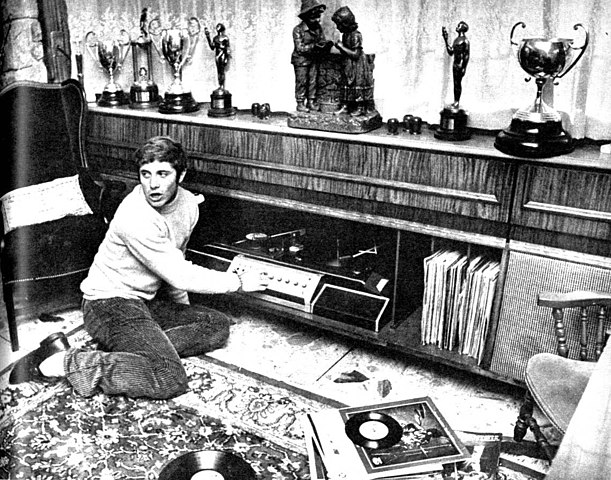
Vilas with his record collection, in 1973

What Țiriac could do was ensure that his charge was the fittest man on tour. Fellow players would collapse halfway through Țiriac-Vilas practice sessions. The Romanian coach worked out a strategy for every opponent, then drilled it until it could be drilled no more.

In the 1977 US Open final, Vilas exposed a Connors weakness by constantly chipping to Jimbo’s forehand. “You like that shot?” Vilas asked reporters after match. “I practice that one nine hours or something [in the] last few days.”

* * *

1978 opened with the belated culmination of the 1977 season. The Masters event at Madison Square Garden was newly sponsored by Colgate, and the company shelled out enough cash to ensure that the big three–Borg, Connors, and Vilas–all showed up. The number one ranking–in hearts and minds, anyway, if not on the ATP computer–was at stake.

The round robin event settled nothing. Vilas beat Connors, Connors beat Borg, and Borg beat Vilas.

The Argentine still had a case for number one. But he relaxed and let Țiriac schedule a slew of big money exhibitions while Connors and Borg tightened their grip on the circuit. He dropped the Roland Garros final to the Swede in a match nearly as routine as his defeat of Gottfried the year before. At the US Open–now, alas, played on hard courts–he crashed out in the fourth round.

The 1978 Roland Garros final

Peaking at the same time as Björn Borg, it turned out, was not a good idea.

Between 1976 and 1980, Vilas lost eleven straight meetings with the Swede. Willie remained a thorn in the side of everyone else on clay courts, especially the United States Davis Cup team when they were forced to play away ties in Buenos Aires. Vilas even developed a workable game for grass courts, picking up the 1978 and 1979 Australian Open titles against middling fields. But he never again threatened to become number one.

In the end, Vilas’s reputation as an all-time great rests on that exceptional 1977 season and his ability to rise above the already stratospheric levels of Connors and Borg. His time at the top was short, at least compared to the reigns of his two prime rivals. But he deserves to be recognized for achieving the number one ranking, even if the accolade comes nearly a half-century too late.

The Tennis 128: No. 44, Jaroslav Drobný

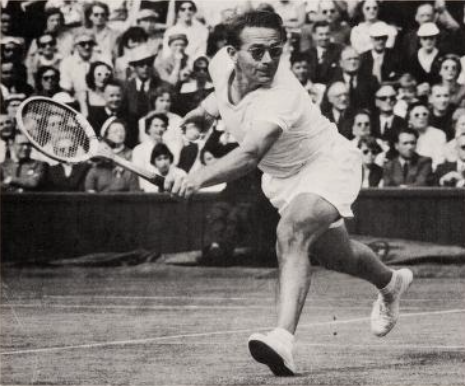
Jaroslav Drobný

In 2022, I’m counting down the 128 best players of the last century. With luck, we’ll get to #1 in December. Enjoy!

* * *

Jaroslav Drobný [CZE/EGY/GBR]
Born: 21 October 1921
Died: 13 September 2001
Career: 1938-65
Played: Left-handed (one-handed backhand)
Peak rank: 1 (1954)
Major singles titles: 3
Total singles titles: 158
 

* * *

Jaroslav Drobný was, in a way, the John Isner of his day. His serve was nearly unbreakable, and with a backhand that often abandoned him under pressure, he struggled to make headway against his opponents’ service games as well.

One difference: Drobný was a lefty. He took full advantage of his left-handedness in an era with even fewer standout southpaws than there are today.

He owned what Harry Hopman called a “big fast service,” which he often used to pile up ace after ace. He possessed every other serve in the book, too. Lefty slice? Check. Nasty kicker? Got that too.

Lew Hoad beat him only once in seven tries. He wrote that the Czech had “more serves than a magician has rabbits in a hat.” Hoad compared the challenge of facing Drobný’s serve to that of a cricket batsman trying to guess what delivery will come next.

One result of the Czech’s service prowess was an Isnerian predilection for very long matches.

In the 1948 Davis Cup Inter-Zonal final against Australia, the lefty dropped his first rubber to Bill Sidwell, 6-3, 6-2, 9-11, 14-12. Drobný and Vladimir Černík kept the Czechs in the tie with a win in the doubles, starting with a 10-8 opening set. To continue the comeback, Drobný faced down Adrian Quist in the longest Davis Cup match of the amateur era. He saved five match points–five points that would’ve given the tie to Australia–before pulling out a victory, 6-8, 3-6, 18-16, 6-3, 7-5.

Embed from Getty Images

In addition to the serve, Drobný had one of the best smashes in the game

Long before the tiebreak was invented, Drobný was no stranger to marathon sets. At Wimbledon in 1953, he and Budge Patty delivered the match of the tournament in the third round. The Czech won, 8-6, 16-18, 3-6, 8-6, 12-10. At 10-all in the decider, the referee indicated that the match would be suspended for darkness after two more games. The 31-year-old Drobný knew he would barely be able to move the next day, so he made a final, desparate push to finish the match.

The veterans met again two years later for a wood-court title in Lyon. After three hours and 45 minutes, the score stood at 21-19, 8-10, 21-21. At that point, as the New Yorker put it, “the contestants arrived at one of the most sensible decisions in the annals of tennis.” They called it a draw.

I forgot to mention one thing. Jaroslav Drobný–the left-handed ace machine, the master of a half-dozen deliveries, the man who could hold serve 20 times in a set–stood five feet, seven inches tall.

* * *

Drobný didn’t look like a tennis player, and it’s only by an accident of family history that he became one. His parents tried for years to find an apartment for their growing family. When an opportunity finally arose, the new home came attached to a job. Father Josef would be the live-in head groundsman at the First Czech Lawn Tennis Club.

By the time young Jaroslav–“Jarda” to his friends–moved to the family’s roomier new digs, he was an avid footballer and a prodigy on ice skates. Tennis was the national sport for the elites. Jarda, a working-class boy, was on his way to mastering the favorite games of the Czech masses.

Drobný was offered a pro football contract as a teen. By then, though, he was developing into one of the strongest tennis players in the country. In the winter of 1936-37, aged 15, he was the youngest player ever chosen for the national ice hockey team. He would forgo football and balance the other two pursuits for more than a decade, wielding a racket in the summer, a hockey stick in the winter.

Strangely, for a man who would struggle with his backhand for much of his career, he was more or less ambidextrous. He played hockey and golf right-handed. As a ball boy at his father’s club, he saw plenty of top international stars up close, and for a time, he emulated the two-handed backhand of Australians Viv McGrath and Geoff Brown. He might have had a smoother path to the top had he defied convention and stuck with a double-hander.

Jarda looked more suited to ice hockey than tennis. He was not only short, he was stocky. Hopman described him as “thickset to chunkiness.” Time magazine simply called him “squat.” His appearance became even more unusual when, during a hockey game, an opponent’s skate blade scraped his eye. He needed glasses for the rest of his life.

Embed from Getty Images

The silver-medal winning 1948 Czechoslovakian Olympic team. Drobný stands furthest to the left in the back row.

His appearance raised doubts, but his racket silenced them. In 1937, Drobný defeated the ethnically German Czech veteran, Roderich Menzel, the only time Menzel was ever beaten in his home country. The following year, Jarda made his first trip to Wimbledon, where he lost in the first round. He watched Don Budge win the title, the third leg of the American’s Grand Slam. Budge followed the Czech delegation home to play the International tournament in Prague, where he won again–but only after Drobný pushed him to five sets.

* * *

In 1939, the 17-year-old Czech reached the third round at Wimbledon and was well on the way to stardom. However, German aggression halted international competition in Europe. Drobný had it better than most. The German occupiers in Prague generally left him alone. He was drafted to work at a factory, but he could still play ice hockey, and when scarce balls and racket string were available, he could practice his tennis, as well.

As the European circuit resumed in 1946, Drobný was better prepared than most of his Continental competition. He reached the semi-final at Wimbledon on the back of a shock fourth-round upset of the second seed, Jack Kramer. It was the first of many dramatic matches he’d play on the No. 1 court, and it foreshadowed the marathon duels in his future at the Championships. He beat Kramer 2-6, 17-15, 6-3, 3-6, 6-3.

The Czech did even better at the French, which was held later that summer. In Paris, he made it to the final and won the first two sets of an all-lefty battle with Marcel Bernard before falling in five.

The runner-up finish at Roland Garros offered an outline of Drobný’s fate for the rest of the decade. He became known for an occasional lack of concentration, as well as the flimsy backhand that collapsed under pressure.

At Forest Hills the following year, he took a one-set lead over Kramer in the semi-finals. But he lost focus when tournament officials asked the players to switch courts. He was also distracted when his opponent changed into spiked shoes, which he’d never seen before. He won only four games in the final three sets. At the 1948 US National Championships, a similar story played out in a semi-final against Richard “Pancho” González. After splitting two hard-fought sets, 10-8 and 9-11, Drobný managed just three games the rest of the way.

Drobný in 1949 Davis Cup action

Jarda was runner-up in Paris again in 1948 (to Frank Parker), second place at Wimbledon to Ted Schroeder in 1949, and bridesmaid to Budge Patty at the French in 1950. Parker was the only man who put him away in four sets; his other three final-round losses up to that point required five.

“[Drobný] is always the most feared opponent in any tournament,” Patty wrote in 1951, “because he is capable of beating anyone in the world.” He just had a hard time finishing the job in a major final.

Patty recognized that some of his rival’s struggles were psychological. If those could be overcome, watch out. “Once he is champion he will be a king difficult to dethrone.”

* * *

The war was over, international tennis was back to normal, and–for a little while–Czechoslovakia was no different. Drobný and his teammate, Vladimir Černík, made up a dangerous Davis Cup side. They won the European Zone, falling one step short of the Challenge Round, in both 1947 and 1948.

But as the Russians tightened their grip on Czechoslovakia, no aspect of life in Prague went untouched. Party officials could withhold exit visas, and they increasingly controlled Drobný’s schedule. They even became stingy with equipment. Sokol, the national gymnastics body, took over all of sport, and the upper-class associations of lawn tennis caused the racket sport and its exponents to fall under suspicion.

When the Davis Cup team went to North America in 1948 for the Inter-Zonal final, they were accompanied by a new captain, former great Karel Koželuh. Koželuh, however, didn’t do much coaching. He was well-connected at home, and he was more concerned with keeping his name clean. More than anything else, that meant making sure Drobný didn’t defect.

It was a justifiable fear. The United States accepted several defectors from Eastern Bloc countries at the 1948 London Olympics. A number of less prominent Czechs went into voluntary exile. In 1950, the entire national ice hockey team hatched a plan to defect as a group. When they were caught, most of the players were barred from organized competition and sent to work in Sudetenland’s uranium mines.

Drobný, as a two-sport star, was safe for the moment. The government recognized the power of sport as propaganda, and he could help deliver that. But it was less clear what would happen when he stopped winning. When the Davis Cup team advanced, the press hailed them as heroes of the proletariat. When they lost, they were lazy, capitalist flunkies.

The breaking point came in July of 1949, at a tournament in Gstaad. Party minders ordered Drobný and Černík to withdraw and return home. The event was off-limits, they said, because of the presence of competitors from “fascist” Germany and Spain. The players refused. Drobný reached the final, and the duo won the doubles. They announced they would seek exile.

Drobný and Černík in Gstaad

Drobný and Černík were an interational sensation, front page news in the New York Times. Leaving their families behind, they said they would apply for asylum in the United States.

Sokol immediately issued a statement. The traitorous pair had gone over “to the pay of capitalist entrepreneurs.”

* * *

The only entrepreneur involved in the decision was Jaroslav Drobný. Exile wasn’t easy. Britain ignored an asylum request*, and he attempted to settle in Australia before making connections in Egypt that got him citizenship there. Until he settled in London a few years later with his wife, fellow player Rita Anderson Jarvis, he essentially lived on the circuit, out of a suitcase.

* Years after marrying a British national, Jarda would finally become a citizen. In 1960, he played his final Wimbledon as a representative of the host country.

Somehow, the loneliness of solo travel didn’t stop him from playing some of the best tennis the Continent had ever seen.

Here is a summary of Drobný’s record from 1950 to 1954, based on the results listed at TennisArchives.com:

Year   Matches  Wins  Events  Finals  Titles  
1950       100    88      27      21      15  
1951        97    85      31      22      19  
1952       104    97      31      29      23  
1953        75    67      21      15      13  
1954        88    78      26      19      16  
Total      464   415     136     106      86

As usual when we’re dealing with amateur-era results, these totals are probably not quite complete. All events are likely accounted for (except for exhibitions), and for a player of Drobný’s stature, we probably know about all of his losses. These numbers may miss some early-round victories.

The sum of his performances are truly remarkable. He won 89% of his matches in this five-year span. He reached the final in four out of every five tournaments he entered. He took the title at nearly two in three.

Discussing his future, in 1949

Some of the events were minor. After all, there weren’t 30-plus major tournaments on offer every year, especially for a player who didn’t like the bustle of Forest Hills and preferred to stick to European clay. But Drobný hardly avoided competition. He finally won the French in 1951, then mounted a successful defense a year later. He reached a second Wimbledon final in 1952, where he lost to Frank Sedgman.

With the backing of Egypt’s King Farouk and a reputation as the best player on the Continent, the exile’s bet on himself paid off. Not only was he free of suffocating political control, he could also make a handsome living. While no amateur tennis players got rich on the circuit, the best of them collected ample expense money at nearly every stop. Drobný made a lot of stops.

* * *

In 1954, Jarda was 32 years old. He could no longer serve as hard as he used to, at least not all the time. For years, he had heard people say that his game couldn’t keep up with the speed of grass courts. With two final-round losses in ten attempts at Wimbledon, he could never quite prove them wrong.

We saw a moment ago that he was still a dominant player in 1954. But he lost in the fourth round at Roland Garros–his worst result at the French to that point–to eventual finalist Art Larsen. The Wimbledon committee considered that upset, combined it with Drobný’s fatigued semi-final defeat to the unseeded Kurt Nielsen the year before, and saddled him with the 11th seed.

The exile loved Wimbledon, and the crowds loved him back. But he was so insulted that he was tempted to withdraw from the tournament. His wife talked sense into him, and he compromised by entering only the singles draw. On his days off, he went fishing.

A year after his record-setting marathon against Patty, things couldn’t have gone more smoothly. He didn’t lose a set in his first five matches. Larsen, the seeded player he was drawn to face in the fourth round, didn’t make it that far. Drobný’s quarter-final opponent, second-seed Lew Hoad, couldn’t make inroads against the veteran’s service savvy and went out in straights.

The 1954 Wimbledon final (from 1:15)

No British players made it past the fourth round, so the home fans had an easy decision. Everyone was for Drobný, the warrior, the underdog, the adopted Londoner with his home in Tooting.

(Not everyone recognized him–after all, he never did look like a tennis player. When he arrived at the All-England Club one day, a scalper tried to sell him a ticket. “Sorry,” Drobný said, “I shall have to stand during the match.”)

In the semi-final, the left-hander came up against–who else?–Budge Patty. The two men had played 13 times since the war, five of those going to a fifth set. Two months earlier, Patty had won a marathon four-setter in the semi-finals of the Italian, every set reaching 5-all. This time, Drobný wrote, “my resolve was calm, my temperament equable.” He beat Patty in four.

Waiting in the final was the 19-year-old Ken Rosewall, an Australian already recognized as possessing the best backhand in tennis. Rosewall followed the old game plan, using his own baseline weapons to attack Drobný’s weaker wing. On this day, the Czech’s backhand held up.

They split the first two sets: the first to Drobný, 13-11, the second to Rosewall, 6-4. The veteran had played a cagey game up to that point, sticking to the backcourt. The Australian, with his middling serve, did the same. In the third, Drobný went on the attack, coming in behind his serves and grabbing the edge, 6-2.

Jarda served for the match at 5-4 in the fourth, but Rosewall still wasn’t done. With a lucky net cord and a stinging backhand down the line, he fought back to 5-all. The Australian was visibly tiring, but he held on through 14 games. Finally Drobný broke to take the lead. With two big serves, he sealed the victory, 9-7 in the fourth.

Champion in his eleventh Wimbledon, the 32-year-old said after the match, “That’s it–and that’s all. From here in it will be fun.”

The Tennis 128: No. 45, Conchita Martínez

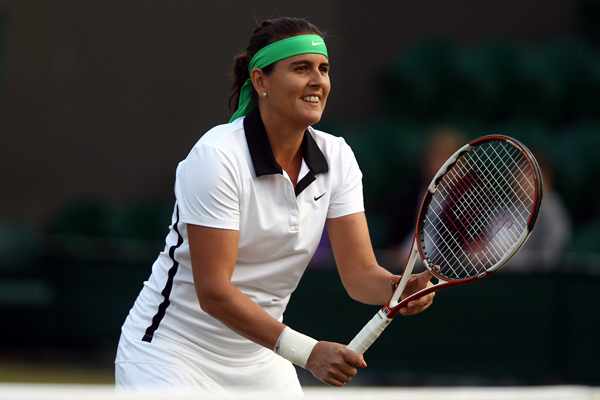
Conchita Martínez

In 2022, I’m counting down the 128 best players of the last century. With luck, we’ll get to #1 in December. Enjoy!

* * *

Conchita Martínez [ESP]
Born: 16 April 1972
Career: 1988-2006
Plays: Right-handed (one-handed backhand)
Peak rank: 2 (1995)
Peak Elo rating: 2,328 (2nd place, 1995)
Major singles titles: 1
Total singles titles: 33
 

* * *

Didn’t see this one coming, did you?

There is probably no Open era player more underrated than Conchita Martínez. Her timing is partly to blame: She arrived on the scene alongside other players who peaked sooner. Steffi Graf and Gabriela Sabatini were already there. Monica Seles, while a year and a half younger than Martínez, was one of the great teen sensations of all time. Arantxa Sánchez Vicario was four months older, and she won the hearts of her countrymen before many of them knew Conchita’s name.

Then there’s her playing style. Graf, Seles, and Jennifer Capriati hit harder than anyone who had come before them. Arantxa excelled at a retrieving game that made her a lovable underdog. Martínez, by contrast, was a less graceful version of Sabatini, complete with an increasingly anachronistic one-handed backhand. She outlasted opponents by alternating heavy topspin with a sizzling slice backhand, camping out several feet behind the court while her contemporaries refused to give an inch at the baseline.

She earned the nickname “Señorita Topspin,” playing a game that connoisseurs could appreciate but would rarely inspire oohs and aahs from the crowd.

Conchita’s career trajectory, as well, is of the type that defies full recognition. Tennis fans love the youthful breakout, the stratospheric peak. There were plenty of those in the early 1990s. Martínez opted for the slow burn. She won her first tour-level title in 1988, when she was 16 years old. She ultimately picked up at least one winner’s trophy in thirteen different seasons, hoisting the last one in 2005, when she was 32.

From 1993 to 2000, she reached the third round at thirty consecutive majors. Yes, I know, grand slam third rounds aren’t exactly the currency of tennis greatness. But players outside the innermost circle of the Hall of Fame almost never put together streaks like that. Sánchez Vicario is the only other woman since 1990 to reach more than 18 in a row. Elise Mertens was the active leader with 17 until last month, when she lost to Irina-Camelia Begu in the first round of the US Open. Mertens fell more than three years short of Conchita’s standard.

Most of all, fans fail to appreciate Martínez because she peaked in the most unassuming fashion imaginable.

Embed from Getty Images

Conchita, thinking

The Spaniard won her lone major title at Wimbledon in 1994. (Yes, the consummate dirtballer won Wimbledon–we’ll come back to that.) She would’ve been the underdog against almost anyone, and as things turned out, her victory was also the secondary news item of the day–by far. She defeated Martina Navratilova in what was almost the highlight of the nine-time champion’s retirement tour. Martina’s farewell was, understandably, the story of the tournament. Conchita was merely the anonymous challenger who stopped her from going out with a tenth crown.

Martínez won the biggest title in tennis–something Arantxa never did, incidentally–and she didn’t gain a single endorsement. Not one.

She went on a tear the following Spring, dominating the clay court swing and posting results so strong that, had the WTA used the same ranking formula they use today, she would likely have become number one. Steffi Graf ended the Spaniard’s hot streak at Roland Garros, and Conchita resumed her old role as the forgotten woman of the WTA.

During her playing days, Martínez usually gave the impression that she was content to fade into the background. She deserved better, and she still does.

* * *

Conchita only came to global attention in 1994. Still, if you didn’t know her name by then, you hadn’t been paying attention.

In March 1992, when the Spaniard was still 19 years old, the WTA published a list of the top players on tour–minimum 200 matches–ranked by career winning percentage. Martínez came in fourth, ahead of Sabatini, behind only Seles, Graf, and Navratilova.

She won three titles in 1990, despite taking the summer off. In 1991, she added three more–all on European clay–while grappling with an injured thigh. The pain management shifted to her right arm in 1992, as she struggled with tendonitis. It hurt to serve, it hurt to hit a forehand, yet she still picked up a title in Kitzbühel and reached a fourth-straight French Open quarter-final. She made it to four other finals, where she lost to Graf, Seles, Sabatini, and Capriati.

Conchita suffered a bit every time she struck a topspin forehand that season, but her opponents often had it worse.

Embed from Getty Images

Señorita Topspin hits a forehand at the 1996 US Open

Early in 1990, her coach Eduardo Osta thought that the Martínez forehand was second only to Graf’s. Like Steffi, Conchita hit the shot whenever she could, often drifting far into the backhand corner to stick with her preferred wing.

“I was born with my forehand,” she said in 1995. “That’s natural.”

Natural as it was, Martínez was more sophisticated than the typical slugger. She always had been. Her long-time coach Eric van Harpen recognized that, as a junior, she didn’t play like the other girls her age. “She was so clever, so professional in the shots she chose,” he said.

Shot selection may have been Conchita’s strongest weapon of all. When she beat Sánchez Vicario in a 1992 Hilton Head semi-final, the New York Times described her attack as “a steady spattering of astrologically correct moonballs interspersed with high-paced forehand drives.” By that time, Arantxa knew her game better than anyone. But even she couldn’t always handle the variation.

Once she put the tendonitis behind her, Martínez’s favorite shot grew even more vicious. In 1993, it won her titles on three surfaces, and she nearly pulled even with Graf. Playing only her second Wimbledon, Conchita reached the semi-final, where she pushed Steffi to a first-set tiebreak. In Philadelphia later that year, she beat the German in straights.

The 21-year-old cracked the top five in August, and she ended the season at number four. The tour had the makings of a new star.

* * *

If Martínez was going to break through at a major, the smart money favored her at Roland Garros. She had grown up on clay courts, and her game was built for them.

Conchita’s most impressive achievement in 1993 was her first title at the Italian Open, home of some of the slowest conditions on tour. She defeated Navratilova and Mary Joe Fernández to reach the final, then wore down Sabatini for the championship. The third game of the title match lasted 32 points, and the women traded seven consecutive breaks of serve in an 89-minute first set. Martínez could do that all day, but her opponent couldn’t, and she cruised to a 7-5, 6-1 victory.

The Spaniard wouldn’t lose again in Rome until 1997, when Mary Pierce beat her in that year’s final. She won the circuit’s second-most prestigious clay court tournament four years in a row. In her 24-match reign at the event, she lost only three sets.

Embed from Getty Images

The Martínez one-handed backhand was a
perfect match for the Roman clay

Conchita’s dirtballing magic didn’t have quite the same effect in Paris. She reached the second week of the French Open for 13 consecutive years, from 1988 to 2000. But she didn’t clear the quarter-finals until 1994, in large part because she had a nasty habit of colliding with Graf, Seles, or Sabatini in the final eight. In the 1994 semi, one step closer to the title, she fell flat against Sánchez Vicario. She managed only four games in a disappointing clash with her more decorated countrywoman.

Van Harpen thought she wasn’t fit enough to be the perfect clay-courter. She certainly couldn’t out-scamper Arantxa, though in fairness, no one could. He kept after Martínez for years, insisting that she lose weight. For the coach, it was the obvious route to dominance. “[W]hat would be easier, for Graf to get that topspin backhand she needs, or for Sánchez Vicario to get a forehand like Conchita’s or for Conchita to get the fitness of both of them?”

In a different context, van Harpen said that his charge “should stop telling everybody she’s a clay-court player.” This time, he wasn’t criticizing her preparedness. He believed her style was good enough to win anywhere.

* * *

By the time Martínez rose to stardom, the women’s serve-and-volley game was dying out. While Jana Novotná would keep it alive to the end of the century, Navratilova’s retirement signaled the end of an era.

An alternative reading is that serve-and-volley didn’t fade out. Instead, it was Conchita who killed it.

Okay, okay, that’s not really what happened. There weren’t legions of teenage wannabe serve-and-volleyers who saw the Spaniard’s topspin forehand and, terrified, never rushed the net again. But judging by Martínez’s results against the players who did dare to come forward, if serve-and-volley tennis hadn’t been on the way out, Conchita would’ve at least nudged it toward the door.

Martínez arrived at Wimbledon in 1994 as a 33-to-1 longshot. Her odds improved on the first day, when Lori McNeil recorded one of the great upsets in tournament history by ousting five-time champion Steffi Graf. Still, no one was about to pick Conchita as the new favorite. Despite her status as the third seed, she was playing only her fourth career grass-court event.

The first time the Spaniard ventured onto the turf, at Eastbourne in 1992, McNeil showed her how much she still had to learn. The hyper-aggressive American eased through, 6-0, 6-3.

Embed from Getty Images

At Wimbledon in 1994

Two years later, McNeil rode her first-round upset at Wimbledon to a semi-final meeting with Martínez. The pair split the first two sets. Then, as the New York Times put it, they “dug themselves into their respective trenches … and waited for attrition to take its toll.” Clearly McNeil didn’t have a good scouting report on her opponent. Attrition was the name of Conchita’s game. The Spaniard won the third set, 10-8.

Martínez piled up passing-shot winners throughout the tournament. Her opponents stuck with the grass-court playbook. Señorita Topspin said, “[E]verybody is coming in, and it’s like, thank you.”

It was no different in the final. Navratilova, who had earned her living at the net for two decades, watched one groundstroke after another fly by. The veteran came forward 113 times. Conchita took 60 of those points. In three sets, the underdog claimed the match and the title.

Navratilova explained how Martínez did it:

She passed me as well as anybody ever has, even Monica Seles, because she passed well from both sides. She has a lot of dip on the ball, so it comes over lower by the time it gets to you, which made it more difficult to volley well, and she stands back behind the baseline for her return of serve, which gives her time to line up her shots.

“She’s playing great tennis, period,” said Martina. “And that works on any surface.”

* * *

Conchita flailed a bit that fall. In a post-Wimbledon swoon, she lost three matches in a row for the first time since 1991. Even though she remained under the radar, pressure mounted from some quarters.

Van Harpen was part of the problem. He believed Martínez could become number one, perhaps more strongly than she did herself. He certainly cared about it more. “I’m the kind of person who would give up two fingers to be number one,” he said. “I’d give one finger for her to be number one.”

It had always been a bit rocky between the unassuming player and the overweening coach. In their seven-year relationship, they had split multiple times only to team up again. Finally, in early 1995, Conchita moved on for good, throwing in her lot with Carlos Kirmayr, Sabatini’s former coach.

The results were immediate, and they were stunning. After losing to Graf in the Delray Beach final in March, Martínez began what her fans call, simply, The Streak.

On clay courts in North America and Europe–with a Fed Cup tie on carpet thrown in for good measure–the reigning Wimbledon champ reeled off 26 wins in a row. At the German Open in Hamburg, the Spaniard double-bageled Magdalena Maleeva in the semi-finals and beat the 14-year-old Martina Hingis in the final, 6-1, 6-0. At the Italian the following week, she straight-setted Fernández, Pierce, and Sánchez Vicario in succession. The only woman who could stop her was Graf–again–in the semis at the French.

The 1995 Rome semi-final

In those 26 matches, she lost only two sets. She won 11 bagel sets. Another 15 went her way by a score of 6-1.

Conchita was nearly as good on hard courts between Wimbledon and the US Open. She swept a Fed Cup tie, then won back-to-back titles at San Diego and Manhattan Beach. For the season as a whole, she won 63 of 73 matches. That was good for six titles, semi-final showings at all four majors, and an undefeated performance in three Fed Cup ties as she led Spain to third consecutive championship.

(These streaks start to blend together, but there’s one more worth mentioning. The six Fed Cup wins were part of a five-year run in which Martínez won 19 of 20 singles rubbers. The one loss came in 1994 to the German Sabine Hack. The next year, she beat Hack 6-0, 6-0–twice.)

In November, she rose to the number two ranking. That’s when, under a rating system that rewarded quantity more heavily, like the WTA’s current formula, she might have grabbed her moment in the top spot.

Still, the woman who the New York Times called “the world’s most highly ranked low-visibility performer” couldn’t quite beat everybody. Bud Collins explained what he demanded of a “champion.” He said, “She still has to come to grips with what’s expected…. You don’t [need to] win all the time, but more than she has done.”

It was bad enough having to play for a decade in the Steffi Graf era. It might have been even worse to be judged by the impossibly high standards that Steffi set.

* * *

There’s one more reason why Conchita has remained so underrated. She hung around on tour for a decade after her peak, playing well enough that everyone knew she was there, rarely well enough that anyone would call her great.

She picked up her fourth consecutive Italian title in 1996, but lost to a player outside the top 100 at her next tournament in Madrid. She fell out of the top five in early 1997, to return only briefly a few years later. She remained capable of a big win, advancing to the Australian Open final in 1998 behind a three-set upset of second seed Lindsay Davenport. But as injuries and age took their toll, she was rarely considered a prime contender for another major title.

Now veterans, Conchita and Arantxa defeated Martina Hingis and Patty Schnyder to win the 1998 Fed Cup

Had Conchita chosen to pursue a second career as a doubles specialist, she might have lasted another decade beyond her 18-year pro career. In 2004, she and Virginia Ruano Pascual won the women’s doubles silver medal at the Athens Olympics. It was Martínez’s third medal. A year later, she finished her grand slam career with a semi-final showing at the US Open. She and Ruano Pascual only gave way after pushing Lisa Raymond and Sam Stosur, the eventual champions, to a deciding-set tiebreak.

In 1994, coach van Harpen said, “For sure, she is overlooked. For sure, she doesn’t like this. Even in Spain. She is not the people’s darling.” Her fan club was never as big as Arantxa’s, if she had a fan club at all. Yet when all was said and done, Conchita had more tour-level titles: 33 to her countrywoman’s 29.

One of those titles, of course, was the most important of all. Señorita Topspin was the first Spanish woman to win Wimbledon. There wouldn’t be another for more than two decades. Finally, in 2017, when Garbiñe Muguruza added her name to the list, sitting courtside was Garbi’s part-time coach, Conchita Martínez.

* * *

This post is dedicated to Jeff McFarland.

The Tennis 128: No. 46, Victoria Azarenka

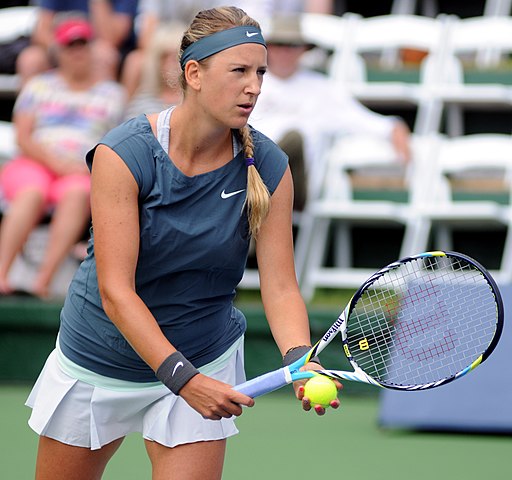
Victoria Azarenka at the 2011 Australian Open
Credit: n.hewson

In 2022, I’m counting down the 128 best players of the last century. With luck, we’ll get to #1 in December. Enjoy!

* * *

Victoria Azarenka [BLR]
Born: 31 July 1989
Career: 2006-present
Plays: Right-handed (two-handed backhand)
Peak rank: 1 (2012)
Peak Elo rating: 2,326 (1st place, 2013)
Major singles titles: 2
Total singles titles: 21
 

* * *

The first time I saw Victoria Azarenka play was by accident. I had Arthur Ashe Stadium tickets for the 2007 US Open men’s quarter-finals, and without much happening on the outer courts, I settled in for the mixed doubles championship match. Leander Paes, at least, was sure to give me my money’s worth.

He did, but the star of the afternoon was an 18-year-old Belarussian in her second grand slam final. Vika partnered her countryman, the doubles specialist Max Mirnyi, and she seemed committed to proving the old saw that in mixed doubles, women make all the difference. She hit the hardest of the foursome, and in case anyone didn’t notice, every shot was punctuated with the two-part grunt that all tennis fans would soon know well.

Azarenka and Mirnyi beat Paes and Meghann Shaughnessy for the title, 6-4, 7-6. The Belarussians had also reached the final in Australia, and Vika would appear in another two major doubles finals the following year. She reunited with Mirnyi for the mixed event at the 2012 London Olympics, where the slam-winning pair earned a gold medal.*

* BBC headline: “Andy Murray & Laura Robson take silver in Olympics final”

The hard-hitting teen wasn’t destined for a career as a doubles specialist, of course. Her achievements alongside Mirnyi would soon be relegated to a footnote, something for television commentators to mention when she made a rare foray beyond the service line.

In 2005, Vika won two of the four junior slams as a singles player. By the 2007 US Open, her ranking was on the brink of the top 40, with a tour-level final in Estoril already to her credit. A few weeks later in Luxembourg, she recorded her first top-ten win, backing it up in October with an upset of the number four player in the world, Maria Sharapova. Facing three set points against Masha in the Moscow second round, she kicked off a run of ten straight points and fought out a 16-point tiebreak.

Azarenka appeared to be on the brink of great things. She would, in fact, steadily improve. Compared to the sudden breakthroughs that had defined women’s tennis for decades, though, the Belarussian’s ascent moved slowly.

Vika’s path, both in reaching the top and in finding her place as a less-dominant veteran, has always been complicated.

* * *

Azarenka’s reign as an elite player can be dated, roughly, to March of 2011.

She first broke into the top ten almost two years earlier, on the strength of a 2009 Miami title when she beat an injured Serena Williams. But in a crowded field, she struggled to establish herself as more than a fringe member of the top tier. In seven hard-court tournaments after Wimbledon that year, she won only nine matches.

Azarenka at the 2009 Australian Open
Credit: Brett Marlow

In 2011, by contrast, Miami was a springboard, not an aberration. Vika defeated second-seed Kim Clijsters, third-seed Vera Zvonareva, and Sharapova back-to-back–all in straight sets, no less–to win the title for the second time. She followed it up with a champion’s trophy in Marbella. To this day, it is her only tournament victory on a clay court.

While she didn’t win another title until Luxembourg in October, Azarenka’s failure to do so said more about the depth of the tour than any inconsistency on her part. She lost to Petra Kvitová in the Madrid final and the Wimbledon semis. Li Na beat her in the French Open quarters, en route to the title. At both Toronto and the US Open, Azarenka lost to Serena, giving the American champion a hard fight in the Flushing third round.

Williams was the 28th seed in New York, a hilariously bad draw for the up-and-coming star. It was of a piece with her season to that point. Pete Bodo wrote in August of that year, “Very few women in tennis history have played as well as Azarenka through three majors and come away without even a final berth for it.” She had yet to reach number three in the rankings, but Bodo was ready to appoint her as a close second on the “Best Active Player Not to Have Won a Major” list, behind only Caroline Wozniacki.

At the season-ending WTA Championships, Vika again came up short. She beat Li, Zvonareva, and Sam Stosur, then fell in three sets to Kvitová in the final. Her serve–the one part of her game that has never been particularly imposing–proved to be her downfall. She was unusually conservative with her first offerings, landing more than three in four. The Czech ate them up and won nearly half of those points. In a close match, a single weakness was enough to make the difference.

Still, Azarenka finished third on the year-end ranking list. The final step to superstardom was in sight.

* * *

The Vika who returned for the 2012 campaign was the one who a later headline writer would call “The Most Intense Tennis Player on Earth.” She was finally able to channel all of that intensity toward victory.

The rest of the tour could only watch in awe, perhaps hoping they’d land in the other half of the draw next time. Azarenka began the season with 26 straight wins, grabbing titles at Sydney, Doha, and Indian Wells–and in between, at the Australian Open. The (second) best active player without a major now had one.

The 2012 Australian Open semi-final

In Melbourne, she needed an extended warmup before overwhelming eighth-seed Agnieszka Radwańska. She lost seven straight points and a tiebreak, then came back to win the next two sets, 6-0, 6-2. She allowed Sharapova only three measly games in an overpowering final.

The scariest part was, she seemed to improve every week. In Sydney and Melbourne, Radwańska was able to take a set. Azarenka beat her in straights in Doha the following month, and then at Indian Wells, Vika clobbered her, 6-0, 6-2. She no longer needed the wake-up call of a lost opening frame. In the Indian Wells final, Azarenka confirmed her victory over Sharapova, winning another easy straight-setter.

In 79 matches that season, Vika won 15 bagel sets and another 24 by the score of 6-1. A few years later, Tom Perrotta described the attitude that allowed her to destroy first-class opponents:

She fights for points when ahead, when behind, when there’s little chance of winning them. In the first round [at the 2016 Australian Open], she beat Alison Van Uytvanck 6-0, 6-0. At one point in the first set, Azarenka had a comfortable lead when Van Uytvanck served at 40-0, one point from winning what would likely be a meaningless game. Azarenka scrapped and won the next three points, and eventually the game.

That fall, she reeled off 13 consecutive wins–including titles Beijing and Linz and another day at the beach against Sharapova–without losing a single set. No one even got to 5-all against her. In a match with a young Simona Halep during that span, she won a breathtaking 70% of the total points played.

The Australian Open victory was enough to propel Vika into the number one position on the WTA computer. Except for four weeks that summer, she held on to the top spot for a full year. In the half-century since the tour began maintaining rankings, only eleven other women have been number one for more than her total of 51 weeks.

* * *

As you might have noticed, I skipped over a big chunk of Azarenka’s 2012 season. She reached the final in Madrid… and lost to Serena Williams. She made it to the semi-finals at Wimbledon… and lost to Serena. In the final four at the Olympics, she lost to Serena. (Here, at least, there was a consolation prize: She won the bronze medal the next day by defeating Maria Kirilenko.) She beat Sharapova to reach her first US Open final… where she lost to Serena.

Vika dropped just ten matches that year. Five of them came against Williams. At the end of the season, their career head-to-head stood 11-1 in Serena’s favor. The single Azarenka victory came from their meeting at Miami in 2009, when the veteran was hampered by a leg injury.

In 2017, Serena’s then-coach Patrick Mouratoglou told the New York Times:

I always thought that if Serena hadn’t blocked her path, she would have lots of Grand Slam titles. Serena really hurt her, because Azarenka was very, very, very close to acquiring so much confidence that she would have been unstoppable.

The 2012 US Open final explains why Patrick said “very” three times. Williams was even more imperious than usual in New York. When she met Vika in the final, she had just beaten Sara Errani, 6-1, 6-2, winning more than 90% of points behind her first serve. She hadn’t dropped a set in six rounds.

Serena opened the final in the same form, winning the first set, 6-2. But Azarenka brought the set streak to an end, making quick work of the second by the same score. Vika was one of the few players who could absorb the American’s hardest shots, shrug off the unreturnable serves, and find enough opportunities to make Williams look vulnerable.

Embed from Getty Images

Azarenka and Williams before the 2009 Miami final

At 3-all in the third set, Serena offered up a sloppy service game. Azarenka broke at love and held for 5-3. But that was as far as the challenger could go. Williams held for 5-4, and she immediately put pressure back on the Azarenka serve. Vika’s normally sturdy backhand started spitting errors. She had two chances to force a tiebreak, but the backhand had lost its punch, and Serena secured the victory, 7-5.

Not every Vika-Serena match was so dramatic. The US Open final was only the second time Azarenka had even forced a third set. But the Belarussian could handle Serena’s pace and intensity. While the head-to-head record didn’t show it, she was as close to dethroning the queen as anyone else on the circuit. According to the WTA ranking formula, she had already done so.

* * *

2013 started almost as well as the year before. Vika defended her Australian Open title with a final-round victory over Li Na. In Doha the following month, she came out on the winning side of a mammoth battle against Serena, beating her long-time tormentor, 7-6, 2-6, 6-3.

While the result hinted at the onset of a new era, it was instead a high point for the Belarussian. Williams’s run in Doha gave her the points to nudge Vika out of the number one ranking position, despite the outcome of the final. At Indian Wells a few weeks later, Azarenka reached the quarter-finals before pulling out with a right ankle injury. The injury kept her out of Miami as well, so she missed the chance to rack up wins and ranking points at two of her strongest events.

The 2013 Australian Open final

In one sense, Vika had pulled even with Serena. They met four times in 2013, every time in a final, each woman winning two. With the exception of a lopsided encounter in Rome, each one was an epic. But the ankle injury was just the start. She missed Toronto with a back issue, and the cumulative effect of her struggles–and, perhaps, the mental blow of losing a second-straight US Open final to Williams–left her listless in the final months of the season. On the hard courts where she was typically so dominant, she lost four of five matches to end the campaign.

A foot injury made 2014 even worse. She didn’t fully regain her form for two years.

The one thing Azarenka never lost was her belief. No matter how her body complicated things, no matter what the results said, she knew she belonged at the top. Even when she nearly dropped out of the top 50 in the world rankings, that faith never wavered.

I will never forget watching the trophy ceremony of the 2015 Qatar Total Open in Doha. It was Azarenka’s first final in more than a year, and Lucie Šafářová beat her in disappointingly routine fashion. The emcee greeted her with farcically misplaced enthusiasm, saying something like, “Great news! Back in the top 40!” After a blink-and-you’ll-miss-it glare that could have pulverized the poor man, Vika explained that she set her goals higher than that.

Much, much higher.

* * *

Finally healthy and working with new coach Wim Fissette, Azarenka opened 2016 looking more fearsome than ever. Before falling to Angelique Kerber in the Australian Open quarter-finals, she won nine straight matches, never losing more than four games in a set.

She kicked off another streak in March, taking 16 matches in a row to lift the trophy at both Indian Wells and Miami. Her final match in the desert sent the strongest message of all. She beat Serena Williams, and she needed only two sets to do it.

Azarenka at Carlsbad in 2013
Credit: Christian Mesiano

The Indian Wells title put Vika back in the top ten. Miami got her back in the top five. She looked as good as she had in 2012. But her future held more than just another trip to the top of the ranking table. In July, she announced that she was pregnant. She would play only two events in the next 21 months.

Still, Azarenka’s story wasn’t over. It isn’t over now. Between injuries, child care, a protracted custody battle, and a global pandemic, she didn’t play another full season until 2021. Of all the what-ifs in women’s tennis history, the Vika-keeps-playing counterfactual doesn’t get discussed much. But her form this decade suggests that things could’ve turned out very differently.

She proved to be well prepared to handle the socially-distanced tour that resumed half a year after the arrival of Covid-19. After years of being one of the less-popular stars on the circuit, perhaps she got accustomed to playing in empty stadiums. In one of the first events of the pandemic era, the “Cincinnati” tournament held at Flushing Meadows, she lost only one set en route to the final. She won the trophy by default when Naomi Osaka withdrew. A week later, at the US Open, she beat Serena to reach the final and, drawing Osaka again, fell one set short of the title.

The 2020 US Open semi-final

The cast of characters had changed since her previous major final–she defeated Aryna Sabalenka and Iga Świątek in the early rounds in New York–but she remained equal to the challenge. Azarenka nearly won her third Indian Wells title a year ago, when she reached the final and lost in a third-set tiebreak to Paula Badosa. Her ranking has risen as high as 15th this season, and her most recent match was a three-hour battle with Karolína Plíšková in the fourth round of this year’s US Open.

At a press conference in Flushing last month, Vika said, “Tennis, to me, is about adaptation…. [I]t’s okay that you fail. It depends how you come back from it.” If Azarenka has failed, it’s only on a small scale, in the sense that she has lost the occasional match she could’ve won.

Now 33 years old, Azarenka is unlikely to return to number one. Even another spell in the top ten is a lot to ask. (Just don’t tell her I said that.) But if our standard is the ability to adapt, to change with the tour, to overcome obstacles that would send most women into early retirement, Vika remains one of the very best in the business.

The Tennis 128: No. 47, Jennifer Capriati

Jennifer Capriati on a 1991 trading card

In 2022, I’m counting down the 128 best players of the last century. With luck, we’ll get to #1 in December. Enjoy!

* * *

Jennifer Capriati [USA]
Born: 29 March 1976
Career: 1990-2004
Plays: Right-handed (two-handed backhand)
Peak rank: 1 (2001)
Peak Elo rating: 2,317 (4th place, 1993)
Major singles titles: 3
Total singles titles: 14
 

* * *

When Jennifer Capriati was 14 years old, she dreamed that someday, she’d be walking down the street, and she’d hear people say, “There’s Jennifer Capriati, the greatest tennis player who ever lived.”

She was surely not the first 14-year-old to imagine such things. But her aspiration might have been the most realistic. In the month before her birthday that year, she reached the finals of her first pro tournament, beating top-tenner Helena Suková and two more players ranked in the top 21. A few weeks later, she dropped just two games to 5th-ranked Arantxa Sánchez Vicario and made another final.

Rick Macci, one of her early coaches, said, “I’m telling you. She’s scary.”

Tracy Austin, once a teen sensation herself, considered her the best prospect in American tennis since, well, Tracy Austin.

In her first season as a pro, Capriati became the youngest player ever to reach the semi-finals at the French Open. She lasted until the second week of all three majors she played; had she not drawn Steffi Graf in the fourth round at Wimbledon and the US Open, she may have done even better. She even took a set from Graf at the season-ending Slims Championships.

Billie Jean King rated her “the most powerful person of her age I have ever seen, without any question.” King thought that Graf was the only woman on tour who hit harder. Capriati might even be her equal.

On the other hand, Billie Jean had seen prospects come and go for three decades. “Sophomore year is the dangerous one,” she told Sports Illustrated. “The first year, everything is new, and nobody really has the book on you. But it gets tougher after that.”

Yep, it got tougher after that.

* * *

Skip forward eleven years–eleven messy, often painful years. Now 25 years old in June of 2001, Capriati was halfway to a Grand Slam.

She showed up for the injury-decimated 2001 Australian Open in the best shape of her life. After escaping a tricky quarter-final against Monica Seles, she straight-setted Lindsay Davenport in the semis and did the same to a listless Martina Hingis in the final.

Embed from Getty Images

Capriati with the 2001 Australian Open trophy

At the French, she defeated Serena Williams in the quarters. She once again left Hingis looking like a spent force with an easy win in the semis. The championship match against Kim Clijsters turned into an epic battle. Clijsters came within two points of the title on four different occasions, before the American finally gutted it out, 1-6, 6-4, 12-10.

Writing for Sports Illustrated, S.L. Price concluded:

For what no one knew about Capriati then–what no one really would know until 4:58 p.m., Paris time, last Saturday–was that at her core, she needs a fight. Capriati responds best to adversity, not ease.

Indeed, back in 1990 at her first pro event, the teenager starlet told the assembled media, “I like to fight.”

But Price got things backwards. Tennis, and life, offered Capriati plenty of adversity in the early 1990s, and she couldn’t cope with a lot of it. That isn’t a criticism: No one her age could’ve met the expectations that were set for her. She was 14, 15 years old with mounting pressure to reach number one and become the next Chris Evert.

(Just how far did the hype go? Journalist Dave Scheiber, writing in 1990, made clear that Jennifer might be better than Chrissie: “Capriati’s baseline game seems as potent as Evert’s was. But Capriati attacks more and packs more punch with her serve.”)

The young star never lacked for a challenge. What changed in the decade between her coming-out party and the double-major season of 2001 was that she slowly adopted the right attitude about the adversity that is inevitable on the pro tour. Still bludgeoning breathtaking groundstrokes, Capriati 2.0 finally had what it took to reach some of Capriati 1.0’s enormous potential.

* * *

In 1985, the nine-year-old Capriati went to tennis camp. She took home the following evaluation:

She has potential and should be developed wisely. Keep her tennis ‘career’ in perspective. Keep it fun! Be careful not to push her progress too quickly.

Roger that.

Within a few years, there was no stopping the Jennifer juggernaut. She won the national 18-and-under event at age 12. She added the French Open and US Open junior titles at 13. IMG, the management company, signed her and lined up several million dollars’ worth of endorsements before she played a single pro tournament.

After the injuries and burnout that ended the careers of Austin and Andrea Jaeger in the early 1980s, the women’s tour put some age restrictions on the pro circuit. They had to tweak the rules for Capriati, then bent them even further to get her into the season-ending Slims Championships. She ended up playing 12 events–48 singles matches–in the nine-plus months following her pro debut.

Embed from Getty Images

Capriati at her first pro event at Boca Raton, in 1990

In 1990s, memories of Austin and Jaeger–and Kathy Rinaldi, and Andrea Temesvári, and more–were fresh. Jennifer’s father, Stefano, preferred to ignore them. “They belong to the past. I believe in the future. There is nothing to be learned from their stories. They were completely different.”

Austin cautioned that Capriati “learn three things: patience, patience and patience.”

Jaeger offered a more detailed warning:

If she gets hurt, people will say she started too young. If she throws a racket or swears or loses a lot of first-round matches, they’ll say the pressure has gotten to her. Then she’ll start thinking about the pressure, and the game really won’t be fun anymore. After a few failures she’ll learn that the only people who really care are friends and family.

Within a few years, Jaeger would be proven correct on all counts. But once the 13-year-old Jennifer was beating established pros and appearing on the cover of Sports Illustrated, there was no turning back. Stefano said, “Where I come from the saying is: ‘If the apple is ripe you eat it.'”

* * *

There’s no question that Capriati was physically ready to compete on tour in 1990. She won 37 of 48 matches that first year. She reeled off a 14-match win streak in the summer of 1991, culminating in a near-miss against Monica Seles at the US Open. She didn’t lose a first-rounder until 1992. She cracked the top ten at the end of her first season. She was number six a year after that.

But within two years of her debut, the mental strain began to tell. She was the future of American tennis, the face of Diadora’s North American marketing campaign, yet she was stuck outside the top five. She recorded wins over the likes of Seles, Sánchez Vicario, Gabriela Sabatini, and Conchita Martínez, but they beat her just as often. When they didn’t, Steffi Graf was waiting in the next round.

It was a tough time to break into the top tier of women’s tennis.

By the end of 1991, tennis wasn’t as much fun anymore. It certainly didn’t prove to be easy. Capriati took some time off in early 1992, before a training block with Manolo Santana seemed to get things back on track. His enthusiasm was infectious, and he sent her to the Barcelona Olympics with renewed energy.

The 1991 US Open semi-final. Bud Collins called it “a tennis match played by axe murderers.”

Santana was just the voice she needed. She enjoyed her time at the Olympics, just another teenage sensation among many. She won three-setters over Sánchez Vicario and Graf in the semi-finals and final to claim the gold medal. It was her first victory against the German in five tries, and she didn’t show the slightest sign of nerves in closing out the biggest match of her life.

Back on tour, the Olympic triumph didn’t have much of an effect. She lost in the third round of the US Open. In 1993, she hung on to a place in the top ten, but she failed to make any progress at the majors, losing to Graf in the quarter-finals at the Australian, French, and Wimbledon. In Flushing, she fell in the first round to 37th-ranked Leila Meskhi.

She wouldn’t win a match at a slam for another five years.

* * *

Capriati’s struggles off the court were publicized just as much as her successes on it. She was caught shoplifting and cited for marijuana possession, minor offenses for a typical teen but the stuff of tabloid headlines when the rebel in question was a celebrity.

It took years, and a few false starts, before Jennifer was again a factor on tour. By the time she was fully fit, she had internalized the comeback-kid narrative, and it showed. At the Australian Open in 2001, she won her fourth-round match in straight sets after losing five of the first six games. Monica Seles led her by a set and a break in the quarters before she came charging back for a three-set victory.

In the Roland Garros final that year, she lost the first set 6-1 and failed to serve out the match three times before finally securing the deciding set. She still liked to fight, and now she had the stamina to come out on the winning end of marathon matches.

After Capriati beat the number-one-ranked Hingis in the French Open semis, the Swiss player admitted that her opponent looked more like the best player in the world than she did. Even though Jennifer didn’t complete the Grand Slam–she lost to Justine Henin in the Wimbledon semis and Venus Williams in the final four at the US Open–she ascended to the number one ranking in October.

The 2001 French Open final

Before 2002 was out, Jennifer would lose the top spot on the ranking table–and a whole lot of matches–to the Williams sisters. First, though, she had one more comeback to add to her legacy.

She faced Hingis again in the 2002 Australian Open final, and the Swiss Miss quickly showed what had made her such a clinical champion a few years before. Hingis jumped to a 6-4, 4-0 lead, forcing Capriati to fend off four match points. Over the course of the second set, the American became more and more aggressive. Defying logic, she told reporters afterward, “I felt I was right there in the match.”

Capriati won the second-set tiebreak, 9-7. In the stifling Melbourne heat, she proved to be the fitter competitor, coasting to a 6-2 final set victory.

* * *

There’s an irony in Capriati’s legacy. It’s impossible not to remember her as the defining teen prodigy of late 20th century tennis. Her story has it all: The ever-present father, the impossibly early success, the million-dollar endorsements, the apparent burnout. She took the Andrea Jaeger story and cranked it up to eleven.

But the resulting career–a gold medal, three majors, ten more slam semi-finals, 17 weeks at number one, victories over every notable player for a generation or more–is one that most teens (and their parents) would take in a heartbeat. It just didn’t unfold quite on schedule.

We’ll never know, of course, how things would’ve gone had Jennifer’s parents held her back. Maybe she would’ve burned out anyway, and we wouldn’t know her name at all. Alternatively, she might have waited until 16 or 17 to make her pro debut, and with added maturity and no mid-career burnout, she would’ve gone on to win twice as many majors.

Or, just maybe, she would’ve become the greatest tennis player who ever lived.

The Tennis 128: No. 48, Arthur Ashe

Arthur Ashe in 1966
Credit: Los Angeles Times

In 2022, I’m counting down the 128 best players of the last century. With luck, we’ll get to #1 in December. Enjoy!

* * *

Arthur Ashe [USA]
Born: 10 July 1943
Died: 6 February 1993
Career: 1959-79
Played: Right-handed (one-handed backhand)
Peak ATP rank: 2 (1976)
Peak Elo rating: 2,206 (2nd place, 1976)
Major singles titles: 3
Total singles titles: 87
 

* * *

Nearly thirty years after his death, Arthur Ashe is best known as the name on a building–the largest tennis stadium in the world.

Before that, Ashe was an activist and humanitarian. In retirement, he was one of the most authoritative voices on the subject of race in sports. But he was too curious to be limited to a single topic. He would speak out on anything that caught his attention and triggered his sense of injustice.

When his HIV diagnosis became public knowledge–very much against his wishes–he immediately turned much of his remaining energy to HIV/AIDS-related causes.

Before that, Arthur was a prolific, best-selling author. His magnum opus, A Hard Road to Glory: A History of the African-American Athlete, was an enormous, unprecedented project. When no publisher would take on the expense, he raised the funds himself, then supervised the research. He couldn’t believe how little was known about Black sports before Jackie Robinson.

Before that, he was already an elder statesman in tennis. He captained the U.S Davis Cup team, handling the unenviable task of motivating both John McEnroe and Jimmy Connors. Ashe appeared regularly as an analyst, offering detailed, technical explanations of the game. He refused to talk down to his audience.

Ashe at the White House in 1982, meeting Ronald Reagan

Before that, he was a Wimbledon champion, an unexpected victor over Connors in 1975. Seven years earlier, he won the first US Open. He was still an amateur then, so while he beat Tom Okker for the title, Arthur settled for modest expenses while the Dutchman took home prize money of $14,000.

It goes without saying that Ashe was the first Black man to accomplish virtually all of those things.

Even before Arthur won the US Open, sportswriters poked fun at the way in which every media mention of the young star had to describe him in racial terms. He was “the first Negro” on the Davis Cup team, the first to win this or that national championship, and so on. There were a lot of firsts. One 1964 squib in the New York Times spanned all of three paragraphs–and used the phrase twice.

Arthur Ashe is, justifiably, a legend. So much so that the messy details of his personality and his game tend to get lost. So much so that it’s daunting even to write about him. The best tennis book ever written–John McPhee’s Levels of the Game–is half about Ashe. Four years ago, Raymond Arsenault published an excellent, 784-page biography of the man.

I don’t claim any special insight that McPhee, Arsenault, or Ashe himself hasn’t already put on record. Instead, I want to look back at Arthur before that first major title. As early as his teens, he demonstrated many of the qualities that would define both the veteran superstar and the later public intellectual.

His game didn’t peak until the mid-1970s, but Ashe was one of the most fascinating figures in 1960s tennis.

* * *

The New York Times gave Ashe his first extended notice in 1963, when the 19-year-old was named to the United States Davis Cup team.

Frank Litsky wrote that Arthur “suffers from an embarrassment of riches. His repertoire of tennis shots is too large for his own good…. His understanding of the game and agility leave little to be desired. But he lacks experience and frequently makes the wrong shot.”

Ashe provided much of the material himself: “What good are 10 types of backhands when I don’t use the right one automatically at the right time?” And: “I tend to be lazy with my forehand.”

There was always a whisper of latent racial stereotyping. The six-foot-one-inch, rail-thin teenager had prodigious physical gifts, but he didn’t yet have the necessary mental qualities to become a champion.

The 1968 US Open final

Even as a teenager, Arthur was more complicated than that. Yes, his mind wandered during matches–he was the first to say so, and he’d go into detail about what distracted him. (In one 1965 final against John Newcombe, it was a stunning Trinidadian stewardess named Bella.) Journalists rarely needed to analyze Ashe matches for themselves–the player himself would offer more detail, positive and negative, than they could ever fit into their stories.

Ashe also saved reporters from the awkwardness of writing about race. He was always the most perceptive observer of his unique position as a Black prodigy in the whitest of sports. He said in 1963:

I wouldn’t like to feel that I am considered a representative of the Negro race, but I know I am. I just want to be taken as another tennis player. If I make it, fine. If I don’t–well, lots don’t. I know the odds are against me because there’s only one of me now.

* * *

Even at age 19, Arthur realized he’d never be just another tennis player. Still, he amazed fellow players with his casualness. He didn’t feel any pressure from posterity, and he sometimes echoed one of his father’s mantras. Arthur Sr. liked to say, “No one will care a hundred years from now.”

Ashe’s unexpressive on-court demeanor had a different explanation, though. The men who helped him as a youngster realized that he could very well end up making history. They insisted he behave accordingly.

Dr. Robert Johnson was an energetic talent scout and coach who took on the ten-year-old Arthur. He knew that his young Black charges would need to comport themselves impeccably to avoid problems in the white tennis world. Between backhand drills, he urged his boys to remain calm, never make a scene or argue with an official, and give the benefit of the doubt to opponents who probably wouldn’t do the same in return.

No one learned those lessons better than Ashe did. He may not have needed them at all. He was so relaxed on court that fans occasionally suspected he didn’t care. He reached the final of the 1966 Australian Championships, where he faced Roy Emerson. He lost the last point on a foot fault, and Emerson showed more disgust with the ruling than he did.

Embed from Getty Images

Ashe and Emerson in 1965

By 1966, Ashe was one of the best players in the world, with a résumé that included several defeats of Emerson himself. But such non-displays left the question open: Did he have the killer instinct necessary to win the most important titles?

Arthur, as usual, had an opinion. He told Frank Deford later that year:

Do I have a killer instinct? No. Sorry, I just don’t have a killer instinct. I play the game. That’s me. I give it all I’ve got–people are wrong about that–but if it’s not enough I figure they’ll just get someone else.

When John McPhee asked Ashe’s first coach, Ron Charity, he got a very different answer:

People say that Arthur lacks the killer instinct. And that is a lot of baloney. Arthur is quietly aggressive–more aggressive than people give him credit for being. You don’t get to be that good without a will to win. He’ll let you win the first two sets, then he’ll blast you off the court.

* * *

Killer instinct or not, no one would question Charity’s implication that Ashe could take his game to stratospheric heights. At Forest Hills in 1965, the 22-year-old put the tennis world on notice with a quarter-final upset of Emerson, the reigning Wimbledon champion. After three hard-fought sets–13-11, 6-4, 10-12–he delivered the knockout fourth-set blow in just 17 minutes.

Every match he contested was decided on his own racket. George Toley, the University of Southern California coach who had ample opportunity to watch Arthur when he represented UCLA, said, “He wins or loses every match. Nobody really beats him in that sense.”

In early 1966, Ashe played a practice set against Richard “Pancho” González, the standout pro who remained one of the strongest players in the world at age 37. Ashe won, 6-0. González could be stingy with praise, but not this time. “I was really trying. I tell you, it was the greatest set of tennis I ever saw played. Yes, including any of the ones I played.”

Arthur’s serve, as well as the rest of his game, relied on coordination and strong wrists. Detractors would sometimes call his style “wristy.” His strokes weren’t as sturdy as they could be, and that probably contributed to his streaky nature. Still, wristiness was hardly a death knell. The other star player of the decade known for his wristy shots was Rod Laver.

The 1975 Wimbledon final

The wrist action made his backhand particularly devastating. McPhee wrote, “Tennis players fear Ashe’s backhand and say that hitting a second serve to it can be like serving into the mouth of a cannon.” Arthur had the ability to wait until the last second to commit to a direction. At the 1968 US Open against Cliff Drysdale, he hit one such shot that was so hard and so unexpected that Drysdale–even though he was in position–didn’t lift his racket.

At his best, Ashe hit all of his shots like that. One of those veins of form turned up for the fourth set of the 1968 US Open semi-final, the match chronicled in Levels of the Game. McPhee wrote:

Ashe now begins to hit shots as if God Himself had given them a written guarantee. He plays full, free, windmilling tennis. He hits untouchable forty-five-degree volleys. He hits overheads that skid through no man’s land and ricochet off the stadium wall. His backhands win everywhere–crosscourt, down the line–and one of them, a return of a second serve, is almost an exact repetition of the extraordinary shot that finished the third set. “When you’re confident, you can do anything,” Ashe tells himself.

When Arthur was confident, he could do anything. His opponents could only wait for the moment to pass. Clark Graebner, Ashe’s opponent in that match, said, “I didn’t know he’d go ape.”

* * *

There was an enormous gap between Ashe’s best and worst games. After beating Emerson at Forest Hills in 1965, he fell in the next round to Manuel Santana, a weaker opponent. He was the hero of a 1965 Davis Cup tie against Mexico, but his punchless performance was the prime cause of a loss to lowly Ecuador in 1967.

Still, it’s easy to take this line of thinking too far. From 1965 until he turned pro, he was one of the best amateurs on the circuit. According to my historical Elo rankings, the 22-year-old was already the fifth-best player in the game–amateur or professional–at the end of 1965.

On an Australian tour in 1965-66, Ashe claimed four of the prestigious state tournaments Down Under, winning finals against Emerson, Newcombe, and Cliff Richey. He won six titles in 1966 and eight in 1967, and he reached the final round of the Australian Championships both years.

Embed from Getty Images

Arthur in 1967 or 1968

He gave journalists some ammunition for their “inconsistent” tags, sometimes going as far as showboating in early-round matches. He still had more shots that he knew what to do with, and when a victory was assured, he would sometimes look terrible, spinning and dinking his way to a roundabout win.

But unlike players who couldn’t harness their talent and resorted to outright clowning, Ashe understood when to put that side of himself away. His college coach, J.D. Morgan, said in late 1965:

[I]n tough matches, particularly when he’s behind, Arthur sticks with basic stuff. [His imagination is] an asset. There never was a tennis champion without imagination, who never came up with the unexpected–a great shot, not always basic–at a critical time.

At match point against Graebner at the 1968 Open, he told himself to play it safe. But when a second serve spun toward his backhand, he crushed it. Imagination? Carelessness? Does it matter?

* * *

Arthur’s game made him one of the most popular players on the circuit. His role as the only notable Black man in the sport kept him in the papers. No one understood that as well as Ashe himself.

The mid-to-late 1960s were the peak of “shamateurism.” McPhee wrote that a top amateur player could bring in $20,000 a year from endorsements and expense money–well north of $150,000 in today’s dollars. One anonymous admirer sent Ashe nearly $10,000 worth of General Motors stock.

Ashe had long since gotten over any wish to be just “another tennis player.” Ron Charity told Sports Illustrated in 1966, “Arthur has a very keen, uh, let us say, marketing sense.” Ashe studied business at UCLA, and he couldn’t help but think about his tennis in those terms:

Let’s face it. Being known as the only Negro in the game probably puts me a hundred dollars a week ahead of the others in market value…. Every time I go out and beat one of the big ones, like Emerson, I can almost hear the cash register ringing up a higher figure…. People will usually pay a little more for a product that’s different–and that’s what I am.

By the time Ashe finished his Army service and elected to sign a pro contract, he was worth a lot more. He ultimately agreed to a deal worth $750,000 over five years.

He struggled more with the question of what non-monetary value his fame could offer. Some Black activists pressed him to become more vocal in the Civil Rights movement. At this stage of his career, he preferred to set an example and leave it at that.

Embed from Getty Images

Ashe giving a clinic in 1968

Arthur was too intellectually curious to settle for easy answers. On a State Department tour of Africa in 1971, he told Frank Deford, “Before I’m finished in tennis, I want to get out and see everything, everything on earth.” Eventually, he accepted a more public role on racial and other issues, but he remained open-minded above all else.

* * *

Ashe never lost his reputation as an inconsistent player capable of soaring short-term feats. As late as 1974, John Newcombe explained how to handle one of Arthur’s hot streaks: “you’ve just got to demoralize him by raising your game a touch.”

By then, Ashe was in his thirties, widely considered to be on the downslope of his career. His shock victory at Wimbledon in 1975 changed all that. He tacked on another eight titles in the twelve months that followed, briefly earning a place at number two in the ATP rankings.

He never left the public eye. His retirement was accelerated by a heart attack in 1979. A blood transfusion during a second heart surgery is believed to be how he contracted HIV. Ashe was hyperactively busy throughout retirement, even as the disease left him with less and less energy.

The “supreme casualness” that defined Ashe on the tennis court could hardly account for the scope of his post-retirement activities. He had grown up hearing Arthur Sr. say that in a hundred years, no one will care what we did. At some point, Arthur Jr. must have realized his father was wrong.

A century from now, Arthur Ashe’s life will still matter, very much.

Photo credit: George Stone

The Tennis 128: No. 49, Helen Jacobs, Part 2

Helen Jacobs

In 2022, I’m counting down the 128 best players of the last century. With luck, we’ll get to #1 in December. Enjoy!

* * *

Helen Jacobs [USA]
Born: 6 August 1908
Died: 2 June 1997
Career: 1924-41
Played: Right-handed (one-handed backhand)
Peak rank: 1 (1936)
Peak Elo rating: 2,228 (1st place, 1936)
Major singles titles: 5
Total singles titles: 27
 

* * *

Note: This is Part 2. I recommend starting with Part 1.

* * *

By the early 1930s, Helen Jacobs had at least one advantage over Helen Wills Moody. She was more committed to tennis, and she played more of it.

After losing the 1932 Wimbledon title, Jacobs went home with the rest of the American contingent. Wills stayed in Europe to study painting. The younger Helen had the run of the Eastern swing for the first time, and she made the most of it. She won consecutive titles at Seabright, Maidstone, and Forest Hills, dropping only two sets in 15 matches.

When Time put Jacobs on the cover a few years later, it added the cheeky caption, “Where there isn’t a Wills, there’s a way.” With the elder Helen absent, it was clear just how far Jacobs stood ahead of the field. The New Yorker noticed several outstanding individual strokes belonging to other American women, like the volley of Sarah Palfrey. But Jacobs–now increasingly dubbed Queen Helen II–had “the best-rounded and most effective game.”

The 1933 season proved that Jacobs wasn’t the only princess in waiting. She lost twice to England’s Dorothy Round, a hard-hitter who would finally end Wills’s set streak in the Wimbledon final. (Queen Helen I held on to the title anyway, winning in three.) Jacobs beat Jadwiga Jędrzejowska in the Austrian Championships–her first title on clay–but fell to an even more accomplished dirtballer, Simonne Mathieu, in the semi-finals in Paris.

Jacobs (left) arriving on court with Peggy Scriven before the final of the 1934 French Championships.
Colorization credit: Women’s Tennis Colorizations

The most important development of the European sojourn, however, happened out of competition. Among the many people who wanted to see Jacobs topple Wills was one of the last women to do so herself: Suzanne Lenglen. Lenglen had won her only meeting with the elder Helen back in 1926. She went pro not long afterwards. Suzanne felt that she still knew how to defeat the reigning amateur champion. From the wrong side of the amateur/professional divide, there was no hope of a grudge match to prove it, so her only option was to train someone to win in her place.

The obvious choice was Jacobs. Lenglen gave her some lessons, and like Hazel Wightman a decade earlier, Suzanne found her a willing pupil. The former champion urged Helen to hit deep groundstrokes into the corners–as often as necessary–while retaining a hefty margin of safety. She felt it was a “tennis crime” to miss into the net. Only when it was time to go for the kill should Helen hit flatter balls with a greater risk of error.

Beyond the tactical advice, Lenglen gave Jacobs the confidence that Wills had exploitable weaknesses. Many players, Jacobs later wrote, knew how to beat Wills–they had seen men do so in exhibitions and practice matches. She wasn’t “naturally agile,” so she could struggle when drawn to the net with drop shots. Strong volleyers could beat her by taking the net themselves. The problem was getting there. The elder Helen understood this as well as anyone, and she had “perfected a defense against the volleyer that required on the part of her opponent a baseline game as sound as the net game.”

Suzanne helped close that gap. Jacobs would watch her rival celebrate more victories, but she would never be dominated by “Big Helen” again.

* * *

Both Helens arrived at Forest Hills in 1933 nursing physical ailments. Wills had a back problem that came and went. Jacobs had just been diagnosed with acute gallbladder inflammation. She fainted at her hotel during the Seabright tournament, and her physician recommended that she not play at all.

The two women cruised through the early rounds, then showed their fragility as they neared the finish line. Jacobs was pushed to an 11-9 first set in the quarter-finals by Josephine Cruickshank, a Californian she had handled easily the year before. Wills needed three sets to escape a threat from Betty Nuthall in the semi-finals, a match that brought Queen Helen’s American set streak to a close after more than seven years. Jacobs played her own three-setter in the semis, getting revenge on Round for her defeat at Wimbledon.

Once again, Jacobs would attempt to dethrone her elder on one of the sport’s biggest stages.

She executed the Lenglen game plan to perfection. Her forehand chop–long a weak link in her game–was relentlessly deep and accurate. Her net play was the best anyone had seen all week. Her serve, a reliable standby for the challenger, was as strong as ever, especially under pressure. Playing perhaps the best tennis of her life, Jacobs won the first set, 8-6.

The second seed recognized how much ground remained to be covered. She wrote in Gallery of Champions:

If I was to win, I must maintain my game at the same level for two more sets, if necessary…. I did not agree with those who claimed that a woman player could not attack at the net for three sets. In fact, I found it less tiring to go to the net, volley and smash, than to remain in the backcourt covering twice the ground in pursuit of Helen’s magnificent drives.

Wills fought back to take the second set, 6-3, and the players went off court for the customary pause before the third set. A break was exactly what the older woman did not need. Her back tightened up, and when the gladiators returned to court, she increasingly felt what she called a “blinding” pain when she stretched for balls. She began to feel dizzy, and onlookers could tell that the player who came out for the third set was a mere shell of the one who had left ten minutes before.

The 1933 Forest Hills final

With Jacobs leading 3-love in the third, Wills signaled that she could not continue. Accounts differ at this point–there are more versions of these few moments on court than there are of the feud itself–but it seems that Jacobs offered to let her opponent rest and attempt to recover. The Wimbledon champion declined and walked off the court.

In the tenth meeting of the Helens, the challenger finally got her victory. Sort of.

* * *

Jacobs was gracious in victory. She didn’t question the severity of the injury or the motivations behind her retirement.

(At least in public. I don’t know what she wrote in her diary.)

Her supporters were less charitable. To a man, they felt that Wills should’ve played out the match and allowed Jacobs an unblemished victory. A radio broadcast put Molla Mallory on the air almost immediately. Molla had benefited from what was–until that day–the most famous retirement in Forest Hills history. In a 1921 match, Lenglen walked away after losing the first set to the defending champion. Suzanne didn’t appear hobbled at all, and the American press was vicious. She was dubbed “Miss Cough-and-Quit.”

Mallory saw history repeating itself. She thought that Wills quit because she knew was going to lose. Queen Helen I wanted to deny her opponent a true victory.

Jacobs on the cover of Time in 1936

Elizabeth Ryan found it hard to argue with that. Ryan was Wills’s doubles partner, and the pair was scheduled to play the final later the same day. Wills, oblivious, intended to remain in the doubles. Even setting aside the impropriety of returning to the court after a default, her partner realized that if Wills did so, it would cause a riot. Ryan was forced to do her partner’s dirty work for her. Technically, she the one who defaulted, missing her chance at winning the French, Wimbledon, and US Championships in a single year.*

* At Wimbledon, Wills had been Ryan’s fourth choice as a partner, largely because she feared Helen would, for some reason or other, end up pulling out of the event.

While there was never a consensus, Wills found little support for her conduct in the third set. Allison Danzig wrote in the New York Times, “Perhaps it would have been for the best if she had followed her doctor’s orders … and given up tennis for the year.” Bill Tilden said, “I like to think she regretted the decision before she reached the clubhouse.”

The British press refused to believe the reports from across the ocean. A champion couldn’t really have behaved that way. They figured their Stateside counterparts were twisting the story beyond recognition.

The final word belonged to a writer for the Saturday Evening Post, who had reflected earlier that year on the Mallory-Lenglen default. “The American idea is to finish no matter what happens.”

Helen Wills did a bit of journalism, as well.

* * *

However the elder Helen should’ve handled the Forest Hills final, there was no question that her back injury was severe. She would be confined to her bed for much of the fall, and she wouldn’t play competitive tennis again until 1935.

Jacobs didn’t take as much advantage as she could have. In 1934, she beat Simonne Mathieu at Roland Garros, but lost in the final to the Englishwoman Peggy Scriven. In Gallery of Champions, she ranked the major winners she had faced in her career, and Scriven came in last. At Wimbledon, she reached the final and lost a tough battle to Dorothy Round.

Back at Forest Hills, she cruised to a third consecutive US title. Elizabeth Ryan managed only a single game in their quarter-final match, and Sarah Palfrey won only five in the final.

The 1934 Forest Hills final

Queen Helen II didn’t reign as imperiously as her predecessor, but you’ll notice there aren’t any early-round defeats in this story. After she defeated both Scriven and Round in Wightman Cup play, the New Yorker described her effect:

Miss Jacobs has the spirit of a quattrocento murderess in tennis. She is merciless and precise and trim, and one suspects that her opponents feel as soon as they step on the court that their function is simply to be fascinated victims.

Most challengers were in the same boat as Palfrey. Talented, sure, but hopeless. The same author concluded that the Forest Hills runner-up “simply had nothing with which to overwhelm Miss Jacobs, who patiently sticks to the baseline until her opponent is off guard, then polishes off the point, from the rear, mid-court, or the net.”

On the other hand, she would never be mistaken for a cold, Wills-style killer. George Joel of the Jewish Criterion gave the best description of why so many fans were drawn to Jacobs. She was “a delight to watch. She makes wry faces, smiles at the good ones, gesticulates and chases a ball as though her life depended on it.” Even when she was mowing down the competition, her humanity was on full display.

* * *

Jacobs rode her 1934 momentum all the way to match point at the following year’s Wimbledon final. Despite losing at the French Championships to Hilde Sperling, she turned the tables on the Danish player at Wimbledon, beating her 6-3, 6-0 in the semi-finals.

She came within one wind-blown overhead smash of the 1935 title. Winning the final point against Helen Wills Moody was still too much, and she was stuck with another second-place finish. At home, though, she was as authoritative as ever. She beat Palfrey again for a fourth-straight US National title, winning twelve of twelve sets en route.

Simultaneously underdog and champion, Helen’s popularity only grew. The New Yorker called her, along with Englishman Bunny Austin, “the noblest player who has never actually won at Wimbledon.” She had now introduced man-tailored shorts to women’s tennis in both the United States and Europe, igniting a fashion trend.

Jacobs didn’t have Wills’s glamour, but the Daily Mail conceded that she “looked better in shorts than any man we could think of.”

Just one year later, she looked positively radiant as she finally lifted the Wimbledon trophy. Wills had opted for semi-retirement, and despite a ragged start to the season, Queen Helen II steadily improved throughout the fortnight.

The 1936 Wimbledon final

Jacobs began her stay in England with two losses in the Wightman Cup. The two women who beat her, Round and Kay Stammers, were conveniently dispatched by others at Wimbledon. That still left stiff competition. Her final four opponents were all past or future major finalists: Lili Alvarez, Anita Lizana, Jadwiga Jędrzejowska, and Sperling. Championship point at the All-England Club remained difficult–Helen needed more than one this year, too–but against Hilde, the psychological barrier proved to be surmountable.

The crowd went wild, if you’ll pardon the cliché. They showered Helen with a five-minute ovation. Some historians attribute the outpouring to anti-German feeling–Sperling was born in Essen and had become a Danish national by marriage–but Wimbledon fans have always loved an underdog. They’d been watching Jacobs fall just short for nearly a decade.

George Lott, the partner with whom Helen won the 1934 mixed doubles title at Forest Hills, once said that she “got the furthest with the leastest.” The British crowd recognized that Jacobs, at long last, had gotten as far as a tennis player could hope to go.

* * *

She made it in the nick of time. At her first tournament back in the States, Jacobs won a three-set final against the 22-year-old Alice Marble. Another Bay Area product, Marble had long been credited with the best serve on the circuit. The rest of her game was catching up. At Forest Hills a few weeks later, Marble reversed the result. She beat Helen in another three-setter to end the veteran’s four-year reign at the US National Championships.

The match against Marble was compromised by a bandage on Jacobs’s right hand–though she was too much the sportswoman to mention it. Helen’s career was increasingly a matter of injury management. With other things to do–books to write, parties to attend with Henrietta Bingham–she cut her playing schedule to the bone. In 1937 she played seven events. In 1938, she entered only three tournaments plus the occasional exhibition.

One of those tournaments–of course–was Wimbledon. For the first time since 1935, she wouldn’t be the only Queen Helen in the draw.

The 1938 Wimbledon final (from 0:21)

Neither woman arrived at the 1938 final in peak condition. Wills was noticeably slower after her two-year layoff, and she had lost two matches in the month before the Championships. Jacobs suffered an Achilles injury in the early rounds.

The tournament committee seeded them third and fourth, but it was impossible to imagine they’d go home without one last showdown. Wills battled through a monumental semi-final against Sperling, winning 12-10, 6-4. Jacobs collected her last-ever victory over Marble, who wouldn’t lose another match in the remaining two and a half years of her amateur career.

The final battle of the Helens was an anticlimax. It really lasted only eight games. Wills took a 4-2 lead; Jacobs came back to even the score. The reporter for London Times believed “the match was in the balance.” Fighting for a break in the ninth game, the younger woman wrenched her ankle, aggravating the earlier injury. She limped on, and “what followed was embarrassing to watch.”

Wills, as she had done so many times, oversaw a bloodless execution. She was apparently unfazed by her opponent’s suffering, and she lost only three points as she ran out the match, 6-4, 6-0, in little more than five minutes.

No one, absolutely no one, missed the message. Wills had denied her rival a proper victory five years earlier. Jacobs, more visibly compromised, refused to do the same. As Bill Tilden wrote, “Wills left the court eight times World Champion, but Jacobs left it crowned World Champion Sportswoman.”

In that one category, at least, Little Helen surpassed her elder.

The Tennis 128: No. 49, Helen Jacobs, Part 1

Helen Jacobs

In 2022, I’m counting down the 128 best players of the last century. With luck, we’ll get to #1 in December. Enjoy!

* * *

Helen Jacobs [USA]
Born: 6 August 1908
Died: 2 June 1997
Career: 1924-41
Played: Right-handed (one-handed backhand)
Peak rank: 1 (1936)
Peak Elo rating: 2,228 (1st place, 1936)
Major singles titles: 5
Total singles titles: 27
 

* * *

Note: This is a jumbo entry, since I hate myself and love my readers. Or maybe it’s the other way around. This post is Part 1. Part 2 is here.

* * *

She came so close. Helen Jacobs had match point for the 1935 Wimbledon title. At 5-3, 40-30 in the deciding set, she forced her opponent to hit a shallow lob, moving within one easy smash of the championship she had so long sought. She had even made sure to drill her overhead ahead of this very matchup. A tougher smash than this one won her the previous point.

A gust of wind caught the ball, knocking it down faster than she expected. She couldn’t adjust and sent it into the net.

Jacobs wasn’t psychologically prepared for such a near miss. She had struggled to put away the second set. Now, her advantage gone, she seemingly sleepwalked through the rest of the match. Down 5-6, she appeared to forget it was her turn to serve. Her opponent was running on fumes, as well, but all Jacobs could muster were two strong serves.

It wasn’t enough. The 26-year-old American had to settle for runner-up, 6-3, 3-6, 7-5. She had reached four Wimbledon finals and lost them all–three of them to the same woman.

Jacobs told a reporter after the match, “I thought it was too good to be true! I just couldn’t believe it when I reached match point and then….” Unable to finish the sentence, she could say only of her conqueror, “She is certainly a great player.”

Helen wrote in her diary: “Finals. Could have beaten the bitch.”

* * *

The “bitch” in question was, of course, Helen Wills Moody. The 1935 Wimbledon title was the 18th of her 19 career major singles titles. The final that Jacobs so nearly pulled out was the 11th meeting between the two. Jacobs had lost nine of the previous ten, the other one decided by retirement.

Long before 1935, the rivalry–if we can be so generous as to call it that–defined women’s tennis. The “warfare” between the women filled more column inches than any other story in women’s sport. Speculation about a frigid off-court relationship was so persistent that Jacobs once wrote a magazine article titled, “There Was Never a Feud.”

There was a feud.

Wills-Jacobs matches sucked so much oxygen out of the sporting scene that people assumed they had faced off even more often than they did. Reporters often wrote that they had played 15 times. Wills herself, later in life, insisted the pair had contested 20 singles matches.

The 1935 Wimbledon final (from 1:30)

It’s a rare case of record-keeping from the amateur era that we’ve definitely gotten right. By the time Jacobs was skilled enough to play top-level tennis, Wills was a national champion and Olympic medalist. Within a few years, the younger Helen had established herself as one of the few women, and probably the only American, with the slightest chance of dethroning the queen.

In other words, it’s well-nigh unthinkable that a battle between the two Helens could be lost to history.

What the rivalry lacked in quantity, it more than made up for in quality–and even more so in gossip-page fodder. They clashed in seven major finals, meeting in Paris, London, and New York. Two years before Jacobs missed her match-point smash, she overcame Wills via the most famous default in tennis history. In 1938, the Helens would play to a draw for eight scintillating games before Jacobs aggravated an achilles injury and made news simply by not retiring.

When the Helens met on court, it was impossible not to take sides. Wills played the more impressive tennis, so she never wanted for fans. Jacobs was the determined challenger, as well as the friendlier woman once the competition ended. Every news report seemed to have a tinge of bias one way or the other. Former champions, including Bill Tilden, Suzanne Lenglen, and Molla Mallory didn’t bother to hide their preferences. They were Team Jacobs all the way.

* * *

Full disclosure: I, too, am a card-carrying member of Team Jacobs.

This is the card

Apart from her on-court exploits, she may be the most interesting figure tennis has ever produced. She was a half-Jewish lesbian in an era when Jews rarely made names for themselves in sports and the L-word was not spoken in polite company. She was the first prominent woman to wear shorts on the tennis court. During World War II, she set aside her racket, trained as a Navy WAVE, and rose to the rank of commander in Naval intelligence.

She was popular with fellow players, men and women alike. She wasn’t quite a bohemian, but she moved easily among writers and artists. She chain-smoked.* Her 1936 autobiography, Beyond the Game, drew criticism for containing too much about her literary friends and not enough about her tennis. Jacobs’s belated response, Gallery of Champions (1949), is the best book ever written about women’s tennis.

* She chain-smoked!

Put it this way: If a genie ever grants me a dinner for four with anyone I wish from tennis history, I choose Jacobs, and she gets to pick the other two guests.

On court, she was everything you could ask an underdog to be. The first time the two Helens played a practice match, it was over in seven minutes. (I don’t need to tell you who won.) When Wills retired in the 1933 Forest Hills final and deprived her rival of a full-fledged victory, Jacobs’s public statements could have been mistaken for those of an old friend. “It’s not a game to the death,” she said. “I’m glad Helen didn’t place me in the position of taking the championship over her disabled form.”

She never, ever gave up hope. In the clubhouse after the great disappointment of the 1935 Wimbledon title match, she told a journalist, “Things may be better at Forest Hills…. The day must come when I can beat Mrs. Moody.”

* * *

If the Wills-Jacobs story were made into a Hollywood movie, the first act would end up on the cutting room floor. No one would believe it.

Jacobs was two years and ten months younger than her future rival. From the moment she entered her first San Francisco public parks tournament, in 1922, she followed so closely in Wills’s footsteps, one would’ve thought she was trying to avoid leaving her own.

Her father gave her an old racket and taught her the rudiments of the game. She was beating him soon after, and at one of her first tournaments, she was spotted by Pop Fuller. Fuller was the pro at the Berkeley Tennis Club, where he also coached national junior champion Helen Wills.

The Jacobs family relocated to Berkeley, and thanks to a tip from Fuller, their new house was the one the Wills family had just vacated. Jacobs settled into Helen Wills’s old bedroom and began attending the same private school where Wills had matriculated. Like the older Helen, Jacobs won back-to-back national junior titles. Then she enrolled at the University of California, where–I know, this is getting boring–Wills was also a student.

Jacobs in 1929. Colorization credit: Women’s Tennis Colorizations

Wills didn’t concern herself much with her schoolmate. She was already winning majors and setting her sights on a showdown with Suzanne Lenglen. Jacobs, on the other hand, “worshipped the ground on which the elder Helen walked,” at least according to an early biographer. She even took to wearing the same eyeshade that Wills turned into her signature accessory.

Wills remained an idol even after their seven-minute practice match. She almost entirely ignored the younger player, then begged off a second set. Jacobs took the experience as a lesson. She wondered “if the unchanging expression of my opponent’s face and her silence when we passed at the net on odd games were owing entirely to deep concentration; or whether they weren’t perhaps a psychological weapon.”

At this stage, Jacobs was a sponge. Four-time national champion Hazel Wightman made a visit to California in 1923, and she worked with Helen three times a week for the duration of her visit. It was a fulfilling relationship for both. “She was wonderful to work with, that girl,” Wightman later said. “How she would listen to what you were trying to get across, and how she’d concentrate on applying it! Helen Jacobs was the most responsive and, in a way, the most satisfying pupil I’ve ever taught.”

At the 1925 National Girls’ Championships in Philadelphia, Jacobs met Bill Tilden for the first time. The nation’s leading male player never missed a chance to help an up-and-comer, and Jacobs was no exception. The day before the final, Tilden drilled her relatively weak forehand slice. She must have learned something: She won the junior title over Alice Francis, 6-0, 6-0.

* * *

The press had already dubbed Wills and Jacobs “Big Helen” and “Little Helen.” At the Pacific Coast Championships in June 1925, they met for the first time in competition. Big Helen won, 6-3, 6-1. Even at 16, Little Helen was a fearsome competitor; Wills was just too strong. Against credible regional opponents, Jacobs had lost only two games–total–in two previous matches at the event.

One local authority wasn’t ready to make too much of Little Helen’s potential. “They could play every day for the next twenty years,” he said. “Jacobs wouldn’t take a set.”

For a few years, it looked like he was right. The Helens met eight times between 1927 and 1932, and Jacobs never managed more than three games in a set. That isn’t quite as bad as it sounds–Wills was in the middle of a seven-year, 180-match win streak. She wasn’t losing sets, let alone matches, to anyone. No matter how much the younger woman solidified her status as the number two American, she could progress no further.

The 1929 Wimbledon final

There were occasional reasons for hope. At the US National Championships in 1927, the two women met in the semi-finals. Wills won the first set, 6-0, and tacked on the first two games of the second in little more than sixty seconds. Finally, encouraged by a volley winner, Jacobs began to hit harder. She gave the gallery something to cheer, winning two games in the second set and taking several others to deuce.

“Miss Jacobs,” wrote the New York Times, “was not to be intimidated, even though she must have realized that her task was hopeless.”

The 1932 Wimbledon final–6-3, 6-1 to Wills–was less engaging. John Tunis described it as “tennis of mediocrity: drive and chop, drive and chop, forever and ever, world without end…. It was tedious tennis, tiresome to watch and, I should imagine, more so to play.” Still, the London Times found a dash of encouragement for the challenger. The older woman, now Mrs Moody, usually swept aside her victims in a half hour or less. Jacobs kept her busy for 46 minutes.

* * *

At some unknown point in the first few years of the lopsided Wills-Jacobs rivalry, something happened to pit the two against each other, personally as well as competitively.

Many observers believed that the bitterness went only one way. Wills wore her disdain for Jacobs on her sleeve. The younger woman, by contrast, could be fulsome with public praise. Sportswriter John Lardner concluded, “It was a one-way friendship, launched by Miss Jacobs and dying of exposure five miles off the Grand Banks of Newfoundland.”

However much Jacobs protested, there was nothing she could do about the other woman’s feelings. Fred Moody, Wills’s husband from 1929 to 1937, told the historian Larry Engelmann, “Helen really hated Helen Jacobs. Don’t ask me why…. But Helen hated her like nothing else.”

Jacobs was eventually infected as well. Years after she called Wills a “bitch” in a fit of post-match frustration, she described her former idol to her diary as “that foul woman who calls herself a lady.”

A Jacobs glamour photo from 1935.
Colorization credit: Women’s Tennis Colorizations

We’ll probably never know exactly what triggered tennis’s coldest war. But Wills’s pretensions to social stature may well have played a part.

Helen Wills’s father, Clarence, was a surgeon, and the family ran in Berkeley’s most elite circles. The Jacobs clan was decidedly middle-class by comparison. Ronald Jacobs tried his hand at mining in Arizona, then moved to San Francisco to take a job in newspaper advertising. The two families would never have crossed paths if it weren’t for the tennis activities of their daughters.

One origin story for the feud identifies a clash between Wills and Jacobs’s mother, Eula. The first time the older Helen went East, she and her own mother, Catherine, were careful to mix only with players and families that met their stringent standards. When mother and daughter Jacobs made the trip a few years later, the Willses made sure that their acquaintances knew that not all Berkeley families were social equals.

That speculative tale is the basis for another: that Eula became carelessly outspoken in her dislike of Helen Wills. One story even has Mrs. Jacobs jeering Wills from the grandstand when she turned up late for a Wightman Cup match. Another version has Eula misinterpreting (or correctly interpreting, who knows) a frosty post-match handshake as a slight of its own.

* * *

So many possible causes of the feud have been put forward that it seems like one of them must be true. Maybe all of them are true, and it’s a miracle the Helens didn’t kill each other.

Ted Tinling, the Wimbledon player liaison and dress designer, wrote of “dark rumors of religious differences and difference in sexual preferences.” Hoo boy, that would do it, wouldn’t it?

Ronald Jacobs was Jewish. Helen, as far as I know, was not observant, of Judaism or any other faith. The Jewish press enthusiastically claimed her, though a 1936 Time magazine profile includes the non sequitur, “Helen Jacobs is not a Jew.”

Tinling may have been suggesting that Wills was anti-Semitic. It wouldn’t have been out of character for a snobby, upper-class white American family of the time to have disparaging views of religious and ethnic minorities.

Helen got along with most of her peers on the circuit. Jacobs (left) with Sarah Palfrey.
Credit: Boston Public Library

To Teddy’s other implication, we know that Jacobs was gay, and Wills–at least on the evidence of her two marriages–was straight. Jacobs’s orientation seems to have been an open secret. A recent profile calls her “out, loud and proud”–certainly not by today’s standards, but perhaps by those of her own era. She had a ten-year relationship with Henrietta Bingham, daughter of the American ambassador in London. On one occasion, a door unexpectedly swung open and ballroom full of guests saw the two women in the middle of a decidedly non-platonic kiss.

She wasn’t the only gay woman on the circuit. Far from it. But if Wills did object (if–as with the possibility of anti-Semitism, we just don’t know), she may well have shunned every player rumored to be homosexual. From our vantage point almost a century later, we can’t tell either way.

What makes Tinling’s hints believable is that Wills’s dislike for her rival seemed to verge on physical repulsion. The fingertip-brush handshake that Eula witnessed in 1927 was par for the course.

Fellow player Edith Cross told a story that Wills once entered a locker room and found Jacobs’s bags next to her own. She hurled them out the window without explanation. Like Fred Moody, Cross couldn’t explain where it all came from. All Cross knew was, “She just hated her.”

* * *

Two more theories, then we get back to the tennis. Feel free to skip ahead, but you have to admit, this is juicy stuff.

In 1933, the Chicago Tribune ran a three-part series called “The Warfare Between the Helens.” It was written by Ruth Reynolds, who appears to have been a teenage novice working for the advertising department. Though her sources are unclear, her pieces are full of plausible detail.

Reynolds explained that at the University of California, Wills was a member of the Kappa Kappa Gamma sorority. Other Kappas wanted Jacobs to join, too. “Neither girl will talk about it,” she wrote. But there were two possibilities. One, that Wills blackballed her rival–literally. Voting was done with colored balls, and Wills dropped a black one, killing the younger Helen’s chances. Or, maybe, Jacobs was admitted as a pledge, but it was she who didn’t want to share a sorority with another tennis star.

Jacobs, “surrealized” by Angus McBean for The Sketch in 1936

Contemporary sportswriters loved to play up the “catfight” aspect of the dispute, so an origin in sorority membership would’ve been appropriate.

The final possible root of the feud is the most believable of all, even if it doesn’t seem to account for the level of hatred that developed.

Alice Marble learned early on that Helen Wills was not the most generous of champions. Marble–another Pop Fuller protégé–was practicing one day with her coach when Wills passed by. Fuller asked if she would be willing to give young Alice some pointers. Helen simply said no.

Marble told Larry Engelmann, “She saw us all as competition for attention and that was that…. I think she considered every other player as a rival.” From an early age, Marble was a faithful member of Team Jacobs. Wills hardly left her any other choice.

* * *

Click here for part 2, which covers the remainder of Jacobs’s career.

The Tennis 128: No. 50, Mats Wilander

Mats Wilander at the 1988 US Open

In 2022, I’m counting down the 128 best players of the last century. With luck, we’ll get to #1 in December. Enjoy!

* * *

Mats Wilander [SWE]
Born: 22 August 1964
Career: 1981-96
Plays: Right-handed (two-handed backhand)
Peak rank: 1 (1988)
Peak Elo rating: 2,309 (1st place, 1983)
Major singles titles: 7
Total singles titles: 33
 

* * *

Mats Wilander played some of the longest matches in tennis history. Those epics, especially the ones against Ivan Lendl, featured grueling baseline rallies that often spanned several dozen strokes or more. In the 1982 French Open final against Guillermo Vilas, a single point lasted 90 shots.

“Tennis to be respected,” said one spectator in Paris. Not necessarily enjoyed. Vitas Gerulaitis, one of Wilander’s victims that week, called him the “Ball-Wall from Sweden.”

Despite relying on a brand of tennis that Sports Illustrated once called “patty-cake,” Mats considered himself an aggressive player, even more so than the famous net-rushers of his era:

I’ve always believed that I play more aggressively than a player like Edberg or McEnroe. I think they play a tennis of chance, win or lose. I think that’s a negative attitude, which stems from the fact that you’re not good enough from the baseline. My game was built on hitting shots that prevented my opponent from hitting his best shots. To rush up to the net like that is like holding up a dartboard and giving your opponent an arrow. If he makes his shot, I won’t be able to hit the ball.

In 1982, he said, “I hate baseline rallies. Sometimes, though, I have to stay back there to win matches.”

Mats was a tactician, first and foremost. A problem solver, and one of the greatest of all time. If he needed to hit 30 shots before the court opened up for a backhand winner, he would do that. If he worried he was getting predictable, he would serve-and-volley with his opponent two points away from victory.

If a young player came along with a shot he thought he could use, like Stefan Edberg’s devastating kick serve, Wilander would copy it and put it to use in a grand slam final.

He was the master craftsman. For seven years in the 1980s, the rest of the tour was his toolbox.

* * *

It took some time before the tennis world recognized Wilander as an individual. Seeing a teenage clay-courter from Sweden with a two-handed backhand, people couldn’t help but think of a young Björn Borg.

Borg didn’t play the 1982 French Open, because he wasn’t willing to commit to the full schedule that the tour required. More than one wag speculated that he showed up anyway, in disguise. He wasn’t hitting quite as hard, but he couldn’t help but take the title, all under the assumed name of “Mats Wilander.”

When Mats won the tournament, extending Sweden’s reign at Roland Garros to five years, it hardly helped differentiate the two. Ion Țiriac asked, “Do you have some kind of laboratory for tennis machines in Sweden? Machines you put small heads on?”

https://www.youtube.com/watch?v=zDzFht20HNw
The 1982 French Open final

Wilander had nothing but respect for Borg, of course. They had faced each other once, the previous year in Geneva, and the older man won, 6-1, 6-1. Mats believed that the two games he won were gifts. Had he faced Björn at Roland Garros, he figured he would fare just about as well.

However, the two Swedes didn’t know each other well, and Borg wasn’t even the 17-year-old’s idol. He looked up to Ilie Năstase. “You don’t idolize someone who is like yourself,” he said. “You idolize somebody you’d like to be like.”

Both men had two-handed backhands, but that’s correlation, not causation. Mats was wielding his double-hander–and using it to beat kids much older than himself–before Borg was Borg.

Wilander also displayed a more well-rounded game, even if he didn’t always use it. He volleyed better than the teenage Borg had, possibly better than Björn ever did. He didn’t serve-and-volley against Vilas in the 1982 French final, but 18 months later, when he was still just 19 years old, he came in behind almost all of his first serves in the Australian Open final against Lendl. He won better than three of every four.

* * *

What the two men had in common was an on-court calm that bordered on the superhuman.

It was the first thing that many observers noticed about the young Swede. Țiriac said, “Wilander’s mind is a weapon. Let’s put it this way: This is an old kid.” At the French in 1982, no one expected him to beat Lendl–Wilander himself most emphatically included. He assumed that his opponent would mount a fifth-set charge, and he started to feel the nerves. Solution? “I decided not to show it to anyone. It’s always best just to keep playing.”

Six years later, Paul Annacone said, “The biggest weapon in today’s tennis isn’t [Andre] Agassi’s forehand, it’s Mats Wilander’s brain.” Or maybe it was Brad Gilbert who said it. Or Jay Berger. Sources disagree. They probably all said it. It was obviously true.

Even here, Borg and Wilander were more different than similar. Borg achieved his imperturbable calm by controlling everything, orienting his entire life around his tennis. The younger man could never do that. He slept every chance he got, but it would never occur to him to track the hours. He wasn’t obsessive about training. On tour, he had few rivals and many drinking buddies.

Embed from Getty Images

Mats playing guitar in 1985

His coach, John-Anders Sjögren, called him a “life connoisseur.” It’s not a label that would fit many multi-major winners, especially in the modern era.

The contrasting approaches of Borg and Wilander brought them back to the same place: an absolute disregard for pressure. Teammate Anders Järryd said,

If I had a choice of one player in the entire history of tennis to have on my Davis Cup team, I’d choose Mats. He’s so cool in the critical moments. He’s the one you’d want next to you if your house caught fire.

* * *

It didn’t hurt that Wilander was one of the fittest guys on tour. He told Tom Perrotta of the Wall Street Journal in 2011, “Tennis is a running game, not a hitting game–it’s not golf.”

Mats certainly wasn’t concerned about finishing matches quickly. In his first couple of seasons on tour, he never aimed for the lines. His margin of safety was enormous, he rarely missed, and rallies dragged on until the other man made a move. So what if the result was so boring that a proposal emerged to change the game? The idea was that a warning light would flash after the 30th shot. Once the light was on, the players would have five strokes to finish the point.

The 1982 Roland Garros final lasted four hours and 43 minutes. Vilas, veteran of many protracted clay-court battles, admitted that Wilander was physically stronger than he was.

In 1987, Wilander and Lendl dragged out the US Open final for four hours and 47 minutes–and that one didn’t even make it to a fifth set.

Mats may have liked his chances even better had he come along a couple of decades sooner, before the widespread adoption of the tiebreak. The marathon match in Flushing required two of them. Without breakers, Wilander would’ve smashed every match-length record on the books.

The 1982 Davis Cup quarter-final

In July 1982, he played what was then the longest Davis Cup singles match in history. On an indoor carpet court in St. Louis, he went toe-to-toe with John McEnroe–then the number one player in the world–for six hours and 32 minutes. He dropped the first two sets, but nearly completed the comeback in the deciding fifth rubber. Final score: 9-7, 6-2, 15-17, 3-6, 8-6.

McEnroe didn’t play again for a month. Wilander went straight to the airport, hopped a plane back to Sweden, and won a tournament in Båstad the very next week.

* * *

The game that made Mats a teenage champion wasn’t going to work forever. In fact, he started to discover holes in his approach just one year later, when he lost the 1983 Roland Garros final to Yannick Noah.

Most opponents did their best to avoid the Wilander backhand. Noah, by contrast, went after it, feeding him shallow, low balls on that wing. Players with slice backhands wouldn’t have had a problem with the tactic. A two-handed slugger was left with few options.

Solution: Learn to hit a one-handed slice backhand.

Wilander’s strategy was simple. He copied the best slice he knew, the one hit by Australian doubles specialist Peter McNamara. In the Noah match, he hit only a dozen slices. Six months later in the Australian final against Lendl, he hit 34. The next time he competed for the French Open title, in 1985, he hit 57. It hardly increased his screen time on highlight reels, but he subtly forced opponents to play to his strengths.

Embed from Getty Images

The slice backhand often set up a more aggressive two-hander

Lendl presented a different set of problems. Not only was he one of the few men who could win a long baseline battle against the Swede, he was also committed to self-improvement. The Lendl that Wilander faced in 1986 was far superior to the one he beat as a 17-year-old.

Solution: Beat Lendl at his own game.

A fellow player, Matt Doyle, convinced Mats that a proper regimen of strength training would add power to his serve, his forehand, even his best-in-class double-handed backhand. Working out with Doyle–essentially, training like Lendl–would mean a new level of dedication for the Swede. But if he was ever going to dislodge Lendl from the top of the ranking list, it was clear what he needed to do.

* * *

Half-hearted commitment might have held Wilander back more than any physical deficiency.

He was never a tennis machine, no matter what critics of his style liked to say. He found it especially hard to get motivated for smaller tournaments. In 1988, he explained to journalist Franz Lidz that he easily gave 100 percent in every match at a grand slam. At the year-end Masters, 99 percent. Anywhere else, it was 70 or 80 percent.

The number one ranking didn’t drive him the way it motivated the likes of McEnroe and Lendl. Winning a Davis Cup championship for Sweden did, at least until he achieved that goal by beating the Americans in 1984. After that, he wondered, “What more could people ask of me? And when I started to think like that, the pressure went away.”

What good is it to be preternaturally cool under pressure, if there’s no pressure?

Taking aim at Lendl and the number one ranking gave Wilander a renewed push. In 1987, Lendl was still too strong. The pair met three times, and Mats won only a pair of sets–one each in the marathon Roland Garros and US Open finals. Despite seeing some of the improvements that Doyle had promised, like more punch on the serve, he finished the year where he started, ranked third behind Lendl and Boris Becker.

The payoff came in 1988. He beat Pat Cash for the Australian championship, 8-6 in the fifth. At the French, he straight-setted Henri Leconte for his third title there. He finally came face to face with Lendl at the US Open, where they played for both the title and the number one ranking.

https://www.youtube.com/watch?v=BGXlWqiC_Xw
The 1988 US Open final

A younger Wilander wouldn’t have had a chance. The 24-year-old edition, armed with a bigger serve, a more confident net game, and an ever-improving slice backhand, had just enough to outlast Lendl. The match ran to five sets, and at four hours and 54 minutes, it set a new record for the longest grand slam final. (Novak Djoković and Rafael Nadal added an hour to the mark in 2012.)

Wilander came to the net over 100 times, and he hit an astonishing 395 slice backhands. By now, the slice wasn’t just a stopgap, it was a weapon in its own right. Typically a defensive stroke, players tend to win far fewer than half the points they play when they use it. Against Lendl that day, Mats won 58% of points when he hit a slice.

The Swede won the match, 6-4, 4-6, 6-3, 5-7, 6-4, improving his record in grand slam fifth sets to an unbelievable 13-1. After eight years on tour and seven major singles titles, he finally ascended to the number one ranking.

* * *

What happened next was, in retrospect, entirely in character.

Wilander won a small tournament in Palermo, then managed just two victories in six matches over the rest of the season. In the Davis Cup final that December, the newly-minted number one gave away a two-set advantage to lose to Carl-Uwe Steeb, a German ranked 74th in the world.

As far back as 1983, Mats had seen it coming. “In the future,” he said then, “if there is too much pressure, too much publicity, maybe I won’t want to be number one.”

Once he overtook Lendl, he didn’t have anything left to prove. He told Sports Illustrated, “John [McEnroe] and Jimmy [Connors] felt a responsibility to reaffirm their ranking every week. It was different for me…. I’ve just been Number One. What am I supposed to do, show them I can be Number One again?”

Wilander (right) in his current gig with Eurosport, interviewing a player who won the French Open only once
Credit: Corinne Dubreuil / Eurosport

There was no risk of that. Mats lost the top spot after a second-round exit at the 1989 Australian Open. He didn’t win a title for the entire season–the first time since 1981–and he finished the year outside the top ten.

He liked tennis, but the “life connoisseur” had other interests and new challenges. He played guitar and started a band. He stayed home with his wife and young daughter. He would always be the problem solver capable of puzzling out how to beat every new tactic that cropped up on tour. Now he had other problems to solve.