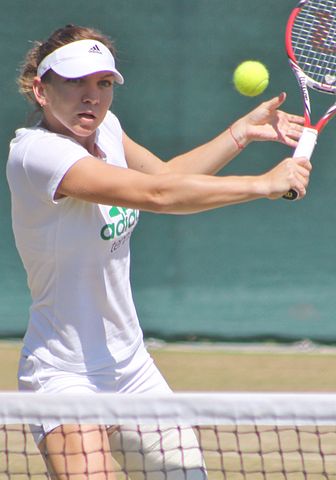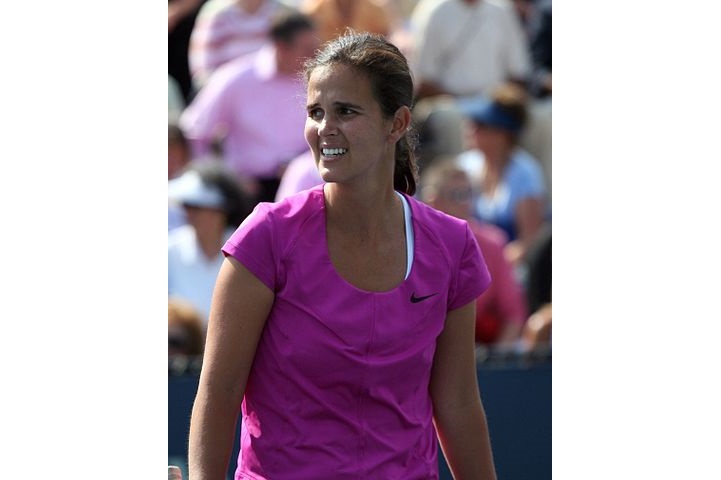
The Tennis 128: No. 90, Caroline Wozniacki

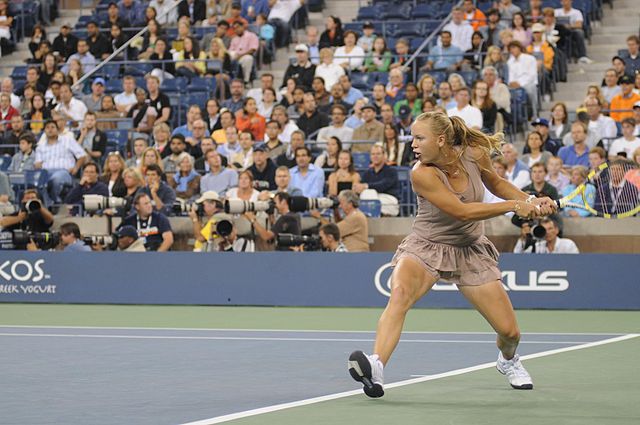
Caroline Wozniacki at the 2009 US Open. Credit: Edwin Martinez

In 2022, I’m counting down the 128 best players of the last century. With luck, we’ll get to #1 in December. Enjoy!

* * *

Caroline Wozniacki [DEN]
Born: 11 July 1990
Career: 2006-20
Plays: Right-handed (two-handed backhand)
Peak rank: 1 (2010)
Peak Elo rating: 2,251 (1st place, 2010)
Major singles titles: 1
Total singles titles: 30
 

* * *

At the 2015 Australian Open, Caroline Wozniacki told a reporter at the Australian Open, “It’s not a sprint, it’s a marathon.” It was a healthy attitude for her to have: She hadn’t reached the quarter-finals in Melbourne for three years, and her place in the top ten was precarious. She also knew what she was talking about. Two months earlier, she had completed the New York City Marathon in three hours and 26 minutes.

Obvious as it is, the marathon serves as a metaphor for Wozniacki’s career at every scale. In a single match, she could outrun anyone–even for 2 hours and 49 minutes against a fellow warrior like Simona Halep, as in the 2018 Australian Open final. She played a busy schedule when her body allowed it, topping 80 matches per year from 2009 to 2011, and playing 82 again in 2017.

It’s at the full-career level that Caro’s persistence truly comes into focus. Her failure to convert match points in the semi-finals of the 2011 Australian Open hung heavy over her reputation for years, and she felt it as much as anyone. She entered 27 more majors before she finally shook off the “slamless” tag. In between, she suffered 16 first-week exits and fell to players outside the top ten 23 times.

No one would’ve blamed her for an early retirement. She struggled with injuries in 2015 and 2016, and she was diagnosed with rheumatoid arthritis before the 2018 US Open. Plenty of WTA greats have called it quits in their late 20s or earlier, and Caro’s early-career exploits had made her a fan favorite and a decamillionare many times over.

Yet when she put the injuries behind her in late 2016, she started to look like the Wozniacki of old. Rebuilding a ranking that had fallen as low as #74, she picked up titles in Tokyo (over 18-year-old wild card Naomi Osaka) and Hong Kong to finish the 2016 season in the top 20. In 2017, she reached eight finals, defending her Tokyo title and beating Venus Williams for her first year-end championship.

When she finally won her first major the following year, it was a triumph of perseverance fitting for a distance runner.

* * *

In a roundabout way, my entire Tennis 128 project started with Caroline Wozniacki. Her career encapsulates the difficulty of comparing different types of achievements, and I’ve spent countless hours in the last few years trying to crack the code of how to do so.

I ran a Twitter poll back in January of 2020, when Wozniacki announced her imminent retirement. The question: Where did Caro rank among women in the Open Era? Voters were all over the place, with some weighing heavily her 71 weeks at number one, while others considered her to be outside the greatest-of-all-time conversation entirely. My first stab at a GOAT metric, the Greatness Quotient, ranked her 19th among women since 1977. As I’ve improved my methodology, she’s lost a few places, but she still merits a position on the list ahead of many multi-slam winners.

Only nine women in the Open Era have occupied the top spot for longer. She reached the number one ranking in 2010 at age 20, and despite a short spell in second place in early 2011, she finished 2011 as number one as well. She turned in a respectable performance with the coveted ranking, going 73-23 with five titles and a near-miss at the 2010 year-end WTA Championships.

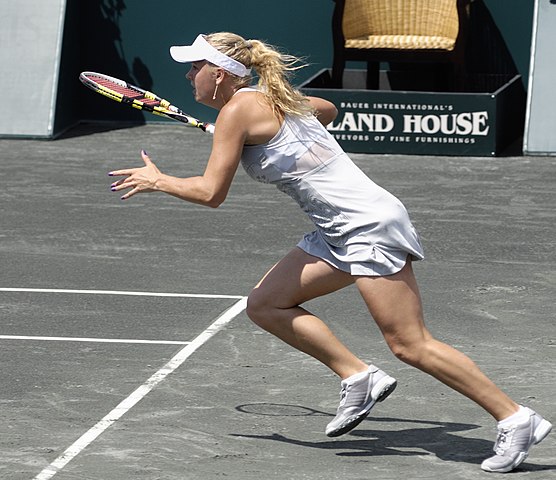
Caroline on the run, in 2010. Credit: Charlie Cowins

But the most important number in most greatest-of-all-time debates remains the grand slam count. For most of her career, Wozniacki was stuck at zero. In five grand slams as the top seed, she got close only once, when she came within a single point of defeating Li Na in the 2011 Australian Open semi-finals. She limped out of the US Open semis against Serena Williams the same year. The rest of her span at number one at majors consisted of one exit apiece in the quarter-finals, fourth round, and third round. It wasn’t bad, exactly, but with women like Serena and Kim Clijsters swatting her off the court at will, fans reasonably wondered if the ranking formula had it right.

Adding to the confusion was that Wozniacki just didn’t look like a number one. She chased, she counterpunched, she moonballed … she wore down opponents until they finally beat themselves. Even when it worked, it often wasn’t particularly eye-catching. And when it didn’t work, you wondered how she ever won at all.

Whatever the optics, Caro’s defensive game got the job done. She could certainly keep up with anyone. Even against Serena Williams, who beat her in 10 of 11 meetings, she forced a third set five times. In 2010 and 2011, she won just short of 80% of her matches, including 16 of 24 against the top ten.

It just didn’t work at slams.

* * *

When Wozniacki rose to number one, fans had gotten plenty of practice adjusting to the idea of a slamless number one. Jelena Janković held the position for 18 weeks in 2008-09, and Dinara Safina claimed it for half of 2009. Both women were plausible contenders when they ascended to the throne. Janković had reached two slam semis, and she made the final at her first major after attaining (and quickly losing) the number one ranking. Safina was coming off the 2009 Australian Open final, and she was runner-up again as the top seed at the French.

Janković and Safina also looked like number ones, at least at their best. Janković sported a flashy, aggressive baseline game. The six-foot-one-inch Safina had the power to hit opponents off the court. Neither player ever picked up a major, but both unquestionably had the weapons to do so.

Caro was different. She had reached the 2009 US Open final, where she lost to Clijsters, but by the time she grabbed the top spot from Serena, her last four slam showings consisted of a semi-final, a quarter-final, and two fourth-round exits. She departed Wimbledon after a 6-2, 6-0 drubbing at the hands of Petra Kvitová, and only one of her vanquishers–#8 Vera Zvonareva–ranked inside the top 16.

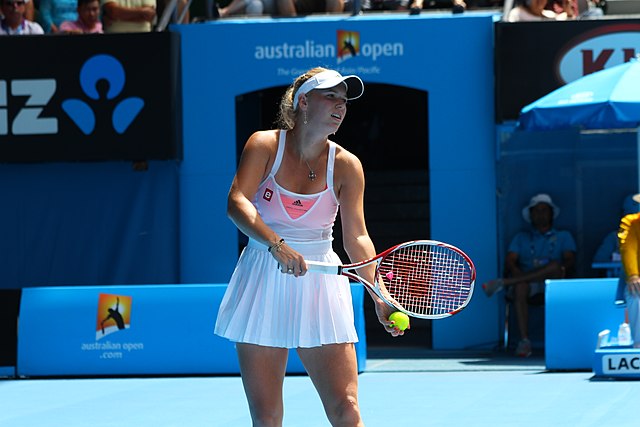
Wozniacki at the 2011 Australian Open. Credit: Christopher Johnson

Skepticism was understandable, especially when Wozniacki only modestly improved on her grand slam performance in her time as number one. Critics weren’t shy about picking apart her game style. When she retook the top spot in February 2011 with a decisive 6-1, 6-3 victory over Svetlana Kuznetsova in Dubai, Caro was ready with an answer:

[W]ell, if I don’t have a weapon, then what do the others have? Since I’m No. 1, I must do something right. I think they’re not actually criticizing me. I think the other players should be offended.

It’s true that many people weren’t attacking Wozniacki herself–though plenty did. The ranking system itself was a frequent target. It rewarded players who slogged it out week after week, winning small tournaments and turning in respectable results at majors. A different system, one that gave greater weight to slam performances, would’ve kept Serena at the top, despite her limited schedule.

Still, Caro’s achievement was more than a statistical quirk. According to my Elo ratings–a very different algorithm from the one that powers the WTA computer–she reached the top of the table at the end of 2009. Elo credits her with 35 weeks at number one–fewer than the official count, but still a tally that indicates she was no fluke. She was never the most feared player in the game, but she was probably the best on tour for about two-thirds of a season.

* * *

For her entire career, Wozniacki got the same unsolicited advice from commentators, journalists, and fans. She was so passive; couldn’t she attack more? Even a little bit?

She took defensive tennis to a new level. The Match Charting Project has logged every shot of more than one hundred of her matches. By Rally Aggression Score–a metric that quantifies how frequently a player ends points, either for good or bad–Wozniacki ranks among top four most passive players in the dataset:

Player                   RallyAgg  
Sara Sorribes Tormo          -135  
Sara Errani                   -96  
Arantxa Sanchez Vicario       -92  
Caroline Wozniacki            -88  
Monica Niculescu              -86  
Agnieszka Radwanska           -86  
Gabriela Sabatini             -83  
Chris Evert                   -78  
Alize Cornet                  -76  
Yulia Putintseva              -75

The three players who score as more passive than Caro are clay-court specialists, while Wozniacki was more comfortable on hard courts. It’s a game style that is rapidly dying. The most passive player among more recent standouts is Elina Svitolina, who rates at -49, while Simona Halep’s career average is -34. Halep is closer to the average rating of zero than she is to Wozniacki’s level of passivity.

Despite the conventional wisdom, Wozniacki’s defensiveness was a feature, not a bug. When she finally won her first major, a three-hour slugfest at the 2018 Australian Open, she hit 24 winners and 24 unforced errors to Halep’s 38 and 45. Aggression score: -109. In the final of the 2017 year-end championships, she hit 19 winners and 7 unforced errors to Venus Williams’s 31 and 39. Aggression score: -160.

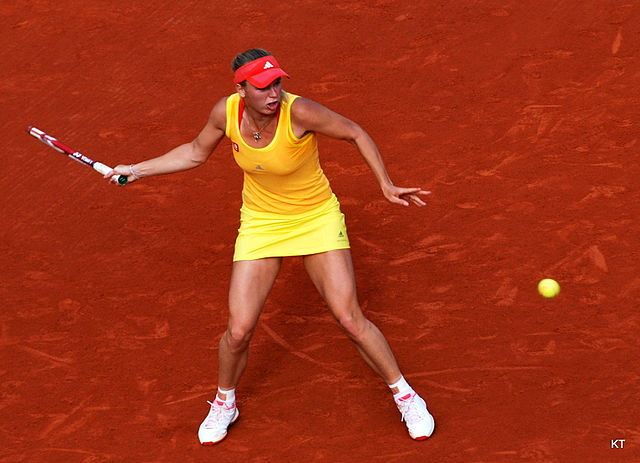
This forehand probably wasn’t a winner, but it wasn’t an unforced error, either. Credit: Carine06

Sometimes, Wozniacki’s unwillingness to change things up bordered on trolling. She was known for hitting her first serves in a specific pattern: wide on the first point of the game, down the middle on the next two, and wide on the fourth point. She followed that sequence more than 80% of the time, and in some matches, she never deviated from it at all.

Such predictability sounds like a recipe for disaster. Had she come along a decade later, facing hyper-aggressive returners like Jelena Ostapenko and Aryna Sabalenka, it might have been her downfall. (Ostapenko beat her all four times they played.) Most of the time, though, it didn’t seem to matter any more than her indifferent forehand. At 4-all in the third set of the 2018 Aussie final, she stuck with the plan, going wide-middle-middle-wide against Halep. The two serves down the middle weren’t even that close to the line. Even after double-faulting at 40-15, she got her hold.

* * *

When the 2018 season began, three years after she ran the New York City marathon, Wozniacki still appeared to be treating the majors like a distance race of their own. She had reached the second week of only two of her previous eleven slam entries, and she lost easily to Angelique Kerber in her one appearance in a semi-final.

Serena Williams missed the 2018 Australian Open due to injury, leaving the draw wide open. Sportsbooks set the odds with a whopping six co-favorites: Wozniacki, Halep, Kerber, Svitolina, Karolína Plíšková, and Garbiñe Muguruza.

The 2018 Australian Open final

Caro was the second seed, but the pressure was off. When she faced two match points against 119th-ranked Jana Fett in the second round, she escaped the sort of trap that had bedeviled her so often at slams. The draw opened up, and she reached the final without facing an opponent ranked in the top 20. The championship was decided in a hot, humid battle of attrition against Halep, a defender every bit as determined as she was. Caro was predictable, passive, and just a little bit better. She took the title, 7-6(2), 3-6, 6-4.

Exactly six years after she lost the number one ranking to Victoria Azarenka in 2012, she got it back. No woman has ever reclaimed the top spot after such a long span. This time, there were no questions about whether she deserved it. For the slam-winning, top-ranked Caroline Wozniacki, it had always been a marathon–one in which she got to decide when she crossed the finish line.

The Tennis 128: No. 91, Ann Jones

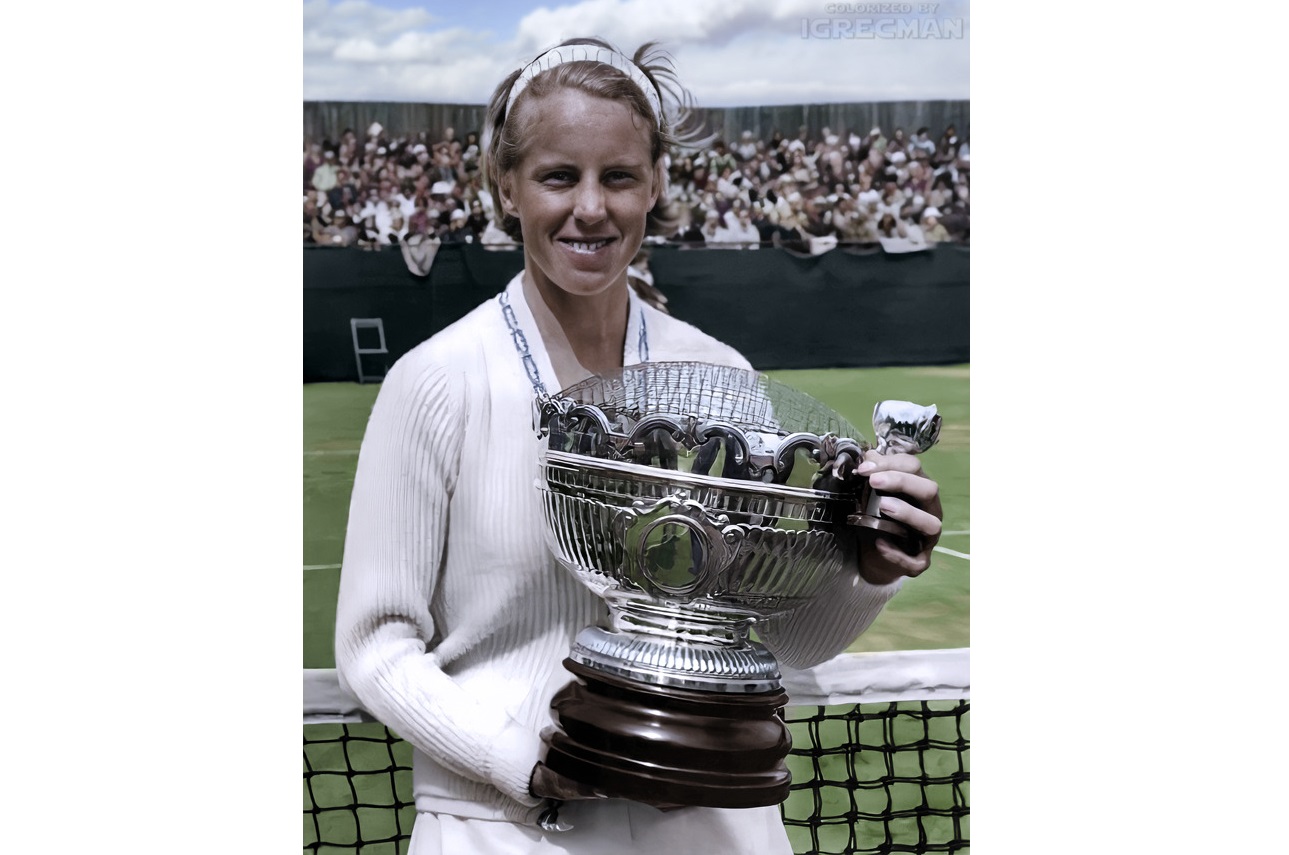
Ann Jones in 1965.
Colorization credit: Women’s Tennis Colorizations

In 2022, I’m counting down the 128 best players of the last century. With luck, we’ll get to #1 in December. Enjoy!

* * *

Ann Jones [GBR]
Born: 17 October 1938
Career: 1956-71
Plays: Left-handed (one-handed backhand)
Peak rank: 2 (1967)
Peak Elo rating: 2,288 (2nd place, 1960)
Major singles titles: 3
Total singles titles: 130
 

* * *

Ann Jones played a lot of tennis. That sounds like a banal observation, and I suppose it is. Still, for a woman who wasn’t fully committed to the sport until her early 20s, and who mostly hung up her racket when her first child was born at age 33, the sheer volume of competition she put herself through is remarkable.

My records credit her with 1,067 singles wins (including a few from juniors) and over 1,300 total matches played. That may actually be an undercount, since we haven’t yet catalogued the early rounds of every amateur-era event. Most sources give Jones 113 singles titles. My records list 130, counting all of her local tournaments and the small pro events she played in 1968-69.

Those four-digit tallies aren’t all-time records, but they aren’t far off. Martina Navratilova and Virginia Wade both played over 1,600 matches, and Chris Evert topped 1,400. Among Jones’s direct contemporaries, only Billie Jean King is in the same league, with her career total (by my unofficial count) of 1,369 matches. There aren’t many women in tennis history who have played 1,000 singles matches, let alone amassed that many wins.

Jones’s work ethic was second to none, and she rarely let an opportunity pass if more tennis could be played. Throughout her 1971 memoir, A Game To Love, she refers to long absences from the circuit, or she explains a poor performance as the result of rustiness. Cross-referenced with her career records, those breaks were rarely longer than a month or two. With winter events in South Africa and the Caribbean and indoor championships in Europe, a woman who wanted to keep herself match-fit could play a schedule even more punishing than today’s WTA calendar.

By the time Jones won her signature Wimbledon title in 1969, she had been criss-crossing the globe for a decade, racking up titles on all surfaces, usually ranking among the top five players in the world.

Not bad for a second career!

* * *

Before Ann Jones became Britain’s best tennis player, she was Ann Haydon, one of Britain’s top table tennis players. She came from a table tennis family, and she competed at elite-level events around the world throughout her teens. At the 1957 World Championships in Stockholm, when Haydon was 18, she reached the finals in singles, doubles, and mixed doubles.

Embed from Getty Images

Haydon receives a table tennis medal in Stockholm

At first, lawn tennis was just something to do in the summer. Table tennis was a winter pursuit, and plenty of women played both sports. Teenage Ann tried to play lawn tennis the way she did the smaller-scale game, by keeping herself in points until she could end them with a big forehand. She eventually developed a somewhat more well-rounded game, and she won the Wimbledon girls’ title in 1956.

Promising as she was with the bigger racket, it took a few more years before Haydon left table tennis behind. She split her time between the two pursuits until 1959, when table tennis politics and rule changes made the game less appealing. She had reached the quarter-finals at Wimbledon and the semis at Forest Hills that year, so there was little doubt she could compete at the highest level of both sports.

Her first winter without table tennis was a success. She began on the European indoor circuit, reaching finals in Cologne, Helsinki, Copenhagen, and Paris, and winning two of the three title matches she played against Angela Mortimer. From there, she headed to Florida and the Caribbean, where she held her own against two of the best players in the world, Maria Bueno and Darlene Hard. She beat Hard four times in the sunshine, and won one of three matches with Bueno. She would beat both of them later that year to win the Pacific Southwest in Los Angeles.

The 18-year-old Haydon wouldn’t slow down until November. She played 30 singles events, winning 15 and splitting the title with Hard in a 16th when the final couldn’t be held. She swung the racket in 13 different countries, from Brazil to Finland, and picked up multiple titles on all four major surfaces. In 10 months, she won over 100 matches.

* * *

Even after such an astonishing full-season debut, questions remained. Lance Tingay placed Haydon sixth in his year-end rankings, behind (among others) fellow Brit Christine Truman.

Experts had a hard time imagining how Haydon’s left-handed baseline game would overcome the power and serve-and-volleying prowess of the likes of Bueno, Hard, and Truman, especially at Wimbledon. Haydon already had a reputation as a grinder: In the 1960 Sutton final, she took two hours to beat Shirley Brasher, 6-2, 6-2. One of the rallies reached 120 shots.

She summed up her own early-career limitations in her memoir a decade later:

My main weakness was that I did not possess one really outstanding stroke with which to dictate the pace of a match. … I had no power game with which to hit back and relied instead on my steadiness and a willingness to work hard. This paid dividends on clay but was insufficient on grass.

Or as Virginia Wade put it:

Though Ann reached the semifinals of Wimbledon each year, her game was like a cake without the final layer of icing. … Mine had too much icing and not enough cake.

Fortunately for Haydon, icing wasn’t always necessary. She won her first major title at Roland Garros in 1961, advancing past the young Margaret Smith (later Court) in the quarters and 1958 champion Zsuzsa Körmöczy in the semis. Her opponent in the final, the Mexican Yola Ramírez, struggled with both the occasion and the inclement weather, and Haydon ran away with it, 6-2, 6-1.

The newly-minted French champion had a hard time sustaining her form. She lost twice to Smith on grass, then took an early exit at Wimbledon in the fourth round to Renee Schuurman. Haydon beat Mortimer to reach the Forest Hills final, but failed to put up much of a fight against Hard. It was another 30-tournament season, and by Wimbledon the following year, she was “emotionally exhausted.” Still, the pair of major finals meant that she ended her 1961 campaign as the consensus third-best player in the world.

* * *

By September of 1962, Haydon had played another 87 matches, including two major semi-finals and a 25-match winning streak in the winter that spanned South Africa, Norway, France, and Britain.

Finally, she took a break, prompted by her marriage to Philip “Pip” Jones. Gossips clucked, as Jones was 31 years her elder. The relationship proved beneficial for both Ann and her tennis career, as Pip encouraged her to continue whenever she wavered in her commitment to the game. He even traveled full-time with the professional troupe his wife joined for 1968 and 1969.

At first, Mrs. Jones shifted her priorities, writing later that, “For the next two or three years, I was essentially a housewife who played tennis when it didn’t involve too much inconvenience.” Of course, this is Ann Haydon Jones we’re talking about, so tennis was sufficiently convenient to the tune of 99 matches in 1963 and another 95 in 1964.

Still, savvy observers recognized Ann’s wavering commitment, even as she reached another Roland Garros final in 1963. In 1964, Maureen Connolly coached the British Wightman Cup team, and she told Jones that she “should either give it my all or not bother to compete.” The two women became friends, and Connolly helped her develop the more aggressive game that she sorely needed.

Jones got another boost after the 1966 season, when she again reached the French final. A businessman named Ernest Butten, better known for his support of British golfers, arranged for her to spend the offseason doing serious physical training for the first time. She developed her right side for better balance, and strengthened her neck to counteract the effects of a long-lingering injury.

Nearly 900 matches into her lawn tennis career, Jones was finally ready to turn a corner.

* * *

At the 1967 Kent Championships in Beckenham, Ann drew Billie Jean King in the semi-finals. King had beaten her 11 of 16 times, including 8 of their last 10 meetings. Jones struggled with the the American’s topspin, and Billie Jean was particularly skilled at exposing the Brit’s weak backhand.

There was nothing to lose in trying something new:

Tired of baseline duels, I was determined to go to the net, so I chipped and rushed in on everything. These tactics paid off handsomely against [quarter-final opponent] Kerry [Melville] and I decided to employ them for my semi-final with Billie Jean. For the first time for ages, I beat her on grass.

Jones defeated King in three sets, and went on to win the tournament in another three-setter against Virginia Wade. She followed up the success at Wimbledon, where she reached her first final. With the pressure on, in front of a packed Centre Court crowd, Billie Jean was in her element, and Jones lost in straights.

Connolly had showed her how to use better judgment when coming in behind approach shots. Later in 1967, they shifted focus to the serve, lowering her toss and adjusting her foot position to make it easier to follow serves to the net.

Embed from Getty Images

Ann (left) had 50,000 reasons to be smiling in this picture

Jones faced Billie Jean once again in the Forest Hills final that year, and while the result was the same, the score was closer, with Ann matching her opponent up to 9-9 in the first set. Both women joined George MacCall’s four-woman professional group in 1968, so Jones had constant opportunities to test herself against the American. They played an epic three-setter at a Wembley pro event in May, then went another three sets in the Wimbledon semi-final. Billie Jean usually came out on top–she won 38 of their 49 career meetings–but the gap was narrowing.

* * *

The professional game agreed with Ann Jones. Years of table tennis had prepared her for pro-style scheduling, when most matches were held in the evening. In 1969, the first full season for the women of MacCall’s troupe, Jones would pile up another 100-plus matches, and the workload wouldn’t faze her at all.

She lost a tight French Open final to Margaret Court, so when she drew the top-seeded Court again in the Wimbledon semi-finals, she didn’t expect to win. She surprised herself by pushing Margaret to a 12-10 first set, then shifted the momentum by winning a marathon game to open the second set. She won the second, 6-3, playing what Jones called “the best tennis of my whole career.” Court cramped and faded, and the Brit pressed home her advantage to reach the Wimbledon final once again.

Billie Jean King was waiting, but this time, Jones was prepared for the occasion. She ignored the mountains of telegrams and focused on the challenge ahead. In three sets, she beat Billie Jean at her own game. Connolly had taught her that she should be coming in behind three-quarters of her first serves and half of her seconds. On the day, she advanced behind 85% of firsts and 58% of seconds. The Wimbledon crown was hers, 3-6, 6-3, 6-2.

Jones-King highlights start from ~1:00

Jones would continue playing for another two years, until she was pregnant with her daughter. But she didn’t defend her Wimbledon title, opting for a chair in the commentary booth instead. With three singles majors, six runner-up finishes, and another five doubles majors to her name, she had nothing left to prove. The 1957 table tennis runner-up could finally retire on top.

The Tennis 128: No. 92, Gottfried von Cramm

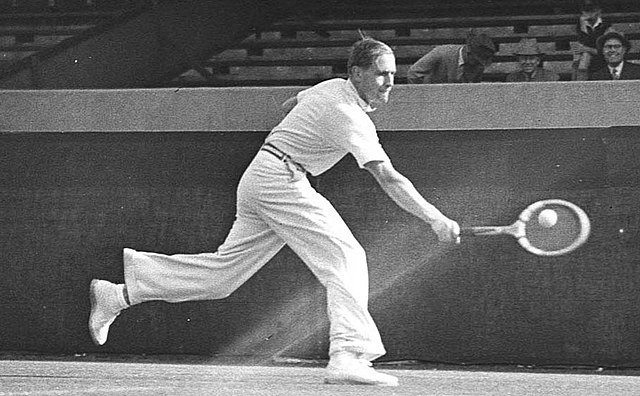
Gottfried von Cramm in 1937

In 2022, I’m counting down the 128 best players of the last century. With luck, we’ll get to #1 in December. Enjoy!

* * *

Gottfried von Cramm [GER]
Born: 7 July 1909
Died: 8 November 1976
Career: 1929-55
Played: Right-handed (one-handed backhand)
Peak rank: 1 (1937)
Peak Elo rating: 2,105 (1st place, 1935)
Major singles titles: 2
Total singles titles: 75
 

* * *

Some sports stories never get old. For me, every single tale of the sportsmanship of Gottfried von Cramm is worth repeating.

Nowadays, if a tennis player commits the most modest act of kindness on court–say, he suggests that his opponent challenge a close call–Twitter explodes with praise and the tournament rushes to post a clip on YouTube of the historic moment. Nobel Peace Prize nominations are filed forthwith.

Gottfried Cramm–he dropped the aristocratic von as well as his title of “Baron” for most introductions–did that sort of thing every day before breakfast.

The first time Don Budge met Cramm, it was 1935, and both men had both just won their Wimbledon quarter-final matches. They were slated to meet in the semis. Cramm took the 20-year-old Budge aside, and explained that in his match against Bunny Austin, he had been “a very bad sport.” A close call went against Austin, and Budge agreed that the linesman made a mistake. To put things right, Budge tanked the next point.

That’s how Bill Tilden did things. Even though Tilden’s brand of theatrics went beyond what most players would dare, a generation of American players followed his lead. They thought it was the sportsmanlike way of responding to such unfairness. But no, Cramm explained: “You made yourself an official, which you are not, and in improperly assuming this duty so that you could correct things your way, you managed to embarrass that poor linesman in front of eighteen thousand people.”

In Cramm’s view, proper treatment of everyone–including linesman, who were often of a middling standard, at best–came first, ahead even of fairness on court.

Once, when a linesman called Cramm for a foot fault, the German apologized.

(Once, when a linesman called Jim Courier for a foot fault, the American said, “F— you.”)

In the 1935 Davis Cup Interzone Final, Cramm played what one of his opponents, the American Wilmer Allison, called “the greatest one-man doubles match.” Daniel Prenn, until recently Cramm’s equal, had been barred from the German national team due to Nazi racial policies. (Prenn was Jewish.) Instead, doubles duty with the Baron fell to the much weaker Kai Lund.

Gottfried’s play that day was so dazzling that the German team came within a point of victory. After Lund missed an easy volley on the fifth match point, he hit a winner to earn a sixth. But Cramm told the umpire what no one else in the stadium had noticed–the ball grazed his racket before Lund made his shot. The Germans conceded the point. They lost the match and, with it, any hope of winning the tie.

The Davis Cup meant a great deal to the Nazis. A federation official traveling with the team criticized the star player, accusing him of failing the German people. Cramm responded:

Tennis is a gentleman’s game, and that’s the way I’ve played it ever since I picked up my first racket. Do you think that I would sleep tonight knowing that the ball had touched my racket without my saying so? Never, because I would be violating every principle I think this game stands for. On the contrary, I don’t think I’m letting the German people down. I think I’m doing them credit.

* * *

Cramm’s personality and aristocratic bearing were so compelling that, even eight decades later, it’s easy to forget that he was one hell of a tennis player.

The German packed a lot of tennis into a very short span of time. Unfortunately, his time at the top overlapped that of Don Budge and Fred Perry. Budge once said, “Gottfried was the unluckiest good player I’ve ever known.”

Cramm won his first title in Germany in 1929, just after his 20th birthday. He made his major debut at Roland Garros and Wimbedon in 1931, and played his first Davis Cup rubbers in 1932. By 1937, he was on sufficiently thin ice with the Nazis that the German federation didn’t enter him in singles at the French, where he was the defending champion. The following March, he was jailed for a homosexual affair.

Cramm in the 1936 Wimbledon semi-finals

In little more than half a decade, the Baron won the French Championships twice, beating Jack Crawford in 1934 and Perry in 1936. He played 14 majors in total before World War II, and reached the final in 7 of them. Every loss was at the hands of Perry or Budge, and he was injured in a taxi accident on the way to one of the clashes with Perry. He tacked on another three major doubles championships, not to mention a whopping 65 match wins for Germany’s Davis Cup team.

After his arrest and imprisonment 1938, Cramm’s career was effectively over. Wimbledon wouldn’t grant a place in its 1939 draw to a man convicted of morals charges, and the black mark on his record prevented him from getting a US visa. The character of his Nazi accusers counted for nothing.

Yet the German clearly had more championship-quality tennis in his racket. At Queen’s Club in 1939, he beat the strong American player Elwood Cooke in the quarter-finals. In the semis, as sportswriter Al Laney put it, “He simply smothered Bobby Riggs,” winning the first 11 games in a row. Cramm had to sit out Wimbledon, and a few weeks later Riggs beat Cooke for the title there.

Gottfried wasn’t allowed to return to Wimbledon until 1951, when he was 41 years old. He was no longer a factor on the world tennis stage, but his post-war performance suggests just what he might have accomplished had the Nazis never come to power. Between 1946 and 1954, playing mostly in Germany, he tacked on 27 titles to his career record. Unlucky, indeed.

* * *

Cramm’s best shot was, very possibly, his American Twist-style second serve. Marshall Jon Fisher’s excellent book, A Terrible Splendor, centers on the great 1937 Davis Cup match between Budge and Cramm. Fisher describes the kicker:

Von Cramm has a famous second serve, maybe even better than his first. He likes to toss the ball a bit to his left, almost behind him, and arch his back as he swings to create a rounded motion, catching the ball from left to right as well as back to forward, creating enormous topspin. … On clay it has a particularly ferocious high bounce, since spin has more effect on clay, but even on the grass he is able to win points outright with his second serve.

The second serve was particularly deadly in one of Cramm’s most memorable matches. In the 1936 Davis Cup Interzone Final–the round that determined which nation would take on the defending champion for the trophy–Cramm edged out the Australian Adrian Quist by the narrowest of margins, 4-6, 6-4, 4-6, 6-4, 11-9. The German saved five match points, and he needed nine of his own. It was a gusty day, and it was a wind-aided Cramm kicker that finally settled the contest.

Embed from Getty Images

The Cramm service motion

Cramm’s serve wasn’t the only American influence in his game. Bill Tilden first visited the von Cramm estate in 1928, and he spent a great deal of time with the young player. He particularly focused on Gottfried’s backhand, replacing a defensive slice with a topspin stroke like his own. Tilden would remain in Cramm’s corner throughout his career, even coaching the German Davis Cup team when they took on the Americans in 1937.

Few men could teach tennis like Tilden could. Al Laney wrote of the Baron’s new-and-improved shot, “[F]ew players ever had a stroke to compare with his ‘flat’ backhand, with which he occasionally blinds the gallery.” Harry Hopman said, “Gottfried was the most fluent and best looking stroke maker I have seen in my fifty years of international tennis.”

* * *

While I’m reeling off the superlatives, how about this one from British Davis Cupper John Olliff: “He could raise his game a little above what you and I always thought was perfect. For short spasms he could make Budge look like a qualifier.”

One of those bursts of brilliance was particularly well-timed. Budge and Cramm faced off in what was long considered to be the greatest match of all time. In 1937, Germany and the United States met in the Davis Cup Interzone Final. The winner would advance to the Challenge Round against Great Britain to decide the winner of the Cup. Both Germany and the US would be favored against the Brits, so the Interzone tie was effectively the final. Budge and Cramm met in the decisive fifth rubber.

Just a few weeks earlier, the American had trounced the Baron in the Wimbledon final, 6-3, 6-4, 6-2. Budge was fast becoming the best player in the world: He would win six majors in succession, including all four in 1938. Cramm was gracious (as usual) in defeat: “‘I was quite satisfied with my form today. But what can one do against such perfect tennis?”

Embed from Getty Images

One way to beat Budge was to partner with Helen Wills Moody (left)

Cramm must have been even more satisfied with his form in the Davis Cup match. He won two close sets, 8-6 and 7-5, to take a commanding lead over the Wimbledon champion. The level remained astonishingly high, and after Budge took the third set, Tilden told a reporter it was the greatest Davis Cup match he had ever seen.

Budge grabbed an early lead in the fourth, and Cramm let the set go to save energy for the fifth. The German raced out to 4-1 in the decider, and Budge held on only by adopting the risky strategy of taking Cramm’s high-bouncing second serves on the rise. The American drew even, and with a burst of spectacular shotmaking, Budge sealed the match, 8-6 in the fifth.

For the remainder of his life, US Davis Cup captain Walter Pate told anyone who would listen that it was the greatest match ever played.

* * *

In the tennis world of the 1930s, the stakes didn’t get any higher than the Davis Cup. The Americans, as expected, swept aside the British defenders and reclaimed the Cup for the first time since 1926. The Nazis were well aware of the trophy’s status, and Cramm’s inability to secure the Davis Cup for Germany contributed to his downfall.

Tilden suggested that Gottfried take a break after the Davis Cup, but the Baron kept playing. He headed to the United States, where he won the US national doubles title but lost to Budge in a five-set final at Forest Hills. He kept moving west, playing at the Pacific Southwest in Los Angeles before sailing–with Budge–to Australia.

Embed from Getty Images

Budge and Cramm (right) after the 1937 US final

He told Tilden that he was playing for his life. He knew that the Gestapo had enough evidence to arrest him. A few powerful tennis fans and admirers, such as Hermann Göring, couldn’t protect him forever. Perhaps a US national title would’ve made the difference, but he seemed to sabotage his own efforts. He increasingly spoke out against the regime, at one point calling Hitler a “housepainter,” and his tennis suffered from the strain. He beat Budge in a couple of exhibitions, but in the semi-finals at the Australian Championships, he lost to the 19-year-old John Bromwich.

You already know how the Baron’s time at the top ended. He went home, heard the Gestapo knock on the door, and spent several months in jail. When he returned to the tennis circuit, he was often unwelcome. When the war began, his morals conviction overrode his aristocratic status, so he fought as a conscript on the Eastern front. He was eventually discharged from the military, possibly because of suspicions he was working to undermine the regime.

Somehow, he came through the conflict sufficiently unscathed that he inspired the same kind of awe in a new generation of post-war tennis players. 1951 Wimbledon champion Dick Savitt played Cramm in Egypt, and said, “He dressed so well that I hated to walk out on the court with him.”

Don Budge spent much of his own long life singing the Baron’s praises. At the 1937 Wimbledon ball, the newly-minted champion said:

I do appreciate this chance you give me to pay a tribute to a great-hearted gentleman. For when it comes my turn to lose, I hope I may lose with half the gallantry, half the graciousness, and with something of the fine spirit of sportsmanship shown by Baron Gottfried von Cramm.

Budge would say the same for another six decades. I told you: Some stories never get old.

The Tennis 128: No. 93, Simona Halep

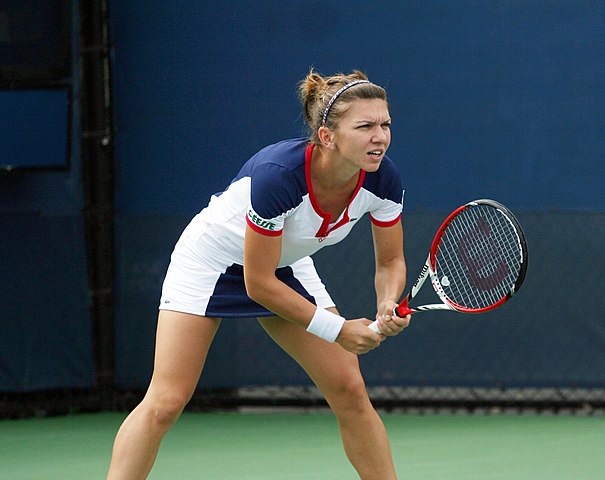
Simona Halep in 2013. Credit: robbiesaurus

In 2022, I’m counting down the 128 best players of the last century. With luck, we’ll get to #1 in December. Enjoy!

* * *

Simona Halep [ROU]
Born: 27 September 1991
Career: 2010-present
Plays: Right-handed (two-handed backhand)
Peak rank: 1 (2017)
Peak Elo rating: 2,178 (1st place, 2015)
Major singles titles: 2
Total singles titles: 23
 

* * *

Here’s a fun stat to kick us off. In my summaries of Match Charting Project data, I group points into four categories: 1-3 shots, 4-6 shots, 7-9 shots and 10+ shots. 133 women have at least 20 charted matches in the dataset, which covers every active player of note as well as most all-time greats back to Martina Navratilova and Chris Evert.

Only five women have won at least 52% of points in all four of the rally-length categories:

Ashleigh Barty
Steffi Graf
Simona Halep
Justine Henin
Iga Swiatek

Serena Williams is below 52% (though still above 50%) in the two longest types of rallies. Evert won less than half of 1-to-3’s, and Navratilova won only 40% of 7-to-9’s. (At least in charted matches, which in their cases are skewed toward finals against each other.)

Our five players don’t have a lot in common, except that they are–by definition–exceptional all-around competitors. Barty and Graf were elite servers whose baseline games were sometimes underrated because their serves were so good. Henin was great at everything. Halep and Swiatek are top-drawer baseliners who have gotten the most out of their serves.

In 2014, Louisa Thomas wrote of Simona at Grantland, “She is a defensive aggressor, an aggressive defender. She is becoming unclassifiable.” At that stage in her career, she wasn’t yet winning so many of the 1-to-3’s. Her serve, and the game she would construct around it, were works in progress. Even then, the “clay-court grinder” tag didn’t quite suffice. Halep’s career has been a remarkable story of steady improvement, and she is even more difficult to classify now than she was eight years ago.

* * *

When Simona Halep first tried her hand at the adult tour, the “clay-court grinder” label was a best-case scenario. She won the French Open girls’ title in 2008 and ascended to number one in the junior rankings, but she was hardly a slam-dunk prospect. A WTA staffer who profiled the 18-year-old in August of 2010 sounded more excited about Alexandra Dulgheru than Halep.

It’s easy to see why the pundits were slow to anoint Simona a future star. In 2012, the 20-year-old was a circuit veteran, but one who struggled to win half her matches. Her third tour-level final came on the dirt at Brussels that year, after she upset both Jelena Janković and Dominika Cibulková. She put up a good fight in the title match against Agnieszka Radwańska, but Aga finished her off with a bagel.

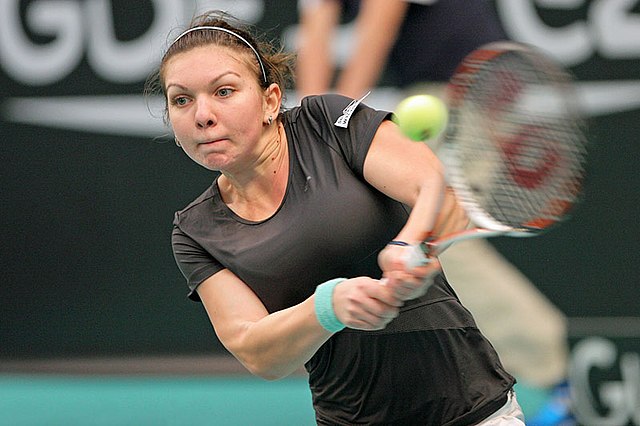
Simona in 2009. Credit: Romain Dauphin-Meunier

Her serve was simply not good enough. She won fewer than 53% of her serve points that year, a tick down from the 54% marks she posted in 2010 and 2011. Radwańska won nearly two-thirds of Halep’s own first serve points in the Brussels final. At Linz later in the year, Victoria Azarenka used Simona’s deliveries as batting practice, winning 66% of return points.

After parts of three years on tour, Halep had won fewer than half of her main-draw matches, and even on clay, she barely broke even. She was only five-feet, six-inches tall, so there was little reason to expect she would develop a bigger game. She finished the 2012 season ranked 47th on the WTA computer, good enough to rank fourth best among 21-and-unders. But it took a hefty bit of wishcasting to see her following in the footsteps of Petra Kvitová and Caroline Wozniacki, top-tenners who were only one year older.

Simona had four more months of frustrating grinding to go before everything changed.

* * *

2013 began as 2012 ended. Halep won about half of her matches, rarely stringing two victories together, and losing lopsided contests against the players she would need to draw even with. She lost 6-3, 6-1 to Radwańska in Auckland, then dropped back-to-back matches to Sloane Stephens–who was higher ranked despite being 18 months younger–at Hobart and the Australian Open.

Simona hobbled into Rome after two early-round losses on clay. Her ranking down to 64th in the world, she breezed through the qualifying draw, then battered her way past a roster of experienced WTA stars. She started with a 6-1, 6-1 dismantling of Svetlana Kuznetsova, then won a three-setter against 4th-seeded Radwańska–her first win against the Polish star in four tries. Halep overcame Roberta Vinci in front of the Italian’s home crowd, and then came back from another one-set deficit to beat Jelena Janković in the quarter-finals.

The breakthrough week didn’t translate into success at the majors–she would lose to Carla Suárez Navarro in the Roland Garros first round and Li Na in the second at Wimbledon–but Halep kept the momentum going everywhere else. After the French Open, she won back-to-back titles at Nuremberg and ‘s-Hertogenbosch–the latter on grass.

A rare sighting of Halep at the net. Credit: si.robi

By the end of the year, she had added titles in Budapest, New Haven (with wins against Wozniacki and Kvitová), and Moscow. She finished the season with an undefeated run at the Tournament of Champions in Sofia, where she beat Ana Ivanović and Samantha Stosur.

In the six months between Rome and Sofia, Halep went from a clay-court specialist on the margins of the tour to a rising star just outside the top ten. She leapfrogged Stephens to finish the year as the highest-ranked player younger than 23. The Radwańska win seemed to have cleared a mental block. After the first time they played–when Aga won, 6-1, 6-2–Halep thought, “I cannot beat her ever.” She proved herself wrong, and she went on to beat nearly everyone else as well.

* * *

Simona wouldn’t hire her first big-name coach until 2014, when she teamed up with Wim Fissette. The 2013 breakthrough came with the Romanian coach Adrian Marcu. Halep credited her step forward to a more relaxed attitude on court, the sort of platitude that we often hear–and players might even believe–but tells us nothing.

Halep’s stats improved across the board, including five-percentage-point jumps from 2012 in both serve and return points won. With data from the Match Charting Project, we can see that she became considerably more aggressive in rallies in her fourth season on tour. The Aggression Score metric quantifies how often players hit point-ending shots (for good or bad), and scales the result to a number between about 100 (very aggressive) and -100 (very passive).

In the handful of charted matches from 2012, Halep’s Aggression Score in rallies was -57. Wozniacki and Radwańska were often more passive than that, but few other successful players are. In 2013, Simona’s Aggression Score in rallies increased to -22. That’s still below average, but it represents far more risk-taking than the 2012 mark.

Embed from Getty Images

Once forgettable, now (occasionally) fearsome:
The Halep serve in 2022

With Fissette, Halep began to work on her serve in earnest. Her first-strike numbers would improve, but as far as rally aggression is concerned, she never advanced beyond the appetite for risk that she showed in 2013. Her Aggression Score stayed roughly the same (-24) in 2014, and has steadily headed back downward since. In 2015, it dropped to -36; in 2017 it fell to -47; and in 2019 it returned to the starting point of -57.

It turned out that Simona could win with a more passive style, but only once her serve improved. The degree to which the five-foot, six-inch Romanian developed that part of her game is one of the more remarkable parts of her story.

* * *

About a year ago, a friend pointed out that Maria Sakkari was doing something very special. Every season from 2016 to 2021, she improved her first-serve winning percentage. Over the whole span, she gained more than ten percentage points, from 58.6%–worse than 86% of WTA players–to 69.9%–better than 93%. She didn’t quite maintain that level throughout the 2021 season, but she still improved on her 2020 campaign, and her 2022 numbers so far are even better.

Few players have done anything remotely similar to Sakkari’s recent run. You will not be surprised to learn that Simona Halep is one of them.

Simona didn’t take steady, incremental steps like Sakkari did. In 2012, she won 56.4% of first serve points, a number so low that it is barely sustainable for a tour-level player. Two years later, with the help of Wim Fissette, she won over 66.4% of first serve points, a rate better than three quarters of her peers. Only nine other players in the last decade-plus have done anything like that:

Player       Weak   1st%  %ile  Strong   1st%  %ile  
K Bertens    2015  59.5%    18    2019  71.9%    97  
M Sakkari    2016  58.6%    13    2021  69.9%    93  
D Kasatkina  2017  59.0%    15    2021  66.4%    78  
S Halep      2012  56.4%     3    2014  66.4%    78  
Y Shvedova   2011  59.4%    17    2016  66.1%    75  
A Cornet     2011  58.9%    14    2020  66.1%    75  
M Linette    2016  59.9%    21    2020  65.8%    73  
Y Wickmayer  2012  60.0%    22    2017  65.8%    72  
A Sasnovich  2016  58.4%    11    2018  65.1%    67  
S Stephens   2011  59.7%    19    2015  65.0%    66

The “%ile” columns show how each first-serve winning percentage stacks up against the WTA tour as a whole. Halep’s 66.4% in 2014 isn’t as good as a couple other of these remarkable late developers, but her starting point was far worse than any of them. And of this elite group, only Aliaksandra Sasnovich bettered her numbers so quickly.

Halep didn’t quite maintain that 66% first-serve winning percentage, but the numbers she posted in 2015 and beyond were much closer to her career high than her previous lows. She never fell below 62.7% for a full season, and her rate has exceeded 65% since 2020. She may have even reached a new level this year, at age 30. In 19 matches in 2022, her first-serve percentage sits at a career best of 68.4%, a number that ranks her between much taller sluggers such as Aryna Sabalenka and Clara Tauson.

* * *

The knock on Halep has always been that she couldn’t close. She reached her first major final at the 2014 French Open, but lost a heartbreaker to Maria Sharapova. She reached the same stage in 2017, where she was the heavy favorite against Jeļena Ostapenko. She won the first set, but collapsed at 3-all in the decider. Her third major final was another three-set loss, this one at the 2018 Australian Open to Wozniacki.

Another strike against her reputation: In 2017, she lost multiple matches–including the 2017 Roland Garros final–when she had the chance to secure the number one ranking. She finally cleared the hurdle in October and held on the top spot for a total of 64 weeks, but it’s hard not to think of the opportunities she missed to amass an even more impressive record.

You might remember the 2018 Wimbledon third-rounder against Hsieh Su-Wei, when Halep lost from match point up. Six times, she was two points away from the win. Or perhaps her loss to Kiki Bertens in the 2018 Cincinnati final comes to mind, another instance when she was one point from victory. Or maybe you just think of the embarrassing on-court coaching visits when she simply berated herself (“I’m ridiculous bad”) before listlessly seeing out a loss.

It’s certainly true that Simona could’ve used a mental coach earlier in her career. An interviewer in 2010 asked her to describe herself in one word, and she went with “nervous.” Even when she finally hired a sports psychologist, her coach at the time, Darren Cahill, suspected she wasn’t committed to the process. A different mindset would’ve done wonders, and it probably would’ve nudged her quite a bit higher on the all-time list.

Still, it’s possible to take this line of criticism too far. Halep lost her first three major finals, but then she became the only player to lose so many and still go on to win one. Halep missed several chances to become number one … and then she did it, and she played well while she held the position. She’s lost a few matches she should’ve won, but the Hsieh and Bertens matches are two of only three times since her breakthrough that she failed to win when she held match point.

* * *

Once she convinced herself she deserved major titles and the spot at the top of the rankings, Halep was able to turn in one of the most impressive performances of the last decade.

At Wimbledon in 2019–on Simona’s weakest surface–the draw opened up for everyone. Second seed Naomi Osaka lost in the first round, and top seed Ashleigh Barty lost in the fourth round. Halep beat Victoria Azarenka and teen sensation Coco Gauff early on, and she cruised to the semi-final without facing a seeded player. She made quick work of Elina Svitolina in the semis to earn a date with Serena Williams in the final.

This time, the pressure was off. Serena was the one with history on the line, as she targeted her 24th major title. The two women had played ten times before, and Williams had won nine. The one time that Halep beat her, at the 2014 WTA Finals in Singapore, Serena bounced back to get her revenge only four days later.

No one expected Halep to win. Simona has never been shy about expressing her admiration for her opponent that day, and one suspects that she would’ve been fine to see Serena make history instead.

The 2019 Wimbledon final

Instead, the Romanian played the match of her life. Williams never had a chance to get settled, and Halep refused to let her into the match. Simona recorded 14 winners against only 3 unforced errors, and she saved the one break point she faced. It was over, 6-2, 6-2, in only 56 minutes, the most lopsided major final loss in Serena’s long career.

* * *

Halep struggled for the rest of 2019, but she came back strong in 2020 and remained effective even after the six-month break for Covid-19. She recovered to number two in the rankings, and she stayed in the top three until an injury finally knocked her out of the top ten in the middle of last year.

Now age 30, Simona can only go as far as her health will allow her. Her Wikipedia page uses some form of the word “injury” 28 times, and she has missed a handful of tournaments after a thigh tear last month. The odds are against a return to the very top, but she’s preparing for her comeback with Patrick Mouratoglou, Serena’s former coach. After a strong start to 2022 in Australia, she clearly believes she has more great tennis ahead of her.

She remains unclassifiable. Her serve has developed into a weapon as her baseline game has drifted back toward more cautious counterpunching. The New Yorker called her “no one’s idea of a grass court player,” and she hoisted a Wimbledon trophy. Known as something of a choker, she has ascended to the highest peaks of the sport.

Just ten years ago, most people in the tennis world didn’t think Halep would amount to much. But careers don’t have to make sense. “Aggressive baseliner,” “defensive aggressor,” or “aggressive defender,” Simona has helped define an era in which few women have been able to stay close to the top for as long as she has.

* * *

Subscribe to the blog to receive each new post by email:


The Tennis 128: No. 94, Kitty McKane Godfree

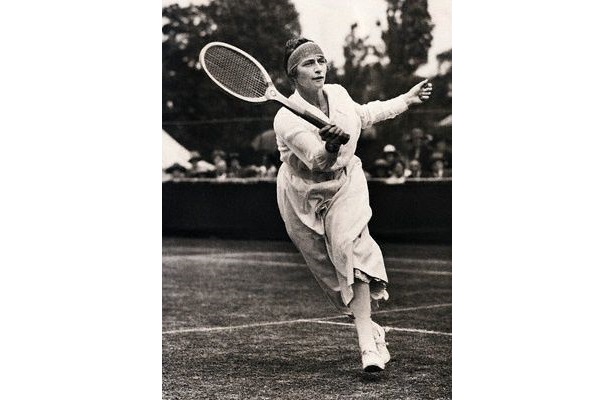
Kitty McKane Godfree

In 2022, I’m counting down the 128 best players of the last century. With luck, we’ll get to #1 in December. Enjoy!

* * *

Kitty McKane Godfree [GBR]
Born: 7 May 1896
Died: 19 June 1993
Career: 1919-34
Played: Right-handed (one-handed backhand)
Peak rank: 2 (1923)
Peak Elo rating: 2,173 (2nd place, 1922)
Major singles titles: 2
Total singles titles: 43
 

* * *

In 1919, the 23-year-old Kitty McKane played her first Wimbledon. She was only a couple months into her tournament tennis career, and she had picked up the sport less than a year before. Still, her first competitive results were so strong that she was invited to make her debut at Worple Road.

She proved herself worthy, winning three straight-set matches to reach the quarterfinals. In the round of eight, she drew Suzanne Lenglen. The Frenchwoman calmly dispatched the newcomer, 6-0, 6-1.

Even for a more experienced player, this would be nothing to be ashamed of. At tournaments in France that Spring, Lenglen had won 16 straight matches, dropping a total of nine games. She won three of her Wimbledon matches that year by the same score by which she beat McKane, and she secured the championship with a 6-1, 6-1 dismantling of Phyllis Satterthwaite.

Years later, Kitty McKane Godfree (she became Mrs. Godfree in early 1926) would point out that she won both of her Wimbledon titles in years when Lenglen withdrew. She told her biographer, Geoffrey Green, that Suzanne “was too good for me and for everybody else as well.”

It’s true–Kitty probably wouldn’t have won the championship in 1924 had Lenglen not withdrawn before their semi-final meeting. Yet she was far more than just another pebble that the Frenchwomen kicked aside in the years that she ruled the tennis world. McKane not only challenged her as few others did, she even sought out the opportunity to do so.

* * *

When she heard that Lenglen had entered the 1922 World Hard Court Championships in Brussels*, McKane made sure to be there. The pair hadn’t met since the lopsided encounter three years earlier. Kitty may have felt she missed an opportunity at the 1920 Olympics, when she withdrew from her singles semi-final against countrywoman Dorothy Holman in order to save her energy for the doubles. Holman advanced to the final against Suzanne, where she lost 6-3, 6-0.

* Back then, “hard court” meant clay.

In the Brussels semi-final in 1922, McKane very nearly toppled the queen. She reached set point the first set at 5-4 before losing 10-8. She even recovered well enough to earn a 2-1 edge in the second before Lenglen ran away with the last five games.

It was the beginning of a 14-month span in which Kitty kept hammering away at the best player in the game, even if she never won a set. Here are the results of their five meetings in 1922 and 1923:

Year  Event      Round  Score     
1922  Brussels   SF     10-8 6-2  
1922  Wimbledon  R32    6-1 7-5   
1923  Menton     F      6-2 7-5   
1923  Paris      F      6-3 6-3   
1923  Wimbledon  F      6-2 6-2

If I showed you those scores out of context, you probably wouldn’t be all that impressed. But against peak Suzanne, they represent one triumph after another.

Embed from Getty Images

Kitty with husband Leslie Godfree in 1928

Before the Brussels semi-final, Lenglen had played seven matches in 1922. She hadn’t lost a single game. In her entire season, she lost only five sets by scores closer than 6-2: two of them to McKane, two to Elizabeth Ryan, and one to Irene Peacock*.

* Poor Irene Peacock: The best tennis of her life earned her a 6-4 6-1 defeat in the Wimbledon semi-finals. One competitive set, and then, goodnight, Irene.

Suzanne was even more dominant in 1923. She played 65 singles matches and won them all. 37 of them were double bagels, and another 10 involved the loss of only one game. McKane’s 6-2, 7-5 loss in the Menton final was the closest anyone got to her that year. Lenglen lost six or more games only six times–once each to Ryan, Satterthwaite, and Germaine Golding, and thrice to McKane.

* * *

There’s plenty more to Kitty McKane Godfree than some respectable showings against Lenglen. She won five medals in the six events she entered at the 1920 and 1924 Olympics. The only medal she missed was in the 1924 mixed doubles event, when she and partner Brian Gilbert withdrew from the bronze match. No one equaled her total tennis medal tally until Venus Williams won her fifth in 2016.

The medal count is just the beginning of her list of doubles achievements. She traveled to the United States to play Wightman Cup in odd-numbered years, and the Brits stayed on to play the US National Championships. In 1923, 1925, and 1927, McKane won either women’s doubles or mixed doubles at Forest Hills. Twice in her career, she beat Lenglen on the doubles court, nearly as rare a feat as a singles upset.

Most impressive was Kitty’s overall athleticism, which allowed her to shine regardless of the sport. Her family bicycled to Berlin when she was nine years old, and she earned national recognition as a child for her ice skating prowess. She was a standout lacrosse player at school, and had World War I not intervened, she and her sister Margaret probably would’ve been selected for international lacrosse matches.

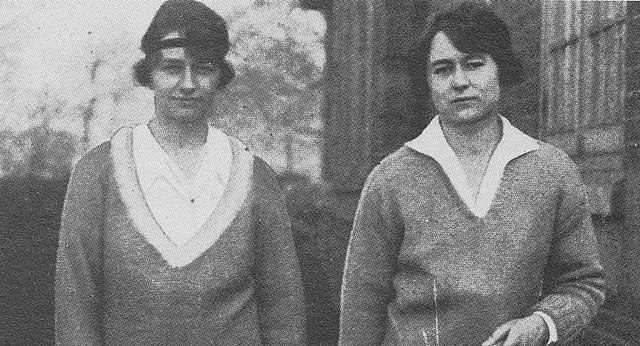
Kitty (left) and sister Margaret in 1921

McKane had no signature shot, but her all-around skills made her good at everything. Dan Maskell wrote, “Mrs. Godfree was one of the first British players to develop an all-court game, completing a deep ground stroke approach shot with a finishing volley.” There were great volleyers, like Elizabeth Ryan, but few players who could compete both at the net and from the baseline.

A. Wallis Myers sketched his early impressions of the star:

I remember seeing her first play in 1919 at Chiswick Park–a pretty, merry volleyer, with a long vaulting stride, a natural hitter if there ever was one. She did not wear, and has never worn, the solemn mien of some players of her sex, and doubtless it has been this air of joyous abandon, index of an unaffected nature, which has made her so popular with crowds wherever she has played.

All this, and with minimal coaching. Lenglen had an overbearing father who helped develop her game, but McKane did not:

I was never coached. What ability I may have had was natural and instinctive. In any case there was little or no coaching in my day and I imagine none at all before the first war in the days when women served underarm.

The only advice–not coaching–I got was from uncles and cousins when I first picked up a racket at the age, I suppose of ten. “Use your right hand” they used to urge. “Tennis is played with the right hand.”

Kitty was naturally left-handed.

She played badminton right-handed as well. Indoor tennis was rare, so many tennis players of the era kept fit during the winter on the badminton court. No one crossed over as effectively as McKane did. She won the All England Championships (the unofficial badminton world championships of the day) four times in singles, twice in doubles with sister Margaret, and twice in mixed doubles. In 1924, she won all three events, just four months before claiming her first Wimbledon title.

* * *

Lenglen was the prime obstacle standing in the way of McKane and major singles championships. The other stumbling block was the powerful American, Helen Wills.

Suzanne won Wimbledon every year from 1919 to 1923, then again in 1925. Wills was six years younger than Lenglen (and nine years younger than Kitty), so her arrival was well-timed to dominate the game after the Frenchwoman went professional in 1926. The American was particularly deadly at Wimbledon, where she finished her career with a 54-1 record. She won the tournament eight times between 1927 and 1938.

Her one loss was to Kitty McKane.

When the pair met in the 1924 Wimbledon final, Wills was not yet the unstoppable force that she would become. But she had already ascended to the top ranks of the game. In 1923, she won 26 of 28 matches, including two wins against McKane. The victories carry a bit of an asterisk, as the first battle was in the inaugural Wightman Cup, when the Brits had little time to find their land legs and prepare for the unfamiliar conditions. But after another week passed and Kitty advanced to the quarter-finals of the US National Championships, Helen beat her again, this time in a 2-6, 6-2, 7-5 nail-biter.

When Wills arrived in England in 1924, the situation was reversed and conditions favored McKane. Helen lost both of her Wightman Cup matches, including a routine 6-2, 6-2 defeat to Kitty. But like McKane had at Forest Hills the year before, Wills quickly adjusted. Wimbledon followed immediately after the Wightman Cup, and Helen blitzed through five rounds, reaching the final with the loss of only 11 games.

The 1924 Wimbledon final

Kitty acknowledged that it took some luck for her to become champion. Lenglen eliminated two of the best players in the draw–Hazel Wightman and Elizabeth Ryan–before withdrawing from the semi-final. As usual, she had a legitimate illness to justify her exit, but the timing came suspiciously after a weak performance. In this case, the cause of Suzanne’s nerves was a narrow three-set win over Ryan in the quarter-finals.

Even with good fortune on her side, McKane barely won her title. She said in retrospect, “I had a reputation for being a strong finisher. But equally true was the fact I was a weak starter.” In the final, she almost waited too long to turn the tables.

Wills won the first set 6-4, despite dropping 12 points in a row. In her newspaper column, Lenglen described it as “an exciting spectacle but not great lawn tennis.” Helen rode her momentum to a 4-1 advantage in the second, and what A. Wallis Myers called the “palpitating conflict for the sixth game” ran to five deuces and three game points for the American. Kitty saved them all, then sent the score careening in the other direction. She won the second set, 6-4, and sealed the title with another 6-4 score in the decider.

The British crowd was thrilled by their new champion, but journalists could hardly wait to appoint Wills as the inheritor to Lenglen’s throne. Two days after the final, the New York Times wrote:

[Wills] is a better stroke maker than her conqueror, Miss McKane, and probably hits harder than any other woman player at Wimbledon. … The experts find it difficult to decide exactly what gave the British woman the victory, some attributing it to her speedier footwork and others to Miss Wills’s occasional lapses from her best.

Helen would go on to justify even the most outlandish forecasts of her future greatness, but in the summer of 1924, she wasn’t quite good enough to get past Kitty McKane.

* * *

Most onlookers in 1924 would’ve predicted that Wills’s first Wimbledon title would come before McKane’s second. Helen was undefeated for the rest of the season, picking up Olympic gold as well as her second title at Forest Hills.

But in 1926, the draw once again opened up for Kitty. Now married to Davis Cupper Leslie Godfree, she watched as an appendectomy sidelined Wills and a spat with tournament organizers sent Lenglen packing. Her toughest match came in the third round against Elizabeth Ryan, who she beat after dropping a 6-1 first set. She reeled off 11 games in a row to eliminate Diddie Vlasto in the semis, and she secured the title by winning the last five games of a three-set final against Lili de Alvarez.

As if that wasn’t enough, she and Leslie won the mixed doubles. Their title is best remembered as the only one by a married couple, but it was no mere historical curiosity. It was certainly no walk in the park for the newlyweds. In the two final rounds, they beat two strong American teams: first Ryan and Vinnie Richards, then Mary Browne and Howard Kinsey.

For the perennial number two, the pair of Wimbledon trophies represented a final hurrah. She won four titles in five tournaments in the remainder of 1926, then lost to Wills and Ryan in an abbreviated 1927 schedule. She started a family and never returned full-time to the circuit.

Yet she still had one more great performance for her British fans. A key part of the 1924 and 1925 Wightman Cup-winning teams, she was drafted to play doubles again in 1930. In the deciding rubber of the seven-match series, Kitty paired Phoebe Holcroft Watson to upset a truly imposing duo, Helen Wills (now Wills Moody) and Helen Jacobs. With the Cup on the line, the Brits pulled out the victory, 7-5, 1-6, 6-4.

Embed from Getty Images

Kitty (right) with Pam Shriver in 1986

The Americans would retake the Wightman Cup in 1931 and hold on to it until 1958. Kitty’s Wimbledon titles wouldn’t loom quite so historically large, as Dorothy Round picked up two singles wins for the Brits in the 1930s.

Still, Kitty McKane Godfree herself wouldn’t soon be forgotten. She lived to the great age of 96, and she continued to play–occasionally with Jean Borotra–into her nineties. When the Wimbledon centenary arrived in 1986, she was drafted to present the trophy to that year’s women’s singles champion, Martina Navratilova. Navratilova was more like a Lenglen or a Wills than a McKane, but then again, Martina’s coaches let her play left-handed.

The Tennis 128: No. 95, Vitas Gerulaitis

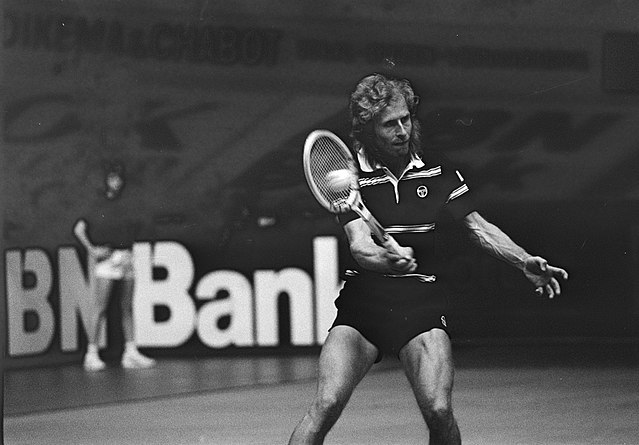
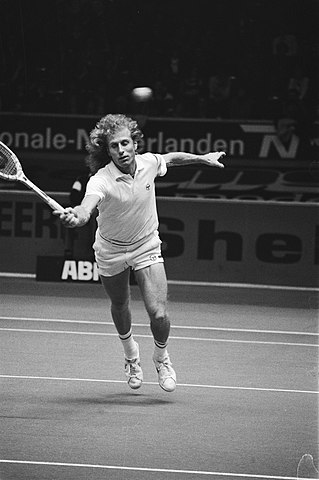
Vitas Gerulaitis in Amsterdam in 1979

In 2022, I’m counting down the 128 best players of the last century. With luck, we’ll get to #1 in December. Enjoy!

* * *

Vitas Gerulaitis [USA]
Born: 26 July 1954
Died: 17 September 1994
Career: 1973-85
Played: Right-handed (one-handed backhand)
Peak rank: 3 (1978)
Peak Elo rating: 2,201 (3rd place, 1978)
Major singles titles: 1
Total singles titles: 26
 

* * *

Tennis was alive in 1979. The men’s game had the big three of Björn Borg, Jimmy Connors, and 20-year-old John McEnroe. All three had compelling personalities, they delivered one dramatic match after another, and they–at least the Americans–gave every impression of hating each other. The media–and not just the sports media–ate it up.

The women’s game had Chris Evert, Martina Navratilova, and its own wunderkind, 16-year-old Tracy Austin. The tour featured great rivalries, movie-star good looks, and just enough cattiness to keep the sport in the tabloids. Recreational tennis was booming, and the sport was drawing on talent from more and more corners of the globe.

And then there was Vitas Gerulaitis. Sometimes ranked fourth behind the big three, he won the Australian Open in December of 1977 and reached a career-high #3 on the ATP computer before McEnroe arrived in 1978. His game was plenty good enough that his sex appeal, easygoing lifestyle, and undeniable charisma made him a global icon.

At the end of 1979, the 25-year-old New Yorker shared the cover of People magazine with CHiPs actor Erik Estrada and Bee Gees frontman Barry Gibb. Gerulaitis and his flowing blonde mane was one of the “10 sexiest bachelors in the world.” I would be doing you a disservice if I didn’t quote at length:

Lipstick has been spotted more than once on the collar of Vitas Gerulaitis’ tennis whites. “Well, I’m a pretty sociable guy and I don’t get lonely too often,” shrugs the world’s fifth-ranked tennis player and the game’s No. 1 ladies’ man. His tastes run to actresses and models. “It doesn’t hurt for a girl to be pretty,” he says of his entourage. “But after a match I don’t want someone to sit there and talk about my backhand. I want to discuss the Pope’s visit or something.” …

Known around the circuit as “the Lithuanian Lion,” Vitas denies his own sex appeal. “Rod Stewart,” he says admiringly, “is the only sexy guy in the world.”

The list hasn’t aged well–Gerulaitis slots in between Prince Andrew and O.J. Simpson–but there’s no denying that Vitas’s celebrity far transcended the aficionados who appreciated his footwork and his forehand.

* * *

It is tempting to ignore Gerulaitis’s on-court career entirely and simply reel off his best lines. Perennial runner-ups tend to give the best press conferences, and the self-deprecating New Yorker was no exception.

You probably know his most famous quip: “And let that be a lesson to you all. Nobody beats Vitas Gerulaitis 17 times in a row.” The man who failed to improve on a 16-0 head-to-head was Jimmy Connors, and the occasion was the January 1980 Masters tournament in New York. Vitas won two of his three round-robin matches–one of them a three-set comeback over John McEnroe–and he knocked out Connors in the semi-final in straight sets.

The sequel is rarely told: Gerulaitis really did figure him out. He beat Connors in their next three meetings, including the Roland Garros semi-finals five months later.

The irony in Vitas’s remark is that he did lose 17 times in a row to one player–Björn Borg. It wasn’t for lack of trying. “Every time I play Borg I come out with some thirty ideas that should get me victory,” he said. “And each time Björn breaks each one of the thirty to pieces, like a clay-pigeon shooter.”

Gerulaitis never gave up hope, even after Borg’s stunning early retirement. “If I have to invite him over to my house when I’m 95 and get him out of a wheelchair, I’m going to beat the guy,” Vitas said. “If someone asks me how long I’m going to play tennis…until I beat Borg.” It didn’t take that long–Gerulaitis beat his long-time tormentor in a handful of early-1980s exhibitions.

The Lithuanian Lion can be forgiven for his exasperation. Perhaps his greatest single-match performance was one that he lost, to Borg in the semi-finals of Wimbledon in 1977, 6-4, 3-6, 6-3, 3-6, 8-6. Gerulaitis was up a break in the fifth set before it slipped away. He won 176 points to Borg’s 177.

There are worse ways to spend the next 25 minutes of your life.

Yet the next day, Vitas offered to help his vanquisher prepare for the final, and they became fast friends. Borg would prepare for the US Open at Gerulaitis’s house, and when the Swede got married, Vitas threw him a four-day bachelor party. McEnroe wrote in his 2002 autobiography, “Borg and Gerulaitis had, shall we say, perfected the art of enjoying the fruits of tennis.”

* * *

Indeed, another of Vitas’s one-liners captures the lifestyle that inspired People magazine: “If I did as well on the court as I do off the court, I’d be No. 1 by now.” He partied with Andy Warhol at Studio 54, and when he bowed to the Royal Box before that 1977 Wimbledon semi-final, Warhol spotted a cocaine cutter on his gold chain.

Gerulaitis’s relentless pursuit of off-court pleasure makes it easy to conclude that he was a dilettante, lacking the work ethic to become the very best. Nothing could be further from the truth.

Tony Palafox, one of his coaches at the Port Washington Tennis Academy, said, “He might be on the court for 10 hours a day. It didn’t matter how long it took; he would practice something until he had it right.” He was a perfect sparring partner for Borg, perhaps the only man on tour who took practice time more seriously.

His attitude was crucial. He only stood a chance when he was in top physical condition. Vitas was fast, and he needed to be. In the 1977 Wimbledon epic against Borg, he rode his trademark “bunny steps” to the net 216 times, including behind almost every second serve.

There was nothing “baby” about the Gerulaitis net game.

His father, a Lithuanian immigrant who became the first head coach at the USTA National Tennis Center, identified one flaw in his son’s game: a second serve he called a “baby serve.” In eight matches charted for the Match Charting Project–admittedly a sample biased toward the toughest opponents, given the limited film that has survived from Gerulaitis’s playing career–Vitas won 71% of first serve points and only 45% of second serves.

By his late 20s, the partying and drug use–not to mention a decade of opponents jumping on the second serve–had begun to slow him down. Yet at the Masters event in January of 1982, he pushed Ivan Lendl to a fifth set in the final round. Lendl was so frustrated by his inability to put the match away that, in the deciding set, he drilled a forehand right back at the head of the hard-charging Gerulaitis. It knocked him over, and Lendl won the match. But as usual, Vitas got the final word. “I have nothing in my head to really damage anyway.”

* * *

Oddly, fans in New York took some time before they warmed to the Lithuanian Lion. Gerulaitis and McEnroe reached the 1979 US Open final after McEnroe beat Connors and Vitas defeated Roscoe Tanner. (Tanner had eliminated Borg in the quarters.) It’s hard to imagine the media circus that would ensue if a pair of New Yorkers faced off in the US Open final today. But at the time, Gerulaitis said, “They hate us. Popularity-wise, I’m a notch above John, and John is a notch above Son of Sam.”

Fans in the Big Apple would come around. Still, Vitas’s reputation played better abroad. If he hadn’t played alongside McEnroe and Ilie Năstase, he’d be remembered more for his on-court theatrics. He never hesitated to get in an umpire’s face, even if the confrontations didn’t have the sometimes vile undertones of Năstase’s or the sheer intensity of McEnroe’s.

Gerulaitis was particularly popular in Italy, where he graced billboards advertising a racket called the Wilson Stiff Model. (Yes, really.) This despite the fact that when he lost the first set to top seed Adriano Panatta at the 1977 Italian Championships, he said, “These people are animals. Rome is the asshole of the universe.” He came back to beat Panatta in the third, and he went on to win the title.

He scored a second Italian title in even more impressive fashion two years later. At the same tournament where Tracy Austin ended Chris Evert’s six-year winning streak on clay, Vitas bounced back from a first-set bagel to defeat countryman Eddie Dibbs in the semi-final. Waiting in the title match was Guillermo Vilas, the best clay court player of the era behind Borg.

The 1979 Rome final

The Vilas match was possibly Gerulaitis’s greatest victory. It certainly represented everything he was capable of on court. The final lasted five hours and nine minutes, a record for the tournament. The total of 57 games set a new mark as well. Vilas won two tiebreaks to a take a two-sets-to-one lead, but the American came back to win, 6-7, 7-6, 6-7, 6-4, 6-2. Gerulaitis said after the match, “I changed strategy about four times during the match and played just about every way I know how to.” To beat Vilas on European clay, that’s what it took.

Even after retirement, Gerulaitis had one more Roman triumph up his sleeve. In 1994, he filled in for the vacationing Tim Gullikson and coached Pete Sampras to the Italian Open title, Pete’s best clay-court result.

* * *

Regardless of how the crowd felt about Gerulaitis in Flushing, Vitas was enormously well-liked around the game. As a teen at the Port Washington Tennis Academy, he was idolized by McEnroe and Mary Carillo. He was one of the few men who could claim to be friends with McEnroe, Borg, and Jimmy Connors. Vitas’s coach, Fred Stolle, said, “Maybe he was too nice to be the top guy, but that’s what he chose. He couldn’t be any other way.”

Vitas’s celebrity ensured a steady stream of hangers-on, but the friendships were something else entirely. Tracy Austin said, “People gravitated to him because he was so likable, so unselfish, so giving.” Another player of the era, Rick Meyer, compared Gerulaitis’s charisma to that of Bill Clinton. Vitas was the same with everyone, including kids he worked with at charity clinics. He would tell them, “We’re gonna go through this a few times together, and maybe it’ll help us both get it right.”

This Vitas-inspired song is catchy, if semantically impenetrable

Gerulaitis hung on in the top ten throughout his twenties, retaking the fifth spot on the ranking list as late as 1983. But his lifestyle took its toll. His last season with a winning record was 1984, when he turned 30, and he was in and out of rehab for much of the mid-1980s.

Vitas’s story doesn’t exactly have a happy ending. He died of carbon monoxide poisoning in 1994, when he was only 40 years old. He may or may not have kicked his drug habit (opinions differ), but he had recovered to the extent that he worked as a color commentator for the USA Network. He was good at it. McEnroe wrote, “Vitas was head and shoulders above almost any of the tennis broadcasters out there.”*

* J-Mac continued, “…which wasn’t saying a lot, since I felt (and still largely feel) that most of them stank: Virtually without exception, they were arrogant, dry, pompous, or just plain boring–take your pick.” Oh, John.

Gerulaitis the commentator gives you a pretty good idea of what he was like on court. He could hardly keep his energy in check–this is not a man who was about to pause an explanation just because the next point was underway. He had plenty of opinions, but he was never imperious about them.

Above all, Vitas was good on television because he was so enormously likeable. It’s quite a trick, wielding such a compelling personality that being one of the hundred best tennis players of the century is a mere footnote.

The Tennis 128: No. 96, Elena Dementieva

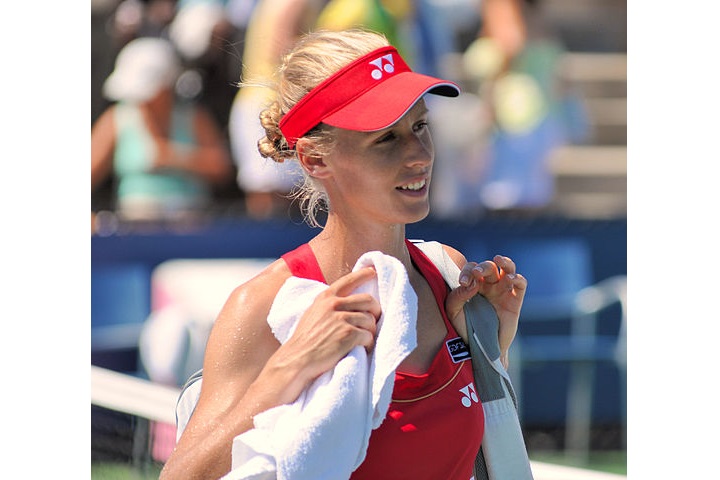
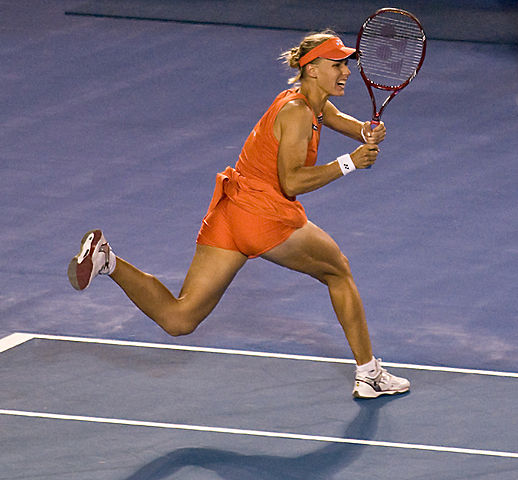
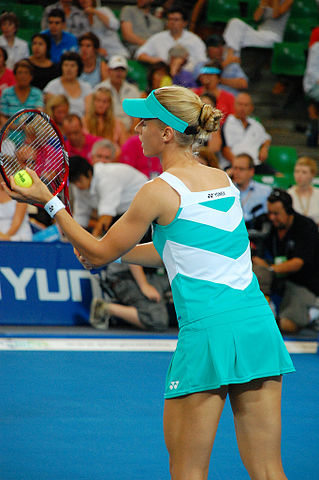
Elena Dementieva at the US Open in 2010.
Credit: Christian Mesiano

In 2022, I’m counting down the 128 best players of the last century. With luck, we’ll get to #1 in December. Enjoy!

* * *

Elena Dementieva [RUS]
Born: 15 October 1981
Career: 1998-2010
Plays: Right-handed (two-handed backhand)
Peak rank: 3 (2009)
Peak Elo rating: 2,168 (2nd place, 2010)
Major singles titles: 0
Total singles titles: 16
 

* * *

How important is an Olympic gold medal?

Tennis struggles with that question. It hasn’t always been an Olympic sport, and we have our own long-standing pinnacles that players target. You can find players anywhere on a wide continuum of positions between “The Olympics are everything!” to “Eh, I’ll play Atlanta instead.”

Elena Dementieva was firmly on the pro-Olympics side of that question, even before she won the singles gold medal at the 2008 Beijing Games. After overcoming Dinara Safina in the final, she made it clear:

I can’t even compare a grand slam to the Olympic Games, it’s just so much bigger. This is what I was waiting for. This is what I was working for. This is the biggest moment in my career, my life.

It’s not really possible to make an analytical case that the Olympics should be placed on the same level as the majors. The draw is smaller, and some top players usually skip it. (The Beijing field was missing Lindsay Davenport, Ana Ivanovic, and Maria Sharapova, and world number one Justine Henin had retired in May.) The event disrupts the established tennis calendar, so some of the stars who turn up aren’t as prepared as they would be for Wimbledon or the US Open.

But Dementieva is far from alone in valuing an Olympic gold so highly. If we do sometimes underrate the event, hyper-motivated competitors like her are the reason why. Winning a grand slam isn’t a significant achievement just because you need to win seven matches, or because someone with a British royal title might be in attendance. They matter because all the players agree that they matter.

Some tour players are willing to give the Games a miss, and most of the rest don’t care enough to skip events to aid their Olympic preparation, as Dementieva did. Still, enough competitors value an medal so highly that they treat it like a slam–Serena Williams certainly cares about medals, and Elena beat her in the quarters. Dementieva never got her major, but of all the great players who just missed, she might be the one who regrets it the least.

* * *

There. I did it. Nothing about the serve. I’ve been an admirer of Dementieva’s since 1999, when I saw the 17-year-old Russian on the outer courts at the US Open. I was also a teenager at the time, so it’s just possible that I was drawn to the statuesque blonde for reasons other than her devastating, rock-solid groundstrokes.

Whatever the initial appeal, I suffered first-hand through the decade of Elena’s near-misses and serving woes, so it doesn’t seem right to talk about the serve right out of the gate. She put together a great career–the 96th-best of the last century!–in spite of her limitations, and there are plenty of other things to talk about.

But… it always comes back to the serve.

Dementieva pulled a ligament in her right shoulder in late 2000, and she developed a sidearm slice serve to compensate. While the shoulder eventually recovered, the serve remained unorthodox, inconsistent, and an enormous liability. She knew it–how could she not?–so it was an even bigger problem in important matches. In her first major final, at the 2004 French Open, she double-faulted on 10 of her 45 service points.

The serve could be this bad.

By the time she retired in 2010, Elena had improved her serve, hitting harder and struggling less when it counted. That last year, she won 47.1% of her second serve points, a bit above tour average. It was a long, hard road to get there. Here are her year-by-year second-serve winning percentages:

2004: 39.0%
2005: 38.7%
2006: 40.6%
2007: 42.9%
2008: 45.3%
2009: 46.4%
2010: 47.1%

* (WTA stats are spotty before about 2006, so the ’04 and ’05 numbers are based on only some of her matches. There are some individual matches missing from the 2006-10 totals as well.)

39% is so, so bad. No player in today’s WTA top 50 is below 40%, and only two women are below 42%. There are no mitigating factors, either. Dementieva didn’t make an unusual number of first serves–her career average was 61%, and she landed just 58% in 2004–and the numbers were worse on high-leverage points.

Somehow, the rest of Dementieva’s game was so good that in 2004, she reached two slam finals. She also finished the season in the top eight for the second year in a row. Pam Shriver said, “With that serve, it’s a miracle she’s in the Top 10.” What’s that, Pam? “A miracle!”

* * *

The reason the Russian remained competitive was her groundstrokes. Ed McGrogan wrote in 2008 that both forehand and backhand were “things of beauty … undeniably some of the best in the women’s game.” Her open-stance forehand was a weapon capable of firing in any direction, and she had superb control over her backhand.

As Dementieva’s serve evolved from a softball of a slice to a more tactical spinner, some onlookers even tried on the idea that it became fearsome in its own right. Writing in 2005, coach Jim McLellan explained how “her side spin serve has become deceptively strong.”

The contact is still low and out to the right, and there are still the double faults but her unique side spin creates problems for the girls on tour. In the deuce court it curves wide and stays low, driving the receiver well into the alley, but equally forcing them to play the ball from below the level of the net…. Elena’s serve arrives at a speed, with a direction, and considerably lower contact point than all the others.

It worked against some opponents, anyway. McLennan was talking about the US Open quarter-final that year against Lindsay Davenport, which she won in a third-set tiebreak. The following summer, Elena beat Maria Sharapova and Jelena Jankovic back-to-back to win in Los Angeles. She was side-arming serves by the third set of the final, and Jankovic admitted it kept her off-balance:

You don’t know what’s coming up, a slow serve or a fast serve. Sometimes she changes. Sometimes for the second serve, she hits like a first. Normally with the players, they hit a big serve and a little kick serve, and she hits all kinds.

Other observers sought to invent new ways of describing Dementieva’s inexplicable effectiveness. Multiple writers seem to have independently coined the phrase “return of return of serve”–essentially a serve-plus-one for bad servers. In theory, Elena’s court sense was so good that she could anticipate where the returner would bludgeon her serve, and she’d do her own damage on the second shot. It’s a clever concept, but the Match Charting Project has logged every shot from 35 of her matches, and it turns out she was only a bit better than average when it came to ending points with her second stroke.

* * *

The explanation for Dementieva’s persistence at or near the top of the game was much more simple. She was the best returner in the game for much of her career. She didn’t get the benefit of a powerful serve, but she simultaneously neutralized everyone else’s.

In 2005, Elena won a measly 51.5% of her service points … and 50.7% of her return points. Even Simona Halep, the best returner of the post-Dementieva era, never topped 50.3%, and only posted one season above the 50% mark.* The Russian won more than half the points she played on return for three consecutive years, and her career mark is above 49%.

* Halep currently sits right at 50% in 2022. If she returns from injury in time to play many clay-court events, watch out.

Those numbers are averages, so her best days were truly eye-popping. I have stats for 320 of her tour-level matches, and in 73 of them, she won a higher rate of return points than serve points. In 35 of them, she won at least 60% of her return points, including dissections of Victoria Azarenka, Lindsay Davenport, Li Na, and Dinara Safina. She won 57% on her return in the 2007 Moscow final against Serena Williams.

Probably a backhand winner. Credit: Steve Collis

Dementieva didn’t hit a lot of return winners–in fact, she hit fewer of them than almost anyone else on tour. But she set herself up well for the remainder of the point. The return of serve was the shot best-suited to her occasional mental fragility: She didn’t have enough time to think about it.

A 2006 profile in ESPN: The Magazine suggests what could’ve been possible if Elena had figured out how to switch off her brain on the serve, as well:

Before Wimbledon in June 2005, Dementieva spent a week in Holland working with Richard Krajicek, once regarded as the most fluid server in the men’s game. He put three balls in her hand and had her serve them rapid-fire. Nearly every time, the third serve-the one she had the least time to think about-flew fastest and landed with the best topspin bounce. Krajicek is convinced Dementieva’s faulting problem has become a self-fulfilling prophecy. “I believe with Elena, it is not mechanical,” he says. “It is psychological.”

A brief conversation with Dementieva would lead most people to the same conclusion. “I hate my serve,” she said. “I don’t know how to serve.”

* * *

Fittingly, Elena’s greatest triumphs came not when her serve magically worked, but when she outgutted opponents who were struggling just as much.

That was the story of the 2008 Olympic final, when Dinara Safina’s serve abandoned her, as well. With the stadium still half-empty, the two Russians lost the first four service games, and things barely got better from there. The match saw 31 break points in its 30 games, and holds of serve were only slightly more common than breaks.

With every ball toss, renewed optimism.
Credit: Spekoek

For once in her career, all Dementieva had to do was to be the steadier competitor. She managed it. She double-faulted only three times out of 100-plus serve points, and only once in the deciding set. Safina, on the other hand, hit 17 doubles, four of them when facing break point. On her first match point, Elena landed a modest first serve and sealed her gold-medal performance with a forehand winner.

The post-match interview was one of the few of her career with no questions about the serve–what was wrong with it, how she worked around it, or what she planned to do about it. Her famous liability didn’t win her the gold medal, but it didn’t cost her the victory, either. It’s tough to think of Elena Dementieva without dwelling on the serve and what-could-have-been, but I’ll always try to remember the glorious game that emerged when the serve got out of the way.

The Tennis 128: No. 97, Frank Parker

Frank Parker. Credit: Ernest King / AP

In 2022, I’m counting down the 128 best players of the last century. With luck, we’ll get to #1 in December. Enjoy!

* * *

Frank Parker [USA]
Born: 31 January 1916
Died: 24 July 1997
Career: 1931-50
Played: Right-handed (one-handed backhand)
Peak rank: 1 (1948)
Peak Elo rating: 2,103 (1st place, 1941 and 1945)
Major singles titles: 4
Total singles titles: 73
 

* * *

It’s possible to tell the story of men’s tennis in the 1930s and 1940s with only a passing mention of Frank Parker. When Bill Tilden went pro, he passed the baton to Ellsworth Vines, who gave way to Fred Perry and Jack Crawford. In the late 1930s, Don Budge emerged to dominate the circuit, followed by Bobby Riggs, a wartime hiatus, Jack Kramer, and Richard “Pancho” González.

Parker wasn’t a match for any of those men. He won the US National Championships in 1944 and 1945, the editions most affected by World War II. The 1944 field was only 32 players, only a handful of them serious contenders. Even the typically exuberant Allison Danzig wrote of that year’s title match, “It was not a brilliant match … but it was a worthy final for a wartime championship.”

Still, any retelling of the era is much richer with Parker in the story. During his two decades in amateur tennis, superstars came and went, winning a few majors before (understandably!) bolting for the professional ranks. The serve-and-volleying “Big Game,” exemplified by Kramer, steadily took over. Parker’s career is a reminder that there was an alternative path. Especially if, like the two-time Forest Hills champion, you had a world-beating backhand.

* * *

Parker’s signature shot was often compared to the famous Budge backhand. Frequent competitor Gardnar Mulloy called it “uncanny” and “a thing of beauty.” Pancho Segura said simply that it was “the finest.” The backhand was a gift from God. Frank owed just about everything else to Mercer Beasley.

Beasley was a super-coach at a time when many players didn’t even have regular coaches. Though he stumbled into the profession at age 40, he made his mark right away, discovering a 14-year-old Ellsworth Vines in 1925. The coach’s reputation spread quickly, so when a wealthy member at the Milwaukee Town Club in Wisconsin thought he spotted promise in an 11-year-old ballboy, he arranged to hire Beasley as the club pro.

That ballboy, working for a nickel a set, was Franciszek Andrej Pajkowski. The Americanized “Frank Parker” was, in part, a sop to chair umpires who couldn’t handle the Polish mouthful. Under Beasley’s guidance, he quickly developed into a star. He won the national boys’ championship at age 15, and he added the national junior title a year later. In 1933, aged 17, Frankie added his first significant adult trophy at the US Clay Courts.

Embed from Getty Images

Parker posing

By then, Mercer and his wife Audrey had effectively adopted the young man. They even wanted to make the arrangement official. But while Frankie’s mother Anna recognized the advantages that the Beasleys could offer a talented boy from a poor family, she wasn’t willing to give up her son. Still, when Beasley chased coaching opportunities first to California and then to Tulane University in Louisiana, Frank followed. When Mercer couldn’t accompany him to tournaments, Audrey served as chaperone.

Parker became Beasley’s ideal player: a steady, conservative baseliner who rarely showed emotion on court. He took things one step further when he began wearing dark glasses on court, earning the nickname “Mr. Incognito” to go with the expression that reporters invariably called a poker face. Only when Frank finally won the US national title in 1944 did the New York Times claim to detect “a muffled cry of exultation barely breaking the bounds of his habitual restraint.”

* * *

The only things Beasley couldn’t do for his charge were to make him taller–Frankie never grew beyond five feet, eight inches tall–and to fix his forehand. It was a challenging pair of handicaps for an elite player, and they prevented him from getting as far as the semi-finals at Forest Hills until 1936.

Beasley tweaked Parker’s forehand every offseason. When Frank described his own game in 1935, he said he used three different grips on that side, a hint that none of them worked that well. Oddly, the coach may have been responsible for wrecking a natural shot nearly as effective as the backhand. Jack Kramer wrote in The Game:

[A]s a boy he had this wonderful slightly overspin forehand drive. Clean and hard. Then for some reason, [Beasley] decided to change this stroke into a chop. It was obscene; it was like painting a mustache on the Mona Lisa.

Both player and coach acknowledged that the forehand was a problem, but Kramer may have overstated his case. Parker made his first Davis Cup team in 1937, when the Americans traveled to Britain to win back the trophy. Playing second singles behind Don Budge, Parker lost to Bunny Austin in the first rubber, but bounced back to win in straight sets against Charles Hare and secure the Cup. The Milwaukee Journal reported, “Even his forehand, long a weak chink in his armor, was a thing of beauty. Shots made off that side had power and perfect length and accuracy.”

Parker in the 1937 Davis Cup Challenge Round. Note that both Parker and opponent Bunny Austin are wearing shorts! Austin was the trailblazer in this respect, having worn shorts at Wimbledon the previous few years. Parker was the first American to do so in a Davis Cup match. His biographer, Cynthia Beardsley, wrote that no one minded because he had such great legs.

On the other hand, Kramer’s criticism had some relevance even five years later. Parker reached his first major final at Forest Hills in 1942, where he met Ted Schroeder. Schroeder attacked the backhand and eventually broke it down, but he didn’t mince words about Frankie’s weaker side:

Frank’s forehand was so bad. On a crucial shot, Frank did not know where he was going to hit it. It was a matter of execution. On Frank’s forehand, you did not know where it was going to go.

Fortunately, Parker’s court coverage–plus that backhand–were usually good enough to make up for everything else. When author Stan Hart tracked down the 68-year-old Frank in 1984, he wrote that the former champion still “covered his baseline like an ocelot.” Bobby Riggs paid him more conventional praise, writing, “His footwork is marvelous. You never see Frankie hitting the ball from an awkward position.”

* * *

Beasley also–to put it crudely–gave Parker his wife. Audrey traveled with Frank for years, ensuring that the handsome young player kept his focus on tennis and away from off-court enticements. Parker seems to have found a distraction anyway. In 1938, Audrey and Mercer went to Reno for a quickie divorce, and shortly thereafter, Frank and Audrey got married. It was, in Parker’s words, “a love match,” and they remained together until Audrey’s death.

In Frank’s later telling, the Beasleys had long since grown apart. But in the 1930s, the triangle was prime gossip-page fodder. It even drew comparisons with the scandal of the day, the affair between Wallis Simpson and King Edward VIII. The player “stole” his coach’s wife, and the age difference invited constant jokes. Parker was only 22, and the middle-aged Beasleys had a 21-year-old daughter. Even a decade later, when Audrey tagged along on Frank’s first professional tour, Pancho Segura made a game at international borders of trying to get a glimpse of Audrey’s passport. He wanted to see just how old she really was.

Remarkably, the divorce and marriage changed very little, at least as far as Parker’s tennis was concerned. Reporters noticed that he loosened up a bit–but only a bit. Somehow he and Mercer remained friends, to the extent that when Frank won at Forest Hills in 1944, the New York Times story led with Beasley’s pride that his student finally became the national champion. And Audrey kept at her chaperoning. She accompanied the American Davis Cup team to Australia in 1946, and she carefully managed her husband’s training and rest schedule.

Apart from the unusual player-wife-coach triad, Parker’s life and career progressed steadily and predictably. He won multiple singles titles every season from 1932 to 1949, with the exception of the war years. He reached the fourth round at Forest Hills every year from 1934 to 1949, including during World War II. He took part in four Davis Cup campaigns, from the 1937 title effort against Great Britain to the 1948 defense against Australia.

Even the war didn’t really slow him down. He served in the Army, but his superiors saw his value as an entertainer. He spent much of the conflict based on Guam, touring with other stars in uniform like Bobby Riggs and Don Budge.

* * *

In fact, World War II is responsible for many of Frank Parker’s mentions in the history books, both directly and indirectly.

His two national titles came in 1944 and 1945. The fields were not strong ones, and they were smaller than usual–Parker needed only five match wins to secure each championship. Not only was almost every entrant American, but many US standouts were missing. Ted Schroeder, who beat Parker in the 1942 final, didn’t return to Forest Hills until 1949. Joe Hunt, who won the 1943 title, missed the opportunity to defend in 1944 when his Navy flight training course was delayed by weather, and he died on a training mission the following year. Jack Kramer, who would beat Frank in the 1947 final, didn’t play the tournament in 1944 or 1945.

Instead, Parker played two finals against Billy Talbert. Both years, he had the advantage of all that time on the road with Riggs, Budge, and others. On the other hand, Forest Hills was nearly the only proper tournament he was able to play. Maybe that kept the pressure off. His always-troublesome forehand served him well in the 1944 final, working even better than his backhand despite Talbert’s attack in that direction.

Frank’s 1945 title deserves an even bigger asterisk. Talbert was a particularly dangerous challenger this year, as he had won ten straight tournaments before the national event. But he pulled a tendon in his left knee during his semi-final against Pancho Segura and visibly limped through the final. Still, Talbert fought Parker to 12-all in the first set, once coming within two points of victory. But once the 66-minute opening frame was decided in Parker’s favor, there was no coming back.

Parker in the 1948 Roland Garros final

The two national championships raised Parker’s stature, and his resulting ranking at the top of the 1945 American list upped it even more. He never had the time or money to play the European circuit, but in 1948, the USLTA sponsored him to enter the French Championships and Wimbledon. The 32-year-old took the title at Roland Garros, beating Jaroslav Drobný, and he made it a twofer the following year, overcoming young American Budge Patty. He teamed with Richard González in 1949 to win the doubles titles at both European majors.

In the late 1930s, there were always Americans ahead of Parker in line, so when he was at his physical peak, international opportunities just weren’t there. But the two French titles raise some interesting questions. If the man who had won the US Clay Court championship five times had made a habit of traveling to Roland Garros, just how many majors could he have won?

* * *

Parker’s record of four major singles titles and two more finals–all that wartime context aside–is an outstanding one. Oddly enough, they don’t have much to do with his ranking on this list.

In 1944 and 1945, he entered only a handful of events, and most of his matches were against middling competition. He probably was competing at a high level, but the evidence we have just doesn’t tell us much either way. Aside from the fact that he lifted a famous trophy in early September, Parker didn’t add much to his resume as a would-be all-time great during the war.

In 1949, he turned pro after Forest Hills, and promptly started losing to Pancho Segura. He had always beaten Segura outdoors; on the indoor courts that constituted most of the professional circuit, Pancho got the better of him. By tacking a bunch of losses onto an otherwise sterling campaign, Parker lessened the value of his 1949 season, at least in the eyes of algorithms like mine.

Still, my ratings show that Parker was a world top-tenner at the end of 1936, 1937, 1939-41, and 1945-49, with peaks in ’41 and ’48. His performance in 1941 was particularly steady. He tallied eight titles, one of them at the prestigious Pacific Southwest, where he beat Bobby Riggs and Frank Kovacs in the last two rounds.

In 1946, Jack Kramer made the case that his pal Ted Schroeder–not Frank–should play second singles in the Davis Cup final against Australia. Schroeder was rusty, but Kramer argued, “Frankie doesn’t ever upset anybody. He doesn’t get upset himself either, he just plays the same level every match. Here, that’s not good enough.” Maybe so–although weekends like that Riggs-Kovacs double in 1941 suggest otherwise.

More importantly, what matters in Davis Cup selection is not what matters to the broader question of a player’s legacy. Frank Parker won the matches he was supposed to win–more than 600 of them–for two decades. Eddie Moylan, who faced him several times after the war, said, “There were no easy points with him. When you won a point from Frank, you deserved it.” Few men on the circuit were up to the task.

The Tennis 128: No. 98, Zina Garrison

Zina Garrison

In 2022, I’m counting down the 128 best players of the last century. With luck, we’ll get to #1 in December. Enjoy!

* * *

Zina Garrison [USA]
Born: 16 November 1963
Career: 1981-96
Plays: Right-handed (one-handed backhand)
Peak rank: 4 (1989)
Peak Elo rating: 2,160 (5th place, 1985 and 1990)
Major singles titles: 0
Total singles titles: 14
 

* * *

Stories tend to lose their nuance over time, and sports history is no exception. One sportsmanlike act slowly morphs into a narrative that a player was one of the kindest ever to walk the earth. A few ill-judged remarks from a young player affect their reputation for years to come.

This tendency is reliable enough that if you come across a cartoonish, extreme description of a person or event, it’s usually safe to assume that the truth isn’t quite so one-sided. That great sportman had his warts; the outspoken youngster was selectively quoted.

Sometimes, though, the germ of the story that has survived over the decades isn’t extreme enough. So it is with the case of Zina Garrison, the grand slam finalist without a clothing sponsor.

You’ve probably heard about this. Zina spent most of the late 80s and early 90s in the top ten. She was seeded fifth at Wimbledon in 1990, in line with her WTA ranking at the time. She had the greatest fortnight of her career, racing through the first four rounds, then knocking out Monica Seles and Steffi Graf in succession to reach her sole major singles final.

Through those six matches–and for years prior to her standout run–she had no clothing sponsor. The most prominent companies didn’t believe that Black women constituted a big enough market to justify signing up a top-five player, and they didn’t have the imagination to consider that Garrison might appeal to fans outside of her own race. Only after Zina beat Graf did Reebok make her an offer commensurate with her new status as a grand slam finalist.

It’s bad enough that a perennial top-tenner didn’t have a clothing deal in large part because of her race. It gets worse.

It isn’t that no company wanted to associate themselves with Garrison. Early in 1990, her agent told the Washington Post that she had turned down offers that didn’t suit for various reasons. And for three years in the mid-80s, Zina had represented the Pony brand, a deal worth $125,000 per season. When that contract expired, she was 23 years old, continuing to perform at a high level, still showing signs that she might climb even higher.

Pony didn’t renew the deal. The company cited tight budgets while they signed blonde, blue-eyed Anne White. White was best known for wearing a lycra bodysuit at Wimbledon. Her ranking peaked at #19, and she never reached the quarter-finals of a major. Pony’s new “Golden Girl” concept had little to do with on-court achievement, and apparently it had no room for a diminutive Black woman, no matter how talented.

* * *

If we adjusted the career achievements of all-time greats by the difficulty of the obstacles they overcame, Garrison would rocket several dozen places up this list. Her years without a clothing sponsor are just one example of the systemic racism that still permeated tennis. Zina never grew taller than five-foot-five, and she struggled with bulimia for much of her career. Her height meant she had to execute her strokes that much more perfectly to succeed, and the eating disorder often robbed her of the energy needed to see out a tough match.

If it hadn’t been for the early intervention of a Houston-area coach named John Wilkerson, Garrison probably wouldn’t have become a tennis player at all. Wilkerson was a former player who set up a public-parks program, and he heard about Zina from her older brother, a baseball player at nearby Texas Southern. Around the same time, Wilkerson was introduced to Lori McNeil, another young talent just a month younger than Garrison.

A young Zina (left), with Andrea Buchanan, Althea Gibson, and Leslie Allen

Wilkerson said, “It was as if God handed these two young girls to me. They were meant to play tennis.” The coach trained all of his charges as serve-and-volleyers, and both women would rely on the strategy for their entire careers. At her best, McNeil was every bit as dangerous as Zina. She also cracked the top ten, and she twice upset Steffi Graf.

Garrison bloomed within what McNeil called Wilkerson’s “highly disciplined program.” When she was 14, Zina won the junior division of the American Tennis Association (ATA) Championships, the annual event of the leading organization of Black tennis. She and McNeil dominated ATA tournaments until they moved on to the main tour.

Wilkerson didn’t just teach technical nuts and bolts. McNeil said, “He emphasized the mental side of the game. You had to be able to think your way through a match and be mentally tough and know how to handle difficult situations.” Tough situations were plenty common for Black players in Texas. At one junior tournament, Zina overheard a tournament organizer say, “Throw the n—–s in the same bracket.”

Embed from Getty Images

Zina and Lori McNeil (front L and R) with the
1988 Wightman Cup-winning US team

Garrison became a WTA tour regular in 1982, and she quickly proved she belonged. In February at her hometown event in Houston, she pushed Pam Shriver to three sets. Within seven months, she had reached the quarter-finals at Roland Garros and the fourth round at both Wimbledon and the US Open, recording wins over Evonne Goolagong at the All-England Club and former champion Mima Jaušovec in Paris.

In 1983, the 19-year-old Zina improved her won-loss record to 38-19. It was the first of eleven straight seasons in which she’d win two-thirds of her matches. She reached her first final in Indianapolis, where she lost to the Hungarian top seed, Andrea Temesvári. She would go on to reach a tour-level final for 13 consecutive years, a streak only seven women in the Open Era have bettered.

* * *

A further obstacle stopping Zina Garrison from becoming a multiple major titlist was the quality of the opposition. When she arrived on tour, Martina Navratilova and Chris Evert ran the show. Steffi Graf and Gabriela Sabatini arrived soon after. By the late 80s, a new superstar was arriving on tour seemingly every year.

By won-loss record, Zina’s best season was 1989, when she went 59-15 and won three titles. She had a rough couple of weeks on grass, losing in Eastbourne to the unheralded Etsuko Inoue and at Wimbledon to the unknown Louise Field. Aside from that pair of puzzling results and a loss in Houston to Temesvári, check out the list of players who beat her:

Gabriela Sabatini
Lori McNeil
Steffi Graf
Chris Evert
Monica Seles
Martina Navratilova
Steffi Graf
Martina Navratilova
Martina Navratilova
Mary Joe Fernández
Martina Navratilova
Gabriela Sabatini

Garrison’s career haul of only 14 titles would seem to argue against her inclusion on the Tennis 128 list, but remember that at least one of these women–and often several of them–stood in her path at nearly every event she played for a decade or more.

The women’s field wasn’t as deep then as it is today, but the players on top were as strong as in any other era, before or since. Zina’s best position in my historical Elo rankings was fifth, even worse than her peak at number four on the WTA computer. But the women in front of her set a nearly unreachable standard. Her peak rating of 2,160 is the equal of many players who ranked higher in other eras, such as Shirley Fry, Angelique Kerber, and Li Na.

Zina’s 1991 NetPro trading card

Zina played 108 different women at least three times in her career, and she broke even or better with 83 of them. 37 never beat her at all. The damage was done by the handful of women who kept her stuck in the 4th or 5th spot on the ranking list. She was 2-9 against Evert, 2-12 versus Graf, 2-11 with Arantxa Sanchez Vicario, 3-10 facing Sabatini, and most painful of all, 1-33 against Navratilova.

Simply to reach her one major final, she had to beat both Seles and Graf. She was the first player–and one of only two ever–to defeat both in the same tournament. The reward for that superhuman effort was a date with Martina in the final. Zina wrote in her autobiography, “I’ll forever remember Martina as the villain of my professional career. Nearly every time we played she beat my brains out.” So it was at Wimbledon in 1990, when Garrison won only five games in the final.

* * *

It’s easy to focus on Zina’s near-misses, so let’s take a moment to review the times that she broke through. Her 14 titles include a 1985 win on clay at Amelia Island over Chris Evert, two grass-court triumphs over Pam Shriver, and a pair of final-round victories over Lori McNeil, including one in 1992 that required a 22-point deciding-set tiebreak.

She won 20 women’s doubles titles as well, including a 1988 Olympic gold medal with Shriver, three tour-level championships with McNeil, and another six with Katrina Adams. With Sherwood Stewart and Rick Leach, she won two Wimbledon mixed doubles crowns plus a third major title at the Australian Open.

Given the challenges Garrison faced, it’s remarkable that she not only ascended to the elite ranks of women’s tennis, but that she stayed there for more than a decade. In their 2007 book Charging the Net, Cecil Harris and Laryette Kyle-DeBose put her achievements in context:

[Her struggles made] her accomplishments in an anxiety-filled sport even more commendable. She split with the coach that taught her the game, and split with the best friend with whom she shared so many tennis memories, suffering silently from a negative body image and a failed marriage. Through it all, Garrison persevered. Her career serves as a reminder that it is never just a mastery of tennis strokes that makes a player what she becomes.

Zina put it a bit more succinctly: “I never allowed the fact that I was short, pigeon-toed, and black stop me from doing anything.” By the time Reebok signed her up, she had long since come to terms with the reality of the times. She learned early on to focus on what she could control, and as long as someone other than Martina was standing across the net, that meant winning an awful lot of tennis matches.

The Tennis 128: No. 99, Tom Okker

A Dutchman, flying

In 2022, I’m counting down the 128 best players of the last century. With luck, we’ll get to #1 in December. Enjoy!

* * *

Tom Okker [NED]
Born: 22 Februrary 1944
Career: 1962-81
Plays: Right-handed (one-handed backhand)
Peak rank: 3 (1974)
Peak Elo rating: 2,190 (1st place, 1974)
Major singles titles: 0
Total singles titles: 40
 

* * *

For a man who never won a major singles title, Tom Okker was amply rewarded for his tennis career. When the world’s major tennis federations agreed to try “open” tennis in 1968 and allow competition between amateurs and professionals, Okker became the world’s first “registered player,” a hybrid category that allowed him to earn prize money but still–unlike professionals–compete for his country’s Davis Cup team.

He was lucky that the Dutch federation was so swift to give him the new designation. At the US Open in 1968, he beat pros Richard “Pancho” González and Ken Rosewall to reach his sole major final. His opponent in the final was the still-amateur Arthur Ashe, so even though Okker lost the match, the $14,000 winner’s check was his.

At the beginning of the following year, promoter Lamar Hunt convinced Okker to join his burgeoning World Championship Tennis (WCT) circuit. Experts rated him no higher than third-best in the world, and some listed him as low as fifth. But Hunt was confident enough in his value to the tour that he offered more than $200,000 over four years.

$50,000 per year was a big payday for a recently converted amateur. But it seemed was chump change just a few years later. When the newly-formed World Team Tennis (WTT) organization drafted squads at the end of 1973, Okker was the first choice of the Toronto/Buffalo Royals, who wanted the veteran to do double duty as a player-coach. He said, “If they offer me enough money, I’ll play.” They did, and he did, on a five-year contract for a reported $136,000 per year.

Barely a half-decade into the Open Era, a select few players were already getting rich. Debates more familiar to fans of team sports took over the tennis headlines–were these men and women worth all the money? A rival WTT owner, Boston’s Ray Ciccolo, griped:

[F]rom what I’ve seen of the owners’ mistakes, I see why 80% of them are in trouble. Most made their first mistakes at the draft, before the first set of tennis. They came unprepared or didn’t have enough money to do it right. But Okker’s signing was the worst thing Toronto/Buffalo could’ve done to the league.

One reading of Ciccolo’s complaint is that elite-level money was getting handed out to players that didn’t deserve it. Okker didn’t seem like a top-tier talent next to names like Billie Jean King, Jimmy Connors, and John Newcombe. The Dutchman ranked as low as tenth on one journalist’s year-end list for 1973, and he didn’t have any unusual level of celebrity to make up for it.

Royals owner John Bassett may have misjudged Toronto’s interest in team tennis–his club folded after just one last-place finish. But he was more right than wrong in picking–and paying–Tom Okker. In addition to Okker’s doubles prowess, which was particularly valuable in the WTT format, he was a better player than either the public or the rankings gave him credit for. He was at his peak in 1973 and 1974, a frequent runner-up in a field full of all-time greats. Okker was one of the first tennis players to earn $1 million on court, and he deserved every penny.

* * *

No sketch of Tom Okker is complete without a reference to his nickname, “The Flying Dutchman.” Forgive my ignorance: I always assumed people called him that just because it was the only term they knew with “Dutch” in it, and he wasn’t noticeably slow. In fact, the man from Amsterdam was as fast as it gets.

He needed to be. A generous measurement put him at five-foot-ten-inches tall, and after his retirement, Okker said he “should have been just a bit bigger and stronger and had a dominant service.” Had those wishes been granted, no one could have stopped him.

Okker (left) with Marty Reissen in 1968
Credit: Eric Koch

At Queen’s Club in 1968, Okker was the first amateur to beat Rod Laver since Laver turned pro six years before. The New York Times wrote that the “lean, wiry, and fantastically fast” underdog “outmaneuvered and outran the little Australian redhead.” When the Times previewed the Forest Hills final later that year, it reported, “His contemporaries insist that he is the quickest man in the history of tennis.”

This isn’t to say that Okker relied only on speedy retrieving. He was one of the first players to hit a heavy topspin forehand, and in an era when so much spin was still a novelty, it took some getting used to. The 1968 Times preview warned:

More than once today, Arthur [Ashe] will be tempted into letting Tom’s wicked top-spin drive go by, convinced the ball will land well beyond the base line. It will take a sharp eye, indeed, to discern balls from those sharply dipping inbounds. And when at net Ashe’s best defense may well be to reach for every ball originating from Okker’s forehand side.

The Dutchman’s combination of weapons was almost enough to win the first-ever professional major played at Forest Hills. He pushed Arthur Ashe to five sets, including a 26-game first set. The American needed one of the best serving performances of his career to come through. At 5-5 in the first set, Okker was already exasperated by his inability to get into points. After Ashe hit two more aces, Okker faced the wrong way to return Arthur’s next delivery, earning a laugh from the crowd as he signaled his surrender.

Okker quickly resumed the fight. Ashe’s game plan involved wearing out his opponent, a strategy that proved to be built on wishful thinking. The Dutchman didn’t noticeably tire, but Arthur’s serve was just enough to make the difference. The final score was 14-12, 5-7, 6-3, 3-6, 6-3, a near-miss in Okker’s one shot at a major title.

* * *

As we’ve seen, Okker had plenty of reason to be pleased with his performance in 1968. He earned over $20,000 in prize money in his campaign as a “registered player,” and his results garnered the big contract with Lamar Hunt in 1969.

What wasn’t clear at the time was just how close the Flying Dutchman came to the top of the rankings. Before 1973, rankings were unofficial, generally published by veteran sportswriters only once per year. The phenomenon of a slam-less number one is very modern, because it wasn’t possible without computer rankings. The men who used to make the lists believed that Wimbledon and Forest Hills were the only two tournaments that mattered.

Embed from Getty Images

Okker (left) with Ashe, after the 1968 Forest Hills final

According to weekly Elo ratings I’ve assembled, Okker was the second-best player in the world for about four months between June and September of 1969. His status was built in part on the runner-up showing at the US Open, combined with a 78-24 record–including eight titles–in the year that followed. When he wasn’t winning, he was reaching finals. He lost title matches in 1969 to Rod Laver, Roy Emerson, and (three times!) to Tony Roche.

Laver was in the middle of his second Grand Slam season, so second place was as good as a mere mortal could hope for. My ratings report an imposing top ten that Okker nearly surmounted in June 1969:

1  Rod Laver
2  Tom Okker
3  Tony Roche
4  John Newcombe
5  Andrés Gimeno
6  Roy Emerson
7  Ken Rosewall
8  Arthur Ashe
9  Stan Smith
10 Fred Stolle

As if that weren’t enough, 1966 Wimbledon champion Manuel Santana was 15th and ageless wonder Richard González was 17th. It was a great time to be a tennis fan, and a tough time to cling to a spot at the top of the game.

* * *

The cast of characters steadily changed, but the level of competition remained sky-high. Okker somehow kept up.

In 1973, he went 91-23 and won seven more titles against the likes of Ashe, Gimeno, Newcombe, and Ilie Năstase. After finding out that the Toronto/Buffalo Royals coveted his services for World Team Tennis, he continued strong into 1974, winning another title against Năstase and defeating Tom Gorman to secure a championship at home in Rotterdam.

As in 1969, Okker’s reputation was built on these occasional titles, frequent victories over strong competition, and his ability to avoid too many poor showings. Still, no one considered him much of a threat at grand slam events, and he did little to change their opinion. He reached only one major quarter-final–at the French in 1973–between 1971 and 1975.

Okker playing Ken Rosewall in 1970

In traditional terms, his case for a spot near the top of the rankings was even less compelling than it had been in 1969. But returning to my Elo ratings, Okker was briefly–for just one week!–the best player in the game.

It was a spell at number one worthy of Pat Rafter. Okker comes out on top for the week of June 24, 1974, when that year’s Wimbledon Championships began. John Newcombe was number one the week before, but a bad loss handed the top spot to Okker, who didn’t play that week.

The All-England Club didn’t see anything special in Okker’s play that year. The committee seeded him seventh, and he didn’t even live up to that, losing to Alex Metreveli in the fourth round. Third seed Jimmy Connors won the Wimbledon title, which was enough to leapfrog both Okker and Newcombe. Jimbo–again, according to the Elo algorithm–would keep the number one ranking until June of 1978.

Like Rafter’s week at number one 25 years later, Okker’s brief spell at the top feels like a footnote. But the unheralded feat is much more impressive when we consider the cast of characters. There weren’t many easy matches in men’s tennis in 1974. Here is the Elo list for Okker’s sole week at number one:

1  Tom Okker
2  John Newcombe
3  Jimmy Connors
4  Ilie Năstase
5  Rod Laver
6  Stan Smith
7  Björn Borg
8  Ken Rosewall
9  Arthur Ashe
10 Alex Metreveli

For the Flying Dutchman, it was a last hurrah. He was slowing down, and his topspin didn’t bewilder opponents like it once did. He would fall to fifth on the Elo list by the end of the year, and he dropped out of the top ten before Wimbledon in 1975.

* * *

Of course, no one was optimizing tennis rating systems during Tom Okker’s career, and few fans do so even today. Okker was known as a perennial runner-up, an entertaining and talented player who didn’t have quite what it took to reach the top of the game. It didn’t help his reputation that he stuck around into the early 80s, losing ten matches to Borg, eight to Connors, and another seven to Brian Gottfried.

Like his near-contemporary Tony Roche–who did manage to win a major singles title–Okker was born at the right time to share the court with a long list of Hall of Famers, even if it didn’t help him build a strong resume of his own. Also like Roche, he proved his mettle on the doubles court, winning two majors in that discipline and amassing 78 titles, a record that would stand into the 21st century.

The men with the checkbooks knew what they were doing. Okker didn’t make as much money from tennis as he would have a decade or more later, but it would’ve been difficult to imagine World Championship Tennis or World Team Tennis without him. His era was so strong that even an also-ran could earn a spot among the 100 best players of the century.

* * *

Thanks to Kees Haasnoot for research and translation help from the Dutch.