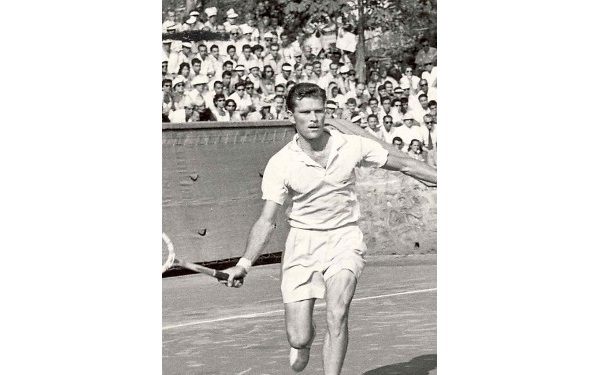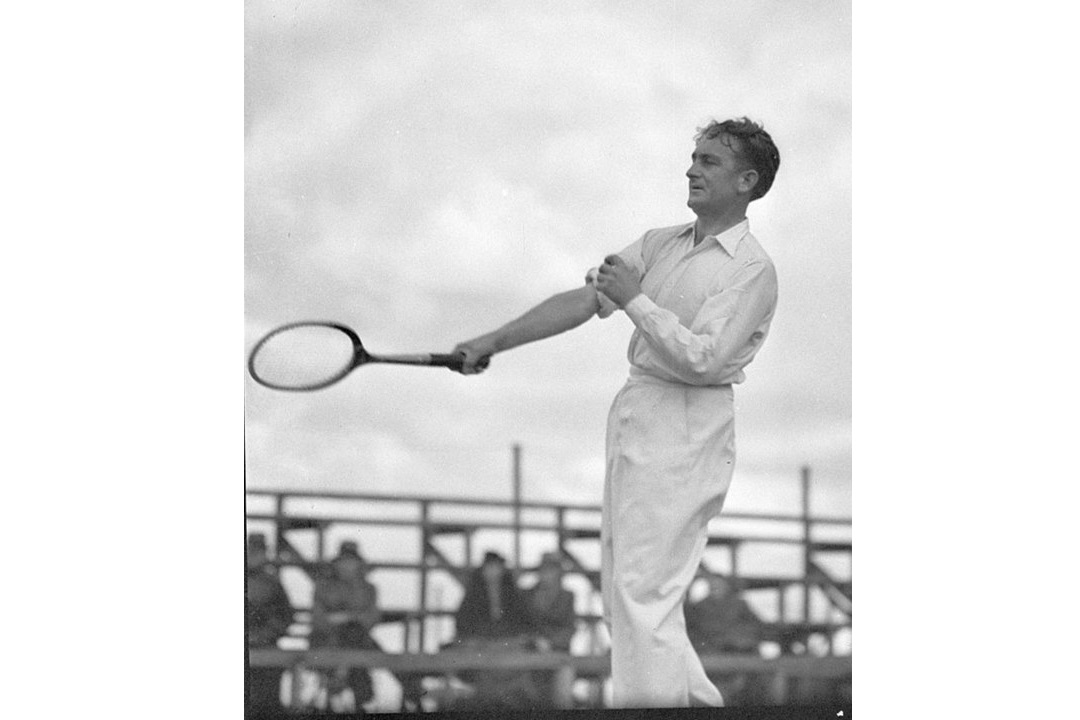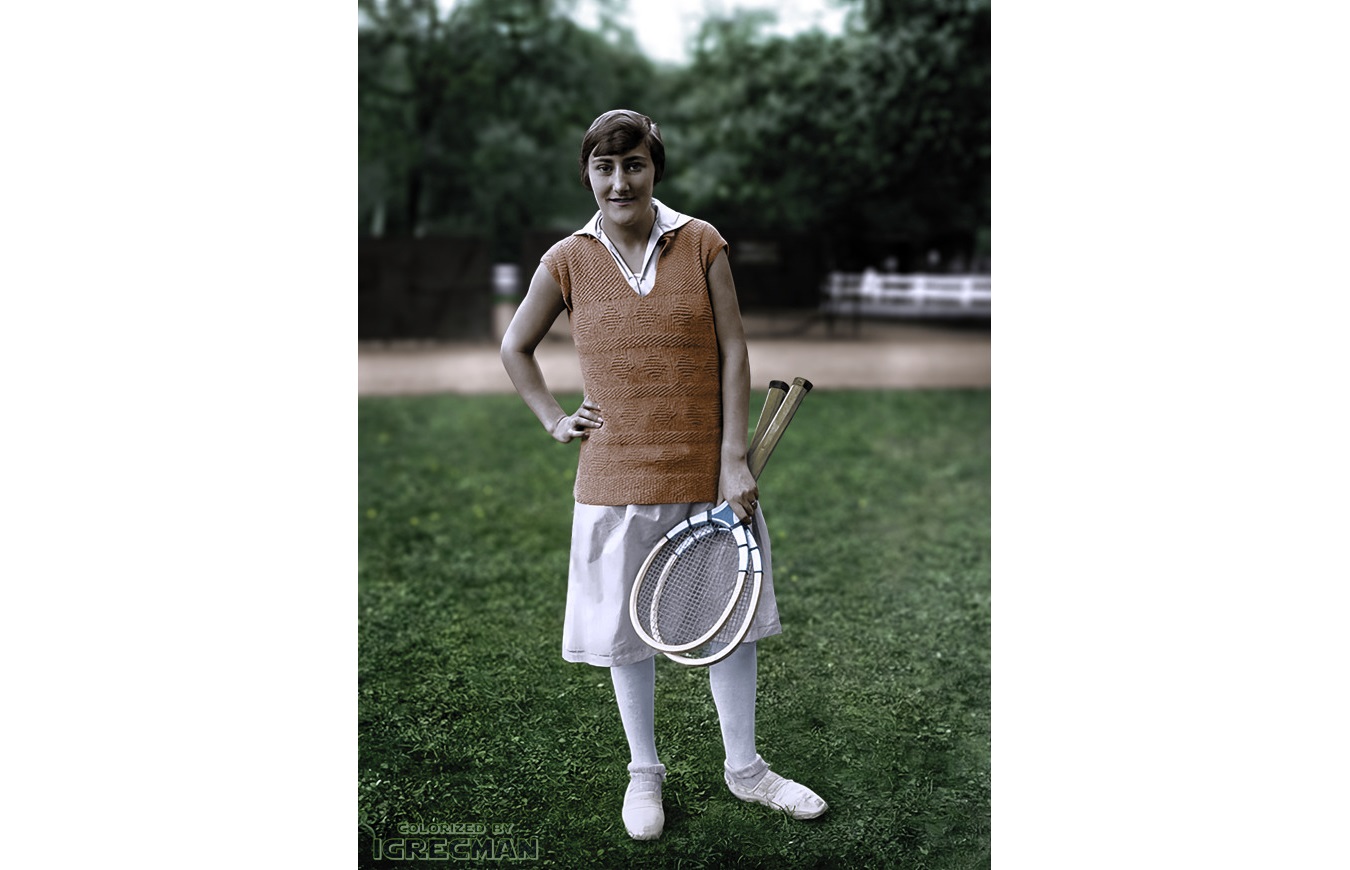
The Tennis 128: No. 81, Budge Patty

Budge Patty

In 2022, I’m counting down the 128 best players of the last century. With luck, we’ll get to #1 in December. Enjoy!

* * *

Budge Patty [USA]
Born: 11 February 1924
Died: 4 October 2021
Career: 1940-60
Played: Right-handed (one-handed backhand)
Peak rank: 1 (1950)
Peak Elo rating: 1 (1954)
Major singles titles: 2
Total singles titles: 89
 

* * *

Take a quick glance at the Budge Patty biography and you might think you’ve found the impossible: a mid-century American champion who didn’t come from California. He was born in Fort Smith, Arkansas, in 1924, and after serving in the US Army during World War II, he settled in Paris, working as a travel agent and playing the majority of his tennis on the Continent.

Patty broke the mold, to be sure. Allison Danzig called him the “glamour boy” of men’s tennis, and Harry Hopman likened him to the fashion pioneer Beau Brummel. He always balanced the sport with other interests, and he rarely appeared to be working hard. Tony Trabert joked, “[P]hysical training for him meant breaking his cigarettes in two and then smoking only half the amount.”

He developed into a one-of-a-kind character, an unlikely American in a strong era of American men. But despite the unorthodox biography, his path did, indeed, run through California.

His father died when he was young, and the family moved to Los Angeles. He lived near Pauline Betz–with whom he would win the 1946 French mixed doubles title–and the pair were frequent practice partners. Patty took his first lessons at the Beverly Hills Tennis Club, where he found playing partners and patronage. When his coach, Bill Weissbuch, couldn’t convince him to develop a strong net game, Weissbuch brought in Bill Tilden to show the young man why it was necessary. The aging Tilden beat the youngster, 6-0, 6-0, 6-1.* Message received.

* Patty wrote, “I don’t remember now, but I am sure I must have won my solitary game by hitting four net-cords.”

Budge was born J. Edward Patty, and he gained his nickname when his older brother thought him so lazy–or stubborn, in one rendition–that he wouldn’t budge. On court, however, he proved to be quite flexible. He didn’t grow to his full height until his later teens, so some creativity was required as he won one junior title after another. Hopman wrote,

The ‘slam bang’ big-hitting service and volley game was not for one who was not much higher than the net post, so he studied court-craft and the tactics of visiting stars who were not all-out net-rushers and he experimented in his own way as he progressed.

Even as a six-footer, Patty would always do things his own way.

* * *

Patty won the 1941 and 1942 United States junior titles. The Army drafted him just as he was about to enter the University of Southern California, and when he was sent to Europe for the duration of the war, he was forgotten by American tennis fans.

In his first entry at Forest Hills after the war, in 1946, the 22-year-old Patty quickly reminded them of his promise. He scored the upset of the tournament in the second round, straight-setting Wimbledon champion Yvon Petra. The six-foot-five-inch, big-hitting Frenchman wasn’t accustomed to opponents who would take advantage of a short backswing to return his serve from inside the baseline. In the New York Times, Allison Danzig couldn’t resist punning on the newcomer’s name. Petra had break point to even the third set at 4-all, “But Patty refused to budge.”

He lost in the fourth round to another big man, Bob Falkenburg, but the rest of the circuit was on notice that the suave expatriate was a force to be reckoned with.

Patty would solidify his reputation at Wimbledon the following year. At the 1947 Championships, he pulled through one nail-biter after another, needing five sets to beat Australian Davis Cupper Bill Sidwell in the first round, another five to advance past Atri Madan Mohan in the second, and four to defeat the unheralded Brit Derrick Barton in the third.

Embed from Getty Images

Patty at Wimbledon in 1949

In the fourth round, he recorded the outstanding upset of yet another major. After another five sets, he knocked out second-seeded Australian John Bromwich in a roller-coaster of a match, 6-4, 0-6, 6-4, 1-6, 6-4. Patty’s exhaustion accounts for some of the set scores, as he admitted to throwing the fourth set to save energy. He couldn’t afford to do the same against Jaroslav Drobný in the quarter-finals, falling behind two-sets-to-one after a 9-7 third frame. In the first of many memorable matches against the sixth-seeded Czech, he came through in still another five-setter. No wonder he blamed fatigue for his semi-final loss to fellow American Tom Brown.

Funnily enough, Drobný considered Patty’s (probably legitimate) exhaustion to be gamesmanship. He wrote, “So often during the match he looked near exhaustion, leaning on his racket, sitting down as we changed ends that I took pity on him and allowed my concentration to wander.” Drobný likened his opponent to Ted Schroeder, another five-set master: “Patty is not only an artist on the court but a great match player as well. He … knows what points to win and those that do not matter.”

Another contemporary with praise for Patty’s match-management skills was Jack Kramer. Kramer was not exactly the humblest of champions–decades later, he made a hypothetical list of Wimbledon and Forest Hills champions, had professional players been allowed to compete. In the reconstruction, lifelong amateur Patty lost his 1950 Wimbledon title to–you guessed it–Jack Kramer. Still, Kramer said that Patty’s forehand volley “came close” to the best he’d ever seen, and he credited Budge with an unusual clutch skill:

[T]he strangest competitive stroke was the backhand that belonged to Budge Patty. It was a weak shot, just a little chip. But suddenly on match point, Patty had a fine, firm backhand. He was a helluva match player.

Kramer’s decision to go pro meant that the two men never faced each other after 1946. Drobný wouldn’t be so lucky.

* * *

For the next two years, Patty settled into a life of cosmopolitan comfort in Paris. He reached the semi-finals at Roland Garros in 1948, losing in five sets to Drobný. He made the 1949 final, where Frank Parker out-steadied him. The Wimbledon title, on the other hand, crept further away–he lost to Bromwich in the 1948 quarters, and to Drobný in the third round in 1949.

The losses were still fresh in his mind when he wrote his 1951 autobiography, Tennis My Way: “When the draw is made … the thought that immediately runs through most players’ minds is, ‘I hope I’m not in Drobný’s half.'”

Patty opening his 1951 Wimbledon campaign

On the Continent, Patty learned, winning wasn’t everything. He explained in his book why he chose to play in Europe. The short answer: “Because it is more amusing.” The longer answer involved money and respect. In the US, a handful of prestigous tournaments held all the power, and they treated players accordingly. Across the Atlantic, a larger number of events competed for a relatively small group of high-profile players, of whom Patty was one. They were willing to pay higher “expenses” to secure the stars.

Plus, European crowds took to the debonair American. Harry Hopman wrote, “[T]he French gallery [went] ‘overboard’ for ‘Pat-tee’ almost as if he were a Cochet, Lacoste or Borotra playing Davis Cup for La Belle France.” In Rome, Patty won over the raucous, partisan Italian crowd when he stopped play mid-way through a point, turned to the crowd, and shouted, “Silencio!”

The American would spend another decade pleasing galleries around the Continent. But in the third-round loss to Drobný at Wimbledon, he threw the fourth set only to discover he didn’t have enough energy for a victorious push in the fifth. “I decided then and there,” he wrote, “that next year I was either going to give myself the chance to play properly or give up tennis altogether.”

* * *

Patty thought himself a changed man, but his new training schedule would get him laughed out of a modern-day clubhouse.

For one thing, the decision he took at Wimbledon in 1949 didn’t exactly spur him into immediate action. He started seriously working out the following May, a few weeks before the French. Only then did he give up smoking. He made sure to get ten hours of sleep every night, and he jogged one to three miles each morning. It was a step in the right direction, but Emil Zátopek he was not.

Somehow, it was enough. At the French, he faced an unexpected quarter-final challenge from Irvin Dorfman, an American who never advanced past the third round at another major. Dorfman won the first set, 6-0, and he led 4-2 in the fifth. Patty came back for a 11-9 victory in the decider. The semi-final, against another American, Bill Talbert, was even closer. The contest was frequently stopped due to thunder, usually when Talbert had the momentum. Patty pulled that one out too, 13-11 in the fifth.

Waiting in the final was, of course, Jaroslav Drobný. Budge won the first two sets, then conceded the third and fourth. The pair were playing their fourth match at a major in four years, and every time, it went five sets. The few weeks of moderate training paid off. Drobný wrote, “I doubt whether, since that day, he has reached such a peak of physical fitness.” Patty won the fifth set, 7-5, and claimed his first major victory.

A few weeks later, Wimbledon tested his fitness even further. Once again on the other side of the draw from Drobný, he coasted through the singles, relatively speaking. He won a pair of four-setters to beat Talbert in the quarter-finals and American up-and-comer Vic Seixas in the semis. Drobný lost in the semi-finals to the top seed, Australian star Frank Sedgman.

The 1950 Wimbledon final–watch the whole thing for the full match point!

Sedgman needed five sets to get past Drobný, and he had used another five to beat Art Larsen in the quarters. Both finalists could’ve used a day off, but the scheduling committee had another idea. The two men got a preview of each others’ games in a men’s doubles quarter-final, Patty pairing Tony Trabert and Sedgman with Ken McGregor. On a different day, it might have served as a light warm-up. Instead, the match took nearly six hours, with a second set that ran to 31-29. At Wimbledon, balls were only replaced for each new set, and midway through the marathon frame, Trabert had to threaten to hit the dead balls out of the stadium just to switch back to the lightly-used balls from the first set.

The Americans won the doubles, but Trabert didn’t have much hope for Patty the following day. Sedgman was the typical, hyper-fit Australian, while Budge… well, Budgie had been off tobacco for seven whole weeks!

Patty’s fitness didn’t let him down, but it was his tennis mind that won him the Wimbledon crown. Hopman wrote that “no other player in world tennis puts as much thought into the game,” and the American went into the final with a plan. While the two men had never played a singles match against each other, Patty had seen plenty of the Australian, both in singles and in the previous day’s interminable doubles struggle.

Sedgman didn’t like to face a net-rusher, so Patty came in behind every serve. Sedgman didn’t usually come in behind his own serve, preferring to attack a weak service return and come in behind that. So Patty sliced his returns as deep as possible. Sedgman tended to crowd the net, so Patty lobbed at every opportunity–including three times on match point. The Parisian from Arkansas triumphed, 6-1, 8-10, 6-2, 6-3.

* * *

Patty is still one of just three Americans to win the “Channel Slam,” the Roland Garros/Wimbledon double. Don Budge did it in his Grand Slam year of 1938, and Trabert accomplished the feat in 1955.

Both Trabert and Don Budge finished their historic summers with a title at Forest Hills. Patty didn’t even make it on court. He hurt his ankle at a warm-up event in Newport and withdrew from the national championships. The injury also derailed his hopes of playing in the 1950 Davis Cup Challenge Round against Australia. The defending-champion Americans could’ve used him. Both Ted Schroeder and Tom Brown lost to Sedgman, and the trophy went back Down Under, where it would stay until 1954.

Patty continued to tour the European circuit, but he wouldn’t again be fully fit until 1953. His reward: a Wimbledon draw in Drobný’s quarter. The last time they had played, at the Italian in 1952, the Czech exile won in a rout, 6-1, 6-0, 7-5.

Their third-round meeting at Wimbledon would push both men to their limits. It lasted almost four and a half hours, and its 93 games set a record that would stand until 1969. Patty reached match point six times, three each in the fourth and fifth sets. At 10-all in the decider, in the fading light, the tournament referee announced that only two more games would be played before the match was postponed. Drobný mustered one last bit of energy to push himself across the line, 8-6, 16-18, 3-6, 8-6, 12-10.

Embed from Getty Images

It was a tough match.

The crowd rose to their feet and gave the warriors a five-minute ovation. Despite cramps that attacked each player seemingly in turn, the play was of high quality throughout. Drobný wrote, “Patty and I kept our touch and accuracy to the last shot.” The American won 304 points to his opponent’s 301.

A match like that hardly needs a postscript, but it has one anyway. Patty and Drobný were doubles partners, and they came back the next day to play their second-round match. They won in four, even though neither had the energy even to pick up stray balls. Drobný had torn an abductor muscle in the singles match, and Patty–presumably without much argument–agreed to default in the doubles before sleep-walking through another round. Drobný, remarkably, reached the semis in the singles tournament. He believed that, had they not physically destroyed each other in the third round, he or Patty would’ve won the tournament.

The Czech exile would win his long-awaited Wimbledon title the following year, beating Patty in the semi-finals. Budge would never again get closer than that to a major title, losing to Trabert in the semis both at the French in 1954 and Wimbledon in 1955. He remained one of Europe’s elite, winning 14 titles in 1954, including the Italian and German championships.

In 1953, an Egyptian artist drew Patty, one side in tennis gear, the other in evening dress. One hand held a racket, the other a cigarette. A career like his would have been impossible in the States, where the game belonged to t-shirt-clad strivers in the Jack Kramer mold. Patty was the strangest of juxtapositions, an elegant Parisian from Arkansas, a dilettante willing to fight for hours on the tennis court. Of all the men who have managed both a French and Wimbledon title in the same year, no one else so adroitly kept their feet in two different worlds.

The Tennis 128: No. 82, Maria Esther Bueno

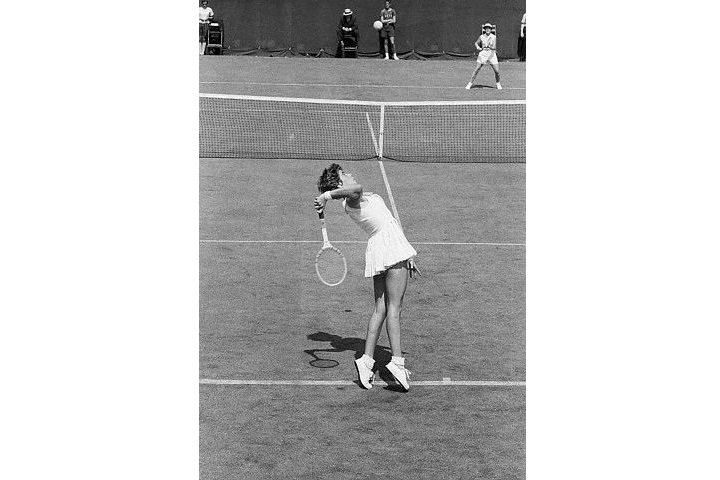
Maria Bueno serving to Nancy Richey in 1960

In 2022, I’m counting down the 128 best players of the last century. With luck, we’ll get to #1 in December. Enjoy!

* * *

Maria Esther Bueno [BRA]
Born: 11 October 1939
Died: 8 June 2018
Career: 1957-77
Played: Right-handed (one-handed backhand)
Peak rank: 1 (1959)
Peak Elo rating: 2,184 (1st place, 1959)
Major singles titles: 7
Total singles titles: 63
 

* * *

In her later years, Maria Esther Bueno loved Roger Federer. Of course she did. The vocabulary that commentators resurrected to describe the Swiss star–balletic, graceful, effortless–had been employed decades earlier for Bueno. Long before Federer first picked up a racket, the lithe Brazilian was the very definition of elegance on the tennis court.

Virginia Wade faced Bueno four times in the late 1960s. She lost all four, and it’s possible that Virginia was just starstruck:

She had presence. She had that fantastic body and feline grace on the court and you were left with a fabulous memory. Her tennis presence really came from her heart. It’s like when Nureyev stands on the stage. You can’t take your eyes off him. It’s physical but it’s the soul out there as well.

Another famous Brit who fell for the Bueno allure was dress designer Ted Tinling. Tinling cut his tennis teeth in the 1920s as a personal umpire for Suzanne Lenglen, and he parlayed his insider status into a player-liaison gig at Wimbledon. He became the go-to guy for distinctive female tennis attire, and he even designed a wedding dress for 1934 and 1937 Wimbledon champion Dorothy Round.

By the time Bueno came along, Tinling was cast out of Wimbledon, the result of the controversial lace underwear he dreamed up for American glamour girl Gussie Moran in 1949. He remained as in-demand as ever. Women on the circuit knew they had made it when they wore an original Tinling. For years, one of the few champions he didn’t dress was Angela Mortimer. She preferred to wear shorts on court, and the designer eventually gave in and made her a specially tailored pair.

For much of the 1960s, Maria Esther was a one-woman runway show for Tinling. He didn’t just make dresses for her–he often made her a new dress for every match she played. She claimed that she once wore 21 of his creations in the course of a single tournament. At home, she had a closet filled with hundreds of them. The designer considered her to be a worthy successor to the great Suzanne.

* * *

Bueno’s on-court performance also–occasionally–reminded fans of Lenglen. At age 19, she swept to her first major title at Wimbledon in 1959. She defeated her friend and doubles partner Darlene Hard, 6-4, 6-3, in only 43 minutes.

Half a decade and one near-retirement later, she claimed her sixth major singles title at Forest Hills, a 6-1, 6-0 bludgeoning of Carole Graebner in 1964. She won the last 16 points in a row. No one had sealed the US national title in such lopsided fashion since Molla Mallory in 1916. Another two years on, she was nearly as good against Nancy Richey, winning her final Forest Hills trophy in 1966 after running off 10 of the last 11 games in a 6-3, 6-1 victory.

The 1966 US final

Bueno won a lot of matches–641 of them, by my best count–but when a good player stood on the other side of the net, things could get complicated. In the 1960 Wimbledon semi-finals, she faced Christine Truman, the tall, hard-hitting British hope. Bueno won the first set, 6-0, in nine minutes. (Nine!) She broke early in the second, then suddenly her serve couldn’t find the court. Truman took the second set, as Sports Illustrated put it, “aided by some thoughtless shots by Maria and some plain bad ones.”

Bueno’s poor form continued into the third set, when Truman broke her in the first game and built a 40-0 lead in the second. Somehow, the Brazilian woke up, fought back to nab the second game, and ran out the set for a 6-0, 5-7, 6-1 victory.

Angela Mortimer, the other great British player of the era, knew first-hand just how unpredictable Bueno could be:

Maria is a strange player. She is temperamental in the extreme. One day she is brilliant. The next, she is brilliantly inaccurate. One day she is smiling and chattering to everyone, the next she is silent, and passes her friends without a word.

Mortimer lost to Bueno in the 1960 Wimbledon quarter-finals, 6-1, 6-1, and she wasn’t even playing badly. Three weeks later, she held a match point against the Brazilian in Hamburg. Mortimer hit a passing shot that would’ve finished the match against anyone else. Not the Brazilian, who replied with a “perfect forehand cross-court drop-shot. If I had been wearing wings I could have landed nowhere near that ball.” Bueno came back to win, 5-7, 9-7, 6-3.

* * *

Bueno’s colleagues on the circuit called her Maria, but to her legions of fans back home in Brazil, she was Maria Esther, Esther, or the diminutive Estherzinha. She took an unusual route to the top, one that starts to explain her highs and lows. She told an interviewer in the 1980s,

To me tennis was more of an art than a sport. I was a very natural player. Everything was done by impulse or intuition. I could never be programmed like most of the players are today. Maybe it would have helped me if I had had some special advice. But I think I would never change.

She occasionally worked with the Australian coach Harry Hopman, but a more formal arrangement didn’t last a week. Hopman championed a steady program of hard training, while Bueno preferred the beach.

This isn’t to say that all of her skills came effortlessly, even if that’s what she claimed herself. While tennis was not popular in Brazil in the 1940s, her father was a recreational player with a family membership to the club across the street from their home. She treated the club as her personal playground, batting a ball against any surface she could find. When she wasn’t practicing, she’d study older players.

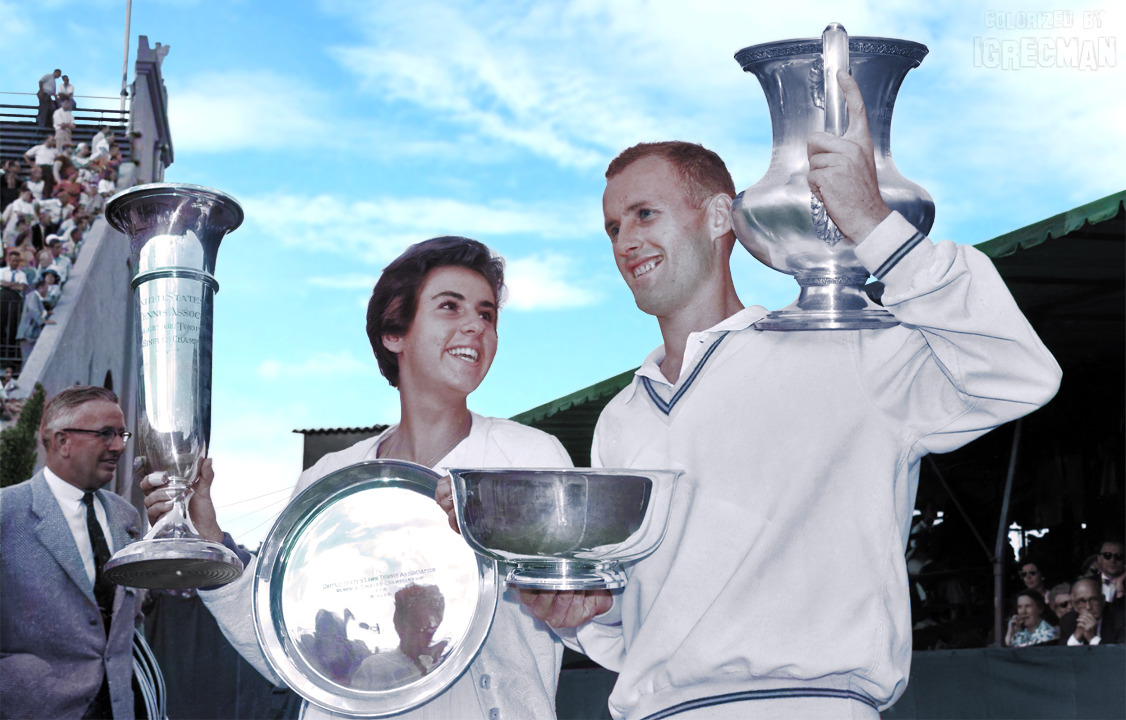
Bueno and Neale Fraser with their 1959 Forest Hills trophies.
Colorization credit: Women’s Tennis Colorizations

Eventually she found a book with detailed action photos of Bill Tilden’s serve. She worked for hours to replicate it perfectly, occasionally seeing results when a ball rocketed off her racket. Her gift, from the beginning, was mimicry. When world-class players visited Sao Paulo, she watched closely and tried to replicate their strokes.

Her efforts on serve, in particular, were a success. When Herbert Warren Wind assessed Bueno’s game for Sports Illustrated in 1960, he likened her movement to Lenglen’s and her serve to that of Alice Marble. Maria Esther approved of the latter comparison. Marble was the first female player to hit an offensive twist serve that equalled the deliveries of the male stars of her day.

In 1965, Los Angeles Times columnist Sid Ziff thought it would be fun to get a returner’s-eye look at the famous serve. Bueno said, “I hope I don’t hit you in the eye.” In Ziff’s telling:

Her serve swooped straight at me, hit the cement almost at my feet and hooked sharply to the right, leaving me feeling like the victim of the old-fashioned shell game. She did it again. Zip, wham and off it went at a 45 degree angle to right.

Bueno didn’t blind him, but if she had, he wouldn’t have fared any worse.

* * *

Even after Estherzinha took the Wimbledon and Forest Hills crowns as a 19-year-old, there were detractors. Wind’s Sports Illustrated profile acknowledges the case against:

The not-so-pro-Bueno group takes a much more conservative view. As they see it, her quick ascent to the top was made possible only by her arrival on the scene at one of those arid periods when there were no first-class women players around. A pretty strokes-maker, yes, with tremendous potential, indeed, but whom has she beaten?

Uncertain, roller-coaster wins like the one against Truman only solidified the case. Had Althea Gibson remained an amateur, or if Beverly Baker Fleitz continued to play the circuit, there might have been fewer laurels available for the flashy youngster to claim. When that issue of Sports Illustrated was on newsstands, a 6-4, 10-12, 6-4 loss to Hard in the Forest Hills final hardly silenced the doubters.

The 1960 Forest Hills final

Just when Bueno began to show that she could pair her stylishness with steadiness, disaster struck. She began the 1961 season with only a single loss in 21 matches, winning three titles on the Caribbean swing with a trio of final-round victories over Hard. Her only loss came to Yola Ramírez in Naples, and she beat Ramírez on the way to an Italian Championships title in Turin the following week.

Before Bueno and Hard could play the doubles final to defend their Roland Garros title, Maria Esther came down with a debilitating case of hepatitis. She withdrew from the doubles and was ultimately bed-ridden for eight months. She couldn’t take her shot at a third straight Wimbledon title, and for a time, it looked like she might never play tennis again.

She was back in the spotlight soon enough–a Tinling-designed dress with pink-trimmed underwear at Wimbledon the following year made sure of that. Her game was remarkably resilient, and she won two titles in the Caribbean in March of 1962. Still, she was a shadow of her former self. She lost to a young Billie Jean Moffitt (later King) in the 1963 Wimbledon quarter-finals. “[S]he played as though she was her own ghost,” wrote David Gray of The Guardian. “[I]t seemed beyond belief that she could ever win a great singles title again.”

* * *

No one would’ve questioned Estherzinha had she chosen to retire. She had won three singles majors and another eight slam titles in doubles. She had done well financially out of the amateur game, commanding appearance fees that her fellow players could only envy. She had the adoration of an entire nation, which gave her a ticker-tape parade and put her image on a stamp after she became Wimbledon champion.

But Bueno knew that she was much closer to the top than the sportswriters gave her credit for. While she worked her way back into form, the young Australian Margaret Smith (later Court) consolidated her hold on the game. Smith won three of the four majors in 1962, and she completed her career grand slam when she claimed the Wimbledon title in 1963, still shy of her 21st birthday.

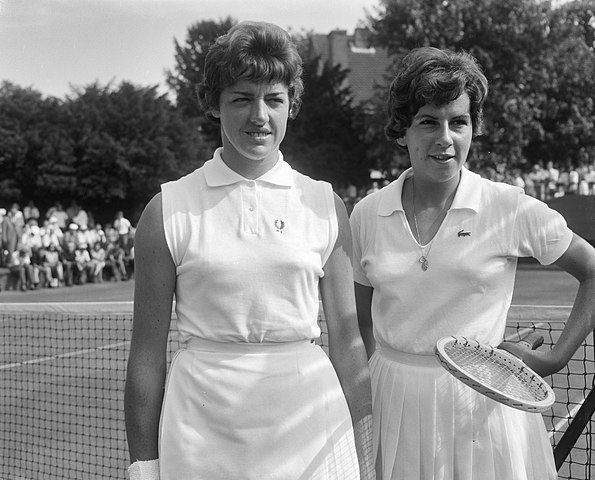
Bueno (right) with Margaret Smith (later Court) in 1964

Smith was just beginning what would be a decade-plus of nearly uninterrupted domination, but she hadn’t really figured out the Brazilian ballerina. Bueno had beaten her easily just before hepatitis laid her low. The pair met four times in 1962, and while the Australian won the lot (she lost only two matches the entire season), three of the four went to a deciding set.

Years later, Bueno said that the two women brought out the best in each other. There were certainly no secrets: Between 1960 and 1968, they played 22 times, 17 of them in finals. Five of the title matches came at grand slams.

Just two months after David Gray thought Maria Esther was playing like her own ghost, she reached the Forest Hills final with the loss of just one set. Waiting for her there, of course, was Margaret Smith, who had been equally dismissive of the field. Bueno won a close first set, 7-5, then struggled in the second. She fell to 0-3, 0-40, then 1-4, 0-30. Just when Smith must have felt she was getting the match under control, the Brazilian produced what the New York Times called “one of the most electrifying bursts of super shot-making produced by a woman at the championship.” Bueno won the last five games on the trot. 18 months after picking up a racket again, she held another major trophy.

The 1963 US final

The next year, she did it again. Smith was as imperious as ever in 1964, winning her fifth straight Australian Championships along with her second French title. The defending champion arrived at Wimbledon riding a 33-match winning streak. She made it 38 by coasting through the first five rounds at the Championships.

The Forest Hills title the previous year had proven that Bueno could once again compete at the highest level. But in the amateur era, Wimbledon was a pinnacle above all others, and she had yet to climb it since her comeback. Commentators still doubted Maria Esther’s fitness–she had won the first set from Smith in the Roland Garros final, but she collapsed to a 5-7, 6-1, 6-2 loss. At Wimbledon, once again, it would be–in Bueno’s words–“three sets against the best of the world.”

If the head-to-head record is to be believed, Bueno was the weaker of the two players on court that day. And as Billie Jean King observed a couple years later, the Brazilian had a lost a step to her various injuries. But as Smith struggled under the pressure, Estherzinha showed the Centre Court crowd what had made her a champion just four years before. Gray wrote,

[I]n the crisis of the match she invariably found it possible to produce luxurious quantities of shots which were rich and imaginative, graceful and deadly. She was the more effective server; she did not miss a smash and, in the recollection of even the oldest members, no woman has hit so many beautiful and piercing volleys.

Bueno won the epic duel, 6-4, 7-9, 6-3, and when Smith lost early at Forest Hills, she tacked on a sixth major with her 25-minute dismantling of Carole Graebner.

The Brazilian had always held herself to the highest standard. She said, “I was never satisfied if I did not play beautifully. I was always going for the impossible shots.” She didn’t always manage to play the graceful tennis that she so admired in Roger Federer. And she missed more than her share of low-percentage shots, even when the smart play would’ve been a safer one.

Yet even on the biggest stages, against the best players of her era, she was capable of serving like Marble and moving like Lenglen. When everything came together, the result was everything she aimed for: impossibly beautiful.

The Tennis 128: No. 83, Jack Crawford

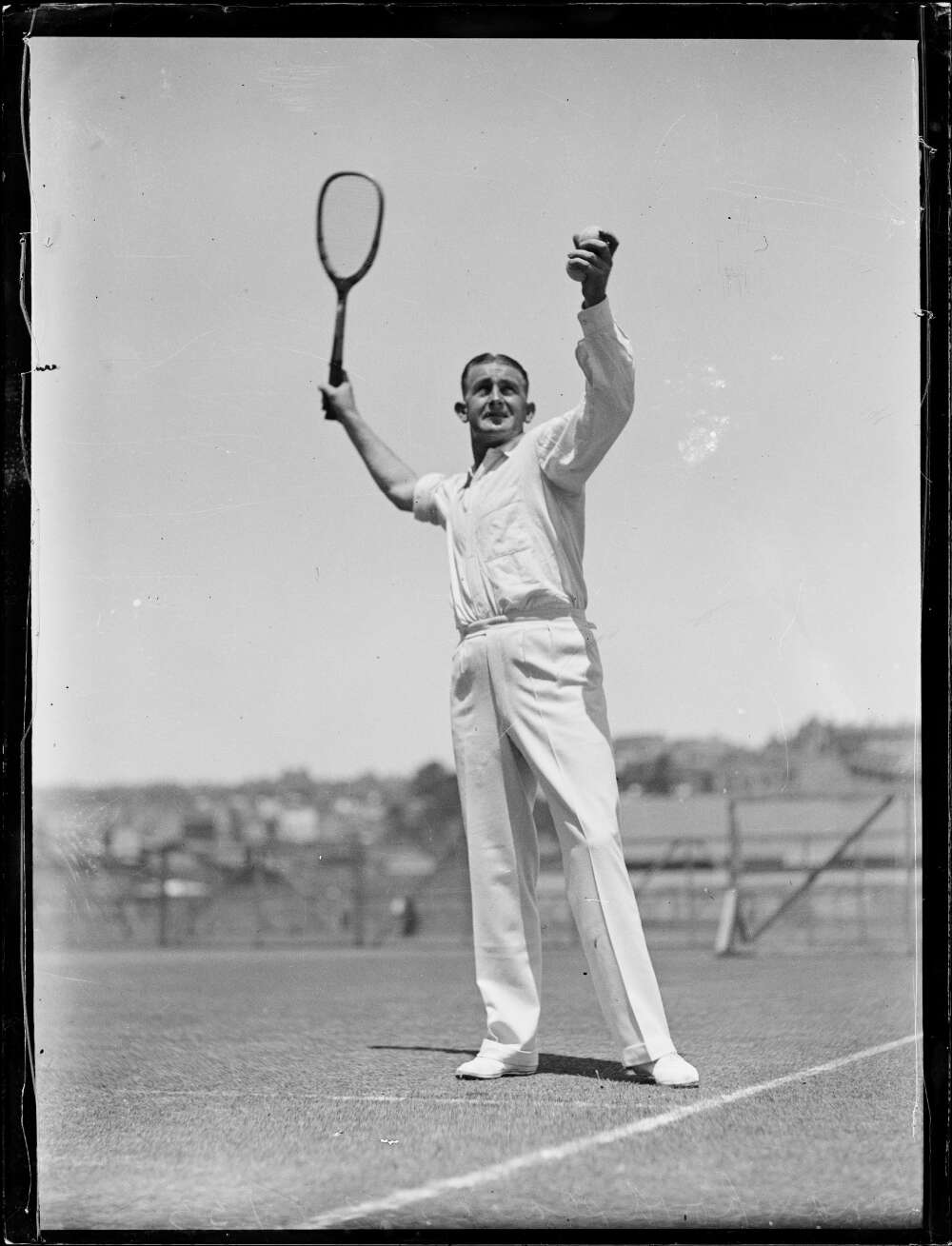
The casually brilliant Jack Crawford

In 2022, I’m counting down the 128 best players of the last century. With luck, we’ll get to #1 in December. Enjoy!

* * *

Jack Crawford [AUS]
Born: 22 March 1908
Died: 10 September 1991
Career: 1926-51
Played: Right-handed (one-handed backhand)
Peak rank: 1 (1933)
Major singles titles: 6
Total singles titles: 66
 

* * *

Winning the Grand Slam has never been easy. If the variety of surfaces and conditions don’t get to you, the pressure will, as the target on your back keeps getting bigger and bigger.

Before the advent of commercial air travel, the logistical challenge was almost as significant. The first big tournament of the year was played in Australia, and that meant multiple weeks of traveling in each direction for anyone not lucky enough to reside Down Under. Even when Australians headed to Europe for Wimbledon and the Davis Cup, they didn’t always continue across the Atlantic to the fourth major of the year.

The modern tennis calendar took shape after World War I, and the majors took their present form when the French Championships opened up to foreigners in 1925. By the end of the 1920s, players were already talking about winning the four major titles. No one played all four until 1928, when Jean Borotra paired a round-the-world tennis tour with business travel in 1928. He won the Australian Championships, but he wasn’t quite good enough for a serious Grand Slam attempt. He didn’t win another major that season. The next year, Brits Bunny Austin and Colin Gregory made the trip. Gregory won the Australian title, but he didn’t bother to complete the quartet, skipping Forest Hills.

In 1933, a group of Americans made their own tour. The tall, slender Ellsworth Vines had ridden his unreturnable serve to titles at Wimbledon and Forest Hills the previous year, and he was seeded first in Melbourne. His Slam quest ended before it began, at the hands of 16-year-old Australian Vivian McGrath and his unorthodox two-handed backhand.

Fred Perry would complete the career slam by 1935, though an early exit at the French that year would stop him from winning all four titles in the same calendar year. The feat itself would need to wait only until 1938, when Perry had turned pro and Don Budge carefully executed his attack on the most hallowed courts of the tennis world.

But back in 1933, when Vines was supposed to pick up an easy win Down Under, the man who won the Australian title nearly pulled off the Grand Slam himself.

Jack Crawford, a 24-year-old farmer’s son from New South Wales, beat two of Vines’s traveling companions to win his own national title for the third consecutive year. After becoming the first foreigner to win the French title, he outlasted Vines in a Wimbledon final for the ages. He was within a set of the Grand Slam when, at Forest Hills, he finally ran out of gas and watched as Perry ran away with the trophy.

* * *

As the first man to win three majors in a single season, Crawford could tell you that winning four was an entirely different type of challenge. The accomplishment didn’t have the same cachet it does now, but fans were certainly watching. It was in Crawford’s great season of 1933 that sportswriter John Kieran borrowed a term from bridge and gave the four-major target its moniker: the Grand Slam.

Crawford could tell you how difficult it was, but he wouldn’t. Dubbed “Gentleman Jack” by his admirers worldwide, he was a throwback in almost every way. When he won, he said it was luck. When he lost, all credit to his opponent’s skill. At the same time that Bunny Austin began to popularize shorts on the tennis court, Crawford not only stuck with trousers, he wore long sleeves as well.

Crawford even preferred vintage equipment. After a friendly game with Norman Brookes, the 1907 and 1914 Wimbledon champion from Australia, Brookes offered him one of his old rackets, a model with a flat-topped head. It was old-fashioned even in Norman’s heyday, but Crawford adopted it when he realized it gave him a bit of extra power when he had to reach for his shots. He ultimately endorsed the racket and caused a belated fad in flat-tops in the 1930s.

Crawford raises his vintage racket for a serve

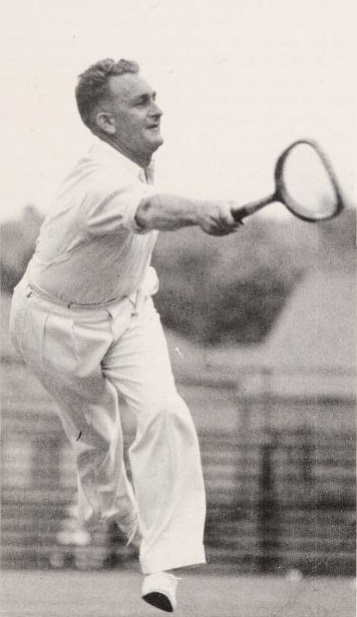
What made the “Gentleman Jack” label so apt was that Crawford was absurdly economical of motion. He made tennis look easy because, most of the time, he didn’t bother to try very hard. Paul Metzler, who devoted a chapter to Crawford in his 1969 book, Tennis Styles and Stylists, wrote, “Never has there been a champion so indolently content to reach for wide shots or high lobs, or one so loath to run or leap for them.”

Jack played almost exclusively from the baseline. It took an awful lot of effort, after all, to make a dash up to the net.

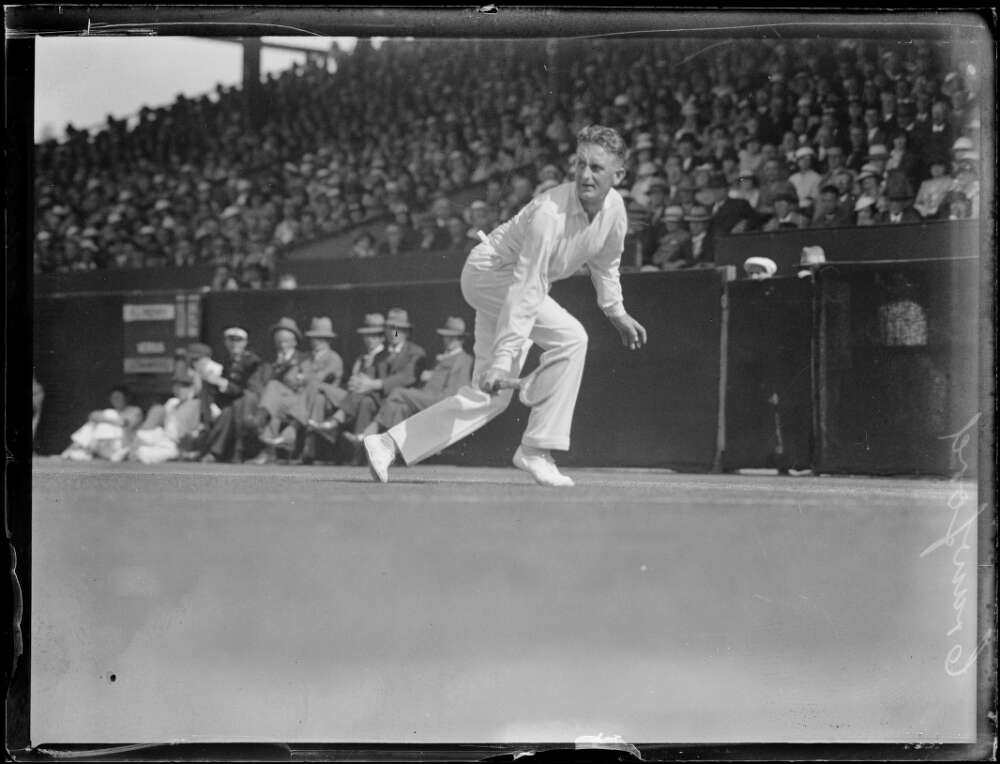
Beneath the laid-back façade, however, was probably the most aggressive baseline player of his era. He rarely took more than a step behind the line, and he used the whole of his opponent’s court like no one else. He handled the fearsome Vines serve by stepping in to take it on the rise, and in rallies, he would concede so little territory that, in Metzler’s words, he “[gave] the impression of commanding the net, almost in the manner of a volleyer.”

* * *

Still, appearances were not entirely deceiving. Gentleman Jack sometimes needed to be encouraged to make an effort. He won his first major mixed doubles championship at Wimbledon in 1930, paired with the 38-year-old Elizabeth Ryan. Ryan had been winning Wimbledon titles since 1914, and she wasn’t about to miss another chance because of a lazy partner.

Harry Hopman–who also won doubles majors with Crawford–tells the story in his book, Aces and Places:

The hustling Miss Ryan found Jack’s lethargic mixed doubles game more than her patience could stand. She could see nothing funny in the half-joking references of their mixed play as “Ryan and Miss Crawford” because she was playing the net game more than her partner; she wanted to win the event and make it her sixth Wimbledon mixed doubles. So she kept niggling at Jack to make him intercept more and to move in to the net quicker–and she got results.

Crawford’s next three mixed doubles majors came alongside his wife, the former Marjorie Cox. Hopman credits Marjorie for a good portion of the competitive spirit Jack would develop:

Marjorie’s greatest success was in the power of her influence on Jack’s determination and will-to-win and in the intensification of his dislike of defeat which her support and encouragement so strongly increased. She was both a restraining influence and, at times, an acceptable excuse for the refusal of friendly but wearying offers of hospitality which provide so much fun, but do so little to raise an international sportsman’s competitive calibre.

Hopman would go on to train generations of Australian stars, instilling unshakeable work ethics in the best of them. Crawford clearly didn’t measure up to that standard. Writing of Jack just five years after his marriage, Hopman added, “He was beginning to take things a little more easily … [H]e did not practise so hard as before, nor as strenuously as some of the younger and ‘hungrier’ players.”

Is Gentleman Jack exerting himself?

Hopman must have wondered what his friend could’ve accomplished had he possessed the work ethic of a Ken Rosewall or Ashley Cooper. Strong an opponent as Fred Perry was, a worn-out Crawford missed his Grand Slam by just one measly set.

* * *

Or, maybe Jack knew what he was doing.

Before his almost-magical season of 1933, the six-foot Crawford had gained 15 pounds, settling in at a distinctly un-tennis-like 185 pounds. John Tunis, writing for the New Yorker ahead of the US National Championships, called Jack “tremendously fast for a big man” and opined that his size worked in his favor:

[The additional weight] not only enables him to burn over a service ace now and then, and to put additional speed when necessary into his drives, but has also given him the stamina and resources to help him go through a twelve-month campaign which has almost ruined the game of a slender, nervous boy like Vines.

Journalists were unanimous that he was a joy to watch. Al Laney wrote, “I do not think any tennis player has given me more genuine pleasure than Jack Crawford.” Yet it was difficult to pin down exactly what made him so great.

He didn’t have an obviously powerful serve, especially when compared to someone like Vines. But Laney called him “one of the finest of servers,” and he used his flat delivery to open up the court. He was acclaimed for his low volleys–the flat-topped racket helped here–but he rarely came to net.

The most puzzling paradox is that observers couldn’t even agree which wing was Crawford’s strongest. Mercer Beasley, coach of Vines (and later Frank Parker), wrote, “We wouldn’t play a ball to Crawford’s forehand around the service line on a bet.” Vines agreed that Jack’s backhand was more fragile, and their Wimbledon final included long stretches where the two players simply tested each others’ weak points with backhand after backhand.

The 1933 Wimbledon final

Yet less than two months after Crawford won his third major of the year, Alison Danzig of the New York Times wrote that his backhand “was thought to have no equal in its steadfastness.” Perry attacked Jack’s backhand at Forest Hills, and in Danzig’s interpretation, the strategy was meant to break down the Australian’s best shot, not his worst.

Hopman gives us a way out of the riddle. Writing in 1957, he ranked Crawford’s forehand higher than that of any Australian since. In his telling, the quality of the forehand, combined with Jack’s otherworldly anticipation, made the backhand look better than it was.

Whichever side was stronger, opponents barely had time to react, and they rarely knew what was coming. Crawford lost the 1934 French final in a five-setter to Gottfried von Cramm. He still made quite the impression on the German, who said, “I had never seen a man make such perfect lobs.”

* * *

Thanks to the reticence of Gentleman Jack, we don’t know exactly what happened between the third and fourth sets of the 1933 Forest Hills final. With the Grand Slam on the line, he dropped the first set to Perry, 6-3, came back to win a marathon second frame, 13-11, and took the lead in the third, 6-4. By convention, players took a ten-minute intermission between the third and fourth sets.

Crawford had asthma, and it had occasionally sidelined him earlier in his career. He learned to drink a little brandy during matches to manage the ailment, and he did so on this day. He seemed to struggle in the warm, muggy conditions, and he had appeared to be in physical distress during his semi-final victory over Frank Shields, as well.

It’s possible that the asthma was too much to overcome. Another theory is that he overdid it with the brandy. The cumulative fatigue of the long season might have gotten to him–he admitted that “he felt himself in a daze” even before the intermission.

Easy does it

A further possibility is that he was a bit too, well, gentlemanly during the intermission. Perry changed his clothes and got himself a massage. Jack, however, chatted with his wife while relaxing with a cigarette.

Perry’s account of the fourth and fifth sets? He “went mad.” The rest of the match barely took as long as the interval. Perry stormed back to win, 6-0, 6-1, taking 13 minutes for the fourth set and 15 minutes for the fifth. Was it the asthma, the brandy, the conditions, or the characteristic indolence? Or was Perry just that good? Crawford wouldn’t say. All that was certain was that, for at least one more year, grand slams would be limited to baseball and bridge.

* * *

Perry’s prowess doesn’t fully explain the result, or else Jack wouldn’t have built up a two-sets-to-one lead. But after that fateful intermission, the Brit had the better of the rivalry, and it wasn’t even close.

The two men faced off nine more times, and Perry won seven. In 1934, he straight-setted Gentleman Jack in the Australian final, and he won 12 games in a row to take that year’s Wimbledon in a rout. It was an awkward scene that Perry wouldn’t soon forget: Plenty of the home fans clearly sided with the Australian, and a Wimbledon club official told Crawford that the better man lost–in Perry’s hearing.

The 1934 Wimbledon final

The casual classism further fueled Perry’s competitive fire. Crawford got the better of him in the 1935 Australian final, but when they met at Wimbledon that year, Perry once again put him away comfortably.

By then, Jack was earning a comfortable living endorsing his unusual rackets, and he was content to let Perry have the limelight. He remained competitive on the doubles court, winning the 1935 Wimbledon title with Adrian Quist and reaching the men’s doubles final in Australia as late as 1940. His casual on-court demeanor disguised an abiding love for the game: He entered the Australian Championships every year until 1951, and he played seniors tennis after that.

It was common practice for decades that, when a match concluded, one player would jump the net on the way to shaking his opponent’s hand. When Perry won the Forest Hills final, he was so fast across the net that he greeted Jack at the Australian’s service line. The low-energy Crawford only did it once–without even thinking about it–after beating Vines for the Wimbledon title. He said, “I didn’t realize I could clear such a high barrier.” Had he been a bit healthier, or had his opponent been a bit less formidable, he would’ve cleared the highest hurdle of them all–and I suspect he would’ve had exactly the same reaction.

The Tennis 128: No. 84, Lleyton Hewitt

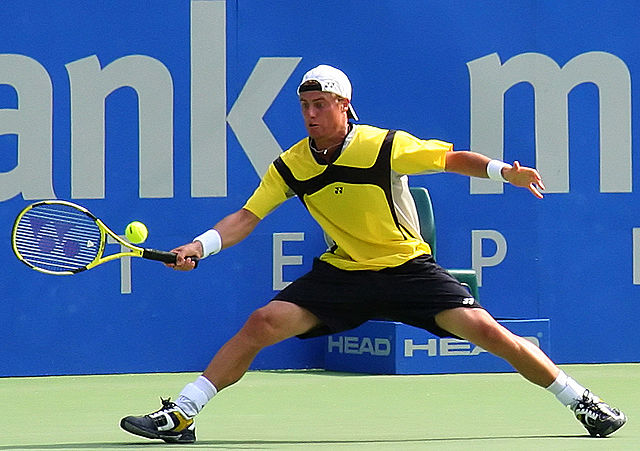
Lleyton Hewitt in 2006. Credit: Glenn Thomas

In 2022, I’m counting down the 128 best players of the last century. With luck, we’ll get to #1 in December. Enjoy!

* * *

Lleyton Hewitt [AUS]
Born: 24 February 1981
Career: 1998-2016
Plays: Right-handed (two-handed backhand)
Peak rank: 1 (2001)
Peak Elo rating: 2,192 (1st place, 2002)
Major singles titles: 2
Total singles titles: 30
 

* * *

It was impossible not to have an opinion about Lleyton Hewitt. In 2002, when Hewitt ruled the men’s tennis roost, Billie Jean King said:

How can you not love Hewitt? He’s incredible for all of us that aren’t 6’2″…. He’s giving everybody hope again to play this sport. This guy loves it so much he just loves every ball, he’s just like… give me the ball. God, I love him. How can you not love this guy?

Plenty of people were ready to answer Billie Jean’s question. In the London Times in 2003, Simon Barnes spoke for many fans as he basked in Lleyton’s first-round exit at Wimbledon:

He looked–and behaved–as if he had left his skateboard parked outside. … He was the most unpopular champion since Jimmy Connors did his brat’s stuff in 1974 and has the air of a stormtrooper who has been ostracised by the other stormtroopers because they find him a bit on the fanatical side.

Part of the problem was that he became a star so early. It’s a rare teenager who finds himself on the world stage and doesn’t act like a jerk. When he was 18, he proclaimed that the Australian public was stupid. Two years later, he called umpire Andreas Egli a “spastic,” and then gave one of the worst apologies in the history of lame athlete apologies: “If I did say it, it’s not something I’m proud of, that’s for sure. I apologise to whoever it may be.”

He hinted that a line judge was giving calls to James Blake because both men were Black. He hated the practice of congratulating opponents on excellent shots. He constantly yelled C’MON!–every two seconds, according to Greg Rusedski–even if it was his opponent’s mistake that decided the point. When Juan Iganacio Chela spit at him on a change of ends in 2005, we all knew that it was wrong… but we understood.

Expectoration at 2:06

Many of Hewitt’s peers were careful to make the distinction between his on-court and off-court personalities. He was pleasant enough out of the heat of competition, at least if he wasn’t talking to journalists. But with a match on the line, as Roy Emerson put it, “He plays every point as if it’s World War II.” Inevitably, there were casualties.

Nobody liked to face him–partly because of the abrasiveness, and partly because Lleyton usually won. But it was impossible not to respect the way he played the game.

* * *

Hewitt certainly didn’t look like an elite tennis player. He stood only five-feet-ten-inches tall, and when he arrived on tour as an outspoken 16-year-old, he weighed barely 130 pounds. Reporters couldn’t decide whether he looked more like a surfer or a skateboarder.

Vince Spadea, who played him in the quarter-finals of the 1998 Adelaide tournament, thought he looked “weak, inexperienced, unrehearsed, and unpolished.” Three sets later, Spadea was sent packing and Hewitt was in the semi-finals. The teenager backed up the win with a two-tiebreak victory over an out-of-form Andre Agassi. He took the title in a third-set breaker over fellow Aussie Jason Stoltenberg.

Embed from Getty Images

Hewitt in 1998

Over the years, Hewitt was often criticized for his apparent arrogance. But as baseball great Dizzy Dean once said, it ain’t bragging if you can do it. Hewitt became the third-youngest player ever to win an ATP title, behind only Aaron Krickstein and Michael Chang. He was just getting started.

In 1999, he beat top-ten opponents six times, and won four singles rubbers for the champion Australian Davis Cup team. Hewitt kicked off his 2000 season with 13 straight victories Down Under, beat Pete Sampras for the Queen’s Club title, and reached the semi-finals of the US Open. He became the youngest player ever to qualify for the season-ending Masters Cup, where he beat Sampras again.

By 2001, no one was underestimating the brash young Aussie. With wins in Sydney, Queen’s Club, and ‘s-Hertogenbosch already under his belt, he advanced to his first major final at the US Open, where he whipped Sampras, 7-6(4), 6-1, 6-1. He blitzed the field at the Masters Cup, scoring five top-ten wins in a week with the loss of only two sets. Aged 20 years and 9 months, he became the youngest number one in ATP history.

* * *

Pete Sampras was one of the great servers in history, and he was not accustomed to losing sets by scores like 6-0 and 6-1. Before the 2001 US Open final, the only men to win such lopsided sets from Pete in the previous five years were Agassi and Hewitt himself. Andre was the only man in memory who could return like Hewitt, and the Australian was a better mover. After the 2001 US Open final, Pete said, “The kid is so quick it’s unbelievable.”

How about this for unbelievable: Going into the US Open final, Sampras had held 87 straight service games, 24 of them in the quarter-finals against Agassi. Hewitt broke him six times in the championship match. Pete won 73% of his service points in his first six matches at the tournament and less than 55% against Lleyton.

Hewitt and Sampras in the 2000 Queen’s Club final

Hewitt pulled the same trick at Wimbledon the next summer. David Nalbandian, his opponent in the final, was another baseliner. His serve was nothing like Pete’s. In his first six matches at the Championships, he won 63% of his service points. Lleyton still had the same effect he had on Sampras, holding the Argentinian to a pathetic 44%, breaking him eight times. The unlikely grass-court final, in which neither player serve-and-volleyed a single time, was over in less than two hours. Hewitt won, 6-1, 6-3, 6-2.

Sampras and Nalbandian had nothing to feel bad about. Lleyton defanged everybody. Between 1999 and 2002, Hewitt broke serve in at least 187 consecutive matches. The streak might run as high as 230 matches, though I haven’t been able to determine whether he broke Sébastien Grosjean in a 1999 Davis Cup dead rubber. Either way, it’s the longest such streak in the 30-plus years that the ATP has recorded break point statistics.

What’s less clear is how he did it. Sampras wrote, “It was very tough to get the ball by him, or to ace him.” Yet in the US Open final, Pete still hit aces on more than 10% of his serves–lower than Sampras’s average, but not by a wide margin. Roger Federer aced him 12% of the time, a better rate than he managed against the tour in general.

Embed from Getty Images

C’MON!

The Match Charting Project has logged 120 of his matches. It’s not a random sample–it’s biased toward finals and late-round grand slam matches against quality opponents, so it understates his peformance in general. In those matches, he put the return in play only 67.6% of the time, a rate that both was and is below average. But simply getting the ball back wasn’t the point. Like Agassi, Hewitt took his return position with aggression in mind, accepting that some serves would get past him. The ones he could reach, he sent back with interest.

Sampras wasn’t alone in the belief that Lleyton was particularly hard to ace, or that he got an unusually large number of serves back. It’s understandable that Hewitt’s rivals got it wrong. Agassi considered him to be “among the best shot selectors in the history of tennis,” and he loved a target. Those skills were enough to end the domination of serve-and-volleyers at Wimbledon and to alter the trajectory of the game as a whole.

* * *

When Hewitt retired at the 2016 Australian Open, Tom Perrotta of The Wall Street Journal explained the magnitude of his effect on men’s tennis:

Before Hewitt, there used to be a clear division between defensive and offensive players. Hewitt blurred that line, which [Federer, Rafael Nadal, and Novak Djokovic] have since erased. Like Hewitt, they can all defend with bursts of speed and quick hands, but also attack from a defensive position. Like Hewitt, they have no glaring weaknesses.

Lleyton’s former coach, Darren Cahill, told Perrotta:

The past champions of every era always had a place to get to, a safe zone. Pete’s backhand wasn’t that strong. Andre’s movement wasn’t that strong. You go through every single player and they all had a slight weakness that you could attack. Lleyton of that period, he did not.

You could say the same about any of the Big Four. Early returns suggest that Carlos Alcaraz fits the same mold. The best players of the post-Hewitt era have better and worse parts of their games, to be sure, but it is no longer possible to reach the top while covering up for a true weakness like the Sampras backhand.

Hewitt had an even more direct impact on the modern game. He forced Federer to develop the game style that would win him 20 major titles.

Embed from Getty Images

Hewitt (left) and Federer in 2004

Lleyton is only six months older than Fed, but he owned their early rivalry. He won their first three meetings, and when he came through a five-setter in the 2003 Davis Cup semi-finals, he led the head-to-head, seven matches to two. In those days, Federer serve-and-volleyed more, and he frequently attacked the net behind middling approach shots. It worked well–after all, Roger was ranked third in the world by the 2003 Davis Cup encounter–just not against the Australian.

Federer said, “Lleyton made me figure out my game.”

Starting in 2004, Roger won their next 15 meetings. It was sometimes close–they went to four sets at majors on three different occasions–but the result was never really in doubt. Hewitt didn’t win 48% of the total points played in any of them. More data from the Match Charting Project illustrates how Federer changed his approach to solve this particular puzzle. He serve-and-volleyed less and less, and he was incrementally more careful about approaching the net at all:

Match             Winner   S&V%  Fed App%  
2002 Masters Cup  Hewitt    16%       26%  
2003 Davis Cup    Hewitt    24%       23%  
2004 Aus Open     Federer    7%       19%  
2004 Wimbledon    Federer    9%       19%  
2004 US Open      Federer    7%       19%  
…                                          
2005 Wimbledon    Federer    3%        9%

The final column shows Fed’s net approaches, as a percentage of total points played. By 2005, even on the grass at Wimbledon, he’d learned not to challenge Hewitt with anything but a can’t-miss approach shot.

* * *

It’s odd to think of the brash teenage champion turning into one of the game’s elder statesmen, but tennis fans tend to embrace almost anyone if they stick around long enough. Hewitt didn’t say goodbye until the 2016 Australian Open, eight years after a hip injury essentially ended his chances of returning to the game’s elite.

What was once “abrasive” became “no-nonsense,” and the on-court behavior that used to be called “obnoxious” was recast as “fiery.” Hewitt’s intensity reached a particularly high pitch when he played for his country. He was a key part of the champion Australian teams in 1999 and 2003, he handled singles duties as late as 2015, and he wrote in his own name for doubles after he became team captain. He and John Peers took the Bryan Brothers to five sets in 2016, and they won a match two years later.

Embed from Getty Images

The 1999 Aussie champion Davis Cup team

Hewitt said early in his career, “[W]hen I set my schedule at the start of the year, Davis Cup is the first thing that I write down.” He never wavered from that commitment. Lleyton holds just about every Australian Davis Cup record there is. He played 40 ties, winning 42 singles rubbers and another 16 in doubles.

No one compared him to surfers or skateboarders anymore, but as retirement approached, Lleyton was still the same player he had always been. Wally Masur, the Davis Cup captain who preceded him, said in 2015, “The very first point I saw him play was as a junior at the US Open. He hasn’t changed a bit since then. He’s full of enthusiasm…. I used to say: ‘Whatever you think about Lleyton Hewitt, if you pay the price of admission, he gives you full value.'”

The early, peak Hewitt–and his effect on an opponent–remains impossible to forget. “I’ve always enjoyed watching him. Playing against him has been cool at times,” Federer said at Lleyton’s final Wimbledon. “Not always so much fun.”

The Tennis 128: No. 85, Svetlana Kuznetsova

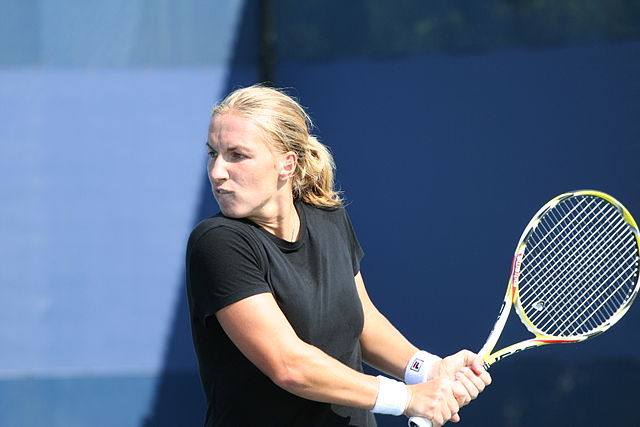
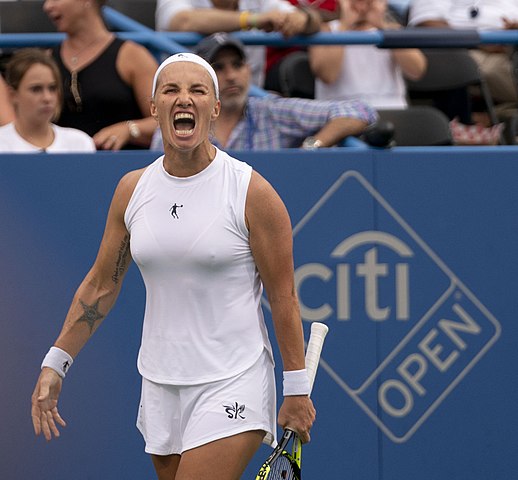
Svetlana Kuznetsova at the 2009 US Open. Credit: Robbie Mendelson

In 2022, I’m counting down the 128 best players of the last century. With luck, we’ll get to #1 in December. Enjoy!

* * *

Svetlana Kuznetsova [RUS]
Born: 27 June 1985
Career: 2002-present
Plays: Right-handed (two-handed backhand)
Peak rank: 2 (2007)
Peak Elo rating: 2,192 (3rd place, 2007)
Major singles titles: 2
Total singles titles: 18
 

* * *

The two longest matches of the 2011 season lasted exactly four hours and 48 minutes each. At the Australian Open, David Nalbandian outlasted Lleyton Hewitt in the first round, 3-6, 6-4, 3-6, 7-6(1), 9-7. At the US Open, Juan Carlos Ferrero beat Gaël Monfils, 7-6(5), 5-7, 6-7(5), 6-4, 6-4. There were 17 five-setters that reached the four-hour mark that year, including the US Open final between Novak Djoković and Rafael Nadal.

The third longest match of 2011 wasn’t one of those five-setters. No, it was a fourth-round women’s match at the Australian Open. Svetlana Kuznetsova and Francesca Schiavone battled for four hours and 44 minutes before Schiavone came out on top, 6-4, 1-6, 16-14. It was the second-longest WTA match in history, behind only the wacky 1984 contest with the 643-shot rally.

The Melbourne marathon had everything. 80 deuces, 50 break points, and 17 breaks of serve–over 1,800 shots by the time it was done. Both women even serve-and-volleyed–Schiavone led that category by doing it twice. To say it was topsy-turvy would be a bit like calling Isner-Mahut “long.” The contributor who logged the match (all 358 points of it!) for the Match Charting Project noted at the 4:25 mark, “Both players starting to look a bit tired.”

The Kuznetsova-Schiavone head-to-head is one of the wilder subplots of 21st century women’s tennis.

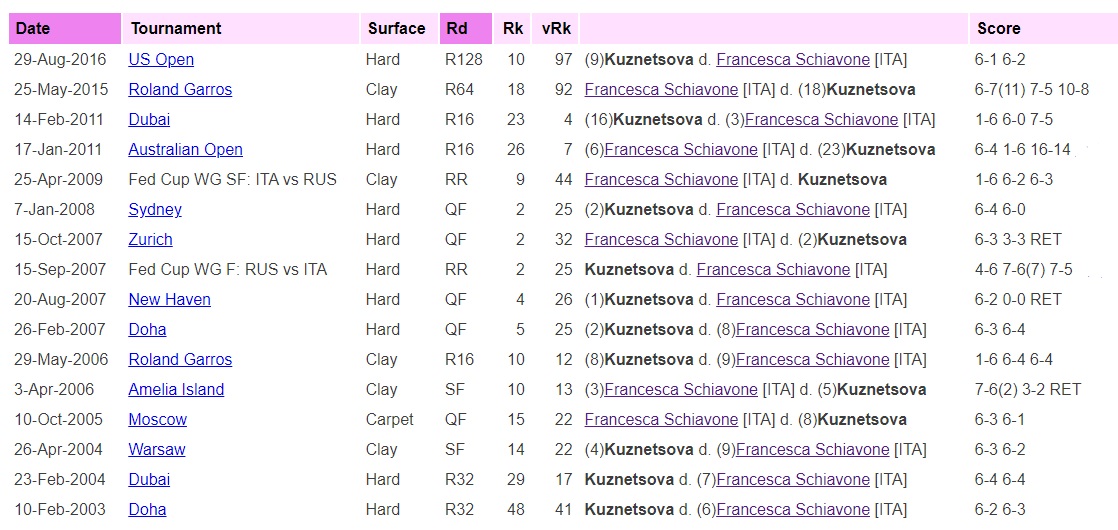
TennisAbstract.com attempts to summarize the impossible.

Kuznetsova won 10 of the 16 meetings, but Schiavone snuck off with half of the six three-setters. Sveta won the first of their epic clashes in the 2007 Fed Cup final. Four years after their meeting at the 2011 Australian Open, they did it again, going to 10-8 in the third in Paris. That match didn’t quite clear the four-hour mark, but like the gutbuster in Melbourne, it had just about everything else.

Kuznetsova’s history against her Italian rival represents her career in miniature. She has enjoyed the occasional triumph in between struggles with inconsistency. She has fought out one slugfest after another, losing many of them by the smallest of margins. Most of all, she has played lots and lots of tennis.

* * *

Ironically, both of Kuznetsova’s victories in major finals were rather tidy affairs. At the US Open in 2004, she outplayed Elena Dementieva, 6-3, 7-5, and at the French in 2009, she defeated Dinara Safina, 6-4, 6-2. Both opponents had their own internal demons to grapple with, and Sveta took advantage.

It was rarely that simple. The Spring after her US Open victory, she suffered a sequence of near-misses that would’ve sent lesser competitors into early retirement. At Indian Wells, she lost to Dementieva, 7-5 in the third. In Miami, she fell to Ana Ivanović, 7-5 in the third. A month later in Warsaw, she beat Kim Clijsters but lost in the final to Justine Henin–you guessed it–7-5 in the third. Another month down the road at Roland Garros, she lost another three-hour heart-breaker to Henin. You don’t need me to tell you what happened from 5-all in the third set.

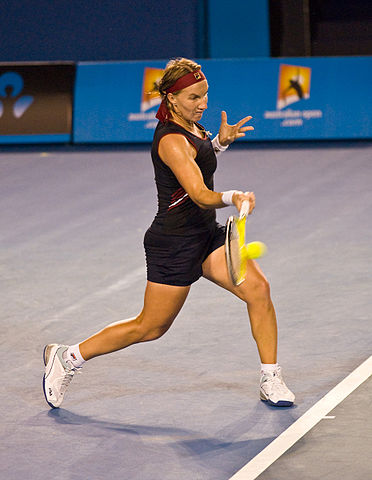
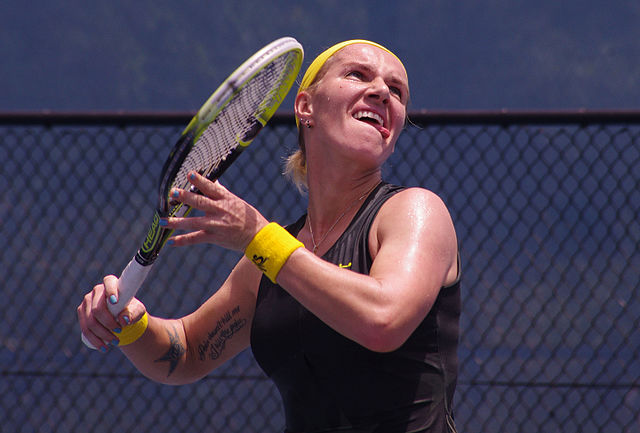
Kuznetsova in 2010. Credit: Steve Collis

She bounced back to reach the Wimbledon quarter-finals, but when it came time to defend her US Open title, her nerves could no longer keep up. In Flushing, she lost to 97th-ranked Ekaterina Bychkova in straight sets, making her the first female US Open champion to lose the following year in the first round. Her ranking, which had reached a career-best number four in August, careened back out of the top ten.

Her defense of the 2009 French Open title was nearly as punchless. Her entire 2010 clay court campaign lasted seven matches, including first round exits in Rome and Madrid to Maria Kirilenko and Shahar Peer, respectively. (Both were in three sets, but the Peer match ended 6-0.) At Roland Garros, she reached the third round only to lose once more–in three sets, of course–to Kirilenko. Her ranking had climbed back to number three after winning the 2009 Beijing title, but with the French Open points gone, she fell out of the top ten again.

Kuznetsova’s peak came in between the two slam titles, when she reached number two on the WTA computer (and 3rd on the Elo list) in late 2007. She won the US Open warmup in New Haven in the strangest way possible: a three-setter over Agnieszka Radwańska and then three victories by retirement. In the season as a whole, she won 17 of her 24 deciding sets. Unfortunately, two of the seven losses came at the year-end WTA Tour Championships in Madrid. She failed to win a match against the elite field, falling to Ana Ivanović by a score of (what was that again?) 7-5 in the third.

* * *

I trust that you’ve noticed a pattern. In 2009, Pete Bodo called Sveta “a complicated young lady who never met a match she couldn’t choke away.” That isn’t quite right, even if it has sometimes felt that way. She is plenty complicated, to be sure, and she has a knack for making any match she played as complicated as she is–often emerging through the muddle as an exhausted winner.

Here are the active leaders in three-set matches played:

Player                    Deciders  Wins  Losses  
Svetlana Kuznetsova            355   215     140  
Venus Williams                 306   187     119  
Angelique Kerber               271   152     119  
Alize Cornet                   261   140     121  
Petra Kvitova                  254   149     105  
Sara Errani                    251   125     126  
Anastasia Pavlyuchenkova       246   133     113  
Serena Williams                236   170      66  
Vera Zvonareva                 234   137      97  
Karolina Pliskova              208   131      77

These numbers might be off by a couple of matches here and there–they may include the occasional ITF or a misclassified retirement or two. If you look up the results using Tennis Abstract’s filters, you’ll get slightly different records. But the margins here are so big that the details don’t matter. Kuznetsova has played way more three-setters than any other active player. She tops the list in both wins and losses as well.

It’s a bit surprising, given all of the Russian’s memorable defeats, that her winning percentage is so high, at 61%. She’s just a tick behind Venus Williams (also 61%), and the only other women on this list who win their three-setters at a higher rate are Serena Williams (72%) and Karolína Plíšková (63%). Jelena Janković, who had a great deal in common with Kuznetsova, also played more than 300 three-setters in her career but lost more often than she won.

Sveta in the 2018 Washington final (yes, it was a three-setter).
Credit: Keith Allison

Kuznetsova also stands out when we limit our view to the tightest three-set contests. Here are the active leaders in matches that reach 5-all in the decider:

Player               3rd 5-alls  Wins  Losses  
Svetlana Kuznetsova          80    46      34  
Venus Williams               75    41      34  
Serena Williams              56    32      24  
Angelique Kerber             54    31      23  
Karolina Pliskova            53    31      22  
Caroline Garcia              49    33      16  
Petra Kvitova                49    27      22  
Andrea Petkovic              47    22      25  
Varvara Lepchenko            47    20      27  
Kristina Mladenovic          45    20      25

In this category as well, Sveta has played more matches than any other active player. She has won more of them, and she’s tied with Venus for the most losses. Again, for all the painful 7-5 defeats, her win rate is respectable. Janković played 78 of these, and she lost more often than she won. Another contemporary with a reputation for circuitous routes from coin toss to handshake, Sam Stosur, won just 24 of 67 matches when they were so close.

* * *

It’s a cliché that tennis players struggle when they think too much. In Kuznetsova’s case, it might be true. She certainly has more going on upstairs than the direction of her next serve.

Journalist Matt Cronin described Sveta as more introspective than the other Russian stars of her generation. He interviewed her in early 2013, when she returned to the tour after a six-month hiatus. Her excitement to come back wasn’t quite wholehearted:

When you play over and over every year the same tournament, the same players, it’s quite difficult. I never feel sick of the game because I love tennis a lot. I have been sick from travel and sick from staying away from home, from my family, from my friends. But I never hated tennis. I love tennis and I enjoy tennis.… But I’ve been watching matches, and I didn’t really feel like I wanted to be out there.

She may have had reservations, but she picked up where she left off. For three years, she played a full schedule, coming through qualifying when necessary and reaching the occasional final. It wasn’t until 2016, after her 30th birthday and more than a decade past her first major title, that she returned to the ranks of the elite.

She started the 2016 season ranked 25th, and quickly made a statement, knocking top seed Simona Halep out of Sydney in three sets. If fans needed any more proof that Sveta was back in all her glory, she turned in another performance for the history books in Fed Cup the next month. She and Richèl Hogenkamp went at it for four hours, the longest match in the competition’s history.

Kuznetsova in 2014. Credit: NAPARAZZI

She lost the Hogenkamp match, 10-8 in the third, but she won a whopping 22 three-setters that year. That’s not quite a record–Petra Kvitová won 25 in 2013–but it was by far the most of Kuznetsova’s third-set packed career. One of the third sets got her past world number one Serena Williams in Miami; another put her in the second week at Wimbledon when she beat Sloane Stephens, 6-7(1), 6-2, 8-6. In October, she needed to win the title in Moscow to qualify for the elite year-end championships, and with three-set wins in the quarter-finals and semi-finals, she did just that.

Less than 48 hours after securing the Moscow trophy, she was 5,000 miles away in Singapore, taking on Agnieszka Radwańska in her first round-robin match. She had climbed back into the top ten after more than six years, so she must have felt that she could handle anything–even some unwanted hair in her face.

Your fave could never.

A newswire reported that she looked to be “on the verge of exhaustion and close to breaking down,” yet she got the better of Radwańska for the 13th time in her career. She went on to beat Karolína Plíšková in a third-set tiebreak, qualifying for the elimination rounds of the season-ending event. In the semi-finals against Dominika Cibulková, she finally ran out of gas, taking the first set 6-1 but dropping the next two. It wasn’t quite the fairy-tale ending she’d hoped for, but it re-established her as a force on the tour, and she remained in the top ten throughout 2017.

Wrist surgery ended her comeback, and she has played a limited schedule since. As recently as the summer of 2019, she flashed the power and persistence that made her a major champion, ousting both Plíšková and Ashleigh Barty to reach the final in Cincinnati. She’s been out of action since Wimbledon last year as she tries to get back in playing shape. A month away from her 37th birthday, a return to the top seems unlikely, but opponents should remain ready for battle. She only won 5 of her 16 matches last year, but half of them went three sets.

The Tennis 128: No. 86, Margaret Osborne duPont

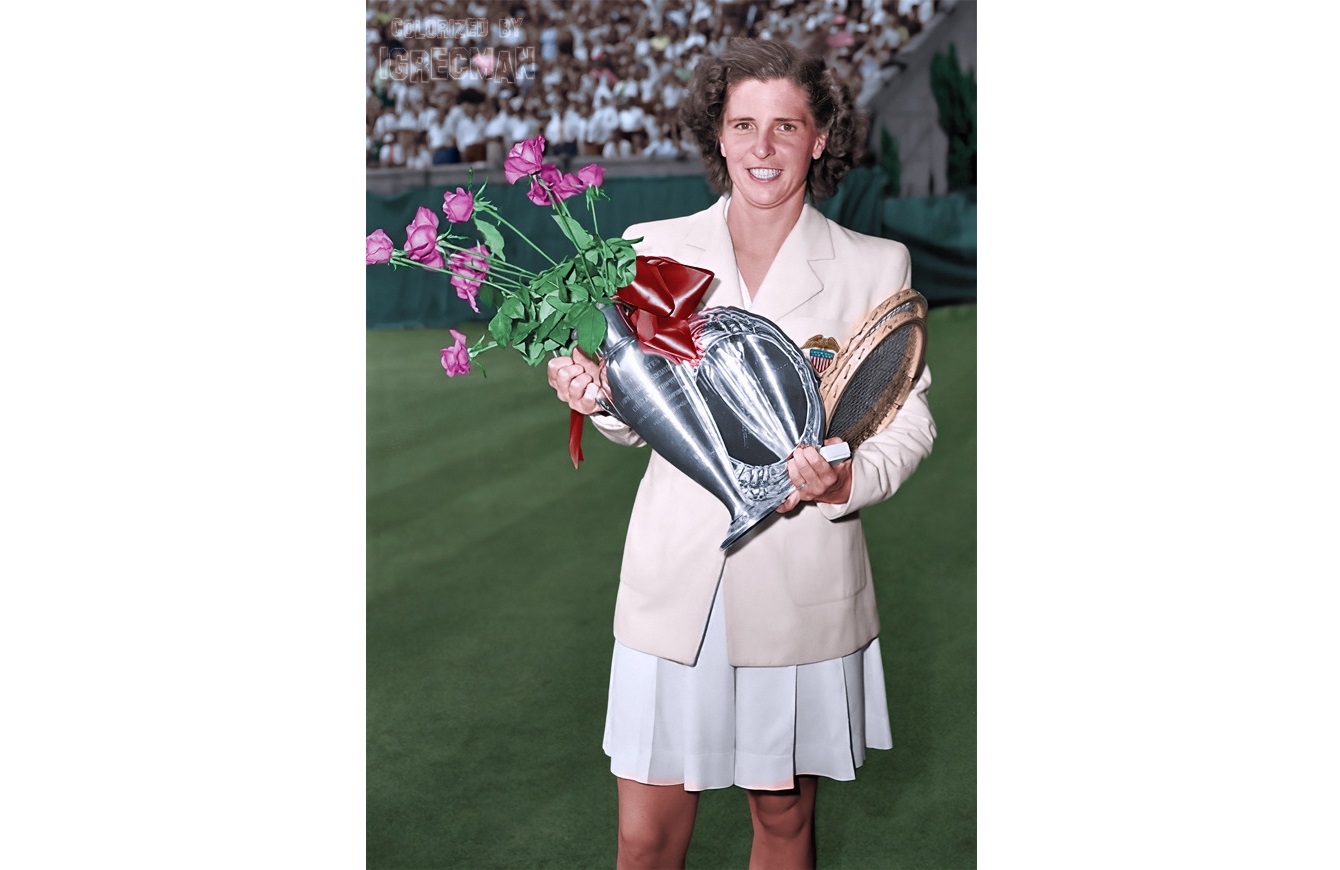
Margaret Osborne duPont at Forest Hills in 1948
Colorization credit: Women’s Tennis Colorizations

In 2022, I’m counting down the 128 best players of the last century. With luck, we’ll get to #1 in December. Enjoy!

* * *

Margaret Osborne duPont [USA]
Born: 4 March 1918
Died: 24 October 2012
Career: 1935-62
Played: Right-handed (one-handed backhand)
Peak rank: 1 (1947)
Peak Elo rating: 2,302 (1st place, 1951)
Major singles titles: 6
Total singles titles: 48
 

* * *

In the early 1930s, Hazel Wightman made a trip back to her old stomping grounds in San Francisco. Now established in Boston, the four-time national champion was the doyenne of American tennis. She surveyed the local talent, including a hard-hitting teenager from Oregon named Margaret Osborne.

Osborne’s mother asked what she thought. Wightman didn’t consider the youngster to be national champion material. “She’s too nice. She doesn’t have the killer instinct.” Wightman knew a thing or two about what it took to destroy an opponent on the tennis court. Back in 1910 as Hazel Hotchkiss, she had won a golden match–48 points in a row–against a poor girl in Seattle.

Wightman was a keen judge of talent, but she was wrong this time. She didn’t misjudge Osborne’s personality–the youngster really was that nice, and her main flaw as a young player was her inability to finish points. But the apparent kindness wasn’t what defined her on the tennis court. More than anything else, Margaret was calm, ignoring the annoyances that derailed other players and keeping her head when matches were tight.

In one title match after another, her unflappability was put to the test. Osborne won her first major at the 1946 French Championships, saving match points against Pauline Betz. Betz had beaten her in every previous meeting on clay and in most of their matches on other surfaces, too.

Margaret won her first US national championship in 1948 in circumstances that are almost impossible to believe. They would’ve overcome just about any other player. Two days before she was set to face the defending champion, her great friend and doubles partner Louise Brough, Osborne had learned that her father died after being hit by a car back home in California. Her mother convinced her to play anyway–that’s what Dad would’ve wanted.

The match that ensued was, by games played, the longest in the tournament’s history. Two rain delays stretched the contest even longer, further testing the players’ nerves. Osborne and Brough both possessed devastating American Twist serves–“two bombs,” as Doris Hart put it–and neither could break for the first 26 games of the third set. Some spectators lost their patience with the stalemate, chanting “Bring on the men!” Somehow, Margaret made the first move, and she won the match, 4-6, 6-4, 15-13.

Maybe she didn’t have the killer instinct, but at age 30, she had what it took to become the national champion.

* * *

Margaret Osborne duPont–she gained a last name when she married businessman and horse breeder Will duPont in 1947–is best known for her feats on the doubles court. With Brough, she won the title at Forest Hills for nine years running and 12 times overall. (She also won the women’s doubles title the year before the streak began, with Sarah Palfrey Cooke.) Altogether, Brough and Osborne duPont won 20 majors together. Margaret added another 10 mixed doubles titles with four different partners over a span of nearly two decades.

It’s easy to forget what a formidable–and versatile–singles player she was, as well. She won a second Roland Garros title in 1949, making her just the second American woman, after Helen Wills, to win the French twice. She is one of only 13 women to win two French titles as well as two (or more) other majors:

Suzanne Lenglen
Helen Wills
Margaret Osborne duPont
Doris Hart
Maureen Connolly
Margaret Court
Chris Evert
Martina Navratilova
Steffi Graf
Monica Seles
Justine Henin
Maria Sharapova
Serena Williams

If you wanted to compile a ranking of the 13 best players of all time, you could do a lot worse than to start with this list.

Osborne duPont’s career haul of six major singles titles–three at Forest Hills, two at the French, and one at Wimbledon–puts her in elite company. The strikes against her were largely out of her control: her peak was relatively short, and she excelled during a relatively weak era, when Pauline Betz had just turned pro and the European game was still recovering from World War II.

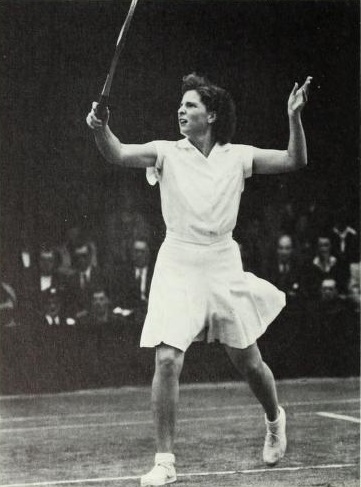
Another putaway at net

The war limited her playing opportunities when she could have been at her peak. She didn’t win her first major until 1946, when she was 28. She cut back on travel after her marriage in late 1947, and the 1950 season was the last time that she played at least 30 matches. An elite doubles player for two decades, she packed a lot of results into a much shorter span as a world-beater on the singles court.

* * *

It’s ironic that family life limited Osborne duPont’s playing opportunities, because she married one of the great tennis fans of the 20th century.

William duPont, Jr. was a scion of the Delaware duPont family, whose fortune dated back nearly a century to its origins in the gunpowder business. Will was more interested in horses, and he turned the family’s 400-acre estate, Bellevue Hall, into a center for his thoroughbred breeding and training operation.

He also converted Bellevue into a luxurious stop on the women’s tennis circuit. He built eight tennis courts–including grass, cement, and both outdoor and indoor clay. During World War II, some long-established tournaments were suspended, and duPont stepped into the breach. The estate in Wilmington, Delaware became part of the summer grass-court swing.

Pauline Betz played at Bellevue in 1944 and 1945, beating Margaret both years. She described the experience:

As many as thirty-six players at the same time have been living at [Bellevue] wondering what the poor folk were doing. We drop tennis clothes on the floor and receive them back laundered and ironed; breakfast and lunch at any hour; converge on the dinner table for home-grown steak or roast beef; raid the ice box once or twice per night for home-made ice-cream, and just can’t understand how we gain weight during an exhausting tournament.

Margaret said of Will, “He wasn’t very good, but he sure loved to play.” Perhaps it was inevitable that after he divorced his first wife in 1941, he would marry a tennis player. Alice Marble claimed that Will said he’d leave his wife for her. Louise Brough told an interviewer much later in life that he had hit on her as well. Both Brough and Betz reported that Will always smelled bad, a trait they attributed to his eccentricity but might have been because he spent so much time with his horses.

Osborne (left) and Brough at Wimbledon in 1947

When Margaret married Will, her life changed. She would never again need to worry about money, and she developed a love of horses that would last for the remainder of her life, long after the couple divorced in 1964. But Will was set in his ways, and some of those habits got in the way of competitive tennis. She knew what she was getting into, but it must have bristled that her schedule was no longer her own.

The first thing that the world top-ranked singles player lost when she became Mrs. duPont was any kind of opportunity for post-match celebration. Will was a homebody, so after Margaret finished her last match at Forest Hills–even if it was decided by an epic 15-13 third set–they caught the 8:30 train back home to Wilmington.

More damaging to Osborne duPont’s legacy, the marriage prevented her from ever playing in Australia. Will took his annual holiday in January, and he expected Margaret to accompany him to California. In the late 1940s and early 1950s, a succession of American stars–Hart, Brough, Maureen Connolly–made victorious trips Down Under. Given the opportunity, Osborne duPont probably would’ve picked up another major and won the career slam–very possibly doing the same in doubles as well.

* * *

I mentioned that Margaret was known for her calm under pressure. That didn’t mean that her opponents had much chance to relax.

S. Wallis Merrihew, the editor of American Lawn Tennis, assessed her game in 1942:

She has all the strokes and they are men’s strokes. Maurice McLoughlin and Billy Johnston at their highest and best could scarcely surpass it. Her serve is ideal to go to the net on, her volley is on a par with it, she can smash and drive with the best of them.

Pauline Betz was particularly impressed by Margaret’s overhead smash. In her autobiography, Wings On My Tennis Shoes, she made a brief list of the players with the best smashes. It was all men–Jack Kramer, Richard “Pancho” González, and so on–except for one woman: Osborne duPont. Betz poked fun at her own shaky smash and said that unlike her, the likes of Kramer and Osborne “cannot understand why there should ever be a question of missing.”

Margaret was a few years older than Kramer, and she reached her peak at about the same time. Kramer, along with González, Ted Schroeder, and others, popularized the “Big Game”–relentless, high-percentage serve-and-volley tennis. The women’s game had always been more baseline oriented, especially as generations of Americans tried to emulate the slugging prowess of Helen Wills.

Margaret competing in the 1948 Wightman Cup

Osborne duPont and Brough didn’t quite adopt the all-out net attack that came to define the men’s game, but they displayed an all-court prowess rarely seen at women’s tournaments. It’s part of what made them so deadly as a doubles team. Betz said that Osborne duPont was “almost impossible to hit through or past in a doubles match,” even if she sometimes missed volleys in singles.

* * *

Forty times in their career, “Ozzie” and “Broughie” faced off in singles. (This was not a strong era for nicknames.) Brough won their first eight meetings, and they split the rest down the middle. 27 of their encounters were in finals, 4 of them with a grand slam title on the line.

Osborne duPont’s one triumph over Brough in a major final came in the epic 1948 match at Forest Hills. The other three didn’t quite measure up to the same standard, but the big-serving duo always made things interesting. At Wimbledon in 1949, Brough won by the oddball scoreline of 10-8, 1-6, 10-8. Margaret had four set points in the first set, and she was two points away from closing out the match on her own serve at 6-5 in the third. This is in the era before sit-down changeovers, and unlike Forest Hills, Wimbledon didn’t give players a ten-minute intermission after the second set. The two women were on their feet, without pause, for 43 games.

The 1949 Wimbledon final also stood out in memory for another reason. Cynthia Starr and Billie Jean King interviewed the two women for their 1988 book, We Have Come a Long Way. Osborne duPont’s reputation was that she never choked. She said, as humbly as she could manage, that she couldn’t remember ever choking. The two women rarely disagreed, but Brough “gently disputed” the point–surely thinking back to that marathon title match.

Osborne duPont (and Brough, of course) in the 1950 Wimbledon final

Margaret certainly didn’t choke very much. Her last major title came when she was 44, in mixed doubles at Wimbledon in 1962. She and Neale Fraser finally secured the trophy after 41 games, beating Ann Haydon and Dennis Ralston, 2-6, 6-3, 13-11. In another classic mixed doubles match, Ozzie and Bill Talbert beat Gussie Moran and Bob Falkenburg, 27-25, 5-7 6-1. In Margaret’s memory, “The wind was so strong … that you couldn’t possibly win a game on one side of the court.” The match was postponed at 22-22 in the first set, and sanity prevailed in the less extreme conditions of the following day.

Osborne duPont was at Wimbledon in 1962 as the coach of the US Wightman Cup team. Mixed doubles at the Championships was just a bonus. It had been three decades since Hazel Wightman herself–the original force behind the annual international meeting–had doubted Margaret’s potential. Since then, Osborne duPont had won 37 grand slam titles. She went undefeated in 19 Wightman Cup matches. She ranked among the US year-end top ten 14 times, three of them after she became a mother.

She didn’t think there were any particular secrets to her success. In 1962, she told a reporter, “I just enjoy tennis very much and play the game a lot. It’s as simple as that.” Sure, yes, that, plus a serve with so much spin that spectators could hear a swish as the racket made contact. Wightman was wrong, but no matter. “In a way it was a compliment. I considered her one of my very best friends in tennis.”

The Tennis 128: No. 87, Juan Martín del Potro

Del Potro in 2009. Credit: Yann Caradec

In 2022, I’m counting down the 128 best players of the last century. With luck, we’ll get to #1 in December. Enjoy!

* * *

Juan Martín del Potro [ARG]
Born: 23 September 1988
Career: 2006-19
Plays: Right-handed (two-handed backhand)
Peak rank: 3 (2018)
Peak Elo rating: 2,233 (3rd place, 2009)
Major singles titles: 1
Total singles titles: 22
 

* * *

Since February 2, 2004, when Roger Federer took over the number one ranking, the top player on the ATP computer (whether it be Fed or someone else) has won 1,165 matches against 174 losses, a win percentage of 83%. If you take out the 100-plus matches that the Big Four played against each other when one of them was number one, the top player won more than 90% of their 1,200 matches.

In this span of nearly two decades, only a dozen players have won at least four times against the world number one:

Player                 Matches  Wins   Win%  
Rafael Nadal                41    22  53.7%  
Novak Djokovic              31    14  45.2%  
Andy Murray                 41    12  29.3%  
Juan Martín del Potro       24    10  41.7%  
Roger Federer               25     8  32.0%  
Dominic Thiem               13     5  38.5%  
Stan Wawrinka               26     5  19.2%  
Alexander Zverev            11     4  36.4%  
Nikolay Davydenko           19     4  21.1%  
Tomas Berdych               34     4  11.8%  
David Ferrer                26     4  15.4%  
Daniil Medvedev              8     4  50.0%

Juan Martín del Potro is the only man outside of the Big Four to reach double digits. In fairness, two of those wins were by retirement, when Novak Djokovic quit in a 2011 Davis Cup match and Rafael Nadal surrendered at the 2018 US Open after losing two sets. Even discounting that pair of results, he snatched as many matches from number ones as Federer did, and he won at a better clip than Andy Murray’s.

And–oh yeah–these aren’t exactly cheap victories. The list includes the 2009 US Open final, when Delpo handed Federer his first defeat in Flushing for six years. He knocked out the number-one ranked Federer in two other title matches, one in the enemy territory of Basel, the other recovering from match point down to win at Indian Wells in 2018. Del Potro also scored another upset for the ages: his first-round shock of Novak Djokovic at the 2016 Olympics.

Even Delpo’s catalog of losses to number ones is impressive. He pushed both Djokovic and Nadal to five sets at Wimbledon, and when the All-England Club hosted the Olympics in 2012, del Potro went toe to toe with Federer for four and a half hours. The final score, 3-6, 7-6(5), 19-17, went in Fed’s favor, but it set a pile of records and ultimately led to a rule change that will stop Olympic matches from ever again taking so long.

You don’t have to listen to tennis commentary for long before you hear about a guy who, on a good day, can beat anybody. Often, it’s just wishful thinking that a one-sided match will turn out to be more suspenseful than expected. With del Potro, it was absolutely true. He had the weapons, the stamina, and the mental strength to beat anybody–and on the sport’s biggest stages, he did exactly that.

* * *

I first saw Juan Martín del Potro play at the US Open in the 2006 qualifying rounds. If you spend enough time watching challenger and qualifying-level tennis, you’ll spot the occasional megastar before he makes his breakthrough. Then you can spend the next few decades telling everyone you meet about it.

Hipster brags of “I saw him when” may be boring, but del Potro never was. A month short of his 18th birthday, his serve was still mostly punchless, relying on spin and the angles he could generate from his height of six-foot-six. His on-court demeanor was laconic, verging on sleepy. But even at that stage, the effortless power was there. The man who would become known as the Tower of Tandil–after his hometown in Argentina–had plenty of weapons. His forehand was already devastating.

Delpo at the 2008 US Open. Credit: aon

Delpo’s final-round qualifying opponent was the Austrian Daniel Köllerer, a mind-bogglingly inconsistent shotmaker with a temper that made John McEnroe look like Mr. Rogers. (Köllerer would be banned from pro tennis in 2011 for match-fixing. Evidence was easy to come by because everyone else on the circuit hated him so much.) “Crazy Dani” was a tricky opponent who had beaten del Potro at a Challenger ten months earlier, and they would meet against in the third round of the Open in 2009. The 17-year-old Argentine simply sat back and watched Köllerer implode. The score was 6-3, 6-2, and Delpo would never play grand slam qualifying again.

He made steady progress throughout 2007, climbing into the top 50 and ending the year as the highest-ranked teen. There were some encouraging results–a win over top-tenner Tommy Robredo in Madrid; a five-set loss to Fernando González in Australia–but he struggled to stay fit. He retired from five matches (including the near-miss against Gonzalez), and he wouldn’t be fully fit again until midway through 2008.

Delpo responded by replacing both his coach and his physio. The new man in his corner, Franco Davín, gave him a burst of confidence, and the pair would stay together for seven years. After an early exit at Wimbledon to Stan Wawrinka, del Potro put the tennis world on notice. He won his first tour-level title in Stuttgart … then another … and another … and another. All told, he won 23 straight matches, including four titles, with wins over Richard Gasquet, Mardy Fish, Andy Roddick, Tommy Haas, and Kei Nishikori.

It took an in-form Andy Murray to stop him in the US Open quarter-finals, and even that was a four-hour struggle in which Delpo hit 27 forehand winners past one of the best retrievers in the game. When Roddick lost to the youngster in Los Angeles that summer, he said that del Potro had the ability to hit hard in any direction–“a good thing for him, bad for the rest of us.” Another month, and the Argentine cracked the top ten, two weeks after his 20th birthday.

* * *

Del Potro finished 2008 ranked 9th in the world, the only player under the age of 21 inside the top 20. He was 16 months younger than Djokovic and Murray, and it was increasingly clear that if anyone was going to break the growing stranglehold of the Big Four, it was the quiet giant from South America.

For most of 2009, Delpo solidified his status as the next guy on the list, rising to 5th on the ATP computer in April. He also learned just how difficult it would be to go farther. He lost to Federer in Australia, Nadal at Indian Wells, and Murray in Miami. Djokovic knocked him out of Rome. Federer beat him again at both Madrid and Roland Garros, the latter in five sets. del Potro upset Nadal in the Montreal semis, then lost to Murray in the final.

Del Potro celebrating another victory at the 2008 Citi Open

The US Open figured to be more of the same. Federer had won the tournament five years running, and no one outside of Fed, Nadal, and Djokovic had won a major since the Australian in 2005. Del Potro was seeded sixth, and he made easy progress, losing only two sets in his first five matches. That earned him a semi-final date with Rafa. Delpo turned in the best performance of his career to date, hitting 35 winners to Nadal’s 20, and winning 6-2, 6-2, 6-2. When he was able to hit a forehand, he won the point a remarkable 59% of the time.

Waiting in the final–of course–was Roger Federer. The two men had faced off six times. Before the French Open, Delpo hadn’t won a set. In the Australian Open quarter-finals that year, Fed obliterated him, 6-3, 6-0, 6-0. When the world number one raced to a set-and-a-break lead in just 45 minutes, history seemed to be repeating itself.

Del Potro settled down and made a match out of it. Federer served for the second set at 5-4. At 30-30, Delpo rifled a forehand down the line on his second shot–winner. Break point, Fed came in, Delpo hit a forehand passing shot down the line–winner. Del Potro reached set point in the tiebreak on his own serve. Fed sliced a deep return to the backhand, the challenger ran around it to hit an inside-out forehand–winner.

When the forehand was firing, no one–not even the Swiss maestro–could touch it. Del Potro lost the third set when his serve deserted him late in the frame. But unlike almost everyone else who came close to beating Fed in those years, Delpo came back stronger. He broke the top seed to love at 2-all in the fourth, and Fed muscled the score back to even, the Argentine took a second tiebreak. In a set where he held Federer to a mere two forehand winners, Delpo hit eleven.

The fourth set tiebreak. Admit it: You’re tempted to watch the whole match.

Del Potro hit two more forehand winners to break for a 2-0 advantage in the decider, and he never let go. When Federer had a game point to stay in the match at 2-5, Delpo delivered yet another forehand winner down the line. Two points later, yet another big forehand forced an error, and the match went to the Tower of Tandil. A star was born, and at age 20, the sky was the limit.

* * *

The 2009 US Open final was not del Potro’s last hurrah–far from it. I’ve already told you about his big upsets more than a half-decade later, and the small print up top reminds us that he finally climbed to number three in the rankings in 2018.

But Delpo would never again play a match as healthy as he did in 2009. Here’s the rest of his career in one graphic:

A right wrist injury sidelined him for almost the entire 2010 season, and despite leading Argentina to the Davis Cup final in 2011, he needed most of that campaign just to return to form. He was winning regularly again by 2012, only to discover that Federer hadn’t lost a step. The two players met eight times that season, and Fed won the first six, including the Australian quarters, the French quarters, and the heart-breaking marathon at the Olympics. Delpo beat Djokovic for the Olympic bronze, and he turned things around against Federer with wins in Basel and in London at the Tour Finals. It looked like another deep grand slam run was still in his future.

2013 was another collection of near-misses. A final at Indian Wells (three-set loss to Nadal), a partially-lost clay-court season due to a viral infection, and a semi-final at Wimbledon (five-set loss to Djokovic). He recorded wins over each of the Big Four–just not at the right time for another major championship–and returned to the top five.

And then it was the other wrist. Between the year-end finals in 2013 and the Rio Olympics in 2016, del Potro played only 35 matches.

* * *

Delpo had always been popular with fans. His electric game drew them in, and his soft-spoken good nature won them over. Players found him endearing, too. Some Federer supporters believe that Fed lost to him so often because their hero liked him too much. Del Potro’s post-match hugs were legendary. Jason Gay wrote in The Wall Street Journal, “If he was not your favorite player, he was your favorite player’s favorite player.”

Every successful return to the tour added to his allure. There was no way that a player could undergo so many surgeries, rehab both wrists, and still come back strong. Yet in some ways, the older, rebuilt Delpo was even better.

Just another 107mph forehand

The left wrist injury made it harder for Delpo to hit two-handed backhands with power. He relied more on his less-effective slice, but more importantly, he shifted tactics to emphasize the monster forehand even more. When he faced Djokovic in the opening round at the 2016 Olympics, he walloped 32 forehand winners in just two sets. Barely halfway into another comeback, still ranked 141st in the world, Delpo rode his pared-down game to a Olympic semi-final win over Nadal. He pushed Murray to four sets in the final before settling for a silver medal.

Del Potro 3.0 wasn’t just about the power game–it relied on a heart as big as the man himself. As a kid, he dreamed of winning a grand slam and the Davis Cup. Argentina had never done the latter. Without a second star behind Delpo, it seemed unlikely that they would break the losing streak. He rejoined the team for the 2016 semi-finals, and barely a month after the Olympic defeat, he came back from a two-sets-to-one deficit to beat Murray.

In November, he helped his country finish the job. He beat Ivo Karlović in the second rubber, then lost in the doubles as Croatia took a two-to-one lead. With the Cup on the line, del Potro came back from another two-to-one disadvantage, this time against Marin Čilić. Federico Delbonis straight-setted Karlović, and the trophy went to Argentina.

In his career up to that point, del Potro had fallen behind two sets to one on 20 occasions. 16 times, he lost. The other four: the 2009 US Open final, a 2010 Australian Open match against James Blake, and those two critical matches of the 2016 Davis Cup.

* * *

In Buenos Aires this February, del Potro returned to the ring one last time. The tennis world tuned in to watch for flashes of the old Delpo magic, but he lost easily to Delbonis, 6-1, 6-3. It had been 965 days since his last tour-level match, so it was understandable that he’d need more time to get back in form.

Del Potro had entered a second event in Rio de Janeiro, but he withdrew. It wasn’t really a comeback–it was a farewell.

Usually when we talk about injury-riddled careers, we focus on the what-ifs. It’s certainly tempting to speculate about what Delpo could’ve accomplished with two healthy wrists. But in his case, it’s beside the point. He is a living legend to fans and an inspiration to his peers. In his limited time on court, del Potro delivered far more than one career’s worth of memorable moments, dramatic upsets, and just flat-out eye-popping tennis.

The Tennis 128: No. 88, Mary Joe Fernández

Mary Joe Fernandez in 2009. Credit: Robbie Mendelson

In 2022, I’m counting down the 128 best players of the last century. With luck, we’ll get to #1 in December. Enjoy!

* * *

Mary Joe Fernández [USA]
Born: 19 August 1971
Career: 1985-99
Plays: Right-handed (two-handed backhand)
Peak rank: 4 (1990)
Peak Elo rating: 2,261 (5th place, 1991, 1993)
Major singles titles: 0
Total singles titles: 7
 

* * *

In 1992, Mary Joe Fernández reached 12 semi-finals. She lost the first in Sydney to Gabriela Sabatini, then got her revenge on Sabatini two weeks later at the Australian Open. She lost to Monica Seles in the final, then won another semi-final in Essen in February. Waiting in the final: another defeat at the hands of Seles.

Between March and October, she cracked the final four nine more times. The Olympics, the US Open, in Europe, in Asia, on clay, on grass, on hard–she reached the semis in 12 of the 17 events she played, and one of the early losses was due to injury at Wimbledon.

Here are her opponents in those last nine semis:

Steffi Graf
Gabriela Sabatini
Arantxa Sánchez Vicario
Lori McNeil
Steffi Graf
Monica Seles
Monica Seles
Gabriela Sabatini
Jana Novotna

There were not a lot of easy draws on the women’s tour of the early 1990s. Graf and Novotna accounted for two of her earlier-round exits, as well.

Heading into Indian Wells in March of 1993, Mary Joe had piled up $2.2 million in career prize money, despite winning only two tournaments. She had reached 37 semi-finals but only eight finals.

She said then: “It’s just a matter of getting that break. Once I win one or two, it’s going to be easier. It’s mental. It’s all in the head.” She beat Helena Sukova and Amanda Coetzer to win in Indian Wells, but it didn’t get easier. As she got older, it was less often Graf, Seles, or Sabatini in the semis. Instead, she drew the likes of Mary Pierce, Lindsay Davenport, and Martina Hingis.

Fernández arrived on tour when it was at its most crowded with talent, and she was never quite able to elbow her way in. Like Zina Garrison, she was an all-time great player with the bad luck to play match after important match against foes who were even better.

* * *

I’ll be honest: I never expected to see Mary Joe Fernández on my list of the 128 best players of the last century, let alone inside the top 90. I’m sure you’re surprised to see her here. Mary Joe is surely too busy to follow along, but on the off chance she’s counting down with us, she probably didn’t think her name would come up, either.

The remaining 87 players on the list include a few more who never won a major, but I suspect that for most of you, Fernández will be the last real head-scratcher. While I’m generally more interested in celebrating the accomplishments of the all-time greats than picking through the details of why one is ranked above another, this case calls for some explanation.

According to my historical Elo ratings, Fernández was at her best in early 1993. After winning Indian Wells, she beat Sabatini and Sánchez Vicario to reach her first French Open final, where she took Graf to a third set. Her rating after the French was 2,261, which slots her onto the all-time list between the peaks of Andrea Jaeger and Evonne Goolagong. 13 Open Era women on this list–including a few who are still to come–never achieved such a high Elo rating.

There’s no denying that she was utterly helpless against the very best. She lost all seven matches against her idol Chris Evert, eight of eight against Martina Navratilova, all 17 she played against Graf, and 15 of her 16 meetings with Seles. There was a mental component to her inability to trouble Graf or Seles, but she also just didn’t have the weapons to challenge them. Few women did.

Embed from Getty Images

I don’t consider doubles accomplishments in the ranking, but still: those medals are gold.

What saves Mary Joe’s reputation is how she fared against everyone else. In her main years on tour, from 1986 to 1997, she played at least three matches against 70 different opponents. Only ten of them got the better of the head-to-head. In addition to the four women I’ve already mentioned, she lost every meeting with both Martina Hingis and, for some reason, Irina Spirlea. She lost two of three against Kimiko Date, and she fell short of a .500 record against Sabatini (10-13), Sánchez Vicario (4-7), and Novotna (4-5).

That leaves 60 women, three of which fought her to a draw. The other 57–including, again, many players who earned a place on the Tennis 128–lost to her more often than they won.

Here’s another way to look at it. In her years as a full-time competitor, Fernández won 400 matches against 172 losses–almost exactly a 70% win rate. That’s roughly equivalent to the more recent marks of Simona Halep and Caroline Wozniacki. Take out her matches against Evert, Graf, Navratilova, and Seles–in other words, put her in an era without four of the ten or so best players of all time–and her winning percentage improves to 76%. That pulls her about even with the career winning percentage of Venus Williams.

Yes, I know most great players lead most of their head-to-heads. Everyone’s record looks better if you take away some of their losses. I may not be able to convince you that Mary Joe was one of the 90 best players of all time, but I hope you’ll recognize how easy it is to underrate a player whose main accomplishment is that she managed to hold her own in a uniquely difficult era.

* * *

However you value Mary Joe Fernández’s pro career, there’s no disputing she was one of the great juniors of the modern era. When she was 14 years old, she won the 18-and-under division at the Orange Bowl. It was her fourth straight title there. She won the 12s, 14s, 16s, and 18s in consecutive years.

IMG, the sports management firm, began courting her when she was in elementary school. She won her first three matches on the pro tour when she was 13, and she claimed victory in her US Open debut a week after her 14th birthday. She made a surprise run to the quarter-finals at Roland Garros in 1986, when she was still 14. She cracked the top 20 on the WTA computer a year later.

For nearly every milestone Fernández hit, she was the second youngest in history to do so. Only Kathy Rinaldi, an equally precocious 14-year-old a few years earlier, had outdone her. The precedents on most people’s minds, though, were the more successful teen queens Tracy Austin and Andrea Jaeger. Austin and Jaeger had scaled the highest peaks of the sport before they were old enough to legally drink, but injuries and burnout quickly knocked them both off tour.

Embed from Getty Images

Mary Joe at Wimbledon in 1991

That wasn’t going to happen to Mary Joe. For one thing, she wanted to go to college–an aspiration that was delayed when she opted to turn pro at age 14. She still finished high school, an unusual credential in the single-minded teenage ranks of the tour. The WTA had introduced limitations on the number of matches that players as young as Fernández could play, and unlike some of her peers, she didn’t bristle at the restrictions.

Plus, she was mature beyond her years. Her early coaches couldn’t say enough good things about her. When she was 14, one of them told Sports Illustrated:

She has a mind like a steel trap. She is the most mentally tough person in the history of tennis. People talk about how great her strokes are. It’s true, but it’s her head that makes her great.

* * *

There was no point in leaving a talent like Fernández in the juniors, and she proved herself equal to the challenge of the adult circuit. But she also quickly discovered her limitations.

Twice in early 1986, Mary Joe faced Steffi Graf. Graf was two years older, and she was already on the brink of dominating the tour. Fernández failed to last an hour on court on either occasion. On her first trip to Wimbledon, she opened against Chris Evert. The match was highly touted, as Fernández had just broken out at the French. But the result was predictable: Evert lost only five games. They met again at the US Open with the same result.

https://www.youtube.com/watch?v=GBBP3JW2SYM
Struggling against Steffi in 1988

One knock against the youngster is that her vaunted mind worked against her. In his 1993 book Ladies of the Court, Michael Mewshaw wrote:

[T]here were those who suspected that she was too sweet to break through to the top. Or else too intelligent. Tennis, it was said, was a game where you had to be smart enough to do it and dumb enough to think it mattered.

Harold Solomon, a one-time Roland Garros finalist who coached Fernández in the early 1990s, concurred:

She’s a very sincere, genuine type of person. She’s not on an ego trip at all–sometimes to her detriment. Sometimes there’s not enough animal on the court. It’s my job to try to bring that out.

But in Solomon’s view, it was more than just the mental game. Because Mary Joe hadn’t adopted the typical dawn-to-dusk training regimen as a teen, her technique left plenty of room for improvement. Only in late 1991 did she learn to hit a one-handed backhand volley. The same year, she started doing simple strength workouts. Before that, she couldn’t manage a single push-up.

* * *

Fernández had plenty of success before teaming with Solomon. In 1990, she reached the Australian Open final (where she fell to Graf), and she won the Filderstadt title in October to reach a career-best ranking of fourth in the world. But it took a new coach–and his triple goal of technical improvement, physical fitness, and aggressiveness–to take another step forward.

At the 1993 French Open, she played the most memorable match of her career, a quarter-final against Sabatini that tested her will to win like never before. The third seed from Argentina had won eight of their last ten encounters, and she quickly built up a 6-1, 5-1 lead at Roland Garros. Sabatini double-faulted on her first match point, and Fernández saved four more before taking the second set in a tiebreak. Mary Joe made her coach proud–“I figured I should just hit it as hard as I could and see what would happen”–and pulled out the decider by a score of 10-8, needing five match points of her own.

She’ll never forget the three-and-a-half-hour battle for a place in the final four, but Fernández remembers the semi-final itself as “one of the best matches I ever played.” Against Sánchez Vicario–who had beaten her in six of seven meetings–she continued on the attack. She won more than half of her return points and won easily, 6-2, 6-2.

Highlights from the 1993 Roland Garros semi-final

The reward: another major final against Steffi Graf. Fernández rode her semi-final form into the title match, taking the first set, only the second set she had won against the German in ten meetings. She nudged out to a 2-0 lead in the decider, then broke again for 4-3 on a Graf double fault. Graf broke back, and finally, Fernández’s jitters were too much. Steffi won, 4-6, 6-2, 6-4.

Coach Solomon had Mary Joe on a three-year plan to win a grand slam, and the run in Paris cut the schedule in half. But immediately after Fernández discovered her best tennis, her body betrayed her. A shoulder injury, among other accumulated woes, limited her to only 12 matches for the rest of the season. Among them: a 6-0, 6-1 embarrassment at Wimbledon at the hands of Zina Garrison.

Still only 22 years old, she he was able to come back, winning Indian Wells and reaching two major quarter-finals in 1995 alone. But as the field got more crowded with young talent from around the world–a trend she had spotted three years earlier, at a time when journalists were bemoaning the top-heavy nature of the women’s game–Fernández found it increasingly difficult to keep up. Mary Joe settled for doubles glory instead. She and Gigi Fernández won gold at the 1996 Atlanta games, equaling their result from Barcelona in 1992.

Solomon’s three-year plan never came to fruition, and as a singles player, Mary Joe Fernández finished her career with three major runner-up trophies and a handful of tour-level titles. It wasn’t quite what her junior exploits foretold, and it isn’t the typical resume of an all-time great. She wasn’t too intelligent to reach the top, nor was she too nice–smart and friendly as she may be. She was simply born at the wrong time.

The Tennis 128: No. 89, Michael Chang

Michael Chang in 2016. Credit: Tourism Victoria

In 2022, I’m counting down the 128 best players of the last century. With luck, we’ll get to #1 in December. Enjoy!

* * *

Michael Chang [USA]
Born: 22 February 1972
Career: 1988-2003
Plays: Right-handed (two-handed backhand)
Peak rank: 2 (1996)
Peak Elo rating: 2,186 (2nd place, 1994, 1996-7)
Major singles titles: 1
Total singles titles: 34
 

* * *

When John McEnroe made his first trip to Roland Garros in 1977, his wise-cracking idol, Vitas Gerulaitis, told him what to expect. “You’re going to play some guy from Europe that you’ve never heard of, and you’re going to get your ass kicked.” Vitas was wrong–McEnroe never did lose to an anonymous European at the French–but such was the general fate of Americans on the French clay.

When McEnroe made his debut, no player from the United States had won the French title since Tony Trabert in 1955. Americans went nearly twenty years without even putting a man in the final. Gerulaitis was runner-up in 1980, and Johnny Mac came one set short four years later. In 1988, McEnroe reached the fourth round before losing (again) to three-time champion Ivan Lendl. En route, he routined a 16-year-old American wild card named Michael Chang, 6-0, 6-3, 6-1.

By the end of the 1988 Roland Garros fortnight, there were hints that things would start to change for the Americans. In just his second appearance at the tournament, Andre Agassi reached the semi-finals, where he pushed eventual champion Mats Wilander to five sets. Insiders knew that another young American, Agassi’s former roommate Jim Courier, was right behind him. Courier would upset Agassi and make his own mark at the event a year later.

Agassi and Courier would both go on to win French Open titles. But the man who ended the drought was Chang. When he returned to Roland Garros in 1989, he was 17 years old, stood only five-feet-eight-inches tall, and weighed 135 pounds. He had played only five clay-court events on tour, four of them on the ersatz Har-Tru surface used in the States. 20 months younger than Agassi, 18 months younger than Courier, and six months the junior of Pete Sampras, he jumped the queue to become the first slam winner of the quartet and kick off a memorable decade for American men.

Chang would go on to win 32 more titles and rise to number two in the rankings seven years later. But the 1989 French Open would be Chang’s only major championship. It was so unexpected, such a unique achievement, that it tends to overshadow the rest of an excellent career. That’s okay–it really was one of the transcendent moments of modern tennis.

* * *

Chang and Sampras grew up together, facing each other a dozen times in Southern California junior tournaments. Chang usually won, and when Franz Lidz profiled him for Sports Illustrated in 1988, Pete was referred to as “Michael’s sometime doubles partner.” The pair spent some time before the 1989 French Open training with Jose Higueras, a Spaniard who won all but one of his 16 tour-level titles on clay.

Avoiding Vitas’s curse, the 15th-seeded Chang cruised through the first three rounds on his second attempt at Roland Garros. He beat the Belgian Eduardo Masso and Francisco Roig, from Spain, with a straight-set drubbing of Sampras in between. His reward for living up to his top-16 seeding was a fourth-round test against Ivan Lendl, the number one player in the world. To Chang at the time, Lendl was “the most feared opponent on the tour.”

In the half-year before the French, the two men had met twice. The first time, at an exhibition in Des Moines, Lendl dismantled the youngster. He then spent the limo ride back to hotel explaining to Chang why he lost: “You know, with your game the way it is now, you have nothing that can really hurt me.”

The second time was also an exhibition, this time on green clay in Atlanta. Chang had taken Lendl’s words to heart. Just a few months of added strength and aggressiveness, and Michael took the match, 7-5 in the third. It didn’t count, but it planted a seed in the teenager’s mind. Lendl came into the French as the reigning Australian Open, with five titles in his last seven events. But Chang knew he had a chance.

Embed from Getty Images

Chang at Wimbledon in 1990

The top seed won the first two sets, 6-4, 6-4. But it was hardly one-way traffic. When Lendl served for the first set, Chang broke him after a 20-stroke rally–a length that barely registered after 40- and 51-stroke points earlier in the set. Chang broke again early in the second before Lendl charged back to take the two-set advantage.

It’s hard to imagine the mindset that allowed the 17-year-old to approach the third set with the belief that he could still win the match. Mark Kratzmann, an Australian player who lost a five-setter to Chang at Wimbledon in 1990, said, “If you have him in a losing position, he’s going to change. A lot of players are scared to change; he’s not. Then he almost forces you to decide whether to stay with your tactics or adjust to his. He makes you think, and a lot of guys can’t handle that.”

Another brainy tennis player concurred. Arthur Ashe told the Los Angeles Times, “He is easily the smartest young player I have ever seen. He has an intuitive sense that I can only compare to a chess prodigy at age 9. You see him do things on the court that you would expect to see from someone who’s been on the tour for years.”

* * *

With nothing to lose, Chang ramped up the aggression. He still didn’t have many weapons that would hurt Lendl, but he had learned how to use the few that he wielded. He broke serve at 3-all in the third with two inside-out forehands. He took Lendl’s serve again in the final game of the set, planting a few doubts in the mind of the top seed.

After Chang broke for 4-2 in the fourth, the cracks started to show. Lendl complained about the conditions, he whined about line calls, and after he accused chair umpire Richard Ings of cheating him “every time,” he lost the seventh game of the set on a point penalty. Chang earned set point with a bruising, 39-shot rally, then evened the score on another Lendl unforced error.

It was already the match of the tournament. The fifth set would make it one of the matches of the decade. Chang began cramping, and he nearly retired after three games. Barely able to move, he stuck it out, moonballing to buy time, attempting high-risk shots whenever the slightest opportunity presented itself. For all his experience, the veteran couldn’t adjust. “Lendl choked,” said 1955 champion Tony Trabert, at the match as a commentator for Australian television. “Michael, to his credit, worked him around pretty good.”

Chang broke in the seventh game to take a 4-3 lead, and at 15-30, he sensed a turning point where he could win or lose the match. The idea struck him to try an underhand serve: “I never thought twice about it. I just did it. … I had never planned to serve underhand. I had never hit an underhand serve in my life before that moment.” It worked; Lendl reluctantly followed his return to the net, and Chang passed him. The crisis passed.

Every heart-stopping point. Skip to 3:27:00 for the underarm serve.

The American had one more trick up his sleeve. With Lendl serving at 3-5, 15-30, Chang hit down-the-line backhand winner on the point’s 26th shot to reach match point. When Lendl missed his first serve, Chang crept up to a foot behind the service line, a tactic he’d occasionally used to rattle opponents in junior tournaments. Lendl responded just like a jittery teen. He missed his second serve, handing the match to Chang.

Years later, a journalist would ask Chang to name his favorite character from the Bible. He chose David, the Israelite who took down the giant Goliath in single combat. No explanation was necessary.

* * *

At five-foot-eight, Chang naturally identified with underdogs, and underdogs idolized him in turn. His upset of Lendl inspired another 17-year-old, Arantxa Sánchez Vicario, to her own unlikely feats. Reaching the final as the 7th seed, the Spaniard upset Steffi Graf in a marathon final, handing Graf her first loss at a major since 1987.

Chang followed Arantxa’s progress, but his main focus was on another David-versus-Goliath struggle much further afield. For weeks, Chinese pro-democracy protesters had amassed at Tiananmen Square. Chang and his parents–his father was born in China, and his mother was the child of Chinese diplomats–spent the tournament glued to CNN as the tensions rose. The day before the Lendl match, the government sent in the army. The result was a massacre of at least several hundred, and probably several thousand people.

Some studies suggest that athletes perform at a higher level when they compete for something greater than themselves. Chang certainly had that motivation. He later said, “What it was really about, was an opportunity to bring a smile upon Chinese people’s faces around the world when there wasn’t a whole lot to smile about.”

The giant-slayer gave Chinese and American fans plenty more to smile about. He knocked out Ronald Agenor–“the Haitian sensation”–in the quarters, even after Agenor saved a critical point by using Chang’s service-line return position against him. Then he won another four-set grindfest against Andrei Chesnokov.

https://www.youtube.com/watch?v=HOWWL6WvegU
Highlights from the 1989 Roland Garros final

Waiting in the final was the third seed, Stefan Edberg. The Swede had years of experience to his advantage, not to mention three major titles. But Chang had his own reasons to be confident: The two had met just three months earlier, at Indian Wells. The American won that match easily, 6-3, 6-2.

This one wasn’t as easy, but the result was the same. It ran to five sets, and Chang fought off 19 of 25 break points. He held his own against Edberg’s world-class serve-and-volley game, limiting the Swede to only 58% of points when he came in behind his first serve. When they reached a fifth set, no one would’ve blamed Chang for running out of gas–the cumulative emotional toll on him was enormous, and the cramps had attacked him again after the semi-finals. But it was Edberg who faded, and the American won, 6-1, 3-6, 4-6, 6-4, 6-2.

* * *

The French Open title was the pinnacle of Chang’s career. He’d never again win a major championship, despite reaching three more finals in the mid-1990s. Agassi, Courier, and Sampras would all overtake him, each one claiming multiple slams of their own and spending time at the top of the ranking list. Sponsors and agents would never again fight for Chang’s affections like they did in the wake of his Roland Garros triumph.

Chang felt something pop in his hip during a December 1989 practice session. He ended up spending a month on crutches, and he struggled to string wins together when he returned to the tour. His ranking, which had peaked at 5th in his breakthrough season, fell to 14th before the French, then it dropped to 24th after he lost to Agassi in the Roland Garros quarters. Despite the ups and downs, he was hardly a spent force: He beat Agassi and Sampras back-to-back to win the Canadian Open, then came back from two sets down to beat Horst Skoff in the September Davis Cup semi-finals.

Embed from Getty Images

Chang in 2003

It would take two more years before he could re-establish himself at the top. Before the 1991 season, he instituted a new coaching arrangement with his brother Carl. Together, they focused on developing bigger weapons so that Michael’s game wouldn’t rely entirely on his retrieving skills and tennis smarts. After a racket change in 1994, the serve that averaged 77 miles per hour during the 1989 French Open would sometimes reach 120.

Chang returned to the top ten in March of 1992, and he stayed there for six years. He barely mentions that span in his autobiography, except to say they were the best years of his career. He spent most of 1997 ranked number two in the world, and he came within one match of reaching the top spot. Patrick Rafter dashed those hopes in the US Open semi-finals, and Chang won only three of ten matches for the rest of the season. Injuries struck again in early 1998, and his time among the elites was effectively over.

* * *

From his teenage triumph to his later years as a top-five stalwart, Chang always puzzled both journalists and his peers. John Feinstein called him “as serious-minded and as colorless as Agassi was goofy and colorful.” Reporters didn’t know how to process his outspoken Christianity, and his confidence that God was on his side alienated fellow players.

Agassi found Chang’s faith particularly irritating:

Every time he beats someone, he points to the sky. He thanks God–credits God–for the win, which offends me. That God should take sides in a tennis match, that God should side against me, that God should be in Chang’s box, feels ludicrous and insulting. I beat Chang and savor every blasphemous stroke.

French crowds also bristled at the openly religious star, whistling at the player who they otherwise would’ve enthusiastically embraced. Over time, Chang became a bit more circumspect about his faith, though he never hid it.

What his contemporaries found most baffling was the degree to which Chang was a thinker. Arthur Ashe compared him to a chess prodigy, but Chang’s search for tactical advantages was sometimes more prosaic. McEnroe told Feinstein about the first time he faced the young player:

We tossed the coin and he won, so it was his choice–serve or receive. He just stood there, thinking. I mean, the match was indoors. Finally, after thirty seconds I said, “Is there a time limit on this or what?”

Tennis, for Chang, was all about preparation. He responded to Ivan Lendl’s dissection of his game in a matter of months. His father and brother obsessively watched match video to give Michael an edge against upcoming opponents. He executed under pressure as well as anyone–he won 27 of 30 deciding third sets in one mid-1990s span–a reflection of the fact that he always had another game plan to turn to.

Off-court, he liked to unwind on a fishing boat. He wrote in his autobiography:

I found fishing, in some ways, to be similar to tennis. Preparation and technique were important, as well as planning how you were going to beat that fish. That meant you had to choose the right hook, position the boat just so, pick the right lure–plastic worms, spinnerbaits, crankbaits, or surface plugs–or choose the correct live bait, such as night crawlers, crayfish, mealworms, or water dogs.

Not many players would see that all that slow-paced planning had much of anything to do with tennis. It’s certainly tough to reconcile a love of bass fishing with the way Chang would step inside the baseline to smack an inside-out forehand. But no David ever won the battle by playing Goliath’s game.

10,000 Charted Matches

The Tennis 128 will return tomorrow with player #89.

* * *

I introduced the Match Charting Project to the world in November 2013. I had no idea whether it would ever draw the interest of anyone outside of a tiny group of tennis-obsessed friends. I was okay with that. The project was designed to be valuable even if we only ended up charting a few matches.

Eight and a half years later, that group of tennis obsessives has grown. Over 140 of you have learned my detailed charting notation and worked through an entire match. A dozen of you have logged every shot of 100 matches or more. One indefatigable contributor, Edo, is now over 1,300 matches. Another super-charter, Zindaras, is also closing in on four digits.

Yesterday, another all-star contributor, Ludo, sent in charts of two John Isner matches. They were the 9,999th and 10,000th charts for the project. We’ve logged six million shots, over one and a half million points, and yes, ten thousand matches. The 10,001st chart appeared in my inbox as I was writing this post.

* * *

Ten thousand matches is hardly a complete record of professional tennis, but it gives us a remarkably detailed view of both the men’s and women’s game.

In the last few years, we’ve come close to finishing many ongoing sub-projects. We have a chart for every grand slam final back to 1980, and many from the 1970s. We have most grand slam semi-finals back to the mid-1980s. We have nearly every Masters 1000 final back to 1990, when the Masters series began, and we have most Masters semi-finals in that span as well.

We’ve charted every match between members of the Big Four. We have almost every tour-level final ever played by the Big Four. We’ve collected charts of the major WTA events back to the 1990s, and we’ve racked up dozens of Evert-Navratilova matches before that. More recently, we’ve charted every single tour-level final (and a fair number of challengers and ITFs) from the last several years.

We have a shot-by-shot log of nearly every point Simona Halep has played back to the birth of the project, and near-complete sets of Aryna Sabalenka and Bianca Andreescu matches. We have charts of 543 Roger Federer matches, and over 400 each for Novak Djokovic and Rafael Nadal. We’ve charted at least ten matches for most players who have reached the men’s or women’s top 50 in recent memory. We have one hundred matches or more for 34 different players, and we’ll add Iga Swiatek and Diego Schwartzman to that list any day now.

You can always check in on the state of the project, along with a full list of charted matches, here. Raw data from more than half of the charts is available for research purposes and updated monthly, here.

* * *

The best part about this project, to me, is that there is value in every single contribution. It may feel like a drop in the ocean to submit, say, the 544th Federer chart, but even that gives us a fuller historical record of Fed’s career and a more detailed statistical summary of his performance that season–not to mention more data on his opponent. If you’re more interested in breaking new ground, there are always interesting young players who are barely represented in the dataset.

Most of all, it’s fun–at least for the right kind of person. Maybe you think it’s bonkers that some of us enjoy typing alphanumerical codes into a spreadsheet as we watch tennis. Put it that way and … well, I get it. But once you get the hang of charting, it forces you pay more attention and learn more about this endlessly complex sport. While watching tennis. Which I suspect you enjoy quite a bit.

Learn how to get started here. I hope you’ll contribute as we march on to the next 10,000 matches.