A deep return is better than a shallow one. A return to a corner is better than one down the middle. There’s no doubt that return placement matters, but how long does it matter?
With every shot after the return, it is logical that the effect of the return would decay. A strong return might not go for a winner, but it probably induces a weak reply, making it more likely that the returner can end the point on her next shot. But if she doesn’t, if the rally continues to 6, 10, or more shots, at some point the quality of that return is no longer a factor. Either she sacrificed the advantage it gave her, or her opponent defied the odds to get back on neutral (or better) terms.
You guessed it: We can quantify this.
Drawing on the thousands of 2020s matches logged by the Match Charting Project, let’s start with the simplest comparison: returns that landed beyond the service line versus those that landed in the service box. Deeper is unquestionably better: For men, a back-half return means winning the point 50% of the time, while an in-the-box return is good for only 41.4%. Even controlling for match (opponent, surface, etc), the difference is 7.7 percentage points.
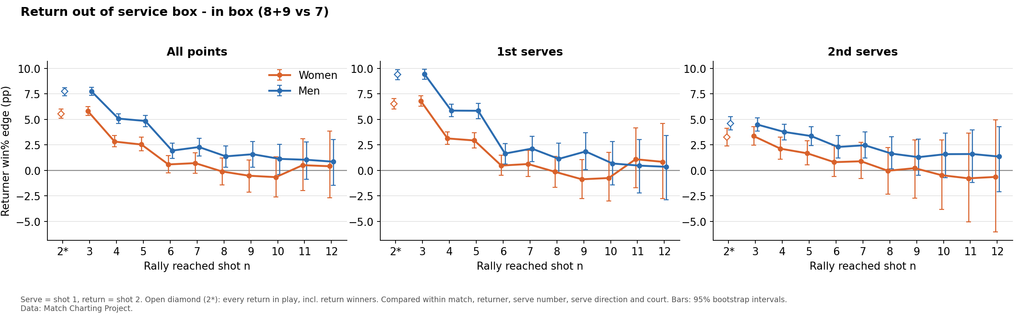
Most of that advantage shows up in just a few shots after the return. These plots show the percentage-point advantage of a deeper return at each stage of a rally:
Return depth matters more, and for longer, in the men’s game. A back-half return against a first serve is worth about 2.5 percentage points more to men than to women. Against first and second serves, return depth plays a role up to at least the eighth shot.
For women, this basic measure of return depth loses half of its predictive power once the rally reaches its fourth shot. By then, the server has either capitalized and ended the point, or she has squandered her advantage. (Or the return was good enough that she didn’t have an advantage to squander.) By the sixth shot the return is barely a factor at all: The confidence interval says the effect could be zero.
The server’s natural control of the point also explains the stair-step nature of the graph. A big part of the difference between return influence on 3-shot rallies and 4-shot rallies is that the points with the weakest returns become third-shot (plus-one) winners. There is no fourth shot. The effect is similar, if smaller, between the 5th and 6th shots as well, in some of the plots.
What about angles?
An ideal return forces the server to move away from the middle of the baseline. Intuitively, it seems like line-kissing returns affect the development of a point differently than deep ones do. To overgeneralize: If the server has to move, he could immediately be at a disadvantage. A deep return, by contrast, merely stops him from putting the point away.
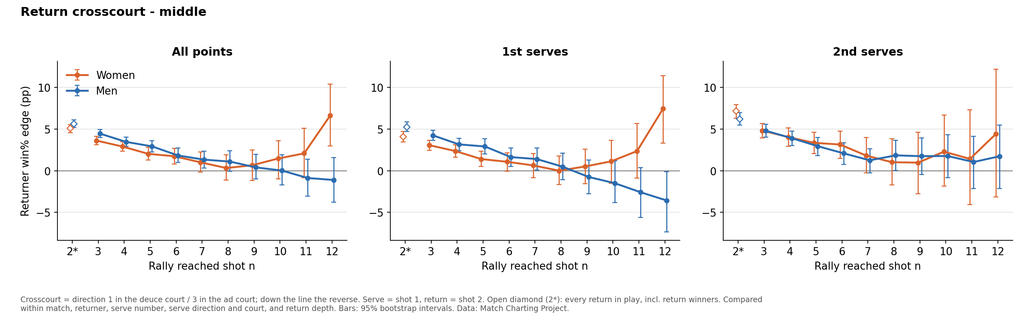
The next set of plots show the difference between down-the-middle returns and crosscourt returns. (That is, crosscourt to the ~third of the court closest to the opposite sideline.) For men, the difference between crosscourt and middle isn’t as great as the gap between back-half and front-half. For women, it’s about the same. The return still remains a factor until the sixth or seventh shot:
(Ignore the women’s trend lines that head back upward for long rallies. That might be a selection effect. Maybe returners who neutralize the server’s advantage are more likely to come out ahead in marathon points.)
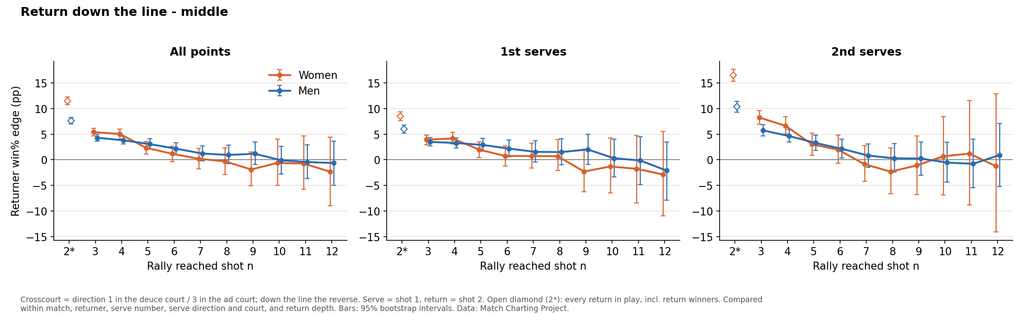
Down-the-line returns are a little different. The biggest effect of hitting in that direction is an increase in service winners: In the next set of plots, check out the diamonds in the 2* column for second serves. That column includes all non-ace points; the other data points on the graph depend on the server putting a second ball in play:
I expected that crosscourt returns would both be better than down-the-line returns and have a longer-lasting influence. I was wrong about the first. All else equal, down-the-line returns are a bit more effective, assuming they land in. Maybe servers expect a crosscourt return and lean that way. There’s a stronger case for the second. The advantage of a down-the-line return is gone for women by the sixth shot of the rally, the seventh shot for men.
Finding the backhand
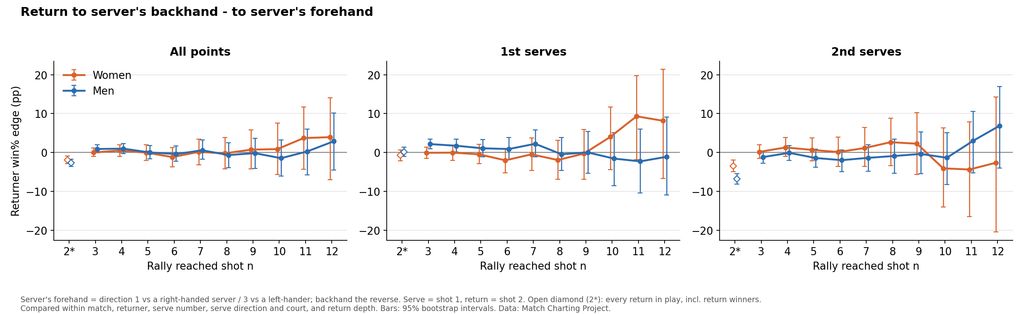
Often, the returner’s goal isn’t to hit a particular corner, it is to target the server’s weaker side. For men, especially, that side is usually the backhand. Maybe there’s a detectable advantage–and ensuing influence–in finding the server’s backhand?
The evidence says: Not really. On men’s first serves, a little bit, and it’s gone after another stroke or two. The plots tell the story:
Of course, tennis is complicated and these are descriptive statistics, not recommendations. Returners have to weigh several factors (assuming they have time to think at all), not just which wing to target. If men tried to hit more returns to the backhand side, they’d have to do so with opportunities that aren’t as well-suited to a return in that direction, and that next marginal percentage point of returns-to-the-backhand might not be as good. In that sense, seeing near-equal outcomes for returns to either wing suggests that returners have found a reasonable, if not quite optimal, balance.
What about the extremes?
So far, we’ve been looking at one variable at a time. What’s the difference between a really well-placed return and a poor one? To put it another way, how much does return location matter at the extremes, and how long does the difference persist?
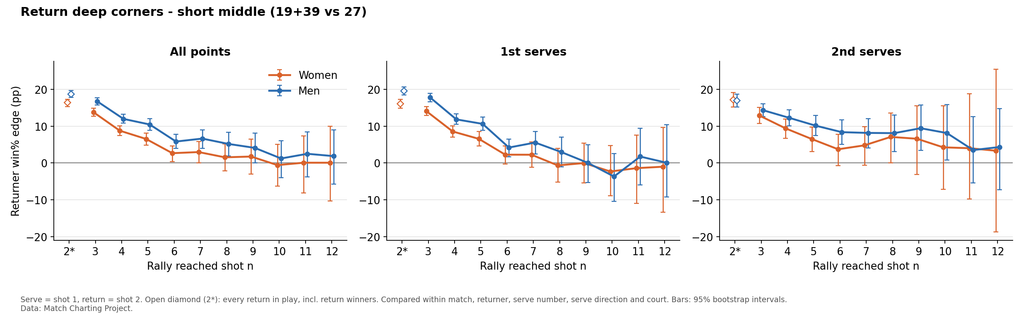
We can measure that by comparing “shallow-middle” (service box, middle third of the court) with “deep-corner” (back quarter of the court, outer thirds of the court) returns. The difference is substantial–nearly 20 points of win percentage for men on both first and second serves–but it doesn’t last much, if any, longer than the other effects we’ve seen:
For women, the advantage of a very well-placed return is almost entirely gone before the sixth shot of the rally. It lasts longer for men, with the confidence interval touching zero only on the ninth shot. Still, both server and returner have just a short window in which to capitalize on a weak or strong reply.
Putting it all together: A good or bad return affects the development of the rally even after more shots have been struck. But not forever: If somebody tells you that a return set up a winner on the 12th stroke of a rally, they’re overstating the case. A good service return can accomplish a lot, but its powers are not unlimited.
The human brain is a trend-spotting machine. A couple of groundstroke errors in a row, and fans and commentators conclude that a player’s stroke has gone off the rails, perhaps because her opponent has exerted just the right pressure. Shots, we say, can “break down,” and even that opponents can “break them down.”
Except… an awful lot of the trends we spot are mirages, misguided attempts to make sense of noisy data. Yesterday, we learned that first serves aren’t streaky. For pros, missing one doesn’t make it more likely that you’ll miss the next; women even tend to make slightly more first serves after misses. So, what about groundstrokes?
It’s a trickier phenomenon to pin down, because unlike first serves, forehands (or backhands) are not all created alike. After missing one forehand, you might not see one on the next point or two. Or if you do, it could be at a different angle, a different height, a different court position, and so on. Still–and long-time readers are going to struggle to believe me on this–there is a detectable effect! Really!
Based on women’s matches since 2020 logged by the Match Charting Project, if a player makes a forehand unforced error on one point, she is 0.45 percentage points more likely to make a forehand unforced error on her next point with a forehand in it. It’s a tiny shift, representing about a 2% tick upward from the typical error rate around 20%, but it is real. The results are about the same (slightly weaker, but in the same neighborhood) for backhands. Men are in the same neighborhood, as well.
But wait: If we control for set, establishing our expected error rates for a single set rather than the entire match, the effect shrinks, and for men, it vanishes almost entirely.
This is good news and bad news. There’s little or no short-term influence of one error on the next opportunity to hit that shot. But error rates do drift over the course of the match.
Drift away
Splitting matches into chunks of 20 forehand points, error rates move around quite a bit more than that sub-half-point shift. Without controlling for set, the typical WTAer sees her forehand UFE rate jump around 1.4 percentage points more than would be expected from chance alone. That’s still not detectable within a single match, but it is a meaningful difference in the long run. Over the last 52 weeks, the range in UFE rate between the most error-prone player (Anna Kalinskaya) and the least (Belinda Bencic) is only 9 percentage points. 1.4 points represents a jump of several places at most positions on the leaderboard.
A bunch of subsequent tests reveal some aspects of that drift. For one thing, it’s usually not a single stroke that ebbs and surges. When a player starts making more errors, both wings suffer. There’s a hint in the men’s data that forehand and backhand error rates don’t quite move in lockstep, but the data is inconclusive.
It’s also clear that players seize on their opponents’ sloppiness. You can probably imagine situations where gaffes seem contagious and no one can keep the ball in the court, but typically, one player tightens up his (or her) game while the other one struggles. I don’t know which direction the causation points: Does one player “break down” the other? Does she take advantage of her opponent’s errors and play more conservatively? Anything along those lines is just speculation at this point.
The strongest effects, though, were somewhere I didn’t intend to look. Error rates shift chronologically, both across sets and within them, in predictable ways.
Tightening up
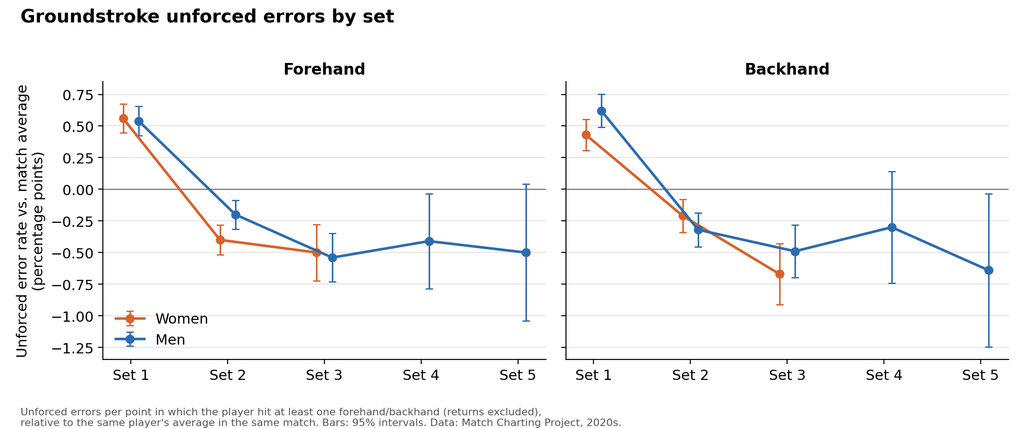
These graphs show the trend in relative unforced error rates by set, for both men and women:
On both wings, players make more errors in the first set. Women improve their forehand error rate by almost a full percentage point between the first and second sets. While there’s not much movement after the second set, the rates stay well below the first-set standard.
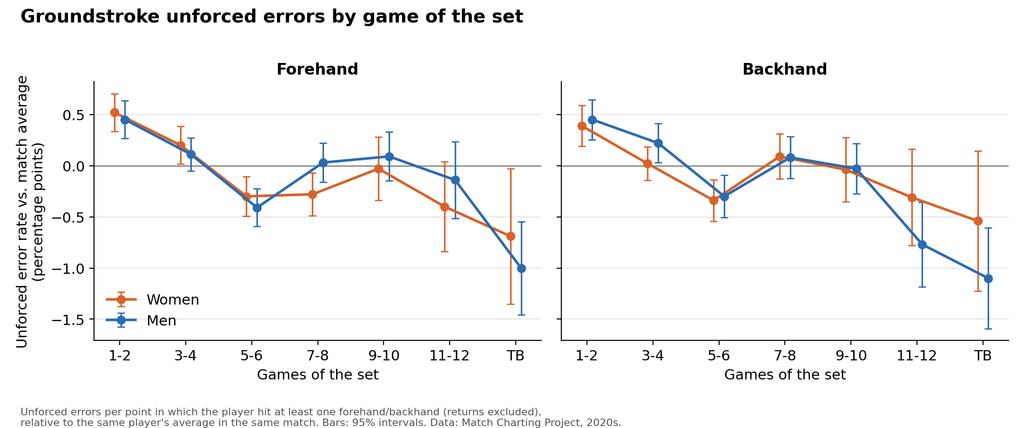
Before we speculate about the causes, let me show you another pair of plots, now comparing relative error rates within sets, by pairs of games:
Again, we start high then tack lower. Though it’s not an unequivocal downward trend, the first two games are consistently the most error-prone, and tiebreaks are the least. (Players become more conservative in tiebreaks by just about every possible metric, from serve speed to rally length to errors.)
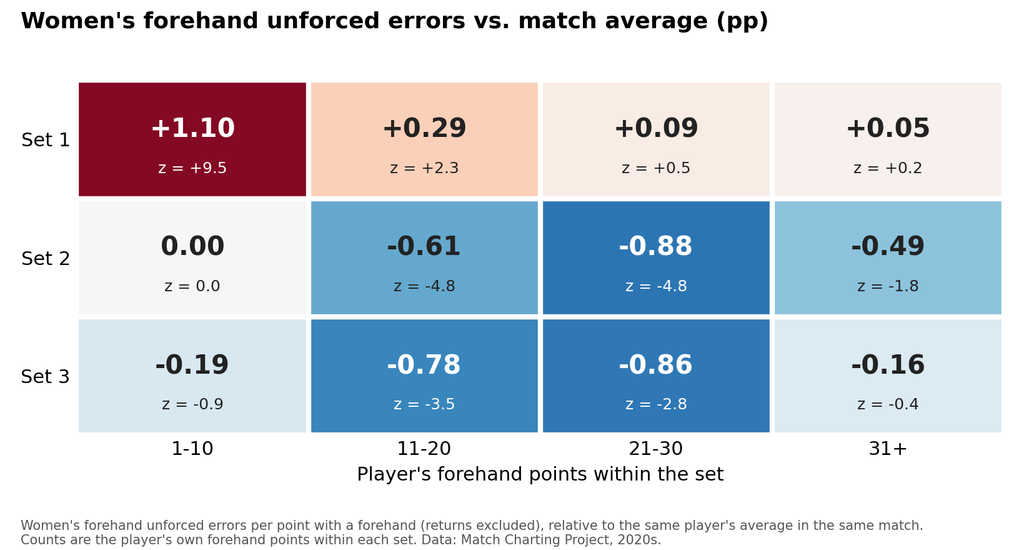
Combine those two effects, and you have some sloppy opening games. Here’s one more plot, using WTA data, showing each set broken into chunks of 10 forehand points. The top left corner is the beginning of the first set; the bottom right is the end of the third. Red means more errors than expected (the numbers are percentage points), blue means less:
Every set tightens up as it goes along, but my oh my are those first ten points brutal. These shifts account for much of the “drift” within matches. Error rates move for reasons other than chronology, but chronology is a single factor that seems to affect a large number of players.
Sloppy or aggressive?
High error rates are not inherently bad: Jelena Ostapenko has made a career out of winning matches when she loses one of three points with a (wild) miss. The trick is to pair errors with winners, to take the good aggression with the bad.
That’s not what’s happening here! For women, on both wings, winner rates are at their lowest in the first set. Within sets, winner rates are lower in the first two games than they are until 5-5, when tiebreak caution starts to take over.
These numbers strongly point toward a “warm-up” effect at the beginning of the match and a smaller “re-set” effect at the start of each subsequent set. Maybe that’s understandable: No amount of actual warming up can prepare you for the reality of a new opponent’s individual mix of speed, spin, and angles. And despite the dark red of that upper-left-hand heatmap cell, we’re still only talking about a shift of one percentage point: Enough to pick up across 4,000 charted matches, but far too small to notice even in a fortnight of attentive tennis-watching.
What about the players?
Up to this point, we’ve been talking about averages. We don’t have enough data to identify tendencies for most players, but we can find some.
One of the strongest individual-player findings for women is that Coco Gauff’s error rates drift quite a bit within a match: about three percentage points compared to less than two for the average player. Gauff is slightly more prone than average to a sloppy start, as well, but the full-match metric excludes the first 20 baseline points, so her variance goes far beyond that.
By contrast, Aryna Sabalenka and Iga Swiatek are remarkably steady, showing effectively no in-match variation in error rates beyond what would be expected from chance.
Sabalenka also stands out in that her aggression (winners plus errors) goes up under pressure, defined as the ninth game of a set or later, with the score within one game. The effect is small–a bit more than one percentage point–but it is striking because the average trend under pressure is negative. Gauff, Elena Rybakina, and Jessica Pegula all score about one percentage point in the opposite direction, more conservative under pressure than the average player. Iga is almost precisely average.
I haven’t said much in this post about men, because the trends are generally the same across both tours. Still, there are some interesting individual numbers for ATPers.
Both Stefanos Tsitsipas and Grigor Dimitrov see even more error-rate drift within a match than Gauff. Lorenzo Musetti is the slowest starter, committing the most errors (relative to match averages) in his first 20 chances per match of all men for whom I have a lot of data. It’s suggestive, though hardly conclusive, that those three outliers all have one-handed backhands. I can sympathize: If I play a match on Monday morning, my backhand starts rounding into form on Wednesday afternoon. (Tsitsipas and Dimitrov, for what it’s worth, aren’t slow starters; their error-rate drift comes later.)
A slow start isn’t necessarily bad. Second on that list behind Musetti is Carlos Alcaraz, even though Carlitos scores about average for general within-match drift.
Jannik Sinner’s career of bloodless executions turns up in the data as well. His within-match drift is the lowest (tied with Felix Auger-Aliassime, surprisingly enough) of all players with enough data. In the big moments, he grinds you down, committing fewer errors under pressure and improving his winner-errors ratio. He isn’t the most conservative in the big moments, though: That honor belongs to Novak Djokovic, with the perpetually cautious Alexander Zverev right behind him.
Circling back to where we started: Pro groundstrokes don’t really break down. They take a few games to reach optimal form, and on occasion, they rattle a bit. Most of the apparent trends we spot as fans are fake. But in this case, there are indeed a few drops of water in the desert of statistical noise.
Is Victoria Mboko a pusher? I was tagged in a Twitter exchange the other day debating that exact question. From watching her play, I would hardly compare her to Ostapenko, but the p-word wouldn’t have come to mind.
Rally Aggression Score puts her at +6, on a scale designed to run from -100 to +100. Based on 27 charted matches from the last 52 weeks, that makes her about neutral, tactically similar (at least along this dimension) to the likes of Belinda Bencic and Karolina Muchova. Counterpunchers, maybe, not pushers.
On the other hand, “neutral” overstates it. Lowell West devised the metric about a decade ago, and the game has changed since then. The way I initially scaled it, Petra Kvitova flirted with triple digits, and that was about it. Now, Dayana Yastremska gets close to 200. Elena Rybakina, at exactly 100 in the last year, ranks only fifth among players with at least five charted matches. There’s nothing so extreme at the other end: Emma Navarro has averaged -68, while the most passive top-tenners are Coco Gauff and Mirra Andreeva at -20 and -30, respectively.
Mboko’s +6, while hardly vintage Wilander, is indeed more passive than the average WTA player in 2026.
Aggressive growth
Will the Canadian change tactics with age? These days, it seems like nearly everyone at least tries to take more chances and hit more winners. (If you don’t, your opponent will!)
I can’t tell Mboko’s future, but I can load up a database and run queries on it.
So, different question: Do players in general change tactics with age? It’s easy to think of examples: Serena Williams got more aggressive over the years. Ostapenko (remarkably) has done the same. I’m not sure there are equally prominent players who have moved in the other direction, but it does seem like some teenagers show up bashing balls, then settle for a more measured game in their 20s.
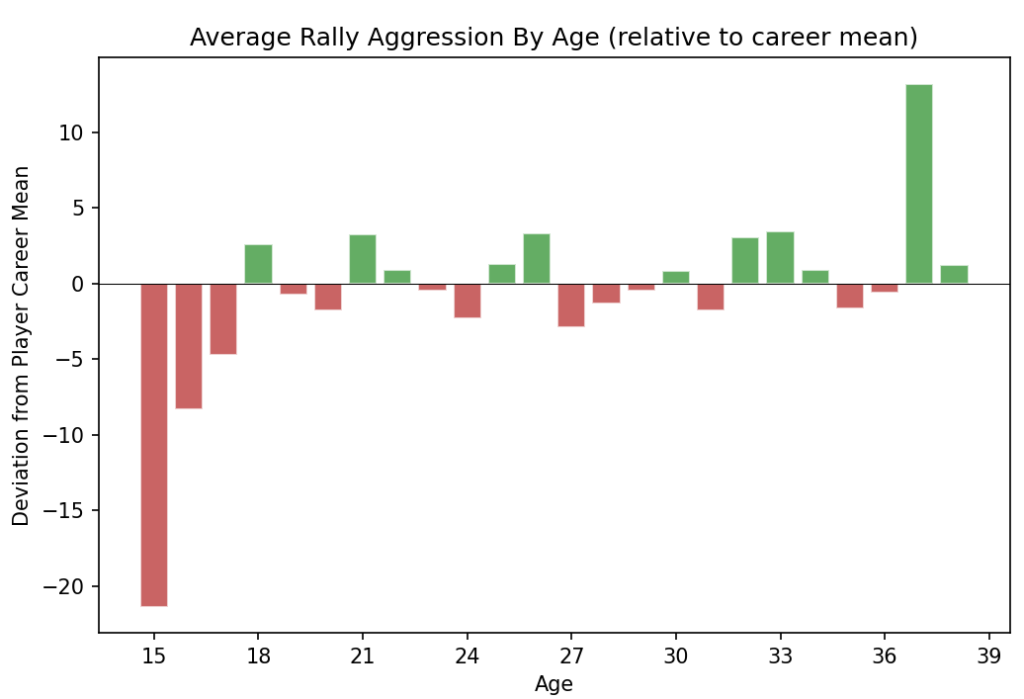
I took all women with at least 20 charted matches, grouped their rally scores by year, and figured out how much each year’s score differed from their career norms. Average those deviations across all players, and this is what you get:
From age 18 to 36–the entirety of most players’ careers–there’s nothing to see here. Plus or minus five points of rally aggression score is a rounding error, especially since these are non-random samples based on what Match Charting Project contributors wanted to chart and could find on video.
The spike at age 37 is also not very instructive: It’s basically Serena Williams, and we already knew that as she aged, she took increasingly few prisoners. From 2007 to 2009, her average aggression score was about +20. In 2019, when she was 37, it was +109.
Still, that climb at the left end of the graph is suggestive. It doesn’t literally apply to Mboko, who is already 19. But it supports a plausible narrative. When young women–especially the youngest prospects–arrive on tour, they aren’t as strong, or perhaps even as tall, as they will soon become. (Even Lilli Tagger recently gained a centimeter.) Their experience is disproportionately against juniors, who are even less physically imposing, relative to adult pros. The typical 16-year-old, no matter how talented, isn’t going to show up on tour and play like Sabalenka.
There are exceptions, of course. Maria Sharapova’s highest single-season aggression score was in 2004, when she was 17. Madison Keys arrived on the circuit playing essentially the same game she would play for the next decade. Iga Swiatek was more aggressive at age 18 than she has been since.
On average, though, the youngest players are more conservative–fewer winners, fewer errors–than they will become as they graduate from their teens. The mechanism could well apply to a 19-year-old, too.
The trend is null
We’re always talking about how players could develop and improve, or what their new coach brings to the table. Yet the undefeated champion of tennis forecasting is the null hypothesis. The null hypothesis, of course, means that you should’ve skipped this entire post and watched a Friends rerun instead.
It is boring, but the best way to predict how a player will look next year is to point at their current results and say, “yeah, just like that.” You can fiddle around the edges and maybe find players on the cusp of something or other, but … no, usually you can’t even do that.
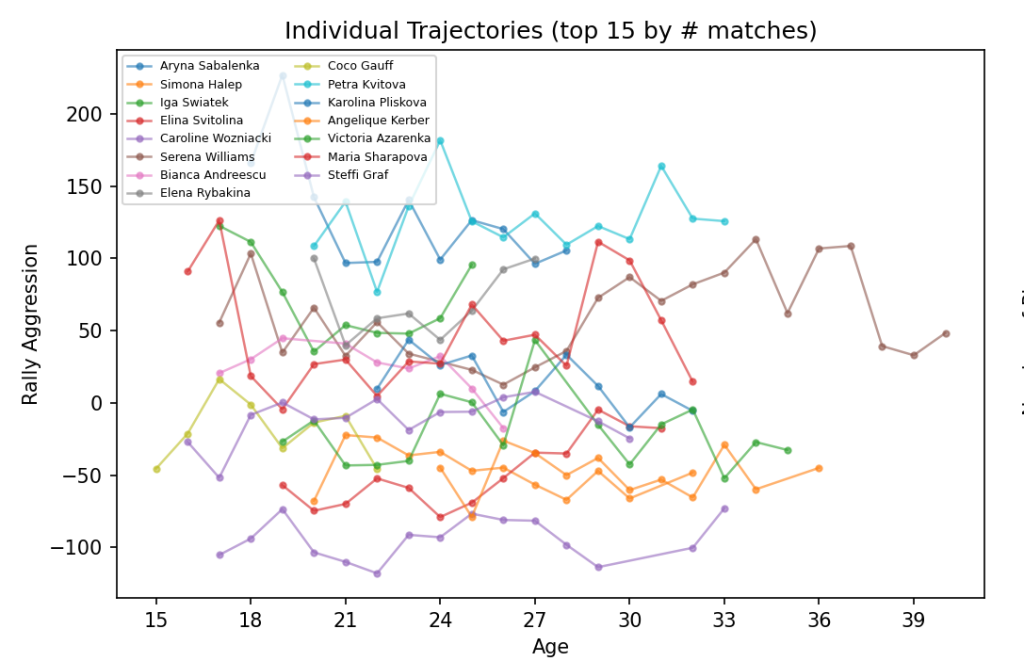
Here are the year-to-year aggression trends of the women with the most matches in the MCP database:
See that trendline that goes from the lower-left corner up to the upper-right? No, you don’t, because it’s not there. The closest is Serena, who dipped to +12 in her late 20s before getting hyper-aggressive in her 30s.
To answer the question posed by my headline, then: No, pushers don’t grow out of it. The style of play you see today is a good predictor of the style of play you’ll see a decade from now.
Lucky for Mboko, then, that she isn’t a pusher. Throughout her career, I’ll bet she tries a lot of new things and incorporates plenty of fresh ideas from a handful of high-profile coaches. The end result may well take her to the top of the rankings: A 19-year-old ranked 6th on the Elo table has a bright future ahead. If she finds a game that takes her all the way to the top, odds are it will look a lot like what we’ve seen so far.
Felix Auger-Aliassime has earned a reputation as a world-beater on indoor hard courts. He’s no Jannik Sinner–as Sinner reminded him all four times they met last year, twice indoors–but FAA is a fearsome customer against just about anybody else.
Last week the Canadian added to his indoor title haul with his second-straight championship in Montpellier. This time, he straight-setted Adrian Mannarino. While that win doesn’t particularly raise any eyebrows, the body of work keeps growing. It’s his eighth career title indoors, three of them at ATP 500s. Last fall in Paris, he also reached his second Masters final. (The first was in Madrid, the indoorsiest of the clay Masters.)
What’s the secret?
The conventional wisdom is that he has a big game, especially a deadly first serve. The controlled environment indoors, plus typically fast conditions, play to his strengths. The serves skid across the court even faster. His weaknesses are mitigated because the bounce is more predictable and because points are shorter.
All that sounds plausible. My only gripe is, couldn’t you say that about a lot of players? The whole paragraph applies, almost word for word, to Hubert Hurkacz, who has two Masters crowns on outdoor hard, plus a clay title, yet just a pair of indoor 250-level championships. What about Matteo Berrettini? The description might match him even better, yet the Italian has never won a title indoors. He has reached only one indoor 250-level final.
Before we go to the numbers, let me give you my seat-of-the-pants theory. FAA has huge weapons, but he doesn’t always play like it. He doesn’t consistently swat away easy plus-ones like Berrettini does. He gets sucked into long rallies, where he’s often at the disadvantage. Indoors, though, he knows what the tactics are, and he plays the way he should play. Indoor Felix, then, is the best Felix, both because his game is suited to the conditions and because he shows up with the right approach.
On the other hand, the last two points against Mannarino on Sunday were 8- and 18-shot rallies, respectively. So, you know, don’t trust my pants.
Numbers!
You can, however, trust the spreadsheets. The Match Charting Project has well over 100 Auger-Aliassime matches. Going back to 2020, the total includes 41 on indoor hard and 40 on outdoor hard, nicely suited for some comparisons. I was tempted to throw out the seven Tour Finals matches from the indoor tallies, because they skew the quality of the opponents, but the Canadian’s indoor averages are about the same with or without them.
Surface       Unret%  <=3 W%  RiP W%
Indoor Hard    35.7%   47.7%   55.5%
Outdoor Hard   32.8%   43.4%   49.7%
About three percentage points more serves don't come back, and there's an even wider gap in points polished off on the serve or plus-one (the "<=3 W%" stat). The biggest gap here is in points won when the return comes back. Sub-50% is below average, especially for hard courts. 55% or better is very good, even in fast conditions.
Almost all of the indoor/outdoor serve differences are thanks to the first serve. FAA's second-serve numbers are about the same regardless of roof status.
Of course, Felix isn't the only guy on tour who wins more easy serve points indoors. I don't have comprehensive stats on the indoor/outdoor split, so I can't tell you the exact tour average. But we can compare how much Auger-Aliassime gains on serve to how much he gives up on return:
Surface        RiP%  RiP W%
Indoor Hard   65.3%   48.8%
Outdoor Hard  67.5%   43.2%
He retrieves 2.2 percentage points fewer serves indoors--better than the 2.9-percentage-point difference he gains on serve. But when he gets the serve back, he's actually better indoors than outdoors! He gains five percentage points in that department on serve, and he gains the same margin on return.
This might dovetail with the conventional wisdom. His monster serve really pays off indoors. And predictable conditions give him a bit of cover on return.
Whatever the reason, Auger-Aliassime's groundstrokes are way more effective indoors. My Potency metrics, FHP and BHP, combine winners, unforced errors, and shots that set up winners and errors. They give you one-number estimates of how valuable each shot is, and... wow:
Surface       RallyLen  FHP/100  BHP/100
Indoor Hard        3.7     +8.5     +0.0
Outdoor Hard       3.9     +3.2     -5.8
His indoor points are a little shorter, but I assume that is typical. I would've guessed that the difference was greater.
The Potency numbers (expressed here as rates per 100 shots), tell a more emphatic story. A +3.2 FHP/100 is ok, not great. Tommy Paul and Ugo Humbert are in that zone. On the other hand, +8.5 is the 52-week average of Carlos Alcaraz. A -5.8 BHP/100 is near the bottom of the pack, below the likes of Ben Shelton and Grigor Dimitrov. By contrast, +0.0 is, as it sounds, a good solid average.
These numbers don't drill into the "why" questions that naturally follow. But they help us pick between theories. I suspect that much of the difference in groundstroke stats has to do with the shots he gets to hit. The winners are downstream of good serves. Auger-Aliassime picks up some aces, but he picks up more plus-one (or even plus-two) winners, and those make his forehand and backhand numbers look good.
The "indoor predictability" thesis also looks good here. Remember that everybody should benefit from that--and not everybody's numbers improve like Felix's do--but it may be that the Canadian is more-than-typically exposed by the vagaries of outdoor play.
All the angles
Quick thought experiment. Picture Roger Federer hitting an ace.
Now imagine Auger-Aliassime hitting an ace.
What specific serves came to mind? If you're like me, you pictured Federer shooting a bullet right down the tee. And then you visualized FAA hitting a flat bomb out wide.
Of course, both guys hit plenty of aces in every direction. The charting stats suggest that Felix has a slightly better chance of an ace when he goes up the middle. (Federer did too, by a bigger margin, as do most players.) Still, this indoor/outdoor split caught my eye:
Surface       Deuce Wide%  Ad Wide%  BP Wide%
Indoor Hard         50.5%     47.8%     33.7%
Outdoor Hard        46.9%     45.2%     41.0%
Each column shows how often Auger-Aliassime opted for a wide serve in various scenarios. The first-serve differences are probably more marked, because his second-serve tendencies are about the same.
Indoor, he goes wide more often--but less often under the pressure of break point. While the margins are rather slim, it seems like the wide serve becomes his bread-and-butter indoors, and he uses the tee serve to mix things up on break point--because he's hitting more wide serves the rest of the time.
Wide serves are more likely to come back, but they don't make the returner any more likely to win the point. Especially against Felix: His signature serve might not even be an ace, but a wide bomb that the returner just barely plops back over the net.
The fact that he hits more wide serves indoors explains a lot. He gets a few more unreturned serves (as everybody does, probably), but he gains more of an advantage on the serves that (weakly, oh so weakly) come back. His groundstroke stats sparkle, padded by those easy balls.
Here's one final comparison:
Surface       2ndAgg
Indoor Hard       +7
Outdoor Hard     +46
"2ndAgg" is the Aggression Score stat tailored specifically to second serves. A higher score means more double faults and more unreturned second serves. Lower means fewer risks on second balls. +7 is quite conservative: Only about a dozen players consistently score so low.
But--those careful second servers include Sinner, Hurkacz, and Berrettini. With a game like Auger-Aliassime's, the second serve isn't the time to take risks. And indeed, in all of his indoor finals, he has never topped a double-fault rate of 5%. In the Montpellier final, he missed his second serve just once, and he committed no double faults at all in the quarter- and semi-finals.
Here, finally, is some support of my seat-of-the-pants theory, that when Felix goes indoors, he plays the way he ought to be playing all the time. He stays within himself, which is still imposing enough to earn a lot of cheap points. It's not a particularly complicated story, and I'm still not convinced why it doesn't apply to a half-dozen other guys on tour. Maybe it is all about the wide serve, the signature shot that allows Auger-Aliassime to manage risk and put his opponents on the back foot, all at the same time.
On Saturday, 20-year Sara Bejlek won her biggest title–by far. She had just slipped out of the top 100, so after qualifying for the main draw in Abu Dhabi, she charged past the likes of Jelena Ostapenko and Clara Tauson, then secured the trophy with a 7-6, 6-1 win over almost-top-tenner Ekaterina Alexandrova.
It’s tough to overstate just how out of the blue this was for the Czech. By ranking, Ostapenko, Tauson, and Alexandrova represent three of her four highest-ranked victories. Her two other main-draw victims, Sonay Kartal and Ashlyn Krueger, also count among her top ten. And she beat Kartal 6-0, 6-2.
That’s a big-hitting set of opponents. Bejlek, by contrast, lacks the power weapons that are becoming standard on the WTA tour. As a left-hander, she practically begs us to call her “crafty.” One upset against that group is plausible enough: After all, Ostapenko’s low-percentage tennis invites chalk-defying outcomes. But so many?
The final
I don’t pretend to be an expert on the Czech’s game. She has only a couple dozen tour-level matches under her belt, so she’s a newcomer for most of us. That said, we now have a detailed match chart from Saturday’s final that offers some clues as to how Bejlek battled the barrage of ball-bashers in Bahrain Abu Dhabi.
The conditions helped. It was windy, and the conditions were slow. None of that favored Alexandrova, who likes predictable balls she can smack flat back across the net. The court speed not only made it difficult for Alexandrova to hit through the court, it gave her a little less pace to work with on Bejlek’s own balls. Surely the Russian must have wished she had played indoors in Ostrava(!!!) instead.
The lefty’s game plan seized on those advantages. She looped balls back down the middle. She sliced more than she had to, refusing to give her opponent a predictable bounce height. She mixed in some almost impossibly slow serves. She won the first point of the match with a dropshot-lob combo that, while she didn’t attempt many more, surely gave Alexandrova pause.
The central result was that the Russian just couldn’t hit winners. By my count, she ended with 13 winners against 37 unforced errors. Just as telling as the abysmal ratio was that the 13 winners represented less than 10% of total points. In her last 60 charted matches–going back to 2022–opponents have held her under 10% just six times. When they do, it’s usually because they take the racket out of her hands by playing hyper-aggressively themselves. Two of the opponents in question were Anisimova and Yastremska.
Bejlek, by contrast, gave Alexandrova ball after ball that looked like it should have been obliterated. In different conditions, or when the Russian was in better form, maybe the winner count would have been much higher. But from the first few games, it was clear that the Russian wasn’t confident in her ability to take control. Big, aggressive hitters usually have more influence on rally length than more passive opponents, but that wasn’t what happened on Saturday. The average point lasted 5.1 strokes, tied for third-longest among the nearly 100 charts we have from Alexandrova’s career.
Translated into tennis cliché: Bejlek let her opponent beat herself.
If we can extract one concrete skill from the Abu Dhabi final, it’s that Bejlek doesn’t let servers overpower her. 85% of Alexandrova’s serves came back, compared to a 52-week average of 75%. Again, we don’t have much data yet on Bejlek, but here’s another bit of evidence: In Madrid two years ago, she retrieved more than 80% of Rybakina’s serves. The Aussie Open champ is the toughest on tour to return, usually holding opponents to around 67%.
Despite all the frustrations and all the extra shots she had to hit, Alexandrova nearly pulled out the first-set tiebreak. She led 4-2 at the change of ends before getting dragged into a series of long rallies broken up only by a couple of well-executed short points from the Czech. Having dropped the 95-point slog that was the first frame, Alexandrova ran out of ideas. She simply watched the error count soar.
You don’t win slams by letting opponents beat themselves–marathon runners notwithstanding. But in the hands of someone persistent enough, it’s a game plan that can keep you in Bejlek’s new neighborhood of the top 40. With 500 points on the books from Abu Dhabi, the left-hander has the rest of the season to prove that she belongs.
It often feels fruitless to pick out the strongest aspects of the Carlos Alcaraz game. (Sinner’s, too, of course.) He is so good at everything that we tend to focus on the same few particularly attention-grabbing attributes. The knee-buckling dropshot, the outrageous will to win (and corresponding fifth-set record), the forehands at full stretch.
We don’t ask often enough why Alcaraz or Sinner won a match, because it seems obvious. They’re simply better than everybody else, except for maybe Novak Djokovic or Cameron Norrie on a good day.
And it’s true, there’s no single reason why. (There’s never a single reason for anybody, though most players make it easier to isolate a small number of effective shots or tactics.) All we can do is focus on one part of the Alcaraz game, then goggle at it.
Today, let’s goggle at the return of serve.
Here’s a fun place to start. Djokovic completed five matches at the Australian Open. Take a look at his first-serve win percentages from those five matches:
Opponent           1st W%
Martinez            93.2%
Maestrelli          86.0%
van de Zandschulp   77.0%
Sinner              71.4%
Alcaraz             65.9%
Djokovic, at any age, is an outstanding hard-court server. 71.4% is below average: Sinner did a nice job on return, even if he forgot on some break points. 65.9%, though, is unreal. Of the ATP top 50, how many players do you think win fewer than 66% of their first-serve points? One: Sebastian Baez. Alcaraz turned Djokovic into Sebastian Baez.
It wasn’t a fluke, either. Djokovic won 66.1% of first-serve points against Alcaraz in the US Open semi-final last year. Those two aren’t the absolute worst serving performances of Djokovic’s last twelve months–Vacherot held him to 60.5% in Shanghai, and Musetti kept him to 61% in their abbreviated match–but they are close.
Two separate skills
Charting data allows us to break down service returns into two components:
Getting serves back
Winning points after getting the serve back
Pretty straightforward stuff. You want to get as many serves back as possible, but you also want to set yourself up to win points after you do.
There’s something of a tradeoff here. Jaume Munar is a good example of somebody who retrieves a ton of serves but loses a lot of the points because he doesn’t do enough with the return. Andrey Rublev is the opposite, not getting many returns back, but winning a relatively high percentage when he does. Adjusting for surfaces and opponent quality, the end result for Munar and Rublev is about the same, even if they get there via such different routes.
The tradeoffs don’t apply to everyone. Take a look at the scatterplot, which shows percentage of returns in play, and in-play return-points won, for all ATPers with at least ten charted matches in the last 52 weeks. The higher you are above the green regression line, the better. You can mouse over each dot for player details, but I don’t need to tell you whose dots are red:
Both halves of Sincaraz get more returns back than average, and they win more of those in-play points than anybody else.
(How they win the in-play points is itself a multifaceted question. Both Sinner and Alcaraz rank in the top six by my forehand and backhand potency metrics, and Alcaraz’s backhand rating continues to creep upwards. I also dug into their shot tolerance last year and found new statistical categories for them to lead.)
Remember I started out by talking about first-serve returns. That’s where Alcaraz really shines, even above his brother in world domination. Same idea, first-serve returns only:
Alcaraz is the right-most red dot. There are 36 players on that plot, and Alcaraz gets more first serves back than all but four of them. (And he’s basically tied with Medvedev, the blue dot underneath his.) There’s no tradeoff for Carlitos: He gets more balls back than almost anybody, and he wins more of those points than anybody except for Arthur Fils (barely), Sinner (barely), and Rublev (whack!).
Both skills were on display in Sunday’s final. Alcaraz put an astonishing 76.5% of Djokovic’s first serves in play–almost off the right side of the scatterplot, against an elite opponent, on a hard court. I say “astonishing,” but was it even a surprise? At the US Open, Alcaraz got 75% of Novak’s first serves back.
When you can handle so many first serves, the win rate barely matters, but of course Carlitos did fine in that department as well, winning 44.6% of those in-play returns in Melbourne. Lower than his usual rate by a healthy margin, but hey, it was still Djokovic, and a massive number of in-play returns is always going to include a fair few weak ones.
When I started looking at returns in play about a decade ago, the tradeoff was clearer. More players fit the Munar or Rublev molds, getting a lot of serves back, or winning a high percentage of points when they did–but not both. Now, the relationship between the two stats is positive, but only slightly. They’re best understood as unrelated.
But for Alcaraz, tennis is built out of a dozen or so unrelated skills–all of which allow him to tower over the field. Sinner is close enough, and his serve might tilt the scale slightly in the other direction. Everybody else, though, is left scratching their collective head. Djokovic became the greatest of his generation by taking away opponents’ second serves. When Alcaraz neutralizes your first, what’s left?
Here are just a few milestones we’ve hit recently:
17,000 charted matches
10,000,000 (yes, ten million) charted shots
1,000 different women with at least one charted match (we reached the same number of men last year)
2025 was the most productive year yet for the project. For the second year running, we added more than 2,000 matches. More than 1,400 of them were from the 2025 season itself, meaning that we kept the database up-to-date in close to real time.
Do the math, and you’ll see that we boosted the historical data, as well. 2025 brought in nearly 800 matches from previous seasons. While we long ago finished up the biggest matches of the past (slam finals and semi-finals, masters finals, big-four meetings, etc.), we’re continuing to flesh out the 30-plus years before the start of the project. Contributors dug into the archives and charted dozens of tour-level finals, second-week slam matches, and consequential Davis Cup rubbers.
Of all the stats I could cite to illustrate the MCP’s progress, my favorite is that 2025 saw more contributors than any previous year. 32 different people charted matches. Three contributors (plus yours truly) have crossed the 1,000-match mark, with one more likely to do so in the next few weeks. Another dedicated contributor has already submitted 300 matches despite getting started barely one year ago.
You can help, too. 1,400 current-year matches sounds like a lot–it is a lot!–but it is only represents about one-quarter of tour-level contests. (Plus, we do ITFs and Challengers!) We have Sabalenka, Swiatek, Alcaraz, Sinner and a few other personal favorites pretty well covered, but there’s always a need to deepen our coverage of the rest of the tour.
Here’s the Quick Start Guide. Charting isn’t for everybody, and it takes a little time and effort to learn. Still, you might be one of the select few to discover that you love it.
The benefits accrue to the entire tennis community. In addition to the detailed match reports (like this one for the Sincaraz US Open final), the Tennis Abstract site has detailed charting data on every player page (here’s Mirra) and leaderboards full of stats you won’t find anywhere else.
Much of the raw data is available, as well. The MCP is one of the most underrated, underused tennis datasets. Like charting itself, it’s complicated: Making sense of shot-by-shot data is tricky business, even before you write your first line of code. But if you want to go beyond aces, break points, and Elo ratings, this is where you’ll end up. A ton of the research on this blog is powered by MCP data, and I always feel like I ought to do more.
Here’s to an even better 2026 full of charts both epic and obscure. I hope you’ll join us.
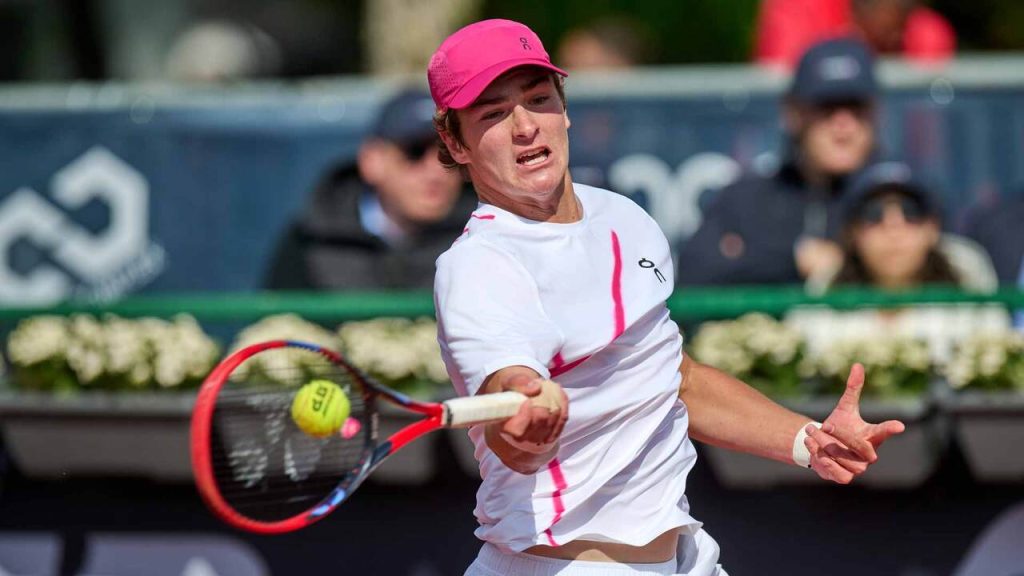
Joao Fonseca made easy work of last week’s Next Gen Finals. He went undefeated against the world’s best under-21s, dropping just one set in best-of-five semi-finals and finals. The youngest player in the field, he joins Jannik Sinner and Carlos Alcaraz as 18-year-old champions in the seven-year history of the event.
There’s no secret to Fonseca’s success. He already possesses a devastating forehand, a shot with power that invites comparisons to fellow South Americans Juan Martin del Potro and Fernando Gonzalez. Outrageous as it sounds, Fonseca’s might turn out to be even better. The Brazilian has a more compact stroke, making his forehand more flexible–and perhaps ultimately more reliable–than the long-levered Delpo motion.
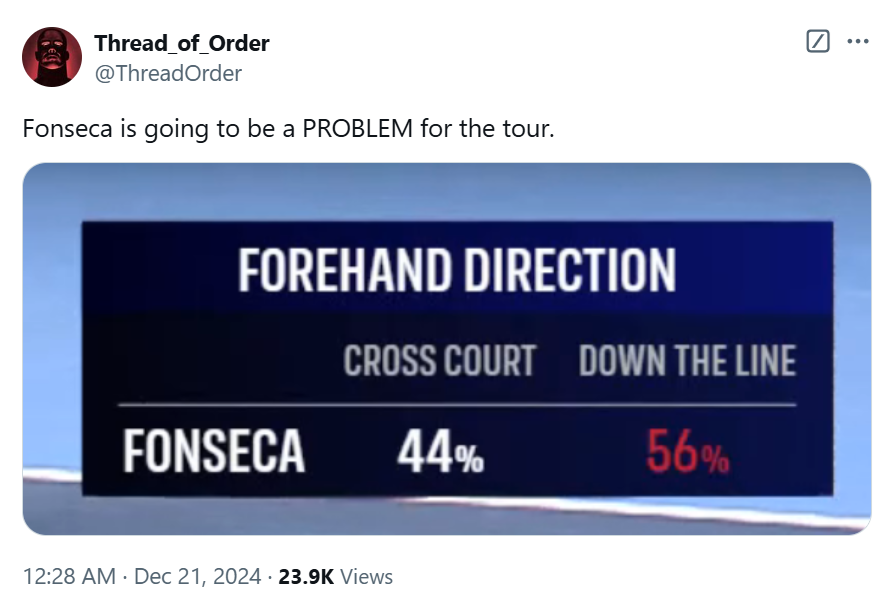
In his round-robin match against Jakub Mensik, the TennisTV broadcast flashed a stat meant to indicate one way Fonseca excels:
The TennisTV commentators were flabbergasted by these numbers: They’d never seen anything like it. Hugh, responsible for the screenshot here, got straight to the point. If a player with a forehand like Fonseca’s can consistently send the ball to his opponent’s weaker side, it’s game over.
The easiest direction to hit a groundstroke is back the way it came. That’s how we end up with protracted cross-court rallies. It takes impeccable timing to react to a elite-level cross-court forehand and change direction. (Pros drill that specific sequence, but no amount of practice makes it easy.) Down-the-line shots are doubly difficult because the net is higher as it nears the posts. The timing needs to be near-perfect, and there’s a smaller margin for error.
Here’s another way to get a sense of the dangerous risk level of down-the-line groundstrokes. Novak Djokovic, king of the down-the-line backhand, doesn’t hit that many of them. The inherent limitations of tennis rackets and the dimensions of the court are unforgiving. Fonseca, if he can really hit more than half of his forehands down the line, could defy those limitations.
Fact-check
Normally, I’d give you all sorts of numbers to help anchor Fonseca’s stats. How much does his 56% clip exceed tour average, or compare to someone like Sinner? That’s my goal, but first, we need to get into the weeds a bit.
The Match Charting Project has 14 Fonseca matches in the database, including all five of his NextGen Finals contests. Here’s the breakdown of groundstroke direction for the Mensik match:
This is… not the same as the broadcast graphic. We should expect minor differences, both because the 44/56 stat was shown midway through the match, and because reasonable people can disagree about how to classify shots that don’t obviously belong to a specific category. But that’s not what’s going on here. There’s virtually no way to take these numbers and conclude that Fonseca hit more than half of his forehands down the line.
What’s more, Fonseca’s forehand-direction profile is rather pedestrian. That’s not to say that his forehand is ordinary, just that he aims in the same directions as his peers. Here is Joao’s forehand-direction distribution, based on those 14 charted matches, compared with tour average:
DIRECTION      Fonseca  Average
Cross-court        40%      39%
Middle             20%      22%
Down the line      10%      11%
Inside-out         26%      24%
Inside-in           4%       4%
Ho-hum, right? Maybe he hits a few more inside-out forehands instead of going back up the middle. Even there, the two-percentage-point gaps between Fonseca and tour average could be an artifact of the matches we’ve charted. The Brazilian’s forehand does plenty of damage, but as a function of how he hits it, not where.
More weeds, sorry
I should probably let the discrepancy go, but let’s give it another minute. I don’t think the broadcast graphic was wrong, but it’s clearly measuring something different than what I count for the Match Charting Project stats. Maybe there’s some important subset of forehands that Fonseca is unusually likely to hit down the line?
One of the more difficult–and damaging–specific shots is the forehand down the line from the forehand corner. The MCP divides the court into three sectors by width: to the (right-hander’s) forehand corner, down the middle, and to the backhand. Maybe Fonseca particularly likes to change direction when he sees a ball in his own forehand corner?
A bit, but not by much. Here are the direction frequencies for Fonseca’s forehands from his forehand corner, for both the Mensik match and the average of his charted matches, along with the frequencies for his opponents:
             To FH  Middle    DTL
vs Mensik    58.1%   22.6%  19.4%
Fonseca Avg  49.0%   23.6%  27.5%
Opp Avg      45.7%   30.9%  23.4%
Nothing really dramatic here, and he went down the line less often in the Mensik match than his typical opponent does.
What about when Fonseca gets a ball down the middle? We saw in the MCP stats above that he hits a lot of inside-out forehands. That includes shots from the middle to the backhand side of a right-handed opponent. Here is the same group of frequencies for the same sets of matches, this time excluding left-handed opponents because they will naturally make different choices from the middle of the court:
              To FH  Middle    DTL
vs Mensik     29.7%   25.7%  44.6%
Fonseca Avg   39.7%   20.0%  40.3%
(RH) Opp Avg  34.2%   25.4%  40.4%
There’s a few more down-the-line shots in the Mensik match. But over 14 matches, Fonseca differs from his opponents only in hitting fewer balls back up the middle.
Maybe you’ve already worked out the underlying discrepancy. Since the 44/56 split adds up to 100%, there’s no “down the middle” category in the broadcast stats. The graphic splits forehands into two buckets, not three. That’s not how I think about tennis, and I suspect it’s not how you do, either. They would have done better to label the columns “to the forehand” and “to the backhand,” or something along those lines. It’s not unusual at all to hit 56% of one’s forehands to the opponent’s backhand side. But a lot of those “to the backhand” shots are not what anybody would normally call “down the line.”
The Fonseca difference
It’s not about tactics, it’s good old-fashioned power and precision. Fonseca’s forehand isn’t innovative, and it doesn’t need to be. If he hits his shots in more or less the same directions that his peers do, he’s probably doing something right. It means that at age 18, he has already internalized pro tactics. The difference is that he’s hitting those forehands harder, and he’s often landing them closer to the lines, something hinted at by his low rate of down-the-middle forehands.
He already shows up near the top of my Forehand Potency (FHP) leaderboard–though I’ll give you some caveats in a minute:
FHP combines forehand winners and errors, along with shots that lead to both opponent errors and winners on the player’s next shot. Given the vagaries of estimating the effect of one shot on others, Fonseca effectively sits in a tie for second place, as good or better than everyone except for Andrey Rublev. Which, I’d say, checks out.
The caveats lie in the dataset. The Brazilian has faced only one top-20 opponent, and that was a possibly-unmotivated #20 Arthur Fils last week. The charting data on which FHP numbers are based includes all the NextGen Finals matches, along with some Challenger-level matches and some early rounds at ATPs. After all, he’s 18 and that’s all he’s played. Point being, an 11.3 FHP/100 (per 100 forehands) against that level of competition probably isn’t is good as Alcaraz’s 10.8 or Sinner’s 9.4, amassed against foes like each other.
But don’t take that adjustment too far. Fonseca scored a 11.0 against Fils in Rio, when he was barely 17 and a half. Facing Botic van de Zandschulp in a Davis Cup tilt, he registered a whopping 16.7 FHP/100. The Dutchman is hardly easy pickings: When Sinner played van de Zandschulp twice early in the season, he managed just 1.2 and 7.1 on the same metric.
Damage (not just) down the line
Fonseca doesn’t hit an unusual number of forehands down the line, but when he does, opponents barely stand a chance. Among the 200-plus players with as many down-the-line forehands in the MCP database as Fonseca has, he ranks sixth in points won when he hits the shot. Admittedly, it’s an odd list:
The 2024 Next Gen field is bizarrely well-represented, with Shang, Basavareddy, and Van Assche leading the way. Is this the age of the deadly down-the-line forehand? Some of the same caveats apply here as with the FHP list: The youngsters have played a different sort of opponent than Nadal, Alcaraz, or (!) Borg. The clay-courters on the list also make for awkward comaprisons. For dirtballers, the down-the-line forehand is a way to build points, not end them.
It’s clear that Fonseca loves this play. He ends points in his favor (with a winner or forced error) more than anyone on this list except for Shang.
Here’s the scary thing: A few clay-court matches are severely dragging down the Brazilian’s numbers. On hard courts, he moves up to second on the list, winning 68% of points in which he hits a down-the-line forehand. The shot ends points outright an incredible 48% of the time. Delpo’s numbers, though of course against stronger competition, pale in comparison, at 60% and 39%, respectively.
Some of the difference between Fonseca and the field is that his forehand is great, period. If you’ve got an extra ten miles per hour that the average player doesn’t, that’s going to show up in every direction, not just one. And for the most part, that’s what we see in Joao’s points won when hitting each category of forehand:
FH Pts Won     Fonseca  Tour
Cross-court        58%   54%
Middle             52%   46%
Down the line      59%   53%
Inside-out         57%   57%
Inside-in          54%   59%
He’s better than average in all but the rarest of the five forehand directions. Even that isn’t really a negative: On hard courts he does better than tour average with the inside-in forehand.
The eye-catcher on that chart is 52% of points won when hitting a down-the-middle forehand. The typical player is likely to lose a point when hitting that shot. That’s not necessarily because down-the-middle forehands are bad, but because if you need to hit one, the point probably isn’t going your way. Unlike the other categories of forehands, it’s usually a defensive shot.
Of the 220-plus players with as many down-the-middle forehands as Fonseca in the MCP database, only 23 win more than half of those points. The Brazilian ranks fourth by points won when hitting down-the-middle forehands. It’s another oddball list, with Pablo Andujar, Tim Smyczek, Gilles Simon, and Carlos Berlocq rounding out the top five. (Yes, really.) To the extent we can group them together, those four men played a different brand of tennis, winning points with conservative shots as they wore down their opponents.
The more telling stat is that Fonseca actually ends points by clubbing forehands down the middle. The average player hits a winner or induces a forced error with less than 2% of these strokes. Joao comes in at 6.4%, better than anyone else in the dataset:
Rank  Player               W/FE%  inPtsWon%
1     Joao Fonseca          6.4%      52.8%
2     Fernando Gonzalez     6.0%      43.2%
3     Christopher Eubanks   5.7%      38.8%
4     Thanasi Kokkinakis    5.0%      46.1%
5     Tomas Machac          4.9%      43.8%
6     Nicolas Jarry         4.7%      41.7%
7     Alexei Popyrin        4.4%      41.8%
8     Sam Querrey           4.3%      41.8%
9     Max Purcell           4.0%      38.5%
10    Lorenzo Sonego        3.9%      46.0%
11    Matteo Arnaldi        3.8%      49.5%
12    Lucas Pouille         3.4%      42.9%
13    Jan-Lennard Struff    3.3%      45.6%
14    Matteo Berrettini     3.3%      42.1%
15    John McEnroe          3.3%      44.0%
16    Otto Virtanen         3.2%      35.8%
17    Boris Becker          3.2%      44.1%
18    Nick Kyrgios          3.2%      43.2%
19    Roger Federer         3.2%      47.6%
20    Carlos Alcaraz        3.2%      50.2%
When you can end points with your forehand twice as often as Federer did, you’re doing something right. The only players even close to the Brazilian’s winner rate end up losing far more points, probably because they need to take many more risks to get that small sliver of positive outcomes.
One more time for the road: Fonseca’s numbers are probably inflated due to his level of competition. In 2025, we’ll see how his forehand holds up against the elites. If we revisit these numbers twelve months from now, he’ll probably come down a notch. But raw power plays at every level. No matter who stands across the net, Fonseca’s forehand is fearsome–in all directions.
* **
Subscribe to the blog to receive each new post by email:
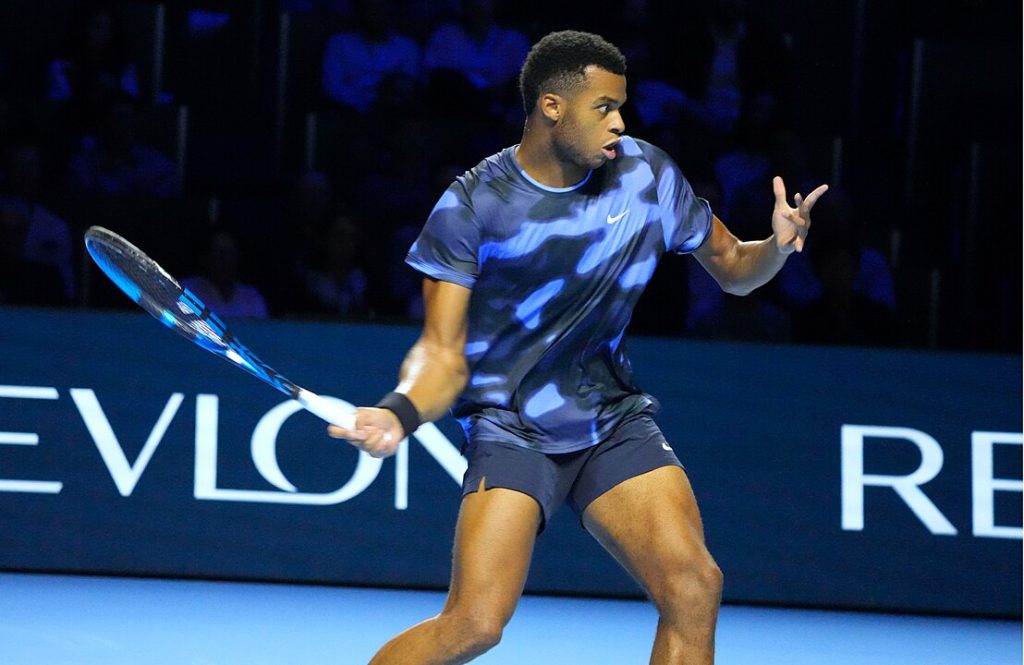
Giovanni Mpetshi Perricard in Basel, playing a longer rally than usual. Credit: Skyscraper2010
The story of last week’s tournament in Basel was the blistering service performance of Giovanni Mpetshi Perricard. The six-foot, eight-inch Frenchman racked up 109 aces in five matches, including more than one-third of his service points in Sunday’s final against Ben Shelton.
Mpetshi Perricard is a big server straight out of central casting. He can nail the corners at 150 miles per hour; on Sunday he hit one second serve at 146. He puts plenty of mustard on his groundstrokes as well. He often plays a high-risk brand of baseline tennis, recognizing that with a serve like his, he only needs to break once or twice–or just pick off a couple of return points in the tiebreak.
The Frenchman’s rapid rise through the ranks also fits his style. For a big server, wins can come in batches, when conditions–or, simply, tiebreak luck–are on his side. After an unexpected breakthrough on clay in Lyon, Mpetshi Perricard upset Sebastian Korda (in four tiebreaks!) and reached the second week at Wimbledon. Basel played faster than any tour event this year, and he took advantage. In between, he suffered through a 1-7 stretch in which he lost five straight tiebreaks and saw his double-fault rate balloon into double digits.
Much of Mpetshi Perricard’s future success will depend on his ability to handle these ups and downs. So far, he has struggled a bit to avoid the bad patches that spell doom for one-dimensional players. In his limited tour-level action, he has won more service points (70.2%) than anyone except Jannik Sinner. Yet five men hold more reliably than the Frenchman does, even after an unbroken week in Basel. The successes of Milos Raonic and John Isner–and even Shelton last year–come from playing better than usual under pressure, something Mpetshi Perricard has yet to consistently demonstrate.
I do love talking about servebots serving service aces. But while everybody raves about the GMP serve, I keep thinking about the backhand.
On the one hand
Mpetshi Perricard is now the fourth-highest ranked man with a one-handed backhand. His shot is nothing like the graceful, big-backswing, Federer- and Gasquet-inspired strokes of Grigor Dimitrov and Lorenzo Musetti. He often does little more than set up the racket to block the ball back. Strong as he is, the resulting flat shot can be much more than a mere defensive maneuver.
A few generations ago, it was standard to see big servers with one-handers. Think Richard Krajicek or Greg Rusedski; you might even put Pete Sampras in that category. More recently, Ivo Karlovic sported a one-handed backhand, though he mostly hit slices. Christopher Eubanks fits a broadly similar mold. Now, though, one-handers are dying breed, with just nine representatives in the top 100 of the ATP rankings.
Unlike Musetti or Stefanos Tsitsipas, Mpetshi Perricard isn’t likely to inspire the next generation of one-handed stars. No one is going to call this guy a throwback. On a good serving day, the Frenchman’s highlight reel features barely any groundstrokes at all.
What, then, do the numbers say? Is the Mpetshi Perricard backhand any good? Would he be better off with a two-hander like Raonic’s, Isner’s, or Reilly Opelka’s? Or, to return to the question I started with: For someone who specializes in ending rallies before they begin, does his backhand even matter?
Safely hidden
When the Frenchman’s game plan is working, his backhand is tucked away, out of sight. No backhands are necessary when the serve doesn’t come back, and when he controls the point, he prefers the forehand. Setting aside service returns, few players avoid their backhands as scrupulously as Mpetshi Perricard does.
The average ATPer hits 44% of their groundstrokes from the backhand side. Here are the most backhand-shy men with at least 15 matches in the Match Charting Project database, along with some other big servers of note:
Player                      BH/GS
Ivo Karlovic                30.1%
Jack Draper                 32.5%
Ryan Harrison               35.2%
Thiago Monteiro             35.5%
Giovanni Mpetshi Perricard  35.5%
Jaume Munar                 36.1%
Vasek Pospisil              36.4%
Alejandro Tabilo            37.1%
Alexei Popyrin              37.3%
Guido Pella                 37.4%
Ben Shelton                 37.6%
Maxime Cressy               37.9%
…
Christopher Eubanks         38.9%
Matteo Berrettini           41.1%
Milos Raonic                42.9%
-- Average                  44.0%
John Isner                  44.3%
Reilly Opelka               45.6%
Greg Rusedski               46.2%
Nick Kyrgios                46.8%
Pete Sampras                47.7%
Richard Krajicek            48.3%
Goran Ivanisevic            51.1%
Mark Philippoussis          52.1%
Backhands per groundstroke is not the easiest stat to parse, because it is the product of so many different factors. Nearly everyone would like to keep their number low, so it’s partly a function of footwork and anticipation. (And sheer willingness to hit forehands from outlandish positions.) But it is also influenced by opponents, who will work more or less hard to find the backhand. Mpetshi Perricard’s place on this list, then, could be telling us various things. He hits his forehand when he can, and his movement is good enough to make it happen. Opponents might not be trying as hard as they could to force a backhand.
Yet another factor is how comfortable the player is with their slice. GMP hits his quite a bit, meaning that he unleashes the flat one-hander that much more rarely. The typical tour player hits their flat or top-spin backhand on 35% of groundstrokes. The Frenchman comes in at 25%, not as often as his most extreme peers, but in line with other big servers:
Player                      not-slice-BH/GS
Ivo Karlovic                           6.1%
Daniel Evans                          11.6%
Milos Raonic                          20.2%
Maxime Cressy                         20.4%
Matteo Berrettini                     21.3%
Grigor Dimitrov                       22.7%
Corentin Moutet                       23.3%
Christopher Eubanks                   23.6%
Giovanni Mpetshi Perricard            25.2%
Alexei Popyrin                        26.3%
...
Bernard Tomic                         27.9%
John Isner                            28.0%
Ben Shelton                           28.5%
Reilly Opelka                         31.5%
-- Average                            34.7%
All of this is to say: Mpetshi Perricard hardly leans on the flat backhand. His serve keeps point short, and his preferences are for other shots. In the 138 points of the Basel final, he hit only 28 flat backhands, six of them on service returns.
Backhand impact
When the Frenchman is forced to hit a backhand (or chooses to–anything’s possible, I guess), the results aren’t great. When he goes for the flat backhand, he wins 43% of points, compared to a tour average of 49%. He takes more risks than his peers, but not overwhelmingly so: 9% of his one-handers end in a winner or forced error, while 12% are unforced errors. (Tour norms are 8% and 9%, respectively.)
These outcomes aren’t as extreme as his preferences. Of about 200 players with as many non-slice backhands in the MCP database, Mpetshi Perricard’s 43% comes in 21st from the bottom. Compared to other big servers, that win rate is positively respectable:
Player                      W/FE%   UFE%  inPointsWon%
John Isner                   6.9%  12.8%         35.8%
Milos Raonic                 7.3%  12.5%         40.4%
Matteo Berrettini            4.8%  10.4%         42.5%
Andy Roddick                 5.5%   7.8%         42.6%
Felix Auger-Aliassime        6.0%   9.9%         43.4%
Giovanni Mpetshi Perricard   8.9%  12.6%         43.5%
Ben Shelton                  6.2%  11.1%         43.8%
Nick Kyrgios                 7.9%  10.7%         43.9%
Kevin Anderson               7.6%  11.0%         44.1%
Hubert Hurkacz               6.2%  10.0%         45.6%
-- Average                   7.3%   9.0%         48.6%
Jack Draper                  6.5%   5.7%         49.1%
Against this group, the Frenchman’s winner (and forced error) rate really stands out. Given the outcomes when he doesn’t go for it, it’s possible he should be even more aggressive than he already is. Master tactician Milos Raonic took a similar tack, piling up as many unforced errors as GMP does, but without quite as many winners.
The picture is less rosy when we look at slice backhands. As noted, Mpetshi Perricard hits a lot of them–close to one-third of his groundstrokes from that wing. When he does, he wins 33% of points, compared to 42% for his peers. Only a handful of players have posted such low slice-backhand win rates, and they are mostly the names you would expect:
Player                      W/FE%   UFE%  inPointsWon%
John Isner                   1.5%  11.1%         27.3%
Christopher Eubanks          1.6%  10.7%         30.2%
Kevin Anderson               3.2%   6.5%         31.4%
Nicolas Jarry                4.0%  13.2%         32.7%
Ivo Karlovic                 3.5%  12.0%         32.8%
Giovanni Mpetshi Perricard   3.1%   3.9%         33.1%
Ben Shelton                  2.0%   7.1%         33.3%
...
Nick Kyrgios                 4.2%   6.1%         35.6%
Felix Auger-Aliassime        3.6%   8.2%         38.1%
Hubert Hurkacz               2.7%   3.9%         38.1%
Milos Raonic                 4.7%   9.4%         40.3%
Matteo Berrettini            2.8%   9.0%         41.5%
-- Average                   3.3%   5.4%         41.6%
The Frenchman doesn’t miss much. Why just keep the ball in play, though, if you’re likely to lose the point anyway? By hitting so many slices, Mpetshi Perricard makes his flat-backhand numbers look better, but he probably doesn’t pick up any points by making the trade. Prolonging the point is a good strategy if you’re Casper Ruud–or, really, about 80% of the guys on tour. But if you play like GMP, it’s better to go big.
This is one way in which the one-hander may cost him. The two-handed backhand is particularly valuable in its ability to block overpowering shots without retreating to a fully defensive mode. While players with one-handers try to achieve the same thing with a slice, the stats tell us that it’s a poor imitation. The Frenchman’s in particular isn’t doing him any favors.
So, does it even matter?
Mpetshi Perricard doesn’t hit that many backhands, and he isn’t that much worse than average when he does. But, the margins in tennis are small, and the margins for big servers are smaller still. In 26 tour-level matches this year through the Basel final, GMP won exactly 50% of his points. (Not 50.1%, not 49.9%–50% on the dot.) Five players in the top 20 win 50.8% or less. That’s how close the Frenchman is to an even bigger breakthrough.
My backhand potency (BHP) stat quantifies the impact that each player’s (non-slice) backhands have on their broader results. The stat measures how often a shot ends the point in either direction, as well as what happens on the shot after that. Based on the matches we’ve charted this year, GMP’s BHP per 100 backhands stands at -4.3, one of the lower numbers on tour for players with at least 10 charted matches from the last 52 weeks:
Player                      BHP/100
Nicolas Jarry                  -6.9
Felix Auger Aliassime          -4.6
Tallon Griekspoor              -4.6
Flavio Cobolli                 -4.3
Giovanni Mpetshi Perricard     -4.3
Alexei Popyrin                 -4.2
Dominic Thiem                  -4.1
Botic Van De Zandschulp        -3.5
Matteo Berrettini              -3.1
Ben Shelton                    -2.4
Stefanos Tsitsipas             -2.4
What does this mean for the bottom line? -4.3 BHP is equivalent to about -3 points per 100 backhands. Since he doesn’t hit many backhands, that’s about -1.1 per 100 points.
My best estimate, then, is that if we magically replaced the Frenchman’s backhand with a neutral one–say, that of Arthur Fils–he’d pick up 1.1 more points per 100. Instead of winning 50% of points at tour level, he’d win 51.1%. That isn’t good enough to crack the top 10, but it would probably get him into the top 20.
Quantifying the impact of slices is tougher, because the more conservative shot is less likely to end the point immediately, or even on the next shot. If we figure that Mpetshi Perricard’s slice is roughly the same distance below average as his flat backhand, that’s another 0.5 or 0.6 points per 100 he could gain by acquiring a tour-average shot. Daniil Medvedev has hung in the top five in the ATP rankings while winning 51.9% of points. Stringing all of these assumptions together, we can start to see how a capably-backhanded GMP could reach that level.
The bad news for the Frenchman is that climbing the ranks is hard. Mpetshi Perricard is the worst returner in the top 50, and it isn’t even close. He breaks in about 10% of his return games; no one else is below 14%. Earlier this year, I wrote about the similar challenges facing Ben Shelton: Historically, a lot of players have arrived on tour with big serves, huge potential, and tons of hype. Few of them have been able to shore up their weak points enough to crack the top ten, let alone achieve greater feats.
The good news: There is so much room for improvement. Even without polishing the strokes themselves, it’s possible that a more aggressive set of tactics could win him a few more points on return. In yesterday’s loss to Karen Khachanov, the Frenchman won the first set despite picking off just two of 37 return points. One-dimensional servebot or not, he can learn to do better than that.
* * *
Subscribe to the blog to receive each new post by email:
If Carlos Alcaraz is the prince of the drop shot, Alexander Bublik is the court jester. We learned this week that Bublik hits droppers more than any other tour regular, about once every 14 points. That’s three times as often as tour average. No one else goes to the well more than once per 19 points.
Persistence aside, Sasha’s results are mixed: He wins about 45% of those points. That’s unimpressive compared to the ATP norm of 54%, and it’s particularly weak next to Alcaraz’s mark of 62%. Assuming that drop shots are, on average, hit from a neutral rally position, one in which each player has a 50% chance of winning the point, Bublik costs himself 3.3 points per thousand with his drop shot. In the last decade, only Benoit Paire has been worse.
On the other hand, the number rests on a big assumption. Alcaraz excels from the baseline; Bublik relies more on his serve. For any given situation–say, 5th stroke of a second-serve point, ball coming to the backhand side–Carlitos probably has a better chance of winning it, drop shot or not. Indeed, based on Match Charting Project data, Alcaraz wins 52% of points from that position. Bublik manages only 46%.
That’s typical. Here are the six situations in which Bublik hits the most drop shots, broken down by whether he is the server or returner, whether it’s a first- or second-serve point, the stage of the rally, and whether he’s faced with a forehand- or backhand-side shot. The table shows the probability that he wins the point if he doesn’t hit a drop shot:
Only two of these scenarios favor Sasha: Plus-one forehands and plus-one backhands behind a first serve. Just about anything else and he’s the underdog.
Here are the same six situations, with expected point winning percentages for Alcaraz:
When Carlitos opts for a drop shot, he’s trading in what’s already a positive expectation for one that he hopes is even rosier.
Repeat this exercise for every situation in which Bublik has hit a drop shot, take a weighted average, and we find that had he not hit drop shots, he would have won 46.5% of those points. With that in mind, his 45.4% drop-shot winning percentage doesn’t look so bad.
The recalculation doesn’t tell us that Bublik’s drop shot is good, but it does make the tactic look more viable. We’re assuming that in the aggregate, all shot opportunities with the same profile (i.e. second-serve point, ball to the backhand for the fifth shot of the rally) are about the same. That’s just an approximation, so a gap of one percentage point could occur because Sasha chooses lower-percentage moments to hit the drop. There’s even a sliver of evidence that he does so: Eight of his charted drop shots are backhands on the seventh shot of the rally or later of his own first-serve points. Those sound like desperate efforts to finish a point he’s given up on, and sure enough, he lost all eight. Take those out of the equation, and his win percentage on drop shots is exactly the same as when he hits something else.
Drops in expectation
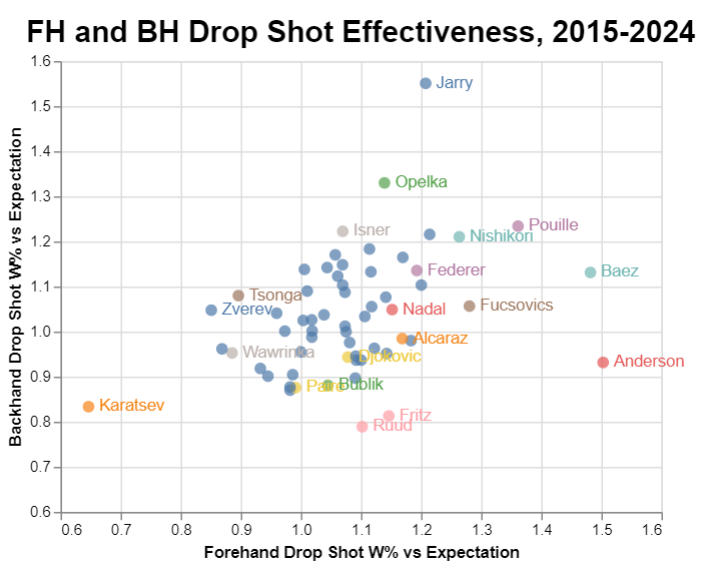
Go through the same exercise for every player, and the drop-shot leaderboard takes on a different look.
Some players, like Kei Nishikori and Nicolas Jarry, win a very high percentage of drop shot points and exceed expectations by a wide margin. Others, like Alcaraz, see less of a benefit from their drop shot, in part because their other options are so good. Still others, like Daniil Medvedev, win more than half of drop-shot points, but because of the rest of their game and the moments they choose to deploy the drop, they may be sacrificing some points when they do so.
Call the new stat Drop Shot Wins Over Expectation, or DSWOE: the ratio of drop-shot success rate to non-drop-shot winning percentage, taking into account the situations in which the player chooses the drop.
Among the 60 players with the most charted points since 2015, here’s the top of the list–the men who gain the most per drop shot–along with a few notable names in Bublik’s section of the list, plus the most extreme laggards:
Player                       Drop W%  Exp W%  DSWOE
Nicolas Jarry                  65.3%   50.4%   1.30
Lucas Pouille                  60.3%   48.1%   1.25
Kei Nishikori                  68.1%   54.5%   1.25
Sebastian Baez                 63.2%   50.9%   1.24
Richard Gasquet                60.7%   50.0%   1.22
Kevin Anderson                 53.8%   44.6%   1.21
Reilly Opelka                  52.1%   43.5%   1.20
Marton Fucsovics               58.2%   49.5%   1.18
Alejandro Davidovich Fokina    59.3%   50.7%   1.17
Roger Federer                  59.5%   51.4%   1.16
Robin Haase                    54.7%   47.8%   1.14
Frances Tiafoe                 54.6%   48.0%   1.14
Pablo Carreno Busta            58.9%   52.2%   1.13
Dominic Thiem                  57.1%   50.7%   1.13
Carlos Alcaraz                 62.1%   55.7%   1.12
Rafael Nadal                   61.5%   55.4%   1.11
Andy Murray                    55.7%   50.5%   1.10
…
Holger Rune                    51.4%   51.3%   1.00
Grigor Dimitrov                47.7%   47.9%   0.99
Alexander Bublik               45.4%   46.5%   0.98
Daniil Medvedev                53.0%   54.8%   0.97
Novak Djokovic                 50.8%   52.9%   0.96
…
Stan Wawrinka                  45.3%   48.9%   0.93
Milos Raonic                   38.0%   41.3%   0.92
Benoit Paire                   42.9%   46.8%   0.92
Tommy Paul                     47.0%   51.5%   0.91
Aslan Karatsev                 39.0%   49.9%   0.70
Surrounded by names like Rune and Djokovic, Bublik doesn’t seem so bad. Alcaraz, on the other hand, doesn’t stand out as much. He and list-neighbor Rafael Nadal are outrageously good in rallies whether they hit a drop shot or not. Even a world-class drop shot is only so much better than a standard Rafa or Alcaraz topspin groundstroke.
Tour average is around 1.05, meaning that the typical player does a bit better when they hit a drop shot than they would have had they chosen a different shot in the same situation. That tells us something that we probably suspected: Players are generally good at choosing the right moment to unleash the drop.
With this more fine-grained notion of expectations, we can re-calculate the number of points per thousand that each player gains or loses from drop shots. It is a function of both success rate (relative to expectations) and frequency. Nishikori and Jarry get great results from the drop but employ it rarely; men like Alcaraz and Sebastian Baez gain more points overall because they hit droppers so much more often.
Here are the players who gain the most points, along with the five tour regulars at the bottom of the list:
Player                       Freq%  W% - Exp%  DPOE/1000
Sebastian Baez                3.9%      12.3%        4.8
Alejandro Davidovich Fokina   5.2%       8.5%        4.5
Lucas Pouille                 2.9%      12.2%        3.5
Carlos Alcaraz                5.4%       6.4%        3.4
Richard Gasquet               2.8%      10.8%        3.0
Robin Haase                   3.9%       6.9%        2.7
Kei Nishikori                 2.0%      13.6%        2.7
Frances Tiafoe                3.2%       6.6%        2.1
Pablo Carreno Busta           2.8%       6.7%        1.9
Nicolas Jarry                 1.2%      14.9%        1.8
Fabio Fognini                 3.7%       4.7%        1.8
Andy Murray                   3.3%       5.2%        1.7
Dominic Thiem                 2.6%       6.4%        1.7
Marton Fucsovics              1.9%       8.7%        1.7
Roger Federer                 2.0%       8.1%        1.6
…
Novak Djokovic                3.3%      -2.1%       -0.7
Alexander Bublik              7.2%      -1.0%       -0.8
Lorenzo Musetti               5.1%      -2.3%       -1.2
Aslan Karatsev                1.2%     -10.9%       -1.3
Benoit Paire                  5.4%      -3.9%       -2.1
Five (or 4.8) points per thousand might not sound like a lot, but it represents the difference between Baez having a place in the top 20 and residing well outside of it. Alcaraz still grades well here, if not as much as he did before making all of the adjustments. Bublik scores closer to neutral too. His drop shot is probably more useful for earning him highlight-reel screentime than it is for winning points, but it isn’t hurting him that much.
Side matters
Armed with these adjustments, we can compare each player’s forehand and backhand drop shots, as well. Bublik has a fairly wide split. He wins just over 50% of points when he hits a forehand drop shot, next to only 39% behind a backhand drop shot. His expectations when faced with a backhand are worse in general, but not that much worse. His forehand drop shot success rate is two percentage points better than if he went with a standard groundstroke, while his backhand drop shot is five points worse.
So Sasha, if you’re reading this: We all love your drop shots. But maybe take it easy with the backhands.
The best forehand drop shots, compared to how the player would have fared with a different shot, belong(ed) to Kevin Anderson, Sebastian Baez, Lucas Pouille, Marton Fucsovics, and Nishikori, with Roger Federer not far behind. The most effective backhand droppers are those of Jarry, Reilly Opelka, Pouille, John Isner, and Richard Gasquet. “Expectations” is the key word for Opelka and Isner: They didn’t win a lot of points once a rally was underway, so a moderately good drop scores very well by comparison.
Here is the field of 60 regulars from the last decade. As usual, top right is good, bottom left is… yikes, Aslan Karatsev.
There are innumerable way to divide these numbers even further, and I know you’re tempted. But with drop shots, there is only so much data. Some of the outliers here, like Jarry and Anderson, are probably a bit aided by luck. Men who don’t hit many drop shots might only have a few dozen attempts on their weaker side. The standouts probably are better than average, but limits of our data lead us to overstate their advantage.
At least with the forehand/backhand division, adjusted for how players would have fared with something other than a drop shot, we can get some hints as to how our faves can improve their games. Taylor Fritz has a strong backhand, and I doubt the points he’s losing with his backhand drop shot are making it any more effective. Alexander Zverev isn’t doing himself any favors with his occasional forehand droppers. Karatsev, well… not everyone can excel at everything.
Bublik, despite his negative numbers in the aggregate, has an effective forehand drop shot. With the power of his serve and forehand, he’ll continue to earn plenty of opportunities to use it. If he resists the urge to showboat on his backhand side, the court jester of the drop shot could continue to show off his touch and still earn a more coveted position in the tactic’s royal house.
* * *
Subscribe to the blog to receive each new post by email: