Is Victoria Mboko a pusher? I was tagged in a Twitter exchange the other day debating that exact question. From watching her play, I would hardly compare her to Ostapenko, but the p-word wouldn’t have come to mind.
Rally Aggression Score puts her at +6, on a scale designed to run from -100 to +100. Based on 27 charted matches from the last 52 weeks, that makes her about neutral, tactically similar (at least along this dimension) to the likes of Belinda Bencic and Karolina Muchova. Counterpunchers, maybe, not pushers.
On the other hand, “neutral” overstates it. Lowell West devised the metric about a decade ago, and the game has changed since then. The way I initially scaled it, Petra Kvitova flirted with triple digits, and that was about it. Now, Dayana Yastremska gets close to 200. Elena Rybakina, at exactly 100 in the last year, ranks only fifth among players with at least five charted matches. There’s nothing so extreme at the other end: Emma Navarro has averaged -68, while the most passive top-tenners are Coco Gauff and Mirra Andreeva at -20 and -30, respectively.
Mboko’s +6, while hardly vintage Wilander, is indeed more passive than the average WTA player in 2026.
Aggressive growth
Will the Canadian change tactics with age? These days, it seems like nearly everyone at least tries to take more chances and hit more winners. (If you don’t, your opponent will!)
I can’t tell Mboko’s future, but I can load up a database and run queries on it.
So, different question: Do players in general change tactics with age? It’s easy to think of examples: Serena Williams got more aggressive over the years. Ostapenko (remarkably) has done the same. I’m not sure there are equally prominent players who have moved in the other direction, but it does seem like some teenagers show up bashing balls, then settle for a more measured game in their 20s.
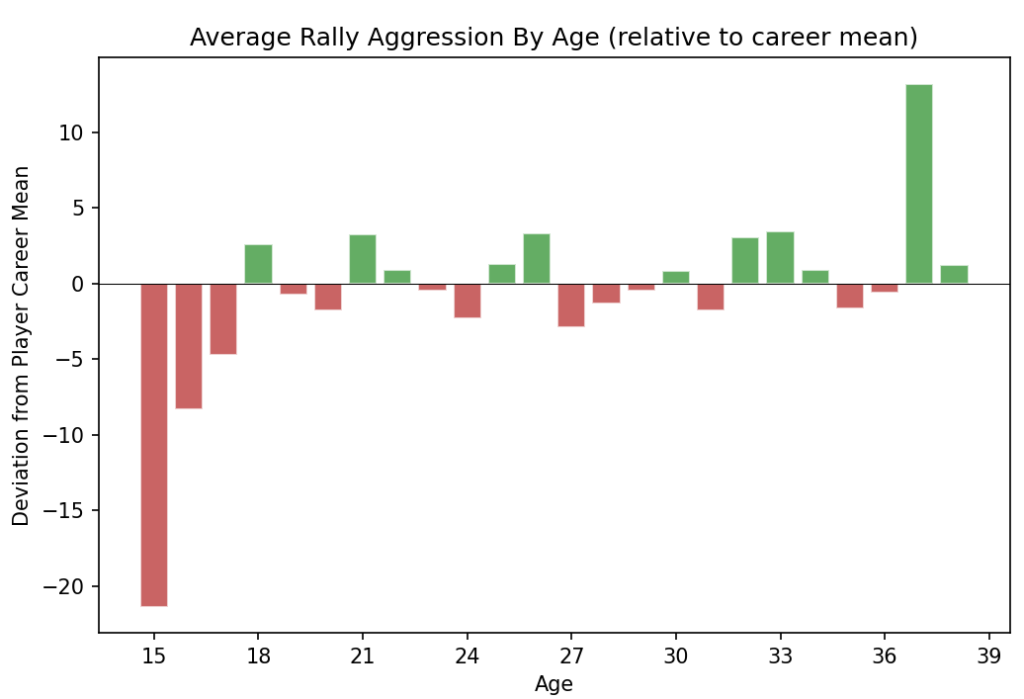
I took all women with at least 20 charted matches, grouped their rally scores by year, and figured out how much each year’s score differed from their career norms. Average those deviations across all players, and this is what you get:
From age 18 to 36–the entirety of most players’ careers–there’s nothing to see here. Plus or minus five points of rally aggression score is a rounding error, especially since these are non-random samples based on what Match Charting Project contributors wanted to chart and could find on video.
The spike at age 37 is also not very instructive: It’s basically Serena Williams, and we already knew that as she aged, she took increasingly few prisoners. From 2007 to 2009, her average aggression score was about +20. In 2019, when she was 37, it was +109.
Still, that climb at the left end of the graph is suggestive. It doesn’t literally apply to Mboko, who is already 19. But it supports a plausible narrative. When young women–especially the youngest prospects–arrive on tour, they aren’t as strong, or perhaps even as tall, as they will soon become. (Even Lilli Tagger recently gained a centimeter.) Their experience is disproportionately against juniors, who are even less physically imposing, relative to adult pros. The typical 16-year-old, no matter how talented, isn’t going to show up on tour and play like Sabalenka.
There are exceptions, of course. Maria Sharapova’s highest single-season aggression score was in 2004, when she was 17. Madison Keys arrived on the circuit playing essentially the same game she would play for the next decade. Iga Swiatek was more aggressive at age 18 than she has been since.
On average, though, the youngest players are more conservative–fewer winners, fewer errors–than they will become as they graduate from their teens. The mechanism could well apply to a 19-year-old, too.
The trend is null
We’re always talking about how players could develop and improve, or what their new coach brings to the table. Yet the undefeated champion of tennis forecasting is the null hypothesis. The null hypothesis, of course, means that you should’ve skipped this entire post and watched a Friends rerun instead.
It is boring, but the best way to predict how a player will look next year is to point at their current results and say, “yeah, just like that.” You can fiddle around the edges and maybe find players on the cusp of something or other, but … no, usually you can’t even do that.
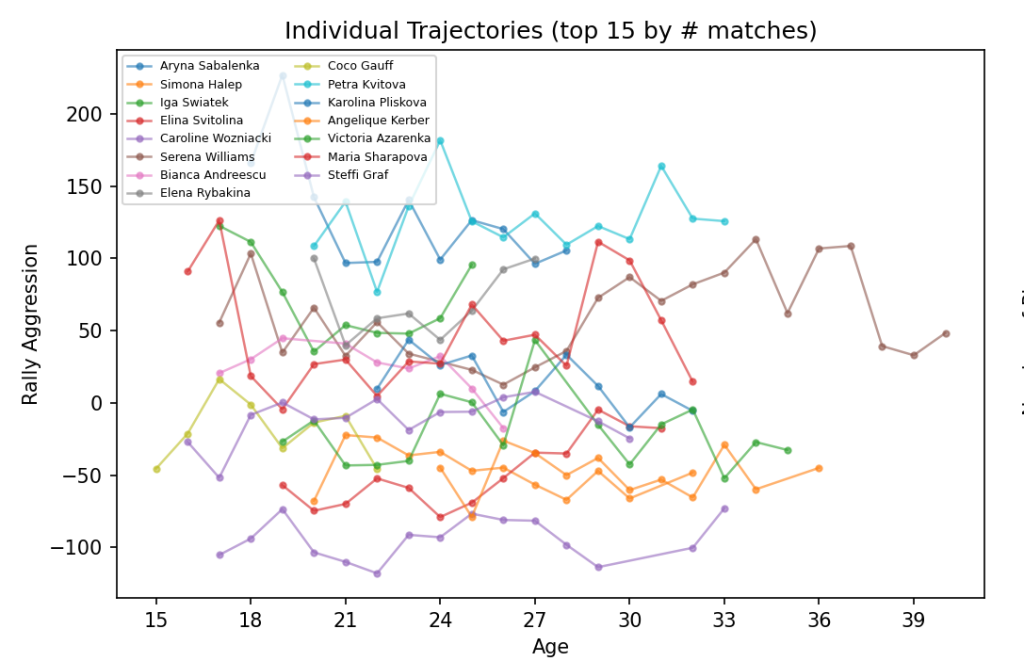
Here are the year-to-year aggression trends of the women with the most matches in the MCP database:
See that trendline that goes from the lower-left corner up to the upper-right? No, you don’t, because it’s not there. The closest is Serena, who dipped to +12 in her late 20s before getting hyper-aggressive in her 30s.
To answer the question posed by my headline, then: No, pushers don’t grow out of it. The style of play you see today is a good predictor of the style of play you’ll see a decade from now.
Lucky for Mboko, then, that she isn’t a pusher. Throughout her career, I’ll bet she tries a lot of new things and incorporates plenty of fresh ideas from a handful of high-profile coaches. The end result may well take her to the top of the rankings: A 19-year-old ranked 6th on the Elo table has a bright future ahead. If she finds a game that takes her all the way to the top, odds are it will look a lot like what we’ve seen so far.
Felix Auger-Aliassime has earned a reputation as a world-beater on indoor hard courts. He’s no Jannik Sinner–as Sinner reminded him all four times they met last year, twice indoors–but FAA is a fearsome customer against just about anybody else.
Last week the Canadian added to his indoor title haul with his second-straight championship in Montpellier. This time, he straight-setted Adrian Mannarino. While that win doesn’t particularly raise any eyebrows, the body of work keeps growing. It’s his eighth career title indoors, three of them at ATP 500s. Last fall in Paris, he also reached his second Masters final. (The first was in Madrid, the indoorsiest of the clay Masters.)
What’s the secret?
The conventional wisdom is that he has a big game, especially a deadly first serve. The controlled environment indoors, plus typically fast conditions, play to his strengths. The serves skid across the court even faster. His weaknesses are mitigated because the bounce is more predictable and because points are shorter.
All that sounds plausible. My only gripe is, couldn’t you say that about a lot of players? The whole paragraph applies, almost word for word, to Hubert Hurkacz, who has two Masters crowns on outdoor hard, plus a clay title, yet just a pair of indoor 250-level championships. What about Matteo Berrettini? The description might match him even better, yet the Italian has never won a title indoors. He has reached only one indoor 250-level final.
Before we go to the numbers, let me give you my seat-of-the-pants theory. FAA has huge weapons, but he doesn’t always play like it. He doesn’t consistently swat away easy plus-ones like Berrettini does. He gets sucked into long rallies, where he’s often at the disadvantage. Indoors, though, he knows what the tactics are, and he plays the way he should play. Indoor Felix, then, is the best Felix, both because his game is suited to the conditions and because he shows up with the right approach.
On the other hand, the last two points against Mannarino on Sunday were 8- and 18-shot rallies, respectively. So, you know, don’t trust my pants.
Numbers!
You can, however, trust the spreadsheets. The Match Charting Project has well over 100 Auger-Aliassime matches. Going back to 2020, the total includes 41 on indoor hard and 40 on outdoor hard, nicely suited for some comparisons. I was tempted to throw out the seven Tour Finals matches from the indoor tallies, because they skew the quality of the opponents, but the Canadian’s indoor averages are about the same with or without them.
Surface       Unret%  <=3 W%  RiP W%
Indoor Hard    35.7%   47.7%   55.5%
Outdoor Hard   32.8%   43.4%   49.7%
About three percentage points more serves don't come back, and there's an even wider gap in points polished off on the serve or plus-one (the "<=3 W%" stat). The biggest gap here is in points won when the return comes back. Sub-50% is below average, especially for hard courts. 55% or better is very good, even in fast conditions.
Almost all of the indoor/outdoor serve differences are thanks to the first serve. FAA's second-serve numbers are about the same regardless of roof status.
Of course, Felix isn't the only guy on tour who wins more easy serve points indoors. I don't have comprehensive stats on the indoor/outdoor split, so I can't tell you the exact tour average. But we can compare how much Auger-Aliassime gains on serve to how much he gives up on return:
Surface        RiP%  RiP W%
Indoor Hard   65.3%   48.8%
Outdoor Hard  67.5%   43.2%
He retrieves 2.2 percentage points fewer serves indoors--better than the 2.9-percentage-point difference he gains on serve. But when he gets the serve back, he's actually better indoors than outdoors! He gains five percentage points in that department on serve, and he gains the same margin on return.
This might dovetail with the conventional wisdom. His monster serve really pays off indoors. And predictable conditions give him a bit of cover on return.
Whatever the reason, Auger-Aliassime's groundstrokes are way more effective indoors. My Potency metrics, FHP and BHP, combine winners, unforced errors, and shots that set up winners and errors. They give you one-number estimates of how valuable each shot is, and... wow:
Surface       RallyLen  FHP/100  BHP/100
Indoor Hard        3.7     +8.5     +0.0
Outdoor Hard       3.9     +3.2     -5.8
His indoor points are a little shorter, but I assume that is typical. I would've guessed that the difference was greater.
The Potency numbers (expressed here as rates per 100 shots), tell a more emphatic story. A +3.2 FHP/100 is ok, not great. Tommy Paul and Ugo Humbert are in that zone. On the other hand, +8.5 is the 52-week average of Carlos Alcaraz. A -5.8 BHP/100 is near the bottom of the pack, below the likes of Ben Shelton and Grigor Dimitrov. By contrast, +0.0 is, as it sounds, a good solid average.
These numbers don't drill into the "why" questions that naturally follow. But they help us pick between theories. I suspect that much of the difference in groundstroke stats has to do with the shots he gets to hit. The winners are downstream of good serves. Auger-Aliassime picks up some aces, but he picks up more plus-one (or even plus-two) winners, and those make his forehand and backhand numbers look good.
The "indoor predictability" thesis also looks good here. Remember that everybody should benefit from that--and not everybody's numbers improve like Felix's do--but it may be that the Canadian is more-than-typically exposed by the vagaries of outdoor play.
All the angles
Quick thought experiment. Picture Roger Federer hitting an ace.
Now imagine Auger-Aliassime hitting an ace.
What specific serves came to mind? If you're like me, you pictured Federer shooting a bullet right down the tee. And then you visualized FAA hitting a flat bomb out wide.
Of course, both guys hit plenty of aces in every direction. The charting stats suggest that Felix has a slightly better chance of an ace when he goes up the middle. (Federer did too, by a bigger margin, as do most players.) Still, this indoor/outdoor split caught my eye:
Surface       Deuce Wide%  Ad Wide%  BP Wide%
Indoor Hard         50.5%     47.8%     33.7%
Outdoor Hard        46.9%     45.2%     41.0%
Each column shows how often Auger-Aliassime opted for a wide serve in various scenarios. The first-serve differences are probably more marked, because his second-serve tendencies are about the same.
Indoor, he goes wide more often--but less often under the pressure of break point. While the margins are rather slim, it seems like the wide serve becomes his bread-and-butter indoors, and he uses the tee serve to mix things up on break point--because he's hitting more wide serves the rest of the time.
Wide serves are more likely to come back, but they don't make the returner any more likely to win the point. Especially against Felix: His signature serve might not even be an ace, but a wide bomb that the returner just barely plops back over the net.
The fact that he hits more wide serves indoors explains a lot. He gets a few more unreturned serves (as everybody does, probably), but he gains more of an advantage on the serves that (weakly, oh so weakly) come back. His groundstroke stats sparkle, padded by those easy balls.
Here's one final comparison:
Surface       2ndAgg
Indoor Hard       +7
Outdoor Hard     +46
"2ndAgg" is the Aggression Score stat tailored specifically to second serves. A higher score means more double faults and more unreturned second serves. Lower means fewer risks on second balls. +7 is quite conservative: Only about a dozen players consistently score so low.
But--those careful second servers include Sinner, Hurkacz, and Berrettini. With a game like Auger-Aliassime's, the second serve isn't the time to take risks. And indeed, in all of his indoor finals, he has never topped a double-fault rate of 5%. In the Montpellier final, he missed his second serve just once, and he committed no double faults at all in the quarter- and semi-finals.
Here, finally, is some support of my seat-of-the-pants theory, that when Felix goes indoors, he plays the way he ought to be playing all the time. He stays within himself, which is still imposing enough to earn a lot of cheap points. It's not a particularly complicated story, and I'm still not convinced why it doesn't apply to a half-dozen other guys on tour. Maybe it is all about the wide serve, the signature shot that allows Auger-Aliassime to manage risk and put his opponents on the back foot, all at the same time.
The replies are fascinating. Responses run the gamut from “Why doesn’t everybody do this?” to “Switching grips will kill him.” Or my favorite: “What if he needs to hit a backhand?”
So we’re agreed: It could be the future of tennis, or it could be nothing. It isn’t completely unprecedented: Cheong-Eui Kim cracked the top 300 a decade ago, and a handful of juniors have reached an international standard for their age groups. Going way back, Beverly Baker Fleitz (#128 on my Tennis 128) took her two forehands all the way to the 1955 Wimbledon final. John Bromwich, another Wimbledon finalist, hit forehands and backhands from both sides.
And, of course, there’s a long history of teaching kids to hit forehands with their non-dominant hand. Rafael Nadal is a natural righty, while all-timers Maureen Connolly, Margaret Court, and Ken Rosewall were lefties who played right-handed. There’s no reason why any of those players couldn’t have developed two forehands instead of the one they did.
Let’s try to put some numbers on this. What’s the value of having two forehands instead of one?
Plug and play
We can’t run the counterfactual where, say, Carlos Alcaraz learns two forehands from age six. But we can work out what would happen if his backhand were exactly as effective as his forehand.
I probably don’t need to tell you that this would be an improvement for most players. We have ten-plus matches’ worth of 2025 charting-level data for 37 different men. Going by my Forehand Potency (FHP) and Backhand Potency (BHP) metrics, only three guys–Alejandro Davidovich Fokina, Daniil Medvedev, and Alexander Zverev–were more effective on the backhand side. Everybody else would’ve benefited from magically attaining forehand-level performance on both wings.
FHP and BHP tally up winners (plus forced errors), unforced errors, and shots that lead to one of those outcomes. Jannik Sinner, for instance, scores +13.2 FHP per match. Divide by 1.5 to translate to points, and Sinner’s forehand earned him about nine points per match more than a “neutral” forehand–one more like Zverev’s.
The typical tour regular grades out at 6.7 FHP and 0.6 BHP per match. That’s a difference of about six, or roughly four points. Put another way: Give the average player a backhand as effective as his forehand, and he’d win four more points per match.
Plus or minus
Four points per match. The average match runs about 140 points, so that’s a boost of nearly 3% of total points. Can you feel something dripping on you? That’s a tennis player uncontrollably salivating.
Three percentage points is huge. I once estimated that an improvement of one point in a thousand (0.1%, or one-thirtieth of 3%) was worth a single position in the rankings. That model wasn’t really designed to handle such big adjustments, so we can’t exactly say that a second forehand would be worth a 30-place ranking boost. On the other hand: Give, say, Tommy Paul four more points per match, and his point-winning rate would be as high as anyone except for Sinner. Hand the same boost to 49th-ranked Jenson Brooksby, and he’d win more points than anyone ranked outside the top six.
But. BUT. So many buts.
I don’t know about Herrera Sanchez, but I suspect that most two-forehanded players still have a weak side. Maybe the gap wouldn’t be as big as the standard forehand/backhand difference. But even with training from a young age, I doubt that the average unnatural-side forehand would be as strong as the player’s natural side forehand. I have no idea what that means for the 3% number, other than the fact that it is too high.
There’s also the issue of grip-changing. Depending on who you ask, the delay and awkwardness of switching from one forehand grip to the other either dooms the whole project, or it isn’t that big of a deal. I suspect that if a kid can learn to hit two forehands, he can figure out the grip-changing issues. Still, there is a probably a cost. (If nothing else, on return of serve. It might make sense to have a defensive backhand for first-serve returns only.) Again, I have no idea what that cost is. You give up a few more winners, but you hit better shots when you get there.
On the otherother hand, simply plugging in forehand value for backhand value might in one regard understate the benefits of having two forehands! 53% of ATP groundstrokes are forehands, yet most players target their opponents’ backhands. In other words, pros are covering considerably more than half the court with their forehand. There’s a cost to that: Awkward inside-out attempts, suboptimal court position after the shot, etc. Depending on the player, I’d guess that 10% to 20% of forehands would be backhands if the forehand weren’t the better option. (For example, only 45% of Medvedev’s groundstrokes are forehands.)
The better a player’s secondary shot, whether a backhand or a weaker-hand forehand, the less often he’ll go out of position to hit a forehand. Those are some of the toughest forehands, so taking fewer of them will mean (dominant-hand) forehand potency will go up, too. As with the other complications, I have no idea how to quantify that with the data we have. It’s probably not a significant change to the number, but directionally, it mitigates some of the effect of second-forehand weakness and grip-changing.
Stepping back
While I can calculate the hypotheticals, this is ultimately a coaching and player-development question. Given a talented, motivated youngster, is it worth teaching them a second forehand instead of a backhand?
Here, I really have no clue. Maybe Herrera Sanchez will make it big. The same level of early tinkering certainly worked out for Rafa! But how often have coaches tried this? For every Rafa or Rosewall, are there ten kids who flamed out (or just gave up) early because a weaker-hand forehand was too frustrating? Or did they end up starting late with a proper backhand, never fully developing that shot? How many youngsters even have the potential to develop a powerful forehand with their non-dominant hand?
It’s hardly a magic bullet, even if a junior does manage to develop high-quality shots on both wings. While 3% of total points is huge by tennis standards, you still need 50% to win most matches. If an up-and-comer with two forehands tops out at 5-foot-9, or struggles too much with double faults, or doesn’t develop elite movement and anticipation, or comes up short on any one of a hundred more dimensions, he’ll have a hard time establishing himself on the Challenger tour, if that. “Not good enough” plus 3% is still, almost always, not good enough.
The best way to think about this, I think, is to frame the second forehand as a really, really good backhand. It isn’t exactly the same, but it’s close enough. Novak Djokovic has one, and of course it has worked out for him, because he’s historically great at all sorts of things. Benoit Paire had one: He won three titles and made an appearance inside the top 20. Elmer Møller has one, and at age 22 he’s still hunting for a top-100 debut. A non-dominant-side groundstroke of that caliber is an incredible asset, yet it’s still a small part of a winning formula.
Is developing a second forehand easier than doubling up on backhand-down-the-line drills? Are there more kids out there who could crush it with their non-dominant hand than could develop an absolute top-tier backhand? I don’t know! If Herrera Sanchez (or someone else) makes enough waves, more coaches will consider the possibilities. Then we’ll get more data, and we might be able to sort out whether two forehands is a blind alley, or if it really is the future of tennis.
I wrote last week about the decline of specialization on the men’s tour. I proposed that we see more good all-around players because, as the overall level improves, there’s less relative value in being a one-dimensional servebot or dirtball grinder.
A few people responded–and I paraphrase, slightly: It’s the surfaces, stupid.
Everybody seems to agree that at some point, let’s say between peak Sampras and peak Djokovic, surface speeds converged. Hard courts got slower, and some grass courts got slower, too. Serve-and-volleying mostly disappeared, and grinding baseline play took over.
The only debate, it seems, is why. Was it a conspiracy to give the fans (well, all the fans except for the ones complaining) what they wanted? Is it the balls? The rackets? The strings?
I’ve always been skeptical of the conspiracy theory. More generally, I have been–and still am–skeptical that playing conditions have changed that much. Just because everybody believes something–even if those people are top-ranked players and well-respected pundits–doesn’t make it true. The historical record shows that styles have changed, but it’s much harder to marshal evidence that the surfaces themselves are meaningfully different than they were 20 or 30 years ago.
A quick review
I’ve looked at this stuff before. Here’s a quick summary:
The Mirage of Surface Speed Convergence (2013): I compared ace rates and break rates on hard and clay courts for pairs of players, 1991-2012. I found that the difference between hard courts and clay courts had, if anything, slightly widened, even though the conventional wisdom of convergence was fully in place by then.
The Grass is Slowing: Another Look at Surface Speed Convergence (2016): I wish I had named this differently, because I didn’t show that the grass slowed, I showed that rally lengths at Wimbledon (and to some extent at the hard-court slams) were converging with those at Roland Garros. It was my first stab at the problem using Match Charting Project data, which meant it used rally length, instead of ace and break rates. However, it relied on limited data, which meant there were heavy biases in which players it measured.
Surface Speed Convergence Revisited (2023): With more MCP data, I worked out a simple model of how much surface affected rally length, and how the effect had changed over time. Now without the selection bias, I showed that in both men’s and women’s tennis, the influence of surface on rally length had shrunk.
Pick your stat
To grossly oversimplify: If you look at ace rate, there’s no evidence of surface convergence. If you look at rally length, there is.
I didn’t want to rely on a 2013 mini-study for the ace-rate conclusion, so I came up with some new fodder.
My surface-speed ratings are based entirely on ace rate. Originally, this is because we don’t have better stats going very far back, while we do have ace rate for all ATP matches since 1991. The MCP has an increasing amount of coverage, but it is not complete, and the ace-based ratings have always seemed to capture surface-speed differences pretty well. There’s some noise, because there are only so many matches per tournament per year. But in general, they give us a pretty good idea of what’s going on.
The downside is that they are indexed to each year’s average. The rating for the 1991 edition of Wimbledon is 1.20, meaning that–controlling for the mix of players–there were 20% more aces than a 1991-average event. This year, Wimbledon’s rating was 1.12: 12% more aces than the 2025 average. But are those averages the same?
That question offers us a neat little experiment. Instead of indexing on a single-year average, why not do two years at a time? The pool of players was almost identical in 1992 as in 1991, so it’s a fair comparison. As it turns out, Wimbledon’s ace-based surface rating went down from 1.20 to 1.06 between 1991 and 1992. That kind of shift often happens due to randomness, but maybe it could be validated by a longer trend. Looking at two years at a time–1991 and 1992 together, 1992 and 1993 together, up to 2024 and 2025 together–allows us to make the same comparisons for the entire tour calendar, for a span of 35 years.
Well, in that span, ace rate has gone up quite a bit. And not just because mediocre servers have been replaced by better ones. On average, the same servers (against the same returners, though the returner effect is much smaller) have upped their ace rate about 2% every year. Not enough to notice as it happens, but enough to move the ATP tour average ace rate from below 7% in 1991 to a bit over 10% today. Some of the difference is due to the tournament mix–a shorter clay calendar, mostly. But I ran the same analysis on a core group of 15 events that have been in the same place since 1991, and the controlled-for-players increase is still 1.6% per year.
What about convergence, taken literally? Have faster events gotten slower, while slower events have sped up?
Nope! The variance between tournament ratings is almost exactly the same in 2024-25 as it was in 1991-92. An example: Back then, Wimbledon’s two-year average was 1.13, while Monte Carlo was 0.58. Over the last two years, Wimbledon’s rating has been 1.14, with Monte Carlo at 0.57.
It’s the strings…
How do we reconcile the evidence that ace rate has gone steadily up, while rally length has also increased?
Setting aside laboratory-type measurements (like CPI/CPR, which we don’t have far enough back, anyway), the purest way to measure court speed is ace rate. A slow court keeps the ball on the ground longer and slows down the rest of its trajectory. Returning is all about reaction time, and ace rate tells us whether returners physically got there or not. That’s why there are, reliably, so many more aces on hard and grass courts than on clay, and on faster hard courts than slower hard courts.
Now, it could be that players have gotten stronger, serve tactics have gotten less predictable, and racket/string technology allows servers to put the ball in the corner more often. All of that is probably true, so the 2%-per-year average likely overstates the change in surface. The ace increase might entirely be attributable to training and tech. But if you want to argue that surfaces have gotten slower, you’ve got an uphill battle to explain how aces have gone so far in the wrong direction.
The rally-length trend is easier to explain. Unlike ace rate, shots-per-point isn’t just about how the ball interacts with the surface. It’s about tactics and spin.
And actually, tactics are themselves largely about spin. And spin, well, that brings us to polyester strings.
Modern topspin is possible largely thanks to polyester strings. The best-known milestone is Gustavo Kuerten’s 1997 French Open title, the first major won with a Luxilon-strung racket. It took a few years for everybody to make the switch, but polyester string was kryptonite for serve-and-volleying. Now it was possible to hit returns that dipped to the server’s feet at the net. All that topspin also made it tougher to move forward. More topspin meant that deep groundstrokes were higher-percentage shots, and that opponents needed to give up even more ground to comfortably handle them.
When I wrote about Lleyton Hewitt a few years ago, I showed how Hewitt forced Roger Federer to basically give up serve-and-volleying. That was 2002-05. If it hadn’t been Hewitt, it would’ve been someone else–or everybody else.
Less serve-and-volleying, safer groundstrokes, fewer net approaches overall … all that adds up to longer rallies. No surface change necessary.
… and the youth
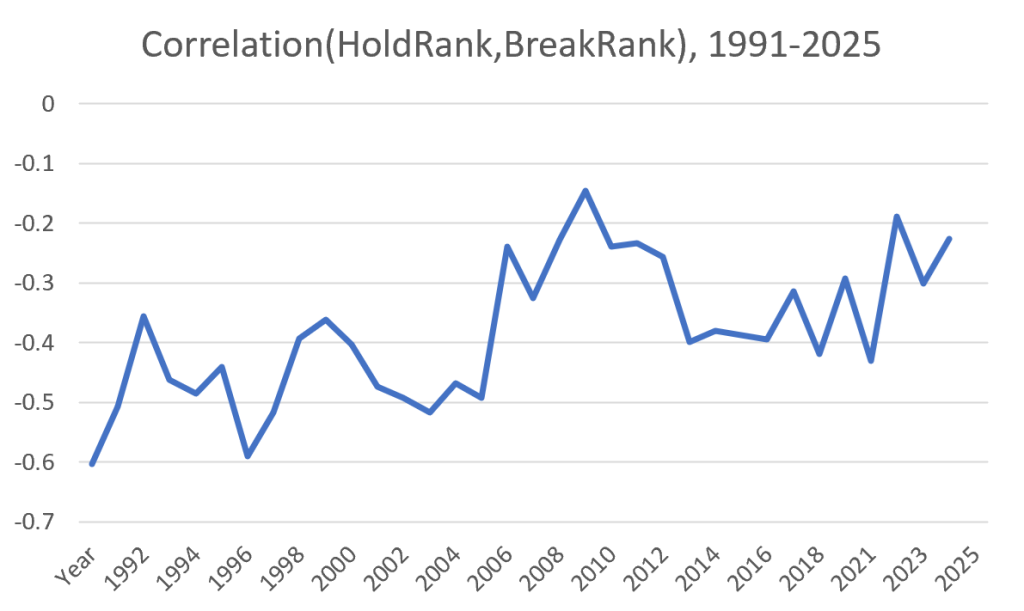
Let me show you the graph from my decline-of-specialization piece again. Generally speaking, it shows how much serve skill is related to return skill. Higher numbers (closer to zero) indicate a closer relationship, or in tennis terms: more all-around players.
Someone on Twitter reasonably asked, what’s up with the peak around 2008-2010? It’s a noisy graph, but a plausible interpretation is that it breaks down into two segments. Up to 2005, most of the data points are between -0.4 and -0.5, with a couple on either side. Since then, the line rarely dips below -0.3. (2013-16 leaves some explaining to do.) Accept this reading, and 2008-10 isn’t a stand-alone peak, it’s the solidification of a new era.
What else was going on in 2008-10? Novak Djokovic won his first slam, and Rafael Nadal established himself as an all-court force. In short, this is when people really started talking about surface speed convergence. Probably not a coincidence.
But why then? Well, in the spring of 1997, the tennis world figured out that polyester strings weren’t just the misguided side-hustle of a bra-strap company. Players with an eye on the future started to switch.
When Guga lifted his trophy, Nadal was 11 years old. Djokovic was 10.
The learning curve
Professional tennis is tough. Players like their gear. They’re used to their gear. It took years for Federer to give up his 90-square-inch frame. Sampras never did abandon his 85-square-incher. When a pro finally does switch, the benefits are hardly instantaneous. It might even mean a temporary step back.
The ultimate advantages go to the tech-natives. For all of Kuerten’s success with Luxilon, he was never going to wring the full benefit of the new technology and the tactics that it implied. If a certain racket/string setup is optimal, the players who do the most with it will be those who built their entire games around it. I don’t know whether the critical age is 8, 11, or 14 (maybe it helped Federer that he was a bit of a late bloomer), but it definitely isn’t 20 or 25.
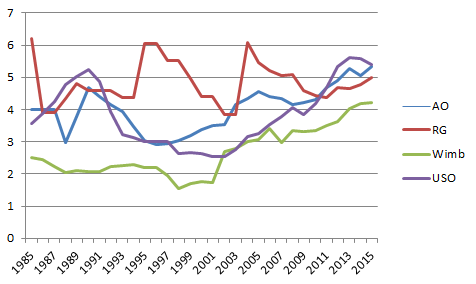
Check out the rally-length graph (based on slam finals) from my 2016 piece:
Wimbledon went from a low in 1998-2001 to a completely different level by 2006-08. Not a coincidence. The slam-finals graph tells the story of a select few guys, but by the late 2000’s, a whole generation of polyester natives–Djokovic, Nadal, Murray, Nalbandian, Berdych, Ferrer, Monfils–had taken over.
None of this requires the surfaces to change one iota. Maybe fans or tournament directors wanted longer rallies, maybe they didn’t. They were going to get baseline tennis no matter what.
Playing styles converged because topspin-powered strategy works across surfaces in a way that no previous style did. Rallies got longer because the players who tried to shorten them were stranded in the forecourt. They fumbled half-volleys into the net or watched passing shots as they whizzed by. Surfaces ended up as the scapegoat for a new era, but they didn’t cause it.
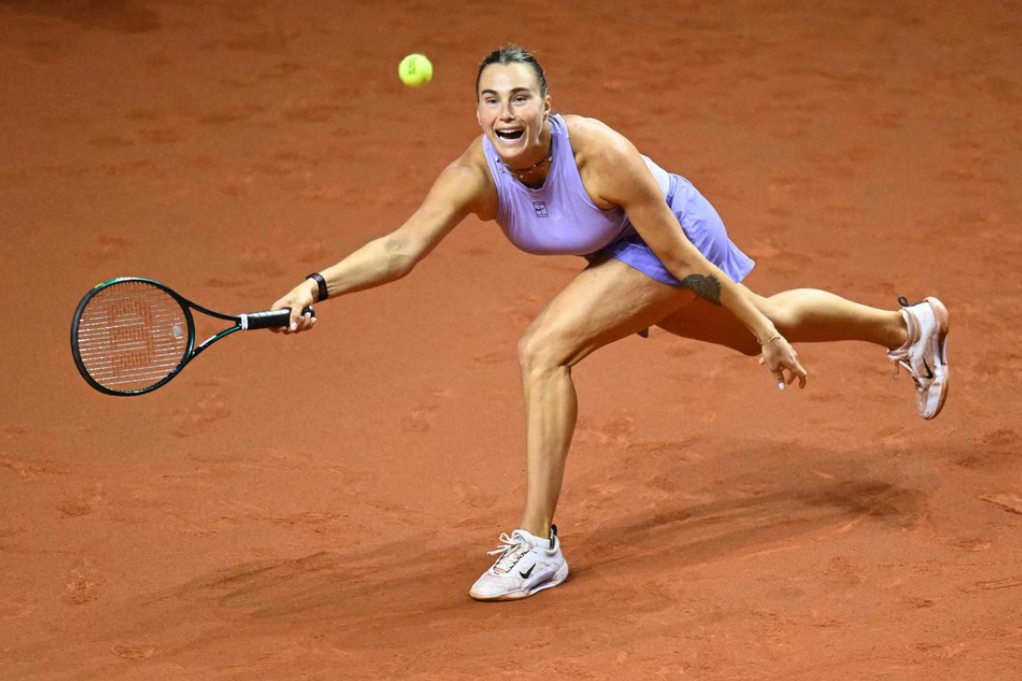
Aryna Sabalenka typically has things more under control, even on clay.
For a while there, it seemed that Aryna Sabalenka and Iga Swiatek would divide the spoils. Sabalenka would dominate on hard courts, and Iga would continue her reign on clay.
At the moment, Aryna is taking it all. She has held the number one ranking for six months now, opening up an astonishing 4,300-point gap on the field. She picked up her third Madrid title on Saturday, straight-setting Coco Gauff shortly after Gauff dealt Swiatek one of her worst-ever clay-court losses. My Elo ratings not only put Sabalenka atop the field, they rank her first on clay. By Elo, at least, the Belarusian will be the favorite at Roland Garros.
Some of this can be explained by Swiatek’s struggles. But Sabalenka has long been ready to seize her chance. Here are her career tour-level results by surface:
This is not the snapshot of a player with a strong surface preference. She has reached ten career clay-court finals, winning three and losing four to Iga.
On the other hand, all three tournament victories (and more final) came in Madrid. Four more of the finals were in Stuttgart. Both events have historically favored bigger hitters: Madrid with its altitude, and Stuttgart with its predictable indoor conditions. Rome and Roland Garros present different challenges.
So, is Sabalenka the new queen of clay, or is her domain limited to the Spanish capital? Is she really the woman to beat in Paris?
(DR = Dominance Ratio, percentage of return points won divided by serve points lost.)
Madrid stands out as Sabalenka’s playground, and Rome is clearly not her favorite tour stop. But her cumulative stats at the French Open, where she has reached only one semi-final and one other quarter, fit better with the tournaments where she has reached so many finals.
You probably remember Aryna’s tough 6-7, 6-4, 6-4 loss to Mirra Andreeva in last year’s final eight. I had forgotten that it was her fifth straight three-set exit in Paris. Two years ago, it took Karolina Muchova more than three hours to advance to the final. Back in 2020, Sabalenka won more points than Ons Jabeur did in their third-round meeting, yet it was the Tunisian who moved on.
The parade of narrow losses isn’t a case for the Queen-of-Clay title–after all, Iga would’ve won some of those matches in about 56 minutes. It’s merely a reminder that the world number one has often been close. She is playing somewhere near her best-ever tennis right now, so if the improved form carries over to Roland Garros, it’s easy to imagine those close matches finally tipping her way.
Surface insensitivity
Here are some (men’s) surface-speed ratings from the last 52 weeks. Stuttgart is a women’s only event, so I’ve included Hamburg as a rough approximation:
Year  Event          Surface Speed
2024  Roland Garros           0.66
2024  Rome                    0.67
2024  Madrid                  0.82
2024  Hamburg                 0.89
(I use men’s data for surface speed because the metric is based on ace rate. Men hit more aces, so there’s better data to assess court conditions.)
Tour average, across all surfaces, is 1.0. Speed ratings in the 0.8 to 0.9 range are slow-ish, but they’re more like a slow hard court. For instance, the men’s Masters event in Montreal last year rated a 0.8, almost identical to Madrid. Point being, there is a clear separation between the traditional clay events and the upstarts. It would stand to reason that a big hitter like Sabalenka would struggle more in Rome and Paris.
Despite the trophy count, surface effects don’t show up where I would expect to find them in the stats. The Match Charting Project–thanks to one unhealthily obsessed contributor–has logged almost all of Aryna’s tour-level matches. Based on that data, here are her average rally lengths by event:
Event          Avg Rally
Roland Garros       3.54
Rome                3.25
Madrid              3.30
Stuttgart           3.14
Sabalenka has defied the slow dirt at the Foro Italico. She has somehow played even shorter points there than in Madrid. We can give some credit to her opponents–she has faced Jelena Ostapenko, Dayana Yastremska, and Danielle Collins there–but even her 2022 match with Iga registered just 3.1 strokes per point.
The same trends–or lack thereof–show up in her serve stats. The next table shows the rate at which Sabalenka’s serves are unreturned, and the percentage of points that she wins with either her serve or her second shot:
Event          Unret%  <=3 W%
Roland Garros   27.2%   46.9%
Rome            31.6%   49.0%
Madrid          30.4%   49.6%
Stuttgart       36.0%   54.0%
Though Stuttgart is a server's paradise, the gap between Madrid and Rome remains slim. Looking at these numbers, you'd never know that Sabalenka had three titles at one of the events and a 9-6 career record at the other. At the very least, it seems that the slow clay has not prevented the Belarusian from playing her game.
The dropshots
Last year, Sabalenka clay-court game changed. She hit more drop shots than ever, especially in Rome and Paris. My deep dive showed that the tactic was a success across multiple dimensions:
Clay-Sabalenka got the best of both worlds. She won more points by playing the drop, and she won more points because of the tactic’s lingering effect. Perhaps because of her growing reputation as a drop shot queen, the effect has persisted since June, even when she doesn’t go to the well so often.
In theory, dropshots give opponents something to think about, and the positive effect of a good dropshot goes beyond a single point. It's hard enough to handle Sabalenka-level power. Thinking you might have to dash forward makes it even worse. The post-dropshot effect doesn't work for everybody--it is neutral for Ons Jabeur, for example--but it has made Aryna even deadlier.
Expect droppers galore in Rome. Sabalenka unleashed eleven in the Madrid semi-final against Elina Svitolina and another eleven on Coco Gauff in the final. She won 14 of the 22 points. If it works in Madrid, it will almost definitely continue to score points on the more stately surfaces in Rome and Paris.
Sabalenka's new weapon remains a minor tweak, but it has clearly been a positive one. Few women gain so much from dropshotting as she did on slow clay last season.
Coronation?
All of this adds up to Sabalenka being the Roland Garros favorite--mathematically if not emotionally. If she is the new Queen of Clay, it's only by default. Swiatek is a generational talent on the surface: If Iga can play her best, Aryna will be lucky to push the final to three sets.
The case for the world number one, then, is more prosaic. Who could beat her? A resurgent Iga, of course. Andreeva could cause problems again: Perhaps no one else on tour can better neutralize the Sabalenka serve. Ostapenko could blitz her way through, as she did in Stuttgart, but she is even more of a threat to Swiatek than she is to Sabalenka. The luck of the draw is a very real factor when the Latvian is lurking.
The next two weeks in Rome won't overturn any of this, but they could refine the narrative. If Iga coasts to a fourth Italian Open crown, it will be tough to bet against her in Paris. If Aryna comes out on top, she would head to the French as more than just a mathematical favorite. If Ostapenko wins it, well, that would be pretty funny.
***
Subscribe to the blog to receive each new post by email:
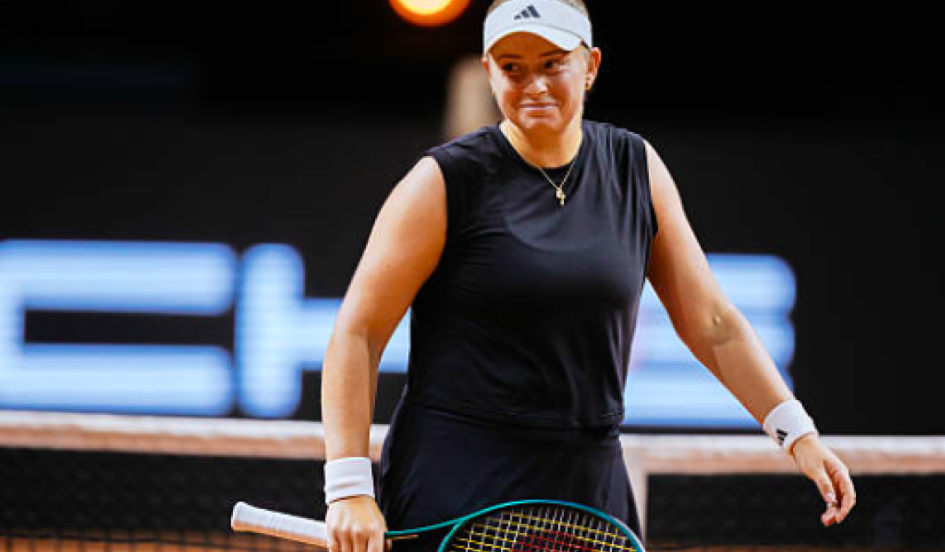
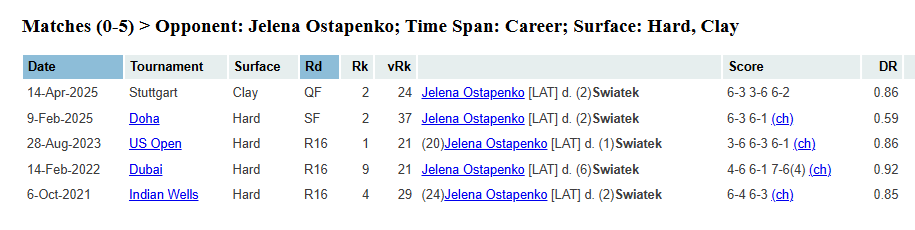
Jelena Ostapenko is now 6-0 against Iga Swiatek. Their first meeting doesn’t really count: It was on grass, and Iga was 18. Since then:
One was close, and Swiatek picked up a set in two others. These are (usually) not blowouts. But most of the time Iga faces an opponent outside the top 20, it is a blowout–in the other direction.
Ostapenko is a special case. No one on tour is more aggressive. Her make-or-break style, standing inside the baseline and swinging for winners even on service returns, turns every match into something more like a coin flip. If her aim is off, she can lose to anyone. By the same token, she’s the worst opponent for a top seed to draw in the middle rounds:
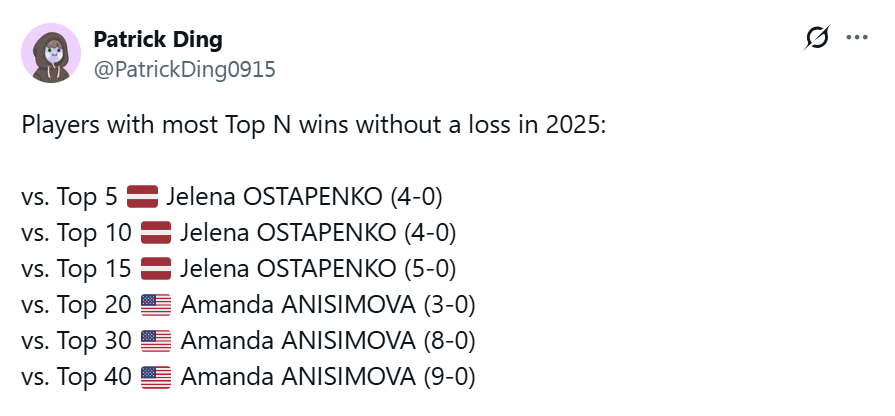
Career, Ostapenko has 25 top-ten wins, 21 of them when she was outside the top ten herself. It’s an exaggeration to say that her opponent doesn’t matter, but opponent matters less to the Latvian than to probably anyone else on tour.
Keep it simple
It’s tempting to go straight to the mental explanation: Ostapenko has gotten into Iga’s head, etc. That might explain why the head-to-head is 6-0 instead of 4-2 or 5-1. But there is a more concrete basis for the fact that the underdog keeps coming out ahead.
One of Swiatek’s lesser-known assets is her ability to win serve points. While she doesn’t have the best serve on tour, her opening delivery is quite fast, she rarely misses, and it sets up the rest of her game to finish off points. Over the last 52 weeks, she has held 79% of her service games, more than any other WTA player: Yes, even Aryna Sabalenka.
In their last five meetings, Ostapenko has broken her 31 times.
Against everybody else, Iga gets her share of service winners, and when the ball comes back, her unparalleled baseline skills keep the odds in her favor. Though she can rally with the best of them, she keeps points relatively short. Her serve points average 3.8 strokes, compared to tour average of 4.2.
Against Ostapenko on Saturday, her average serve point lasted 2.8 shots.
Another way to see the Penko effect is to look at the horrible things she does to Swiatek’s top-line serve numbers:
Matches   1stIn  1st W%  2nd W%
Last 52   64.9%   68.3%   50.3%
vs Penko  57.8%   51.8%   45.7%
Among the WTA top 50, Iga ranks in the top dozen for all three of those stats. The Latvian turns her into a wholly ineffectual version of herself. (In my earlier piece about Ostapenko, I wrote that she turns the rest of the tour into Madison Brengle. Even Iga!)
52% of first-serve points won is atrocious. No top-50 player stands below 57%. Sara Sorribes Tormo is the only woman who can compare. 46% isn’t quite so dire: Elise Mertens typically plays at that level, to take one example. But it’s a marked decline from Swiatek’s usual standard.
If you want to make case that Ostapenko has gotten into Iga’s head, the first-serve-in rate is one place to start. There is some tactical basis for taking more first-serve risks against a free swinger. But in this case, they don’t seem to pay off at all. That dreadful 52% win rate on first serve points is the result of hitting them bigger! Iga took more chances on second serves as well. She is typically one of the stingiest women on tour when it comes to double faults, but she piled up eight of them on Saturday.
The clay conundrum
I intended to write a version of this piece back in February, when Ostapenko trounced Swiatek in Doha. Though I missed my chance, I intended to make clear that Iga couldn’t beat her nemesis on hard courts.
And here we are, two months later. Ostapenko leads the clay-court head-to-head, 1-0.
Sort of. Stuttgart’s conditions are hardly those of Rome or Roland Garros. The tournament is held indoors, and the surface doesn’t behave like the crushed brick in Paris. Big servers have traditionally done better in Stuttgart than elsewhere on European clay. Ashleigh Barty won the title in 2021, and both Linsday Davenport and Maria Sharapova three-peated. Iga is a two-time champ as well, but not because the surface is particularly favorable.
Ostapenko scored her latest “upset,” then, on a relatively fast dirt court, one of that doesn’t give Swiatek’s topspin the big bounce it gets on traditional clay. A lower bounce lets the Latvian step in and swing away, much like she does on hard.
On the other hand, Penko is far from hopeless on the slow dirt. She beat Simona Halep to win the 2017 French Open! Worse, from Iga’s perspective, surface speed doesn’t seem to hinder her game style. Here are the rally lengths from the last few “slow clay” Ostapenko performances logged by the Match Charting Project:
Match               Result           RallyLen
2024 Rome           L vs Sabalenka        2.6
2023 Roland Garros  L vs Stearns          2.7
2023 Roland Garros  W vs Martincova       3.4
2023 Rome           L vs Rybakina         2.9
It’s not the most instructive sample–Ostapenko vs Sabalenka is going to come out under three shots per point on a court made of glue–but it’s clear that the Latvian doesn’t morph into Chris Evert when the conditions change.
At a certain level of aggression, surface just doesn’t matter that much. While Ostapenko doesn’t have an elite serve, she successfully targets the corners, opening up space for easy (for her) winners on the next shot. She takes such breathtaking risks that opponents sometimes are still leaning the wrong way as her shot finds a corner. Slow clay gives players an extra split second to react and respond. A split second is not enough to negate the Ostapenko barrage.
What to do?
Swiatek is one of the best players in the world–indeed, she already ranks among the all-time greats. It can’t really be hopeless.
There are basically two options: Stop Ostapenko from playing her game, or play Ostapenko’s game, but better.
In Stuttgart, Iga seemed to attempt the second. As we’ve seen, she took more chances on both first and second serves, though that tactic didn’t work out. She hit service returns harder, aiming for lines rather than relying on her topspin to give her a Nadal-esque margin of safety on groundstrokes.
At times, it worked. Swiatek hit nearly as many winners as Ostapenko in the second set. When the Latvian lost her way a bit, Iga barely let her win a second-serve point, picking up nearly three out of four. Penko broke her six times, but Swiatek got four of them back.
The play-like-Penko approach should ultimately stop the bleeding. This was the third time the women reached a deciding set; one of these times, the Latvian’s risk-taking will fail to pay off. Nearly everyone else on tour has picked up a win or two against Ostapenko: If Yulia Putintseva can do it, certainly Swiatek can as well.
Iga, though, would prefer something more than just continuing to flip the coin. Is there a way to consistently beat someone with such an outrageously dictatorial game style?
I’d love to give you a galaxy-brain answer here, but I don’t have one. (Wim Fissette hasn’t helped Iga find one either, so I certainly don’t have much of a chance.) At times on Saturday, Swiatek seemed to be trying to wear down the Ostapenko backhand. It is the Latvian’s weaker side, but it is still the source of numerous, often improbable winners. Riskier serving came up empty. The topspin is worthless, though it may have its place in more favorable conditions.
No one on tour owns Ostapenko the way she owns Iga. (Edit: Except Victoria Azarenka–thanks to several of you for pointing that out.) No style or set of tactics–except Vika’s, so far–stops her every time. Sabalenka had won all three meetings with the Latvian, then she managed just five games in yesterday’s Stuttgart final. Sabalenka is one of the few women who can out-hit anybody, but even that level of power isn’t enough to shut out Ostapenko.
The only player reliably able to defeat Penko is herself, and even she hasn’t managed it with Iga standing across the net. She may have another chance in just a few days: The two women are lined up to face each other in the Madrid fourth round. Ostapenko is a mere 5-7 at the event in her career, but she is surely salivating at the chance for another shot at her favorite victim.
***
Subscribe to the blog to receive each new post by email:
2024 did not go as planned for Lorenzo Musetti. He started the season having fallen out of the top 20, and he didn’t win back-to-back matches until Miami. The skid continued on clay, where he suffered first-round exits in Estoril, Barcelona, Madrid, and Rome.
Somehow he found form on grass, reached the Wimbledon semis, then picked up a bronze medal at the Olympics. That was good enough for a return to the top 20, and with last week’s run to the Monte Carlo final, he’s on the cusp of the top ten. Elo already rates him that highly, and even though he is skipping Barcelona this week, he’s likely to rise from 11th to 10th on the ATP computer next Monday.
Some of the slump could be attributed to distraction: His partner had a baby in the middle of it. (Though that doesn’t explain his decision to play Challengers after losing early in Madrid and Rome.) He’s still just 23, so we could write off the losing streak to the grind of the tour. It takes time to adjust–especially to so much hard-court tennis–and Musetti’s early success might have raised expectations too early.
The oddest part, though, is the surface mix. Last February, I introduced a stat to measure “surface sensitivity“–how much a player’s results were influenced by surface speed. Not just surface type, but the degree to which a server could dominate. At the time, Musetti was the ultimate slow-court specialist. Guys like Rafael Nadal, Alejandro Davidovich Fokina, and Stefanos Tsitsipas showed strong preferences for the most stately surfaces. But Musetti was more extreme than any of them.
Then he went near winless on the dirt, and then he went 12-3 on grass. Predictions are hard, especially about the future.
Yet Musetti’s surface profile is sorting itself out. He excelled at the Paris Olympics, and in the best vindication of my surface sensitivity numbers, he came within a set of scoring his first major title in Monte Carlo. The principality hosts the slowest courts of any major ATP event; it’s no accident that Tsitsipas and Davidovich Fokina have thrived there as well.
Was 2024 a blip, and is he now Lorenzo, king of the dirtballers? Or is there more to the Italian’s game than slow-court success?
The one-hander
Musetti’s signature stroke is his one-handed backhand. He’s now the top-ranked guy with a one-hander, ahead of #16 Tsitsipas and #17 Grigor Dimitrov. Like those two, the Italian is a Federer acolyte.
Almost by definition, the Musetti backhand is lovely to watch. No winner looks better in a highlight reel than a one-handed backhand winner, and he delivers more than his share. Still, we have to ask: Is it any good?
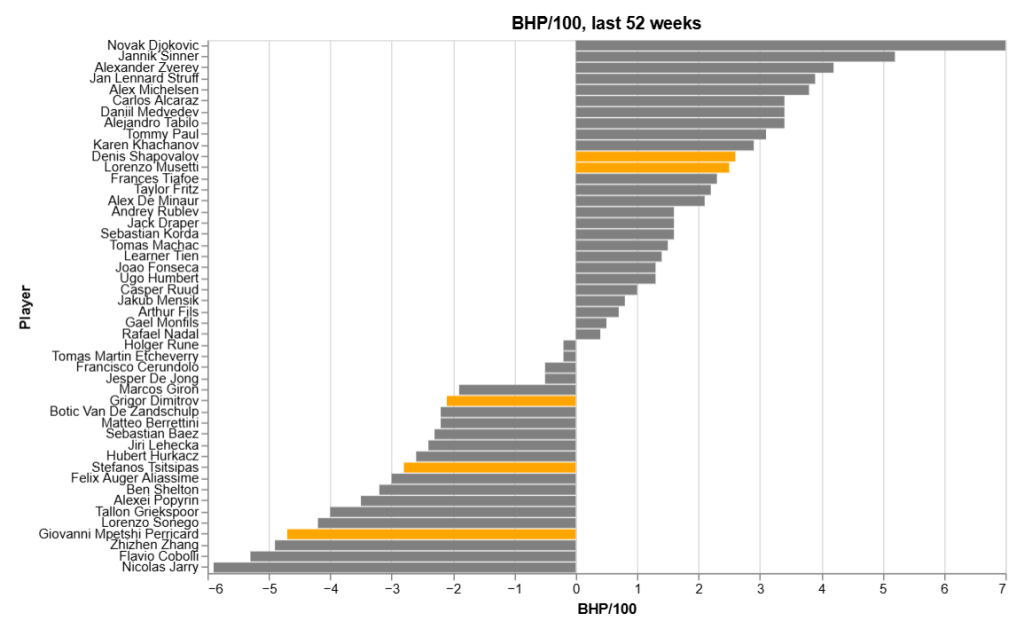
The eye test says yes, but the eye test is not trustworthy when it comes to one-handers. Fortunately, the stats agree. My Backhand Potency (BHP) metric, which balances winners (plus forced errors) against unforced errors, as well as shots that precede one or the other, puts Musetti among the top third of ATP regulars:
The chart shows BHP per 100 backhands for all players with at least 10 charted matches in the last 52 weeks. That includes five guys with one-handed backhands, highlighted in orange. Among those, only Denis Shapovalov is close to the Italian. The other three are in negative territory.
(You can look up other players on the career list. Federer and Stan Wawrinka are both around neutral. Richard Gasquet stands at +2.0, close to Musetti’s current level.)
We don’t have BHP for every match, but there are signs that Musetti’s backhand was particularly effective last week. The stat reached +5.5 in both his second-rounder against Jiri Lehecka and the final against Alcaraz. Whatever the limitations of the one-handed backhand in general, the shot isn’t holding the Italian back.
The best defense…
Topspin backhands, even pretty ones, are best in moderation. Given a choice, just about everyone this side of Alexander Zverev will hit a forehand instead. It’s particularly important to pick the right spots with a one-hander, as the stroke takes more time to prepare. It is also less forgiving when the timing isn’t perfect.
While no single formula applies to everyone, the ideal player will run around some backhands in favor of their forehand, and they’ll skip other backhands in favor of more conservative slices. Here’s how Musetti ranks against his peers over the last year–and the career numbers of a few all-time greats–as measured by forehands-per-groundstroke and slices-per-backhand:
Player              FH/GS  BH Slice%
Grigor Dimitrov     48.5%      55.4%
Lorenzo Musetti     50.5%      39.4%
Stefanos Tsitsipas  52.4%      22.3%
Mpetshi Perricard   55.1%      32.4%
Denis Shapovalov    56.8%      32.4%

Career:
Roger Federer       48.8%      37.0%
Richard Gasquet     45.0%      22.9%
Stan Wawrinka       49.9%      31.3%
The Federer number reminds us that FH/GS isn’t about how often a player would prefer to hit a forehand. Everybody targets the backhand, and the worse your backhand, the more they take aim. So Fed’s 48.8% is what results when far more than half of shots were aimed at that side. He slipped around them for as many forehands as he could justify.
The Italian’s numbers are surprisingly close to both Fed’s and Wawrinka’s. He manages to hit a few more forehands–perhaps because the data we have for him is skewed a bit toward clay–and he slices more than Roger did. That’s a clue as to why Musetti can hold his own on grass: He’s right at home prolonging points with slice backhands.
Forehand-finding is also a clue as to why Lorenzo’s fortunes are on the uptick. Here’s a selection of his FH/GS rate in recent notable clay-court matches:
Match                 Result          FH/GS
2025 Monte Carlo F    L vs Alcaraz    62.0%
2025 Monte Carlo R32  W vs Lehecka    56.0%
2024 Olympics BR      W vs FAA        49.2%
2024 Olympics SF      L vs Djokovic   44.9%
2024 Olympics QF      W vs Zverev     44.8%
2024 Umag F           L vs Cerundolo  41.8%
The Alcaraz match is a tough one to parse, because the stats incorporate Musetti’s attempt to play it out with an injury. But though he lost, he was right there with the Spaniard for the first ten or eleven games. He only needed to hit two plus-one backhands in the entire first set.
However we handle the Monte Carlo final, it should be clear by now that there’s a big difference between 45% and 55% forehands. At 45%, opponents are trying to exploit that wing and the player is happy to hit backhands, a la Zverev or Daniil Medvedev. The Italian may finally be taking a page from the playbooks of compatriots Matteo Berrettini and Lorenzo Sonego, saving his backhand for when he really needs it.
Going hard?
If Musetti is going to make a permanent home in the top ten, he’ll need more hard-court wins. He could get by with an annual romp through clay season, especially if he continues to rack up wins on grass. But the latter seems like a big ask, and there just aren’t enough events on dirt these days for a single-surface guy to find stardom.
The Italian does have a hard-court title: Naples in 2022, where he beat Berrettini in not-so-fast conditions. He added a final last year on speedy courts in Chengdu; the caveat there is that he didn’t face a single top-40 opponent.
Bigger picture: Musetti is 3-11 against top-tenners on the surface, and those three wins don’t inspire confidence. He knocked out a passive Zverev in Vienna last year, beat Casper Ruud in Paris, and got past Diego Schwartzman back in 2021. In those 14 matches, he won fewer than 57% of service points. None of the wins were straight-setters, and all of the losses were.
His game, let’s face it, was made for clay. He’s one of the most passive players on tour. Here are the tour’s least aggressive players–by rally aggression score, a measure of how often the player ends points for good or bad, scaled between -100 and +100–over the last 52 weeks, minimum ten charted matches:
Player            RallyAgg
Daniil Medvedev        -93
T M Etcheverry         -79
Alex de Minaur         -73
Lorenzo Musetti        -58
Sebastian Baez         -53
Rafael Nadal           -53
Alexander Zverev       -47
Gael Monfils           -46
Novak Djokovic         -46
Marcos Giron           -45
Musetti is less aggressive than Zverev. Less aggressive than Sebastian Baez. He hasn’t scored above average on this metric for a single non-grass match in two years.
In other words: He lets the game come to him, and alas… it does.
The tour’s most common surface may be the achilles heel of the one-handed backhand. It is of course possible to win on hard with a one-hander, as Federer showed us for the better part of two decades. To grossly oversimplify, he did it by hiding that backhand. Tstisipas’s recent resurgence in Dubai came from maxing out the aggression on that wing.
You can win on hard courts with passive tennis–go Medvedev!–or you can win on hard courts with a well-shielded one-hander. But it is increasingly clear that you can’t do both. Musetti has proven his potential on both of the game’s natural surfaces, showing off the value of both topspin and slice groundstrokes to do so. That’s enough to make him a top-tenner–barely. To win on hard courts, he will need more Federer-esque tactics to go with his Roger-inspired backhand.
***
Subscribe to the blog to receive each new post by email:
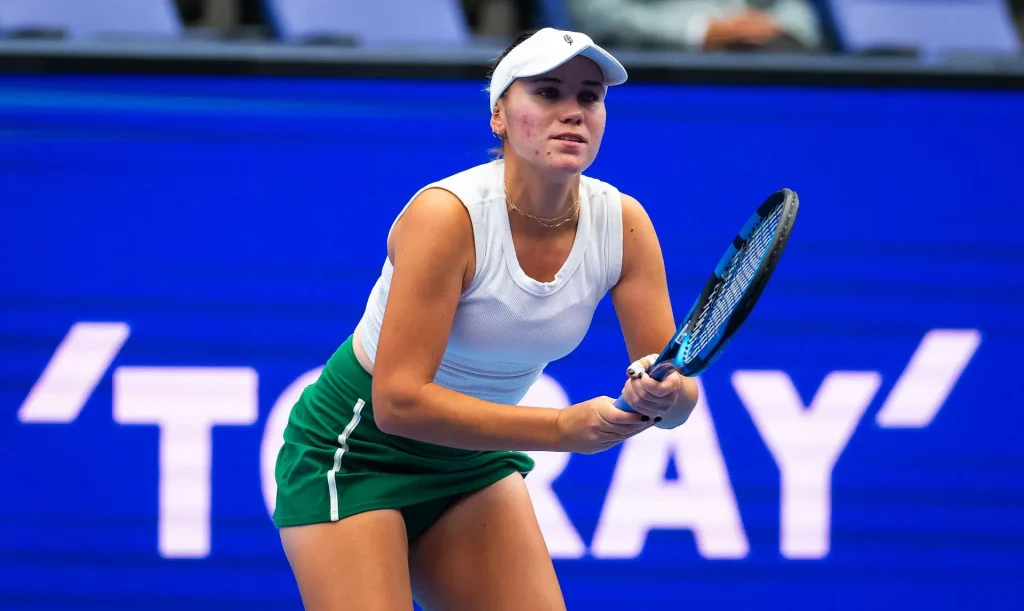
Sofia Kenin in her run to the Tokyo final last year
Is Sofia Kenin back? Was she ever gone? Was she ever there in the first place? Has any player so persistently defied categorization?
Big questions aside, Kenin is suddenly more relevant than she has been in at least 18 months. This time last year, she was suffering through a nine-match losing streak. She would add another bad patch in the summer and fall out of the top 150 before reaching last October’s Tokyo final. Since then, she has lost only one first-round match (when she drew Coco Gauff in Melbourne) and made another 500-level final in Charleston. Kenin had set point on Sunday to force Jessica Pegula into a third set before the veteran summoned her mysterious forces and finished the job.
This is all a far cry from 2020, when the American bracketed the pandemic pause by winning the Australian Open and reaching the French final. But her Charleston showing moves her ranking back up to 34, the highest it has been since late 2023. Her Elo rating is even better, good for 25th on tour.
What is working again for Sonya? Is she back in the top 40 to stay?
Oh, those groundstrokes
When the Kenin game is clicking, it is a joy to watch. She is one of the most versatile players on tour, with the ability and willingness to deploy just about every shot in the book. She tried ten drop shots in the Charleston final against Pegula and sent both forehand and backhand slices across the net. I’ve even seen her win points with moonballs.
In the 2020s WTA, though, versatility can only be the icing, not the cake. Fortunately for the 26-year-old, both her forehand and backhand are among the game’s best. By my Forehand Potency (FHP) metric, she ranks 16th on tour over the last 52 weeks, in between the fearsome weapons of Iga Swiatek and Amanda Anisimova. Her backhand is the signature shot, and it rates even better, coming in 9th.
Combined, she gets more value from her groundstrokes than almost anyone else. Here is the top ten, based on charted matches since this time last year:
Player                 FHP/100  BHP/100  Combined
Jelena Ostapenko          18.7     11.0      29.7
Amanda Anisimova           9.2     14.1      23.3
Aryna Sabalenka           13.0      9.3      22.3
Ekaterina Alexandrova     13.6      8.5      22.1
Danielle Collins          12.7      9.0      21.7
Linda Noskova             14.1      7.4      21.5
Iga Swiatek               10.0      9.0      19.0
Madison Keys              11.3      7.5      18.8
Sofia Kenin                9.4      7.8      17.2
Jessica Pegula             8.3      8.0      16.3
For all the heavy hitters on that list, Kenin is more like Pegula than the rest. She attempts to dictate with placement, not power. Give her an opening, and she’ll rarely squander it. She’ll miss as much as some of these sluggers, but that’s because she relentlessly aims for the lines. The overall tally tilts in her favor.
She falters when she doesn’t have enough space to work with. Pegula, boasting perhaps the best anticipation of anyone on tour, consistently cut down the angles Kenin had to work with on Sunday. Sonya doesn’t have the patience to wait for the next opportunity, so she aimed for narrower and narrower spaces. The result, predictably, was a giant pile of unforced errors. She committed 33 of them off the ground–nearly one in four points.
Speaking of patience: That’s one category where she resembles the power hitters on that last list. Her average point in the past year has averaged just 3.4 shots, the same as Madison Keys and Ekaterina Alexandrova, fewer than Clara Tauson or Donna Vekic. A bit of a paradox is emerging here: Kenin has an impressive range of all-court and defensive skills, but she doesn’t play like it.
Is she a… servebot?
The American doesn’t seem like a weak returner. Aggressive, yes. Too aggressive, maybe. But any woman with such an effective backhand should be able to post decent numbers against the serve.
Yet: It is a constant struggle to break serve. The typical player in the WTA top 50 breaks 37% of the time. Swiatek grades out at 45.5%, and several more women top 42%. Pegula stands at 38.5%. Kenin, at 30.3%, ranks 48th of 50. Here are her peers at the wrong end of the list:
Player                Break%
Lulu Sun               19.7%
Linda Noskova          28.4%
Sofia Kenin            30.3%
Katie Boulter          30.8%
Clara Tauson           31.2%
Magda Linette          31.5%
Xin Yu Wang            32.0%
Donna Vekic            32.6%
Ekaterina Alexandrova  32.9%
Barbora Krejcikova     33.1%
Judging by some of these names, Kenin might be able to sneak into the top 20 with this return game. Vekic is 20th on the WTA points table. Tauson is 21st.
If there’s one characteristic that ties many of these players together, it is that their results run hot and cold. Krejcikova has won two slams but often struggled to get past early rounds. Noskova is a nightmare for Iga but manageable for others. Low break rates mean that the margins will always be narrow: Good for upsets and the occasional hot streak, bad for any semblance of consistency.
Kenin essentially takes the racket out of her own hands. Of players with at least ten matches in the charting database over the last year, only Danielle Collins puts fewer returns in play:
Player                  RiP%  RiP W%
Danielle Collins       61.9%   55.7%
Sofia Kenin            62.5%   54.0%
Ekaterina Alexandrova  63.2%   58.3%
Amanda Anisimova       64.3%   58.9%
Alycia Parks           65.9%   59.6%
Linda Noskova          66.4%   53.9%
Liudmila Samsonova     66.9%   56.6%
Barbora Krejcikova     67.3%   53.9%
Bianca Andreescu       67.4%   54.4%
Madison Keys           68.1%   57.6%
A lot of these names are starting to look familiar. As with the FHP/BHP lists, Kenin shares space with some of the game’s biggest hitters, even if I wouldn’t think of her that way. Maybe she disagrees: She certainly takes chances on return as if she does.
Yet the results aren’t there. The rightmost column, winning percentage on returns in play, shows that Kenin trails Collins, Alexandrova, Anisimova, and most of the rest by a healthy margin. She is roughly equal to Noskova and Krejcikova, though the Czechs get more balls back to start with. It’s fine to win 54% of points if the denominator is big enough–to take one example of many, Paula Badosa stands at 52%–but Sonya loses too many points without forcing the server to hit even one more ball.
As for the question in my subhead: No, Kenin isn’t really a servebot. Her serve itself ranks in the middle of the pack. But alas, her return stats are better suited to someone with a much more powerful first strike.
Same as the old Kenin?
It is tempting to conclude that Sonya’s 2020 was a remarkable streak of luck. She won the Australian Open after sneaking past Ashleigh Barty in the semi-final, winning fewer than 51% of points. She picked up the Lyon title a month later with four three-setters and five tiebreaks. She reached the Covid Roland Garros final even though Samsonova won more points than she did in their first-round encounter.
On the other hand, Kenin is a fundamentally different player than she was five years ago. One indicator is her now-languishing break rate:
34% or 35% isn’t great, but it’s worlds apart from where she is now. Rybakina, while off her own peak lately, gets by with just 36%.
Back then, the American wasn’t so quick to pull the trigger. Based on the 17 matches we have in the charting database, her average point in 2020 lasted 4.1 strokes, another sharp contrast to her 3.4 of the last 52 weeks. 4.1 is at or above tour average, equal to Coco Gauff’s usual mark.
A big part of the difference is that she put more returns in play. In those 2020 matches, she got 71.7% of serves back, nearly ten percentage points higher than her current rate. She also won more of those points:
By just about every metric I have, Kenin is more aggressive now than she was at her best, and the strategy isn’t paying off. Perhaps she feels that she has to hit harder–or at least adopt tactics that mimic her more powerful peers–to keep up. Maybe she has lost a bit of quickness: Ankle and foot injuries sidelined her for much of 2022.
2020-era Sonya, then, is not back. Her form over the last six months suggests she might have landed on something that will work, if not anywhere near her peak level. The stats keep telling us she’s just like Alexandrova, and the risk-taking Russian has spent years in the top 30, picking up a title every year or so and making trouble for her higher-ranked peers. Kenin is on track to do the same.
Yet unlike Alexandrova, Anisimova, and the rest, Kenin is a former slam champ, with memories of an entirely different level of tennis. Performances like Tokyo and Charleston suggest she is getting closer to recapturing that magic. If she starts getting more serves back, then it’s time for the rest of the tour to worry.
***
Subscribe to the blog to receive each new post by email:
On Saturday, Jakub Mensik did it again. Jack Draper was coming off an Indian Wells title, the fortnight of his career, but Mensik was a little bit better. Both sets went to tiebreaks, and twice, at six-all, the 19-year-old Czech took his serving to a new level. He won 14 of 19 tiebreak points and sent the Brit home early.
After such an assured performance, Mensik’s third-rounder felt like a gimme. Roman Safiullin gave him two looks at break points, and that’s all he needed. Behind another monster serve barrage, the Czech waltzed into the fourth round, 6-4, 6-4.
Mensik currently stands outside the top 50, but his ranking doesn’t tell the full story. For one thing, he made his top-50 debut late last year, and his Miami points will almost certainly be enough for him to return. Beyond that, he has proven that he fears no one on tour. Draper was his 6th top-ten win in 11 tries. What’s more, Mensik won a set in three of the five losses, including a meeting in Shanghai last fall with Novak Djokovic.
Djokovic called him “one of the best servers we have in the game.” Indeed, since the US Open last year, the six-foot, four-inch Mensik is cracking aces on more than 15% of his serve points. Only Giovanni Mpetshi Perricard and Quentin Halys rate better among tour players. He has taken things to a new level in Miami. In each of his three matches–against Roberto Bautista Agut, Draper, and Safiullin–he has hit an ace on at least 26% of his serve points. That’s Reilly Opelka-level serve dominance, and even Opelka hasn’t posted three straight ace rates like that since 2022.
Mensik is one of the most exciting prospects on tour, yet Joao Fonseca-mania doesn’t leave much attention to anyone else. What do we make of those top-ten wins… and the non-top-ten losses that have kept him on the edge of the top 50? How should we rate the rest his game–you know, those occasions when he doesn’t end the point with a first serve? Let’s dig in.
Proof of concept
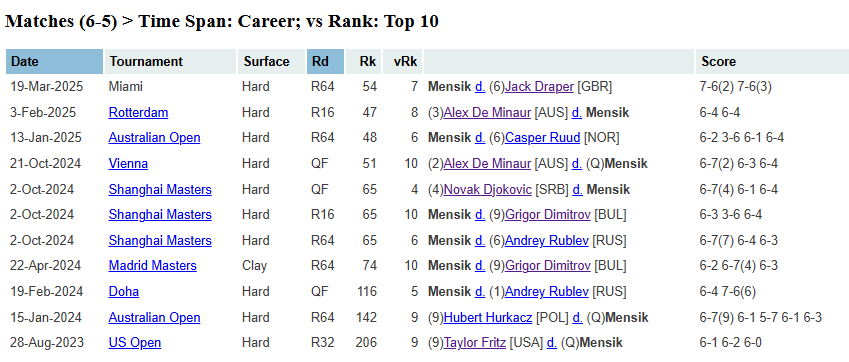
Here is the top-ten record:
Pretty good for someone with another five months left in their teens.
Draper wasn’t the first top-tenner that Mensik overpowered. In the six wins, the Czech held serve 90% of the time, winning three-quarters of first serve points. Djokovic and Alex de Minaur figured out how to neutralize the serve, but lesser returners (read: most other humans) have not.
Even before the Miami upset, Mensik was just the 21st player since the beginning of the ATP rankings to win at least five of his first ten meetings with top-tenners. (I’m excluding players who were already established in 1973, when the points table debuted.) He’s just the 12th ever to win six of eleven. Here’s the full list:
Player               First 10  First 11
Alberto Mancini           7-3       7-4
Miloslav Mecir            7-3       7-4
Fernando Gonzalez         6-4       7-4
Marc Kevin Goellner       6-4       7-4
Lleyton Hewitt            6-4       6-5
Jakub Mensik              5-5       6-5
Ugo Humbert               5-5       6-5
Marcos Baghdatis          5-5       6-5
Marat Safin               5-5       6-5
Carlos Moya               5-5       6-5
Chris Woodruff            5-5       6-5
Magnus Larsson            5-5       6-5
Boris Becker              5-5       6-5
Fabian Marozsan           5-5       5-6
Aslan Karatsev            5-5       5-6
Matteo Berrettini         5-5       5-6
Reilly Opelka             5-5       5-6
Mardy Fish                5-5       5-6
Nicolas Kiefer            5-5       5-6
Henrik Holm               5-5       5-6
Greg Holmes               5-5       5-6
It’s a strong list, if a bit scattershot. We have all-time greats, plus Aslan Karatsev and Greg Holmes, who apparently upset both Mats Wilander and Jimmy Connors. The playing styles might tilt a bit toward heavy hitting and big serving, but not overwhelmingly so.
I mention playing styles because rocket serves, like Mensik’s, have a way of turning matches into coin flips. If the serves aren’t coming back, it doesn’t matter how well the guy returns. Other skills fall by the wayside: We’re headed for a tiebreak. Apart from a pair of early breaks, that’s what happened in the Draper match. John Isner won three of his first ten top-ten encounters, and Opelka earned a spot on this list.
Everything else
When the serves do come back, though, it’s anybody’s ballgame, top-ten opponent or not. For Mensik, just about everything apart from the first serve is a relative weakness. In the last 52 weeks, he has won just 47.4% of his second-serve points, worse than 49 of the top 50 players. (Pedro Martinez is the one guy with a sub-Mensik number.)
The Czech has gotten accolades for his backhand, but it’s not really a weapon. While it doesn’t hold him back, it rates about tour average by my Backhand Potency (BHP) metric. His Forehand Potency is the real issue. At just +1.1 per 100 forehands, he ranks ahead of only a few of his colleagues, including Opelka, Mpetshi Perricard, and Hubert Hurkacz. Hurakcz has proven that it’s possible to hang around the top of the game without much help from the forehand, but it’s a narrow path to follow.
All this adds up to some painful numbers in rallies. I was going to say “long rallies,” but Mensik starts to see a disadvantage about as soon as the word “rally” comes into play. In eleven charted matches over the last 52 weeks (not counting the Draper upset), here are how his results shake out by rally length:
52% on short points is great! That was enough to crack the top ten list when I looked at the same category last week in the context of Draper’s excellence. Since these stats encompass both serve and return, it tells us that he’s cleaning up more of his own quick points than his opponents can manage of their own.
The rest of the story, though, is bleak. He ranks near the bottom in all three of the other categories. If we lump them together, he win the fewest points of anyone with at least ten charted matches in the last year:
Somehow, it gets even worse. With enough short points, weak long-rally skills are survivable. Yet Mensik plays more long points than most of these guys in the bottom ten. The 1-to-3-shot category accounts for less than 63% of his points, while it makes up more than 70% of Mpetshi Perricard’s. Even Jiri Lehecka, hardly an extreme case like GMP, comes in at 66%.
Second to last
Mensik is hardly an elite returner, but he is good enough for now. He has won about 37% of his return points over the last 52 weeks, a rate that–coupled with strong serving–is sufficient to get him into the top ten. Despite his relatively low ranking, he has posted those numbers against high-quality competition. His median opponent has been stronger than those faced by Stefanos Tsitsipas or Casper Ruud.
The immediate concern for the Czech is his second serve. I mentioned earlier that he wins barely 47% of those points. Ben Shelton, who wins exactly as many first-serve points as Mensik does, converts 55% of his seconds. While that’s unusually good, nearly every player in the same first-serve territory wins at least 51% behind the second serve.
This is a good time to remember that Mensik is 19. He hasn’t been six-foot-four for long. It’s possible that his second serve will look entirely different in two years than it does today. He’ll certainly hope so. He misses more than 12% of his seconds, a double-fault rate that would be acceptable only if he were taking chances and reaping the rewards of those risks. At the moment, he’s just struggling.
The second-serve weakness is more than enough to flip the outcome of a match. In the last year, when Mensik has landed at least 60% of his first serves, his record is 16-5. Under 60%, it’s 12-17.
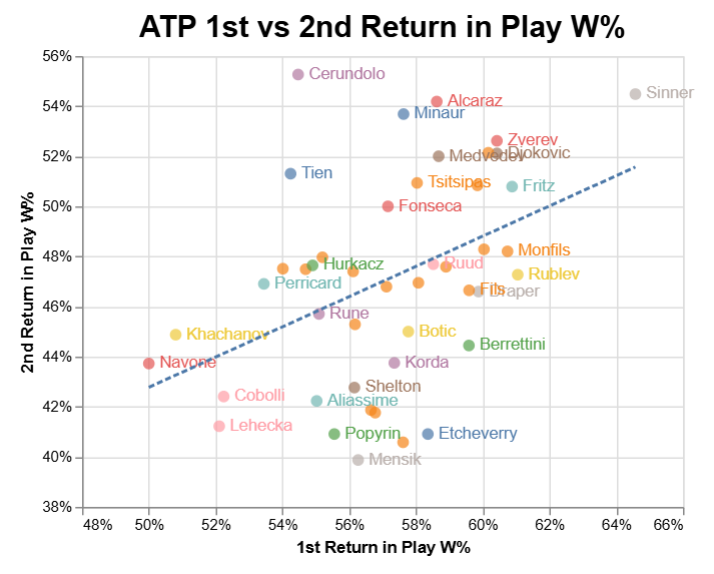
The root of the problem is what happens when the second serve comes back. The Czech’s second delivery isn’t yet strong enough to generate many easy plus-one opportunities, and his ground game isn’t sturdy enough to make up for it. When his first serves come back, his results are close to tour average. But when the second serve comes back, he ranks at the very bottom of the table.
This scatterplot shows every player with at least ten charted matches over the last year. It compares each player’s win rate when their first serves come back with their results when second serves come back. Guys below the dotted line see relatively worse outcomes behind their second serve:
There’s no single limitation that is depressing Mensik’s second-serve results. The positive spin on that is that he has a lot of areas with room to improve. Even an average second serve–seemingly a reasonable goal for a man with such an imposing first–would probably make him a top-20 player.
The way forward
Nothing makes it easier to dream about a big future in tennis than a monster serve. Any list of overrated youngsters is going to be littered with powerful teens who remained too one-dimensional to convert all their aces into tournament victories.
That, I think, is the low-end forecast for Jakub Mensik. If he simply keeps doing what he’s doing, he could be a top-40 or top-50 player for a long time. His first serve is that good, and the rest of his game is adequate. He probably wouldn’t continue to win half of his top-ten meetings, since the game’s top players would have more time to figure him out.
On the other hand, again, he’s 19! The difference between his first- and second-serve results is a statistical oddity, which could mean either that he is uniquely one-dimensional, or that he has plenty of room to develop. The latter seems more likely. He may remain limited on return, but a second serve to match his first would make him near-unbreakable. That’s the recipe for a lot more top-ten wins, and possibly for a single-digit ranking of his own.
**
Subscribe to the blog to receive each new post by email:
On Saturday in Dubai, Stefanos Tsitsipas won his first 500-level title. Just about everything about this was unexpected. He had lost his last eleven finals at ATP 500s. He had dropped four of six matches coming into the event, including three against opponents outside the top 70. He barely deserved to be in the final at all, coming through a quarter-final against Matteo Berrettini in which he won a mere 47% of total points.
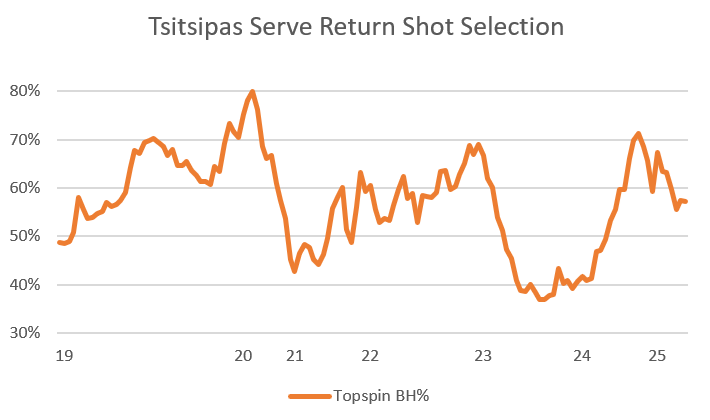
Most of all, the Greek shocked fans with the way he won. For the first time in years, his backhand was a weapon. He took big swings, especially on return of serve. The one-hander was suddenly so fearsome that Felix Auger-Aliassime, his opponent in the final, stopped attacking it. According to my backhand potency (BHP) metric, Tsitsipas’s performance in the semi-final against Tallon Griekspoor was his best on a hard court in more than two years.
For me, this is exciting. How often does a player–in his mid-20s, no less–just, out of nowhere, fix their biggest weakness?
One immediate cause is clear: Tsitsipas swapped out his Wilson racket for a stiffer-framed Babolat Aero. I’ll leave it to the gear experts to dissect exactly how much of a difference that has made. But given the Greek’s tactical shift this week, I have to think that the new racket offered a small boost. More importantly, it provided an excuse for Stef to make some long-overdue changes.
Let’s take a closer look at the new-and-improved Tsitsipas game.
Back(hand) from the brink
I wrote about Tsitsipas a year ago, after he crashed out of Indian Wells to Jiri Lehecka. I focused on Stef’s utter helplessness against first serves to his backhand. No one expects ATPers to win a lot of points against the first serve, but this was dire.
The Greek won just 12% of first-serve return points when Lehecka aimed at his backhand. His ten-match rolling average had fallen as low as 16% in that category, compared to career rates around 23%. At the 2023 Tour Finals against Jannik Sinner, Tsitsipas went oh-for-21 when the Italian first-served to his weaker side.
Of course, this was no secret. Most players mix up their serve direction evenly, rarely hitting more than 60% in either direction. In Acapulco last spring, Alex de Minaur hit 90% of his first serves to the Tsitsipas backhand. Most opponents didn’t go that extreme, but it must have been nice to know that there was a weak point to poke under pressure.
Until about a week ago, nothing had changed. Last fall in Basel, the Greek won barely 10% of first-serve return points when Arthur Fils aimed at his backhand. In Doha just two weeks ago, he salvaged only 15% against Hamad Medjedovic. Griekspoor nearly ousted him in Rotterdam by hitting 71% of his first serves in that direction. So the new look is truly sudden:
Match             1st to BH  inPlay  Pts Won
Prev 10               56.5%   57.7%    23.2%
QF vs Berrettini      67.7%   57.1%    19.0%
SF vs Griekspoor      66.0%   54.8%    29.0%
FI vs FAA             64.7%   72.7%    31.8%
The “previous ten” matches are those indexed by the Match Charting Project, and they run between Tokyo last year through the Medjedovic match. That span looks a bit better than early in 2024, when Tsitsipas’s win rate on these points nearly fell below 20%, but some of that is because he faced weaker servers. Apart from Fils, the span includes two matches against Alex Michelsen and one against Mattia Bellucci.
The Berrettini result doesn’t look like much of an improvement (and again, he won only 47% of points in that match), but it is Matteo Berrettini we’re talking about. Against two more strong servers, Tsitsipas not only leapt beyond his own recent rates, he exceeded tour average. The typical player wins 28% of these first-serve return points. Stef did better.
The Auger-Aliassime result is particularly telling. While Stef has now won seven of ten meetings, Felix has piled up some impressive serve numbers over the years. In Marseille in 2022, the Greek won only 12% of first-serve return points on his backhand side. Back in 2019 when the pair met at Indian Wells, Auger-Aliassime sent 21 first serves in that direction, and Tsitsipas won the point only once.
Back(hand) up
The challenge for every returner is to find a balance between swinging big and playing it safe. Tsitsipas, with his fluctuating confidence in the topspin backhand, sometimes leans too hard on his slice. Slice returns aren’t themselves bad–a deep slice return can instantly snatch the advantage away from the server–but Tsitsipas is rarely the stronger baseliner on court. Settling in for a baseline rally is, for him, a losing proposition.
Surprisingly, Stef’s three matches in Dubai do not reflect a change in overall shot selection. From the time I wrote about his backhand struggles last year, he began hitting more and more topspin first-serve returns. Since the European indoor swing last fall, the rate has drifted back down again, though not as far as its low point, which was probably driven by injury.
This graph shows how often Tsitsipas chose to hit topspin backhand returns (as opposed to chips or slices) against first serves. It shows a ten-match rolling average on hard courts, across more than 130 charted matches since 2018:
The current rate is almost exactly at his career average of 56%. Perhaps that understates his current approach a bit–as noted, he faced some big servers in Dubai, and he’ll always end up hitting more slices to defend against players of their caliber.
This was the biggest surprise for me in the numbers. Tsitsipas looked like a completely different player last week. His backhand returns may well have been qualitatively different. But he didn’t try to attack more of them than usual. The same was true in rallies. His career backhand slice percentage (compared to all backhands) is about 20%, and he continued to land in that range for the final three rounds in Dubai.
Back(hand) in black
This is where I get to say that, yes, the margins in tennis are small. Stef’s one-hander racked up points against Griekspoor, rating 5.5 on my BHP scale. (His average over the last 52 weeks is negative, and no one consistently scores as high as Tsitsipas’s rating in that match.) But against Berrettini, his BHP was slightly negative, and against Auger-Aliassime, it was neutral.
The backhands generated by the Greek’s blacked-out racket made for glittering highlight reels. Yet they do not fully explain the title run. Tsitsipas survived the quarters by the slimmest of margins. He dropped 53% of points and probably would’ve lost the match had it not been for a miraculous half-volley winner at 4-all in the decider. The semis, yes, credit to the backhand in all its glory. The final: unusually steady backhand returns that led a flummoxed Auger-Aliassime to target the Tsitsipas forehand instead.
Assuming Stef adopts his new stick and continues to swing freely with it, the best-case scenario is probably a backhand that is … well, average. Average is not a bad thing! Tsitsipas is one of the elite servers on tour, peaking at an 89% hold rate in 2023. His forehand is a reliable weapon. A year ago, it looked like he was becoming a one-dimensional servebot. He may now be able to avoid that fate.
Where, then, is the equilibrium? Opponents have long feasted on the Tsitsipas backhand, and they won’t give up so easily. Expect servers to push him out wide, where he’ll be stuck continuing to slice. Baseliners will test him to see if they can break the shot down. After years of backhand struggles, both mental and physical, I don’t expect he’ll come through unscathed.
But he doesn’t need to transform into Novak Djokovic. The Greek’s backhand has long been among the bottom third on tour. A step up to average would be worth a point or two per match, something that, at the margin, is the difference between a berth at the Tour Finals and another year-end ranking outside the top ten. Tsitsipas has said he wanted to inspire more youngsters to hit one-handed backhands. Winning more matches would be an excellent way to do that.
* **
Subscribe to the blog to receive each new post by email: