Do Pushers Grow Out Of It?

Is Victoria Mboko a pusher? I was tagged in a Twitter exchange the other day debating that exact question. From watching her play, I would hardly compare her to Ostapenko, but the p-word wouldn’t have come to mind.

Rally Aggression Score puts her at +6, on a scale designed to run from -100 to +100. Based on 27 charted matches from the last 52 weeks, that makes her about neutral, tactically similar (at least along this dimension) to the likes of Belinda Bencic and Karolina Muchova. Counterpunchers, maybe, not pushers.

On the other hand, “neutral” overstates it. Lowell West devised the metric about a decade ago, and the game has changed since then. The way I initially scaled it, Petra Kvitova flirted with triple digits, and that was about it. Now, Dayana Yastremska gets close to 200. Elena Rybakina, at exactly 100 in the last year, ranks only fifth among players with at least five charted matches. There’s nothing so extreme at the other end: Emma Navarro has averaged -68, while the most passive top-tenners are Coco Gauff and Mirra Andreeva at -20 and -30, respectively.

Mboko’s +6, while hardly vintage Wilander, is indeed more passive than the average WTA player in 2026.

Aggressive growth

Will the Canadian change tactics with age? These days, it seems like nearly everyone at least tries to take more chances and hit more winners. (If you don’t, your opponent will!)

I can’t tell Mboko’s future, but I can load up a database and run queries on it.

So, different question: Do players in general change tactics with age? It’s easy to think of examples: Serena Williams got more aggressive over the years. Ostapenko (remarkably) has done the same. I’m not sure there are equally prominent players who have moved in the other direction, but it does seem like some teenagers show up bashing balls, then settle for a more measured game in their 20s.

I took all women with at least 20 charted matches, grouped their rally scores by year, and figured out how much each year’s score differed from their career norms. Average those deviations across all players, and this is what you get:
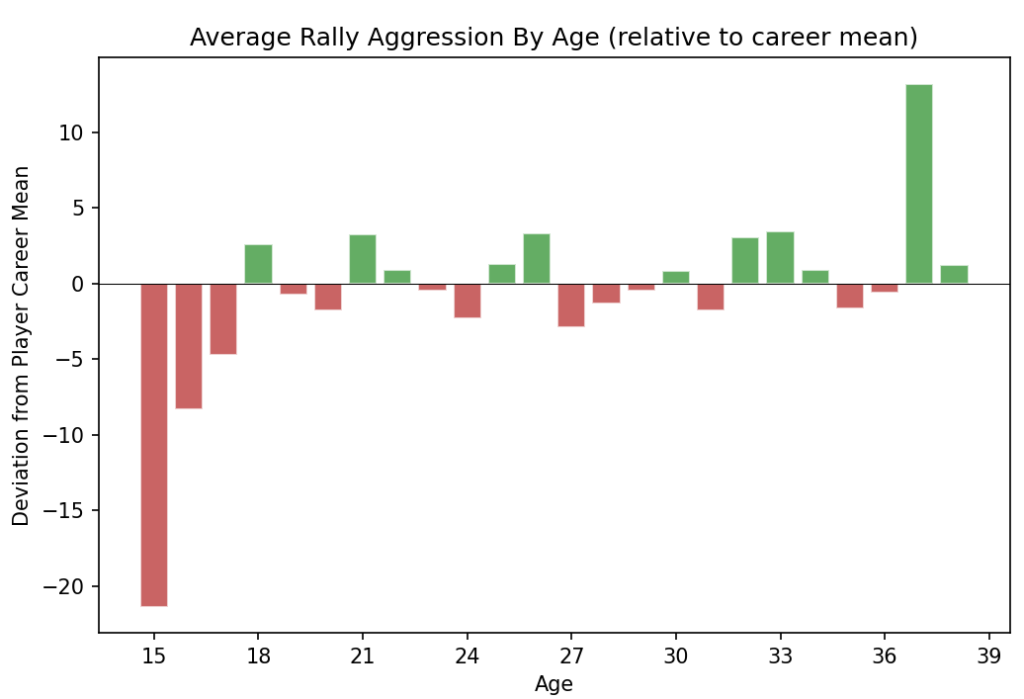
From age 18 to 36–the entirety of most players’ careers–there’s nothing to see here. Plus or minus five points of rally aggression score is a rounding error, especially since these are non-random samples based on what Match Charting Project contributors wanted to chart and could find on video.

The spike at age 37 is also not very instructive: It’s basically Serena Williams, and we already knew that as she aged, she took increasingly few prisoners. From 2007 to 2009, her average aggression score was about +20. In 2019, when she was 37, it was +109.

Still, that climb at the left end of the graph is suggestive. It doesn’t literally apply to Mboko, who is already 19. But it supports a plausible narrative. When young women–especially the youngest prospects–arrive on tour, they aren’t as strong, or perhaps even as tall, as they will soon become. (Even Lilli Tagger recently gained a centimeter.) Their experience is disproportionately against juniors, who are even less physically imposing, relative to adult pros. The typical 16-year-old, no matter how talented, isn’t going to show up on tour and play like Sabalenka.

There are exceptions, of course. Maria Sharapova’s highest single-season aggression score was in 2004, when she was 17. Madison Keys arrived on the circuit playing essentially the same game she would play for the next decade. Iga Swiatek was more aggressive at age 18 than she has been since.

On average, though, the youngest players are more conservative–fewer winners, fewer errors–than they will become as they graduate from their teens. The mechanism could well apply to a 19-year-old, too.

The trend is null

We’re always talking about how players could develop and improve, or what their new coach brings to the table. Yet the undefeated champion of tennis forecasting is the null hypothesis. The null hypothesis, of course, means that you should’ve skipped this entire post and watched a Friends rerun instead.

It is boring, but the best way to predict how a player will look next year is to point at their current results and say, “yeah, just like that.” You can fiddle around the edges and maybe find players on the cusp of something or other, but … no, usually you can’t even do that.

Here are the year-to-year aggression trends of the women with the most matches in the MCP database:
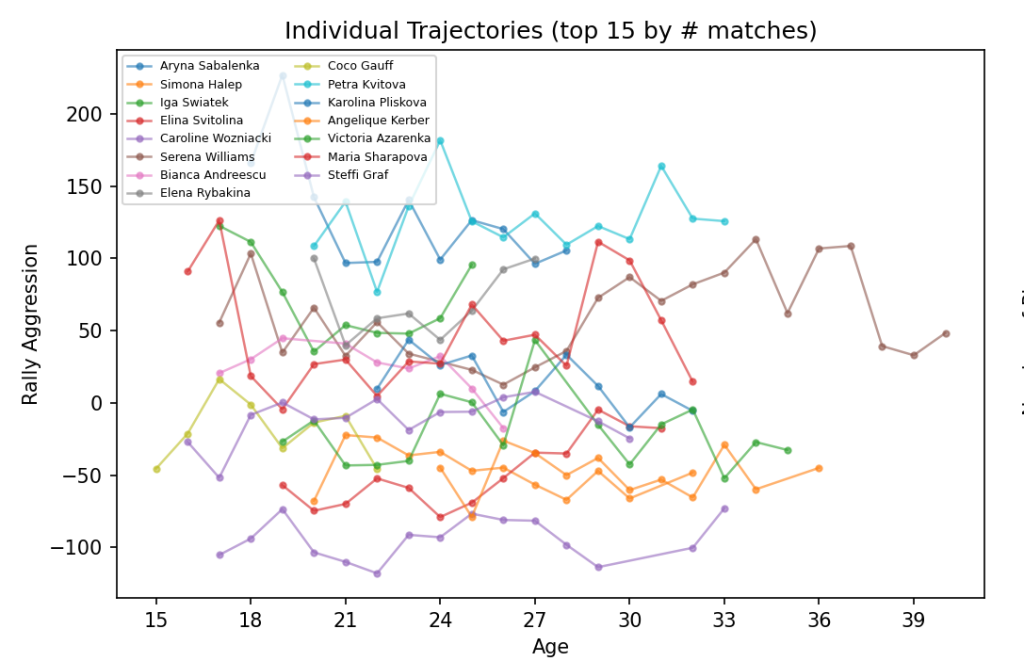
See that trendline that goes from the lower-left corner up to the upper-right? No, you don’t, because it’s not there. The closest is Serena, who dipped to +12 in her late 20s before getting hyper-aggressive in her 30s.

To answer the question posed by my headline, then: No, pushers don’t grow out of it. The style of play you see today is a good predictor of the style of play you’ll see a decade from now.

Lucky for Mboko, then, that she isn’t a pusher. Throughout her career, I’ll bet she tries a lot of new things and incorporates plenty of fresh ideas from a handful of high-profile coaches. The end result may well take her to the top of the rankings: A 19-year-old ranked 6th on the Elo table has a bright future ahead. If she finds a game that takes her all the way to the top, odds are it will look a lot like what we’ve seen so far.
The Rybakina Serves That Tipped the Scale In the Melbourne Final

In Saturday’s Australian Open final, Elena Rybakina won 92 points. Aryna Sabalenka won 92 points. Rybakina won 76% of her first serve points; Sabalenka won 75%. Both players held on to 48% of their seconds. Even their average first serve speeds were nearly identical, Rybakina’s 178 km/h nipping Sabalenka’s 177 km/h.

Only a few moments really mattered. Sabalenka converted two of eight break points. Rybakina converted three of six.

With such narrow margins, we should be cautious to draw conclusions about tactics and player skills. Flip one or two of those break opportunities, and it would have been a very different trophy ceremony. Anybody who tries to tell you “why” Rybakina won should keep that in mind. Still, Sabalenka would surely like to know how to secure another half-dozen points and put the result out of the range of luck. Rybakina will hope to do the same.

Pick target, hit target

Rybakina is the best server in the women’s game. Her ace rate over the last year is better than 10%–a percentage point ahead of second place (Osaka), and miles ahead of Sabalenka’s 6%. Rybakina has won nearly 75% of her first-serve points, while no one else cracks 73% and only a few players are on the north side of 70%.

At key moments on Saturday, Rybakina dazzled with her ad-court serves out wide. She saved the only two break points she faced in the first set with back-to-back unreturned serves, both wide. She finished the match with another signature delivery, acing Sabalenka out wide on match point.

If you’re looking for a “why,” it’s tempting to focus on those wide ad-court serves. Rybakina made 18 first serves when she aimed for that corner, and she won 14 of those points.

But! It’s not the ad-wide corner, specifically. Rybakina was even deadlier when she targeted Sabalenka’s backhand corner in the deuce court. She landed 14 of those first serves, winning 13.

Here’s the Rybakina method for defeating the world number one:

  1. Have a world-class serve
  2. Aim first serves at the backhand corner
  3. Make half of them

Easy, right?

Apparently not easy

Fair enough, most players don’t have anything like Rybakina’s serve. A few–Osaka, Noskova, Qinwen–can do a decent impression on a good day. Still, it’s an uphill battle to knock off Sabalenka with aggression from the line.

What’s striking, though, is that most opponents don’t really try.

Across 120+ charted matches since the beginning of 2024, Sabalenka’s opponents aimed their first serve at her backhand corner about 40% of the time. (That doesn’t mean they aimed 60% at the forehand corner: A fair number of first serves don’t land close to either corner.) In the vast majority of matches, her opponent aimed half or fewer of their first serves at her backhand corner.

On Saturday, Rybakina targeted the backhand corner 63% of the time.

The first serves that landed in were so devastating in part because she took a low-margin approach. Rybakina already misses more first serves than almost anyone on tour: Her 57.4% first-serve-in rate is worse than 45 of the top 50 women. Against Sabalenka, she succeeded exactly half the time when she fired in that direction. Corner-aimed serves are (unsurprisingly) lower-percentage for everybody, but her 50% was even worse than tour average.

It’s a smart tradeoff. Combine the two numbers, and we see that on 32% of her service points, Rybakina put a first serve in play to Sabalenka’s backhand corner. Those, as we’ve seen, are as close to guaranteed points won as you can find. Sure, that leaves 68% of service points to worry about. Yet as much as Rybakina’s premier weapon glitters, she’s a solid average at everything else. She’ll pick up a lot of those other points with quality second serves or rocket-powered firsts to the forehand corner, or by winning baseline rallies.

In the past two years, only a handful of players have managed to put first serves to Sabalenka’s backhand corner on as many as 32% of points. Even then, it doesn’t always work: Marketa Vondrousova, for instance, is unparalleled at hitting her targets, but her deliveries are softballs in comparison. For the players who can serve big, though, Rybakina may have pointed the way to tougher challenges against the world number one.

Ka-zam

This might be a recent refinement to Rybakina’s match tactics. We have over 80 charted matches for her since the beginning of 2024, and she has rarely aimed so many of her serves at the backhand corner. To be clear, she doesn’t need to. She straight-setted Sabalenka for the year-end title in November with only 44% of first serves pointed at that target.

But suggestively, Rybakina hit nearly as many first serves to the backhand corner in her Australian Open quarter-final match against Iga Swiatek. While she wasn’t quite as successful, landing just 40% of those attempts, the end result was encouraging. Even with all the misses, backhand-corner firsts accounted for a quarter of her service points. And she was as eye-poppingly successful on those points against Iga as she was in the final. Swiatek salvaged just 1 of 12.

It remains to be seen whether this is repeatable. When Rybakina is serving at her best, peppering the backhand corner is probably a good way to take advantage. (Unsurprisingly, since this is something tennis coaches tell twelve-year-olds.) If she’s misfiring, low-percentage first serves are probably not the way to fight her way through.

And surely, the world number one will start taking a few more backhand-return reps. She doesn’t have to turn into Andre Agassi to negate Rybakina’s new-found advantage. She just needs to defend that corner a little better. 94 or 95 points would have gotten the job done on Saturday. Even against a world-class serve and superb tactical execution, Sabalenka won 92. The two women will continue jostling for an edge, and it looks like the battle will increasingly take place with Sabalenka leaning to her left.

July 19, 1973: Equal Prize Money

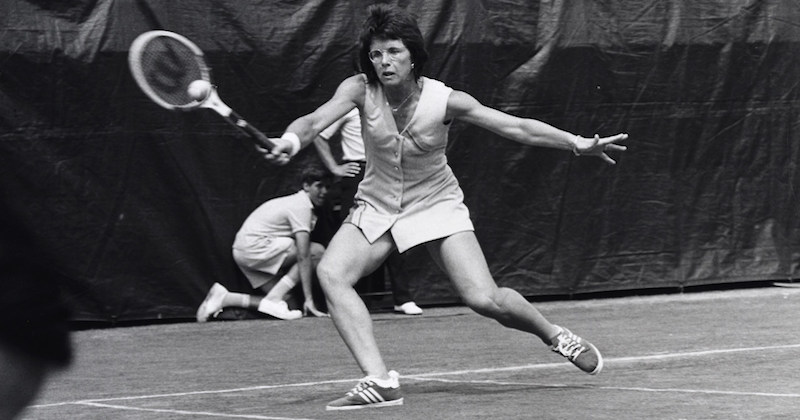
Billie Jean King at Forest Hills

The Women’s Tennis Association was barely four weeks old, and it had already delivered a blow to the prevailing men-first attitude around the sport.

On July 19th, US Open tournament chairman Bill Talbert announced that the 1973 event would be the first-ever major to offer equal prize money to men and women. In 1972, women’s champ Billie Jean King received $10,000 to men’s titlist Ilie Năstase’s $25,000. This year, both winners would get $25,000.

The total prize pot was a record $227,200, and it would be split equally between the genders. Making the difference was a new sponsor, Ban deodorant, which kicked in $55,000. “We feel that the women’s game is equally as exciting and entertaining as the men’s,” said a representative of Bristol-Myers, Ban’s parent company. “We hope that our direct involvement with the 1973 US Open clearly indicates our positive position on behalf of women in sports.”

Talbert agreed. He suggested that the women’s game offered higher-quality rallies, while too many men copied superstar serve-and-volleyers without learning proper groundstrokes to support their attacking game.

If anyone complained about the new reward structure, Talbert said, “I’ll just tell the men to go out and sell their product better.”

First and foremost, the announcement marked an enormous step for King and her WTA brethren. “Thank goodness for Billie Jean King,” said Chris Evert.

Along a different dimension, the Ban “sports grant” signaled how far pro tennis had come in just five years. Gladys Heldman and the initial group of women’s contract pros had recognized from the beginning that female fans and recreational players were an untapped market, and they sold that vision to corporate sponsors like Philip Morris. Talbert was probably right about the quality of the the women’s game, but in another way, it didn’t matter. Ban, and now the US Open itself, understood that prize money was much more than an enticement for top players. Bristol-Myers wasn’t just a purveyor of quality antiperspirants. The company sought to represent a vision of the future.

Jack Kramer, the longtime promoter and now co-founder of the ATP, was slow to learn that lesson. He later wrote that he found another sponsor for the men, as well. To use Talbert’s phrase, the men did sell their product better, thanks to Kramer. But the Open declined the additional money. The tournament decided it was better to offer equal prizes–and align itself with a certain set of values–than to extend the already record sums on offer to half the field.

On this historic occasion, reporters couldn’t help but reach out to Bobby Riggs. The 55-year-old vanquisher of Margaret Court wired back, “I am leaving immediately for Denmark for an operation.” He was talking about a sex change, his chauvinistic way of acknowledging what he had long since figured out: There was an awful lot of money in women’s tennis.

* * *

This post is part of my series about the 1973 season, Battles, Boycotts, and Breakouts. Keep up with the project by checking the TennisAbstract.com front page, which shows an up-to-date Table of Contents after I post each installment.

You can also subscribe to the blog to receive each new post by email:


June 20, 1973: United, Mostly

British star Roger Taylor, who would come under immense pressure to compete at Wimbledon despite his membership in the ATP

A disappointment for the top men and a disaster for Wimbledon, it smelled like opportunity to Billie Jean King. Five days away from the start of the Championships, a British High Court ruled against Niki Pilić, rejecting his request for an injunction against the All-England Club that would allow him to play. There was vanishingly little hope that the ATP would abandon its boycott of the tournament. Dozens of players–including defending champion Stan Smith and 1971 titlist John Newcombe–had already withdrawn.

Wimbledon released its seeding lists. Out of 16 men, only Czechoslovakian Jan Kodeš was not an ATP member. The event got a bit of a reprieve when second seed Ilie Năstase also said he would play, apparently because the Romanian federation ordered him to do so. As David Gray wrote for the Guardian in a front-page story, it was shaping up to be an “Iron Curtain Wimbledon.”

Many women were sympathetic; a few were even prepared to join the ATP’s boycott. Billie Jean, though, was hunting bigger game. “We are in a great bargaining position,” she said, thinking about the appeal of Margaret Court, Chris Evert, Evonne Goolagong, and herself at a sold-out showpiece tournament bereft of its leading men.

Wimbledon planned to pay out the equivalent of $70,500 in prize money to the men and $50,500 to the women. By the standard of tennis distributions in 1973, the imbalance wasn’t egregious. But King targeted full equality, even when her fellow players thought it impossible.

“As for the girls wanting more money,” said tour regular Patti Hogan, “aside from the fact that it can’t be done, there’s no way we could justify this to the public.”

Others didn’t even care. Goolagong said, “I’d be happy to play at Wimbledon even if there was no money.” Evert, who had yet to adopt Billie Jean’s way of thinking, had similar priorities. “I’ve come over here to play tennis,” said the 18-year-old, “and that’s all I’m interested in.”

Once again, King was forced to play the long game. Without a united front that could take on Wimbledon organizers, she sought to create one. On June 20th, she held a meeting at London’s Gloucester Hotel for more than the 60 of her fellow players. By the end of the evening, she had convinced her peers that they needed a players’ union of their own. The Women’s Tennis Association was born. There would be no women’s boycott at the All-England Club, but the new organization would make its presence felt before the summer was through.

In the meantime, Niki Pilić flew home to Yugoslavia. He knew that the battle wasn’t really about him anymore. But this was still Wimbledon, where Pilić had reached the semi-final in 1967. If a compromise did emerge, he was ready to fly back at a moment’s notice.

* * *

This post is part of my series about the 1973 season, Battles, Boycotts, and Breakouts. Keep up with the project by checking the TennisAbstract.com front page, which shows an up-to-date Table of Contents after I post each installment.

You can also subscribe to the blog to receive each new post by email:


May 5, 1973: The Drop Shot Queen

Can’t tell what Rosie Casals will do next? You are not alone.

The 1973 Virginia Slims tour got some criticism for being so top-heavy. Margaret Court won nearly everything. When Billie Jean King was healthy, it could be a two-woman show. Rosie Casals was perhaps third in line, but even she was a tier below the headliners. In eleven events before the Family Circle Cup, she had reached the semi-final at each one. She went 2-9 in those semis. She was 0-2 in finals–against, of course, Court and King.

Rosie was a shotmaker without compare, a skill that made her and Billie Jean the best doubles team in the world. What held her back–and she readily agreed with this–was the mental side of things. (It didn’t help that she was 5-feet, 2-inches tall, either.) But with a record-setting prize at the $100,000 tournament in Hilton Head, she was able to focus. “You’ll go a long way for $30,000,” she said of the first-place check, “even to the point of concentrating.”

The first sign of the improvement came in the semi-finals, against King. Rosie had lost to her long-time pal 14 times in a row, apart form the famous double default at the 1971 Pacific Southwest. Five of their last seven meetings had come in semi-finals, in which Casals had failed to win a set. This time, however, Rosie kept her concentration and took advantage of a subpar Billie Jean. King acknowledged that she had never really gotten going in 1973.

That set up a final with Nancy (Richey) Gunter, who upset an ailing Court in the quarter-finals. The crowd couldn’t have asked for a better contrast. Gunter was a slugging baseliner; Casals was the creative netrusher. The New York Times called it “a marvelous final that dispelled notions over the inability of women to generate excitement on slow clay courts.”

(That’s what passed for a compliment in the early days of professional women’s tennis.)

It was a high-quality match from start to finish. The fifth game of the first set ran to 14 points, 8 of which were ended by winners. Gunter seized the opener, 6-3, before Rosie’s drop shots took their toll. Casals ultimately hit 30 of them, dragging her opponent into unfamiliar territory at the net–and taking advantage of Nancy’s fatigue from the rapid-fire, four-day event. Gunter spent most of the second set guessing wrong, losing 6-1 as Rosie unleashed droppers off of both her forehand and backhand wings.

Still, Gunter nearly claimed the $30,000. She came within two points of victory at 5-4, 30-15 in the decider. Casals evened the game with a chalk-spitting drop shot, then took the advantage with a passing shot winner when a befuddled Gunter came forward of her own accord. Rosie held for 6-5, then triumphed in a remarkable 43-stroke rally at 30-all in the 12th game. Gunter missed a forehand to give Casals the set and the match, 7-5.

“I didn’t want a tiebreaker,” said the champion. “I don’t think I could have made it.”

Rosie more than doubled her prize money on the year to a total of $58,500. Only Court had won as much in 1973. Only a handful of women had ever done so well from a single year of tennis, and it was still May.

With the match behind her, Casals could finally relax. The wisecracking Californian was as good an interview as ever. Asked who she would like to thank, she had a list ready: “Nancy, Margaret, Billie Jean–and everyone else who lost.”

* * *

This post is part of my series about the 1973 season, Battles, Boycotts, and Breakouts. Keep up with the project by checking the TennisAbstract.com front page, which shows an up-to-date Table of Contents after I post each installment.

You can also subscribe to the blog to receive each new post by email:


April 30, 1973: Truce

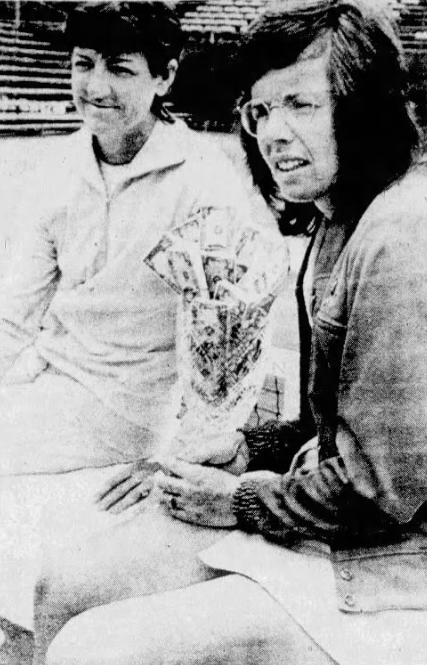
Margaret Court (left) and Billie Jean King holding a Waterford vase full of cash ahead of the $100,000 Family Circle Cup in Charleston

“In tennis,” said a Philip Morris staffer involved with the company’s sponsorship of the women’s game, “it seems like it takes three to tango.”

Quite a challenge, he might have added, when two of them despise each other.

When the Open era began in 1968, the sport’s governing bodies made it clearer than ever that women’s tennis was not a priority. Many tournaments went men-only, and equal prize money was a pipe dream. In September 1970, the “Original Nine” women players, managed by magazine publisher Gladys Heldman and supported by Joseph Cullman of Philip Morris, struck out on their own. Independence was the only possible path to respect.

By 1973, the Philip Morris-backed Virginia Slims tour was a thriving concern. Tennis boomed as both a spectator sport and a recreational activity for men and women alike. The women still relied on Cullman’s support, but the tour’s stops around the United States–led by stars such as Billie Jean King and Margaret Court–were major events, drawing thousands of fans.

The USLTA belatedly realized what it was missing. Just a few years earlier, the organization had put women’s stars on outside courts and signed off on prize money distributions that sometimes gave men nine-tenths of the pot. Now, it scrambled to organize a women-only circuit. With a combination of financial inducements, appeals to personal loyalty, and threats–the Slims tour was non-sanctioned, after all–the USLTA attracted a decent slate of players.

The mud-slinging began even before the first ball was struck. The US federation had the power to ban American players from events such as the US Open. Now with its own tour, the USLTA served warning that it might do just that. Heldman filed suit in January, charging an “illegal trade boycott,” among many other offenses.

“Heldman” became a dirty word in USLTA circles. But the real victims were tennis fans. Both Slims and USLTA events could be outstanding: The Slims didn’t lack for stars, and the presence of young Chris Evert on the federation circuit guaranteed a solid turnout at every stop. Yet the events paled in comparison to what could have been. Neil Amdur of the New York Times wrote that the divide “saddled both circuits with watered-down player draws and produced dull, often routine first-round matches.”

Marilyn Fernberger, a long-time tournament promoter in Philadelphia, was more direct. “The girls have to get together,” she said. “They’re not strong enough to make it alone. If they don’t, they’ll only hurt themselves and women’s tennis in the long run.”

Little progress was made until April, when the stakes rose even higher. The ILTF, the international governing body that worked closely with national associations, said that it would ban all Slims players–not just the Americans–from federation-run events around the world. King, Court and the rest would be suspended from Wimbledon, the US Open, and every other notable tournament for the rest of 1973.

A reporter asked King what she would do if the ILTF blocked her from entering Wimbledon. Well, she said, she’d probably have to sue.

In the end, the whole kerfuffle was shown to be nothing more than a cash grab. The three sides–the USLTA, Philip Morris as the backer of the Slims tour, and the players–sat down on April 27th. The outline of a deal was quickly reached: Philip Morris would pay $20,000 to the federation in lieu of sanction fees. No players would be suspended. The tours would continue to operate as planned over the summer, and Heldman would manage a combined circuit after the US Open.

The players made it official when they okayed the deal on April 30th. They met the ILTF’s deadline, so they could compete in Europe over the summer. Billie Jean, in particular, was relieved. As the lead player representative, she had faced the stress of the circuit’s legal situation at the same time that she promoted the tour and attempted to win a title every week. Now she could head to Hilton Head, South Carolina, and compete for a record-setting $30,000 winner’s check at the inaugural Family Circle Cup.

Arthur Ashe had been through similar struggles in the men’s game. In mid-April, a reporter asked him about the Slims situation. “There has to be cooperation, a meeting of the minds,” Ashe said. “The sport has never been this big before. So everyone is going to have to have that spirit of cooperation and pull together. There’s enough for everybody.”

So it proved–especially once the federation got out of the way.

* * *

This post is part of my series about the 1973 season, Battles, Boycotts, and Breakouts. Keep up with the project by checking the TennisAbstract.com front page, which shows an up-to-date Table of Contents after I post each installment.

You can also subscribe to the blog to receive each new post by email:


Aryna Sabalenka at One Hundred Percent

Aryna Sabalenka played her first match at Indian Wells on Friday, handily beating Evgeniya Rodina. Sabalenka won the first set 6-1, then took a 3-0 lead in the second. Commentator Mikey Perera noted that Sabalenka’s win probability had reached 100%, though he (correctly!) expressed skepticism with the number.

Win probability has steadily crept in to tennis broadcasts. Often we’re shown pre-match percentages along with the change up to the current moment in the match. The silliness of a 100% mid-match win probability has a pedestrian explanation: The numbers are usually given as integers. For most fans, there’s no important difference between 55.7% and 58%, but in extreme cases, another significant digit would come in handy.

So, was the broadcast algorithm correct?

My Elo-based pre-match forecast set Sabalenka’s chances at 94.8%. To get mid-match predictions, we need more granular stats. Sabalenka has won 65.5% of serve points and 46.7% of return points this year (including the Rodina match), and if we nudge the RPW up to 47%, those components predict a 94.7% chance of a Sabalenka victory–virtually equivalent to the Elo forecast.

Plug those numbers into my win probability model with Rodina serving at 1-6, 0-3, and Sabalenka’s chances of victory are 99.7%. Round to the nearest integer, and sure enough, you get a 100% chance of victory. It might have felt that way for Rodina.

In fact, Sabalenka crossed the “100%” (99.5%) threshold in the previous game. She cleared 99.5% at 2-0, 15-0, slipped back under the line when she fell to deuce, then reclaimed it each of the two times she gained ad-in.

So far, I’ve used a relatively simple model to forecast the remainder of the match. (And it’s certainly sufficient for these purposes.) But if we were putting money on the outcome–especially if the first ten games of the match had gone in a less predictable direction–we’d want to do something more sophisticated. I’ve assumed that from 6-1, 3-0, Sabalenka would play the way we could have predicted before the match. In this case, that’s a sound assumption. But a better method would take into account the results of the match itself up to that point.

Through ten games, Sabalenka was playing better than the initial forecast of 66.5% on serve and 47% on return. Her success rate on serve was a bit worse, at 64.4%, but she was destroying any service advantage of Rodina’s, winning nearly 55% of those points. Had we known before the match that she would play that way, our pre-match forecast would have given Sabalenka a whopping 99.4% chance of victory.

Using that pre-match forecast, our prediction at 6-1, 3-0 would have been an overwhelming 99.97% for the favorite.

As the match progressed, then, we gained more and more information that the in-match performance–whether due to the conditions, the players’ fitness or mood on the day, the matchup, or any number of other factors–would be even more lopsided. Had we taken everything into account at 6-1, 3-0, we would have calculated some mix of 99.7% (based on pre-match numbers) and 99.97% (based on in-match performance). The degree to which we should weight each of those numbers is the tough part. Determining the correct weights is a complicated questions; suffice it to say that the correct answer is somewhere in between the two.

The broadcast algorithm jumped the gun with its 100% win probability, though only a bit. No matter how lopsided a match, anything can happen–but it probably won’t.

100 Years of Women’s Tennis History

Exactly one year ago, I updated Tennis Abstract with some missing 1970s and 1980s WTA tournaments. I tweeted this progress report:

https://twitter.com/tennisabstract/status/1332072224858255363

I didn’t know it then, but it was the beginning of an all-engrossing project to massively increase the amount of historical women’s tennis data available–not just on TA, but in any organized, easily-accessible form.

In the last year, TA has gained nearly a quarter of a million women’s singles match results going back a full century, to 1921. We all now have the ability to browse through the results of players from the 1920s the same way that we do players of the 2020s. It’s incredibly cool, and it constitutes a huge step toward a better understanding of tennis history.

The state of play

Until last November, Tennis Abstract’s database of women’s results was built on a combination of what I was able to find from the WTA and ITF websites. For contemporary players and their predecessors from the last few decades, that was enough. But as my tweet indicates, it didn’t even encompass the 80 matches of the greatest rivalry in tennis history. The WTA site still doesn’t display records of many top-tier events from the 1970s.

With Evert-Navratilova squared away*, I went to work on the remainder of the Open Era. Thanks to the Blast From the Past forum and John Dolan’s book, Women’s Tennis 1968-84, I was able to add results for the entire Open Era, including qualifying rounds and challenger-level events.

* I now have 81 of the 80 Evert-Navratilova matches, including one exhibition.

Of course, top-flight women’s tennis didn’t begin out of nowhere in 1968, and once you can look at a few thousand matches from 1968 and 1969, curiosity begins to take hold. Margaret Court and Billie Jean King began their careers in the early 1960s, so wouldn’t it be nice to know exactly what they were up to for the better part of the decade?

The amateur era

However incomplete the historical record was for the 1970s, it was considerably worse before 1968. Wikipedia has grand slam draws and not much else. The heroes of the next phase are the contributors to tennisforum.com’s Blast From the Past section.

Blast contains extensive results for the entire history of women’s tennis, accumulated over two decades. It’s a truly incredible project, the sort of thing that no single person could’ve accomplished on their own. The year-by-year forum entries have complete singles draws for notable events (and many minor ones), and doubles and mixed doubles finals for most tournaments. To give you an idea of just how serious an undertaking this is, the forum topic for 1930 has over 5,000 singles match results from that season alone. A small group of tireless contributors typed all those up.

The downside of typed-up results is that they are very cumbersome to search. There are other issues, like inconsistent player names, since a single player might go by a maiden name, a married name, abbreviations or initials, and nicknames over the course of her career. (Not to mention typos!) To address those inherent limitations, you need a proper database.

247,000 singles matches

That database is what I’ve been doing for the last year. Working backwards one year at a time, I’ve pushed the dataset back to 1921, which–incidentally–gives us almost the entire career of Helen Wills. The project has involved hundreds of hours of proofing, player matching (all those name variations I mentioned), and lots of good old-fashioned data entry. While I’ve developed some automated tools to speed things up, there’s a limit to how much a process like this can be accelerated.

In the process, I’ve jumped over to the newspaper-research side of things, filling in the gaps of the Blast From the Past forum’s extensive coverage. My best estimate is that I’ve added about 20,000 results to the dataset, mostly for North American events before World War II. It’s fascinating if occasionally mind-numbing, and looking at old newspapers can be distracting enough to threaten my progress entirely.

All told, from 1921 to the mid-1990s, the Tennis Abstract database has gained almost a quarter of a million matches since that tweet last year, and it now encompasses a reasonably complete view of the final 47 years of the amateur era.

How you can dig in

Amateur-era players are shown on Tennis Abstract in a nearly identical manner to that of current players. In addition to Wills, here are links for Althea Gibson, Maureen Connolly, and Simonne Mathieu. You can find most of these players using the search box or via the exhaustive yearly summary pages, like these for 1925, 1945, or 1965.

Player and yearly summary pages show Elo ratings for women who played a certain number of matches. There’s a ton of information beyond the simple list of results.

For those of you who would like to do your own calculations, ratings, or other data exploration, I’m also releasing all the raw data on GitHub. Releases of new seasons usually happen several weeks later than the results first hit the TA website, so the GitHub repo currently goes back to 1927. The format is the same from 1927 to the present, so if you’ve worked with my data before, you’ll find the historical results to be in a familiar format.

Black tennis

An interest that has grown into a sizable side project is the history of segregated tennis. In most histories, Black tennis starts with Althea Gibson. Yet the American Tennis Association and various local outfits created a thriving tennis scene for Black players as early as the 1910s, long before the USLTA (now USTA) integrated their events.

Beyond contemporary newspaper writeups, results from Black tournaments have rarely been published. Using sources such as the Chicago Defender, the New York Amsterdam News, and the Baltimore Afro-American, I’ve been able to reconstruct draws, discover forgotten tournaments, and start to piece together career records for women who weren’t allowed to compete elsewhere.

One fascinating place to start is the player page for Ora Washington, the greatest Black player of the pre-Althea era. She spent her winters playing basketball so well that she’s now a member of that sport’s Hall of Fame. Based on her record as a tennis player, the folks in Newport ought to honor her tennis exploits as well.

Challenges and caveats

This is the sort of project that, quite simply, will never be finished. Yes, we can close the door on certain tournaments, such as most majors and certain other events with top-flight competition. But there’s no clear line between amateur era tournaments worth including and worth skipping, so there’s always more to hunt down. And even some of the events of the greatest historical interest–like the national tournaments of the aforementioned American Tennis Association–are poorly represented in the dataset, simply because I can’t find more than a few match results.

Another central challenge has to do with names, and it gets worse the further back we go. Newspapers often identified players only by their last name, sometimes including a first initial. Is this “M Smith” in a London-area draw in the 1920s the same as that “M Smith” in a different London-area draw in the 1920s? I have no idea! There are hundreds of questions like this, and I can’t imagine we’ll ever answer even a fraction of them. Newspapers also made lots of mistakes. Even an august publication like the New York Times would occasionally mix-and-match the first names of players. “Madelon Westervelt” is surely the same as “Madeleine Westervelt,” but is “Margaret Westervelt” the same person? (In this case, probably, but you get the idea.)

When you combine spotty source data, hand-made tools to help automate things, and the bleary-eyed researcher that I often am, you end up with bugs. Lots and lots of bugs. If you poke around the site for long, you’ll surely find some. When you do run across something that looks wrong, feel free to let me know, and please be patient. I want to resolve known bugs, but I also want a more exhaustive dataset. Balancing those two goals–along with other aims such as not alienating my family–often results in long wait times for bugfixes.

Thanks for reading all this far. I’ll be writing more about pre-Open Era topics in 2022, and when I’m not doing that, I’ll be pushing back in the 1910s and beyond.

The Best at Getting Better

Here’s a stat you probably didn’t know*. Since the restart, the WTA top five in first-serve points won are Naomi Osaka, Serena Williams, Ashleigh Barty, Jennifer Brady, and … Maria Sakkari.

** unless you’ve been listening to me podcast lately.

The first four names are to be expected: Osaka, Williams, and Barty are probably the top three offensive players in the game, period, and Brady makes her money with big serving. Sakkari is the one who stands out. She does many things well, but I would never have thought to put her in this group, ahead of the likes of Karolina Pliskova, Aryna Sabalenka and, well, everybody else.

Sakkari’s first serve might be the best-kept secret in the women’s game, in large part because it hasn’t been around to keep secret for long. When she started playing tour events, her serve was quite weak, and it has only gradually improved since then. That’s what I marvel at. In six seasons at tour level, all with at least 18 matches played, here are her rates of first-serve points won:

Year     1st Win%  
2016        58.6%  
2017        59.7%  
2018        63.7%  
2019        65.2%  
2020        66.5%  
2021        69.9%

This probably doesn’t need further explanation. Fewer than 60% of first serve points isn’t very good, 70% is excellent, and improving from one to the other is a massive accomplishment. But in case you’re not convinced, here’s the same progression along with percentile rankings, showing that Sakkari started her career better than only 13% of her peers, and this year is outperforming 93% of them:

Year     1st Win%  Percentile  
2016        58.6%          13  
2017        59.7%          20  
2018        63.7%          53  
2019        65.2%          67  
2020        66.5%          79  
2021        69.9%          93

Players can and do improve, but they usually retain the same relative strengths and weaknesses throughout their career. The Greek star has broken that mold, and there’s a natural follow-up question: Has there been anyone else like her?

Meet Kiki

Here’s the simple filter I used to identify players who had substantially improved this aspect of their game. For every player with a full season in which they won fewer than 60% of first-serve points (almost exactly the 20th percentile), I identified those who eventually recorded a full-season in the top half of WTA players, roughly 63.3% or better.

From 2010 to 2021–yes, an awfully short span, due to the limited availability of historical WTA match stats–112 different players posted a sub-60% season. 26 of them went on to an above-average year. One example is Carla Suarez Navarro, who won 59.0% of first-serve points in 2010, and peaked at 64.0% (56th percentile) in 2016. That’s a respectable progression, but far from Sakkari’s standard.

Here are the 10 players who improved on a sub-60% season to eventually manage a season of 65% or better, ranked by the best level they attained:

Player       Weak   1st%  %ile  Strong   1st%  %ile  
K Bertens    2015  59.5%    18    2019  71.9%    97  
M Sakkari    2016  58.6%    13    2021  69.9%    93  
D Kasatkina  2017  59.0%    15    2021  66.4%    78  
S Halep      2012  56.4%     3    2014  66.4%    78  
Y Shvedova   2011  59.4%    17    2016  66.1%    75  
A Cornet     2011  58.9%    14    2020  66.1%    75  
M Linette    2016  59.9%    21    2020  65.8%    73  
Y Wickmayer  2012  60.0%    22    2017  65.8%    72  
A Sasnovich  2016  58.4%    11    2018  65.1%    67  
S Stephens   2011  59.7%    19    2015  65.0%    66

Kiki Bertens wasn’t quite as bad as Sakkari at her worst, but she wasn’t getting much benefit from her first serve. Like the Greek, she had back-to-back seasons below 60%, but unlike Sakkari, her improvement was instant. She leapt from sub-60% in 2015 to almost 68% (86th percentile) a year later. You won’t be surprised to hear that her ranking catapulted upwards as well, from 104th at the end of 2015 to 22nd a year later.

Kiki’s several years since also bode well for Sakkari. Her first-serve winning percentage of 67.4% last year was her worst since crossing the 60% barrier. A slightly less optimistic story comes from Simona Halep, whose 78th percentile mark in 2014 remains her career best. Coming from such an abysmal starting point, it’s remarkable that Halep has improved as much as she has, but she remains firmly in the range of good-but-not-great in this dimension of her game.

Steady improvements

There’s no particular advantage to spreading out one’s gains over a half-decade, like Sakkari has. If she had been given the option of picking up eight percentage points in a single year, like Bertens did, she would’ve taken it.

Still, the fact that the Greek keeps marching upwards is what makes her ascent so fascinating to me. In the decade-plus of data available, no other woman has improved her first-serve win percentage for five years running. Only two players–Yulia Putintseva and Saisai Zheng–have enjoyed positive bumps for four consecutive seasons, and neither situation really compares. Zheng’s improvement took her from 53.2% in 2015 to 59.3% in 2019, and Putintseva rose from 57.9% in 2017 to 62.4% so far this year. While both are making the most of what they have, neither has fundamentally transformed the type of threat they bring on court the way that Sakkari has.

In search of a better comparison–any comparison–with this five-year streak of gains, I turned to the more extensive set of ATP match stats, which go back to 1991. In those three decades, I found exactly 10 players who improved in this department for five (or more) consecutive years. It’s a decidedly diverse group, with a few names you might recognize:

Player            Streak  Start %ile  End %ile  
Renzo Furlan           6           2        73  
Slava Dosedel          6           2        16  
Julien Benneteau       5          16        55  
Arnaud Clement         6          18        70  
Michael Chang          5          18        92  
Roger Federer          5          47        94  
Thomas Enqvist         5          58        94  
Boris Becker           6          79        99  
John Isner             7          82        98  
Marc Rosset            5          87        98 

The starting and ending percentiles indicate that this list includes players who began bad and ended a bit less bad, servebots who started great and eked even more out of their biggest weapon, and then a handful of Sakkari-esque figures who steadily went from considerably below average to far above it.

Michael Chang is the closest parallel of the group, even if we don’t have complete match stats for the first few years of his career. In 1991 he was one of the best returners in the game, but winning barely two thirds of his first serve points wasn’t enough to keep him in the top ten in an offense-dominated era. Five years later he was winning 77% of his first deliveries and ended the season at his peak ranking of #2. He couldn’t sustain the elite-level serving stats, but he did have a few more above-average years.

And then there’s Roger Federer. I’ll leave it to Sakkari fans to work out whether his presence on this list can tell us anything about her future.

Ave Maria

This is all just a long way of saying “wow!” There are other aspects of Sakkari’s game that she has improved, though none so consistently and dramatically. Once you start looking at year-to-year trends for individual stats, future projects start to multiply: identifying peak ages for different parts of the game, determining which stats are more or less likely to regress to the mean, finding which ones best predict ranking climbs, and so on.

We’ll get to some of those answers eventually. In the meantime, I’ll be watching Sakkari with new, better-informed eyes.

Love-Six? No Problem

Last week, Tsvetana Pironkova dealt Aryna Sabalenka a rough start to her Miami campaign: a 6-0 first set. It took two more hours and a third-set tiebreak to settle the issue, but ultimately Sabalenka came back, shrugging off the abysmal opening frame.

It’s not the first time Sabalenka has completed such a comeback. In 2018, she overcame a bagel opener at the hands of Marketa Vondrousova at ‘s-Hertogenbosch, and famously, she recovered after losing the first 10 games in Ostrava last fall to Sara Sorribes Tormo. She didn’t just claw her way back against the Spaniard, she won the next 12 in a row–not to mention her next 13 matches after that.

Remarkably, these three matches are the only times Sabalenka has lost a first-set bagel at tour level. She’s won them all.

Context, please

Three-set comebacks are common in women’s tennis, but as you might guess, they are less common when the first set is a lopsided one. A 6-0 or 6-1 opener suggests either that the players are mismatched, or one of the competitors is having a particularly good or bad day.

Approximately one-third of matches go to a third set, and about one in six end up in favor of the woman who lost the first one. But when the opening frame is a bagel, those numbers are roughly halved–more than four in five of the matches are put away in straights, and fewer than 8% of the 0-6 losers complete the comeback.

Here are the numbers for every opening set score, drawing on all WTA tour-level matches since 2000:

Score  p(3 Sets)  p(Win)  
0-6        18.6%    7.5%  
1-6        24.3%   10.9%  
2-6        29.3%   14.4%  
3-6        33.2%   17.4%  
4-6        37.1%   21.0%  
5-7        36.0%   20.1%  
6-7        39.7%   22.7%  
Total      32.0%   16.8%

All else equal, losers of close first sets have a much better chance at coming back than those who drop lopsided openers.

About those 7.5%

All else is never equal, so it isn’t right to say that Sabalenka had a one-in-thirteen chance of coming back against Sorribes Tormo or Pironkova. A top player who loses an opening set is much more likely to bounce back than, say, Renata Zarazua, the qualifier who lost 6-0 6-0 to Angelique Kerber the same day as Aryna’s latest exploit. Zarazua isn’t that bad, but the odds she’d win the last two sets were much worse than Sabalenka’s.

Yet in the 2000s, no one has done what the Belarussian has, winning all of the matches in which she loses a love-six opening set. She’s three-for-three, and no one else is even two-for-two at tour level.

Sabalenka has a ways to go to catch Klara Koukalova, who came back from a first-set bagel six times, more than anyone else on tour this century. It took her 24 tries, which still works out to an impressive conversion rate of 25%. By contrast, Sorana Cirstea has been first-set-bageled 19 times, and has yet to turn any of them around.

There are more meaningful aspects of Sabalenka’s powerful and entertaining game, but at the moment, her perfect record after love-six openers is my favorite.