Surface Sensitivity and Ugo Humbert’s Serve

Ugo Humbert in 2023. Credit: Hameltion

Let’s start off with a couple of puzzles. I realize they aren’t the sort of things that keep most of you up at night, but they were odd enough to drive me to a flurry of coding, data analysis, and now blog writing.

On Wednesday, Ugo Humbert lost his first-round match in Rotterdam to Emil Ruusuvuori. It marked an unceremonious end to a hot streak for Humbert: He not only won the title in Marseille last week–launching himself into the Elo top ten–but he strung together 31 consecutive holds. 1,000 kilometers north, on a different indoor hard court, he got broken twice by a man ranked outside the top 50.

That’s the first puzzle: Why did the Frenchman lose? Again, it’s not that odd, as my Elo ratings gave Ruusuvuori a one-in-three shot to pull the upset. But it’s a match that Humbert should have won.

Head-scratcher number two: Why does Humbert always lose to Ruusuvuori? Wednesday’s decision marked their fifth meeting, and the Finn is undefeated. While the outcome is always close–Rotterdam was their fourth deciding set, and the other match went to two tiebreaks–the results are starting to get boring. Ruusuvuori is a solid player, and he is consistently able to blunt the Frenchman’s serve. But five in a row?

The answer to both mysteries is the same, and it’s more satisfying than I expected. Rotterdam is unusually slow for a hard court, especially indoors. Like most (or perhaps all) of the previous Humbert-Ruusuvuori venues, it plays slower than tour average. Just as important, Humbert’s game is unusually sensitive to surface speed. While that isn’t always true of big servers, he stands out as a fast-court specialist. We couldn’t have confidently predicted a Finnish upset, but we could have guessed that the Marseille champion would find this week’s tournament tougher going.

Rotterdam, it’s slow

The last time I published surface speed numbers, in late 2019, Rotterdam rated as the slowest indoor hard court on tour. Adjusting for the mix of players at the event, there were 10% fewer aces at the tournament than expected. It was a sharp decline from 2017 and 2018, when the venue sported more typically speedy indoor conditions.

Since then, the results have remained similar. Last year, the rate was 5% lower than expected, roughly tied with Stockholm as the slowest indoor surface on tour. Marseille, by contrast, gave players 12% more aces than usual.

There are limitations to using aces as a proxy for surface speed; I use aces because it’s the most relevant data that is widely available. Still, while you can quibble about the methodology or about a specific tournament’s place on the list, the overall rank order seems about right. Aces–adjusted for each event’s field–tell you much of the story.

With a growing mass of Match Charting Project data, we can do a little better. We have shot-by-shot logs for over one thousand matches since 2021. To compare conditions, I used my Serve Impact metric, which estimates how many points a player wins, directly or indirectly, because of his serve. It counts aces, other unreturned serves, and a fraction of the service points that take longer to decide. Depending on your motivation in measuring court speed, this isn’t perfect either: It doesn’t directly tell you anything about bounce height, for instance. But if you want to know what sort of players a tournament favors, Serve Impact gets you close.

By this more sophisticated metric, Rotterdam is… still slow. The venue takes away 4% of the points a player typically earns from his serve. Marseille and Montpellier each swing 7% in the other direction, Stockholm and Vienna provide a modest 3% boost, and Basel adds 8% to the server’s punch. With the exception of the short-lived tour stop in Gijon, Rotterdam has been the slowest indoor hard court of the 2020s. Even the clay in Lyon plays faster.

Here are the Serve Impact adjustments for the tournaments best represented in the dataset. Higher numbers mean faster conditions with more points decided based on the serve:

Tournament            ServeImpact  
Stuttgart                    1.29  
NextGen Finals               1.20  
Tour Finals                  1.16  
Wimbledon                    1.11  
Shanghai Masters             1.11  
Halle                        1.10  
Queen's Club                 1.08  
Basel                        1.08  
Washington                   1.08  
Dubai                        1.07  
                                   
Tournament            ServeImpact  
Antwerp                      1.05  
Gstaad                       1.05  
Australian Open              1.04  
Davis Cup Finals             1.04  
Cincinnati Masters           1.04  
Paris Masters                1.03  
Vienna                       1.03  
Miami Masters                1.02  
Madrid Masters               1.01  
US Open                      1.01  
                                   
Tournament            ServeImpact  
Canada Masters               1.00  
Rotterdam                    0.96  
Indian Wells Masters         0.95  
Rome Masters                 0.92  
Acapulco                     0.87  
Barcelona                    0.87  
Roland Garros                0.83  
Monte Carlo Masters          0.83 

Average Serve Impact is around 34%, so the 4% hit in Rotterdam knocks that down to about 32.6%. Humbert has an above-average serve, so the slow-court penalty is greater still. He isn’t going to win any awards for rallying prowess, especially against someone as sturdy as Ruusuvuori, so the points that he doesn’t secure with his serve will disproportionately go against him.

The first three meetings in the Humbert-Ruusuvuori head-to-head were on clay, at Roland Garros, Madrid, and Rome. The fourth came on grass, at ‘s-Hertogenbosch. It rates a bit faster from 2021-23 than Halle or Queen’s Club by the Serve Impact metric, though it rated as the slowest grass court on tour last year by my older ace-rate algorithm. Maybe it was less server-friendly in 2023, just in time for Humbert to be flummoxed once again.

Surface sensitivity

We tend to take for granted that players are suited to conditions in predictable ways. Big servers like fast surfaces, right? Broadly speaking, yes, but it’s not a hard-and-fast rule. Bounce height makes a difference, footwork matters, and some players are just more comfortable on some surfaces than others.

Armed with surface speed ratings, this is something we can test. If a player is particularly sensitive to conditions, each tournament’s Serve Impact rating should have a predictable influence on his match outcomes. I tried that for all tour regulars, controlling for player strength by using overall Elo ratings at the time of each match.

The resulting numbers are an abstraction on top of an abstraction, so they’re a bit difficult to get your head around. I’ve tried to simplify matters by rendering them in terms of Elo points. A player who is very sensitive to surface and does better on hard courts is, effectively, a better player in faster conditions. The ‘Sensitivity’ numbers given here are the benefit–denominated in Elo points–of each single percentage point that a surface is faster than average. For players who like it slow, negative numbers express the same idea, the Elo-point advantage of a one-percentage-point slowdown.

Here is the list of all players with at least 100 tour-level matches since 2021, plus Rafael Nadal:

Player                       Sensitivity  
Tallon Griekspoor                   11.1  
Ugo Humbert                          9.5  
Richard Gasquet                      9.1  
Novak Djokovic                       8.7  
Adrian Mannarino                     7.9  
Sebastian Korda                      4.9  
Jordan Thompson                      4.3  
Matteo Berrettini                    4.0  
Aslan Karatsev                       3.6  
Tommy Paul                           3.4  
Marcos Giron                         2.9  
Marton Fucsovics                     2.9  
Marin Cilic                          2.6  
Felix Auger-Aliassime                2.1  
Hubert Hurkacz                       1.7  
                                          
Player                       Sensitivity  
Frances Tiafoe                       1.6  
Carlos Alcaraz                       1.4  
Emil Ruusuvuori                      1.3  
Brandon Nakashima                    1.3  
Cristian Garin                       0.6  
Alexander Zverev                     0.5  
Alexander Bublik                     0.5  
Ilya Ivashka                         0.0  
Arthur Rinderknech                  -0.1  
Taylor Fritz                        -0.3  
Jan Lennard Struff                  -0.3  
Lorenzo Sonego                      -0.4  
Mackenzie Mcdonald                  -0.5  
Andy Murray                         -0.9  
Grigor Dimitrov                     -1.1  
                                          
Player                       Sensitivity  
Roberto Bautista Agut               -1.2  
Alex de Minaur                      -1.2  
Karen Khachanov                     -1.4  
Jannik Sinner                       -1.4  
Yoshihito Nishioka                  -1.5  
Miomir Kecmanovic                   -1.9  
Andrey Rublev                       -2.2  
Daniel Evans                        -2.2  
Cameron Norrie                      -2.5  
Holger Rune                         -2.9  
Roberto Carballes Baena             -3.0  
Botic van de Zandschulp             -3.1  
Daniil Medvedev                     -3.4  
Denis Shapovalov                    -3.5  
Sebastian Baez                      -3.7  
                                          
Player                       Sensitivity  
Laslo Djere                         -4.1  
Dusan Lajovic                       -4.1  
Pablo Carreno Busta                 -4.4  
Jaume Munar                         -4.6  
Fabio Fognini                       -4.8  
Nikoloz Basilashvili                -4.9  
Casper Ruud                         -5.0  
Diego Schwartzman                   -5.4  
Francisco Cerundolo                 -5.9  
Alexei Popyrin                      -6.4  
Albert Ramos                        -6.8  
Rafael Nadal                        -9.9  
Alejandro Davidovich Fokina        -10.1  
Stefanos Tsitsipas                 -10.2  
Lorenzo Musetti                    -11.2 

There’s Ugo! He’s not quite as surface sensitive as Tallon Griekspoor, but a couple of points is within the margin of error. A sensitivity rating of 9.5 means that Humbert is about 100 Elo points worse in Rotterdam than he is Marseille, as long as I’ve accurately estimated the server-friendliness of the respective playing conditions. Ruusuvuori may also like it faster, but only marginally so; he’s effectively neutral.

Keen-eyed readers may have noted that I earlier referred to “overall” Elo. I’m not using surface-specific Elo ratings here, because I don’t want to adjust for surface twice. Surface-specific ratings already capture some of this: Humbert’s hElo (for hard courts) is 120 points higher than his cElo (for clay courts), which tallies reasonably well with these more fine-grained distinctions. What hElo and cElo can’t tell us, though, is how much his (or anyone else’s) performance will vary on the same surface, depending on the conditions at each specific venue.

It’s easy to get lost in the weeds of Elo-based forecasting calculations, but it’s important to remember they are just tools to help measure a real-world phenomenon. Not every big server is equally at sea on clay; some dirtballers are less dependent on slow conditions than others. Small differences in surface speed are, for most matchups, a minor consideration. But for some players, conditions matter a lot. Ugo Humbert likes his surfaces fast, as much as almost anyone else on tour. In Rotterdam, the conditions did not cooperate.

* * *

Subscribe to the blog to receive each new post by email:
 

Welcome to the Show, Luciano Darderi

Luciano Darderi in 2023. Credit: jmmuguerza

Italian tennis hardly needs any more prospects, but Luciano Darderi has announced himself as yet another young player to watch. The Argentinian-born right-hander turns 22 today, three days after securing his debut ATP title. He came through qualifying in Cordoba, and in just his third appearance in a tour-level main draw, knocked out the 2nd, 4th, and 7th seeds en route to the championship.

Darderi is a supercharged clay courter, comfortable on dirt yet possessing a serve and forehand that will play on faster surfaces. He cracked 25 aces in the Cordoba main draw, plus another 11 in qualifying. On Sunday, fellow qualifier Facundo Bagnis got barely half of Darderi’s first serves back in play. Against Sebastian Baez in the semi-finals, the Italian ended 22 points with a forehand winner or forced error and, as we will see, held his own from the baseline against one of the game’s most stubborn defenders.

Though the magnitude of Darderi’s breakthrough came out of nowhere, he has been inching toward a double-digit ranking for some time. He reached 13 Challenger quarter-finals last year, advancing to three finals and collecting a pair of titles. He finished the year ranked 128th and gained 60 places with the victory in Cordoba, ensuring he’ll have plenty more chances to prove his mettle on tour.

He hasn’t hesitated to take advantage, dropping just three games in beating Mariano Navone in Buenos Aires yesterday. The victory extended the Italian’s winning streak to eight and shows just how fast he is developing, having lost to Navone in a bruising Challenger final just a few months ago.

It won’t always be so smooth for Darderi: The hard-court skew of the top level of the circuit may not prove hospitable to a youngster who has played 84% of his career matches on clay. Even with the right weapons in hand, it will take some time to become more than just a dark horse on the Golden Swing. But that’s all in the future: Darderi’s 22nd birthday is an ideal opportunity to dig into the upsets that lifted him from Challenger warrior to the top 100.

Bullying the little guy

The defining win of the Italian’s week in Cordoba was the semi-final. Baez struggled at the end of 2023, but he is always a tough out on clay, especially coming off a third-set-tiebreak victory in Davis Cup. At just five-feet, seven-inches tall, the Argentinian relies on speed and defense, neutralizing the weapons of larger men. It doesn’t always work–his serve puts him at an immediate disadvantage, and he can become overly aggressive and error-prone to compensate–but he doesn’t give much away.

Despite his size, Baez doesn’t mind going toe-to-toe with an opponent’s best shot. In 19 clay-court matches tracked by the Match Charting Project since the beginning of 2022, Baez’s opponents have hit forehands–excluding service returns–as 61% of their baseline shots, compared to a tour-wide clay-court average of 55%. Thomaz Bellucci found the forehand 72% of the time against the Argentinian; Tallon Griekspoor clocked in at 71%.

Both lost. No matter what the shot, if you find yourself in a rally with Baez, your odds aren’t good. When you hit a forehand after the service return, your chances of winning the point are 45%; with a backhand, your chances are 44%. (Tour averages on clay are 53% and 47%, respectively.) Some individual cases are downright comical. In the 2022 Bastad quarter-finals, Dominic Thiem won just 27% of points when he hit a forehand. When the two men met again in the Kitzbuhel final last year, Thiem relied a bit more on his backhand. Alas, he won only 14% of points when he hit one of those.

Darderi ran around a few backhands to find his bigger weapon, but he generally refused to take the bait. He waited for his spots to attack one of the toughest men on tour to be patient against. This table details the results he got from his forehands and backhands in the semi-final:

                   FH/GS  FH W%  FH Wnr%  FH UFE%  
Darderi vs Baez    55.4%  50.6%    12.2%     8.5%  
Average vs Baez    60.6%  45.2%    10.4%    12.0%  
                                                   
                   BH/GS  BH W%  BH Wnr%  BH UFE%  
Darderi vs Baez    44.6%  48.5%     6.1%     6.8%  
Average vs Baez    39.4%  43.8%     6.3%    10.3%

The Italian hit fewer forehands than the usual Baez opponent, and it won him more points, in part thanks to hitting winners at a higher rate and coughing up fewer unforced errors. His backhand numbers were favorable as well, perhaps in part because he set up for backhands in places where other opponents would go for an inside-out forehand. He was particularly stingy with free points on that wing.

Despite possessing the bigger gun, Darderi let his opponent make the mistakes. Baez obliged, piling up 32 unforced errors, including an uncharacteristic 11% of his backhands. Winning percentages of 50.6% and 48.5% hardly make for good headlines, but coupled with a big serve, they are enough to beat Baez. Few players on tour have been able to manage the same.

Tailored attack

The classic clay-court baseline weapon is the inside-out forehand, a salvo that might not end the point, but will pull the opponent out of position and leave the court open for a finishing blow. Darderi can win matches with that shot, as he did in the final against Bagnis. His left-handed opponent kept sending balls to his backhand corner, and the Italian ran around a lot of them. More than half of Darderi’s forehands in the final were inside-out, and he won the point 78% of the time he hit one. The match wasn’t close.

As we’ve seen, though, manufacturing forehands against Baez is a trap. The Argentinian can blunt the angle and absorb the pace, and meanwhile, his opponent is out of position. When Thiem had his terrible day in Bastad, he hit 62 inside-out forehands, only 16 of them in points that he won. (He typically wins more than half, as does the tour as a whole.) Whether by preparation or intuition, Darderi took those chances much less often, and far less frequently than he would against Bagnis. Just one in six of his forehands were of the inside-out variety, and he won just shy of half those points.

Instead, with Baez accustomed to playing defense on the backhand side, Darderi attacked to the forehand. While he didn’t go crosscourt particularly often, he hit hard when he did. 22% of his crosscourt forehands ended the point in his favor with a winner or forced error. That shot can be a slightly favorable play against Baez–opponents win 47% of those points, compared to 45% for forehands overall–but only Nicolas Jarry has cleaned up against Baez in this category the way that Darderi did. It’s way too early to draw any conclusions about how the Italian’s game will fare on tour, but when you share the top of a forehand leaderboard with Jarry, you’re doing something right.

A big serve and a forehand isn’t enough: Nearly everybody has those, even if Darderi’s forehand has a bit of extra mojo. Upsetting the forehand-neutralizing Baez, especially in between victories against less complicated opponents, is a sign that the Italian has resources between his ears as well. Every week, it seems, Italian tennis looks a little bit better.

* * *

Subscribe to the blog to receive each new post by email:
 

Elena Rybakina and the Value of Average

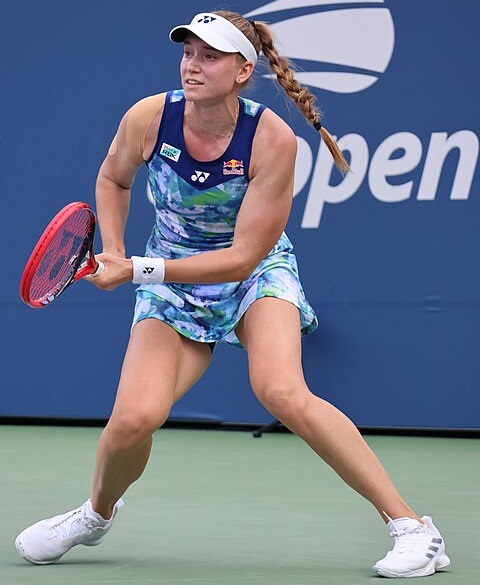
Also today: Ugo Humbert in the (Elo) top ten; South American Davis Cup hard courts

Elena Rybakina at the 2023 US Open. Credit: Hameltion

Never underestimate average. Establishing oneself on the top level of the pro tennis circuit is extraordinarily difficult; proving that any particular skill is average among one’s tour-level peers is even harder. Most players are better than the norm in some categories, worse in others. Anyone who can beat the middle of the pack in every department is virtually guaranteed to be a superstar.

Average is Elena Rybakina’s secret weapon. You probably didn’t know she needed one, because she has a very effective, very evident non-secret weapon: an unreadable bullet of a first serve. In the last year, over 43% of her first serves have gone unreturned. No one else on tour comes within three percentage points of that, and only five other women top 35%. On a good day, the serve can put a match out of reach nearly on its own. When she faced Aryna Sabalenka in Beijing last fall, 65% of her first serves didn’t come back. Most women barely manage to win that many first serve points, let alone decide them with one stroke.

I’ll come back to the serve in a moment, because it is so remarkable, and it would be strange to talk about Rybakina without discussing it. But what makes her a contender every week–not to mention a champion in Abu Dhabi yesterday–is the way that the rest of her game doesn’t hold her back. Among the other women who end points with more than 35% of their first serves, you’ll find a long list of weaknesses. Qinwen Zheng doesn’t put nearly enough of them in the box. Donna Vekic and Caroline Garcia struggle to break serve. Liudmila Samsonova doesn’t break much, either, and her mistakes come in excruciating, match-endangering bunches.

Lopsided player profiles make sense. Only a few people have the combination of natural gifts and discipline to develop a dominant serve. Tennis skills are correlated, but not perfectly so. Someone who serves like Vekic can often learn good-enough groundstrokes and secondary shots. But players with one standout skill are unlikely to be solid across the board. Just because someone is top ten in the world in one category, why would we expect them to rank in the top 100 by a different measure?

Rybakina has reached the top–or close, anyway–by coupling a world-class serve with a set of skills that lacks defects. (You can nitpick her footwork or technique, but none of that holds her back when it comes to winning enough points.) After we review the devastation wrought by her serve, we’ll see just how average she otherwise is, and why that wins her so many matches.

First serves first

I’ve already given you the headline number: Since this time last year, 43.4% of Rybakina’s first serves haven’t come back. That’s one percentage point better than Serena Williams’s career rate. Serena’s numbers are based on matches logged by the Match Charting Project, a non-random sample skewed toward high-profile contests against strong opponents, so I’m not ready to say outright that Rybakina is serving better than Serena. But I’m not not saying that–we’re within the margin of error.

Some back-of-the-envelope math shows what kind of gains a player can reap from the best first serve in the game. Rybakina makes about 60% of her first serves–lower than average, but probably worth the trade-off. (And improving–we’ll talk about that in a bit.) When the serve does come back, she wins about half of points, roughly typical for tour players. All told, 43% of her serve points are first-serve points won. Tack on about half of her second serve points–she wins 48% of those, better than average but not by a wide margin–and we end up with her win rate of 62.5% of serve points–fourth-best on tour.

Put another way: We combine one world-class number (unreturned first serves) with a below-average figure (first serves in), one average number (success rate when the serve come back), and one more that was slightly better than average (second-serve points won). The result is an overall success rate that trails only those of Iga Swiatek, Sabalenka, and Garcia. That, in case you ever doubted the value of an untouchable first serve, is the impact of one very good number.

The key to Rybakina’s first serve–apart from blinding speed–is its unreadability. She must lead the tour in fewest returner steps per ace, a stat I dreamed up while watching the Abu Dhabi semi-final on Saturday. Samsonova seemed to stand bolted to the ground, watching one serve after another dart past her. After one business-as-usual ace out wide, Samsonova even offered a little racket-clap of appreciation, an unusual gesture for such a routine occurrence.

In addition to the deceptiveness of a nearly identical toss and service motion, Rybakina is effective in every direction. There’s no way for an opponent to cheat to one side, hoping to get an edge on a delivery in that corner of the box. Here are Elena’s rates of unreturned first serves and total points won in each corner of the two service boxes:

Direction   Unret%  Won%  
Deuce-Wide     36%   69%  
Deuce-T        45%   75%  
Ad-T           37%   70%  
Ad-Wide        42%   74%

The average player ends points with their first serve between 20% and 25% of the time and wins 60% of their first serve points. Rybakina obliterates those numbers in every direction. If there’s a strategy to be exploited, it’s that returners ought to lean toward their forehand, because if the serve comes to their backhand, they don’t have a chance anyway.

The scariest thing for the rest of the tour is that the 24-year-old’s biggest weapon may be getting even bigger. Her 43.4% rate of unreturned first serves in the last 52 weeks compares favorably to a career clip of 38.2%. Against Samsonova on Saturday, over 41% of all serves didn’t come back, better than Rybakina managed in any of their four previous meetings.

She may be getting savvier, too. One of the dangers of a game built around a single weapon is that certain players might be able to neutralize it. Daria Kasatkina, Elena’s opponent in yesterday’s final, is just such an opponent, a resourceful defender and a first-class mover. When the two women played a three-and-a-half-hour epic in Montreal last summer, Kasatkina put three-quarters of first serves back in play, something that few women on tour could manage and one of the main reasons the match stretched so long. Rybakina survived, but she was broken ten times.

Yesterday, Kasatkina was as pesky as ever, getting almost as many balls back as she did in Montreal. But Rybakina took fewer chances with her first strike, perhaps as much to counter the wind as to adjust for her opponent. Whatever the reason, Elena made three-quarters of her first serves. She had never landed more than 61% against Kasatkina.

The Abu Dhabi final was an exaggerated example of a longer-term trend. Somehow, Rybakina is making way more first serves than ever before, sacrificing no aces and only a fraction of first-serve points won. The overall results speak for themselves:

Year    1stIn%  1st W%   Ace%   SPW%  
2024     66.8%   70.9%  10.3%  64.8%  
2023     56.8%   73.6%  10.5%  62.8%  
Career   57.8%   71.1%   8.4%  62.0%

It’s not a perfect comparison, because the entire 2024 season so far has been on hard courts. Her season stats will probably come down. But a ten-percentage-point increase in first serves in? Nobody does that. Kasatkina won just five games yesterday, and she won’t be the last opponent to discover that whatever edge she once had against Rybakina is gone.

Average ballast

As Ivo Karlovic can tell you, the best service in the world can take you only so far. Some first serves will go astray, some serves will come back, and then there’s the whole return game to contend with. Women’s tennis rarely features characters quite as one-sided as Ivo, but Vekic and Garcia illustrate the point, struggling to string together victories because their serves alone are not enough.

Here’s a quick overview of how the rest of Rybakina’s game stacks up against the average top-50 player over the last 52 weeks:

Stat     Top-50  Elena  
2nd W%    46.7%  48.4%  
DF%        5.2%   3.9%  
RPW       44.4%  44.2%  
Break%    35.5%  36.9%  
BPConv%   46.6%  43.5%

She’s somewhat better than average behind her second serve, as you’d expect from someone with such a dominant first serve. It’s aided by fewer double faults than the norm. On return, we have two separate stories. Taking all return points as a whole, Rybakina is almost exactly average, matching the likes of Barbora Krejcikova and Marta Kostyuk. The only category where she trails the majority of the pack is in break point conversions–and by extension, breaks of serve.

The discrepancy between Rybakina’s results on break points and on return points in general may just be a temporary blip. Most players win more break points than their typical return performance, because break points are more likely to arise against weaker servers. That hasn’t been the case for Elena in the last 52 weeks, and it wasn’t in 2022, either, when she won 41.9% of return points that year but converted only 40.5% of break opportunities.

Match Charting Project data indicates that she is slightly more effective returning in the deuce court than the ad court; since most break points are in the ad court, that could explain a bit of the gap. Charting data also suggests she is a bit more conservative on break point, scoring fewer winners and forced errors than her normal rate, though not fewer than the typical tour player. It may be that Rybakina will always modestly underperform on break opportunities, but it would be unusual for a player to sustain such a large gap.

In any case, she hasn’t struggled in that department in 2024. In 13 matches, she has won 46.9% of return points overall and 47.3% of break points. It’s dangerous to extrapolate too much from a small sample, especially on her preferred surface, but it may be that Rybakina’s single weak point is already back to the top-50 norm of her overall return performance.

The value of all this average is this: What Rybakina takes with her first serve, she doesn’t give back with the rest of her game. We’ve already seen how a standout rate of unreturned first serves–plus a bunch of average-level support from her second serve and ground game–translates into elite overall results on serve. A tour-average return game generates about four breaks per match. Elena has been closer to 3.5, but either way, that’s more than enough when coupled with such a steady performance on the other side of the ball.

I can’t help but think of Rybakina’s “other” skills as analogous to the supporting cast in team sports. Her first serve is an all-star quarterback or big-hitting shortstop; the rest of her game is equivalent to the roster around them. In baseball, a league-average player is worth eight figures a year. Though Elena’s return, for instance, doesn’t cash in to quite the same degree, it is critical in the same way. A superstar baseball player can easily end up on a losing team, just as Caroline Garcia can drop out of the top 50 despite her serve. Rybakina is at no risk of that.

A final striking attribute of Rybakina’s game is that her array of tour-average skills can neutralize such a range of opponents. Her weekend in Abu Dhabi was a perfect illustration, as she overcame Samsonova and Kasatkina, two very different opponents, each of whom has bedeviled her in the past. Elena is more aggressive than the average player, but she is considerably more careful than Samsonova; her Rally Aggression Score is equivalent to Swiatek’s. She was able to take advantage of the Russian’s rough patches without losing her own rhythm or coughing up too many errors of her own.

Against Kasatkina, she posted the most unexpected “average” stat of all. In a matchup of power against defense, defense should improve its odds as the rallies get longer. On Sunday, the two women played 15 points of ten strokes or more, and Rybakina won 8 of them. In her career, Elena has won 52% of those points–probably more by wearing down opponents with down-the-middle howitzers than any kind of clever point construction, but effective regardless of the means.

Rybakina won’t beat you at your own game. But she’ll play it pretty well. Combined with the best first serve in women’s tennis, drawing even on the rest is a near-guarantee of victory. Abu Dhabi marked her seventh tour-level title, and it will be far from her last.

* * *

Ugo Humbert, Elo top-tenner

You probably don’t think of Ugo Humbert as a top-ten player, if you think of him at all. The 25-year-old left-hander cracked the ATP top 20 only a few months ago, and his title last week in Marseille gave him a modest boost to #18.

Elo is much more positive about the Frenchman. Today’s new Elo rankings place him 9th overall, just behind Hubert Hurkacz, the man he defeated to reach the Marseille final. Humbert has always been dangerous against the best, with a 22-25 career record facing the top 20, and a 10-12 mark against the top ten.

Humbert’s place in the Elo top ten might feel like a fluke; there’s a tightly-packed group between Hurkacz at #8 and Holger Rune at #13, and an early loss in Rotterdam could knock the Frenchman back out of the club. But historically, if a player reaches the Elo top ten, a spot in the official ATP top ten is likely in the offing.

I wrote about this relationship back in 2018, after Daniil Medvedev won in Tokyo. As his ATP ranking rose to #22, he leapt to #8 on the Elo list. In retrospect, it’s odd to think that “Daniil Medvedev will one day crack the top ten” was a big call, and it wasn’t that far-fetched: Plenty of people would’ve concurred with Elo on that one. He made it, of course, officially joining the elite the following July.

In that post, I called Elo a “leading indicator,” since most players reach the Elo top ten before the ATP computer renders the same judgment. This makes sense: Elo attempts to measure a player’s level right now, while the ATP formula generates an average of performances over the last 52 weeks. That’s a better estimate of how the player was doing six months ago. Indeed, for those players who cracked both top tens, Elo got there, on average, 32 weeks sooner. In Medvedev’s case, it was 40 weeks.

Most importantly for Humbert, Elo is almost always right. In October 2018, I identified just 19 players who had reached the Elo top ten but not the ATP top ten. Three of those–Medvedev, Stefanos Tsitsipas, and Roberto Bautista Agut–have since taken themselves off the list. One more has come along in the meantime: Sebastian Korda joined the Elo top ten in early 2023, but his ATP points total has yet to merit the same ranking.

Most of the Elo-but-not-ATP top-tenners had very brief stays among the Elo elite: Robby Ginepri qualified for just one week. The only exception is Nick Kyrgios, who spent more than a year in the Elo top ten, thanks to his handful of victories over the best players in the game. His upsets earned him plenty of notoriety, but his inability to consistently beat the rest of the field kept his points total deflated.

Humbert, in his much quieter way, fits the same profile. His serve means that he can keep things close against higher-ranked players, but he has struggled to string together enough routine wins to earn more of those chances. (Injuries haven’t helped.) Still, the odds are in his favor. In 32 weeks–give or take a lot of weeks–he could find himself in the ATP top ten.

* * *

Surfaces in South American Davis Cup

It dawned on me about halfway through the deciding rubber of the Chile-Peru Davis Cup qualifying tie: They were playing on a hard court! In South America! Against another South American side!

It made sense for Chile, with big hitters Nicolas Jarry and Alejandro Tabilo leading the team, and they did indeed vanquish the Peruvian visitors. But South America is known as a land of clay courts, the home of the “Golden Swing.” It seemed weird that an all-South American tie would be played on anything else.

As it turns out, it isn’t that unusual. Since the late 1950s, I found 252 Davis Cup ties between South American sides. I don’t have surface for 37 of them, almost all from the 1970s. Presumably most of those were on clay, but since that’s the question I’m trying to answer, I’m not going to assume either way.

That leaves us with 215 known-surface ties, from 1961 to the Chile-Peru meeting last weekend. (I’m excluding the matchup between Argentina and Chile at the 2019 Davis Cup Finals, since neither side had any say in the surface.) To my surprise, 37 of those ties–about one in six–took place on something other than clay. That’s mostly hard courts, but five of them were played on indoor carpet as well.

The country most likely to bust the stereotype has been Venezuela, which preferred hard courts as early as the 1960s. Ecuador also opted to skip clay with some frequency; it accounted for the first appearance of carpet in an all-South American tie back in 1979.

Chile has generally stuck with clay, but not always. The last time they hosted a South American side on another surface was 2000, when they faced Argentina on an indoor hard court. The surface probably wouldn’t have mattered, as Marcelo Rios and Nicolas Massu were heavy favorites against a much weaker Argentinian side. Though they won, the home crowd was so disruptive that the visitors pulled out without playing the doubles. Chile was disqualified from the next round and barred from hosting again until 2002.

The crowd last weekend was typically rowdy, but Jarry and Tabilo advanced without controversy. For some South American sides, hosting on hard courts may finally become the rule, not the exception.

* * *

Subscribe to the blog to receive each new post by email:
 

Felix Auger-Aliassime’s Achilles Heel

Also today: February 8-10, 1974

Felix Auger-Aliassime in 2023. Credit: aarublevnews

There may not be a more beautiful serve in tennis. When Felix Auger-Aliassime is hitting his targets, returners don’t have a chance. Auger-Aliassime has been particularly deadly on indoor hard courts, winning four such championships in 2022, then defending his Basel title last October.

Before returning to the winner’s circle at the Swiss Indoors, the Canadian’s 2023 season was one to forget. He struggled with a knee injury that knocked him out of Lyon and most of the grass-court season, where he would otherwise have figured to thrive. Between Miami–where he last reached his career-best ATP ranking of 6th–and Tokyo, he won just two matches in a dozen starts. We can’t hold much of that against him; when it wasn’t the injury, it was the recovery or the rust.

But he hasn’t played like a top-tenner in 2024, either. He lost to Daniel Altmaier to open his campaign, got dragged into a five-hour slog by Dominic Thiem in Melbourne, and then fell yesterday in Marseille to Zhang Zhizhen. The Chinese man, who lost to 1,107th-ranked Sebastian Dominko in Davis Cup last weekend, isn’t the sort of player who should threaten the likes of Auger-Aliassime, especially on an indoor hard court. Marseille has a reputation as a relatively slow surface for an indoor event, but according to my numbers, it played almost exactly as fast as Basel did last year.

With such a serve, the rest of Felix’s game should fall into place. But it hasn’t, and even the Canadian’s service games can get messy. Zhang broke him three times in ten tries yesterday, and he came close to a fourth. Last week in Montpellier, Auger-Aliassime saved just one of six break points before squeaking past Arthur Cazaux. Apart from an occasional glut of double faults, the serve itself rarely fails him. He reliably sends in aces on at least one of ten service points. Nearly one-third of his serves don’t come back. So what’s the problem?

The Canadian charge

There’s a certain style of play that has become recognizably Canadian, by some combination of the influence of Milos Raonic and the natural development of players who grow up practicing indoors. While Auger-Aliassime, Denis Shapovalov, and Leylah Fernandez–like Raonic before them–rarely serve-and-volley, they often venture far inside the baseline after serving. The move puts them in excellent position to swat away weak replies, at the cost of getting exposed by a deep return.

(The move also calls to mind Evonne Goolagong, perhaps the most casual serve-and-volleyer in the game’s history. Martina Navratilova said of her, “She didn’t serve-and-volley; she would sort of saunter-and-volley.”)

If Felix’s aggressive court position pays off, it should show up in his second shot stats. This may sound familiar, because I talked about the same thing in my piece about Sebastian Korda earlier this week. Though Korda’s serve isn’t quite the weapon that Auger-Aliassime’s is, the two men are similar in that their overall results don’t seem to reflect the strength of their opening deliveries. Korda, for all of his power, hits a second-shot (plus-one) winner or forced error 17% of the time that a return comes back, almost exactly in line with tour average.

Auger-Aliassime is similarly punchless. I ran the numbers again, this time back to 2019 instead of 2020, to capture most of the Canadian’s career. The plus-one winner rates are a bit different, but not enough to alter the story. I’ve also included more players for comparison:

Player                 Plus-one winner%  
Milos Raonic                      24.4%  
Denis Shapovalov                  21.5%  
Matteo Berrettini                 19.5%  
Carlos Alcaraz                    19.1%  
Holger Rune                       18.6%
Lorenzo Sonego                    18.4%  
Stefanos Tsitsipas                18.2%  
Felix Auger-Aliassime             17.6%  
Sebastian Korda                   17.3%  
-- Average --                     17.2%  
Jannik Sinner                     16.8%  
Daniil Medvedev                   16.3%

Given the potency of his serve and the positioning risks he takes, Auger-Aliassime finds himself in the wrong section of this list. He’s not as one-dimensional as Raonic, and he’s less explosive (and erratic) than Shapovalov, but couldn’t he play more like Berrettini? You might argue that Felix’s ground game is better than the Italian’s, and he can thrive without forcing the issue so quickly. That may be true–I believe the Canadian and his team think this way–but the numbers don’t bear it out.

Over their careers, Auger-Aliassime and Berrettini have hit unreturned serves at exactly the same rate. Yet the Italian wins two percentage points more often on his second shot. The overall picture is even more dramatic: Berrettini’s career tour-level rates of 69% serve points won and 88% service games held are each better than Felix has posted in any single season. Berrettini’s forehand is better, sure, but I can’t believe that accounts for the entire difference. The Canadian’s wait-and-see approach too often turns into a ten stroke rally that ends in favor of the other guy.

The Achilles heel

I promised you a weak spot of mythological proportions, and you’re going to get it.

The story of yesterday’s loss to Zhang was captured, oddly enough, in one of the service games that Felix won. At 1-3 in the second set, he raced to 30-love with two points straight from the textbook: big serve to the backhand, shallow reply, swat away a winner. He scored another classic plus-one at 30-15.

The two points he lost, though, show what happens when someone reads the serve, or when he misses the first serve and doesn’t do much with the second. At both 30-0 and 40-15, Zhang took advantage of a second serve to put the return at Felix’s feet. The first time, the Canadian could only keep the ball in play, and he lost a six-stroke rally. Two points later, Auger-Aliassime unforced-errored the backhand plus-one. He secured the hold with a better second serve at 40-30, but he isn’t always so lucky.

When returns land in the service box, Felix’s results are strong, even if he isn’t as aggressive as Berrettini or his fellow Canadians. Here are several stats profiling what happens to those weak replies: plus-one winner rates (P1 W%), plus-one error rates (P1 UFE%), and overall point winning percentage:

Player                 P1 W%  P1 UFE%  Pt W%  
Milos Raonic             43%      12%    64%  
Denis Shapovalov         36%      16%    60%  
Matteo Berrettini        34%      14%    60%  
Holger Rune              32%      13%    61%  
Carlos Alcaraz           32%      12%    66%  
Felix Auger-Aliassime    31%      13%    62%  
Sebastian Korda          31%      14%    61%  
Daniil Medvedev          30%       9%    63%  
Stefanos Tsitsipas       29%      11%    62%  
Lorenzo Sonego           29%      13%    57%  
-- Average --            28%      12%    60%  
Jannik Sinner            28%      11%    63% 

These numbers are from 2019 to present, so Raonic’s stats are probably a caricature of the tactics he used at his peak. Still, it seems like Auger-Aliassime ought to be ending a few more of these points immediately. Either way, there’s no reason to complain about his ultimate outcomes–he wins more of these points than Berrettini does, and almost as many as Daniil Medvedev or Jannik Sinner. (Side note: Holy Alcaraz!)

Here is the same set of stats for returns that are not so shallow, but are still closer to the service line than the baseline. (The Match Charting Project calls these “deep”–as opposed to “very deep” returns.)

Player                 P1 W%  P1 UFE%  Pt W%  
Milos Raonic             31%      12%    56%  
Denis Shapovalov         24%      16%    54%  
Holger Rune              23%      13%    60%  
Matteo Berrettini        20%      14%    54%  
Lorenzo Sonego           20%      14%    54%  
Stefanos Tsitsipas       20%      11%    58%  
Carlos Alcaraz           18%      13%    57%  
Sebastian Korda          17%      16%    55%  
Felix Auger-Aliassime    17%      13%    53%  
-- Average --            16%      12%    55%  
Daniil Medvedev          15%       9%    56%  
Jannik Sinner            14%      10%    56%

Take away a couple of feet of court position, and Auger-Aliassime’s results look awfully pedestrian. He still hits more plus-one winners than average, but barely, and at the cost of more errors. He wins fewer of these points than average, and fewer than anyone in this selected group of players. If we make the reasonable assumption that the returns coming back from Felix’s serves are weaker than average–even if they land in the same sector of the court–those middle-of-the-pack numbers look even worse.

I hope you’ve stuck with me, because you’re about to find out how to beat Felix. It’s not easy, but it worked for Zhang. Here’s how players manage against very deep returns–the ones that land closer to the baseline than the service line:

Player                 P1 W%  P1 UFE%  Pt W%  
Milos Raonic             15%      14%    47%  
Denis Shapovalov         12%      14%    50%  
Matteo Berrettini        12%      11%    52%  
Stefanos Tsitsipas       11%      10%    52%  
Holger Rune              11%      11%    51%  
Sebastian Korda          10%      10%    50%  
Lorenzo Sonego            9%      14%    53%  
-- Average --             8%       8%    51%  
Carlos Alcaraz            8%       7%    54%  
Felix Auger-Aliassime     7%       9%    47%  
Daniil Medvedev           6%       6%    54%  
Jannik Sinner             6%       7%    52%

Auger-Aliassime plays these points like he’s Medvedev, but his baseline game can’t support those tactics. He wins these points at the same rate as late-career, physically compromised Raonic.

This is, in large part, the cost of that aggressive court position. Some players, like Alcaraz, can get away with it. Raonic couldn’t, but he put away so many cheap points that he could live with the drawbacks. It’s exaggerating only a bit to say that Auger-Aliassime gets the worst of both worlds: He doesn’t pick up an unusually high number of freebies, but then he finds himself on the back foot whenever someone manages to land a deep return.

That was the story of Zhang’s upset win yesterday. When the Chinese player hit a shallow reply, Felix won 11 of 15. When the return landed behind the service line, the success rate fell to just 8 of 25. It isn’t always that bad, and even when it is, a uptick in unreturned serves (or a strong return performance) can salvage the day. But opponents will only get better at reading the Canadian’s serve, and perhaps they will recognize that they needn’t attempt any heroics as long as they place the return deep in the court.

Auger-Aliassime isn’t going to wake up one day able to play like Medvedev, however much he might like to. He can, however, choose to play more like Raonic or Berrettini. His current approach is probably good enough for a long stay in the top 20: Elo ranks him 17th, at least until it updates with yesterday’s loss. But if he hopes to crack the top five, he’ll need to do more with the profits from that gorgeous serve.

* * *

February 8-10, 1974: Sideshows take center stage

For a week in February 1974, the women’s tennis circuit had to make do without Billie Jean King. Fortunately, George Liddy was ready to pick up the promotional slack, and then some.

The Slims tour headed to Fort Lauderdale for an event on Chris Evert’s home turf–or, more accurately, her home Har-Tru. Billie Jean didn’t like her odds on clay in enemy territory, so it was a good time for a week off. In her absence, Evert provided the drubbings, Rosie Casals delivered the controversy, and–fulfilling what one newspaperman called Liddy’s “kinky dreams”–none other than Bobby Riggs showed up to sell more tickets.

The biggest story of the week took place off the court. Liddy was promoting more than just the S&H Green Stamps Tennis Classic; he also organized a track exhibition for the Friday night of the tournament. The big attraction was Riggs, who came to town for a much-ballyhooed race against famous miler Jim Ryun. (Earning a living as a professional track star could be complicated: Ryun had taken part in a tennis exhibition the previous June.) Ryun was a world-record holder and Olympic silver medalist, so in true Riggs fashion, some handicapping was in order. The 55-year-old hustler would get a half-mile head start.

Bobby was old, but he wasn’t that old. On February 8th, after a track clinic, a marching band, a pole-vault exhibition, and a 100-meter dash featuring some football players, the real business of the evening got underway. Riggs emerged, accompanied by a phalanx of young women and sporting a portable microphone to spice up the eventual television broadcast. He made a side bet with Rosie Casals and jokingly pleaded with organizers for an even bigger head start.

Ryun ran a respectable 4:03, but he never caught up with America’s most famous male chauvinist. Riggs ran his 890 yards in 3:22 for an easy victory.

“I’d say he needed another 200 yards,” Ryun said.

As for Riggs, he hadn’t been working out much since the Battle of the Sexes the previous September. His assessment: “I don’t think I’ve ever been this tired.”

* * *

Casals was tired, too. She had spent most of the week griping: The tour came back to Florida too often, she didn’t like to play on clay, it was cold and windy, and the crowd was partisan to the point of rudeness when she faced Jeanne Evert in the second round. Another of her complaints–about thoughtless scheduling–had merit. After a late-night doubles match on Thursday, she was first up on Friday’s order of play.

As if that weren’t enough, her routine defeat of Francoise Durr earned her a place in the semi-finals against Chrissie herself. “Nobody’s unbeatable,” Rosie said. But on Saturday, she salvaged just one game. Casals had to settle for a lesser prize–a local columnist declared her the champion of the press room.

The final had unexpected potential. Evert had been expected to run away with the title, and she hadn’t done anything to call that forecast into question. But second-seeded Kerry Melville looked like she might just make it close, allowing just two games to Nancy Gunter in her semi-final. Melville herself had said that the chance of anyone beating the home favorite in Fort Lauderdale were “very, very slim.” But after a near-flawless match, she felt differently: “If I play like I played today, I think I have a good chance of beating Chris.”

Alas, it wasn’t to be. At the hotel on Saturday night, Melville walked to the bathroom in the dark and fractured her toe. She withdrew, and the title went to Evert.

Liddy, though, had another ace up his sleeve. Riggs was already scheduled to play an exhibition match on finals day, against Miami Dolphins quarterback Bob Griese and wide receiver Ron Sellers. Bobby would play one-on-two, and the crowd would get the full raincoat-and-umbrella handicapping show. Everyone would go home with a smile on their face.

The biggest draw of the day, though, was Liddy’s last-minute replacement. Refunds were available, but only two ticketholders asked for their money back.

To play Evert, the promoter brought in none other than Althea Gibson, the two-time Wimbledon champion who had been the world’s best player in the late 1950s. Gibson had since earned her living as a golfer and made occasional attempts at a tennis comeback now that the sport had gone pro. At age 46, no one expected her to upset Chrissie, and she didn’t, winning just three games. But she impressed nonetheless.

“I don’t think there is anyone in women’s tennis today that serves it with that much pure power,” Evert said. “I was really surprised.” Althea wanted a rematch. After all, as one fan shouted during play, Gibson won more games off of Chris than Casals did.

Rosie, though, could take one consolation from the finals-day slate. The crowd immediately took to Althea, the obvious underdog and a legend to boot. Finally, a stadium full of Florida tennis fans was cheering against an Evert.

* * *

Subscribe to the blog to receive each new post by email:
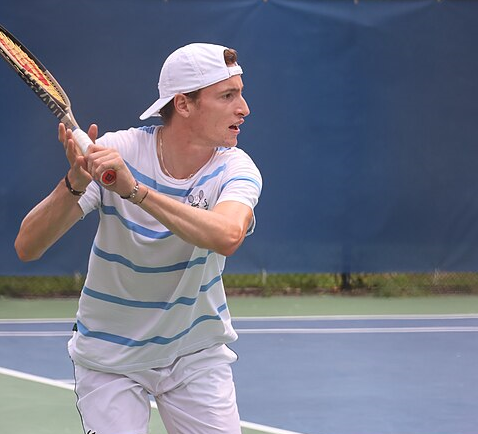
 

Dayana Yastremska’s Erratic Attack

Also today: February 2, 1974

Dayana Yastremska at the 2023 US Open. Credit: Hameltion

Power giveth, and power taketh away. Few women hit as hard as Dayana Yastremska does, and sometimes, when enough of her returns find the court, that translates into victory. She squeaked through Australian Open qualifying by winning three deciding sets against players outside the top 200, then demolished 7th seed Marketa Vondrousova and rode the resulting momentum all the way to the semi-finals.

Then, yesterday in Linz, she managed just two games against Donna Vekic. So it goes.

The Ukrainian is essentially Jelena Ostapenko lite, mixing a middling serve with monster groundstrokes and a do-or-die approach on return. I wrote a few weeks ago about how Ostapenko’s game style leaves her unusually susceptible to chance; that applies even more to her less accomplished colleague.

The good news for Yastremska is that momentum is temporary. She’ll have off days, like the 92-point flop against Vekic, and she’ll occasionally play a perfect hour, like the dismantling of Vondrousova. More often, though, she’ll pack it all into a single match. The 23-year-old’s stats from her third-round adventure in Melbourne against Emma Navarro make for a good illustration:

       SPW%  RPW%  Winners  UFE  
Set 1   64%   54%       12   11  
Set 2   50%   33%        6   15  
Set 3   73%   56%       15    8 

I’ll bet you can tell which sets she won. It was a lopsided match, just not always in favor of the same player.

Typically, the wildest fluctuation came in Yastremska’s return numbers. Her serve is a weak point–she holds less than 60% of service games, worse than all but one other top-50 player–and it is no picture of consistency, either. But her return is a shot she can ride to a major semi-final. In the first five matches of her Australian Open campaign, she won 48% of return points, including 21 of 38 break point chances. Against Victoria Azarenka in the fourth round, Yastremska landed only 60% of her returns, but when she put the serve back in play, she won nearly three-quarters of the time. Almost one in six Azarenka service points ended with a Yastremska return that Vika couldn’t handle.

A few days later against Qinwen Zheng, the same attack proved to be too risky. The Ukrainian put just half of Zheng’s serves back in play. More than 20% of those returns ended the point, but against all of the free points she gave away, it wasn’t enough. Unlike the scattershot second set of the Navarro match, there wasn’t enough time to find the range before the contest was over.

The streaky slugger

After Yastremska’s eight straight wins from qualifying to the Australian Open semi-final, it’s tempting to call her a streaky player. Combine the big-picture run with narrow-focus ups and downs like the three sets of the Navarro match, and she looks like a kite blown around by the winds of chance at both the macro and micro levels.

I normally dismiss claims that any player’s results are particularly momentum-driven: While athletes aren’t robots, study after study suggests that if momentum (or “clutch” or “streakiness”) is real, it’s a minor effect, far more minor than commentators or the casual fan seems to believe. But after watching the Ukrainian’s three sets against Navarro, I had to test it.

Here’s a more precise hypothesis: Yastremska is more likely to win a game when she has won the previous game, compared to when she has lost the previous game. That isn’t the whole story of in-match streakiness, but for a single number, I think it gets to the core of the issue.

Result? True!

Player                 Change after Gm-W  
Alison Riske Amritraj             +11.9%  
Linda Fruhvirtova                  +9.7%  
Lesia Tsurenko                     +8.9%  
Irina Camelia Begu                 +8.7%  
Ajla Tomljanovic                   +7.1%  
Kaja Juvan                         +6.5%  
Polona Hercog                      +6.0%  
Yulia Putintseva                   +5.6%  
Shuai Zhang                        +5.4%  
Dayana Yastremska                  +5.3% 
--- 
Jelena Ostapenko                   +3.2%  
Iga Swiatek                        +1.6%  
-- Average --                      +1.0%  
Aryna Sabalenka                    +0.3%  
Elena Rybakina                     -0.8%  
Coco Gauff                         -1.2%  
Caroline Garcia                    -3.3% 

Among the 102 women with at least 20 charted matches since 2017, Yastremska ranks in the top ten, winning games more than 5% more often than average when she has won the previous game. She out-momentums her fellow hyper-aggressor Ostapenko by a modest amount. Another slugger, Aryna Sabalenka, seems to be impervious to previous results, even more so than the slightly streaky average player.

(The exact metric compares games-that-follow-games-won to games-that-follow-games [that is, games that don’t begin a set] within the same match, and excludes tiebreaks. Winning a match 6-0 6-0 isn’t “streaky” by this measure, because it’s impossible to know whether the result is due to a lopsided matchup [or injury] or to momentum–the winner went 10 for 10 in games that followed games won, and 10 for 10 in games that followed any game. With this metric, a streaky player is one who wins 10 of 20 total games in a match including, say, 7 of 10 games that follow other games won.)

So Yastremska is a little tougher to beat when she’s on a roll. She’s really hard to derail if she has just won a game and you have the misfortune of serving. Here is the same metric, only limited to winning percentage in return games:

Player             After Service Hold  
Katerina Siniakova             +13.4%  
Dayana Yastremska              +13.3%  
Lauren Davis                   +13.0%  
Linda Fruhvirtova              +12.2%  
Tatjana Maria                  +11.2%  
Alison Riske Amritraj          +10.8%  
Marta Kostyuk                  +10.3%  
Anhelina Kalinina               +9.9%  
Yulia Putintseva                +9.6%  
Qinwen Zheng                    +8.8% 
--- 
Jelena Ostapenko                +2.7%  
Iga Swiatek                     +2.6%  
Aryna Sabalenka                 +2.2%  
-- Average --                   +1.0%  
Coco Gauff                      -1.3%  
Caroline Garcia                 -4.9%

Yastremska’s success in return games skyrockets after she has held serve. Maybe she feels especially confident after getting through a service game; maybe a hold is a sign that her whole game is clicking. Whatever the reason, she rides this particular type of momentum as much as anyone, trailing Siniakova at the top of the list by a meaningless 0.031 percentage points.

You might suspect–or at least, I initially suspected–that streakiness is related to slugging. It’s easy enough to invent a story to link the two: Big hitting is risky; winners and errors come in batches. But no, there’s virtually no correlation, positive or negative, between these measures of streakiness and any of the metrics I use to quantify aggression. Grinders like Yulia Putintseva share the top of the list with Yastremska, while attackers like Caroline Garcia appear at the other extreme.

For the Ukrainian, it seems, the ups and downs are here to stay. Until she gets more out of her serve, she’ll continue to get dragged into three-set battles against opponents much further down the ranking list. As long as she doesn’t miss too many returns, she’ll keep herself in position to win. The losses will sometimes be ugly, but the victories–like the games that contribute to them–will compensate by coming in batches.

* * *

February 2, 1974: Five-dollar words

My favorite moments in early-1970s tennis came when Billie Jean King got feisty. I don’t mean the take-this-fight-to-Congress, crusading Billie Jean, though there was plenty of that. On the rare occasions when an opponent pushed Madame Superstar to the brink, she could get downright nasty. Pity the poor linesmen.

Fifty years ago today, King faced longtime friend, doubles partner, and punching bag Rosie Casals in the semi-finals of the Virginia Slims of Washington. It was the marquee match of the week, with all of the tour’s other stars absent. Chris Evert and Nancy Richey were taking the week off, Evonne Goolagong was chasing appearance fees on the other side of the globe, and Margaret Court was pregnant. Billie Jean took it upon herself to keep the crowds happy: She went to three sets in the opening round against Kerry Harris, then delivered a 6-0, 6-1 masterclass to win her quarter-final against the 17-year-old Kathy Kuykendall.

Some fans griped about the ticket prices: five bucks for the King-Casals semi and six dollars for the evening session, which featured Australians Kerry Melville and Helen Gourlay in the other semi-final. The 2,800 locals who showed up for the afternoon match, at least, got their money’s worth.

Casals rounded into form just in time, having struggled a bit to recalibrate her game as the tour seesawed between indoor and outdoor events. Her athletic net game outpaced King’s own attack throughout the first set, leading Billie Jean to find a scapegoat among the officials. She berated the service line judge, even threatening to quit; Casals had to calm her down and convince her to stay. (Rosie quipped later that she deserved 60% of the prize money for keeping her pal on court.) After the Old Lady vented her wrath at the chair and two separate linesmen, she settled for moving the offending service line judge to the net cord.

“What this game needs are professional linesmen,” King said. “We’re years behind the times. There are too many questionable situations for a bunch of amateurs to try to master. I’ve suffered through 21 years of bad line calls, and I’m fed up.”

Tennis officiating was certainly a mixed bag. A few months earlier, at the men’s season-ending Masters event in Boston, a last-minute strike forced organizers to pluck fans from the crowd to call the lines.

But not everyone believed that Billie Jean’s reaction was warranted, or that it was triggered by what King called her own “low boiling point.” Melville and Gourlay played their match with the same crew and had no problems. “Most of this arguing with linesmen is done for tactical reasons,” Melville said. “It helps intimidate them. You can get away with it over here, but not in Australia.”

The offending service line judge, Stew Saphier, had a few words of his own. Nothing like this had ever happened to him before, and he wasn’t embarrassed by it. Why not? “Because I was correct in all my calls.”

Whatever the cause of King’s outburst, the day ended as it usually did. After dropping a 7-5 first set to Casals, she came back to win, 6-2, 6-0. The next day, she dispatched Melville 6-0, 6-2, completing the rare feat of a tournament victory that included a 6-0 set won in every match. She was now 14-1 on the young season, her only loss coming in the previous week’s final against Evert. Past her 30th birthday, more famous than ever, she still had plenty of battles ahead.

* * *

Meanwhile, in Ohio…

The men competing at the 1974 Dayton Pro Tennis Classic didn’t draw much in the way of crowds, but tournament organizers slapped together a sure-fire attraction: an exhibition match between Bobby Riggs and Cincinnati Reds star Pete Rose. 4,000 fans turned out for the famous court hustler and baseball’s “Charlie Hustle.” It was clear what they came for: Half of them left before the next regulation match got started.

“This is a disgrace for tennis,” said Yugoslavian veteran Boro Jovanovic. “People don’t come out to see us all week, then they come out for something like this.”

Rose insisted that Riggs play him “straight,” but after three games of running the outfielder ragged with all the spin that a 55-year-old arm could muster, the clowning began. Riggs donned everything from baseball catcher’s gear to a dress, and he eventually set out beach chairs and carried a briefcase to further aid his opponent’s cause. Final score: five games to two, Riggs.

Bobby recognized that rematches with King and Court were off the table and that neither Evert nor Goolagong were likely to accept a challenge. “I’d like to play women from all the world,” he said, naming Casals as potential foe. In the meantime, he’d take on all comers. With his Battle-of-the-Sexes celebrity still going strong, he knew people would show up to watch.

Click here for other posts about the 1974 season. Or here for dispatches from 1924.

* * *

Subscribe to the blog to receive each new post by email:
 

Yes, Jannik Sinner Really Is This Good

Also: Australian Open coverage recap

Jannik Sinner

Don’t let Daniil Medvedev’s near-miss in the Australian Open final fool you: Jannik Sinner is the best player in the world right now. Like Sunday’s championship match, it’s close–but it might not be close for long.

I wrote in December about what I called the “most exclusive clubs” in tennis. Since 1991, when the ATP began keeping these stats, Andre Agassi and Novak Djokovic have been the only two players to finish a season in the top three of both hold percentage and break percentage. (Agassi did it twice.) Well, in the last 52 weeks, Sinner ranks second in hold percentage behind Hubert Hurkacz, and he stands third in break percentage, trailing only Medvedev and Carlos Alcaraz. It’s not a calendar year so we can’t officially add him to the list, but he’s playing as well on both sides of the ball as anyone ever has, apart from two all-time greats.

Oh, and on hard courts, Sinner out-holds even Hurkacz. He gets broken less than anyone in the game, securing his serve 89.9% of the time.

But wait–it’s even better than that. Alex Gruskin pointed out that since Wimbledon, Sinner’s hold percentage is 91.1%, within shouting distance of John Isner’s career mark of 91.8%. Isner cracked the top ten by combining that monster serve with a return that only a mother could love. Sinner, on the other hand, pairs absolutely dominant serving with one of the best returns in the game. Ever wonder what would happen if Big John had an elite return? Now you know.

Starting the clock at Wimbledon might raise an eyebrow–is that just the line that spits out the most impressive number?–but it’s a sensible way to divide the data. In June, not long before the Championships, Sinner rolled out a new, simplified service motion. While the measurements of the new delivery are not overwhelming–one more mile per hour, four centimeters closer to the line, a 0.7 percentage-point increase in first serves in–the results have been devastating. His serve has always been good; perhaps a few minor tweaks were all it took to make it great.

Winning how?

First, a bit of a puzzle. In the last 52 weeks, Sinner ranks fifth on tour in serve points won, with 68.3%. (Why not first or second, in line with his hold percentage? We’ll come back to that.) Yet despite the Isner comparisons, he doesn’t get it done the easy way. He hits aces just 8.4% of the time. That’s equal to the average of the ATP top 50, and it’s fewer than Djokovic.

The answer doesn’t lie in unreturned serves, either. Some players do get more free points than their ace counts imply. Stefanos Tsitsipas, for instance, ranks well down the ace list, finishing just 9% of his serve points that way. But he looks much more elite when we measure how many don’t come back–almost one-third, in his case. Sinner’s 29.6% rate of unreturned serves is above average, but it’s hardly the stuff that record-breaking hold numbers are made of. The next man on the list, for comparison’s sake, is Frances Tiafoe.

What about plus-ones? Sinner serves big, but relatively speaking, his groundstrokes are even bigger. Can we explain his serve-game success by the rate at which he ends points with his second shot?

Still no! He wins 40% of his serve points by the third shot of the rally. Again, that’s a solid mark: Djokovic and Alcaraz are about the same. On the other hand, so is Jiri Lehecka, and Tiafoe is even better.

Once a point reaches the fourth or fifth shot–especially if it began with a second serve–winning it is more about contesting a rally than converting any lingering advantage of the serve. If the returner puts the fourth stroke of the point in play, he has a 52% chance of winning it. Big servers still get some easy putaways, but opportunities disappear as the rally develops. When that happens, winning service points relies on a different set of skills–assets that Sinner, unlike many a big server, amply possesses.

Sinner, then, has the whole package, even if no single one of his weapons stands out like the Isner serve. He serves big enough to clean up 40% of points with his first or second shot. It the point lasts longer, he has probably hung on to more of an advantage than most players do: His heavy, deep groundstrokes see to that. In a really long rally, okay, maybe the edge goes to Medvedev or Alcaraz, but who else is going to outlast the Italian?

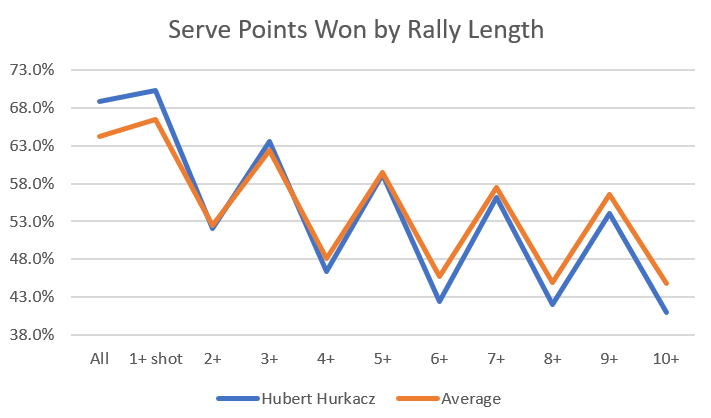
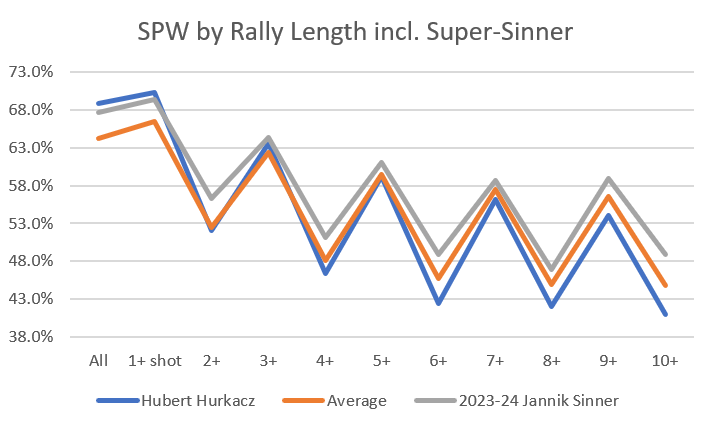
Most players excel at some stage of service points, but not all. The following graph illustrates how service points typically develop, by showing the server’s chance of winning the point when each successive shot is put in play. Based on charted men’s matches since 2021, servers win 64.2% of points. That goes up to 66.5% if they land a serve; it goes down to 52.5% if the return comes back. Several strokes later the server’s advantage is mostly gone: If he puts the 7th shot of the point in play, his chances of winning are 57.4%; if the returner comes back with an 8th shot, the server’s odds are down to 45%.

I’ve shown that progression along with specific numbers for Hurkacz, in order to demonstrate how these things go with our usual image of a big server:

While the differences between Hurkacz and tour average are modest, you get the idea. Early in the point, a big server cleans up; the longer the rally goes, the further his results fall below the line.

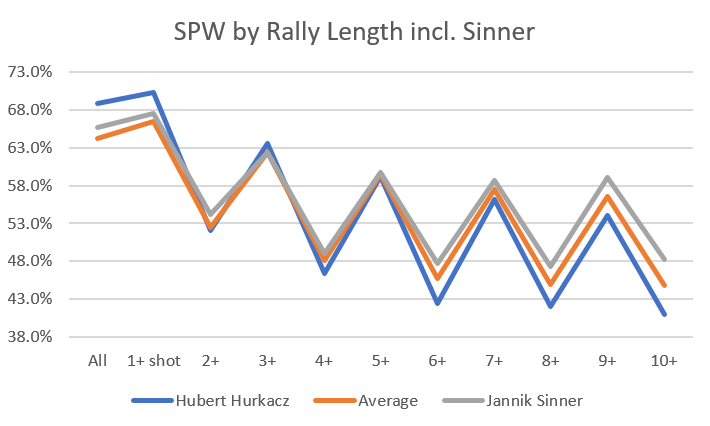
Now, the same graph with Sinner’s results from 2021 to the present:

He doesn’t start as high as Hurkacz, but he does do a little better than average. Crucially, he never falls below the average line, and the longer the point extends, the more he surpasses it.

I hope you’ve stuck with me this far, because the payoff is worth it. Same graph, only instead of Sinner’s three-plus-year average, we have his numbers since the beginning of 2023:

At the beginning of the point, Sinner is almost equal to Hurkacz. From then on, he takes over. A surprising gap comes early, at the two-plus rally mark, indicating that he doesn’t make many mistakes with his plus-one shot, even if he doesn’t put away an overwhelming number of them. No matter how long the point continues, the Italian outperforms tour average for that particular situation.

In tennis, it’s almost impossible to be good at everything. You can put together a nice, quite lucrative career by merely getting close to average in most categories and having one or two standout weapons. Sinner, we’re beginning to see, is not just good at everything, he is verging on great.

Break points

We now know why Sinner is winning so many serve points. But I mentioned another mystery we have yet to resolve. The Italian ranks fifth in the last 52 weeks in serve points won, the middle of a tightly-packed trio with Nicolas Jarry and Taylor Fritz, about one percentage point behind Hurkacz, Tsitsipas, and Djokovic. Yet he challenges Hurkacz for the top spot in the closely related, more consequential category of hold percentage:

Player               Hld% Rk   Hld%  SPW Rk   SPW%  
Hubert Hurkacz             1  89.1%       1  69.6%  
Jannik Sinner              2  88.8%       5  68.3%  
Stefanos Tsitsipas         3  88.4%       2  69.5%  
Novak Djokovic             4  87.6%       3  69.4%  
Nicolas Jarry              5  87.1%       4  68.4%  
Alexander Zverev           6  86.1%       7  67.4%  
Taylor Fritz               7  86.0%       6  68.2%  
Christopher Eubanks        8  85.8%       8  67.1%  
Carlos Alcaraz             9  85.7%      10  67.0%  
Tallon Griekspoor         10  85.1%      12  66.7%

The lists are almost identical, except for Sinner’s placement. He wins points at almost the same rate as Jarry and Fritz, yet he holds serve more often than either one.

As mysteries go, this isn’t a tough one. Not all points are created equal; if you win more of the important ones, you’ll outperform the players who don’t. Nobody knows that better than Sinner, who upset Djokovic in Turin despite winning exactly the same number of points, then beat him again at the Davis Cup with just 89 points to Novak’s 93. He out-pointed Medvedev yesterday 142 to 141.

Sinner wins these matches by saving break points at a remarkable clip. While winning 68.3% of serve points overall, he has held off 71.7% of break chances, including 36 of 40 in Melbourne. No one else on tour tops 69%, and Hurkacz comes in at 65%. On average, top-50 men save break points two percentage points less than they win typical serve points (63.5% to 65.5%), mostly because stronger returners generate more break points.

The question, then, is whether this is sustainable. ATP numbers indicate that Sinner goes bigger on break points, averaging 125 mile-per-hour first serves in those situations rather than his usual 122s. It seems to be working, but it can’t be that straightforward. Surely he isn’t the first player to arrive at the strategy of simply hitting harder, and besides, that usually comes at a cost. Will he continue to land enough of those bigger first serves to justify the payoff?

I can’t answer that question, but I can tell you what usually happens after a season of break-point overperformance: It doesn’t last. Taking over 2,600 player-seasons since 1991, 582 (21.7%) of players saved more break points than they won serve points overall. 183 (6.8%) matched Sinner’s mark of saving at least two percentage points more than their serve-points-won rate.

Of those 183, just eleven repeated the feat the following year. None of them were big servers, and nobody managed it three years in a row. The average following-year performance of the 183 men was 1.5 percentage points fewer break points saved than their rate of serve points won–just a tick better than tour average.

Unless Sinner has developed a new secret sauce–to be clear, with Darren Cahill in his corner, I’m not ruling it out!–that’s probably the fate that awaits him. In more than three decades, only 23 men have saved at least 71.7% of the break points they faced for a full season. The Italian probably won’t keep that up, and his out-of-this-world hold percentage will fall to something more plausible, in the 86-87% range.

Fortunately, that’s still exceptionally good. The 22-year-old serves like Jarry or Fritz while racking up as many return points as Djokovic. Take away the break point magic and you still have a contender for every slam. Sinner continues to lurk in fourth place in the official ATP rankings, but as of today, he is number one on the Elo list. Before long, those positions will converge, and it won’t be because his Elo rating goes back down.

* * *

AO recap

I hope you’ve enjoyed my coverage throughout the Australian Open. I’ll continue to write this sort of thing throughout the year, though not always every weekday!

In case you missed it, here are the ten other articles posted since the action in Melbourne began:

Thank you for reading.

* * *

Subscribe to the blog to receive each new post by email:
 

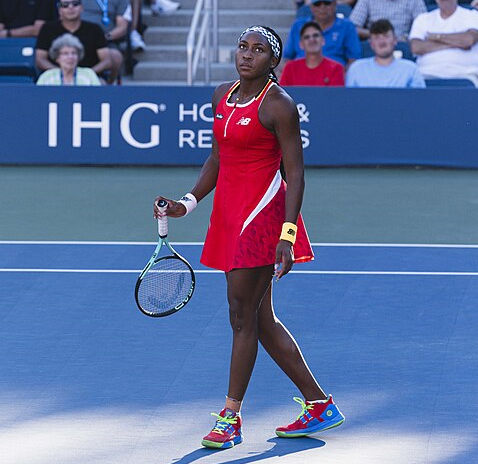
How Coco Gauff Escaped a Trap of Her Own Making

Also today: Jannik Sinner’s near-unbreakability

Coco Gauff at the 2022 US Open. Credit: All-Pro Reels

Coco Gauff is not a pusher, but she can do an awfully good impression of one. In yesterday’s Australian Open quarter-final against Marta Kostyuk, the American coughed up 50 unforced errors against just 17 winners. The average rally lasted 4.6 strokes, a modest number that was rescued from marathon territory only by Gauff’s many unreturned serves.

Coco’s forehand, the usual culprit when things get messy, was on full display yesterday. While the stroke has shown signs of improvement–only 9% of them contributed to the unforced error tally, below both tour average and Gauff’s own standard–it remains loopy, and it gets ever-more cautious under pressure. Kostyuk was willing to go after the high-bouncing mid-court groundstrokes, often putting Gauff on the run. Fortunately for the American, her defense rarely deserts her. She eked out a three-hour, 7-6, 6-7, 6-2 victory for a place in the Melbourne semi-finals.

My impression watching the match was that Gauff put an unreasonable number of returns–especially forehand returns–in the middle of the court, not too deep, and that Kostyuk was punishing them. I was partly right: The Ukrainian forced Coco to hit forehand after forehand against the serve, more than two-thirds of her service returns all told. Gauff did indeed send more of those balls down the middle, closer to the service line than the baseline. And Kostyuk attacked… but to little avail.

Let’s get into the numbers. The Match Charting Project divides the court into thirds, both in terms of direction (forehand side, backhand side, and middle) and depth (shallow [in the service boxes], deep [closer to the service line than the baseline], and very deep). All else equal, shots deep and/or to the sides of the court are better, though of course they are riskier. Some returns will inevitably end up down the middle and shallow; the goal is only to avoid it when possible.

Here is how Gauff’s performance yesterday compared to tour average and her own typical rate of service returns that went down the middle and didn’t land close to the baseline:

RETURNS          Middle/Not Very Deep  
Tour Average                    34.0%  
Coco Average                    40.5%  
Coco vs Kostyuk                 43.7%

Indifferent return placement is nothing new for the American, and she left even more hittable plus-ones for Kostyuk than usual. It wasn’t as bad as last year’s US Open final against Aryna Sabalenka, when Gauff put more than half of her returns in the less effective zones, but Kostyuk is no Sabalenka when it comes to imposing her will with the serve.

Return placement matters. On average, tour players win 46% of points when they land a down-the-middle, not very deep return. When they put the ball anywhere else–closer to the baseline or a sideline–they win 56%. Gauff is a little better behind the weak returns, but for her career, the gap is still present: 47% versus 55%.

Except… that isn’t what happened yesterday!

RETURN OUTCOMES  Mid/NVP W%  Better W%  
Tour Average          46.2%      56.3%  
Coco Average          46.9%      54.8%  
Coco vs Kostyuk       60.0%      55.2%

When Gauff placed a return near a line, her results yesterday were typical. But Kostyuk was unable to capitalize on the rest. Among 88 matches logged by the Match Charting Project, Gauff has won 60% of those middle/not-very-deep returns only a dozen times, usually in blowouts.

Judging from the American’s performance on return, she could have made quick work of yesterday’s contest, too. The sticking point came on her own side of the ball, where her non-committal forehands didn’t work out as well.

Minus-ones

On the WTA tour, when the return lands in play, the server has nearly lost her advantage. A good first serve can give her a lingering edge, or a well-placed return can tilt the balance in the other direction, but overall, the point begins again as a neutral proposition. Servers win 52% of those points.

Gauff, on average, does a little better, converting her serve 53% of the time. There are signs she’s improving, as well. In the US Open final against Sabalenka, she won 55%, and in the Auckland final this month versus Elina Svitolina, she picked up 59%. Apart from lopsided matches, the high-50s are the best anyone can do on an ongoing basis: Iga Swiatek’s average is 57%, and Sabalenka’s is 55%.

Coco won 39% against Kostyuk.

Gauff’s lack of confidence in her forehand showed up in multiple ways. First, she didn’t use it as much as a plus-one weapon. She usually hits 57% of her plus-one shots from the forehand side, in line with tour average. Yesterday, that rate was just 51%, something that had more to do with her own choices than any return magic that Kostyuk conjured up.

Then, she didn’t do much with those forehands. The following table shows plus-one forehand rates (3F%), the percentage of plus-one forehands hit down the middle (FH Mid%), and the server’s winning percentage (FH Mid W%) behind those down-the-middle forehands:

PLUS-ONES          3F%  FH Mid%  FH Mid W%  
Tour Average     56.6%    29.9%      45.9%  
Coco Average     57.2%    35.0%      47.0%  
Coco vs Kostyuk  50.7%    39.5%      40.0% 

Gauff magnified her own tendency to go back down the middle with her second-shot forehand. It didn’t work, as she won just 40% of those points, compared to her typical rate of 47%.

Even beyond the plus-one, Coco just kept pushing the forehand. She went down the middle with 46% of her forehands, compared with her usual 37% and the tour average of 28%. She won barely one-third of the points when she did so, partly because of the nine unforced errors she racked up playing an already conservative shot. Two of those missed down-the-middle forehands came on back-to-back points when she could hardly afford them, taking her from 15-all to 15-40 when trying to close out the match at 5-3 in the second set.

In the end, as we’ve seen, Gauff’s defense saved her. She won more than half of Kostyuk’s serve points despite lackluster returning. Had she served just a little better–she missed six straight first serves in that 5-3 game–she would have finished the job an hour sooner. Had she attacked a bit more effectively with her second shots, even the off-day from the line wouldn’t have amounted to much.

To state the obvious: She’ll have to play better to beat Sabalenka in tomorrow’s semi-finals. One thing, at least, will work in Coco’s favor: She’ll have many fewer choices to make. The defending champion will dictate play and give her less time to think than Kostyuk did. Gauff withstood the Belarusian barrage in New York, winning the US Open title despite a couple of detours against less aggressive players in the early rounds. The American can’t play tomorrow like she did yesterday, but thankfully, Sabalenka won’t let her.

* * *

Jannik Sinner’s near-unbreakability

Jannik Sinner has lost his serve just twice en route to the Australian Open semi-finals. He has faced 28 break points and saved 26 of them.

Since 1991, when the ATP started keeping the relevant stats, he is the 26th player to reach the final four at a major with so few breaks of his own serve:

Tournament  Semi-finalist       BP Faced  Broken  
2013 USO    Rafael Nadal               6       0  
2018 Wimb   John Isner                 7       0  
2015 Wimb   Roger Federer              3       1  
1994 Wimb   Pete Sampras               9       1  
2015 AO     Novak Djokovic            11       1  
2014 Wimb   Roger Federer             12       1  
1997 Wimb   Pete Sampras              12       1  
2010 USO    Rafael Nadal              14       1  
2012 RG     Rafael Nadal              17       1  
2004 Wimb   Roger Federer             17       1  

Tournament  Semi-finalist       BP Faced  Broken  
2014 Wimb   Milos Raonic               9       2  
2011 RG     Novak Djokovic*            9       2  
2007 USO    Roger Federer              9       2  
2006 Wimb   Roger Federer              9       2  
2006 Wimb   Rafael Nadal               9       2  
2015 USO    Roger Federer             11       2  
2014 AO     Roger Federer             11       2  
1997 USO    Greg Rusedski             11       2  
1993 AO     Pete Sampras**            12       2  
2013 Wimb   JM del Potro              13       2  
2019 AO     Rafael Nadal              15       2  
2008 Wimb   Roger Federer             15       2  
2005 AO     Andy Roddick              15       2  
1998 Wimb   Pete Sampras              17       2  
2000 AO     Yevgeny Kafelnikov        22       2  
2024 AO     Jannik Sinner             28       2

* Djokovic won one round by W/O and another by retirement
** I don't have stats for Sampras's QF, but the final score suggests that he wasn't broken

Pretty good company! As the table makes clear, though, Sinner’s 28 break points faced is not so elite. In fact, the average major semi-finalist faces exactly 28 break points in his first five matches.

The Italian’s accomplishment, then, is saving so many. 26 of 28 is a 93% clip, and that is more rarefied air:

Tounament  Player      Faced  Saved   Save%  
2013 USO   Nadal           6      6  100.0%  
2018 Wimb  Isner           7      7  100.0%  
2012 RG    Nadal          17     16   94.1%  
2004 Wimb  Federer        17     16   94.1%  
2010 USO   Nadal          14     13   92.9%  
2024 AO    Sinner         28     26   92.9%  
2014 Wimb  Federer        12     11   91.7%  
1997 Wimb  Sampras        12     11   91.7%  
2015 AO    Djokovic       11     10   90.9%  
2000 AO    Kafelnikov     22     20   90.9%

Things will get tougher on Friday, when Sinner faces all-time-great returner Novak Djokovic for a place in the final. Then again, Djokovic failed to convert his first 15 break points against Taylor Fritz yesterday–maybe he was just preparing for the matchup with Sinner.

* * *

Subscribe to the blog to receive each new post by email:
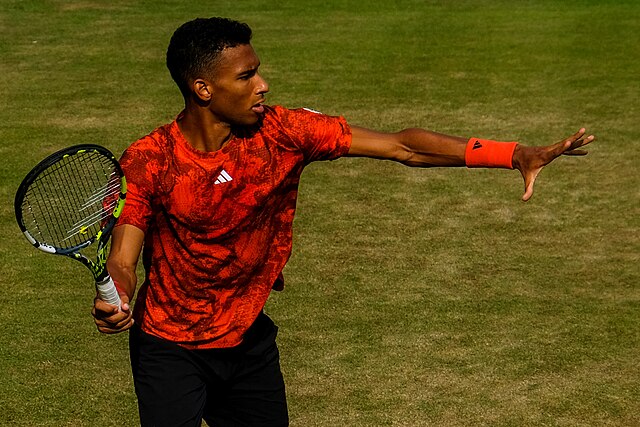
 

Anna Kalinskaya At Her Peak

Also today: Upsets, (partly) explained; January 23, 1924

Anna Kalinskaya in the 2020 Fed Cup qualifying round. Credit: Nuță Lucian

Should we have seen this coming? Of all the surprises in the top half of the 2024 Australian Open women’s draw, Anna Kalinskaya’s run to the quarter-finals stands as one of the biggest. The 25-year-old was ranked 75th entering the tournament, and she had never reached the third round of a major in 13 previous main-draw attempts.

Had we looked closely before the tournament, we wouldn’t have found a title contender, exactly, but we would have identified Kalinskaya as about as dangerous as a 75th-ranked player could possibly be. She finished 2023 on a 9-1 run, reaching the final at the WTA 125 in Tampico, then winning the title at the Midland 125, where she knocked out the up-and-coming Alycia Parks in the semi-finals. 2024 started well, too: The Russian upset top-tenner Barbora Krejcikova in Adelaide, then almost knocked out Daria Kasatkina in a two hour, 51-minute match two days later.

The only reason her official ranking is so low is that she missed nearly four months last summer to a leg injury that she picked up in the third round in Rome. Her two match wins at the Foro Italico pushed her up to 53rd in the world, just short of her career-best 51st, set in 2022. The Elo algorithm, which measures the quality of her wins rather than the number of tournaments she was healthy enough to play, reflects both her pre-injury successes and the more recent hot streak. Kalinskaya came to Melbourne as the 31st-ranked woman on the Elo list.

These alternative rankings put a different spin on her path through the Australian Open draw so far. Here are the results from her first four rounds, in which she appeared to be the underdog three times:

Don’t be fooled!

Elo has some adjustments to make:

Round  Opponent  Elo Rk  Elo vRk  
R16    Paolini       31       37  
R32    Stephens      31       50  
R64    Rus           31      107  
R128   Volynets      31      139

Kalinskaya was hardly an early favorite–Stephens did her the favor of taking out Kasatkina, and Anna Blinkova (who lost to Paolini) eliminated the third-seeded Elena Rybakina. But given how the draw worked out, seeing the Russian’s name in the quarter-finals wasn’t so unlikely after all.

More luck

Kalinskaya has a dangerous forehand and a solid backhand, but she isn’t an aggressive player by the standards of today’s circuit. Her 14 matches logged by the Match Charting Project average 4.2 strokes per point, and that skews low because it includes three meetings with Aryna Sabalenka. Yesterday’s fourth-round match against Paolini took 5.3 strokes per point, and the third-rounder with Stephens was similar.

By Aggression Score, the 25-year-old rates modestly below average, at -17 in rallies and -15 on returns. While she doesn’t have any weaknesses that prevent her from ending points earlier, she’s more comfortable letting the rally develop. When Paolini played along, the results were remarkable: 32 points reached seven shots or more yesterday, and Kalinskaya didn’t end any of them with an unforced error.

The downside of such a game style is that a lot of opponents won’t be so cooperative. Last fall, the Russian lost back-to-back-to-back matches against Ekaterina Alexandrova, Viktoria Hruncakova, and Ashlyn Krueger, three women who opt for big swings and short points. By contrast, consider the Rally Aggression Scores of the quartet Kalinskaya has faced in Melbourne:

Round  Opponent  AggScore  
R16    Paolini         -5  
R32    Stephens       -16  
R64    Rus            -59  
R128   Volynets       -38

Paolini and Stephens have roughly similar profiles to Kalinskaya’s own; Rus and Volynets are even more conservative.

This isn’t just a convenient narrative: Kalinskaya really is better against more passive players. She has played 118 career tour-level matches against women with at least 20 matches in the charting database. Sort them by Rally Aggression Score and separate them into four equal bins, and the Russian’s preferences become clear:

AggScore Range  Match Win%  
57 to 175            35.7%  
0 to 56              46.4%  
-27 to -1            50.0%  
-137 to -27          59.4%

If the whole tour were as patient as she is, the Russian would already be a household name.

Alas, it’s rare to draw four straight players as conservative as the bunch Kalinskaya has faced in Melbourne. And having reached the quarter-finals, her luck has run out. Her next opponent is Qinwen Zheng, who has a career Aggression Score of 27 and upped that number in 2023. It could be worse–fellow quarter-finalists Sabalenka and Dayana Yastremska are triple-digit aggressors–but it is a different sort of challenge than she has faced at the tournament so far.

To win tomorrow, Kalinskaya will need to play as well as she has for the last few months, only a couple of shots earlier in the rally. Otherwise, Zheng will end points on her own terms, and thousands of potential new fans will be convinced that Kalinskaya really is just the 75th best player in the world.

* * *

Why are upsets on the rise?

Only four seeds, and two of the top eight, survived to the Australian Open women’s quarter-finals. Many of the top seeds lost early. This feels like a trend, and it isn’t new.

One plausible explanation is that the field keeps getting stronger. Top-level players now develop all over the world, and coaching and training techniques continue to improve. There are few easy, guaranteed matches, even if Iga Swiatek and Aryna Sabalenka usually(!) make it look that way. I believe this is part of the story.

Another component, I suspect, is the shift in playing styles. I noted a couple of weeks ago when writing about Angelique Kerber is that WTA rally lengths have steadily declined in the last decade. In 2013, the typical point lasted 4.7 strokes; it’s now around 4.3. Shorter points are caused by more risk-taking. Risks don’t always work out, full-power shots go astray, and the better-on-paper player doesn’t always win.

In 2019, I tested a similar theory about men’s results. I split players in four quartiles based on Aggression Score and tallied the upset rate for every pair of player types. When two very aggressive players met, nearly 39% of matches resulted in upsets, compared to 25% when two very passive players met. The true gap isn’t quite that big: given the specific players involved, there should have been a few more upsets among the very aggressive group. But even after adjusting for that, it remained a substantial gap.

It stands to reason that the story would be the same for women. Instead of Aggression Score, I used average rally length. I doubt there’s much difference. I didn’t intend to change gears, I just got halfway through the project before checking what I did the first time.

The most aggressive quartile (1, in the table below) are players who average 3.6 shots per rally or less. The next group (2) ranges from 3.7 to 4.0, then (3) from 4.1 to 4.5, and finally (4) 4.6 strokes and up. The following table shows the frequency of upsets (Upset%) and how the upset rate compares to expectations (U/Exp) for each pair of groups:

Q1  Q2  Upset%  U/Exp  
1   1    40.7%   1.07  
2   1    36.2%   0.99  
2   2    35.7%   0.99  
3   1    35.1%   0.93  
3   2    35.5%   0.97  
3   3    40.9%   1.07  
4   1    37.6%   1.03  
4   2    36.6%   1.02  
4   3    34.6%   0.95  
4   4    34.7%   0.97

(If you look back to the 2019 study, you’ll notice that I did almost everything “backwards” this time — swapping 1 for 4 as the label for the most aggressive group, and calculating results as favorite winning percentages instead of upsets. Sorry about that.)

Matches between very aggressive players do, in fact, result in more upsets than expected. It’s not an overwhelming result, partly because it’s only 7% more than expected, and partly because matches between third-quartile players–those with average rally lengths between 4.1 and 4.5–are just as unexpectedly unpredictable.

I don’t know what to make of the latter finding. I can’t think of any reasonable cause for that other than chance, which casts some doubt on the top-line result as well.

If the upset rate for matches between very aggressive players is a persistent effect, it would give us more upsets on tour today than we saw a decade ago. An increasing number of players fit the hyper-aggressive mold, so there are more matchups between them. The logic seems sound to me, though it may be the case that other sources of player inconsistency outweigh a woman’s particular risk profile.

* * *

January 23, 1924: Debuts and dropshots

Men’s tennis ruled at the early Australian Championships. The tournament had been held since 1905 (as the “Australasian” Championships), but there was no women’s singles until 1922. On January 23rd, midway through the 1924 edition, the press corps was preoccupied with the severity of Gerald Patterson’s sprained ankle and the question of whether Ian McInnes had been practicing.

James O. Anderson, the 1922 singles champion who would win the 1924 edition as well, introduced what was then–at least to the Melbourne Argus–an on-court novelty:

He has developed a new stroke since he last played in Melbourne, and it has proved successful. On the back of the court he makes a pretence of sending in a hard drive, but with a delicate flick of the wrist he drops the ball just over the net, leaving his opponent helpless 30 feet away.

A veritable proto-Alcaraz, was James O.

For the few fans who weren’t solely focused on Australia’s Davis Cuppers, a superstar was emerging before their eyes. Also on the 23rd, 20-year-old Daphne Akhurst made quick work of Violet Mather, advancing to the semi-finals in her first appearance at the Championships.

Akhurst wouldn’t go any further, unable to withstand the heavy forehand of Esna Boyd in the next round. But it was nonetheless a remarkable debut: She won both the women’s and the mixed doubles titles. The correspondent for the Melbourne Age, recapping the mixed final, could hardly contain his admiration:

Miss Akhurst–an artist to her finger tips–belied her delicate mid-Victorian appearance that suggested that she had slipped out of one of Jane Austen’s books by sifting out cayenne pepper strokes from a never-failing supply.

Daphne and Jack Willard–“who ran for every ball, and continued running after he played the ball”–defeated Boyd and Gar Hone in straight sets.

The pair of championships was a harbinger of things to come. Between 1925 and 1931, Akhurst would win five singles titles (losing only in 1927 when she withdrew), four more in the women’s doubles, and another three mixed. The only thing that could stop her were the customs of the day: She married in 1930 and retired a year later. Tragically, she died from pregnancy complications in 1933, at the age of 29.

Daphne is best known these days as the name on the Australian Open women’s singles trophy. For the next several years, there will be many more Akhurst centennials to celebrate.

* * *

Subscribe to the blog to receive each new post by email:
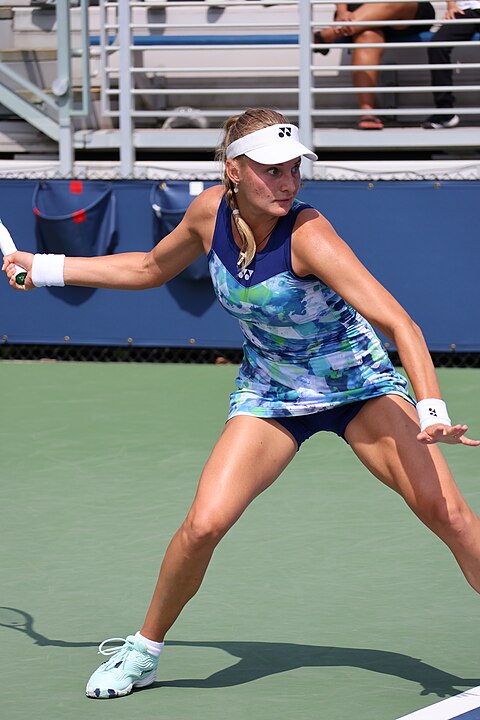
 

Andrey Rublev, Grand Slam Quarter-finalist

Also today: Jannik Sinner’s rosy forecast; lopsided fifth sets

Andrey Rublev at Wimbledon in 2023. Credit: aarublevnews

Andrey Rublev is a known quantity. He will hit big first serves, but his second serves can be attacked. He will hit monster forehands, often venturing far into his backhand corner to play them, and his opponents will often be stuck in place, watching them go by. He’ll also miss a lot of them. His backhand isn’t the same type of offensive shot; he can be dragged into long rallies if you pepper that side.

There isn’t a lot of subtlety to his game. That isn’t a criticism: Subtlety can win you acolytes and endorsement deals, but it isn’t necessary to win championships. With yesterday’s five-set win in Australia over home hope Alex de Minaur, Rublev advanced to his tenth career grand slam quarter-final. He’s 0-9 so far in those matches, but his consistency in getting there is the bigger story. Alexander Zverev is the only other man under the age of 30 with ten major quarter-finals. Rublev will get on the board eventually.

What you might not know about the 26-year-old Russian is that he has matured into a reliably dangerous returner. He’s always been effective on that side of the ball, and his return numbers have remained steady as the strength of his competition has increased. Last year, he won nearly 39% of his return points, good for 3.2 breaks of serve per match–seventh-best on tour. At the 2023 US Open against Daniil Medvedev, his most recent attempt to reach a major semi-final, Rublev broke serve five times in his straight-set defeat. The return wasn’t the problem.

That day, Medvedev’s return was the problem. (Andrey’s second serve didn’t do him any favors either, but that’s nothing new.) Of Rublev’s 98 serve points, 65 of them lasted four shots on longer. I can’t emphasize enough how bizarre that is–or, seen from another perspective, what a performance it was from his opponent. Medvedev not only got 65 serves in play, he got 65 plus-one shots back. Rublev’s top two weapons were negated.

The standard Rublev performance, at least among the 138 matches logged by the Match Charting Project, involves 59% of his service points ending by the third shot. He wins just over three-quarters of those. (Against Medvedev, he tallied a respectable 70%, but 70% of not very many is still not very many.) Put those numbers together, and 45% of his serve points end in his favor in three shots or less.

That’s a pretty good head start! Last year, the Russian won 66% of his total serve points. The majority of the damage gets done early.

The serves and plus-ones not only account for a decent chunk of the points played–at least on a good day–but they also serve as a proxy for how the longer rallies turn out. When Rublev wins most of his short service points–even when he doesn’t play as many as he would like–he almost always comes out on top. If we sort his charted matches by winning percentage on short service points, then split them into thirds, the difference is stark:

<=3 SPW%       Matches  Match Win%  
81%+                45         87%  
75.5% - 80.9%       44         64%  
up to 75.4%         49         24%

(The buckets are slightly different sizes only because I didn't want to put nearly identical percentages into separate categories.)

When Rublev wins most of the short service points, he wins the match. When he doesn't, he usually loses. If anything, the table understates the contrast; a disproportionate number of the low-percentage victories came on clay, including several on the slow dirt of Monte Carlo.

To some extent, it's obvious that "winning more of some subset of points" correlates with "winning more of all the points" and thus winning the match. But remember, this is the success rate independent of how many points end quickly. The combination of frequency and success--"what percent of total service points end quickly and in the server's favor"--should tell us more about the overall result. But for Rublev, that metric isn't as predictive of final outcomes as the winning percentage alone.

Battling demon

Yesterday against de Minaur, Rublev won 82% of the short service points. The Australian kept it close by reducing the number of short points to just under half of Rublev's serves. But the rule I've just outlined held true, despite a pesky defense. When de Minaur put the fourth shot back in play, he won 57% of return points. That's great, but with Rublev cleaning up the overwhelming majority of the short points, it wasn't enough.

We have shot-by-shot logs for four of the six matches between these two guys:

Tournament        Result  Short%  Short W%  
2024 Australian        W   49.4%     82.0%  
2023 Rotterdam         L   60.3%     75.6%  
2022 Monte Carlo       W   42.7%     73.2%  
2018 Washington        L   53.2%     71.6%

De Minaur did his job yesterday, keeping the ball in play more often than he did in the two previous hard-court meetings. (The Monte Carlo surface presumably helped lengthen points in that match.) The Australian won both of those earlier contests, watching Rublev make more plus-one mistakes and taking care of business when the rallies lasted longer.

In Melbourne, the Russian stayed a bit more within himself. He was able to hit a forehand on barely half of his plus-one shots--below both tour average and his own typical rate. Instead of blasting away with ill-advised backhands--part of what lost him the Rotterdam match--he accepted the invitation to rally. His 43% rate of winning longer service points isn't great, but it's far superior to the 0% chance of claiming the point after smacking an unforced error.

I don't want to overstate Rublev's caution, because he didn't play a cautious match. He probably never should. But getting a few more balls in play and fighting out the ensuing rallies makes his second serve look a lot better. As we've seen, Rublev does well on return. His second-serve points aren't much better than return points... but that's okay! Yesterday he won 55% behind his second serve, a glittering result compared to the 37% and 38% he won against de Minaur in Washington and Rotterdam, respectively.

Is this the one?

Rublev can be forgiven for having a losing record in major quarter-finals; he's been the lower-ranked player in seven of the nine. He's dropped two to Novak Djokovic, one to Rafael Nadal, and three to Medvedev. He should have picked up one (or three) along the way, but as the fifth man on a tour that always seems to have a big three or four, it's an uphill struggle.

Tomorrow's opponent is Jannik Sinner, just one place above him in the ATP rankings. (Elo likes him more than that--a lot more. See below.) This will be their seventh meeting, and history doesn't bode well for the Russian. Sinner has retired twice but won the other four.

Here are the short-service-point stats for Rublev in three of those matches:

Tournament        Result  Short%  Short W%  
2023 Miami             L   62.5%     77.1%  
2022 Monte Carlo       L   41.0%     58.5%  
2021 Barcelona         L   43.8%     85.7%

(Unfortunately we don't yet have a chart of his 7-6, 7-5 loss last fall in Vienna.)

This isn't insurmountable for the Russian: He often wins matches behind 77% of his short service points, and he almost always does with a 86% win rate. He'd like more than 44% of his serve points to end quickly, but that's tougher to execute on clay.

Against Sinner, the first three shots are even more important than usual, because the Italian plays a similar game, and once a rally reaches four strokes, he plays that game better. In Miami, Sinner won two-thirds of Rublev's "long" service points. In Monte Carlo, he won 54%, in the vicinity of what de Minaur did yesterday. In Barcelona, Sinner won a whopping 70% of return points when he got the fourth shot in play--as he more often than not did.

Rublev's second serves tell the story, as they did in the de Minaur match. Those, typically, are the points he can't finish early, when he should be thinking in terms of constructing the point, not grunting and crushing. In the four completed Sinner matches, he won only 37.5% of second-serve points. That's not going to get it done.

To beat an elite opponent, Rublev needs to remember when to bash and when to think. He executed well yesterday, pulling away in the end against a man who never stops fighting. Reaching his first major semi-final, against 22-year-old who seems to get stronger every week, he'll need to play even better.

* * *

Sinner in the hands of a friendly forecast

Jannik Sinner is the favorite tomorrow: According to my Elo-based forecast, he has a 78% chance of advancing to the final four. That's a hefty margin for a match between players adjacent to one another in the official rankings. The difference is more about Sinner than Rublev: My forecast gives Sinner a nearly 30% shot at taking the title, second only to Djokovic.

While the Italian ranks fourth on the ATP computer, he's second according to the Elo algorithm, closer to Djokovic than anyone else is to him. Here is the top of the table entering the Australian Open:

Rank  Player             Elo  
1     Novak Djokovic    2217  
2     Jannik Sinner     2197  
3     Carlos Alcaraz    2149  
4     Daniil Medvedev   2104  
5     Alexander Zverev  2037  
6     Andrey Rublev     2035  
7     Grigor Dimitrov   2032 

If you think in terms of major titles, official ranking points, or hype, this probably seems wrong. By those measures, Sinner is the laggard among the top four.

But Elo gives credit based on the quality of opponents beaten, and Sinner built quite a resume in the last quarter of 2023. He beat Rublev, Alcaraz, Medvedev (three times!), and most important, Djokovic twice. Nothing catapults you up the Elo list faster than knocking off the top dog.

The question, then, is whether Elo has overreacted to those two victories. My implementation of the Elo algorithm doesn't differentiate between narrow wins and blowouts. (Other versions use sets, games, or even points, though in my testing, those alternatives don't make the ratings more predictive.) The two Djokovic upsets were nail-biters. The Tour Finals round-robin match was decided in a third-set tiebreak, and each man won exactly 109 points. At the Davis Cup Finals, Sinner took the third set 7-5 despite winning fewer total points than his opponent.

While Sinner certainly deserved those victories--staring down match point against a 24-time major winner is a feat in itself--we might wonder how much they tell us about future results. If the two men keep fighting out such close matches, Djokovic is going to win some of them.

Each of the two upsets were worth a gain of 15 Elo points. Had Sinner lost them, he would've dropped 10 or 11 points instead. Call it a 25-point swing for each match. Thus, if we take the most pessimistic possible route and give both of the dead-heat results to Djokovic, Sinner's Elo rating would stand about 50 points lower, roughly tied with Alcaraz around 2,150.

(That isn't exactly right, because if Djokovic had won the Davis Cup match, Italy wouldn't have advanced to the final, and Sinner would've have beaten de Minaur. But Sinner did beat de Minaur, handily, and if we want to assess his current level, we shouldn't ignore that match.)

Handing both of the close results to Djokovic seems extreme. If we want to measure each player's current level without putting too much weight on the tiny number of points that decided those two matches, we might give one of the two victories to Djokovic. That would knock Sinner down to about 2,172, while boosting Djokovic to around 2,225.

In the Australian Open title-chances forecast, Novak would look a little better, and there would be more daylight between him and Sinner. Still, unless we make the harshest possible adjustment to Sinner's Elo rating, the Italian remains the next most likely Melbourne champion and a heavy favorite against Rublev tomorrow.

* * *

Dessert bagels

The Rublev-de Minaur match had an unusual ending: After splitting four sets, the Russian ran away with the fifth, 6-0.

Typically, if two players are so evenly matched that they reach a fifth set, neither one is going to dominate the decider. For the rare occasions that it happens, it's unique enough that I think it deserves its own name. I propose "dessert bagel."

In grand slam competition since 1968, there have been just 159 dessert bagels, including Rublev's--fewer than one per major. No one has ever recorded a dessert bagel in a final, but it has happened twice in semis. Mats Wilander polished off Andre Agassi in the 1988 Roland Garros semi-final, and Djokovic finished his 2015 Australian Open semi against Stan Wawrinka the same way. Still, second-week dessert bagels are rare: Rublev's was only the 16th in more than a half-century.

It's an oddity piled on oddities: Rublev-de Minaur was the fifth dessert bagel in Melbourne this year:

Round  Winner      Loser       Score                
R128   Mannarino   Wawrinka    6-4 3-6 5-7 6-3 6-0  
R64    van Assche  Musetti     6-3 3-6 6-7 6-3 6-0  
R64    Medvedev    Ruusuvuori  3-6 6-7 6-4 7-6 6-0  
R32    Kecmanovic  Paul        6-4 3-6 2-6 7-6 6-0  
R16    Rublev      de Minaur   6-4 6-7 6-7 6-3 6-0

Five 6-0 deciders is a record for a single slam. There haven't been as many as three since the 2007 Australian, and no major has seen more than one since 2017. If even more dessert bagels start piling up in the quarter-finals, we'll know that something bizarre is going on Down Under.

* * *

Subscribe to the blog to receive each new post by email:
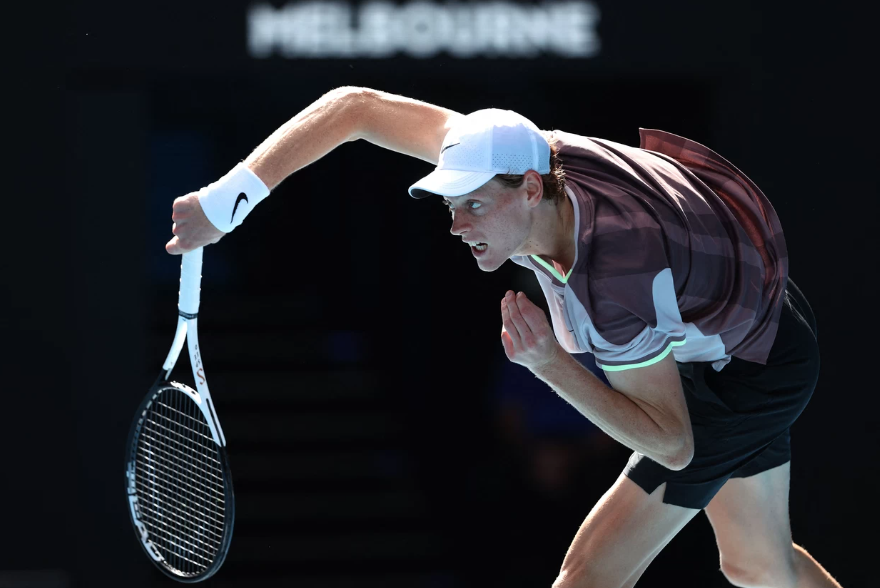
 

Can Lorenzo Sonego Hunt Down Enough Forehands?

Lorenzo Sonego at Monte Carlo in 2022. Credit: si.robi

This year, Australian Open broadcasts threw a screwball into their traditional post-match statsheet. In the addition to the usual numbers–winners, unforced errors, break points won, and so forth–the graphic shows something called “Hunting 3rd Shot Forehand.” I must have missed a memo. This is the first I’ve heard of such a thing.

A puff piece for the Tennis Australia data group offers something of a definition. The new stat measures “the times the server forehands their first post-serve hit, indicating their desire to dictate the point.” Um, ok. In other words, when the service return comes back, how often does the server hit a forehand with his next shot?

The intention behind the metric is straightforward. You hear a lot these days about the “plus-one”–the server’s second shot. While the serve is the most important stroke in tennis, the plus-one shot is the next-most crucial opportunity to attack. Both because it arises often, and because it offers a chance to define the direction of the rally, even if it’s not yet possible to put the ball away.

It is easier to dictate play with a forehand than a backhand; the potential trajectories of the stroke give a player more options. Beyond that, most men have better forehands than backhands. (The stat appears on broadcasts for both men’s and women’s matches, but today I’m going to talk about the men’s game.) If the goal is to command the rally with the plus-one shot, it’s better to hit a forehand than a backhand. A higher “Hunting 3rd Shot Forehand” number, then, is better.

The post-match graphic, with new stat second from the bottom

Before we go further: I simply can’t use this name. It’s long and confusing. (Is the player hunting for the forehand? For a winner? For a silly rabbit?) I’m going to call it “3rd Shot FH%” or “3F%” for short.

(And yes, I promise to get to Sonego eventually.)

The stat is not as straightforward as the intention behind it. The implication of 3F%, I think, is something like, “How hard did the player try to hit plus-one forehands?” A possible further implication is, “How well did the returner prevent his opponent from hitting plus-one forehands?” The second question prompts yet another: “How well did the server keep the returner from sending balls to his backhand?”

It may be possible to separate some of those questions, but there’s a lot more spadework to do before we get there.

What is normal?

(You might doubt whether I am well-situated to answer. Still, we soldier on.)

Your TV screen shows you some “Hunting 3rd Shot Forehand” numbers. Are they good?

The 3F% metric can be calculated from Match Charting Project data, so we have thousands of data points to draw upon. Based on men’s matches since 2014, the average 3F% is 64.7%. The middle third of player-matches falls between 59.3% and 70.9%. Take a little liberty with rounding, and we can say that “normal” is the range from 60% to 70%. Less than 60%, and you’re doing something wrong–or you’d rather hit your backhand, or your opponent had a day. More than 70%, and you were really getting things done in the plus-one department.

Some players consistently land at the far ends of the distribution. Here are career numbers for the top ten active players by this metric, along with 15 more names of interest:

Player                3F%  
Lorenzo Sonego      78.6%  
Rafael Nadal        77.7%  
Joao Sousa          77.6%  
Denis Shapovalov    77.1%  
Albert Ramos        76.0%  
Jeremy Chardy       75.7%  
Milos Raonic        74.6%  
Stefanos Tsitsipas  74.4%  
Casper Ruud         73.9%  
Grigor Dimitrov     73.9%  
* * * * * * * * * * * * *                    
Holger Rune         69.7%  
Dominic Thiem       69.3%  
Hubert Hurkacz      67.5%  
Carlos Alcaraz      67.2%  
Andrey Rublev       64.7%  
Jannik Sinner       62.6%  
Alex de Minaur      61.2%  
Stan Wawrinka       60.9%  
Andy Murray         60.0%  
Taylor Fritz        58.3%  
Diego Schwartzman   56.9%  
Novak Djokovic      56.2%  
Frances Tiafoe      55.8%  
Alexander Zverev    51.1%  
Daniil Medvedev     50.0%

There’s Lorenzo!

The top of the list gives you an idea of what sorts of game styles result in lots of plus-one forehands. Big serves help. Left-handedness works in your favor, perhaps since everyone trains so hard to return to a right-hander’s backhand side. Some clay-courters do well, as they are less likely to think of the serve as a point-ending shot on its own, focusing instead on how it can set up the point.

It also helps to try to hit plus-one forehands. Neither Zverev nor Medvedev seem to think in those terms, so their low 3F% ratings don’t reflect any lack of execution.

Does this even matter?

Some valuable on-screen real estate–and an enormous amount of coaching time–would be wasted if 3F% didn’t correlate with points won. Fortunately for the conventional wisdom, it does: A plus-one forehand is more likely to lead to a point for the server than a plus-one backhand is.

57.5% of plus-one forehands eventually turn into a point won, compared to 50.9% of plus-one backhands. That’s a ratio of 1.13, a number that will be more useful as a reference point in a moment.

The value of a plus-one forehand depends on the player. Matteo Berrettini wins 58.5% of plus-one forehand points but only 44.6% of plus-one backhands. That’s a ratio of 1.31, one of the highest of any active player. For him, 3F% certainly matters: All else equal, more plus-one forehand points leads to better results overall.

(A word of caution, though: The marginal plus-one forehand point–that is, the next return that he might have ran around to hit a forehand, but didn’t–might not have improved his results for the better. Presumably Matteo knows his own capabilities, and he hits forehands only on those points where they improve his odds of winning. The marginal plus-one forehand, for a player like him, is a fairly desperate foray into the doubles alley.)

For others, the plus-one choice barely registers. Zverev wins 56.7% of plus-one forehands and 52.8% of backhands, a ratio of 1.07. Every other top-tenner has a wider split, but there are more extreme examples. Adrian Mannarino wins more points behind his plus-one backhand than forehand, 55.4% to 52.3%.

Sonego, our 3F% champion, gains nearly as much from his plus-one forehands as Berrettini does. He wins 57.1% of plus-one forehand points, against 44.4% for backhands. It isn’t easy to find his backhand, but it’s worth the attempt.

What about first and second serves?

As far as I know, broadcasts don’t separate the “Hunting” metric into first and second serves. But they should! Early in the rally, the effect of the serve retains plenty of influence.

The following table shows some of the tour-wide averages I’ve discussed so far–3F%, plus-one forehand points won, and plus-one backhand points won–broken down into first-serve and second-serve points:

AVERAGES     3F%  FH W%  BH W%   
1st serve  71.1%  60.3%  53.9%  
2nd serve  55.2%  52.2%  48.1%
Total      64.7%  57.5%  50.9% 

Bigger serves generate weaker (and less targeted) returns, which invite more forehands. Behind second serves, ATPers only manage to hit forehands on 55% of their plus-one shots. On the other hand, the gap in points won isn’t as wide.

A fascinating outlier is Andrey Rublev. He finds the forehand on over 80% of his first-serve points, one of the highest numbers on tour. Behind the second serve, though, he hits plus-one forehands only 43% of the time–one of the lowest! It’s no secret that his second serve is a liability, but such a gap still comes as a surprise.

Sonego is a more typical case: lots more plus-one forehands on the first serve than the second (83% to 71%), and a wide gap in the results between forehands and backhands regardless of which serve it supports.

Converting from the backhand corner

With a few exceptions like Mannarino, most players want to hit as many plus-one forehands as they plausibly can. If the return goes to their forehand corner, obviously they’ll hit a forehand. If the return comes back up the middle, it’s either a no-doubt forehand or an easy decision to take a couple of steps around the ball and avoid the backhand.

The real decisions happen when the return goes to the backhand corner. Now we’ve moved into true Match Charting Project territory. I don’t know if the Australian Open has the data to drill down this far; either way, it probably won’t show up on your TV screen. In this corner of the internet, though, we’ll dive in.

About one-quarter of in-play returns go to the server’s backhand corner. Ernests Gulbis set the standard for plus-one backhanding, running around just 2% of those balls. On average, players go for the forehand 26.6% of the time. Even Zverev and Medvedev go that route sometimes: 9% for the German and 8% for the Russian.

Here again, Sonego sets the standard. He runs around 49% of those returns, winning 53% of the resulting plus-one forehands versus 47% of the backhands he can’t avoid. No other active player creates so many forehand opportunities. Of retired players in the charting dataset, only Carlos Moya and Leonardo Mayer were more extreme.

Here’s the same tour-averages table as above, now limited to points with returns to the backhand corner:

BH CORNER    3F%  FH W%  BH W%  
1st serve  34.9%  61.3%  53.0%  
2nd serve  16.9%  52.3%  47.3% 
Total      26.6%  58.7%  50.0%  

It’s possible that many players–though probably not Sonego–are leaving some points on the table here. I’m surprised to see that the gap in win percentages between plus-one forehands and backhand is bigger for backhand-corner returns than returns in general. Backhand-corner returns are somewhat similar to each other–certainly more similar than returns in general. Thus I would expect that players would find an equilibrium in which they ran around enough shots that their forehand and backhand winning percentages end up closer together. Perhaps some ATPers overestimate the quality of their backhands, or maybe they don’t want to look foolish taking a chance in the doubles alley. Or they might just know what they’re doing, and the guy typing on his laptop should shut up about it.

Hunting Alcaraz

Sonego beat Dan Evans in Melbourne yesterday, earning him a date on Thursday with second-seeded Carlos Alcaraz. While there’s more to the match than Sonego’s hunt to maximize his 3F%, the battle for the Italian’s plus-one court position will play a big part.

Alcaraz is a bit better than the typical tour player at landing his returns in the server’s backhand corner, something he does 30.8% of the time, compared to the norm of 27.0%. But it doesn’t make him particularly effective at avoiding his opponents’ plus-one forehand. They find the preferred shot 64.5% of the time, almost exactly tour average. The story is the same when we look at first and second serves separately: Carlitos neither prevents nor encourages plus-one forehands.

There are, naturally, returners who consistently limit plus-one options; others don’t have the skills to avert a barrage of forehands. Jenson Brooksby allows opponents plus-one forehands on just 57.7% of his returns; Andy Murray and (surprisingly?) Rublev keep opponents’ numbers down around 59%. At the other extreme, Cam Norrie allows servers to hit plus-one forehands almost three-quarters of the time. He’s one of many lefties who struggle by this metric: Since serve returns are disproportionately backhands themselves, left-handers must often go down the line to put a return in a right-hander’s backhand corner. Norrie finds that corner only one-fifth of the time.

Well-targeted returns are good; forcing servers to hit plus-one backhands pays dividends. Alcaraz, though, is proof that you can make your money on the fourth shot and beyond. Opponents hit plenty of plus-one forehands against him, yet no matter what they choose for the second shot, they struggle to win the point. First serves, second serves, plus-one forehands, plus-one backhands … Carlitos beats tour average by multiple percentage points in every category. This table shows the difference between how players fare against Alcaraz and the average level, in percentage points:

VS CARLOS  rel FH W%  rel BH W%    
1st serve      -6.9%      -2.5%  
2nd serve      -2.2%      -5.0% 
Total          -5.7%      -3.5%

In other words, a plus-one forehand is 5.7 percentage points less likely to turn out well against Alcaraz than it is against an average ATP player. That’s a hefty margin for something that accounts for nearly half of the typical player’s service points.

It’s fun to know that Sonego occupies the unique position that he does on tour, and it’s entertaining to see some of the far-fetched places from which he’ll smack an inside-out forehand. It might even be useful to see the Italian’s “Hunting” stat at the conclusion of tomorrow’s match.

Alas, “setting up the point” and “winning the point” are two different things. Sonego might hunt down enough forehands against Alcaraz to manage the first, but the second is a considerably bigger ask.

* * *

Subscribe to the blog to receive each new post by email: