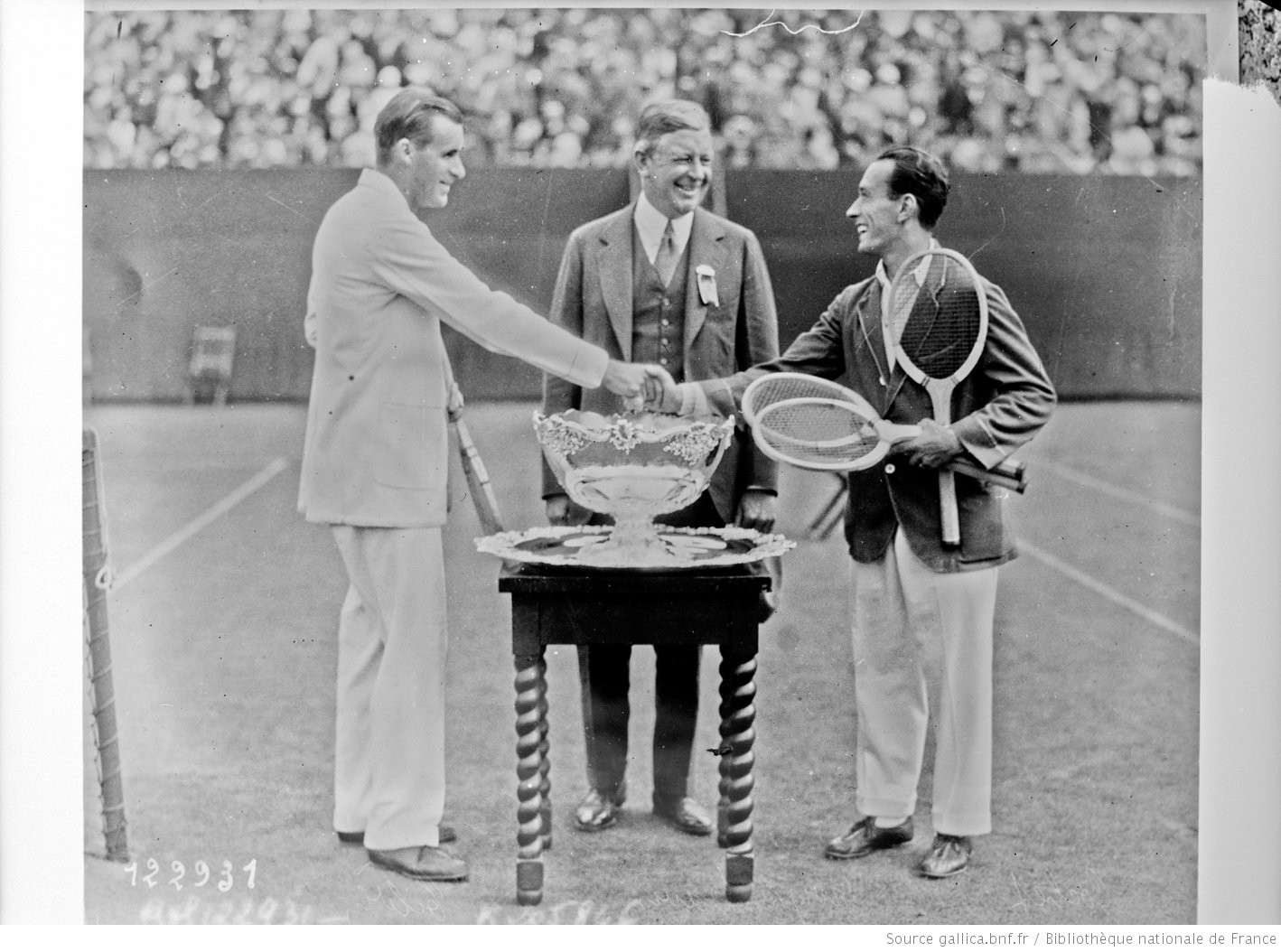
The Tennis 128: No. 71, Tony Trabert

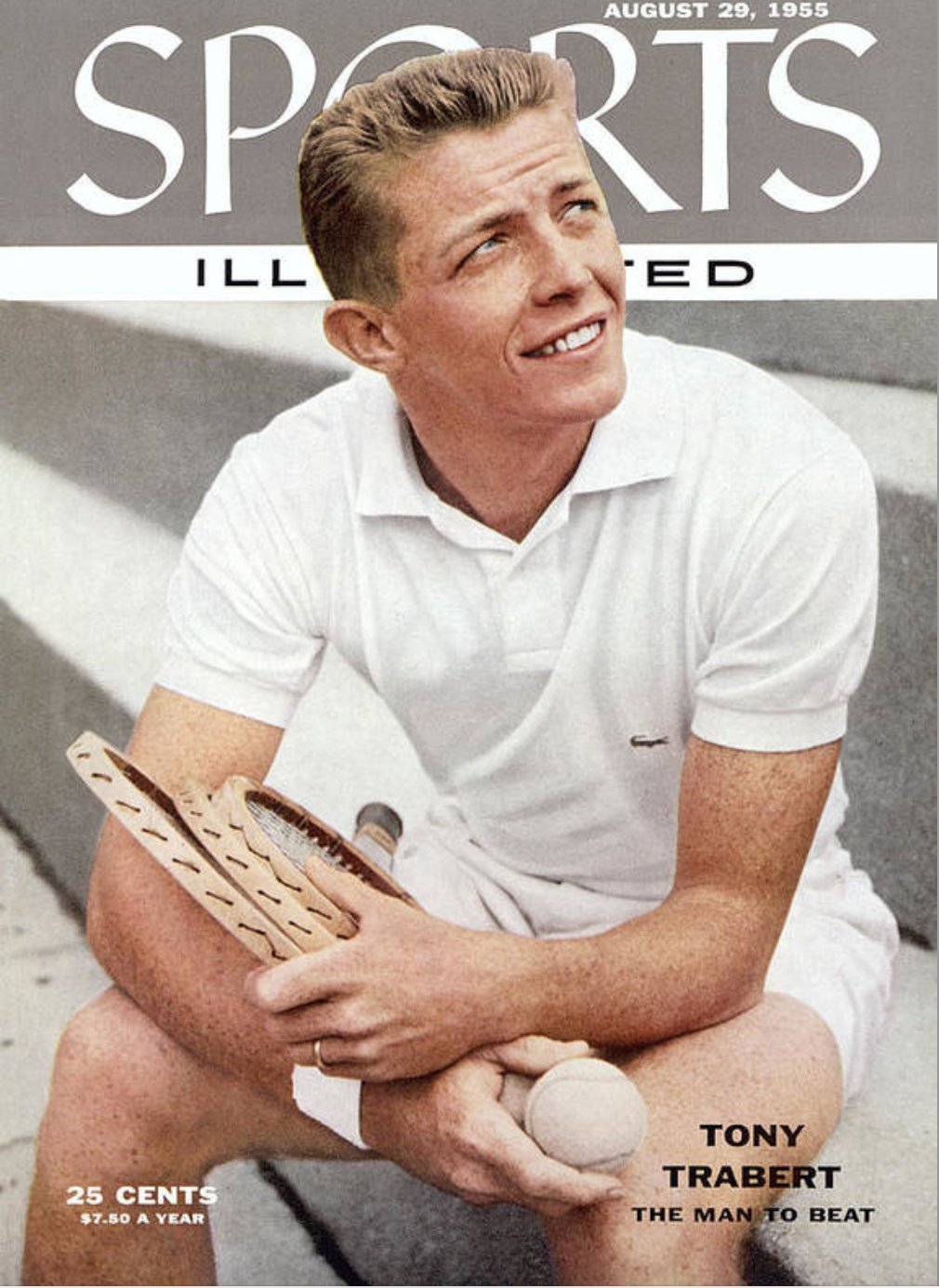
Tony Trabert on the cover of Sports Illustrated in 1955

In 2022, I’m counting down the 128 best players of the last century. With luck, we’ll get to #1 in December. Enjoy!

* * *

Tony Trabert [USA]
Born: 16 August 1930
Died: 3 February 2021
Career: 1948-63
Played: Right-handed (one-handed backhand)
Peak rank: 1 (1953)
Major singles titles: 5
Total singles titles: 56
 

* * *

It’s hard to overstate the extent to which California ruled American tennis in the amateur era. Westerners such as Maurice McLoughlin, Bill Johnston, May Sutton Bundy, and Hazel Hotchkiss Wightman were taking national titles even before World War I.

Philadelphian Bill Tilden kept the balance of power tilted eastward throughout the 1920s, but it was only temporary. Here is a list of the American men who won the US national title between 1930 and the end of the amateur era:

PLAYER            HOME STATE
John Doeg         SoCal         
Ellsworth Vines   SoCal         
Wilmer Allison    Texas         
Don Budge         NorCal        
Bobby Riggs       SoCal         
Don McNeill       Oklahoma      
Ted Schroeder     SoCal         
Joe Hunt          SoCal         
Frank Parker      Wisconsin*    
Jack Kramer       SoCal         
Richard González  SoCal         
Art Larsen        NorCal        
Tony Trabert      Ohio          
Vic Seixas        Pennsylvania

I’ve separated Southern and Northern California to emphasize just how much Los Angeles dominated the country’s tennis. 9 of these 14 players hailed from California, and one of the others–Frank Parker–spent some of his formative years in L.A.

If we count by titles, the gap is even more dramatic. Californians won 14 national championships to 7 for the rest of the country. It’s 16 to 5 if we class Parker with the West Coasters. Even that doesn’t tell the whole story. Most of the other best Americans of the era, such as Frank Kovacs, Budge Patty, and 1948 Wimbledon champ Bob Falkenburg, also hailed from California. A similar list for women would also be blanketed by Westerners, from Helen Wills to Billie Jean King.

The Golden State, and the City of Angels in particular, offered year-round tennis weather, plenty of courts, an ample supply of skilled coaches, frequent tournament play with age-based junior divisions, and local heroes made good.

Tony Trabert grew up in Cincinnati, Ohio. He had none of those things.

* * *

Well, okay, he had a few advantages. Cincinnati wasn’t as tennis-deprived as Chickasha, Oklahoma, the hometown of 1940 champ Don McNeill. Arch Trabert raised his sons to play any sport on offer, and there were playground courts down the block from Tony’s childhood home.

Arch wasn’t much help on the tennis court–his best sport had been boxing–but he knew enough to seek out good coaching for his son. And when Tony started showing promise as a catcher on the local baseball team, Arch sat him down and explained that if he wanted to be great, he needed to pick one sport or the other.

Tony might have picked baseball–this is Midwestern America in the 1940s, after all. Except Cincinnati had one local tennis hero who stepped in. Bill Talbert was 12 years older than Tony, and he was his country’s best doubles player. He won four men’s doubles titles at Forest Hills, plus another four in mixed with Margaret Osborne. Talbert saved his best tennis for his hometown Tri-State Championships (essentially the same event that is still played in Cinci two weeks before the US Open), where he won the singles title in 1943, 1945, and 1947.

Embed from Getty Images

Trabert (right) with Talbert in 1950

By the time he met Tony, Talbert lived in New York City. Still, he became a mentor to the young player, and when Tony’s game was ready, in 1950, Talbert took him to Europe as his doubles partner. The Cincinnatians were nearly unbeatable, winning the Italian Championships and adding a crown at the French, the first of Tony’s five major doubles titles.

Trabert was overmatched on the singles court, especially on the unfamiliar grass at Wimbledon. But that first European trip was enough to convince the 19-year-old that he belonged.

* * *

Even without Talbert’s intervention, Tony might have found his way to tennis stardom. He opted to stay close to home for college, attending the University of Cincinnati. College tennis was the one thing that could put a non-Californian on equal terms with the Golden Staters, as it offered promising athletes coaching, time to practice, and a few extra years to work on their games.

All of the non-Californians to win a national title between Tilden and the Open era–Wilmer Allison, McNeill, Trabert, and Vic Seixas–played college ball. Parker didn’t, but in addition to his time in Los Angeles, he was virtually adopted by Mercer Beasley, who coached the tennis team at Tulane at the same time he developed Parker.

While the University of Cincinnati was no tennis powerhouse, it gave Trabert that extra development time. Tony also took advantage of his two years as a UC Bearcat to get into better tennis shape. He was built more like a football halfback than a racket wielder, and at six-feet-one-inches tall, it took consistent work to stay at his playing weight of 185 pounds. He played for the nationally-competitive UC basketball team, discovering that hoops training helped his endurance and quickness.

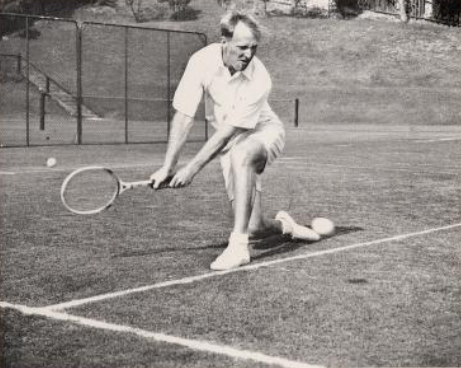
The Trabert forehand

After two years of college, Trabert had reason to feel good about his game. He reached the quarter-finals at Forest Hills, where he pushed Australian star Frank Sedgman to five sets. Sedgman would win the tournament, and none of his other opponents managed to take a single set from him. Tony was also a key member of the 1951 Davis Cup team, winning four singles and three doubles rubbers to put the Americans in the Challenge Round against Australia. He was limited to doubles duty (behind Ted Schroeder, who played badly in his final Cup appearance), but impressed the Aussies nonetheless.

The young man from Cincinnati was one of the brightest hopes for US amateur tennis. But with the Korean War raging, Tony’s local draft board received a few letters suggesting his university studies were just a sham to keep him out of the service. He enlisted in the navy–he felt “forced” to, even if he wasn’t drafted–and spent much of the next two years on an aircraft carrier in the Pacific, trying to have serious conversations with sailors who preferred to swap comic books.

* * *

The path to Trabert’s breakthrough season in 1953 was anything but straightforward. He grew up in a tennis backwater, went to a school without much of a tennis program, and missed tournament play for months at a time.

Somehow, he came back from his time at sea playing better than ever before. He won 14 tournaments in 1953, frequently squaring off with Seixas or the 18-year-old Ken Rosewall. He reached a new peak at the US National Championships, the sole major he was able to enter that year. He didn’t drop a set in his six matches, blasting past Patty and Rosewall, then Seixas in a lopsided final. Rosewall was the only one of the three who even managed to reach 5-all in a set against him.

Trabert’s body, conditioned by basketball and the navy, dispatched shots that mere tennis players could barely handle. The South African player Abe Segal saw Tony win the Wimbledon final two years later against Kurt Nielsen, and he could describe the Trabert game only in military terms. “It was like a tank moving infantry … Trabert was driving the tank. Nielsen machine-gunned him but the bullets just bounced off!”

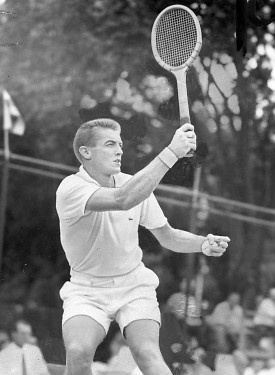
Trabert wins Wimbledon in 1955

Tony wasn’t the first big man to win tennis matches with powerful shots. But he might have been the smartest big man ever to play the game. In the late 1970s, Jack Kramer rated Trabert one of his top 21 players of all time. He wrote, “Trabert had only a few top shots–backhand, backhand volley, overhead–but what he lacked in his strokes and in his mobility, he made up in his head.”

Trabert’s tactical savvy even went so far as to know when not to go big. Writer Joel Drucker went to one of Tony’s tennis camps as a kid, and Trabert gave him a suggestion for an upcoming match. “That guy’s return isn’t that good, so just serve your second serve first and get in quick. That’s how I beat Seixas at Forest Hills.”

He could bludgeon an opponent, sure. Even worse, he could beat you without unleashing the full force of his weaponry.

* * *

Unfortunately, Trabert spent much of 1954 at war with himself.

It started a few days before the end of the year, as the American team once again attempted to prise away the Davis Cup from the Australians. Tony’s teammate Vic Seixas wasn’t playing well, but Trabert was in form, and he fully expected to win both of his singles matches.

Instead, he collided with an in-form Lew Hoad, who saved the Aussies from a 2-1 deficit on the final day in a dramatic five-setter. The crowd of 17,500 was vociferously pro-Australia, of course. Trabert finally lost his cool late in the fifth set. He missed a serve, Hoad smacked the ball back, and the crowd cheered–thinking it was a return winner. Tony thought they were applauding his service fault, and he criticized the home crowd for it after the match.

He later admitted his mistake, but at the Australian Championships a few weeks later, he lost any remaining fans Down Under. He crashed out in the second round to Aussie vet John Bromwich, when once again the crowd got on his nerves. Bromwich lost the first two sets, 6-1, 6-1, then went on a tear. The crowd that had remained mostly silent for two sets came alive as the local man evened things up. Tony couldn’t take it any more, and he tanked the final set against a 35-year-old he should’ve easily beaten.

Trabert bounced back well enough to win the French Championships. Unlike Angelenos, who grew up playing on asphalt courts, Cincinnatians learned to play on clay. Unusually for the day, Tony hit his backhand with heavy topspin. It helped, too, that he avoided the savviest of the Europeans. From the third round to the final, he faced two Australians and three Californians.

Embed from Getty Images

A distracted Tony Trabert in 1954

It was hardly a terrible season. He lost a five-setter to Rosewall in the Wimbledon semi-finals and picked up a couple of smaller titles. But his 1953 campaign had set a high bar that he was obviously failing to clear.

Trabert’s old mentor, Bill Talbert, asked the question in Sports Illustrated in August: “What’s the matter with Tony Trabert?” Jack Kramer, who kept an eye on Tony as a potential pro, thought he knew the answer:

One trouble with Tony is that he’s not as good as he thinks he is. He’s got to quit looking for alibis, and work hard to improve his game. Another thing—he’s got to toughen up his hide. A great champion can’t let himself be upset by a bad call or a heckler. Finally, he’s got to eat, sleep and live tennis. You can’t do this if you’re worrying about outside problems.

That’s a harsh assessment of a player who had won a title and reached a semi-final in last two majors, but Trabert’s performance at Forest Hills bore out the judgment. As the top seed and defending champion, he lost in the quarter-finals to the streaky Australian Rex Hartwig.

* * *

Kramer mentioned “outside problems.” What else did Trabert have on his mind?

In 1953, he met Shauna Wood–Miss Utah, no less–and they were soon married. He found a sales job that allowed him to take advantage of his travel schedule and wouldn’t get too much in the way of his tennis. So Tony’s life was more complicated than that of the typical discharged sailor.

That might have been enough to distract him from his game. But in the eyes of some of his contemporaries, Trabert was unhealthily focused on a pro contract. Kramer–the man who would sign him–probably knew this. Young Australians were in no hurry to turn pro, as their federation would support them financially in ways that were against the rules in the States. Tony, on the other hand, knew he probably had a brief window as a top gate attraction, and he didn’t want to miss it.

While his 1954 season wasn’t good enough, it proved to be the exception. His 1955 campaign–“The New Tony Trabert” in another Talbert article for SI–was the outstanding single-year performance of the decade.

Again, the season effectively began in the final days of 1954 and the Davis Cup Challenge Round. This time, Trabert got the better of Hoad, and the Americans won the first three rubbers to bring back the trophy. He lost to Rosewall in the Australian Championships–his last defeat as an amateur at a major. As a consolation prize, he and Seixas followed up their Davis Cup triumph with a doubles title over Hoad and Rosewall.

The point that won the 1954 Davis Cup for the US

Trabert would play 109 singles matches in 1955. The loss to Rosewall was one of only five defeats.

He told Sports Illustrated in August, “I never have–or never would–admit to a weakness, because I don’t think I have a particular weakness.”

That year, his rivals were forced to agree. He had never been particularly deft with low volleys, so he simply crowded the net more, racking up points with high volleys. As he had in 1953, he often took a bit off the serve, so as to hit fewer seconds. He became increasingly aggressive on the return, as well. The pressure on his opponent was relentless.

Trabert defended his title at the French, beating Swedish clay-court specialist Sven Davidson. He tacked on another doubles title when he and Seixas defeated a pair of Italians. At Wimbledon, Tony turned his howitzer on Kurt Nielsen. And at Forest Hills, he avenged his loss in Australia, defeating Ken Rosewall.

Trabert beats Rosewall at Forest Hills for his third major of 1955

At Wimbledon, he won the title without losing a single set. He was just as untouchable at the US Nationals. Trabert was clearly the best amateur in the game–but not for long. Kramer signed him for a $75,000 guarantee, and by the end of the year, he was on the road, facing off in a pro tennis showdown against Richard “Pancho” González.

* * *

Trabert had a solid, if not great, professional career. He wasn’t as good as González–no one was, especially on fast indoor courts. But Tony’s aggressive game kept the scores respectable. In a series of 100 matches, Trabert won a quarter of them.

He continued to play pro tournaments until the early 1960s, and he took charge of Kramer’s European operation in 1960. After a spell away from tennis, he returned as a television commentator, a plain-spoken yet authoritative voice over the air.

When Michael Chang won at Roland Garros in 1989, he was the first American champion there since Trabert took his titles in 1954 and 1955. Tony saw it live, calling the match for Australian TV.

By then, Trabert was the consummate tennis insider. He had captained winning Davis Cup teams and served as president of the Tennis Hall of Fame. Not bad for a husky kid from Cincinnati, Ohio.

The Tennis 128: No. 72, Stan Smith

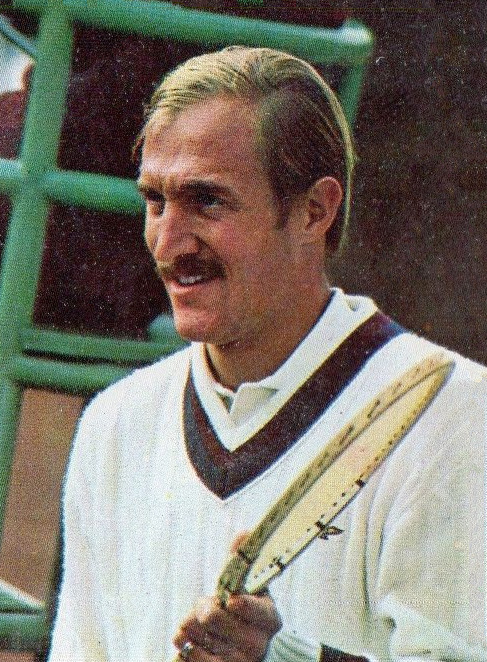
Stan Smith in 1972

In 2022, I’m counting down the 128 best players of the last century. With luck, we’ll get to #1 in December. Enjoy!

* * *

Stan Smith [USA]
Born: 14 December 1946
Career: 1964-83
Plays: Right-handed (one-handed backhand)
Peak rank: 1 (1971)
Peak Elo rating: 2,248 (1st place, 1973)
Major singles titles: 2
Total singles titles: 64
 

* * *

Stan Smith’s first love was basketball. Even while Pancho Segura was turning him into a junior tennis champion on the public courts of Pasadena, he continued playing hoops. Baseball and football, too. He played on his high school basketball team until his senior year, when it was finally impossible to pursue more than one sport.

It was always clear where his sporting future laid, even as he grew to six-feet-four-inches tall. Journalists tended to make too much of his time as a hoopster, and he joked in 1972, “[T]he better I get in tennis, the better I become in basketball. If I ever win at Wimbledon, I think they’ll make me an All-American in basketball.”

The scribes who sought to explain Smith to their readers talked about basketball for a reason. Stan was, first and foremost, a team player. By the end of his career, in the early 1980s, the collective aspect of tennis had been obliterated. In an individual sport where everyone was competing for the same lucrative prizes, there was too much at stake.

But Smith’s career was defined by his teams. He played college tennis at USC, winning national singles titles and doubles championships with Bob Lutz. The 1967 Trojan squad, led by coach George Toley, was one of the best of all time. Toley had spotted Stan at the Los Angeles Tennis Club and given him a scholarship, betting on the big kid’s raw talent.

From there, Smith earned a place on the United States Davis Cup team. Australia had held the cup since 1964, and Stan was hardly expected to be the man to bring it back. Arthur Ashe and Clark Graebner were in charge of singles; Smith was there, with Lutz, to play doubles.

The USC grads did their job, winning four out of four rubbers in the 1968 campaign. Ashe and Graebner won their singles matches in the Challenge Round against Australia to bring back the trophy. Yes, it was a depleted Australian team–the country’s biggest stars were ruled ineligible because of their professional standing. But there are no asterisks in tennis.

* * *

The American squad beat all comers for five years running. Smith, more than anyone else, ensured that his country held on to tennis’s most coveted trophy. The main challenge to US dominance was the Romanian team of Ilie Năstase and Ion Țiriac.

Năstase was the most mercurial of stars, a flashy shotmaker who could embarrass you for a set, then lose interest and let the match go in thirty minutes. Țiriac had none of his teammate’s talent, but he made up for it with tactical savvy and gamesmanship that occasionally crossed over into outright cheating. The “Brașov Bulldozer” had played ice hockey for Romania in the 1964 Olympics, and I suspect he was the team’s enforcer. He also played rugby, because of course he did.

Smith takes on Țiriac in 1971

The only way to beat the Romanians was to ignore their antics. Fortunately for the American side, Stan Smith was the most unflappable of them all.

Even as a junior, Stan realized that he was unaffected by the match pressure that caused his rivals to crumble. He was poker-faced on court. His gestures on court were limited to the nervous tic of brushing back his hair between points. At his most demonstrative, he would fix his hair a bit more slowly.

In contrast to characters like Năstase and Jimmy Connors, Smith was a throwback. Michael Mewshaw offered a sketch in his book, Short Circuit:

Tall, blond, and regally slim, he is the sort of player Wimbledon loves. He has the stiff upper lip and proud carriage of a Grenadier Guard, never complaining, never responding to success or adversity with much more than a bemused smile.

For Stan, it went back to his grounding in team sports. “You don’t see basketball or football players getting upset at themselves and throwing tantrums,” he said. (This was more accurate in 1972!) He recognized the benefit of his late start in tennis, which allowed him to become both an all-around athlete and an adult with a perspective that extended beyond the locker room.

His first five years on tour would put that perspective to the test.

* * *

The first US-Romania showdown was in 1969. The American defending champs set up shop in Cleveland, where they would force the Europeans to play on a fast hard court. The visitors were realistic about their chances. They figured they could win two of the five points–that is, the pair of singles matches against the newly-promoted Smith.

Instead, the 22-year-old American won every match he played. He took on Țiriac in the second rubber, and came back from a two-sets-to-one deficit to win. Frank Deford wrote for Sports Illustrated that the Romanian was “complaining, glowering, stalking and weaving like a bull at bay.” Smith just focused on getting his serve in, and he held off the Brașov Bulldozer.

Smith and Lutz secured the championship with a doubles win the following day. The reverse singles rubbers didn’t count, but the fans still got their money’s worth. Stan had lost to Năstase in the second round of the US Open just a few weeks before. The two men would ultimately face off 18 times in a 13-year span, reaching a fifth set on five memorable occasions. This was the day that Smith made it clear he could hold his own. He upset the top Romanian in an 11-9 fifth set.

Stan would tell Tennis magazine in 2016, “The team thing really affects you. You don’t want to let them down. It’s not just the country. It gets a little more personal at the point. Your result is as a team, so you wanna see the other guy win.”

He watched the “other guy”–in this case, Cliff Richey–win in the Challenge Round against West Germany in 1970. (Australia was still forced to field a non-competitive squad of “two koala bears and a wallaby,” as Deford put it.) Smith was limited to doubles duty. Once again, he and Lutz scored the decisive point with a straight-set win against the visitors.

Davis Cup doubles in 1970

When the West Germans came to Cleveland, Smith was still flying under the radar, an obviously skilled doubles player but no more than the third-best American on the singles court. Almost immediately afterward, his reputation began to soar. He opened November in Stockholm, where he upset Ashe and Ken Rosewall, the top two seeds, for the title. A month later, he beat Rosewall and Rod Laver to win the year-end Masters championship. His days as the Davis Cup doubles specialist were over.

* * *

For an athlete willing to throw his weight behind the collective, Stan was surprisingly standoffish. He teamed with Lutz for years, winning doubles titles and rooming with him on the road. But Lutz said, “[W]e hardly knew each other…. I only met him on the court.”

Journalist Richard Evans was one of many who felt that Lutz was the more naturally talented of the pair. He just didn’t work as hard. Few players did. Early on, Smith’s independence had a whiff of superiority to it, but in time, Lutz and others realized that Stan was simply going to do his own thing. When a group went out of the town, that might mean he stayed at the hotel to jump rope.

In 1971, the extra work began to pay off. Technically, he was a corporal in the US Army, but the military saw his public relations value. His tournament schedule was barely affected. After a surprisingly successful clay court campaign–he won a title and reached a career-best quarter-final at Roland Garros–he beat John Newcombe at Queen’s Club. He went into Wimbledon as the 4th seed and reached the championship round. He nearly upset Newcombe again, losing to the Australian in the fifth set.

Smith took the final step at the US Open. His career at Forest Hills had begun with some nasty draws: Tony Roche was his opening-round opponent in 1968, and he faced Năstase in the second round in 1969. Finally the tennis gods were ready to repay him.

Stan beat compatriot Marty Riessen and 4th seed Tom Okker to reach the final. Waiting there was the Czech Jan Kodeš, mostly known at that time as a threat on clay. Kodeš had knocked out Newcombe, the top seed, in the first round and followed it up with a five-set victory over Ashe in the semis.

With the help of his childhood coach Segura, Smith went in with a game plan. He served well, threatened the weaker Kodeš service, and kept the Czech player honest with lobs when he crept too close to the net. At age 24, he had his first major singles title.

https://www.youtube.com/watch?v=Gm2l4zZ4XIQ
The 1971 US Open final

The Davis Cup defense was, by comparison, a walk in the park. The Americans shifted venues to Charlotte, where they welcomed the Romanians with the slightly less US-biased green clay. It didn’t matter. Smith straight-setted Năstase in the opener. With a new partner, the young and inconsistent Erik van Dillen, he lost the doubles. But he kept his streak of decisive victories alive. In the fourth rubber, he dispatched Țiriac in three, sealing the trophy with a 6-0 final set.

* * *

In 1983, Smith proclaimed, “A truly great player should be able to win on all surfaces.” By that standard, Stan would establish himself among the legends of the game in 1972.

The American Davis Cup defense would be more complicated than usual. The tournament finally gave up the archaic Challenge Round format, in which the previous winner sat out until the rest of the field had been whittled down to one. To win a fifth-straight championship, the US side would need to work through the Americas zone and play four ties just to earn a place in the title round.

Smith remained a stalwart for the cause, winning all seven matches he played in the first three ties. In the meantime, he solidified his status as one of the world’s best. He opened the season by winning four tournaments in a row, two of them in finals against Năstase and another with a five-set victory over the fast-improving 19-year-old Jimmy Connors.

He failed to defend his Queen’s Club title, perhaps distracted by the news that was roiling the tennis world. We tend to remember the 1973 Wimbledon boycott, in which 81 men skipped the Championships over an internecine dispute between the International Lawn Tennis Federation (ILTF) and the fledgling players union. But the 1972 tournament had every bit as much controversy.

Embed from Getty Images

Few things went smoothly at Wimbledon in 1972

That year, the ILTF banned the pros under contract to World Championship Tennis (WCT), the richest of the professional circuits. It was the same dispute that had kept the best Australians out of Davis Cup competition. (It was also the reason why Smith now partnered van Dillen. Lutz had signed up with WCT, making himself ineligible for Davis Cup play.) The details of the conflict are murky to a modern reader, but the broad strokes are familiar to anyone who watched tournaments jockey for calendar position amid the Covid-19 pandemic. Both sides wanted prime spots on the schedule, access to the best players, and full control of as much of the sport as possible. In other words, it boiled down to money, money, and money.

For Stan Smith, it meant that defending champion Newcombe–and a host of others–would spend much of the Wimbledon fortnight at the WCT event in St. Louis instead. Smith, along with Năstase, Kodeš, and others, was an “independent” pro, unsullied by any direct financial link to the competing tour. He entered Wimbledon as the top seed, unthreatened by Newcombe, not to mention Laver, Rosewall, and Ashe.

It was impossible to ignore the decimated draw, but Smith fell back on his usual strategy of blocking out everything that didn’t directly affect his tennis. “You don’t try to lose just because all the best players aren’t here. The subject isn’t even worth my time. This is still the greatest tournament in the world, and the pros know it. For me, this championship would be the pinnacle.”

Or as a less serious competitor put it, it was still Wimbledon, “even if they threw out everybody and seeded two monkeys onto center court.”

Stan beat Kodeš in the semi-finals for yet another showdown with Năstase, who had lost only two sets en route to the final. It might not have been the championship match that the tournament would have delivered with WCT stars on hand, but the clash between top-seed Smith and second-seed Năstase was everything the All-England Club could’ve hoped for.

It was the 9th meeting between the two men. Each had won four: Smith with the Davis Cup victories, and Năstase with successes at Roland Garros and in the 1971 year-end Masters final. Still, the American was confident. He told reporters, “If I have to, I can always go to my guts to beat this guy.”

https://www.youtube.com/watch?v=ufLIhebvS5I
The 1972 Wimbledon final

He had to. The Romanian was brilliant, putting service returns on Smith’s shoetops and–most remarkably of all–generally keeping his emotions in check. Stan could only wait for his opponent to falter. With what he called “80 percent guts and a little luck,” he came through, converting his fourth match point on a missed Năstase smash to win, 4-6, 6-3, 6-3, 4-6, 7-5.

The lengthy New York Times recap of the match said nothing of the absent stars. There are no asterisks in tennis.

* * *

The Wimbledon final was, of course, played on grass. The US Davis Cup team had three rounds remaining in their 1972 campaign, and all three would be played on clay.

First they went to Santiago, Chile, where they made quick work of the hosts. Smith won three matches, including a five-set doubles victory alongside van Dillen. Two weeks later, they were in Barcelona for another dose of the red stuff. Stan lost to Andres Gimeno in the opening match. But by now, you can probably write the next sentence yourself. He and van Dillen won the doubles, and in a deciding fifth rubber, Smith straight-setted Juan Gisbert.

Waiting in the championship round: Romania. Unlike in 1969 and 1971, the Davis Cup would be decided in Bucharest.

Back in 1969, Țiriac had fumed after he failed to figure out the shower faucet in a Cleveland locker room and suffered through a cold mid-match shower. The Romanians, hosting a Cup final behind the Iron Curtain for the first time in history, aimed to pay back every slight, real and imagined.

The surface, in particular, was chosen to ensure a US defeat. Țiriac said, “The U.S. players not like the soft stuff,” he said. “Wait till they see ours. Godzilla, he feel like he serving on the beach.”

“Godzilla” was Țiriac’s nickname for Stan Smith.

The crowd was rowdy, the Romanian linesmen were blatantly biased, and the Americans were accompanied around town by 20 “translators”–bulky men with guns and conspicuously absent language skills. Țiriac, the master gamesman, pushed his advantages to the limit, leaving Tom Gorman–the second US singles player behind Smith–in tears. The Romanian antics were so bad that after the first two matches, American captain Dennis Ralston called it “the most disgraceful day in the history of the Davis Cup.”

Few men could excel under such conditions. Fortunately the Americans had just such a player in Smith.

The tie opened with a rematch of the Wimbledon final. Năstase held his own for 18 games in the opening set, but he was finally thrown off his game by an unexpected double fault call. Smith broke to get on the board first, 11-9. For all of his bluster–Năstase had said the Romanians were 10-1 favorites–the Romanian star simply went away.

Smith-Năstase in the 1972 Davis Cup

Or maybe Smith slammed the door. Herbert Warren Wind described the American’s dominance for the last two sets of the match:

He served with explosive power, he blasted Năstase’s serve for outright winners, and he ranged swiftly around the forecourt, hitting one biting volley after another. I have never seen a man hit his shots on clay with the pace that Smith maintained in winning the next two sets, 6-2 and 6-3. He played exactly as if he were playing on grass–fast grass.

After Țiriac beat Gorman to even the tie, it was van Dillen’s turn to shine. Alongside the ever-steady Smith, he defied the hostile crowd and turned in the match of his life. The Americans won the doubles, 6-2, 6-0, 6-3.

The visitors led, two matches to one, and once again, Stan was in position to finish the job. It wasn’t easy. Țiriac simply refused to give in, and he had help. The linesmen were so bad that after three blatant mistakes in the same game, Ralston was able to get one of them removed. On another occasion, Smith hit a return winner off a Țiriac first serve, only to hear the service line judge pipe up with a belated “out” call. That gave the Romanian a second chance.

After splitting four long and winding sets, Smith was too calm, and his game was too strong for the wily man from Brașov. He hit an ace to open the fifth, and from there, he played what Wind called “an almost perfect set.” He dropped a 6-0 frame on Țiriac, just as he had in Charlotte the year before. The Americans won their fifth straight Davis Cup.

* * *

Thus ends the usual list of Smith’s outstanding accomplishments. In the space of 14 months, he won two singles majors and led his country to two Davis Cup titles.

Yet his best tennis was still to come. He joined the WCT circuit in late 1972 after completing his military obligations. He won his first tournament among the contract pros in Los Angeles a few weeks before the trip to Bucharest.

The level of competition took some getting used to, and he lost matches in early 1973 to Laver and Rosewall. He quickly adapted and went on a tear beginning in March. He won four consecutive tournaments, beating Laver and Richey three times apiece. A month later, he and Lutz won the WCT World Doubles title in Montreal, and Smith followed it up with a victory at the season-ending championship in singles in Dallas. He overcame Laver in the semis and Ashe in the final.

Even before the Dallas final, Stan was confident: “I’ve always claimed Laver was the best. Today is the first time I feel comfortable in saying that maybe I am.”

The ATP wouldn’t roll out its ranking system for another few months, but my Elo ratings support Smith’s contention. They put him at the top of the table midway through his four-tournament run. After Dallas, he had opened up a meaningful 50-point lead over Laver and Năstase.

He later said, “I was probably playing the best tennis of my career right about then.” A couple of months later, he would even win a title on European clay, beating Manuel Orantes and a young Björn Borg in Båstad.

Smith and Borg in 1973

But in that summer of 1973, he wouldn’t defend his Wimbledon title. This time, he found himself on the side of the boycotters. The ILTF suspended Yugoslavian player Niki Pilić for skipping a Davis Cup tie, and the players union–the ATP–took his side. A compromise was within reach: If the ILTF backed down, Pilić was willing to withdraw to let everyone save face. But Wimbledon didn’t take the boycott threat seriously, and Smith was one of 81 men who stood on their principles instead of chasing the most coveted title in tennis.

* * *

It was an unlucky break. Smith never again recovered the form that won him so many laurels in a such a short span. Even the Davis Cup slipped away. The Australians were able to deploy their best players again in 1973, and the duo of Laver and Newcombe handed Smith three defeats in a final-round sweep.

But Stan was rarely one to complain. He has always recognized the role that luck played in his career. He grew up in the tennis hotbed of Southern California, and met Segura at exactly the right age to start him on the path to stardom. A few years later, he secured the final tennis scholarship that USC had to offer that year.

Upon graduation, his timing couldn’t have been better. He and Lutz won the doubles title in their first appearance at Forest Hills, claiming thousands of dollars in prize money that had never been available before. Smith wasn’t drafted into the military until long after he was eligible, and even then, he was able to continue playing tournament tennis.

And the biggest break of all: Stan Smith became a shoe. When Adidas realized that a stylish shoe called the “Haillet”–after a French player–wouldn’t have much traction in America, they turned to Stan. 100 million pairs later, Smith is a wealthy man, and his name is known far more widely than that of the typical Wimbledon champion.

The ultimate irony is that it’s Stan’s name–and only his–on some of the world’s most recognizable footwear. Sure, endorsements don’t really work any other way. But of all the tennis stars to parlay their success into lucrative name recognition, Smith is the one who, in his glory days, tended to deflect attention.

A few big-name players ignored the boycott and entered Wimbledon in 1973. But for the defending champion, it was never an option. It would have been a betrayal of his friends and colleagues, not to mention a blow to player’s rights in the crucial early days of Open tennis. As someone with Stan’s track record could have predicted, luck would eventually tilt back in his favor. He missed his chance to win back-to-back Wimbledon titles. But the first championship was enough for Adidas to make him an icon.

The Tennis 128: No. 73, Elizabeth Ryan

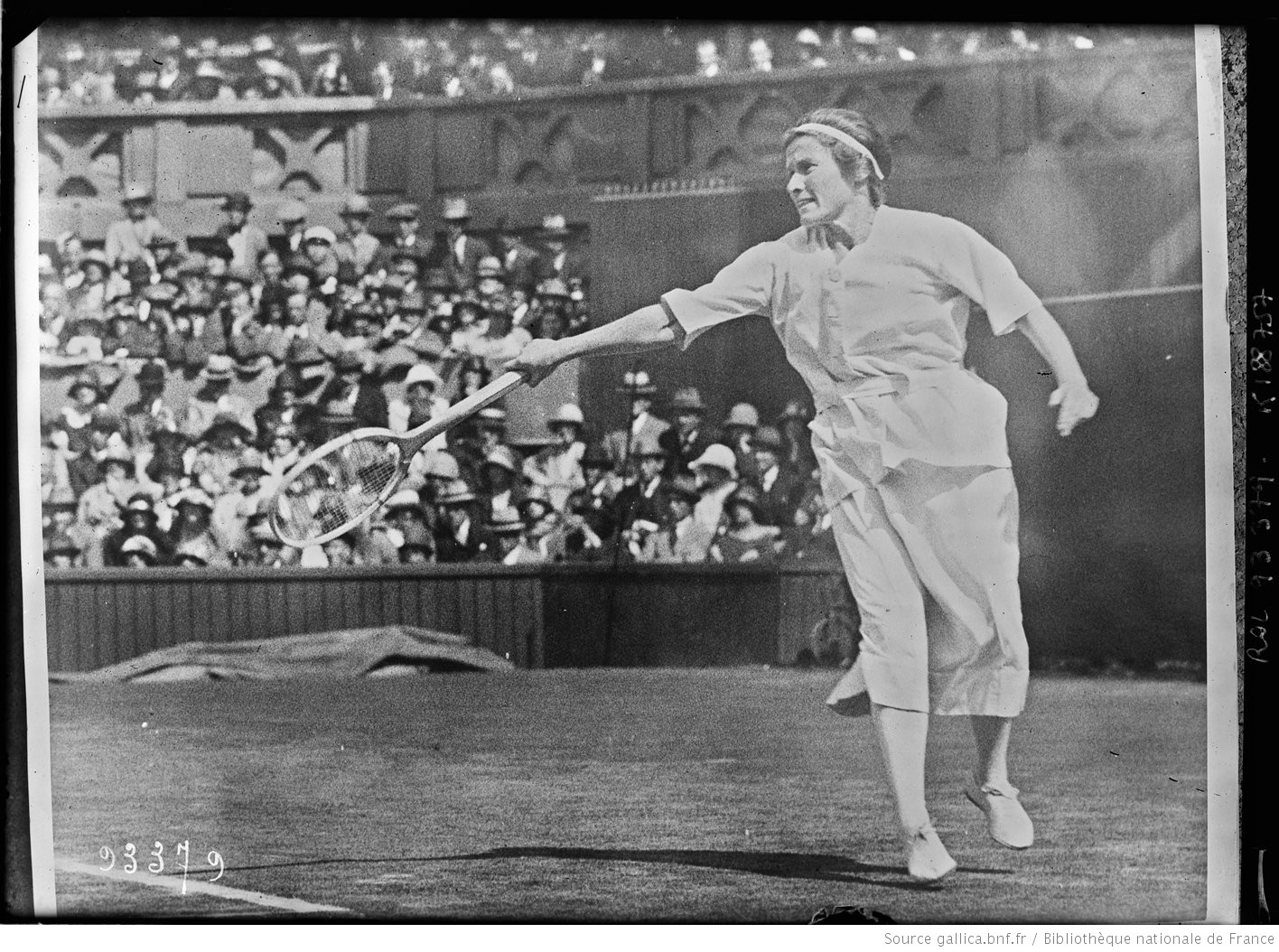
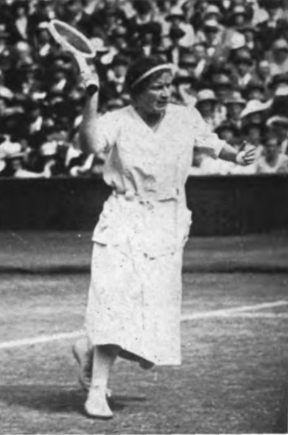
Bunny Ryan hits a backhand in 1924

In 2022, I’m counting down the 128 best players of the last century. With luck, we’ll get to #1 in December. Enjoy!

* * *

Elizabeth Ryan [USA]
Born: 5 February 1892
Died: 6 July 1979
Career: 1905-34
Played: Right-handed (one-handed backhand)
Peak rank: 3 (1927)
Major singles titles: 0
Total singles titles: 214 (at least)
 

* * *

Six hundred and fifty nine.

According to Elizabeth Ryan’s obituary in the New York Times, that’s how many tournaments she won–singles, doubles, and mixed doubles–in a 19-year span.

Yes. Six hundred and fifty nine. Thirty five per year for almost two decades.

Most women would be lucky to win so many matches at the top level of competitive tennis. Among active players, only Serena Williams, Venus Williams, and Svetlana Kuznetsova have tallied that many singles victories, and only a few more have amassed as many across all disciplines. Ryan–“Bunny” to her friends and “Bouny” to doubles partner Suzanne Lenglen–won that number of championships. The resulting haul of trophies and commemorative knickknacks was enough, one wag wrote, to stretch from her adopted home in London all the way back to New York.

Here’s the thing–659 probably isn’t even the complete list. Another source says 662, and when a researcher at tennisforum.com went in search of the full list, he identified 568 of them with five seasons left to finish. What’s more, while the Times assigned the 659 titles to a 19-year span, Ryan collected hardware for nearly three decades. She won her first tournaments in 1906, and she might have snagged a doubles trophy in 1905, when she was 13 years old. She was still occasionally coming out on top in 1934, her last season as an amateur.

When she turned pro–to teach, since she needed to earn a living–a journalist estimated that she had reached 1,500 finals. That’s probably a bit high: Bud Collins came up with a list of 365 tournament entries, and some events didn’t include both women’s doubles and mixed doubles draws. But four digits is within the realm of possibility.

We do have some concrete numbers. Wimbledon historian Alan Little has made a careful study of tournaments on the French Riviera, where she was a “terror” to the rest of the field. On that winter circuit alone, Ryan won 251 titles: 73 singles, 99 doubles, and 79 mixed. Separately, I’ve come up with a list of 214 singles titles (including those Riviera victories), which don’t yet include tournaments from before the war.

So it’s safe to say that 659 is a lower bound. We’ll never know exactly how many competitive matches Elizabeth Ryan won, but it’s well into the thousands. It’s probably more than any other woman in the history of the sport.

* * *

The first thing that many people noticed about Bunny Ryan was her eyes. Greyish-green in color, or perhaps bluish-grey, they were “perpetually in a twinkle” when she was off the court, according to journalist John Tunis.

Behind the twinkle, Tunis saw “a reserve of mental power.” On court, her eyes revealed her determination. Under pressure, you could watch as she became even more focused.

By the time Tunis profiled her for the New Yorker in 1925, she had won ten Wimbledon titles: seven in women’s doubles, three in mixed. She was 33 years old. She had been born in California and learned her tennis on the asphalt courts there, but she had spent most of her adult life in Europe after her sister, Alice, married an Englishman. In 1917, she wrote on an American passport application, “I cannot state definitely, but I do intend to return.”

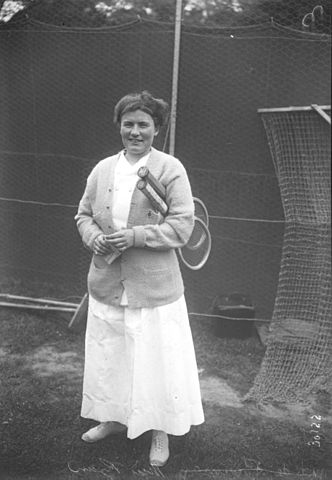
Ryan at the World Hard Court Championships in 1913. Ted Tinling opined that she was “too heavy” to win a major singles title. By contrast, John Tunis wrote in 1925, “[S]he is stocky without being heavy, and her square shoulders and powerful forearm give you, when first you see her, an impression of great physical power. Nor is that a wrong impression.

The occasion for the New Yorker piece was Ryan’s long-awaited return. She had played Wimbledon since 1912, and oddly enough, she had even managed to enter the French Championships in 1913, before it was open to foreigners. (She and a handful of other overseas players probably got in thanks to membership in a French club.) But only in 1925 would she make her first appearance at Forest Hills.

The American press coverage of Ryan is revealing. She is remembered now as a doubles specialist–the doubles specialist of the era–but she was nearly as dangerous on the singles court. Tunis, among others, saw her as the favorite for the US national title, even in a field with defending champion Helen Wills and 1924 Wimbledon titlist Kitty Godfree.

Bunny helped her own case in her very first American tournament in more than a decade. At Seabright, the traditional Forest Hills warm-up on the New Jersey coast, she needed only 40 minutes to dispatch Wills in the final, 6-3, 6-3. Wills hadn’t lost a match since the Wimbledon final the year before, but on the damp grass, Ryan’s forehand chops and imperturbable volleying were too much. Bunny struggled on the faster turf at Forest Hills and lost to Godfree in the quarters. Yet all told, the American trip boosted her reputation even further.

* * *

It was impossible to follow tennis in the mid-1920s and not recognize Ryan’s prowess. If you were the sort of person to scan each week’s results in your favorite tennis periodical, you’d see her name so often you might wonder if there were two players named E. Ryan.

In 1924, the year before she made her triumphant return to the States, Bunny played a jaw-dropping schedule. She entered 36 tournaments a 43-week span between Christmas of 1923 and mid-October the following year. She played every single week for five months starting in mid-May. The closest thing she got to a break was the second week of Wimbledon where, uncharacteristically, she didn’t make any of the finals.

I want to give you a taste of how a player could possibly amass 659 (or more) titles over her career, and a look at her 1924 campaign is the perfect way to do it. You might want to skip ahead to the next section, though. Bunny’s schedule is exhausting just to read about.

She started her season in Monte Carlo at Christmastime. She went on to play 14 straight weeks on the Riviera, winning nine singles titles, ten in women’s doubles, and five in mixed. In four of the tournaments where she didn’t win the mixed, she lost to Lenglen in the final; twice, the victorious team was Lenglen and Henri Cochet. Still, when Lenglen paired the Swiss champion Charles Aeschlimann, Ryan was considered the best player on court. She pushed Suzanne’s team to 15-13 in a deciding set.*

* Bunny’s partner that week was the Canadian Henry Mayes, but I get the sense that it hardly mattered.

After a few weeks off, Bunny played the British Hard Court Championships, where she won all three titles. It was her fourth “triple” of the year–a single week with victories in singles, doubles, and mixed–and it was only April.

Another few weeks, and the real work began. Ryan played six straight weeks before Wimbledon, winning five singles titles, including a triple at the “Gipsy” Club in North London. Her only singles loss was a final against Godfree.

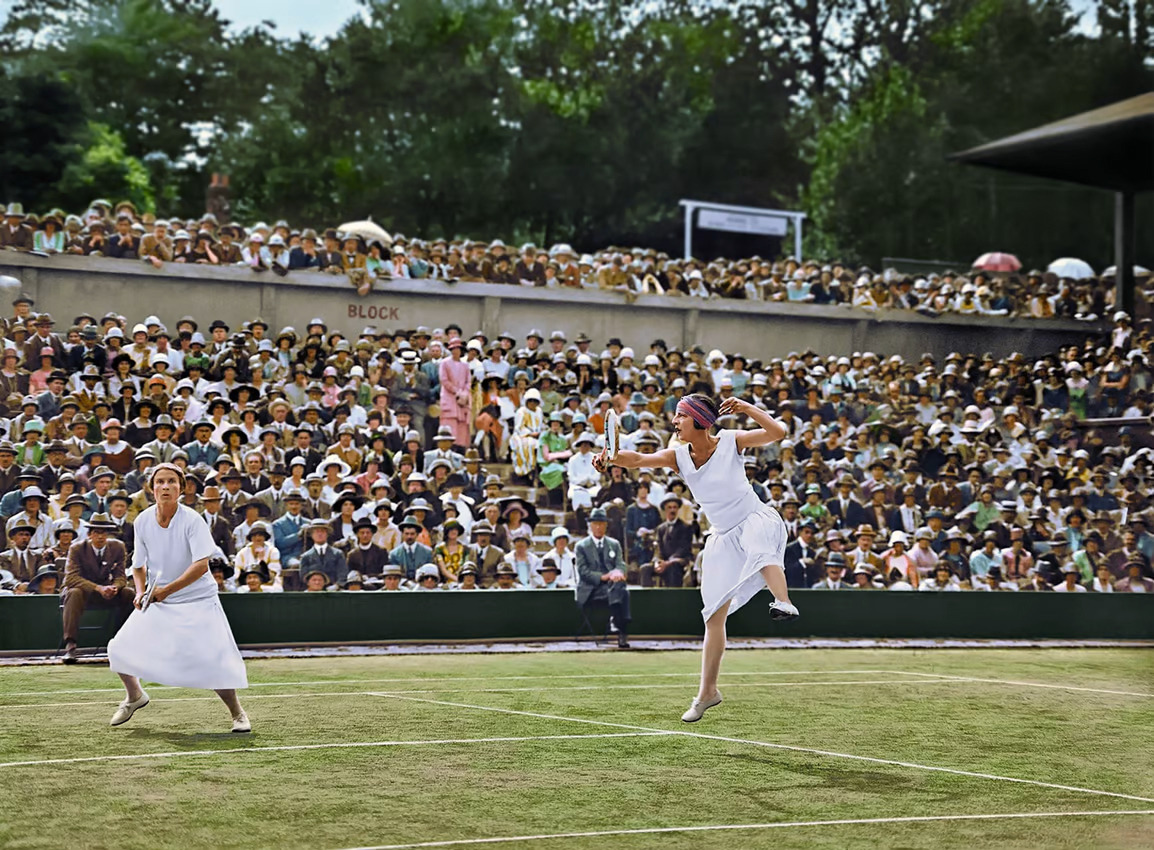
Ryan and Lenglen in 1925 at Wimbledon, where they reclaimed the title to win for the sixth time in seven years.
Colorization credit: Women’s Tennis Colorizations

Wimbledon was a letdown: not even a semi-final in three events. But in a way, it was her most impressive performance of the season. She met Lenglen, her doubles partner, in the singles quarter-finals. Ryan took the second set from the great Suzanne, 8-6. It was the first set Lenglen had lost since her Forest Hills defeat at the hands of Molla Mallory in 1921. Toward the end of the lost set, Lenglen was visibly imploring her father to let her default. He encouraged her to press on, and she won the final set, 6-4.

But the damage was done, possibly to Lenglen’s health, and definitely to her fragile nerves. She withdrew from the tournament, leaving Ryan a loser by default in the doubles quarter-finals. She and Randolph Lycett had lost early in the mixed, so for the first time in more than a decade, Bunny was absent from all three finals.

She made up for it with a vengeance. Here’s what she did for the next seven weeks:

  • Welsh Championships: Triple
  • Nottinghamshire Championships: Triple
  • Midland Counties Championships: Triple
  • Shanklin: Triple
  • Sandown: Triple
  • Worthing: Triple
  • West Sussex Championships: Triple

Add singles and women’s doubles titles in Budleigh Salterton the week after that (she lost the mixed final in three sets), and that’s 23 championships in less than two months.

All told, Ryan won 72 titles in her 36 tournaments between December of 1923 and October of 1924. It could be even more than that. We don’t have doubles results for every one of the events, though in some cases it’s because none were played. In singles alone, she tallied 129 wins against 7 losses.

Bunny won 15 triples, and of the three dozen tournaments she entered, she won at least one title at 33 of them. Even the shutouts make her record sound impressive. One week on the Riviera in February, she pulled out of all three with a bad cold. At the Middlesex Championships in May, she reached all three finals (beating Mallory in singles), but lost two of the title matches to Godfree. And at Wimbledon, she nearly beat Suzanne, indirectly knocking herself out of the women’s doubles. Under any other circumstances, the five-time defending champions would have won easily.

You start to see how she got to 659.

* * *

Ryan was not the first woman to master the volley. But in a field made up mostly of baseliners, she was one of the first great net players, and probably the best of them all, at least until Alice Marble reached her peak in the late 1930s. Tunis called her “a master of her art.”

Bunny was dominant at net, and she made it a point to get there quickly. American Lawn Tennis sketched her playing style in 1923:

It is hard to imagine her on the defensive because she rarely allows herself to get into such a situation, and, when in, gets out of it as quickly as possible. Her strokes are all aggressive except a safe back court chop, which she employs only when forced to take drives from the base line.

The “chop” was once much more common. Struck with heavy underspin, it was sometimes a dropshot, sometimes hit deep, and always–at least to the modern sensibility–very annoying.* Ryan was sometimes known as “Miss Chop and Drop,” and her forehand chop was the stuff of nightmares, especially on slow grass. She used the chop to upset Helen Wills at Seabright in 1925, and she repeated the feat, with the loss of only five games, a year later.

* The hard-hitting Molla Mallory wrote in her 1916 instructional book, “The player with a great repertoire of cuts [chops] may disconcert an opponent for the time being, but so would a server who turned a somersault on her delivery.” Bunny and Molla were not friends.

Unfortunately, her chops weren’t as steady as her net play, and the lack of a reliable baseline game kept Bunny from ever winning a major singles title. Part of the problem was that, despite her killing schedule, she just didn’t play that many majors. Aside from her 16 appearances at Wimbledon, she played the French seven times and the US championships three times. All of the non-Wimbledon entries came after her 33rd birthday.

Bunny’s forehand chop

She also had the bad timing of playing her tennis during the Lenglen years. Three times at Wimbledon, she gave Suzanne an unaccustomed challenge, particularly in the 1919 semi-final, when they met for the first time. But the Frenchwoman won them all. Bunny had her best chance at a major title at Forest Hills in 1926, when Wills was absent. Ryan faced Mallory in the final, and built a 4-0 lead in the decider, even reaching double match point at 5-1, 40-15. But Molla came alive, and in the words of Allison Danzig, Bunny “wilted before the devastating attack.”

Ryan would come close one more time. At age 38, she beat Betty Nuthall and Cilly Aussem to reach the Wimbledon final. On dry turf, she had little chance against Wills (by then Helen Wills Moody), and she went down to a quick defeat, 6-2, 6-2.

* * *

The Elizabeth Ryan story that pops up most often in the history books is an ambiguous one. For decades, Bunny held the record for most Wimbledon titles: 19, comprising 12 women’s doubles and 7 mixed. When Billie Jean King closed in on the mark in the late 1970s, Ryan was still alive. She continued to make annual appearances at the All-England Club.

She clearly had mixed feelings about losing the record. She was reported to have said, “I hope I don’t live to see my record broken, but if someone is to break it, I hope it is Billie Jean.” But she refused to do a joint interview with King when Bud Collins requested it, and Billie Jean found her unfriendly.

In 1979, King finally won her 20th Wimbledon crown, a women’s doubles championship alongside Martina Navratilova. Bunny never saw it. The day before, she collapsed on the tournament grounds after the men’s doubles final, and she died.

It’s a shame that the amateur-era tennis record book has always been so spotty. Yes, Ryan could always point to her remarkable feats at Wimbledon, and she surely knew that her three-decade career had few parallels. But when Billie Jean overtook her most famous mark, Bunny lost her most notable claim to fame. It was the one solo accomplishment that confirmed her as so much more than just Lenglen’s doubles partner.

Even though we don’t always know the exact numbers, there are many more categories in which Ryan stands alone. No one won more Riviera titles than she did. Her 72 (or more) tournament victories in 1924 surely tops the single-season list.

And those 659 career titles? With better record-keeping, it’s a number that every tennis fan would know. No woman has come close in the last ninety years, and Bunny’s name will surely hold pride of place for the next nine decades, too.

The Tennis 128: No. 74, Lew Hoad

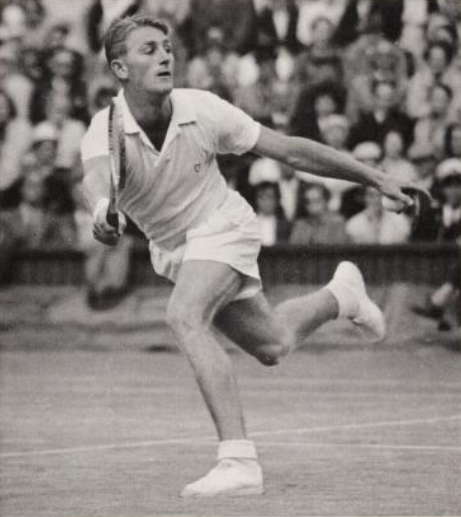
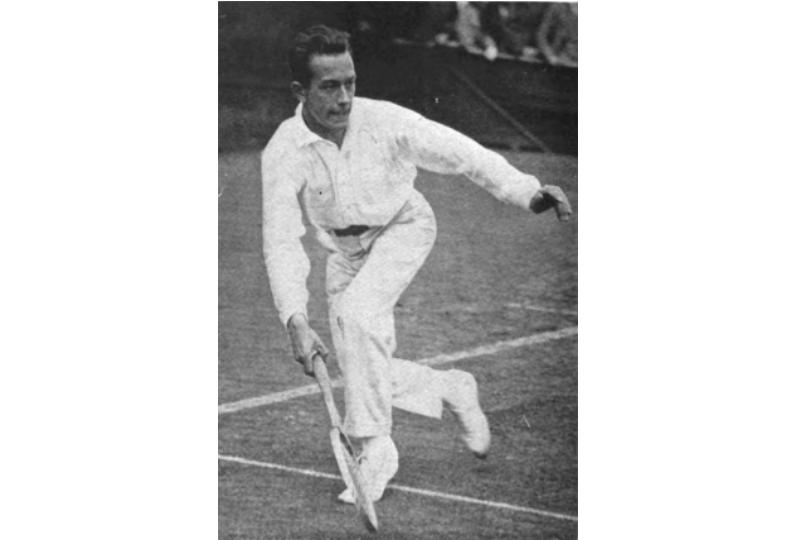
Lew Hoad, magician

In 2022, I’m counting down the 128 best players of the last century. With luck, we’ll get to #1 in December. Enjoy!

* * *

Lew Hoad [AUS]
Born: 23 November 1934
Died: 3 July 1994
Career: 1950-72
Played: Right-handed (one-handed backhand)
Peak rank: 1 (1953)
Major singles titles: 4
Total singles titles: 52
 

* * *

Tennis’s GOAT debate will never be resolved, even if Rafael Nadal wins another ten majors. There are just too many different ways to define “greatest of all time.” Are we looking for the longest span of sustained excellence? The most untouchable peak? Some particular combination of the two?

Many fans prefer the all-time grand slam count, which is essentially a vote for longevity over a shorter peak, no matter how brilliant. The Tennis 128 ranks players by a combination of the two. Many former players, however, tend to recall the best tennis they ever saw in person, often because they were right across the net, on the losing end of it.

One 1950s-era Australian player said, “[W]hen you play [Lew] Hoad, it’s like you’re not even there.”

My friend Charles Friesen tracks GOAT claims over the years from any source he can find–books, magazine articles, forum posts, broadcasts, and more–where a player or expert has offered a their personal list of the best of all time. In Charles’s tally, 17 different men have gotten at least one number-one vote, from William Renshaw back in 1890 to Novak Djokovic last year. Only eight of those players have been named five times or more.

Charles has found eight votes for Hoad, submitted from the 1980s to the early 2010s. More than Richard “Pancho” González, more than John McEnroe, more than Pete Sampras, even more than Djokovic–at least so far.

González never went on record with a GOAT pick of his own. Still, he made a good case for the rival he faced nearly 200 times:

Hoad was the only guy who, if I was playing my best tennis, could still beat me.  I think his game was the best ever, better than mine.  He was capable of making more shots than anybody.  His two volleys were great.  His overhead was enormous.  He had the most natural tennis mind with the most natural tennis physique.

González summed it up: “If there was ever a Universe Davis Cup, and I had to pick one man to represent Planet Earth, I would pick Lew Hoad in his prime.”

* * *

Had Hoad ever gone off to represent his planet in a one-match battle for galactic domination, us earthlings would’ve had plenty of reason to be nervous. The Australian’s career record doesn’t match his imposing reputation because, well, he often wasn’t that imposing.

Jack Kramer, who would spend two years trying to convince Hoad to join his professional troupe, had recognized Hoad’s talent as early as 1946. Kramer and Ted Schroeder were in Australia to compete for the Davis Cup, and they saw the 12-year-old Lew play an exhibition against Ken Rosewall, who was three weeks older. Hoad lost badly–as he usually did against Rosewall in those days–but his raw shotmaking ability was already evident.

Kramer was one of many figures in Hoad’s life who would try to round out his game and help the young man become more consistent. Some of the coaching worked, but most of the efforts on the mental side of things didn’t. Even when Kramer offered cash bonuses for winning matches–on top of the $125,000 Hoad received for turning pro–you never quite knew which Lew would show up.

In the final reckoning, Kramer was a bit harsh on his golden boy. He called Hoad “overrated,” and “the most inconsistent of all the top players.” The promoter even had an explanation for the rosier assessments from others: “[H]e is held in greater esteem than he deserves, I think, because he was so damn popular with everyone that people in tennis wanted to believe he was better.”

Rod Laver was definitely one of those people. Rocket Rod was four years younger than Hoad, exactly the right age difference to make Lew his idol for life. Laver loved his “majestic” game, and he sought to emulate Hoad’s friendly, generous personality. Lew didn’t go in for gamesmanship, and like his mentor Harry Hopman, he barely had any tactics.

Much as he admired Hoad, Laver recognized the man’s shortcomings. “Lew could be lackadaisical in preliminary matches or in minor tournaments, and was knocked out by blokes not fit to tie his shoelaces.” Especially early in his career, he struggled to focus on court. For years, Rosewall–as intense as Lew was casual–didn’t like to play doubles with him because he was so easily distracted.

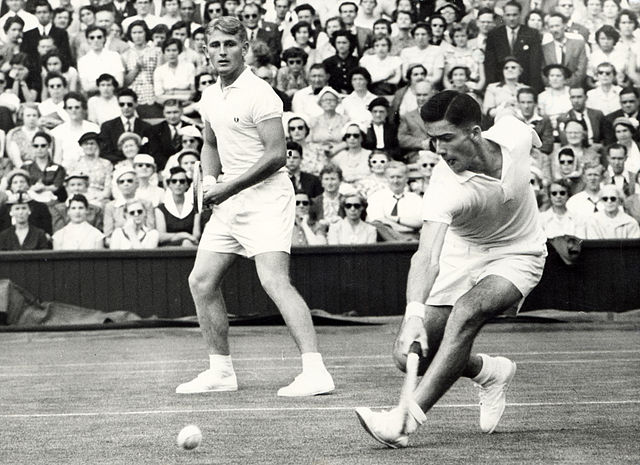
Hoad (left) and Rosewall at Wimbledon

Laver only played Hoad after they had both turned pro, when injuries had limited the older man’s game. Still, Laver claimed that “an on-song Hoad was the best player I ever played against.” Some sources drive home the point by saying that Hoad usually won. In fact, Laver won 34 of the 60 meetings I’ve found records for. Because those matches came at the tail end of Hoad’s career, they don’t tell us much about his greatness. But they do serve as a reminder that memory is tricky. For every one match Hoad played that left his peers with their jaws on the floor, there was another when he inexplicably lost a set or just couldn’t find the range with his groundstrokes.

* * *

When everything was going right, Hoad did indeed play some of the best tennis in history. His last match as an amateur was the 1957 Wimbledon final against countryman Ashley Cooper. He gave Cooper a 6-2, 6-1, 6-2 beatdown in less than an hour, winning more than one-third of the points with aces or clean winners. The London Daily Express called it “Murder on Centre Court.”

Nicola Pietrangeli lost all eight sets he played against Lew. “For one match he was unbeatable. He could do anything.”

Mal Anderson, an Australian who took advantage of Hoad’s absence to win the 1957 US National Championships, never missed a chance to see Hoad and González play. “It was unbelievable tennis. We … were like beginners compared to them.”

Art Larsen, the eccentric American who won at Forest Hills in 1950, said that Lew served harder than Andy Roddick. “He was the best I’ve seen.”

When Kramer wasn’t driven to distraction by Hoad’s inconsistency, he sat back in awe:

I’d marvel at the shots he could think of. He was the only player I ever saw who could stand six or seven feet behind the baseline and snap the ball back hard, crosscourt. He’d try for winners off everything, off great serves, off tricky short balls, off low volleys. … He could flick deep topspin shots with his wrist that González couldn’t believe a human being could hit.

Like all the Australians of his era, Hoad was well-trained in doubles tactics. Yet he had the self-belief to throw them away with the match on the line. In the 1955 Davis Cup Challenge Round, he partnered Rex Hartwig against Tony Trabert and Vic Seixas of the United States. Lew served at 5-all in the deciding fifth set, and the Americans reached break point. In the ad court, the proper serve would’ve been a conservative kicker out wide to open up the court.

Instead, Hoad went big. He hit it flat at full speed, and Trabert could barely make contact. Twice more, the Americans earned a break point, and twice more, Lew gambled with the cannonball. The Aussies held. They took the match 7-5, secured the 1955 championship, and wouldn’t give back the Davis Cup for three more years.

Embed from Getty Images

Hoad (right) with Hartwig and Hopman. Ironically, Hoad considered Hartwig to be a streaky, unpredictable player without precedent: “I reckon it is safe to say that there will never be another like him. He has patches of eight or nine games in which his tennis is so breathtakingly brilliant nobody in the world, amateur or professional, can hope to cope with him.”

Six years later, Hoad and Trabert faced off in the deciding rubber of the Kramer Cup, the fledging pro equivalent of the Davis Cup. Lew was as brilliant in that match as he had been as an amateur. Trabert could only say, “Trying to stop Lew … was like fighting a machine gun with a rubber knife.”

* * *

The only things that could stop Lew were his own mind and, all too often, his body.

His first major breakthrough came in 1953, a year in which he won eight titles, six of them with victories against Rosewall in the semi-finals or final. He failed to make an impact at the majors, losing to Seixas both in the quarter-finals at Wimbledon and the semis at Forest Hills. Hoad got his revenge on Seixas in the Davis Cup Challenge Round, and that was just the beginning.

The Australians were going for their fourth consecutive Davis Cup title. But with the stalwart Frank Sedgman lost to the pro game, they had to rely on “two babes and a fox”–19-year-olds Hoad and Rosewall, coached by the ever-present Harry Hopman. Hoad kicked things off with a straight-set victory against Seixas, and Trabert–fresh off his first major title at Forest Hills–brushed aside Rosewall. The Americans won the doubles rubber as well, making quick work of Hoad and Hartwig.

Lew needed to beat Trabert to keep his country’s hopes alive. In front of 17,000 fans, the 19-year-old delivered one of the most memorable matches in Cup history. Trabert wasn’t as flashy as the Australian, but he played Kramer-style “Big Game” tennis that aimed to keep Hoad on the back foot. Neither man had a tactical lob to speak of, so the result was non-stop aggression, each man looking for the slightest opening to come forward.

The 1953 Davis Cup Challenge Round

Hoad built a 13-11, 6-3 lead, but in a drizzle, on a slippery grass court, he lost the next two sets. Hopman’s craftiness may have been the difference. When Hoad slipped and fell in the fifth set, his coach teased him (something like, “Get up, you lazy bastard,” though recollections differ) to defuse the tension. As the match got even tighter, Hopman slipped him a dry racket when Trabert wasn’t looking. Hoad won, 7-5 in the fifth, and Rosewall sealed the deal with a four-set win over Seixas.

Lew’s performance in the Challenge Round was so impressive that some journalists rated him the number one player in the world, an honor almost never given to someone without a single major to his name. Unfortunately, it would take him a few years to live up to the acclaim.

Immediately after his Davis Cup heroics, Hoad was called up for national service. He missed the 1954 Australian Championships, and in training, he suffered a spider bite that was initially misdiagnosed and left him in a coma for two days. He returned to the tennis grind after his three-month stint in the army, but it took some time before he was back at full strength.

In 1955, Lew reached his first major final at home in Australia, where he lost to Rosewall in straight sets. Except for a Wimbledon doubles title with Hartwig, the rest of the season was a forgettable one. Hoad had even more reason than usual to be distracted: He was courting fellow player Jenny Staley. After they learned she was pregnant, they got married in a secret ceremony just before Wimbledon began. The press, especially in Australia, had been relentless in their speculation about the couple, and it showed in Lew’s on-court performance.

* * *

Back in shape, happily married, the press at bay, and with a baby due soon, Hoad finally showed the world what he was capable of. In 1956, he won 13 titles, including the first three legs of the Grand Slam. He beat Rosewall for the Australian and Wimbledon titles, and took the French title from Sven Davidson despite spending the night before the final splitting a bottle of vodka with a Russian diplomat.

The Wimbledon final was Lew at his best. He took a two-sets-to-one lead over Rosewall but fell behind, 4-1, in the fourth. Recognizing that his longtime rival could quickly take away the set and the match, he sprung into action. Modest as he was, even Hoad couldn’t deny that he had achieved perfection:

Of the last 23 points, I won 20, 14 of them from outright winners, five with aces, and in the fifteen minutes we took for the last five games the ball did not once land where I did not intend it to go, and I did not make a single tactical mistake.

Hoad barely had a chance to bask in his success before a new problem presented itself. He developed back spasms so severe that he opted to spend a week sailing across the Atlantic rather than subject himself to a cramped airplane seat. The pain would come and go, but it would be two decades before he found a doctor who knew what to do about it. The first specialist he saw told him that he needed more exercise.

When Forest Hills came along two months later, Lew had begun to learn how to manage his back, and he reached the final. He met Rosewall once again. On a gusty day, his steady, intense countryman better handled the conditions. Rosewall won in four sets, and it seemed to Lew that his old friend was more disappointed at the Grand Slam near-miss than Hoad was himself. He didn’t blame his back, but it must have been a factor.

https://www.youtube.com/watch?v=6O1qgqc38rw
The Grand Slam denied, at Forest Hills in 1956

The injury didn’t improve, and he spent several weeks in early 1957 immobilized in a plaster cast. He recovered in time to play only a handful of events before Wimbledon, but the abbreviated preparation didn’t hurt him. He worked his way into form throughout the fortnight, facing his only real challenge in a quarter-final battle with countryman Mervyn Rose. He played the best match of his life in the final, leaving Ashley Cooper in the dust.

Then, at age 22, for a signing bonus of $125,000, Lew Hoad turned pro.

* * *

Hoad had always been a work in progress. Even when he beat Trabert in the 1953 Davis Cup Challenge Round, he had little in the way of groundstrokes, a glaring hole in his game that had allowed Rosewall to beat him since they were 12 years old. Hopman split up the Hoad-Rosewall doubles team so that Lew would be forced to play the left court beside Rex Hartwig. The unfamiliar side gave him some much-needed backhand practice.

It sure seemed to work. The more well-rounded Hoad won four of his last five singles majors as an amateur. But Jack Kramer signed him to be the next big professional star, and that meant he would need to hold his own with Richard González. The pro game, with its relentless schedule of one-night stands, was more physically demanding than the amateur tour. The temporary indoor surfaces that served for so many pro matches were unfamiliar to amateurs, while experienced pros like González spent years adapting to them. Most players, no matter how talented, struggled to make the transition.

Kramer knew that Hoad would struggle more than most. His casual approach to the game would clash with the rigors of the pro circuit, and on the technical side of things, he needed more work on his defensive skills. Kramer designed Lew’s first several months as a sort of boot camp. Pancho Segura taught him how to hit a proper lob, and the new star was, for the most part, kept away from González.

It all sounds a bit like pro boxing because, well, it was. The Hoad-González duel–the challenger versus the champion–wasn’t a one-night-only showcase in Las Vegas, but it was the biggest drawing card in pro tennis. Kramer needed to build it up as an arena-filling attraction, and he had to make sure it would live up to the billing.

For a few months, Hoad-versus-González was everything Kramer had hoped for. González didn’t like the way Kramer had kept the challenger away from him in late 1957, but there was nothing he could do about it, just as there was little he could do to stop the young Australian’s power game. The two men were slated to play up to 100 matches to decide the new champion; Hoad got off to an early 8-5 lead, and then built up an 18-9 advantage.

Hoad-González in 1957. González was famously prickly, but unlike with his other rivals, he genuinely liked Lew. Hoad’s friends joked that it should go on his headstone: “Even Pancho González liked him.”

But then, on a chilly night in Southern California, in front of a packed house full of celebrities, Lew’s back seized up again. He never really recovered. For the remainder of the tour, he could barely tie his own shoelaces. González would say he used “every trick I ever learned” and “a maximum of determination” to overcome his compromised foe. The champion came back from his early deficit and won the series from Hoad, 51 matches to 36.

* * *

Hoad continued playing professional tennis for a decade, winning another three dozen matches against González and nearly holding his own against the younger, healthier Laver. He entered Wimbledon a few times after Open tennis became a reality in 1968, though by that point, he was no longer fully committed to tennis. His back wouldn’t have allowed it, anyway.

It wasn’t until 1978 that his back problems were properly diagnosed and treated. He had played more than a decade of professional tennis with two ruptured discs. The doctor who operated on him couldn’t fathom how Lew had continued to compete–or even walk, for that matter.

When he was healthy and focused, Hoad had an effect on spectators–and opponents–much like that of Roger Federer at his peak. The effortless power, the improvised winners–the type of tennis that takes years of practice but somehow looks entirely inborn.

The Australian legends who once considered Hoad to be the greatest of all time seem to have moved on. Laver and Rosewall, in particular, once put Lew atop their lists. They’ve since gone on record for Roger. Perhaps now, in a hypothetical battle for the fate of the universe, peak Federer will play for Earth. Still, Lew Hoad should suit up as first alternate.

The Tennis 128: No. 75, Virginia Wade

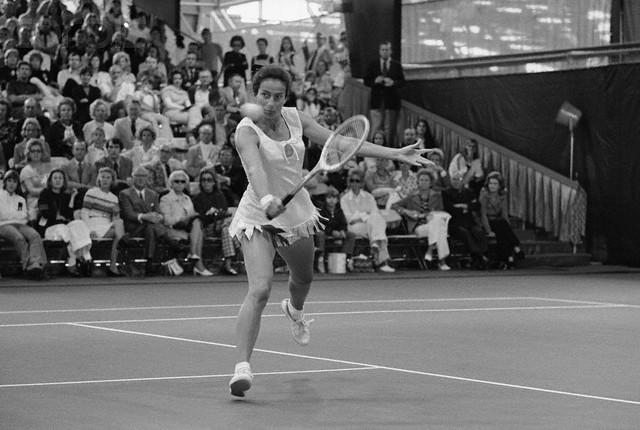
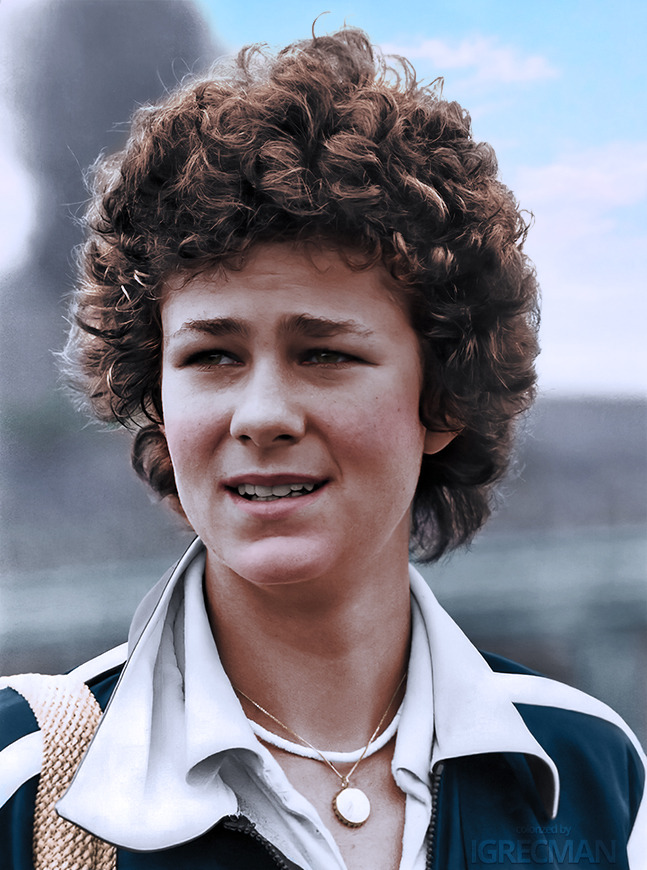
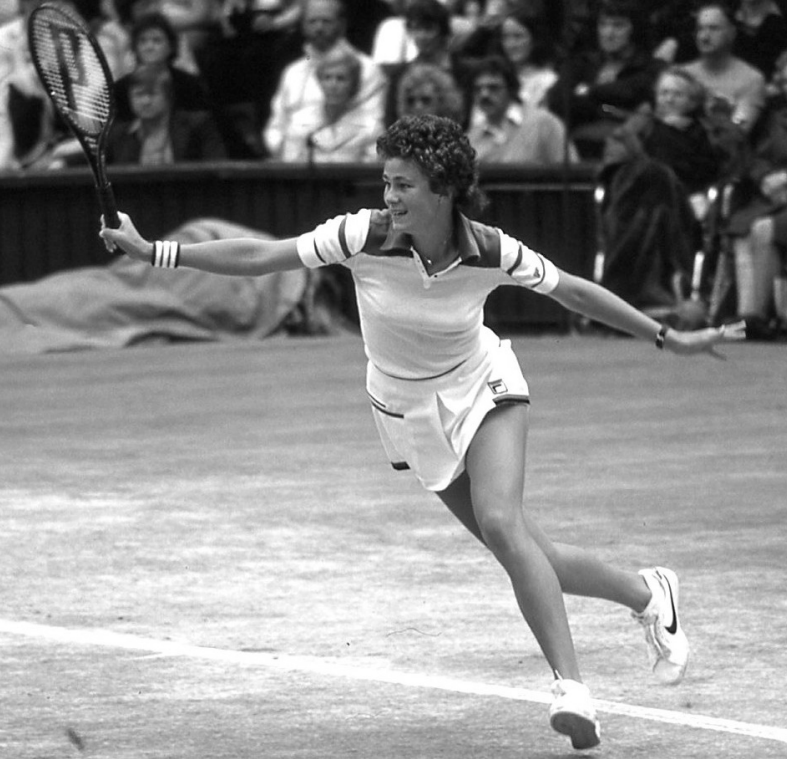
Virginia Wade

In 2022, I’m counting down the 128 best players of the last century. With luck, we’ll get to #1 in December. Enjoy!

* * *

Virginia Wade [GBR]
Born: 10 July 1945
Career: 1962-85
Plays: Right-handed (one-handed backhand)
Peak rank: 2 (1975)
Peak Elo rating: 2,285 (2nd place, 1976)
Major singles titles: 3
Total singles titles: 78
 

* * *

A strange aspect of women’s tennis in the amateur years, and even the first decade of the professional era, is that coaching was virtually nonexistent. There was certainly nothing like what we expect to see today. Most players took lessons as children or teenagers, and some had fathers or brothers who helped them, occasionally even joining them on tour. With rare exceptions, like Eleanor “Teach” Tennant with Alice Marble and Maureen Connolly, there were no traveling coaches.

Maybe we shouldn’t be surprised that Marble and Connolly won so many slams.

Virginia Wade later explained how coaching worked for most of the players on the circuit. You’d try to find an acknowledged expert–someone like Richard “Pancho” González–and get him to spend a few minutes with you. You’d hit a few serves, he’d pass judgment, and that was that.

Somehow, that sort of one-off advice helped Wade win her first big title. Heading into the 1968 US Open, she hadn’t won a title in nine tries, since taking the first Open-era professional trophy in Bournemouth back in April. After losing to Maria Bueno at the US Amateur Championships in Boston in a three-set semi-final, she sought some advice.

González wasn’t on hand, but Doris Hart was. The American had won six singles majors between 1949 and 1955, and in her day, her serve had been as feared as Wade’s was more than a decade later. There was no dedicated training block–Virginia merely sought out the former great for a conversation. On the strength of Hart’s advice, Wade believed she started making 30 percent more of her first serves.

Whatever Hart charged for her time, it should’ve been more. Wade went to Forest Hills and simply overwhelmed the field. She averaged only 40 minutes per match, and after knocking out Rosie Casals in the round of 16, she beat the top three seeds in succession. She finished the job with a 6-4, 6-2 dismantling of Billie Jean King, who had beaten her in nine of their ten previous meetings. She had turned down the prize money to retain her amateur status at Bournemouth, but she happily accepted $6,000 for her efforts in New York.

Virginia Wade in 1968.
Colorization credit: Women’s Tennis Colorizations

The press had long called her “imperious,” but before 1968, they were usually referring to her bearing–and it wasn’t always a compliment. Finally, the service motion that many pundits considered to be the best in the women’s game paid dividends. Her results–at least for those two weeks–were every bit as imperious as her manner.

* * *

Wade could’ve used some of Hart’s advice at Wimbledon. From 1968 to 1971, she lost at her home major to Christina Sandberg, Pat Walken, Cece Martinez, and Judy Tegart–none of them seeds, and none of the matches later than the fourth round. She remained one of the prime British hopes at the tournament, but her early exits became a running joke. Headline writers liked both “Ginny Flops” and “Ginny Fizzes.”

The results steadily improved–Wade reached the quarters for eight years running starting in 1972–but it took another round of external help to push her over the finish line.

Ginny was initially reluctant to join up with World Team Tennis (WTT), the upstart American league that paid guaranteed salaries to top players and put on carnival-like exhibitions around the country from 1974 to 1978. When she gave in, she eventually found herself a teammate of Billie Jean King on the New York Sets (later the New York Apples).

The 1968 US Open final

The 1976 WTT campaign was, as it turned out, some of the best training Wade could’ve asked for. King told her that you start preparing for Wimbledon the day the previous Wimbledon is finished. Playing for the Apples meant daily practice with male hitting partners and coach Fred Stolle, not to mention near-nightly matches in a newfangled format designed to keep the crowd involved and the tension level high. King would write, “[P]layers had the sensation of being on center court every night.”

Won over to the benefits of regular coaching, Wade assembled a brain trust consisting of Americans Hamilton Richardson–a longtime top-tenner and 1958 US doubles champ–and Jerry Teeguarden, who had previously worked with Margaret Court. In 1977, Teeguarden traveled with her for three months before Wimbledon. The two men helped her rebuild the serve which–while imposing–was once again failing to get the results Wade felt it should. The new delivery was less fluid but more technically correct.

It worked. At Wimbledon, she played the best match of her career in the semi-final against Chris Evert. A few years earlier, Evert had told the journalist Grace Lichtenstein that Wade’s serve was so strong that, “[I]n the first couple of games … [I] had to fight the urge to duck.” Yet Chrissie usually handled the onslaught just fine, and Ginny had won only 5 of their 24 encounters. The top-seeded American had an off-day and Wade kept her nerves in check, winning 6-2, 4-6, 6-1.

The 1977 Wimbledon final

She turned in another confident performance to win the title two days later. Against surprise finalist Betty Stöve and in front of the Queen, her self-assurance was so solid that it didn’t waver even after Stöve took the first set. She had come back from match point down against the Dutchwoman twice in 1976, and she knew if it came to that, she could do it again. Stöve was known for her streakiness, and Wade turned the tide, serving so well that one-third of her first offerings didn’t make it back. In her 16th appearance at Wimbledon, Ginny finally won the title, 4-6, 6-3, 6-1.

* * *

There’s a lot to learn by viewing Virginia Wade’s two biggest titles through the lens of coaching. My intent isn’t to take away any of Ginny’s credit for her wins–after all, by modern standards, she barely had any coaching at all. She won 78 career titles in a 17-year-span, most of them with no more than a friend or doubles partner in her corner.

Indirectly, Wade’s peaks shed some light on the media coverage she (incessantly) received. Even if your only reference point is the press hyperventilation over Tim Henman or Johanna Konta, you probably understand how the British media treated their country’s underperforming greatest hope. Ginny noticed, and she lampooned the newspapermen in her 1978 book, Courting Triumph:

My results fluctuated like a yo-yo. There was always a story for the press who loved every see-sawing minute. There was scarcely a report that didn”t mention the word “temperamental”. Sometimes I had “ice-blue eyes”, sometimes “blazing”. Most commonly I was “tempestuous”, “explosive”, “unpredictable”, “arrogant”, “sultry”, “scowling”, “glowering”.

While losing the first set of the 1977 Wimbledon final:

I could just hear some dippy reporter from an obscure tennis biannual calling me a wounded lioness while the others sat in conclave over the riddle of my atavism.

Presumably Wade remains the only Wimbledon champion to have considered the riddle of her atavism before coming back to win a final.

(I had to read this one with a dictionary close by. Thanks to Virginia and her co-author and partner Marylou Mellace, I can now define morphetic and contraviety, as well.)

Ginny in 1971. Ted Tinling, who designed this dress, said, “Virginia is terribly close to the establishment, on the face of it, and wants to look like a virgin, like everybody’s darling, but underneath she’s a tigress who wants to show off like mad.”
Colorization credit: Women’s Tennis Colorizations

Certainly, Ginny suffered some losses that she shouldn’t have. The pressure of entering Wimbledon as a home favorite got to her, and it didn’t get easier over time. But with their focus on the “temperamental” star, journalists rarely considered that Wade simply wasn’t yet good enough. It’s a mistake that pundits have made over and over again for decades. Yeah, Nick Kyrgios may be a headcase, but he also has one of the weakest returns in the game.

* * *

The Wade narrative began long before she had any real chance to contend for a Wimbledon title. She qualified for her first appearance at the Championships in 1962, a month before her 17th birthday. She spent the next four years at Sussex University studying mathematics and physics, sometimes finishing her final exams the day before she was due at the All-England Club.

Billie Jean spent 50 weeks of the year preparing for Wimbledon, and she won the first of her six titles there in 1966. Ginny got 24 hours.

When Wade became a regular on tour, the news coverage fed a vicious circle:

Once my ‘temperament’ was latched onto, I became so conscious of my behaviour I’d be unable to think properly during a match. If I missed an easy shot I’d get furious, then waste time trying to control my anger and miss another easy shot. Getting mad made me feel guilty, and suppressing myself scuttled my involvement in the match.

With the benefit of hindsight, Ginny would divide her career into two phases. The first ran through her defeat in the 1974 Wimbledon semi-finals to Olga Morozova–yet another match she should’ve won. The second comprised two of her best seasons–in 1975 and 1976–along with the Wimbledon title in 1977. She refused to accept that her early struggles were due to temperament–she called that “rubbish”–but instead saw two “tennis lives” separated by her perfectionism.

The first Virginia was the one who said, “I would rather play beautiful tennis than win.” Onlookers saw her outbursts and assumed she was spoiled; she thought the flashes of temper stemmed from perfectionism. When everything clicked, as it did at the 1968 US Open, she could play beautiful tennis and win.

Embed from Getty Images

Preparing to serve in 1975

But that was never sustainable. Wade eventually learned to play high-percentage tennis, to accept a serve that was less fluid but more effective, and to save her energy for the ball. King told her, “You never have time on the court to waste getting mad,” and in her 30s, Ginny finally learned that lesson.

Wade may have been unlucky to play in an era with such limited coaching, but she was fortunate that her career extended into the professional era. Prize money ensured that women who could compete past their mid-20s would continue to be rewarded for doing so. She wrote in 1978:

Ten years ago, a woman was expected to reach her peak by twenty-five at the latest. I am so much better in every way now, including physically, that age obviously has become an arbitrary gauge.

Ginny would never entirely lose the reputation of the temperamental perfectionist. But with her Wimbledon title after so many failed attempts, she ensured that British journalists would never again have to speculate about why she couldn’t win the big one.

The Tennis 128: No. 76, Pam Shriver

Pam Shriver in 1979. Colorization credit: Women’s Tennis Colorizations

In 2022, I’m counting down the 128 best players of the last century. With luck, we’ll get to #1 in December. Enjoy!

* * *

Pam Shriver [USA]
Born: 4 July 1962
Career: 1978-97
Plays: Right-handed (one-handed backhand)
Peak rank: 3 (1984)
Peak Elo rating: 2,266 (3rd place, 1984)
Major singles titles: 0
Total singles titles: 21
 

* * *

Pam Shriver was apparently the sort of player that, if you watched her in action, you just had to give her a nickname. Soon after arriving on tour, she was dubbed the “Lutherville Lamppost.” She hailed from Lutherville, Maryland, a suburb of Baltimore, and “lamppost” was the best alliterative description of a six-footer that the wags were likely to come up with.

Bud Collins did a little better. He called Pam the “Great Whomping Crane,” a nonsensical tag that is nonetheless one of his better coinages. Shriver serve-and-volleyed while the rest of her generation mimicked Chris Evert from the baseline, so she swooped into the net–just like a crane. With arms that nearly covered the breadth of the net and an oversized racket to cover the remaining inches, the swoop often did indeed end with a whomp.

One of the most articulate players off the court, Shriver couldn’t quite be pinned down as a mere lamppost or crane. She kept herself busy, often taking on obligations that other players skipped. Her longtime coach, Don Candy, dubbed her “the Florence Nightingale of women’s tennis”–a positive spin on her charitable nature and packed schedule, even if he didn’t always approve of the distractions.

Pam made her first appearance as a television commentator in 1981 (when she was 18!) and by the middle of the decade, her friends in the Republican establishment were urging her to run for office. She had so many interests away from the sport that John Feinstein suggested she go by yet another nickname: Pam “Not a Tennis Player” Shriver.

Not just a tennis player, to be clear.

* * *

One writer described the 16-year-old Shriver as “gangly as a newborn colt.” Her youth and her undisguised emotion on court–no one ever had to wonder what the young Pam was thinking–gave the impression that she was inexperienced, even naive.

Her results told a different story. She had been playing tennis for more than a decade, and she took her first lesson when she was nine years old. Candy, her coach from day one, was an unlikely character to be teaching beginners in suburban Baltimore. A canny Australian who had won the French doubles title in 1956, he would work with Shriver for more than a decade. Within a few years, she was winning matches for her high school’s boys’ team. By the time she was 15, she was considered the second-best player her age in the nation, behind only Tracy Austin. Candy felt she had nothing more to gain from junior competition.

Her coach was right. Pam started 1978, six months short of her 16th birthday, by winning a local qualifying tournament for a place in the draw of the Virginia Slims of Washington. In that first event on the circuit, she won her opening match against Pam Teeguarden and lost a close second-rounder to Virginia Ruzici. The same month she headed to a Futures event in Columbus, Ohio, where she won twelve straight matches to come through pre-qualifying and qualifying to win the title. At Hilton Head in April, she beat Teeguarden again and took a set from Martina Navratilova.

Pam in 1978

That summer at Wimbledon was her first appearance at a major. She served for the match and a place in the second week, but ultimately fell in the third round to Sue Barker, 2-6, 8-6, 7-5. She bounced back well enough to win four matches in the consolation event and reached the semi-finals. Candy said, “It takes some experience to know how to win at Wimbledon,” but Shriver would quickly prove she could accomplish great things with only a bit more seasoning than she already had.

At Forest Hills just two months later, she became the youngest finalist in the history of the event. She reached the semis without dropping a set, knocking out the Aussie veteran Lesley Hunt 6-2, 6-0 in the quarters. That earned her a meeting with Navratilova, the top seed who had already won ten tournaments that year. The 16-year-old showed a few signs of nerves, losing her serve twice, each one right after she broke Martina. But she survived two rain delays and airplane noise from LaGuardia traffic that was the worst reporters could remember.

Barry Lorge wrote for the Washington Post that she “served oppressively,” and her first serve was reliable when it mattered. She saved four set points in the opening set, and she took full advantage of her height to serve wide to Navratilova’s lefty backhand. Candy’s guidance had made her a tactician beyond her years. Martina said after the match, “She played like a grown-up, a 25-year-old.” Shriver won in two tiebreaks, 7-6(3), 7-6(3).

The 1978 US Open semi-final

Pam’s opponent in the final was Chris Evert. She feared the embarrassment of losing 6-0, 6-0 in a grand slam final, but there was no reason to worry. Evert had a better handle on the serve than Navratilova did, and the decision was still a close one, 7-5, 6-4, in favor of the veteran.

A 16-year-old grand slam finalist, Shriver went back to Baltimore–and her last year of high school–thinking the sky was the limit.

* * *

Nine months after beating Martina at the US Open, in June 1979, Shriver was warming up at the grass court event in Chichester, England. She hit an overhead and felt a pop in her right shoulder. The injury would cause her to pull out of her second-round match at Wimbledon, and she wouldn’t win another match until November.

Shoulder–and later elbow–problems wouldn’t completely derail her career, but they halted her progress at just the time that she could’ve been figuring out how to challenge Evert and Navratilova at the top of the game. Instead, it was Tracy Austin who made headway while Shriver managed her injuries. Six years later, Frank Deford described her appearance at a press conference, “her one shoulder all iced up as usual, bulging like a tuberous potato.”

Shriver wrote five years later, “My right arm has become a focal point in my life, and I hate that.”

We’ll never know whether an unimpaired Shriver could’ve consistently challenged Chrissie and Martina. With her shoulder as it was, all she could do was join the scrum fighting for third place. When David Letterman asked Andrea Jaeger if she thought she could made it to number one, Jaeger spoke for many when she explained just how many tournaments she’d need to win–and how many times Navratilova would have to lose early–for the top spot to even become a possibility.

https://www.youtube.com/watch?v=tOXwt10gwdQ
Pam selling milk

Pam lost her first 14 meetings with Evert, not claiming a set until their 10th encounter and not recording a victory until 1983. She beat Navratilova again at the US Open in 1982, but it was a mere blip in a big picture, as Martina won 41 of their 44 head-to-heads. One indication of Navratilova’s dominance is that even those three defeats made an impression on the champion. She wrote in 1985, “Actually, [Pam’s] given me some of my biggest losses, and she constantly comes up with big matches against me.”

Shriver reached nine major singles semi-finals in her career. After her initial win in 1978 against Martina, she lost four against Navratilova, one to Evert, one against Hana Mandlikova, and two to Steffi Graf. By the time she could finally hold her own against Evert, a new generation–Graf, Gabriela Sabatini, and a non-stop parade of hard-hitting teenagers–came along to make the 20-something serve-and-volleyer feel like a museum piece.

* * *

There’s another what-if in the Shriver story, one that only became public knowledge this year. In April, Pam wrote in The Telegraph that her relationship with Don Candy crossed the line into a sexual–and sometimes emotionally abusive–one. Candy, who died in 2020, was married and 33 years her senior. She is careful not to demonize her former mentor, but she is also clear about the negative effects of the relationship:

It was horrible. I can’t even tell you how many nights I just sobbed in my room–and then had to go out and play a match the next day. [Candy’s wife] Elaine would arrive just in time for the slams: Wimbledon or the US Open. Now I can see that my most disappointing results often correlated with these moments. So, even from the most pragmatic perspective, I look back and think, “Jeez, was this good for your tennis?”

She took four months off from the tour in 1984 to clear her head, rest her shoulder, and find new coaching and management arrangements. Candy retained an advisory role, and as late as 1991, Shriver still sometimes called him for advice. He told Michael Mewshaw, “When the dark clouds gather, Pam still acknowledges me.” It was one thing to recognize that a relationship is unhealthy. It was another to figure out how to replace the voice that had always been in her ear.

Embed from Getty Images

Shriver and Candy in 1980

The transition was not easy, but Shriver emerged to play some of her best tennis. Apart from one blip, she held on to a place in the top five on the WTA computer until March of 1989. She won multiple titles every year from 1983 to 1988.

Most importantly for her legacy, her doubles game remained unaffected.

* * *

The Tennis 128 ranking doesn’t consider doubles accomplishments, but writing about Pam Shriver without mentioning her doubles records would be almost as bad as leaving out the “Great Whomping Crane” nickname.

It’s no surprise that a tactically sound six-footer with good control of her serve and even stronger volleys would become a standout doubles player. She reached her first major final with Betty Stöve at the 1980 US Open, where the pair lost to Navratilova and Billie Jean King. The winning team soon split, and Martina plunked down a quarter to call Shriver, who had proposed earlier that year that they join forces.

Navratilova was the best doubles player of her era, probably the greatest of all time. Shriver was her strongest partner. They reached the 1981 Australian final at their first major as a team, and they won Wimbledon the same year. They would go on to win 20 slams together, including all four in 1984. Between 1983 and 1985, they won 109 matches in a row, and they took the trophy at the WTA Tour Championships ten times in a twelve-year span.

Shriver didn’t have a problem competing alongside the woman who beat her so often on the singles court:

People often ask if it’s difficult to play against Martina in singles and then team up with her in doubles. Well, it would be much worse to play against her in singles and then not team up with her in doubles.

At one point in the Navratilova-Shriver glory days, Martina said in a speech that she never wanted to play with another partner. Pam jokingly jotted it down on a cocktail napkin and got her teammate to sign it. The partnership didn’t quite last forever–after eight-plus years, Navratilova chose to play with Hana Mandlikova at the 1989 US Open. But while Shriver would’ve preferred to stick with what worked, the breakup gave her the opportunity to cement her legacy apart from Martina’s. She had already taken a doubles gold medal at the Olympics in Seoul with Zina Garrison in 1988, and 1991, she paired with Natasha Zvereva to win the US Open.

* * *

Shriver kept a journal throughout 1984, her year of inner conflict. Some of it appeared in Sports Illustrated, and it was later expanded into a book, Passing Shots: Pam Shriver on Tour. It’s one of the better tennis memoirs: candid, insightful, and often laugh-out-loud funny. Frank Deford was one of the editors on the project, and he gained some insight both into the player and his own framework for understanding athletes:

Most champions are a good deal more inner-directed than she. … It is my own view that when we journalists go prattling on about “the killer instinct,” we are really employing a colorful phrase for the more prosaic “self-centered.”

He explained, by contrast, how focused–and egocentric–Chrissie and Martina could be. Shriver couldn’t have been more different. She said in the book, “Tennis alone doesn’t satisfy me,” something that observers had correctly inferred for years.

Still, in the slightly more other-centered game of doubles, Shriver proved to have every bit of the killer instinct necessary to win the biggest titles. Give her a healthy player-coach relationship and a functional right shoulder, and I suspect her killer instinct would’ve been sufficient on the singles court, as well.

The Tennis 128: No. 77, Henri Cochet

Henri Cochet at Wimbledon in 1923

In 2022, I’m counting down the 128 best players of the last century. With luck, we’ll get to #1 in December. Enjoy!

* * *

Henri Cochet [FRA]
Born: 14 December 1901
Died: 1 April 1987
Career: 1920-51
Plays: Right-handed (one-handed backhand)
Peak rank: 1 (1928)
Major singles titles: 7*
Total singles titles: 101
 
* Plus the 1922 French Championships, which were not yet open to foreigners, and the 1922 World Hard Courts, which are considered by some to have been a major.
 

* * *

Down two sets to love, most players begin to recognize it’s just not their day. They might try some new tactics or look for signs that their opponent is tiring. But no matter what optimism they can muster, the odds are stacked in the other direction. In the amateur era, front-runners converted two-set leads even more often than they do now.

Henri Cochet was not “most players.” He was “an enfant terrible who love[d] to play with fire,” in the words of John Tunis. In the New Yorker ahead of the 1928 US National Championships, Tunis wrote:

[H]e is never in his real element until the tactical situation forces him to admit the possibility of defeat…. [W]ith the score two sets and four games to one against him, he becomes tight-lipped and firm, brilliant and audacious, careful and scintillating all at once. Those are the moments when his shots are so uncanny, so unorthodox, so impossible that they seem almost insolent.

We can read between the lines and deduce that at the beginning of a match, the Frenchman was not particularly brilliant or careful. His Davis Cup teammate Jean Borotra was known for steamrolling through the first two sets, then tanking the third–and sometimes the fourth–to save energy for a final push. Cochet didn’t lose the first two sets on purpose, but it sometimes looked that way. The newspapers dubbed him “Five-Set Cochet,” and Tunis’s New Yorker profile was titled “Lucky Cochet.”

But unless we’re talking about the unpredictability of his mood, luck had nothing to do with it. René Lacoste said, “At his best, Cochet is unquestionably the best singles player in the world today.” Suzanne Lenglen agreed: “On a good day, nobody in the world can stop him.”

Bill Tilden went even one step further: “In these inspired moments of his, Cochet is the greatest of all Frenchmen, and in my opinion, possibly the greatest player who has ever lived.” At various times, Tilden called him a “genius” and a “revolutionary.” Most flattering of all, the American considered Cochet to be his nemesis, the only amateur against whom he lost more often than he won.

* * *

It was a great era for nicknames. Lacoste, the diffident baseliner, was The Crocodile. Borotra, the serve-and-volleyer from the Pyrenees, was The Bounding Basque. Cochet, the all-court player with every shot in his arsenal, was The Magician. Together with Jacques “Toto” Brugnon, they were the Four Musketeers, France’s greatest tennis generation.

Before Cochet became The Magician, he was The Ballboy of Lyon. Unlike most of his contemporaries on the international tennis circuit, Henri came from working-class stock. Fortunately, his father earned his paycheck at a tennis club, first as groundskeeper, then as manager. The youngster earned pocket money chasing down stray balls, and when he could borrow a racket, he would hit with anyone willing to play with him.

The Lyonnaise club offered one particularly useful perk: a pair of covered courts. Indoor tennis was typically played on wooden boards, a surface that was quicker than outdoor clay, and one that offered a truer, more consistent bounce than grass or crushed brick. Cochet could practice year-round, and the indoor boards forced him to learn to meet the ball on the rise and half-volley with ease.

Cochet would later earn the reputation of a player who avoided hard training, but he took full advantage of his father’s occupation. He believed that there was no better way to develop strokes than to practice against a wall. The game that eventually made him the best in the world pointed straight back to all those long hours on covered courts in Lyon.

Embed from Getty Images

Cochet at Wimbledon in 1925

The resulting all-court game is what led Tilden to call him a revolutionary. Most players of his time were either baseliners (like Lacoste) or serve-and-volleyers (like Borotra). Plenty of men were able to do both–most notably Tilden himself–but before Cochet, no one had fully integrated a baseline game with the ability to attack at any moment. The Magician was unfazed by the threat of a ball at his feet, so he habitually took a more aggressive position than his peers. And unlike anyone else of his time, he could move in smoothly behind a half-volley.

Cochet’s unorthodox positioning didn’t stop there. He stood only five-feet-six-inches tall, so playing too close to the net just invited a lob. (Tilden, for one, was an expert lobber.) While his height left him with an indifferent serve, he was a master of the overhead smash. The smash, combined with his readiness to hit low volleys and half-volleys, meant he didn’t need to crowd the net. The Ballboy of Lyon knew how to beat you from anywhere, and when he was in the mood, he did just that.

* * *

One theory of why Cochet was so inconsistent, not just from match to match but from set to set, is that he was more temperamental than he looked and was sometimes too nervous to effectively wield his world-class weapons. The alternate theory is that he was so confident that he trusted he could always recover from a patch of bad play.

We’ll never know for sure, but the evidence points strongly in the direction of extreme confidence, self-assurance bordering on the obnoxious.

In the 1926 Davis Cup Inter-Zonal final, France took on Japan for the opportunity to challenge the defending champion United States. The Musketeers increasingly looked like they would threaten America’s dominance of the Cup: Cochet was the reigning French champion, and Borotra had just won Wimbledon. Japan had a strong side but was nowhere near the same level. Still, Cochet needed five sets to get past Tsumio Tawara, and he lost a dead rubber to Takeichi Harada in four. This was not the sort of play that would send the Davis Cup back across the Atlantic.

Henri with frequent mixed doubles partner Eileen Bennett. Wimbledon secretary Norah Cleather recalled, “Cochet’s mixed partner would always be the prettiest girl in the tournament (it was probably for this reason that the mixed was the one event he never won there).”

With the Challenge Round against the US just a few days away, Cochet admitted he was disappointed, but not discouraged. He told Tunis, “Wait until next week. I’m getting better all the time.”

The French captain wasn’t entirely assured, so Lacoste and Borotra handled singles duties. France fell to Tilden and the Americans, four rubbers to one. But at Forest Hills the following week, the Four Musketeers all reached the quarter-finals. Three of them–all but Brugnon–beat their American opponents, and it was Cochet who toppled the great Tilden. The American press dubbed it “Black Thursday.” Bill hadn’t lost a match at his national championship tournament in six years, but the little man from Lyon edged past him, 8-6 in the fifth.

Tilden served for the match at 6-5 in the decider. He showed some signs of fatigue–after all, he was 33 years old, nine years older than his opponent–and his cannonball serve wasn’t quite coming across at full speed. Cochet took the most aggressive return position he could. He didn’t just break serve at love, he won the game with four clean return winners.

Didi Vlasto, a frequent mixed doubles partner of Cochet’s, once said, “Pour Henri c’est toujours l’impossible qui est plus facile”–For Henri, it is always the impossible which is easiest.

* * *

The Magician lost to Lacoste in the Forest Hill semi-finals. The Crocodile won the title–the first ever US champion from a non-English-speaking country–but the failure to capture the Davis Cup still rankled. When the French team left Paris to try again in 1927, Cochet said, “First the Davis Cup and the American Championship. We bring them both back this time, yes?”

By now, his confidence was fully warranted.

Cochet had just won Wimbledon, his first major title outside of France. He had never lacked for self-belief, but the way he took the All-England Club title must have convinced him that he could do absolutely anything.

Embed from Getty Images

Cochet at Wimbledon in 1927. A reporter once asked him to explain his serve technique. “The service? Ah, yes. I throw the ball up–and then I hit it.”

In the quarter-finals, Cochet faced the American Frank Hunter. Hunter had reached the Wimbledon final in 1923, and he would come within a set of winning the Forest Hills title in both 1928 and 1929. The American took a comfortable 6-3, 6-3 lead before Cochet woke up and charged back. The Magician won in five, finishing the job 6-2, 6-2, 6-3.

Waiting in the semi-final round was Bill Tilden. Tilden remembered well what happened at Forest Hills the previous year, and he had watched Cochet erase Hunter’s early lead. He was “not going to let that little fellow get me into a long match,” so he would attack from the first ball.

It almost worked. Big Bill won the first two sets, 6-2, 6-4, and built a 5-1 lead in the third. Sportswriter Al Laney was there, and even 40 years later, he wrote, “I can still speak of it in detail … but I could not explain it then and I cannot now.” From 15-all, Tilden started missing, and Cochet’s magic wand sprung to life. Henri won 17 points in a row, and he seized the third set, 7-5. Wimbledon referee F.R. Burrow said that the crowd was “almost too spellbound to applaud.” Cochet completed the comeback, 6-3, 6-4.

Tilden’s exit ensured that the Wimbledon crown would go to a Frenchman for the fourth consecutive year, as Cochet would face Borotra in the final. Inevitably, the front-running Borotra took a two-set lead over the slow-starting Cochet. In ten previous meetings, Jean had grabbed the first two sets twice. Once, at the 1922 World Covered Court Championships, Cochet made his comeback. And once, at the 1924 French Covered Courts, Borotra had held him off.

With Borotra resting, the Magician took the third and fourth sets to even the score. The Basque bounded to a 5-2 lead in the final set, but he couldn’t convert match point. Cochet ultimately saved six match balls, including one when many onlookers (and Borotra) believed that Henri double-hit a volley. The umpire didn’t call it, and Cochet admitted nothing. The Ballboy of Lyon completed his comeback–a second-straight victory from the brink of defeat.

* * *

Cochet’s faith in himself–and his fellow Musketeers–was well-placed. In the 1927 Davis Cup campaign, there were none of the Davis Cup missteps that had made Henri look beatable against Japan the previous year. He straight-setted Einer Ulrich* of Denmark and Yoshiro Ota of Japan to help put his side back in the Challenge Round.

* Father of Davis Cup player Torben, and grandfather to Metallica drummer Lars.

This time, Cochet couldn’t beat Tilden, losing the second rubber in four sets. But his effort was good enough for his team to win. The Musketeers recognized that they needed to take at least one match from Big Bill, so they aimed to collectively wear him out. Cochet worked him hard in his opening singles, and the duo of Borotra and Brugnon kept him running in a five-set doubles rubber the next day. The Frenchmen went into the final day of play down 2-1, but Lacoste beat the exhausted Tilden, and Cochet secured the Cup with a four-set defeat of Bill Johnston.

The 1927 Davis Cup Challenge Round.
Left to Right: Bill Tilden, Dwight Davis, and Cochet

Lacoste defeated Tilden again in the Forest Hills final, and France’s domination of world tennis was unquestioned. In 1928, Borotra would go to Australia and win the national title there, ensuring that the Muskteers would win seven straight majors between the 1927 French and the 1928 US Championships. They would retain the Davis Cup until Great Britain snatched it away in 1933.

Cochet was an increasingly large part of that success. He won the French and US titles in 1928 and ended the season ranked number one–a position he would hold for four years. He was nearly unbeatable in Davis Cup play in that span, winning both of his singles rubbers every year from 1928 to 1931 and falling short in only one doubles match. He wouldn’t lose a live singles rubber until Fred Perry bested him in a five-setter in 1933.

* * *

With Lacoste retiring due to ill-health and Borotra’s star fading with age, Cochet became the face of French tennis. He won Wimbledon again in 1929, and he added two more French titles to his tally in 1930 and 1932. His sporting goods retailer, Cochet Sports, grew from a tiny shop in Paris to a national chain with outlets in Cannes, Lyon, and La Baule.

For all of Cochet’s nonchalance and dislike of practice, he sure chose to spend a lot of his time on the tennis court. In 1932, he lost in the second round at Wimbledon, only three years removed from his last title there. Tournament organizers were shocked when he turned up to put his name down for the consolation event–which he went on to win. He would keep playing, picking up the occasional title, for another two decades.

The 1932 Forest Hills final against Ellsworth Vines

In 1933, he turned pro, accepting an offer from Tilden for £25,000 per year. As a professional, he played exhibitions all over the world and coached everyone from the Hungarian Davis Cup team to a group of promising youngsters in the Soviet Union. The Russian adventure proved to be a bit rockier than the usual gig. His hosts accused him of espionage and kicked him out amid the purge of foreign influence in 1938.

World War II halted professional tennis in Europe, and the Magician was eventually reinstated as an amateur. He continued playing competitively under the German occupation, and when his country was freed, he featured in the Liberation Match (umpired by Simonne Mathieu) at Roland Garros–a stadium originally built for the Musketeers’ defense of the Davis Cup in 1928.

Cochet won his last title in 1949, at the age of 48, at the Barcelona International Christmas event. He beat the Australian Jack Harper, 13 years his junior. The same year, he played his last competitive match against friend, foe, and teammate Jean Borotra. Borotra raced to a one-set lead, and Henri found his form to win the second. Cochet lost his momentum and the match, but it’s only fitting that the final clash between the Magician and the Bounding Basque, like the Wimbledon final in 1927, went the distance.

The Tennis 128: No. 78, Simonne Mathieu

Simonne Mathieu in 1926
Colorization credit: Women’s Tennis Colorizations

In 2022, I’m counting down the 128 best players of the last century. With luck, we’ll get to #1 in December. Enjoy!

* * *

Simonne Mathieu [FRA]
Born: 31 January 1908
Died: 7 January 1980
Career: 1926-39
Played: Right-handed (one-handed backhand)
Peak rank: 3 (1932)
Peak Elo rating: 2,237 (1st place, 1930)
Major singles titles: 2
Total singles titles: 147
 

* * *

Helen Jacobs described her friend and rival Simonne Mathieu as a “player with limited strokes, average physical attributes and the will to win encumbered … by temperament.” That wasn’t even the worst of it:

[T]here was one great drawback to Simonne’s game that she was never able to overcome–or perhaps she did not think it necessary–the absence of any sort of effective volley or smash. This shortcoming did not prevent her winning innumerable doubles championships, but it was a tremendous handicap in singles competition against players who had the strokes and tactical sense to draw her up to the net with short, low shots and then lob deeply.

Those gaping holes in her game so thoroughly blocked Mathieu’s chances at success that she reached the Roland Garros final eight times–winning two–and claimed nearly 150 singles titles. Oh, and history remembers her as an even more accomplished doubles player, with 13 major titles in women’s doubles and another two in mixed.

Jacobs even went out of her way to make it clear that the Frenchwoman’s distinction wasn’t due to any particular strength in “match play psychology.” (Really, they were friends!) Mathieu had three assets, and three assets only: A powerful forehand, a steady backhand, and what Jacobs called an “indomitable fighting spirit.”

The last one was the most important of all. For someone competing at a world-class level in 1930s tennis without any net game at all, every match was a fight.

* * *

Simonne Passemard started fighting–and winning–almost as soon as she first picked up a racket. Of fragile health as a girl, she took after her older brother and began playing at the Stade Français club in Paris. By the time she was 15, she was collecting national trophies.

Sportswriters were dismayed when, aged only 17, Simonne married the writer and editor René Mathieu. Few women balanced family life with a tennis career in those days, so it seemed that France would lose one of its best hopes before she could make a mark on the world stage. She had two sons in 1927 and 1928*, further decreasing the chances that the young prospect would pursue the sport.

* Several sources claim that when Simonne won the French junior championships in 1926, her baby was sleeping courtside. The story is almost too good to check, but the dates don’t add up. The couple married in October 1925, so even if it was a shotgun wedding–admittedly, as good a reason as any for Simonne to marry at 17–it’s tough to reconcile that with her tournament play in January, March, and May of 1926. The only information I can find about her son’s birthdates is one vague, unsourced mention of 1927 and 1928. There are indeed two separate 10-month gaps in her playing record: one before the 1927 French Championships and the other before the German Championships in August of 1928. She may well have played some matches with one eye on a stroller, just not as a junior.

The young Mme. Mathieu refused to conform to expectations. She handed over her sons to her parents, who then moved out of Paris. Her sons, understandably, felt they had been abandoned. A grandson, Bertrand Mathieu, was able to see the separation with the benefit of greater distance. He thinks of his grandmother as an early feminist.

Mathieu (right) with Kitty Godfree in 1926

Simonne would certainly prove to be a formidable character during the war, when she founded the women’s auxiliary to the Free French Forces, marched with Charles de Gaulle, and was condemned to death in absentia by the Vichy government. First, though, she had a lot of tennis to play.

* * *

Records from European tournaments in the 1920s and 1930s are incomplete, but the best career tally I’ve been able to put together gives Mathieu 510 wins against 94 losses. That tally is an approximation, but it probably understates her actual performance. Her losses were newsworthy, so they’ve generally survived in the historical record. Her wins, especially in early rounds, could be forgettably routine. Whatever the exact numbers, it’s virtually certain that she won more than half of the tournaments she entered and close to 85% of her matches overall.

Rare as they were, her losses seem to paint the most vivid picture of her experience on court. Her skills came into relief when an opponent faced down the challenge they offered. Dorothy Round beat her in the 1933 British Hard Court Championships, and a newspaper report said that Simonne “is one of the most difficult players in the world to beat outright either with a drive or a drop shot.” When Round knocked her out again at Wimbledon the following year, Mathieu lost a three-setter despite missing long only three times.

Helen Jacobs faced her at Wimbledon in 1932–it was their second meeting–and despite winning by the fairly routine score of 7-5, 6-1, the American recorded it as “one of the most difficult I have ever played.” Mathieu left herself little margin of error for her groundstrokes, slugging forehands with a short backswing and a whiplash follow-through. By the second set, Simonne was trying underarm serves, and she was still dogged enough that the two women played a 98-stroke rally. She was so frustrated by the end of the match that she stormed off without waiting for her opponent, a serious breach of etiquette.

Embed from Getty Images

Mathieu (left) with Helen Jacobs at Wimbledon in 1933

Mathieu held her own against Round and Jacobs, as she did with almost all of her rivals. The one exception was her exact contemporary, the German (and later Danish by marriage) star Hilde Krahwinkel Sperling.

Mathieu and Sperling played each other at least 15 times*, and the Frenchwoman lost all but one. Their clashes included the 1935, 1936, and 1937 Roland Garros finals, as well as a 1936 Wimbledon semi-final, one of Simonne’s four missed chances to reach the title match at the All-England Club.

* Jacobs wrote that the pair had met 15 times before what I believe to be their tenth encounter, so it’s possible that we’re missing some results.

The two women had similar styles. Sperling’s advantages: She was taller, and she was not entirely allergic to the forecourt. British journalists ascribed her Wimbledon victory against Mathieu to her “stonewalling tactics” and “impregnable defence.” The Frenchwoman knew how to handle every game style except her own. Jacobs wrote, “[H]er game was extremely steady but her patience was not.” She tried to end points early, but Sperling had an answer to all of Simonne’s attempts at aggression. The German didn’t lose a single set until their eighth meeting.

* * *

Sperling was particularly dominant on Mathieu’s home court. In the 1935 French final, the home favorite was helpless, winning only three games. A news report dismissed the match as being “utterly devoid of interest.”

A year later, Mathieu came a bit closer, losing 6-3, 6-4. Both women were content to wait for the other to make a move, and one observer felt “there seemed no reason why the rallies should ever end.” Individual points often required 50 strokes or more. The crowd booed and whistled until Simonne said, “If you don’t like it, why not come down and take our places?” Mathieu couldn’t outlast the German, and presumably no one in the grandstand could, either.

The fearsome Mathieu forehand

Mathieu had more support on the Riviera. Since 1929, she had made the annual trek to France’s south coast, taking advantage of the mild winter climate and the hospitality at one Mediterranean resort after another. The competition wasn’t up to quite the same standard as it was at the majors, and Simonne feasted on it. She won all 16 Riviera tournaments she entered in 1935, then went undefeated again over 14 events in 1936. In her career, she won more than 50 singles titles along the coast, plus another 86 doubles trophies.

In 1937, the Frenchwoman’s home-away-from-home-court advantage would be put to the test. Sperling, her nemesis, made her first trip to the Riviera. The two women met in the final at Beaulieu-sur-Mer in February. Mathieu had squeaked past another newcomer, Anita Lizana, in the semis, while Sperling clobbered British player Mary Hardwick, 6-0, 6-1. The German hadn’t lost on a clay court in two years.

Sperling built a 5-2 lead in the opening set, and it looked like it would be yet another one-sided victory for the German. But this time, Mathieu had the patience to out-steady the steadiest player of her era. She fought back to 5-all. The match was an hour old–an eternity for ten games in 1937–but it was just beginning. It took another 25 minutes for Simonne to break for 6-5, and 35 minutes more to seal the set. One report says that some rallies reached 70 strokes which, given the time they took, sounds like a conservative count.

After the two-hour battle for the first set, Sperling had nothing left in the tank. Mathieu won the second, 6-1, in “only” 45 minutes.

Beaulieu represented Simonne’s 36th straight singles title on the Riviera. Alas, the triumph was short-lived. Both her winning streak and her hopes against her rival ended just one week later. At Monte Carlo, it was Sperling who won the protracted first set, 8-6, and Mathieu opted to retire and save energy for the doubles. In four more meetings, she would never again win a set against the German champion.

* * *

Mathieu’s consolation prize was a good one: a pair of Roland Garros titles. In 1938 and 1939, the French Championships were played a bit later than usual, so competitors had to choose between a trip to Paris and proper grass-court preparation for Wimbledon. All the Brits and most of the Americans picked grass over clay. Political tensions also contributed to the limited field in 1939.

Simonne didn’t have to defeat Sperling, Helen Jacobs, or Helen Wills to hoist the trophy, but there’s no record of her complaining about that. In 1938, she brushed aside Nelly Landry of Belgium, 6-0, 6-3, and she defended her title in 1939 with a narrower win over Jadwiga Jędrzejowska. Now 31 years old, she had hardly lost a step. Ja-Ja tested her with drop shots in the second set, and the London Times wrote of the champion, “[O]ne has rarely seen her covering a court so quickly.”

Mathieu (left) with Nelly Landry in 1938. The spectator in the white hat is Marlene Dietrich.
Colorization credit: Women’s Tennis Colorizations

In the same two years that she won her French titles, she made her only trips to the United States to play the American grass-court circuit. In 1938, after a career of annual trips to Wimbledon, she struggled to adapt to the slower turf and the higher bouncing balls on the other side of the Atlantic. In 1939, she didn’t even make it on court at Forest Hills. France declared war on Germany a week before the tournament began, and Mathieu headed back across the ocean.

She immediately threw herself into the fray, offering her services to the British Auxiliary Territorial Service in London, then founding a similar organization, the Corps Féminin Français, for women to support the Free French Forces. She ended the war with a rank of captain, though a fellow volunteer later said that the hierarchy was rather improvised, and that Mathieu was given her command only because of her tennis stardom. However she gained her position, she earned the respect of her charges.

When Paris was liberated in 1944, Simonne had spent four years away from her family. She been forced to give up her sporting career just as she was recording some of her best results. The tennis community celebrated the end of the German occupation with a match between Henri Cochet and Yvon Petra at Roland Garros. Cochet was a legend, a seven-time major winner and one of the his country’s beloved Four Musketeers. Petra was the two-time defending champion of the wartime Tournoi de France. But there was room on court for one more champion. In the umpire’s chair, in full-dress uniform, was Simonne Mathieu.

The Tennis 128: No. 79, David Ferrer

David Ferrer in the 2008 Davis Cup semi-finals. Credit: Alejandro Tuñón Alonso

In 2022, I’m counting down the 128 best players of the last century. With luck, we’ll get to #1 in December. Enjoy!

* * *

David Ferrer [ESP]
Born: 2 April 1982
Career: 2002-19
Plays: Right-handed (two-handed backhand)
Peak rank: 3 (2013)
Peak Elo rating: 2,219 (4th place, 2012)
Major singles titles: 0
Total singles titles: 27
 

* * *

Like it or not, the 21st century has not been an easy time to be an old-school, clay-court grinder. Part of the problem is that whenever Rafael Nadal turns up at a clay-court event, he tends to win. Beyond that, the compressed European clay season–which includes the speedier-playing conditions in Madrid–just isn’t long enough that a dirtballing standout is guarantee to place near the top of the rankings.

This wasn’t entirely clear in the first few years of the 2000s, but if it had been, it would’ve spelled doom for David Ferrer. For one thing, he was five-feet-nine-inches tall–respectable for a ball kid or a Rochus brother, but puny for a tour-level player. More to the point, the combination of his size and the clay-court game he developed in Valencia just didn’t play on hard courts.

Ferrer broke into the top 50 in 2004, when he was 22 years old. It was not because of his hard-court prowess. He won just 3 of 13 tour-level matches on hard that season, one of them against a wild card and another against a qualifier. He made some progress the following year, reaching the semi-finals in Miami, but only because Xavier Malisse cursed a linesman and was defaulted to give Ferrer a second-round victory.

By 2005, he was already a major force on clay. He reached a final at his hometown tournament in Valencia, made the semis in Rome, and reached the final eight at Roland Garros. He twice defeated former French Open champion Gaston Gaudio, 6-0, 6-1 at the Italian and again in a four-hour five-setter in Paris. Had Nadal not developed into a star at almost the exact moment that Ferrer did, the older of the two Spaniards would have enjoyed an even more significant breakthrough.

The difference between the two men would keep Ferrer busy for the next decade. Nadal was seemingly born with a weapon of a lefty serve and the tactical know-how to win points behind it. The Valencian… well, Ferrer served like a five-foot-nine clay-courter. Both men were among the best returners in the game, with Rafa winning 44% of his return points in 2005 and Ferrer winning 43%. But while Nadal won more serve points than the average tour player, Ferrer’s offensive statistics left him behind nearly all of his peers.

Such an impotent service game wasn’t good enough for him to become a dominant clay-court player–especially with Rafa around–and it virtually guaranteed that his hard court results would always be anemic.

* * *

After my Andy Roddick essay this week, you probably don’t want to look at any more serve-points-won graphs. Still, you’ve got to see this. Here is Ferrer’s rate of service points won for each season from his first full campaign in 2003 to his winningest year of 2012:

56%, where he started, is just abysmally bad. Diego Schwartzman has never posted a full season on tour below 58%, and among today’s top 50 players, no one has served below 59.5% over the last 52 weeks. Ferrer didn’t get within spitting distance of 60% until his third year on the circuit.

Like just about every dirtball-grinder made good, he learned–he had to learn–how to flatten out his serve, how to be more aggressive with his first delivery, and how to shorten points by attacking as soon as his opponent was on the defensive. What separated Ferrer from all the other would-be all-surface threats is that he continued to improve along all of those dimensions for a full decade. With the rounding-error exception of 2007 to 2008, when his rate of service points won decreased by 0.3%, he boosted his numbers every single year from his fledgling age-21 campaign to his command performance as a 30-year-old.

All the while, he continued to make other servers look like, well, a young David Ferrer. From 2004 to 2016, he won at least 41% of his return points every single year. Even Nadal didn’t quite manage that, dropping below the 41% mark (albeit barely) twice in that span.

Here’s the list of players who have won at least 41% of their return points in six or more seasons, since the ATP started keeping complete(ish) stats in 1991:

Seasons  Player               
14       Rafael Nadal
13       Novak Djokovic          
13       David Ferrer               
11       Andy Murray          
10       Andre Agassi         
8        Michael Chang        
7        Lleyton Hewitt       
7        Magnus Gustafsson    
7        Thomas Muster        
6        Alberto Berasategui

Ferrer’s best serving season puts him even more elite company. Only ten men have posted even a single season in which they won at least 41% of their return points and 67% or more of their serve points: Agassi, Jim Courier, Djokovic, Stefan Edberg, Roger Federer, Daniil Medvedev, Murray, Nadal, Marcelo Rios, and David Ferrer.

* * *

These lists start to give you an idea why Ferrer, with a single unsuccessful appearance in a grand slam final, ended up so high on the Tennis 128 list. His peak Elo rating of 2,219–achieved early in 2013, largely on the back of that outstanding 2012 season–ranks 20th among Open Era men.

By 2012, he had truly figured out how to win on hard courts. He went 33-8 on the surface that year, and three of those losses were to Djokovic. Another one was a first-set retirement. He won back-to-back titles indoors in Valencia and Paris Bercy, and he even won two of three round-robin matches at the World Tour Finals, defeating Juan Martín del Potro and narrowly missing a place in the semi-finals. He finished the season with more indoor heroics, winning both of his singles rubbers in Spain’s losing effort to the Czech Republic in the Davis Cup Final.

Ready to return at The Boodles in 2011. Credit: Carine06

Ferrer finished the 2012 season ranked fifth–behind the Big Four, naturally–for the second year in a row. He wouldn’t play quite as well in 2013, but the combination of good timing and a letdown from some of his rivals meant that a year later, he’d be ranked third, ahead of Murray and Federer. Fortuitous draws, and his usual ability to capitalize on them, meant that he reached his sole major final at Roland Garros, as well as Masters finals in Miami and Paris. He won only two titles (compared to seven the previous year), but he made it to the nine title matches.

Even after his ranking dropped back to a more modest level, Ferrer retained his ability to win regardless of the conditions. Hanging on to the last place in the top ten, he opened his 2015 campaign with a tournament win in Doha, beating Ivo Karlović in a three-tiebreak match in the semis before defeating Tomáš Berdych for the title. He pulled off an unusual trick a month later, taking the trophy in Rio de Janeiro on clay, then winning a hard-court title in Acapulco the following week. In the championship match in Mexico, he didn’t hit a single ace, but the surface switch didn’t faze him. He won half or more of his return points in four of five matches there.

Fans sometimes wrote off Ferrer as little more than a “vulture,” a player who picked up titles only when the field was weak or the draw opened up for him. He certainly won his share of tournaments that way, although defeats of then-7th-ranked Berdych and then-5th-ranked Kei Nishikori in Acapulco don’t really fit that bill. He didn’t stand much of a chance against the Big Four, so he mostly added to his laurels in their absence. Still, in the first years of the 2010s, ranking among the top five–even a distant fifth–required some very high quality tennis.

* * *

Because of his relatively late start and his perennial place in the shadow of the Big Four, fans and pundits were slow to realize just how good Ferrer really was. And even when they embraced the Spaniard’s dogged persistence, few realized how unlikely it was that a player would make a dent in a historically great era the way that he did.

A few years later, Stan Wawrinka would become the poster boy for late-developing stars, winning three majors after his 28th birthday. While Ferrer never posted such signature wins, his belated rise was just as unexpected. After a breakthrough and a year-end #5 finish in 2007, he fell to 17th in the season-ending rankings two years later. No one would’ve been particularly surprised if he had run out the remainder of his career on the fringes of the top ten.

Instead, Ferrer improved to 7th in 2010, his age-28 season. He finished 2011 and 2012 in 5th place, and as we’ve seen, he reached number three in 2013.

En route to the Roland Garros final in 2013.
Credit: Yann Caradec

It’s one thing for players to be great into their 30s. It’s uncommon in men’s tennis, but a handful of stars have been able to hang on. What’s so remarkable is when a mid-career player gets so close to the top of the game for the first time. When I analyzed historical aging patterns in late 2013, Ferrer was only the 12th player in 30 years to post a four-year streak of ranking improvements after age 24. Only Ferrer and Wayne Arthurs did it after age 27, and Arthurs started from the much lower perch of #52.

Ferrer continued to defy the aging curve. He wouldn’t leave the top ten until May of 2016, and even that season, when he fell out of the top 20 entirely, he was still the bane of servers worldwide. For the 13th straight season, he won 41% of his return points. Only Djokovic, Nadal, Murray, and David Goffin did better.

* * *

For many fans, all of this is beside the point. Ferrer (they might say) isn’t the kind of player who can be summed up with statistics. Commentators never missed a chance to tell the story of when he quit tennis as a teenager. After a week working on a construction site, he realized tennis had its advantages, and he picked up where he left off–working harder than ever.

The work ethic never budged, and it was evident in every game of his 1,100-plus matches. Of all the men with 20 or more matches logged by the Match Charting Project, he’s one of only three recent players (Diego Schwartzman and Gilles Simon are the others) to average at least five shots per point. Somehow it felt like more, because he put so much into every one of them.

Rome, 2014. Credit: the_vhale

However hard he worked just to get through a routine match, he always seemed to have more in the tank. He played 37 five-setters in his career, winning 23 of them, and he was particularly dangerous when national pride was on the line. He contributed to Spain’s Davis Cup wins in 2008, 2009, and 2011, winning crucial five-set matches against Andy Roddick, Radek Štěpánek, and Juan Martín del Potro, respectively. Sharing a side with Rafael Nadal meant that the team could probably have squeaked through without any Ferrer victories, but you never would’ve guessed it when the Valencian was on court.

In a 2015 interview, Ferrer told Rolling Stone that he thought, in five to ten years, “players like me, around my height, are going to be extinct.” The continued success of Schwartzman and the rising Sebastian Baez suggest otherwise. In a big-serving game that seems to feature more high-bouncing topspin every year, it will never be easy for a smaller guy to hold his own. But it wasn’t easy 20 years ago, either. David Ferrer, of all people, should know that.

The Tennis 128: No. 80, Andy Roddick

Andy Roddick at Wimbledon in 2010. Credit: Tim Schofield

In 2022, I’m counting down the 128 best players of the last century. With luck, we’ll get to #1 in December. Enjoy!

* * *

Andy Roddick [USA]
Born: 30 August 1982
Career: 2001-12
Plays: Right-handed (two-handed backhand)
Peak rank: 1 (2003)
Peak Elo rating: 2,181 (1st place, 2003)
Major singles titles: 1
Total singles titles: 32
 

* * *

Pretend for a moment that you don’t know who I’m writing about today. Take a look at this graph of service points won, for each year over a span of a decade, and try to pick out the player’s best season:

2005 sticks out, both because the mark of 72.7% is the highest of any season in the span, and because it is considerably better than the years immediately before and after. As far as multi-year spans are concerned, the last four seasons are the best.

Service points won can be a bit deceiving, because a player might have a particular good or bad stretch in clutch situations. A serve-related metric that is more closely tied to match results is hold percentage. Here is the same player, over the same decade, measured by the rate at which he held serve:

This plot tells a similar story, also highlighting a peak season in 2005. There’s not much change from year to year, with seven of the ten years within a half percentage point of 91%. That, by the way, is incredibly good. John Isner’s career average is 91.8%. Even the 2002 outlier below 88% is an outstanding hold percentage–this is a guy who was consistently very difficult to break.

One more graph. I’ve ignored return points so far, partly because this player’s game was so serve-dominated, and partly because the year-to-year changes in return points are about as consistent as his serve performance. Still, it’s worth seeing the whole picture.

The Dominance Ratio stat expresses the ratio of return points won to serve points lost, so it takes both sides of the ball into account. A player who wins half of their points will have a DR around 1.0. 1.2 is very good, and 1.3 is usually good for a place in the top five, if not better. Here is the decade in question by DR:

The 2004 season now looks almost as good as the 2005 peak, with the other years noticeably lower. Setting aside the weak campaign of 2007, when our player won only 34% of return points, the entire 2003-10 span, or at least 2003-09, is quite strong.

* * *

So yes, of course, all of these numbers belong to Andy Roddick. The same Andy Roddick whose on-court career is best remembered for one great season, when he won the US Open and finished the year as number one on the ATP computer. That year was 2005 2004 2003.

Whatever the stats say about it, 2003 was a memorable campaign for the American, who turned 21 years old in August of that year. He reached his first major semi-final in Australia, then after winning titles on both clay and grass, he appeared in his second slam semi at Wimbledon. He was nearly unbeatable on North American hard courts, winning four titles in the course of a five-tournament span between Indianapolis in July and the US Open in September. He even upset Roger Federer in Montreal.

(Barely) see the ball, (try and fail to) hit the ball.

The season began with Roddick clinging to a spot at the outer fringe of the top ten. He came to New York as the fourth seed, he left it as the newly-minted number two in the world rankings, and he ascended to number one by the end of the season. The sky was the limit for the hyperactive Texan with the electric serve.

Then, at the 2004 Australian Open, Roddick lost in the quarters to Marat Safin. Federer won the tournament and knocked the American from his ranking perch. You might have heard about what happened next. 237 weeks later, when Federer finally lost his death grip on the top spot, Roddick was no longer seriously in the mix. Rafael Nadal became the new number one in August of 2008, and Roddick was ranked eighth.

Let me show you the Dominance Ratio graph again, this time superimposed with Roddick’s ATP ranking points at the end of each year. (The points system changed between 2008 and 2009, so the 2009-10 points are adjusted accordingly.) His DR fluctuated, but after 2003, the points went in only one direction:

The stats–at least the ones I’ve shown you thus far–clearly don’t tell the entire story.

* * *

At the point-by-point level, Roddick improved on his breakout 2003 season, and his peak years were in 2004 and 2005. By contrast, the rankings–not to mention the all-important grand slam count–suggest that things went downhill more or less immediately after he straight-setted Juan Carlos Ferrero to secure his sole major trophy.

Which is right? The stats might be fooling us, and his 2004 and 2005 seasons (and beyond) might not be as good as they look. Alternatively, if the rankings are the ones telling a misleading story, we may be underrating a player with unfortunate timing.

There are many possible explanations for the clash of narratives. Here are the three I find most compelling:

  1. He was lucky. That is, he didn’t really deserve the number one ranking (and possibly even the US Open title) in 2003.
  2. He didn’t get worse, but he field overtook him. To put it another way: Federer happened.
  3. His schedule became more favorable, possibly because he chose to play fewer events on clay, or because he opted to play tournaments with weaker fields. If that is true, his stats from those seasons may be artificially inflated.

Let’s dig into each one.

He was lucky

How you feel about this explanation depends on lot on your take on deciding-set tiebreaks. Roddick played 42 of them in his career, winning 27, for a respectable 64% success rate. His overall career tiebreak winning percentage was a similarly strong 62%.

In 2003, he played eight third-set tiebreaks, winning six of them. One of those–a loss to Rainer Schuettler–came at the season-ending Masters Cup after he had secured the number one ranking–so the more relevant group of matches are seven final-set shootouts, of which he lost only one.

Most of the nailbiters had a significant impact on Roddick’s ranking point total, either because they occurred in an important match, or they saved him from losing early in an event where he went on to greater success. He just barely edged Hyung-taik Lee in the Memphis second round, then went on to reach the final. He won a third-set tiebreak (8-6, no less) from Andre Agassi in the Queen’s Club semi-final, then won the final the next day. He narrowly escaped a first-round defeat in Indianapolis to 101st-ranked Cyril Saulnier, and he went on to win the tournament.

Highlights from the 2003 US Open final

Most important of all: He needed a third-set breaker to beat Federer in Montreal (where he won the title), and he won a squeaker against Mardy Fish, 4-6, 7-6(3), 7-6(4), in the Cincinnati final.

And then there was the US Open semi-final against David Nalbandian. The third-set tiebreak didn’t decide the outcome, since it was a best-of-five-set match. But the shootout was every bit as crucial as the ones against Federer and Fish. The Argentine won the first two sets and earned a match point on Roddick’s serve at 5-6 in the breaker. Nalbandian failed to get either of his next two returns back in play, lost the tiebreak 9-7, and collapsed, dropping the final two sets, 6-1, 6-3.

“Luck” may be the wrong word here. A better way to put it might be that there was a mismatch between his point-level stats and his overall performance. In Dominance Ratio terms, a victory via deciding-set tiebreak doesn’t look very good. To take an extreme example, Roddick’s DR in the win over Saulnier was a below-average 0.84, a rate that almost always means that the player lost.

The mismatch leaves us with a new unanswered question. Do Roddick’s point-level stats underestimate him, because he could be counted on to win a lot of those close matches? Or was he bound to regress to the mean?

The answer is probably some of both. A big server is always going to have some matches decided by narrow margins, but he can’t depend on winning so many of them. This explanation accounts in part for the difference between Roddick’s 2003 and, say, 2006, when his full-season DR was the same, but he won three of six deciding-set breakers, not six of eight. But it doesn’t explain the ranking-point drop-off between 2003 and 2004. For that, we need another factor.

Federer happened.

In 2003, Roddick won 72 matches and lost 19. In 2004, he won 74 and lost 18. Like the charts I started with, these numbers suggest that he was every bit as good–and possibly a bit better–in the latter season.

But in that second season, Federer also won 74 matches… and he lost 6. It was the first year that one man won three of the four majors since Mat Wilander did it in 1988.

The Roddick-Federer rivalry, condensed to one point

Roddick didn’t stand a chance. When the American won his major in September 2003, Federer had beaten him four times in five meetings–and as we’ve seen, the one win required a third-set tiebreak. When Roddick played his first tournament as number one, at the 2003 Masters Cup, Fed knocked him out in the semi-finals. The two men played three more times in 2004, in the Wimbledon final and two other title matches. Roddick managed to win only one set.

Federer, of course, wasn’t going anywhere. Roddick ultimately reached five major finals in his career. The last four all pitted him against Fed, and even though he won a set in three of them–even reaching 14-all in the deciding set at Wimbledon in 2009–he never made it across the line. They faced off 24 times in all, and the Swiss maestro won 21, including an 11-match streak that ran from the 2003 Masters Cup through the same event four years later.

Roddick finished 2004 at number two in the rankings, so had it not been for Federer, he probably would’ve stayed on top.

Still, there’s more to explain. Federer’s presence tells us why Roddick couldn’t stick at number one, but by July of 2006, when the American lost to Andy Murray in the Wimbledon third round and failed to defend finalist points, he dropped out of the top ten entirely. According to the stats, he was still playing well, with a DR of 1.28 that year–the same as what he posted in 2003. But he finished the year ranked behind not just Federer and Rafael Nadal, but also Nikolay Davydenko, James Blake, and Ivan Ljubičić.

His schedule became more favorable

Roddick won 32 career titles, and most of the tournaments he won had a lot in common. More than half were in the United States, and they typically came on fast courts. He won a handful of titles on clay, but three of them were on the fast-playing, artificial surface in Houston. Only one came on European dirt.

Most of his titles came at second-tier events, as well. He beat top-ten opponents in finals only twice, and he earned nine of his trophies with championship-round victories against players ranked outside the top 50.

The theory, then, is that after his first successful years on tour, Roddick’s schedule got “cheaper”–fewer matches on clay (excepting Houston) and more time on court against sub-standard opponents. Both of those changes, if true, would make his statistics look better, but they wouldn’t do much for his ranking.

It’s true that he steadily reduced his time on clay courts. In 2003, he played 21 matches on dirt, 5 of them in Houston. He would never again play double-digit matches on non-Houston clay in a single season, and from 2007 on, he cut out Houston as well.

It’s not true, however, that his opponents got worse. Quite the contrary. Here is the median opponent rank for each of his seasons, 2001-10:

In 2003 and 2004, Roddick’s median opponent was ranked just inside the top 50. From 2005 to 2007, his typical opponent was closer to 45th, and it only got tougher from there. On the reasonable assumption that we can use ranking as a proxy for opponent skill, his schedule got tougher throughout the decade, even if he more often played on his preferred surface.

* * *

What are we to make of all of this? If you believe the top-line stats that we started with, Roddick was more or less the same player at the end of the decade–when he ranked 8th on the ATP computer–that he was in 2003. Federer’s arrival derailed any hope that the American would enjoy a second year-end finish at number one, and Roddick fell much further behind than that.

Again, “luck” might not be the right word, but the season that made Roddick number one in 2003 was always going to be difficult to duplicate. His back-to-back Masters titles in Montreal and Cincinnati not only relied on a pair of third-set tiebreaks, but they were also possible because of a field in flux. Federer and Sébastien Grosjean were the only top-tenners Roddick played in the course of the two events, and Ferrero was the only single-digit seed he faced at the US Open.

The 2009 Wimbledon final

The rest of the 2003 season previewed the rest of the decade, and not just because his year ended with a defeat at the hands of Federer at the Masters Cup. Roddick lost close matches to Nalbandian and Tim Henman, and he lost a Masters Cup round-robin match to Rainer Schuettler in a third-set tiebreak. He won 36.4% of his return points that year, just above the 36% threshold I’ve defined as the “minimum viable return game” for a would-be elite player.

Roddick spent his entire career hovering around that line, winning 37.5% of return points in 2004 but only 34.0% in 2007. I’m not sure why 36% in particular is the threshold, but it’s extremely rare to find a player in the top five who can’t defend at least that well. Around that number, every match can turn into a close one, and as the men’s field got stronger and stronger throughout Roddick’s career, he never again had the opportunity to string together so many narrow victories.

Over the course of a full career, though, a player with Roddick’s weapons is bound to have a stretch when form, clutch play, and perhaps a bit of luck come together to show what is possible. In 2009, that meant a four-hour heartbreaker of a Wimbledon final against Federer. But in the land of opportunity that was 2003, he posted a series of accomplishments that, all by themselves, make up a solid case for the Hall of Fame.