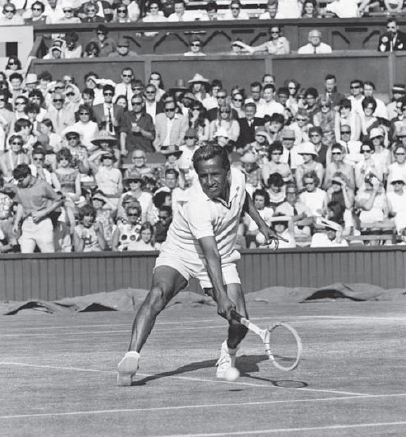
The Tennis 128: No. 61, Ilie Năstase

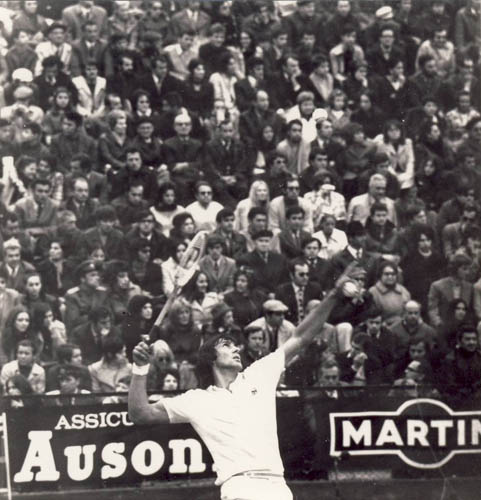
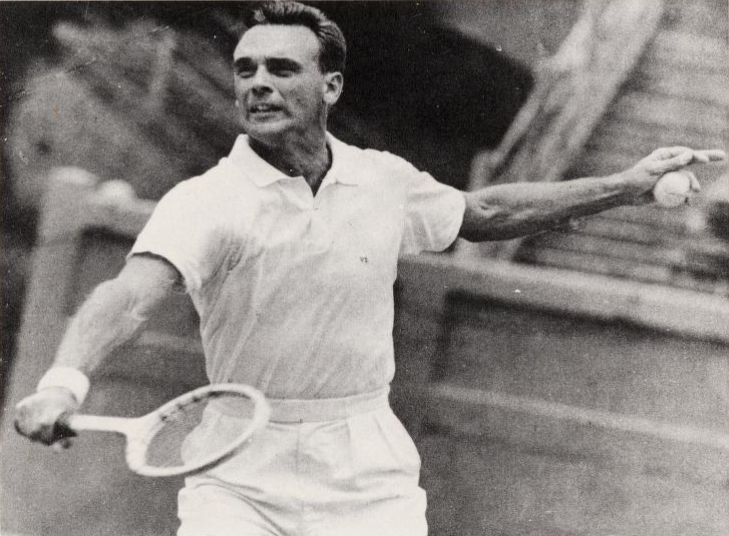
Ilie Năstase in the 1972 Davis Cup final.
Credit: The National Museum of Romanian History

In 2022, I’m counting down the 128 best players of the last century. With luck, we’ll get to #1 in December. Enjoy!

* * *

Ilie Năstase [ROU]
Born: 19 July 1946
Career: 1962-85
Plays: Right-handed (one-handed backhand)
Peak rank: 1 (1973)
Peak Elo rating: 2,256 (1st place, 1973)
Major singles titles: 2
Total singles titles: 98
 

* * *

Here’s a mystery you probably haven’t mulled over for a few decades: Did Ilie Năstase throw his fourth-round match at Wimbledon in 1973?

1973 was the boycott year, when 81 men skipped Wimbledon to protest the International Lawn Tennis Federation’s suspension of Yugoslav player Niki Pilić for missing a Davis Cup tie. The recently-formed Association of Tennis Professionals–the ATP–objected. Functioning more as a player’s union than it does today, it wanted to have a say in disciplinary matters. The ILTF didn’t budge.

Năstase was one of only a handful of ATP members to defy the boycott and play. He was a half-hearted participant in the union: he signed up but generally did whatever he wanted. When the organization fined him after the tournament, he explained that the Romanian Army–of which he was technically a captain–ordered him to play.

He was, by far, the best player left in the field. He had lost a thrilling five-set final to Stan Smith the year before, and he had won seven of his last eight tournaments, including the French Open, the Italian Championships, and Queen’s Club. He should’ve coasted to the title. His competition consisted of a few fellow Eastern Europeans, some prospects (including Björn Borg and Ilie’s doubles partner Jimmy Connors), and an armada of last-minute replacements.

The overwhelming favorite barely made it to the second week. Năstase lost his fourth-round match in four sets. His vanquisher was a 21-year-old American college star named Sandy Mayer, who had an injured thumb and was sneezing with hay fever. Mayer had plenty of promise, but he was nearly a decade away from reaching his career-best ranking. The day wasn’t covered in glory for anybody.

Speculation started immediately. Maybe the Romanian couldn’t have lost his opening match on purpose: That would be too obvious. Mayer was the first opponent he faced who could plausibly beat him. Năstase secretly supported the boycott–so the theory went–and lost at the first opportunity.

Embed from Getty Images

Ilie in uniform, at Wimbledon in 2015

There’s just as much evidence on the other side of the ledger. Ilie was hardly impregnable against second-tier opponents. In a single four-week span at the start of the season, he lost to journeymen Ove Nils Bengtson, Karl Meiler, and Paul Gerken. He managed to drop a set to unheralded Colombian Iván Molina in the second round. And he was hardly in a rush to get away from the scene of the controversy. Năstase and Connors combined to win the doubles title over the boycott-decimated field.

For his part, Năstase has never said anything publicly to support the tanking hypothesis. He wrote in his 2004 autobiography that his back seized up during the Queen’s Club final and continued to give him problems. Against Mayer, he “was not in good shape mentally or physically,” and he didn’t like playing on the upset-friendly Court No. 2.

As conspiracy theories go, it’s pretty weak sauce. Upsets happen, and while Năstase was probably the best player in the world at the time, he was never untouchable. But the question persists.

The historical mysteries that linger are always about something bigger, and this one is no exception. The 1973 Wimbledon fourth round itself is a historical footnote. But Năstase is one of the most compelling characters in the game’s history. Was he a hero or a villain? Did he defy an authoritarian government to silently support his colleagues, or was he little more than a scab acting at odds with his own union?

As for that day on Court No. 2, only Ilie knows for sure. To the broader question, the answer is both. Or neither. The Romanian was a magician, a buffoon, and occasionally, a champion of unsurpassed brilliance.

* * *

Whatever else he was, it’s important to remember that at the peak of his powers, Ilie Năstase was a huge international celebrity. In the early 1970s, he got more global attention than any other sports star save Muhammad Ali. He was the first athlete endorser signed by Nike. While his playing record never quite accounted for his worldwide fame, his undeniable charisma made up the difference.

Fans who showed up, or tuned in, for a Năstase match could expect both shotmaking and showmanship. He might chase down a lob with a behind-the-back flick of the wrist, a shot that Bud Collins dubbed the “Bucharest Backfire.” If the linesman dared call it out, he might unleash a stream of profanity, commiserate with the crowd, or stage a sit-down strike until he got his way.

Embed from Getty Images

A Bucharest Backfire in 1969 Davis Cup competition

Ilie symbolized one possible path for fully professional, Open tennis. Everybody respected the Australians, modest champions like Rod Laver, Ken Rosewall, and John Newcombe. Yet the new big-money atmosphere of the sport made room for more colorful, controversial characters, and Năstase was the first superstar to fill the gap.

Amateur-era tennis had its bad boys, but as Sports Illustrated put it in a 1972 profile of Ilie, “Bad in tennis was always only semibad.” While rebels like Bobby Riggs and Frank Kovacs bent the rules, they rarely stepped across the unwritten boundaries. When a real problem child appeared, national federations were so powerful that they could simply get rid of the offender. At Forest Hills in 1951, an American top-tenner named Earl Cochell berated the tournament referee behind closed doors. He was banned for life.

More than a few people wished that tennis would do the same thing to Năstase. Laver said, “I don’t want my kid seeing Năstase play. The demeanor you show on the court is important to tennis…. Maybe we were too stereotyped. But we were told to behave or they’d take our racket away.”

No one ever seriously thought about taking Ilie’s racket away. He was too good for the box office. John McEnroe, another man whose entertainment value consisted of more than just courtcraft, said, “[H]e’s done more for the game than any single player who has ever lived…. You wouldn’t believe how many people come to see him.”

In the first decade of the Open era, tennis was even more fractured than it is today. Every one of the competing camps–majors, national federations, rival tournament circuits, promoters staging lucrative one-offs–needed to figure out how to make money in the sport’s new environment, and no one was ready to kill a golden goose. At one tournament, Năstase and his mentor Ion Țiriac were defaulted from their doubles match. The next day, they pulled out of the singles, saying that if they couldn’t play doubles, they wouldn’t play at all. Presto–the default was reversed, and they were back in the doubles.

* * *

It wasn’t until 2017, decades after his retirement as a player, that Năstase finally went far enough that a governing body severely sanctioned him. During a Fed Cup tie, he (among other things!) swore at the chair umpire and got himself kicked out of the stadium. The ITF banned him for four years. Even then, he turned up at the on-site restaurant the next day, and he made an appearance at the Madrid Open a few months later.

Hard to believe that when Ilie first came on the scene, the word Țiriac would use to describe him was “timid.”

Țiriac was nowhere near the level that Năstase would reach, but he was the top of the heap in Romanian tennis when Ilie learned the game. A former international rugby and ice hockey player nicknamed the Brașov Bulldozer, he realized that a tennis career would last longer, and that his legs–combined with tactical smarts, gamesmanship, and an unparalleled will to win–would keep him competitive against all but the very best players in the international game.

Embed from Getty Images

Năstase and Țiriac in 1987

He held the Romanian national title for nearly a decade before Ilie took it from him. Even then, in the late 1960s, Năstase looked up to the older man, and the pair traveled the European circuit together. Țiriac would tell his protégé that he needed to open up, until one day, Năstase suddenly had a personality. The veteran may have had second thoughts about that advice.

“I feel like dog trainer who teach dog manners and graces,” Țiriac said in 1972. “And just when you think dog knows how should act with nice qualities, dog make big puddle and all is wasted.”

To some degree, Năstase’s antics were a natural part of his personality. Țiriac thought so, and he cautioned against trying to change him. You could have all of Ilie or none of him.

It would be a mistake, however, to conclude that the behavior was out of his control. Psychologist Dr. Joyce Brothers said in 1976, “Năstase likes attention and because tennis has been considered a gentleman’s game, he keeps his opponents so shook up they can’t concentrate.”

He so riled up Clark Graebner that once, mid-match, Graebner motioned him to come to the net, where he smacked him. In a big-money match against Jimmy Connors, the players exchanged the usual trash talk. Finally Năstase thought his opponent had gone too far. He knew where to hurt Jimmy, saying that Connors couldn’t do anything without his mother. The momentum shift was immediate; it was all Ilie from that point on.

* * *

None of this would’ve mattered if Năstase hadn’t accumulated the results of a champion. He came close to winning his first major title against Stan Smith at Wimbledon in 1972, then took the final step at the US Open. He defeated the home favorite, Arthur Ashe, in five sets.

By 1972, no one could call Ilie timid, either on or off the court. After winning his first titles as the most dogged of clay-courters, even willing to moonball if necessary, he learned to serve and volley. He never developed the serve of a Smith or an Ashe, but he learned the tactics necessary to succeed on all surfaces.

Ashe said, “Năstase is so good that I actually can get inspired watching him play.” Fred Stolle explained, “He’s quicker than anybody. And it’s not scrambling. The guy never scrambles. It’s not much anticipation, either. It’s just all zoom. He doesn’t seem to be trying. He doesn’t do much on the volley, either. Then all of a sudden he’s there. He’s always there.”

The 1972 US Open final

Despite the indifferent serve, Năstase’s zoom was enough to beat tough competition on fast indoor carpet. His most impressive feat was his run of five straight finals at the season-ending Masters event between 1971 and 1975.

The first three of those, all of which he won, were played on carpet. The fields weren’t quite comparable to those at the present-day World Tour Finals because many top stars were committed to the rival WCT circuit, but they were hardly cakewalks. In 1971, he swept a round robin against the likes of Smith, Graebner, and Cliff Richey. In 1972, he went undefeated again, beating Connors and Smith in the knockout rounds. In 1973, he finally dropped a match, but made up for it with straight-set victories over Connors, John Newcombe, and Tom Okker. At the 1975 edition of the event, he obliterated Björn Borg, 6-2, 6-2, 6-1.

When the ATP debuted its computer ranking system in August of 1973, Ilie was number one, and deservedly so. He held on to the top spot for 40 weeks, until Newcombe overtook him the following year.

According to my historical Elo ratings, his legacy would look even better if the ATP had switched on the computer sooner. He earned the top spot starting in August of 1972, lost it for part of 1973, and took it back–as the official formula agrees–in the summer of that year. All told, my system gives him nearly 100 weeks at number one, an achievement that only nine players have matched since.

* * *

So, hero or villain?

If you polled the tennis world in the summer of 1972, you’d have gotten “hero” by a landslide, albeit with some famous names standing up for the opposition. After Ilie beat Ashe for the Forest Hills title, two things happened to shift the narrative.

First, Romania hosted the United States in the final round of the Davis Cup that year. Năstase and Țiriac felt that they had always been at a disadvantage when they played in the States, so they did everything they could to stack the deck in their own favor. The Romanians opted for a glacially slow clay surface, they smothered the visitors with a security detail, and they hired line judges with strong partisan preferences. Gamesmanship aside, it was Romania’s–and Ilie’s–chance to shine at the apex of men’s tennis.

The home team flopped. In the opening rubber against Stan Smith, Năstase got into an argument near the end of the first set, then appeared to lose interest entirely. He fell in straight sets. The Romanians were even more punchless in the doubles, going down 6-2, 6-0, 6-3. Năstase came out of the biggest weekend of his career looking like a clown, one who didn’t have what it took to win when it counted. It wasn’t entirely fair–Ilie played a whopping 52 Davis Cup ties in his career and won 109 matches in the competition–but the reputation was tough to shake.

The other thing that happened was the rise of Jimmy Connors. For half a decade or more, all the complaints about bad boys in tennis–and they were incessant–were about Connors and Năstase, Năstase and Connors.

Embed from Getty Images

Năstase and Connors as doubles partners at Wimbledon in 1974

Ilie’s nickname, inevitably, was “Nasty,” but the term was a better match for Connors. Thrilling as Jimbo was to watch, he had little of the personal charisma that allowed Năstase to get away with anything. In 1972, Sports Illustrated celebrated the potential value that a proper “bad boy” could bring to tennis. A few years later, Connors attracted even more fans, but he ensured that people were a lot more ambivalent about the value of bad behavior in the traditionally elite game.

But even in the Connors era, advocates of old-fashioned, prim-and-proper tennis couldn’t help but recognize greatness. Margaret Court, who briefly played alongside Ilie for the World Team Tennis Hawaii Leis in 1976, spoke for many of them. “Ilie Năstase is a difficult man to like. But he’s just too good.”

The Tennis 128: No. 62, Amélie Mauresmo

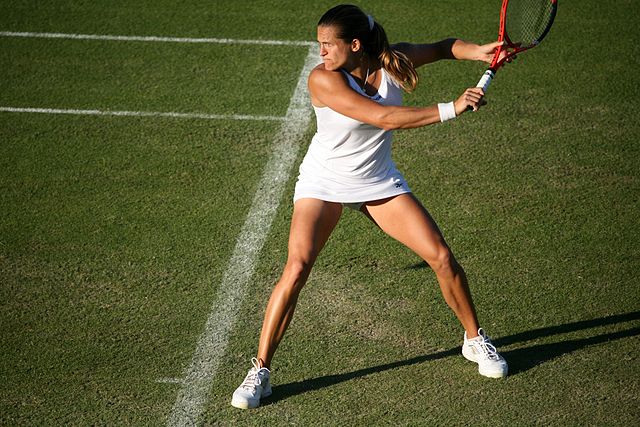
Amélie Mauresmo at Wimbledon in 2009. Credit: Bruno Girin

In 2022, I’m counting down the 128 best players of the last century. With luck, we’ll get to #1 in December. Enjoy!

* * *

Amélie Mauresmo [FRA]
Born: 5 July 1979
Career: 1995-2009
Plays: Right-handed (one-handed backhand)
Peak rank: 1 (2004)
Peak Elo rating: 2,307 (1st place, 2005)
Major singles titles: 2
Total singles titles: 25
 

* * *

As the new tournament director at the French Open this year, Amélie Mauresmo found herself the inadvertent center of attention. The event staged one-match night sessions for the first time in its history, and almost every evening of the fortnight, Mauresmo gave that spotlight to men, not women.

She said, “In this era we are in right now–and as a woman, a former woman’s player, I don’t feel bad or unfair saying this–you have more attraction and appeal, in general, for the men’s matches.” Most days, the women’s field didn’t offer a “confrontation or star” that would fit the schedule.

There were also practical concerns. A one-match session could easily turn out to be a dud, especially if a best-of-three contest ended quickly. While plenty of best-of-five men’s matches are boring, too, at least they last a couple of hours. Mauresmo said that the tournament might address the timing issue by adding a doubles match to the session next year. It might work, but broadcasters rarely salivate at the prospect of early-round doubles in prime-time.

The responses to Mauresmo’s comments, of course, were immediate and emotional. Everyone from Iga Swiatek to Billie Jean King chimed in. It’s a matter of respect; balanced programming is key to growing the sport; and there are plenty of great women’s matches, like the Alizé Cornet-Jelena Ostapenko clash that did merit the night session.

All true, as far as it goes. However, few people took issue with Mauresmo’s central argument. For fans and television schedulers, a handful of famous, veteran names rule the sport. With figures like Ashleigh Barty and Serena Williams missing from the women’s side, men such as Novak Djoković and Rafael Nadal were obvious choices for top billing.

BBC commentator Annabel Croft defended the schedule. “There have been periods when the women’s game has been more interesting than the men’s but I have to say the women’s game has had a bit of a dip lately.”

That historical context helps explain why Mauresmo was willing to give center stage to one gender over the other. When the roles were reversed, she was one of the women appearing on the front page of the newspaper in the morning and playing on center court at night. She knows there will be years when women justifiably monopolize the Roland Garros night sessions. This just wasn’t one of them.

* * *

Mauresmo reached her first major final at the 1999 Australian Open, when she was 19 years old. The women’s draw in Melbourne had everything. Martina Hingis was the defending champion, but she hadn’t won much in the twelve months since. The field was full of stars past and future, from Steffi Graf to Monica Seles to Venus Williams.

By comparison, the men’s draw was “the rough equivalent of the jayvee game,” as Harvey Araton put it in the New York Times. Sports Illustrated called the eventual finalists, Thomas Enqvist and Yevgeny Kafelnikov, “duller than oatmeal.”

There was nothing dull about women’s tennis at the turn of the century. At the 1999 Australian, it was the unseeded, 29th-ranked Mauresmo who caused things to get even spicier than usual.

Mauresmo serving in Sydney, in 2002. Credit: TwoWings

Amélie wasn’t on the radar of most fans, who thought of her as a name for the future if they thought of her at all. She saved match points in the first round, then opened up the draw with a three-set upset win over 8th seed Patty Schnyder in the second. She cruised to the semifinals with three easy wins, including a quarter-final defeat of Mary Pierce.

By the time she faced top seed Lindsay Davenport in the semi-final, Mauresmo was on everyone’s radar, and not because of her first-week victories. Early in the event, she came out as gay to French media. The Aussie tabloids jumped on the story.

The coverage of the 19-year-old’s sexuality ramped up further after she narrowly got past Davenport. She won 103 points to the American’s 102 in a 4-6, 7-5, 7-5 victory. Davenport said more than she meant to in a post-match interview: “A couple of times, I mean, I thought I was playing a guy out there, the girl was hitting it so hard, so strong, and I would look over there and she’s so strong in the shoulders, those shoulders.”

There’s a long history of commentators and opponents talking about women–usually the best of them–playing like men. Often, such remarks were intended as compliments, even if they sound increasingly cringey to a modern ear. Davenport was, to all appearances, just explaining how she was overpowered. A week after Mauresmo came out, though, it sounded like something else.

Davenport was quick to apologize, personally and sincerely. The same was not true of Hingis, who would face Mauresmo in the final. The Swiss Miss said her opponent was “half a man,” and she griped about the Frenchwoman’s public displays of affection. Hingis’s apology was as perfunctory as Davenport’s was genuine.

Alas, this was not a Hollywood movie. The unheralded teen who overcame one obstacle after another, revealing her true self along the way, did not win the tournament. The villain ended up on top. Hingis claimed her third straight Australian Open, 6-2, 6-3.

* * *

Amélie’s Australian adventure prepared her for the media attention she’d receive up to the present day. But the storybook ending was a long time coming.

Two years after her Melbourne final, she was barely hanging on to a spot in the WTA top 20. It wasn’t until the US Open in 2001 that she reached another grand slam quarter-final. She lost that match to Jennifer Capriati, and she lost her next five encounters with top-tenners as well.

In fairness, it was not an easy time to climb the women’s tennis ladder. Consider some of the top women born between 1975 and 1983:

Birth  Player               
1975   Mary Pierce          
1976   Jennifer Capriati    
1976   Lindsay Davenport    
1979   Amélie Mauresmo      
1980   Martina Hingis       
1980   Venus Williams       
1981   Elena Dementieva     
1982   Serena Williams      
1982   Justine Henin        
1983   Kim Clijsters

If great players were evenly distributed throughout the last century, my Tennis 128 list would contain five women from that time span. Instead, there are ten, some of them very close to the top of the all-time rankings. (Spoiler alert: Both Williams sisters are on the list.)

Eventually, Mauresmo would hold her own against most of her peers. She won only 2 of 12 against Serena Williams, but she managed 3 of 8 against Venus Williams. She split 14 meetings with Hingis, and almost broke even against Justine Henin and Kim Clijsters. She won her career series against Capriati, Pierce, and Elena Dementieva.

A Mauresmo forehand at the 2009 US Open. Credit: Charlie Cowins

Those wins helped her climb the rankings, but in the early 2000s, Amélie could only watch while the Williams sisters dominated all the tournaments that mattered. In 2002, she lost a quarter-final in Australia to Capriati, a semi at Wimbledon to Serena, and a nail-biter of a US Open semi-final to Venus. While she cracked the WTA top five for the first time, a major title still seemed a long way off.

* * *

Journalists found it easy to construct a narrative around Mauresmo’s struggles. She never regretted coming out, but the added attention–much of it negative–both distracted her and added to the pressure she faced. Plus, she gained a reputation as a choker, a talented player who didn’t have what it took to win the big matches.

Like many players whose mental strength is questioned, Amélie has accepted the judgment, at least as an explanation for part of her career. She’ll talk about how she was afraid to win, until she finally realized–around 2004–that it ought to have been her name on the trophy instead.

Maybe so. Certainly she improved, and her results took a leap forward that season. She won 63 of 75 matches, claiming four titles and reaching number one on the WTA computer–albeit briefly–ahead of the likes of Davenport, Henin, and Serena.

On the other hand, there are plenty of other reasons why Mauresmo took longer than her peers to put things together. She told the Guardian in 2006 that she wasn’t “a tennis machine.” Despite winning two junior slams, she was never a can’t-miss prospect. According to French journalist Alain Deflassieux, she wasn’t even the best youngster among the strong crop of Frenchwomen born in 1979.

Some slow-motion Mauresmo backhands

Mauresmo was a fascinating player to watch, even apart from the inconsistency that drove the “choker” narrative. She boasted a flashy one-handed backhand somewhere between those of Henin and Richard Gasquet, and she was never afraid to move forward. She rarely went out of her way to play grass-court events, but her game was suited to the surface. In the 2006 Wimbledon final, she serve-and-volleyed 33 times.

The variety was a blessing and a curse. Amélie told the Guardian:

It didn’t help me for a long time. When you have a choice you have to make the right one. When you don’t have a choice you do what you know how to do best and that’s about it. When you have a repertoire–for this ball a chip down the line? Or a top spin short across the court?–there’s a chance that you’ll make the wrong decision.

A chosen few, like Martina Hingis, seem to come out of the womb knowing how to make those choices. For the rest of us, including some of the greatest players in the game’s history, it takes time.

* * *

After her triumphant 2004 campaign, it seemed that Mauresmo might finally win a major. Instead, the 2005 season played out just like the one before. She won just four games against Serena in Australia. She crashed out early to a young Ana Ivanović in Paris. Davenport beat her in a marathon, narrative-reinforcing three-setter at Wimbledon. Then Amélie limped out of the US Open after a 6-4, 6-1 defeat at the hands of Pierce.

Pierce beat her again to kick off the round robin stage of the year-end championships in Los Angeles, but then the tides turned. Mauresmo beat Clijsters and Dementieva in straight sets to advance to the knockout stage, then defeated Maria Sharapova in the semi-final and Pierce in a rematch for the title. While it wasn’t a major, it was the next best thing.

And it was a major confidence boost. Mauresmo would end up winning eleven matches in a row against top-ten opponents, including finals against Henin, Pierce, and Clijsters to kick off 2006.

The Henin match was an unsatisfying victory by retirement, but Amélie could only complain so much: It was her first grand slam title. Her path to the 2006 Australian Open championship was bizarre: She beat Michaëlla Krajicek, Clijsters, and Henin by retirement, and Henin’s ailment was a stomach bug she probably could’ve played through.

Retirements or not, the wins counted. Mauresmo would reclaim the number one position in the rankings in March.

The last two points of the 2006 Wimbledon final

She would justify her position–and her asterisked win in Melbourne–with another big performance at Wimbledon. This time, all seven matches finished when Amélie converted match point. She cast aside any remaining doubts about her mental fortitude, bouncing back from lost second sets against Anastasia Myskina in the quarters and Sharapova in the semis. Then she recovered after losing the first set to Henin in the final. Faced with the pressure of serving for the most storied trophy in tennis, she opened her final game with two aces, executed a textbook serve-and-volley point at 30-all, and coaxed an unforced error from the Belgian to finish the job.

* * *

Mauresmo’s fall from the top was even quicker than her belated rise. She reached the final at the 2006 year-end championships, where she lost to Henin. She beat Clijsters for the 2007 Antwerp title, but the tournament represented 4 of only 27 wins that season. She didn’t reach the quarter-finals in either of her grand slam title defenses.

After two more indifferent seasons, she retired, a few months after her 30th birthday.

Her post-retirement career, however, has been almost as impressive as her decade-plus on court. She helped Marion Bartoli to the 2013 Wimbledon title, and she coached Andy Murray from 2014 to 2016, helping him to his first tournament wins on clay. She was in Lucas Pouille’s box for the young Frenchman’s surprise run to the 2018 Australian Open semi-final.

Now, she runs the French Open, one of the four biggest events on the tennis calendar. Time will tell whether she excels at the helm of a major championship, and whether she even finds it interesting enough to stick around for long. In a good year, the tournament director will spend more of her time behind the scenes. But when the pressure and media attention does arrive, it won’t faze her at all.

The Tennis 128: No. 63, Ora Washington

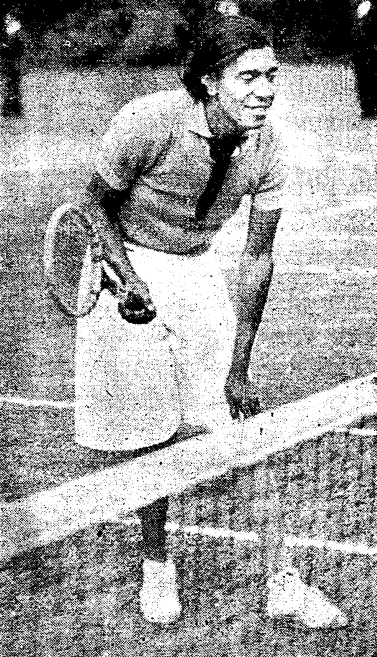
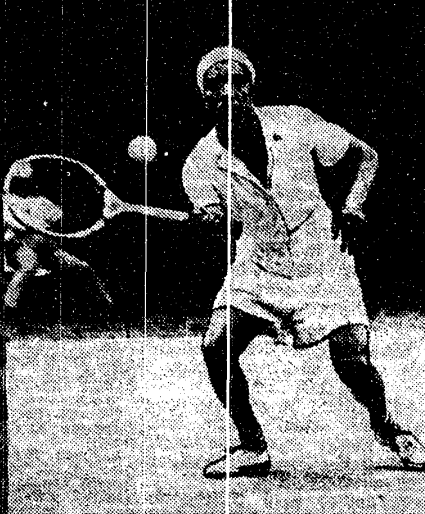
Ora Washington at net,
pictured in the 1937 Chicago Defender

In 2022, I’m counting down the 128 best players of the last century. With luck, we’ll get to #1 in December. Enjoy!

* * *

Ora Washington [USA]
Born: 1898 or 1899
Died: 21 December 1971
Career: 1924-47
Played: Right-handed (one-handed backhand)
Peak rank: 1 (ATA national ranking)
Major singles titles: 0 (in 0 attempts)
Total singles titles: At least 36
 

* * *

For a century or more, the tennis world has been remarkably interconnected. The preeminence of Wimbledon, Forest Hills, and the Davis Cup meant that the strongest competitors of the amateur era regularly faced off against each other. The amateur-professional divide split the field for a few decades, but even then, players earned their spots on a pro tour mainly by winning championships on the amateur circuit.

We measure the all-time greats by their performances against each other, on the sport’s biggest stages. So how do we rate a superstar who wasn’t allowed to compete against the best players of her era, or even to set foot in the most famous venues?

Before 1950, tennis in the United States was racially segregated. Black players were not welcome at the clubs where the most important tournaments were held, and they were explicitly barred from competing in most sanctioned events. Apart from a handful of exhibition matches, there was no meaningful interracial competition in tennis until Althea Gibson made her first appearance at the US National Championships.

Tennis isn’t alone in its shameful, racist past. Major League Baseball, for example, was desegregated only three years earlier. But as other sports have celebrated the exploits of their pre-integration Black stars, tennis has largely ignored its own. The Baseball Hall of Fame has inducted dozens of Negro League players. By contrast, the honor roll at the International Tennis Hall of Fame suggests that the Black game began with Althea and her mentor, Dr. Robert Walter Johnson.

Black tennis thrived before Gibson. There were Black champions even before Althea was born. When Arthur Ashe finished the magisterial volumes of A Hard Road to Glory, he concluded that one of those early greats “may have been the best female athlete ever.”

That was Ora Washington.

* * *

Washington is best remembered today as a basketball player. She toiled in segregated obscurity in that sport as well, but basketball–like baseball–has taken strides to recognize its Black pioneers. Ora was inducted into the Basketball Hall of Fame in 2018. The Women’s Basketball Hall had already honored her in 2009.

She led the champion Philadelphia Tribune team throughout the 1930s. Despite standing a modest five-feet-seven-inches tall, Ora played center. She often led her squad in scoring, and she always intimidated her counterparts. One opponent remembered, “I never saw her when she hit me, but she did it so quick it would knock the breath out of me.”

Her page at the Basketball Hall of Fame website doesn’t mention her tennis exploits. The Women’s Hall page allows that she was “[a]lso a star tennis player.”

This is true. Just like a contributing editor at the Hollywood Reporter, Kareem Abdul-Jabbar, also played a bit of basketball.

Washington shocking the galleries by wearing shorts, from the pages of the 1936 Baltimore Afro-American

Tennis was Ora’s first serious competitive pursuit, even if it was hardly her start in sports. She was born in Virginia to a large family, one in which outdoor games such as croquet were a constant feature. When the Washington clan hit hard times, an aunt moved to Philadelphia. Ora, also in search of work, followed. On her days off from cleaning houses, she hung out at the Germantown YWCA, one of the few gathering places for Black women that maintained tennis courts.

She picked up a racket in 1924, and she won her first titles in Wilmington, Delaware later that summer. Just a year later, she put the Black tennis world on notice. She upset Chicagoan Isadore Channels, the 1924 national champion, and she won the doubles title at the American Tennis Association (ATA) national tournament. In 1929, she would claim her first of eight ATA singles championships. There was no higher accolade available to Black tennis players at the time, and before Althea Gibson came along, no one achieved it as often as she did. No one came close.

Ashe didn’t exaggerate: Washington was in a class by herself. Whether you considered her a hoopster who dabbled in tennis or a racket wielder who filled her spare time with basketball, she was royalty. The papers called her “Queen Ora.”

* * *

We’re still at work on a full accounting of Washington’s on-court exploits. Tennis Abstract credits her with 35 singles titles, spanning 104 match wins against only 11 losses. I found a 36th title last week in the course of researching this essay, and when we consider doubles victories, she probably retired with well over 100 championships to her name.

The match-by-match victory tally is woefully incomplete. While some tournaments had small draws, requiring only two or three singles wins for a title, ATA national events often went through six rounds. Most Black newspapers were weeklies, so they would report a few notable results from the first day’s play, then follow up with a recap of the finals. White publications generally ignored the events entirely. For many of Washington’s triumphs, we don’t know the identity of more than one or two of her opponents or the scores by which she cast them aside.

Just as the 104 known wins understate her dominance, her 11 defeats overstate her vulnerability. Seven of those rare losses came at the hands of Lula Ballard, a fellow Philadelphian and frequent doubles partner who picked up a national championship before the reign of Queen Ora began. Ballard also doubled as a basketball star, and she swung a racket more gracefully than Washington did. Ora maintained a slim edge in their career encounters, winning 10 of 17, many of which went to three sets.

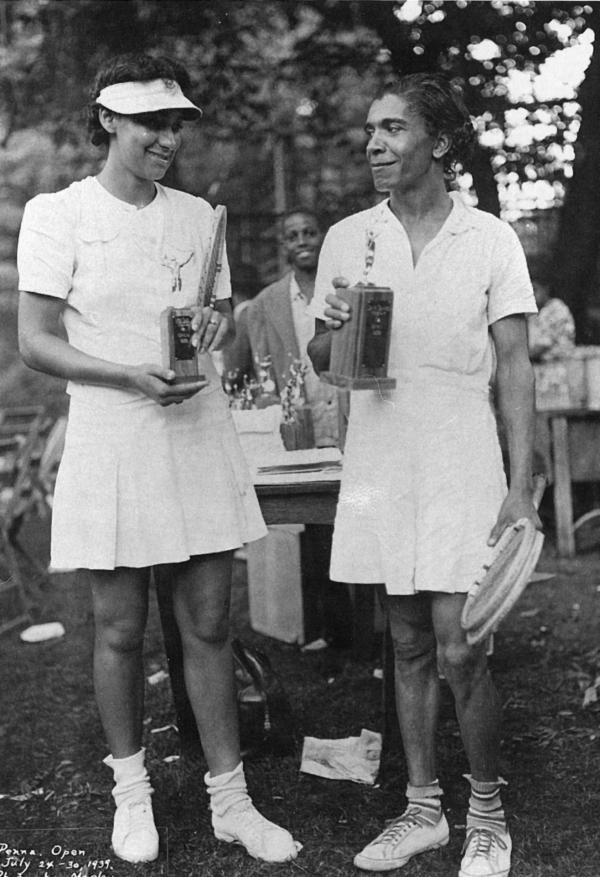
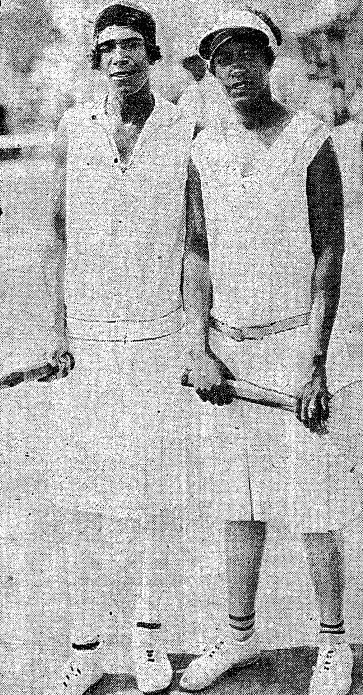
Washington (right) with rival Lula Ballard in 1939

Washington devoted more time to tennis than her rival did, and no one could touch her in her steady battering of the rest of the field. Against everyone else, Ora won 94 of 98 known matches. The New York Age compared her to the boxer Joe Louis, another Black star who won with “deadening regularity.” Beginning in 1928, Washington went undefeated for nearly eight years.

The uncertainty about Ora’s stats extends to just about every aspect of her life. Her home county in Virginia didn’t keep records, so we don’t have her exact birthdate. All we can say is that she was probably born in 1898 or 1899. We know roughly when she started playing tennis, but we can’t be confident of the oft-repeated story that she picked up the sport to get over the death of a sister.

Washington frequently appeared in the headlines during her sporting career, but she drew little attention in retirement. New stars grabbed the spotlight, and integration shifted the focus away from organizations like the ATA. Ora did little to spread her own story. Her obscurity was so complete that when the Black Athletes Hall of Fame inducted her in 1976, no one knew why she didn’t show up. She had died five years earlier.

The resuscitation of her basketball record has given us a bit of a 21st-century Washington revival. Deserved as it is, our knowledge of her life and career hasn’t kept pace. Stories about her have turned into a game of historical telephone. The Basketball Hall of Fame initially honored her as “Ora Mae Washington.” Just one problem: That wasn’t her name. No one knows exactly where the “Mae” came from, but it didn’t come from Ora. Her middle name was Belle.

* * *

The most frequently repeated–and gradually twisted–story about Ora concerns her desire to take on the greatest player of her era, Helen Wills Moody.

Ora knew she was the best player around, and she surely wondered how she would stack up against even stronger competition. In the early 1930s, Helen Wills Moody was the strongest of all. She won 14 majors–six of them at Wimbledon–between 1927 and 1933.

By the end of Washington’s life, reporters would write that her dream had been to test herself against Wills Moody. No match ever happened–or was even seriously discussed. The non-match has somehow developed a mythology. Wikipedia makes a poorly-sourced claim that “Moody refused to schedule a match,” and many journalists have repeated it, sometimes insinuating that Helen wouldn’t play because she was either too racist, too insecure, or both.

The Washington forehand volley, from the pages of the 1939 Baltimore Afro-American

I don’t doubt that Ora wanted the challenge. It would’ve been a huge opportunity for her, and it could’ve accelerated the path to integrated tennis. In the 1940s, Don Budge and Alice Marble played exhibitions with Black players and Marble–along with Sarah Palfrey Cooke and others–pressured the establishment to open its doors to Althea Gibson.

But there’s no evidence that any kind of overture to Wills Moody was made at the time. When a reporter asked her about the non-match in 1976, Helen didn’t remember anything about it, or about Ora. Wills Moody played a very limited schedule, and even a prospective title defense at Forest Hills or Wimbledon didn’t always convince her to leave her home in California. The whole idea of a Wills-Washington showdown was always far-fetched, even if we assume the best of intentions on Wills Moody’s part.

* * *

From our vantage point nearly 100 years later, it’s impossible to know how Ora would’ve fared against the toughest competition of her day. We have mixed reports of her serve, rave reviews of her overhead, and awed tales of her footspeed. She choked up on the racket, and her groundstrokes–particularly a backhand slice–were old-fashioned. Her only chance against Wills Moody probably would’ve been to chop her into submission, the strategy that worked for Elizabeth Ryan.

Ora’s success relied in part on the same intimidating reputation that preceded her on the basketball court. The Chicago Defender wrote in 1931, “[H]er superiority is so evident that her competitors are frequently beaten before the first ball crosses the net.” It’s unlikely that a top-ranked white star would’ve succumbed so quickly.

Baseball researchers are able to approximate the level of play in the pre-integration Negro Leagues. Even with the official color line in place, there was a fair amount of interracial competition. All-star teams of Negro League and Major League players barnstormed against each other in the offseason. We can also look at the records of players such as Jackie Robinson, who spent one year on one side of the divide before shifting to the other.

Washington (left) with Frances Gittens, from the pages of the 1935 Baltimore Afro-American

Tennis has almost nothing of the sort. Black players occasionally entered local public parks tournaments, with some success. Frances Gittens*, a New York-based ATA star who lost her 15 matches against Ora, won at least one parks tournament in Brooklyn against predominantly white competition. Flora Lomax, a national champion in the years following Washington’s retirement from singles competition, played several interracial tournaments in Detroit, often beating the field. A Californian named Juliette Harris held her own in Los Angeles public parks competition, once taking Gracyn Wheeler–a future Forest Hills quarter-finalist–to a third set.**

* Before Frances married fellow player Mr. Gittens, she was, believe it or not, Frances Forehand.

** In 1930, Harris found herself across the net from Dr. Esther Bartosh, around the time that Bartosh began coaching the young Bobby Riggs.

Those three examples aren’t the full extent of interracial women’s competition in the pre-Althea years, but they are frustratingly close. Each one implies that there was plenty of talent blocked by the sport’s color barrier, but the sum of the evidence is not nearly enough to draw stronger conclusions.

* * *

For Black journalists in the 1950s, the most compelling hypothetical was historical, not racial. Who was better: Ora Washington or Althea Gibson? In 1953, Sam Lacy of the Baltimore Afro-American imagined a clash between the two women at their peaks, composing a blow-by-blow report for the fictional match. Lacy gave Althea a slight edge, with a final score of 3-6, 6-3, 8-6.

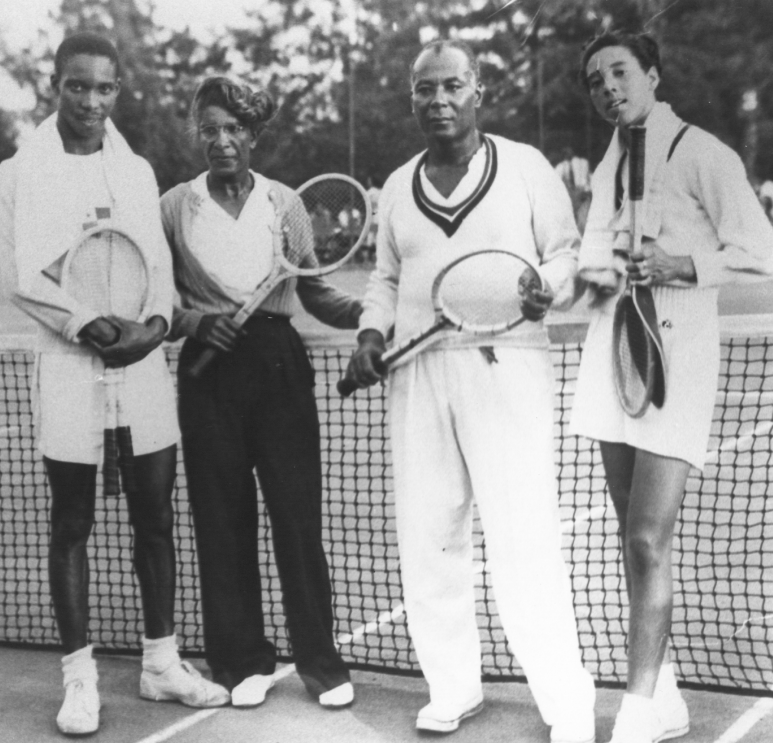
Mixed doubles finalists at the 1947 ATA Championships. Nearly 50 years of age, Washington teamed with George Stewart to win the title.
Left to right: Stewart, Washington, Dr. Robert Walter Johnson, and Althea Gibson

Philadelphia Tribune reporter Malcolm Poindexter offered a more measured comparison in 1956, the year Gibson won her first major title. He made it clear that Ora had her supporters, and that “Miss Washington [could] have given Helen Jacobs or the other great women of her day a real tussle.” But one local connoisseur, Al Bishop, sided with Althea:

[Ora’s] court game was old style…. She had the tactics, and was dynamic to watch. But she didn’t have the stroke. Her overhead game was terrific, but even that wouldn’t have helped too much…. Ora played a different style game entirely.

That brings us back to where we started. We can’t compare Washington to Jacobs or Wills Moody because they never faced off, and they had no opponents in common. We can’t really compare Ora to Althea–even though they did sometimes share a doubles court–because they belong to different eras. Washington was never part of the globally interconnected tennis world. For all that an analytical approach can tell us, Ora might as well have been the champion of Lapland.

The truth of the matter is, Washington probably wasn’t as strong as the all-time greats people want to stack her up against.

The most damaging aspect of segregation wasn’t the exclusion of Black players from top-level competition, it was the complete lack of opportunities for talented youngsters to develop into future champions. Ora probably never saw a tennis court until she was in her early twenties. She never had a coach. She had so little financial support that she continued cleaning houses even while she was a two-sport superstar.

She overcame all that, and she still beat all comers–many of them upper-middle-class young women who would never work a menial job in their lives. She overcame all that, and she still played such impressive tennis that old-timers would put her on par with the Wimbledon-winning Althea Gibson. No better player could possibly have emerged from the milieu of 1920s Black Philadelphia.

It was just as unlikely that a woman with Ora’s background would become one of the great basketball players of all time. Yet 100 years later, she has a plaque at that sport’s Hall of Fame.

It’s well past time that she receives the same recognition for her tennis.

The Tennis 128: No. 64, Bobby Riggs

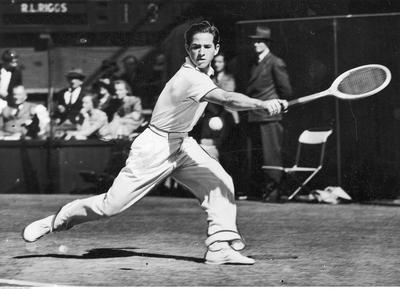
Bobby Riggs at Wimbledon in 1939

In 2022, I’m counting down the 128 best players of the last century. With luck, we’ll get to #1 in December. Enjoy!

* * *

Bobby Riggs [USA]
Born: 25 February 1918
Died: 25 October 1995
Career: 1933-50
Played: Right-handed (one-handed backhand)
Peak rank: 1 (1939)
Major singles titles: 3
Total singles titles: 103
 

* * *

In 2013, a Florida man approached ESPN with a story about an overheard conversation. Forty years earlier, he had heard two mobsters discussing what sounded like a plot to fix Bobby Riggs’s match with Billie Jean King. He was far from the first person to question whether the Battle of the Sexes was on the up-and-up.

Riggs was known as–among other things–the “happy hustler,” a showman whose sense of ethics lagged far behind his flair for publicity. He would bet on anything. If you weren’t interested in a wager, he’d badger you until you changed your mind.

He usually won, and he was a rarely in a situation where throwing a match would benefit him. Tanking a set or two, though? He’d been doing that since he was a teenager racking up both trophies and illicit cash on Los Angeles courts in the 1930s. He had a hard time getting motivated without money on the line, so in a lopsided early-round match, he’d often play indifferently. After losing a few games or couple of sets, a buddy in the stands might signal that he’d finally found someone to take the other side of a bet.

Even before the first Battle of the Sexes–the “Mother’s Day Massacre” of Margaret Court that convinced Billie Jean King to take on Riggs a few months later–some people wondered which side Bobby would back. His bluster was convincing, but he was a 55-year-old pusher taking on the best woman player in the world.

His triumph against Court couldn’t have been greater. He destroyed her in 57 minutes, dropping only three games. What’s more, the event captured the world’s imagination, attracting record television audiences and guaranteeing him a steady stream of sponsorship and appearance income. If anyone threw that match, it was Margaret. But it’s far more likely she just wasn’t prepared for either the spectacle or the craft of the greatest dinkballer of all time.

Footage from the Mother’s Day Massacre

Everything was different against Billie Jean. Riggs was out of shape. Before the match, he was the one who looked morose, overwhelmed by the occasion and the 30,000-strong crowd at the Houston Astrodome. His play was ineffectual from the outset. He double-faulted, made careless errors, and watched as King smashed away one lob after another.

That’s what really got people talking about a fix. Bobby was a control artist. Even with tennis elbow and 15 extra pounds, those aren’t skills that just disappear. He had dominated seniors competition–not to mention won Wimbledon 34 years earlier–by anticipating every one of his opponents’ moves and putting each of his shots exactly where he wanted it. In his prime, he claimed, he once went six months without double faulting.

And then there was the lob. While Riggs had a well-rounded game, his lob was the pièce de résistance, the shot that gave him a chance against some of the greatest players of all time. Some of his friends, like former US National doubles champion Gene Mako, were convinced that he wasn’t just tanking, he was playing badly in such a way that savvy fans would realize it. It’s an odd way to salvage one’s dignity, but it can’t be ruled out.

Bobby insisted to his dying day that he played his best. King is also adamant that there was no funny business. Riggs could’ve laid an egg that day for all sorts of other reasons, most of them stemming from the overconfidence he gained four months earlier. We’ll probably never know for sure. With every year that passes, the truth gets that much murkier.

But there’s a reason the debate interests me so much. Bobby Riggs was so good at age 55 that he obliterated Margaret Court. Experts were convinced he should have had nearly as easy a time with Billie Jean. Just how good was this guy?

* * *

It’s almost as difficult to get a handle on Riggs’s greatness as it is to determine what really happened at the Astrodome in September 1973. Bobby never looked like a champion, and his game was easy to underestimate. As Rosie Casals liked to point out, he walked like a duck. (“And besides, he was an idiot.”) His career was split between the amateurs and the pros, with a generous bite taken out of the middle by World War II.

Bobby was a wiry five-feet-seven-inches tall. While his height wasn’t quite the disadvantage it would be now, it sure didn’t help. His main adversaries were six-footers; his rival Frank Kovacs was six-foot-four. The size difference counted against him both on and off court. As a junior, he was denied some playing opportunities because–among other reasons–he didn’t look like a future star.

His finesse game didn’t help matters. Riggs eventually developed a strong first serve, but as a teen, he just spun it in. He handled himself adequately at net, but he didn’t worry much about getting there. He anticipated well, he was breathtakingly fast, and he almost never missed. He was the GPOAT: Greatest Pusher of All Time.

Yet even that description doesn’t do him justice. He was more than just an exemplary exponent of a playing style designed to wear down and aggravate opponents. Surrounded by serve-and-volleyers like Jack Kramer and power hitters like Don Budge who also sought to take the net early, Riggs deployed a defensive game so deadly it might as well have been offense.

Bobby had consistently lost to Budge before the war, but in a series of Army-Navy exhibitions for the troops, he began to edge ahead. The two men faced off at the Pan-Pacific Auditorium in Los Angeles in January 1946, a rematch after an earlier contest that was largely decided by an arm injury to Budge.

Budge and Riggs in 1942

The Pan-Pacific had a huge clock that hung from the ceiling above the court. Bobby’s lobs not only had to clear the reach of the six-foot-one Budge, they also had to stay under the clock. Riggs recalled:

Every time I lobbed I could hear the crowd holding its breath to see where the ball would go. Most of them fell within six inches of the baseline. Only three of them actually hit the clock. I must have lobbed him about seventy times during that match.

Riggs won, and he solidified his status as the world’s best professional. He’d lose that distinction a couple of years later when he toured against Kramer, but even then, Bobby’s crafty tactics held up against the leading proponent of the hyper-aggressive Big Game. Riggs took the opening match of the series at Madison Square Garden, and he held his own for several weeks before Kramer improved and pulled ahead.

* * *

It takes a bit of discipline to work out Riggs’s place on the timeline of tennis history. He was a rising star in the late 1930s, when Budge’s Grand Slam overshadowed everything else in American tennis. He won three majors between 1939 and 1941, then turned pro just as the Japanese bombed Pearl Harbor. After a couple of post-war years at the top of the pro game, he stepped aside for Kramer.

The chronology doesn’t lie, but Bobby seems to exist in a kind of parallel tennis universe. Thanks to his size, his penchant for gambling, and his wrong-side-of-the-tracks origins, he was never embraced by Perry Jones, the grand poobah of Southern California tennis. Instead, his mentor throughout his teen years was Esther Bartosh, a physician who only took up tennis in her late twenties because she was frequently on call. She needed a sport she could play while still within reach of a phone.

Most promising youngsters traveled the country with financial aid from their regional associations. Bobby had to scare up his own boosters. Bartosh contributed some money and transportation, and Riggs later hooked up with a gadfly named Jack Del Valle. Del Valle drove him to tournaments around the country, funding their travels with bets on Riggs’s matches.

Other stars played for pride–or at least they pretended to. With Bobby, money was always front and center, whether he was negotiating outsized “expenses” from tournament directors or risking his take in an all-night poker game the night before the final.

Eventually Bobby moved to Chicago, where the local establishment was more accepting of his quirks. It helped that he won almost every tournament he entered. Jones’s influence kept him off the Davis Cup team until 1938, and the USLTA didn’t send him to Wimbledon until 1939. By then, still only 21 years old, he was clearly the best amateur player in the country. He was more than ready: He won the singles, doubles, and mixed doubles on his first try.

https://www.youtube.com/watch?v=djOHphNx1fw
Riggs at Forest Hills in 1939 (from 0:47)

Only then did Riggs fall in step with the usual status and schedule of an amateur champion. But the war in Europe tore up the calendar. Wimbledon wouldn’t resume until 1946. After Bobby suffered the most painful loss of his career to Adrian Quist in the Davis Cup Challenge Round that September, he had no chance to redeem himself. The international team competition was suspended for the duration as well.

Observers looking for reasons to discount his accomplishments didn’t have to work very hard. For one thing, the Wimbledon and Forest Hills titles became much more accessible after Budge had turned pro. Even Bobby wouldn’t have backed himself against Budge at that stage. For another, the impending hostilities limited the field. Gottfried von Cramm destroyed Riggs at Queen’s Club in 1939, beating him 6-0, 6-1 in under 20 minutes. Von Cramm would’ve been the favorite at Wimbledon, but the All-England Club forbade him from competing because of a politically-motivated morals conviction in Germany.

* * *

With so many gaps and asterisks on the Riggs record, we’re left to rely on the assessments of his peers. Four-time national doubles titlist Bill Talbert called him “the percentage player par excellence.”

[Riggs had] no real weakness—and no real strengths, either, except the all-important one: he got the ball into the court. He returned everything. His own shots were delivered—like the pitches of such baseball ‘junk artists’ as Preacher Roe of the Dodgers and Eddie Lopat of the Yankees—with a baffling variety of speeds.

Jack Kramer never stopped insisting Bobby was even better than that. He claimed that Riggs was “by far the most underrated of all the top players.”

He had such quickness and ball control, he could adapt to any surface, and he was a super match player…. [H]e could find ways to control the bigger, more powerful opponent. He could pin you back by hitting long, down the lines, and then he’d run you ragged with chips and drop shots. He was outstanding with a volley from either side, and he could lob as well as any man…. He could disguise it, and he could hit winning overheads. They weren’t powerful, but they were always on target.

In the five-plus years between the summer of 1936 and the end of 1941, Bobby won a whopping 68 amateur singles titles. TennisArchives.com credits him with a career tally–including pro tournaments–of 534 match wins against only 93 losses. Many early-round matches are not accounted for, so the actual victory count and corresponding winning percentage are quite a bit higher.

After Kramer dethroned him, Riggs stepped away from serious competition. He returned to serious tennis only in the late 1960s, after a couple of decades promoting pro tours, half-heartedly pursuing a business career, and hustling every rich golfer in America. For Sports Illustrated, it was like Bobby–“The Great Retriever”–never left. “How could anyone really forget Bobby Riggs?”

* * *

Few men could’ve mustered a second act that would outstrip such a sterling first. Only a one-of-a-kind character could play two matches for the history books at 55 years of age.

Journalist Curry Kirkpatrick wrote, “probably his entire life cycle has been one long rehearsal for Ramona”–the Mother’s Day match against Court. Riggs had often played the villain, the cocky dark-haired runt against All-American boys like Kramer. He didn’t mind, especially when it helped him get better odds.

The Battle of the Sexes spectacle could never have reached the same level of notoriety with anyone else. Bobby’s flair for promotion was a good start. But his deceptive game style was what made the whole thing work. He was the weekend pusher against Court’s heavy hitting and King’s netrushing, the unassuming physical specimen against a five-foot-nine Australian nicknamed “The Arm.” Kramer, for one, had far better male chauvinist credentials–Riggs almost certainly exaggerated his own sexism–but he never could’ve played the underdog.

Embed from Getty Images

King and Riggs in 1973

One of the best arguments that Bobby didn’t throw the match against Billie Jean is that he believed a small fortune in future income was at stake. He estimated that he made $1.5 million from the match at the Astrodome, and he envisioned an annual challenge match in which he’d take on the best player on the women’s circuit until someone finally beat him. His celebrity persisted–and paid off–nonetheless. But he didn’t know that until afterwards.

Whatever ultimately caused Billie Jean’s 6-4, 6-3, 6-3 victory, Riggs came to terms with it:

The operation was a great success, a beautiful promotion. The only thing is, me, the patient, got killed. But, hey, a happy ending. I cried all the way to the bank.

Bobby learned in his time hustling golf that playing well was only half the battle. Skillfully negotiating the terms of the bet–handicaps, ground rules, and the like–was every bit as important. He applied the same logic to his everyday tennis hustles, quibbling over what advantages he would give a challenger in order to create the appearance of an even match while still keeping a bit of an edge for himself.

Still, no matter what the terms, he still had to win. Across five decades of competitive tennis, he almost always did just that. In the match with Billie Jean, Bobby finally found something even better. He could win even by losing.

The Tennis 128: No. 65, René Lacoste

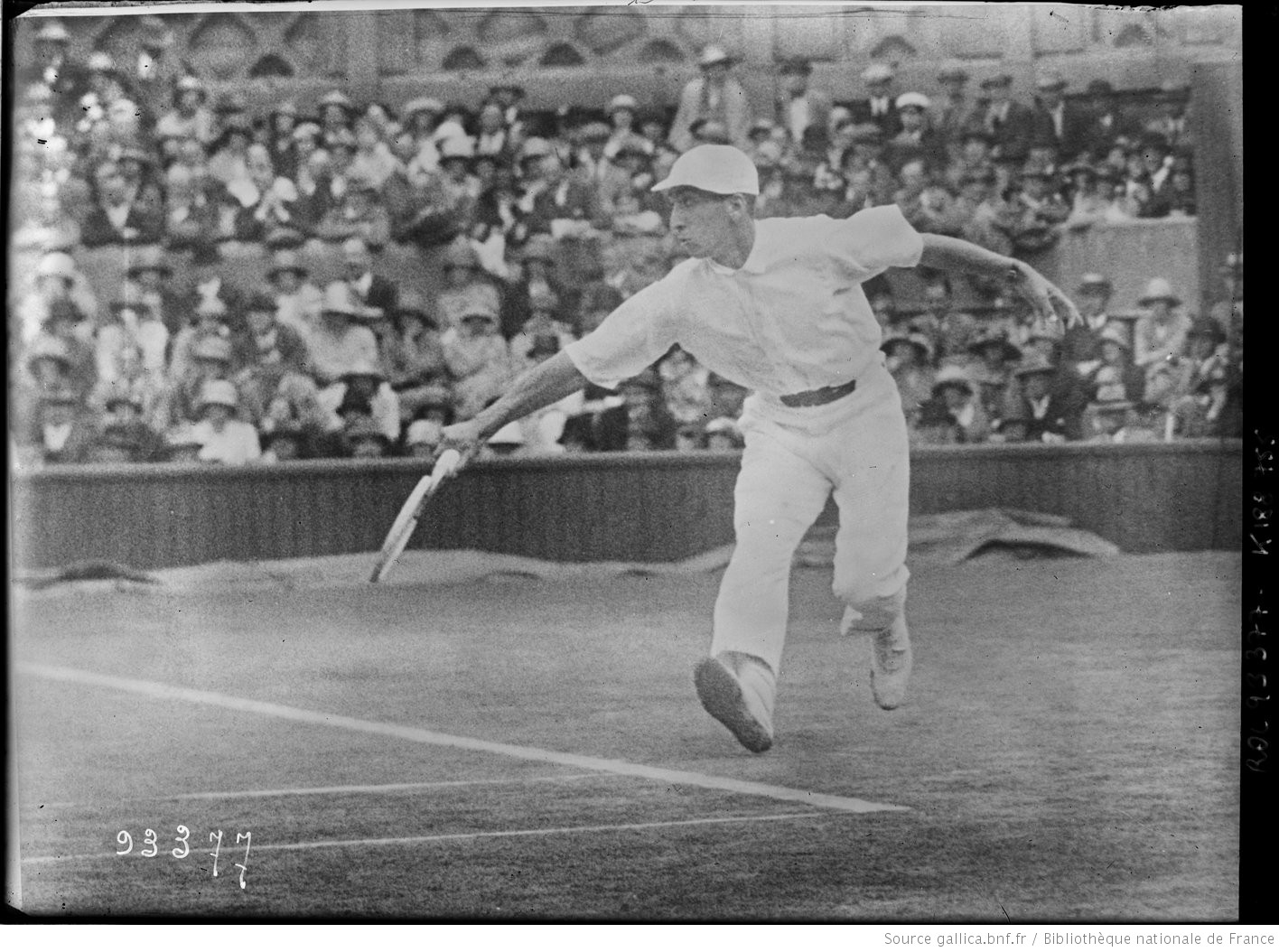
René Lacoste at Wimbledon

In 2022, I’m counting down the 128 best players of the last century. With luck, we’ll get to #1 in December. Enjoy!

* * *

René Lacoste [FRA]
Born: 2 July 1904
Died: 12 October 1996
Career: 1921-32
Played: Right-handed (one-handed backhand)
Peak rank: 1 (1926)
Major singles titles: 7
Total singles titles: 24
 

* * *

Even before he sold millions of polo shirts embroidered with his personal insignia, René Lacoste had one of the best nicknames in tennis history. He was “The Crocodile.”

Or, maybe, the alligator. The debate is almost a century old. Lacoste’s game doesn’t offer an answer. Alligators are the more timid of the two, and Lacoste rarely ventured to the net. On the other hand, crocodiles are deadlier, and on the tennis court, he was certainly that.

Like any good nickname, it’s not entirely clear how it got started. The canonical story was told by a Boston sportswriter named George Carens. In 1923, Lacoste was in Boston for a Davis Cup tie against Australia. Carens sought out up-and-coming stars, so he tagged along one day when the French team went for a stroll around the city.

Lacoste spotted a crocodile-skin valise in a shop window. He loved it, and he made a deal with team captain Allan Muhr that if he won the opening rubber against Australia’s James Anderson, Muhr would buy him the bag. Alas, he lost to the veteran in straight sets, and the French team failed to advance. Still, Carens wrote about it, and the “crocodile” tag stuck. It seemed to fit René’s game. Carens said, “He was relentless, and chewed up his opponents slowly.”

That’s the story, anyway. It’s unclear where Carens worked at the time–his first job was at the Boston Herald, but someone else covered tennis for the Herald that summer. I can’t find any references to Lacoste as the Crocodile (or the Alligator) in the American press until 1925. In September of that year, John J. Hallahan of the Boston Globe wrote that the Frenchman “is now being termed ‘Crocodile.'”

In any event, the moniker stuck. The first time it popped up in the New York Times, it was in the mouth of Lacoste’s teammate Jean Borotra. Ahead of the 1927 US Nationals, Lacoste told American reporters it would be his last full season. Borotra didn’t commit to any particular species, but he thought it was just another reptilian ploy:

Ah, that crocodile, the poor alligator. He will be lucky to win his first match in the [US national] championship. He will never play again, poor fellow. Now I will tell one.

* * *

Borotra, in his sarcasm, was half right. The 23-year-old Lacoste was at the top of his game.

A week after that comment appeared in the Times, the French team finally toppled Bill Tilden and the Americans for possession of the Davis Cup. The “Four Musketeers”–Lacoste, Borotra, Henri Cochet, and Toto Brugnon–pooled their efforts to wear out the great Tilden. Borotra and Brugnon lost the doubles, but they kept Tilden and Frank Hunter on court for five sets. Lacoste took advantage of the 34-year-old’s fatigue to beat him in singles the next day, and Cochet sealed the 1927 Cup victory with a four-set win over Bill Johnston.

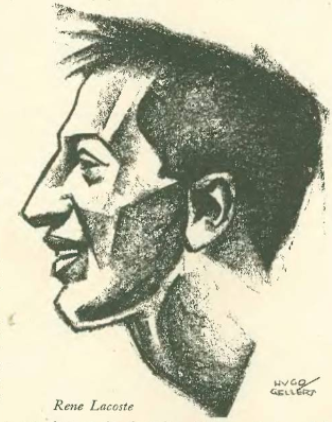
Lacoste sketched in the New Yorker

The US Championships at Forest Hills the following week were little more than a victory lap for the Crocodile. Cochet lost early and Borotra fell to Tilden in the quarters, but Lacoste wouldn’t budge. He won four-set matches over Manuel Alonso and Johnston to reach the final, then bested Tilden once again, 11-9, 6-3, 11-9 in the final.

Big Bill, who had held the national title from 1920 to 1925, recognized that he had met his match. Tilden’s pen was as prolific as his racket, and he would often have reason to praise Lacoste in print. “In the perfection of his stroking, he is a machine,” he once wrote. “He was the genius–shrewd, analytical, superb in technique.”

Lacoste faced Tilden eight times between the 1925 Davis Cup Challenge Round and the 1929 Roland Garros semi-final. The stakes were always high. Every one of their encounters was either for a Davis Cup championship, or in the semi-finals or final of a grand slam. The Frenchman won six, and he pushed the American to five sets in the other two.

* * *

Borotra was also half wrong. It was unthinkable that a sportsman as single-minded and accomplished as Lacoste would simply walk away. Yet soon, he would do just that.

1927 was his last trip to Forest Hills. 1928 was his final Wimbledon and his last Davis Cup. Apart from a one-off comeback in 1932, his farewell major came at the French Championships in 1929, one month before his 25th birthday.

In that final outing, Lacoste beat Tilden and Borotra to win his seventh major title. He entered only 17 in his entire career. Few men have ever packed so many tennis exploits into so little time.

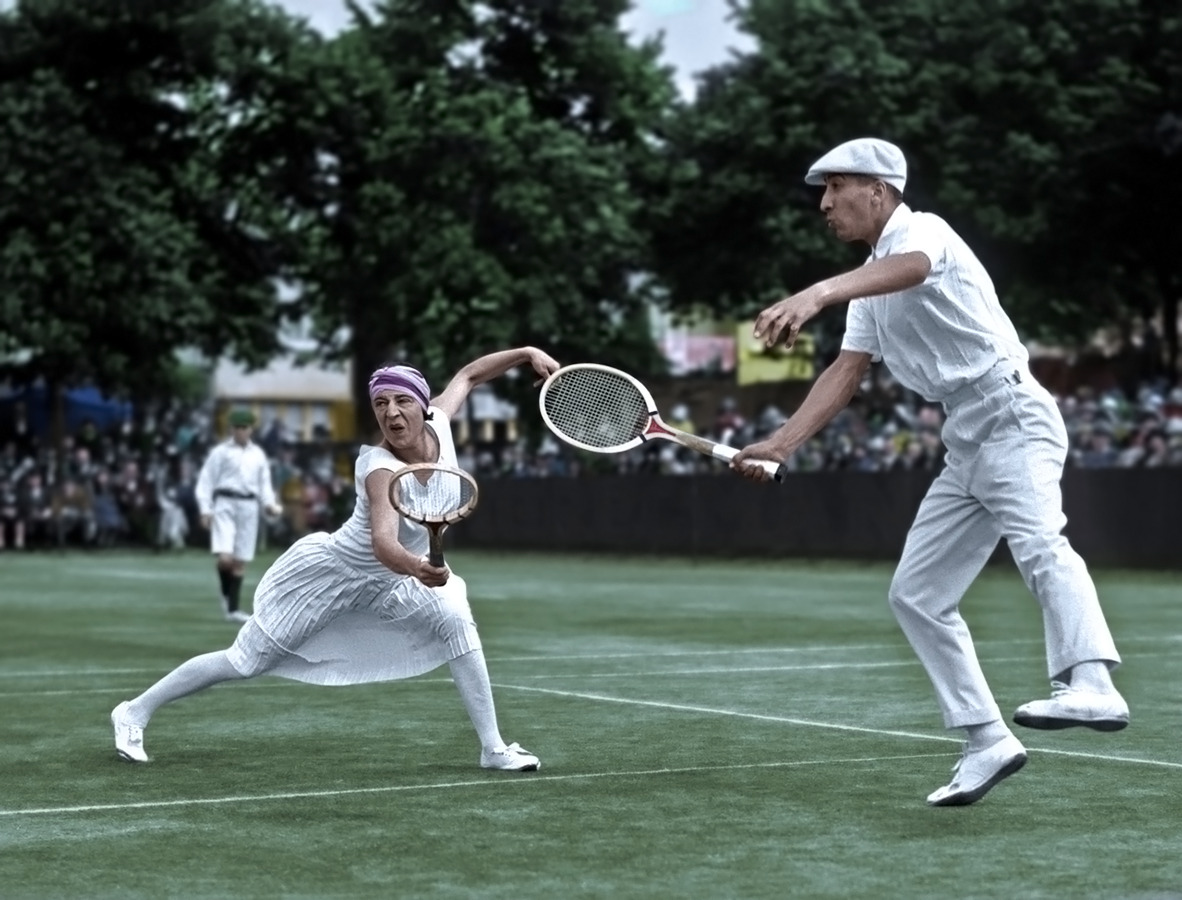
Lacoste with Suzanne Lenglen in 1926
Colorization credit: Women’s Tennis Colorizations

Everything about his career was astonishingly compressed. He only discovered the game when he was 15. It soon developed into an obsession, one that did not fit into the life his father had planned for him. Jean-Jules was a director of the Hispano-Suiza car company, and it was assumed that René, too, would pursue a career in business. The boy was particularly gifted in mathematics and would train as an engineer.

But nothing could shake tennis’s grip on the young Lacoste. Father and son came to an agreement. John Tunis explained in the New Yorker:

At last, however, he agreed to give his son two years to see what he could do. If at the end of those two years he was the fifth ranking player in all tennis, he was to have five years more. If not, he was to go into the factory and become an honest fellow…. That was in 1922. Never a boy applied himself as René Lacoste applied himself to tennis.

Lacoste quickly started winning, but not everyone was convinced he had the makings of a champion.

He beat Marcel Dupont, a national doubles titlist, in 1921. Dupont described him as “a mere schoolboy who can do nothing but poke the ball into the court.” Another potential rival, Paul Féret, concurred: “He is useless, this young Lacoste, he can do nothing but push the ball back and back.”

Dupont and Féret would both learn what Tilden was forced to discover just a few years later. René wasn’t just getting the ball back; he was edging opponents further and further away from their comfort zones. The Times captured the probing game style with a proverb: “It is the sort of genius that is defined as the infinite capacity for taking pains.”

The year that Lacoste made the deal with his father, he lost at Wimbledon in the first round. The following season, he reached the fourth round. In 1924, he made it to the final, where he lost a five-setter to Borotra.

At the end of the season, the experts made their evaluations, and Lacoste was ranked fifth in the world.

* * *

The Crocodile never lost his sense of urgency. He knew that his opportunities to win the sport’s greatest honors were limited, and he prepared accordingly.

From his earliest days in competition, he jotted down the tactics of potential opponents. Racing to meet his father’s deadline, Tunis wrote, “He learned the science of ballistics, of dynamics, the laws of speed, of spin, of the flight of the ball. In note books he worked out angles of a tennis court by trigonometry.” Then he applied the theory to match play, treating every foe like an algebra problem.

While other players grouched about equipment, officials, and weather conditions, Lacoste refused to be distracted. He always kept eight to ten rackets in rotation, so he wouldn’t become too dependent on any of them.

A journalist asked if he blamed his defeat at Forest Hills in 1924 to the blistering heat. His response? “Ah, ça m’est égal [it doesn’t matter]. Changes of ball, changes of climate, changes of diet, all that does not affect me. Give me three days with a new ball in a strange country and I am as good as ever.”

Lacoste (right) with Borotra in 1924

He was equally impervious to surface. His first major title came at the French Championships in 1925. In the final, he straight-setted Borotra, the electric serve-and-volleyer. The slow clay was tailored to his patient game, but it hardly mattered. The two men met again for the Wimbledon championship a month later, and it took Lacoste just one more set to repeat his victory.

René’s persistence even worked on the fastest of amateur-era surfaces, indoor wood. In early 1926, he tagged along with Borotra to the US National Indoor Championships in New York City. Lacoste was as unflappable as ever. Allison Danzig, writing for the New Yorker, said of the semi-final, “Vincent Richards, for all of his knocking the cover off the ball, might as well have tried to hammer down a stone wall.”

Borotra may have been the best wood-court player of all time, but when the two Frenchmen met in the final, Lacoste broke his opponent’s resolve with a 15-13 first set. The Crocodile won in four. While Borotra didn’t mind facing Tilden, there was a limit to his appetite for a struggle. “Excuse me, please,” he said, “from Mr. Lacoste.”

* * *

Lacoste’s preparation may have paid its greatest dividends in, of all things, a dead Davis Cup rubber.

Throughout the 1920s, the French made steady progress as they tried to become the first non-English speaking country to win the Davis Cup. The United States won the Cup back from Australia in 1920, and with Tilden at the top of his game, they had little trouble holding on.

Lacoste made his Cup debut in 1923, the year that he admired that crocodile-skin valise in Boston. For the first time, France came just one step short of the Challenge Round. They lost to Australia, who would stop them at the same stage in 1924. In 1925, they would finally get past the Aussies, but the Americans proved too strong in the championship round. Lacoste lost to both Tilden and Johnston, and he and Borotra lost the doubles in straight sets.

1926 wasn’t much better. France reached the Challenge Round again, but they lost the first four rubbers to the Americans. Lacoste fell to Johnston and Borotra lost to Tilden. Brugnon and Cochet failed to win a set in the doubles. The singles matches of the final day didn’t matter, but René wasn’t about to give up a chance to learn more about Tilden, the man who probably occupied more pages in his notebook than anyone else.

Tilden had needed five sets to beat Lacoste the year before, and the new, improved Crocodile was finally too much for the veteran to handle. Big Bill took the first set, and René came back to grab the second and third. Tilden grew as frustrated with his opponent’s imperturbability as his backhand:

The monotonous regularity with which that unsmiling, drab, almost dull man returned the best I could hit, seemingly without any effect upon him physically or mentally, piled almost irresistible pressure on my nervous system. I used to wish to God he would just once show some form of human reaction. I was often filled with a wild desire to throw my racket at him or hit him over the head.

Allison Danzig was pithier, writing that Tilden was “outguessed, outgeneraled, and outstroked.” Late in the third set, the American aggravated an old knee injury, and he probably should’ve retired. He played on, holding his own as Lacoste failed to work out how to put away an injured opponent. But the result was never really in doubt. While the Americans held on to the Cup, the French won a moral victory. Not only did they avoid a second straight shutout at the hands of the defenders, they finally beat Tilden.

Lacoste (right) with Tilden in 1927

The difference between 5-0 and 4-1 sounds merely academic. But René’s long-awaited victory helped the Frenchmen overcome the last mental block standing between them and international tennis dominance.

The floodgates opened. The next week at the US National Championships, all four of the quarter-finals pitted an American against a Frenchman, and only Vinnie Richards came through for the home team. Tilden lost a five-setter to Cochet. Lacoste beat Borotra in the final, dropping only eight games.

In 1927, as we’ve seen, the French finally triumphed. Big Bill had 50 weeks to plan yet another Davis Cup title defense, but with an aging body, a weak supporting cast, and ever-strengthening competition, there was only so much he could do. The next time the Musketeers got a crack at the American team, they pulled out a narrow victory. France would retain the Davis Cup until Fred Perry’s British team took it from them in 1933.

* * *

Lacoste had barely reached the top of the tennis world when his own body began to let him down. At the start of 1928, he struggled through a tough five-setter on the Riviera against Henry Mayes, an opponent he should’ve beaten easily. Diagnosed with neuritis, he had to take a month off. A year later, he was coping with respiratory disease and stopping competing entirely.

His physical deterioration may have made a tough decision easier. 1929 was the end of the five-year term that his father had granted him to pursue the game. It wasn’t long before Lacoste was selling his signature short-sleeved, crocodile-emblazoned shirts. It turned out that René and his father had had little to argue about: He became a tennis champion and a success in industry, surpassing even Jean-Jules.

When Lacoste retired from competitive play, the rest of the circuit could finally breathe a sigh of relief. They had spent the last half-decade comparing the Frenchman to a machine, one that mere flesh and blood couldn’t hope to compete with. The New Yorker summed it up in 1926: “Mr. Tilden, after all, is human and will make an error. M. Lacoste is simply unreasonable.”

The Tennis 128: No. 66, Vic Seixas

Vic Seixas at net

In 2022, I’m counting down the 128 best players of the last century. With luck, we’ll get to #1 in December. Enjoy!

* * *

Vic Seixas [USA]
Born: 30 August 1923
Career: 1940-74
Plays: Right-handed (one-handed backhand)
Peak rank: 1 (1954)
Major singles titles: 2
Total singles titles: 56
 

* * *

25 years before Vitas Gerulaitis and Jimmy Connors, tennis had Vic Seixas and Ken Rosewall.

Seixas did not have a lot of reason for optimism when he took the court for the second rubber of the 1954 Davis Cup Challenge Round. The Americans had lost to the Australians four years running, and worse, Rosewall owned a six-match winning streak against Seixas. The last victory was just one month old.

Years later, Vic said that Rosewall might not have been the best player he ever encountered, but he was “the toughest opponent I’ve ever faced.” Everything about the matchup tilted in the young Australian’s favor. Seixas was an expert at the net, but with an inconsistent serve and spotty groundstrokes, he didn’t always have a clear path to get there. Rosewall, 11 years the American’s junior, simply hit one passing shot after another.

Their third meeting came in the final of the French Championships in 1953. According to Rosewall’s biographer, Peter Rowley, the very first game of that match “broke Seixas’ heart.” Three of the four points were return winners for the Aussie. The fourth was a perfect drop shot. Vic made a final push in the third set, but the title went to Rosewall in four.

Still, Seixas was optimistic. Before the 1954 Davis Cup showdown, as he remembered it, he said, “Watch out, Ken, because nobody has ever beaten me nine times in a row.” It really would’ve been seven–and nine of ten–but you get the idea.

* * *

Spoiler alert: Seixas won the match. Just as nobody could beat Gerulaitis 17 times in a row (except Björn Borg), Vic was unbeatable when facing an opponent who had owned him for so long.

Before Seixas upset Rosewall, Tony Trabert had eked out a victory over Lew Hoad. The next day, the Americans came back out for the doubles. Vic had never been so confident. On the changeover after the Aussies forced a fifth set, Seixas told captain Bill Talbert, “Don’t worry, Cap, they’re just delaying the inevitable.”

Seixas and Trabert beat Hoad and Rosewall at Longwood for the 1954 US National doubles championship, a preview of the Davis Cup Challenge Round

Neither Talbert, nor anyone else in the tennis world, was accustomed to seeing such a calm, confident Vic. His last name is pronounced “SAY-shus,” giving rise to a convenient nickname of “Vexatious.” Journalist Herbert Warren Wind was kinder, punning on the name for “efficeixas” and “audeixas,” but Seixas’s querelousness was what stuck in the mind. While he was a perfect gentleman off the court, he never let a close line call go unchallenged. He was qualified as an umpire, and he never doubted that he had the best eyes of anyone on duty.

Talbert was convinced that, for Seixas, the key to beating Rosewall was mental. He described his player as “a moody veteran given to periods of deep depression and flashes of brilliance.” Once he had a game plan he felt could cope with the sharpshooting Australian, Vic was “in a happy, positive frame of mind.” Unlike in the 1953 Challenge Round, when Seixas challenged one line call far past the point of 1950s-era decorum, he remained focused throughout the four sets it took to finish off Rosewall.

The Americans triumphed, but it turned to be a mere blip in Vic’s futility against the young Aussie. They met for the last time at Wimbledon in 1956, when Rosewall won in the semi-finals, 7-5 in the fifth set. Seixas threw his racket, covered his ears to block out the cheers for his opponent, and shrugged off Rosewall’s arm after they shook hands at net.

Even though the Australians cultivated on-court diffidence to the point of apparent apathy, they respected their volatile rival. The Aussie Prime Minister R. G. Menzies, whose passion for tennis occasionally slowed the legislative gears, was prepared to forgive him anything. Vic’s behavior, Menzies wrote, “must be overlooked when you realize it is a chip of the rugged and admirable character of Seixas the Fighter on court.”

* * *

Only a few years earlier, no one would’ve thought it possible that a 30-something Vic Seixas could become both Wimbledon champion and Davis Cup hero.

He started early, picking up the sport in his hometown of Philadelphia at age 5 or 6. He could beat his father–“a mediocre club player”–within two weeks. He earned a tennis scholarship to Penn Charter high school, and he came within one point of beating Budge Patty for the national junior title.

Vic’s “scooped” forehand

Then World War II intervened. He spent most of the conflict in the South Pacific, testing and ferrying airplanes for the Army Air Corps. Returning to civilian life, he went to school at the University of North Carolina, where he won 63 of 66 interscholastic tennis matches and played guard on the basketball team. A multi-sport star who also excelled at squash, he always considered himself an athlete who happened to play tennis. Had tennis not worked out, he said, he would’ve given his all to baseball instead.

By the time Vic graduated, a future as a “frustrated baseball player” seemed a lot more likely than an international tennis career. Sports Illustrated explained in 1957:

By every reasonable law of athletics, he should have had no international career at all. If a tennis player is going to develop into a star, he invariably gives definite indications of this when he is in his early 20s. By 27 he is on the way down. Seixas began when he was 27.

He was a mere “regional lion” at the start of 1950. But sent on a tour abroad that year with Art Larsen, Doris Hart, and Shirley Fry, he reached the quarters at the French and the semis at Wimbledon. The busy schedule of a touring player suited him. In eight attempts at Forest Hills as a junior or a part-timer, he had never surpassed the fourth round.

* * *

Seixas played the kind of tennis you’d expect from a late bloomer. Nothing about his game was sensational, except perhaps his volleys. His kick serve was fluid and reliable, but he couldn’t always control his more powerful first delivery. His groundstrokes were compact; neither the loopy forehand nor the sliced backhand functioned as much of a weapon.

These were hardly the strokes of a champion. Australian Davis Cup captain Harry Hopman considered him the most unorthodox of the top ten. A friend told Seixas, “After many years you’ve gained control of basically unsound shots.”

What set Vic apart was sheer tenacity. Like David Ferrer a half-century later, Seixas fought for every point. While that level of persistence has become standard for a certain type of 21st-century competitor, it was extremely rare in the amateur era. The “Big Game” style played by Jack Kramer, Ted Schroeder, and Trabert coupled aggressive serve-and-volleying with periods of rest. Few players were ashamed to tank the third set after winning the first two.

Seixas took full advantage of the conventional wisdom. When an opponent let down his guard, he pounced. Even on his best day, he would have had no chance against an in-form Lew Hoad. But Hoad could rarely sustain the all-time-great shotmaking that his peers still rave about. Lew straight-setted Seixas three times, but Vic led their career head-to-head, six matches to five.

The 1954 US National Championships singles final

Going hard on every point required a level of conditioning that most of Vic’s peers didn’t even attempt. The Hopman-trained Australians did, and that was part of what kept them on top. Seixas was one of the few men who still stood a chance if he found himself in a fifth set against a Hopmanite.

The combination of superior fitness and persistent fight also earned him laurels that his raw talent didn’t obviously deserve. At Wimbledon in 1953, Seixas fought off Hoad in the quarter-finals, winning a 9-7 fifth set. In the semis, he lost the second and third sets to Australian left-hander Mervyn Rose, 12-10 and 11-9. Vic had more left in the tank, and he came back from the two-sets-to-one deficit to win. Rosewall had lost early, so all that was left for Seixas was a routine straight-set victory in the final over the unseeded Dane, Kurt Nielsen.

Seixas realized that the draw broke his way. Rosewall probably would’ve gotten the better of him. But he always said he didn’t want to “belittle” his own accomplishment, and rightfully so.

The 1953 Wimbledon final

Vic reached the quarter-finals of a major 20 times in his career, including 10 semi-finals and 5 finals. If you give yourself that many chances at the ultimate prize, you’ll eventually find fortune on your side.

He took advantage of another set of favorable developments at Forest Hills in 1954. He had been entering the US National Championships almost every year since 1940, when he won a match as a 17-year-old and nearly ousted Frank Kovacs. He had reached two finals, losing to Frank Sedgman in 1951 and Trabert in 1953.

In 1954, none of Vic’s nemeses got in the way. Sedgman had turned pro. Hoad lost a marathon quarter-final to the underachieving American Ham Richardson. Both Trabert and Rosewall lost to Rex Hartwig, an Australian whose extreme highs and lows made Hoad look like an accountant. Seixas probably wasn’t the best player in the draw–though Hopman would put him at the top of his year-end list–but he was far too steady for Hartwig in a four-set final.

* * *

Seixas tends to be remembered as a second-class great, behind Trabert and all those Australians. Sportswriter Al Laney showered him in backhanded praise, describing Vic as one of a few players “who went very far in the game, and gave us some of our most pleasurable moments, not so much because they really belonged on the highest rung of the ladder but because they were such indomitable fighters.”

Jack Kramer was more direct. He never offered Seixas a pro contract because he “was simply not good enough.” He wrote, “Seixas [and a few others] were smart enough to realize that the only reason they won in the amateurs was because the best players had turned pro.”

Maybe. Seixas, Trabert, Rosewall, and Hoad all would’ve had a harder time if Kramer and Richard “Pancho” González had been contesting Wimbledon and Forest Hills every year. Kramer was only two years older than Vic, and González was several years younger, but they crossed paths only at the beginning of Seixas’s time as a star. Whether he was “good enough” or not, Vic held his own against the best amateurs of the 1950s in the year or two before Kramer deemed them worthy of professional deals.

Beyond the major titles and the 1954 Davis Cup, Seixas’s legacy rests in his astonishing longevity. He ultimately played Forest Hills 28 times, and he lost in the first round only twice. In 1966, he had long been a part-time player again, working as a stockbroker in Philadelphia for Goldman Sachs. Yet at the National Championships, he outlasted a cramping Stan Smith, 23 years his junior. Earlier that summer, he won a three-and-a-half-hour match against 22-year-old Australian Davis Cupper Bill Bowrey.

Now, a month away from his 99th birthday, Seixas is the oldest living Hall of Famer. (“I’d rather be the youngest,” he likes to say.) Even amid such a sterling crowd, Vic continues to outlast the competition.

The Tennis 128: No. 67, Mary Pierce

Mary Pierce celebrating at Roland Garros

In 2022, I’m counting down the 128 best players of the last century. With luck, we’ll get to #1 in December. Enjoy!

* * *

Mary Pierce [FRA]
Born: 15 January 1975
Career: 1990-2006
Plays: Right-handed (two-handed backhand)
Peak rank: 3 (1995)
Peak Elo rating: 2,230 (4th place, 1995)
Major singles titles: 2
Total singles titles: 18
 

* * *

Mary Pierce had a word to describe the fans at Roland Garros. “They’re fickle about me,” she said.

She both was and was not a hometown hero. Born in Canada to a French mother and an American father and raised in Florida, she could just as easily have ended up playing for the USA. The French Federation landed her allegiance instead, and she spent her career representing the tricolore.

Pierce entered the French Open for the first time as a wild card in 1990. She was only 15 years old, yet she already had more than a year of pro experience. Her first two Roland Garros campaigns ended early at the hands of veteran stars Mary Joe Fernández and Gabriela Sabatini. In 1992, she reached her first second week in Paris, falling to an even younger rival, Jennifer Capriati. Capriati stopped her at the same stage the following year as well.

No one doubted that Mary had the tools to go further. Her groundstrokes were as powerful as any on tour. At five-feet-eleven-inches, she was one of the “big babes” who defined the era for commentator Mary Carillo. One fellow player said of her baseline weapons, “When Mary Pierce hits the ball, it stays hit.”

The breakthrough finally came in front of the “home” fans in 1994. There was nothing in her record–except that tantalizing potential–to suggest it was coming. She bulldozed the French Open field, dropping only six games in five matches. She double-bageled Lori McNeil and dropped a 6-1, 6-1 defeat on Amanda Coetzer.

Embed from Getty Images

Pierce with Arantxa Sánchez Vicario
ahead of the 1994 Roland Garros final

She was even better against top seed Steffi Graf in the semi-final. Pierce simply blasted the German off the court. She won 6-2, 6-2, handing Graf her worst defeat at a major in three years. After the match, Steffi spoke for plenty of frustrated women on tour: “What tactic can you have when she puts away every point?”

The pressure finally caught up with the 19-year-old before the final. Arantxa Sánchez Vicario had the patience to withstand Pierce’s barrage, and she held off the challenge, 6-4, 6-4.

Mary won over the French crowd, but only temporarily. While she became a grand slam champion in Australia the following year, she won only ten matches in her next five appearances at Roland Garros. The Parisian crowds booed as often as they cheered.

No matter. Mary Pierce had faced worse. Even after a decade on tour, she had plenty of room to develop, physically, tactically, and mentally. In time, she would win over the French gallery for good.

* * *

The USTA had plenty of chances to regret letting Pierce out of their grasp. The French flag showed next to her name as she reached six major finals and ascended to third place in the WTA rankings. Even though she spoke French like a Floridian, she helped her mother’s country to Fed Cup titles in 1997 and 2003, defeating the Americans in the final of the latter campaign.

But this was no failure of talent evaluation. In the late 1980s, USTA scouts recognized the raw talent that would take Mary to the top of the game, even as they threw unprecedented financial and organizational support behind Capriati. Coaches such as Ron Woods and Stan Smith were wowed by what she had accomplished by her early teens, and they wanted to help her improve her match-play skills.

What the USTA couldn’t do was deal with Jim Pierce. Jim was “the original tennis dad from hell,” according to a 2000 profile in the Guardian. He was far from the first–Andrea Jaeger could tell you stories about her father Roland–but he brought the type to its apotheosis.

Mary recently told the New York Times, “From age 10 to 18, my life was basically hell on earth.” As soon as Jim saw the spark of her talent, he took full control of her development. Coaches and hitting partners would come and go, but he never let them get too close. They often chose to stay at arm’s length because Jim was outspoken at his best, physically threatening at his worst.

Embed from Getty Images

Jim Pierce, showing restraint

By the time Mary was 12, her father had crossed so many lines that the Florida Tennis Association banned him from tournaments for six months. He hit a fellow parent, and he berated Mary’s opponents in profanity-laced outbursts. Rumors swirled that he was physically abusive of his daughter. He described himself as a former beach bum, but in reality, he was a convicted felon who had served prison time in two states.

His behavior didn’t improve. The rest of the family–Mary, her mother Yannick, and younger brother David–split from him. He followed her on tour anyway. She filed restraining orders and hired a new bodyguard at each tour stop. The Women’s Tennis Council passed a rule in late 1992 making it possible to ban parents and coaches from tournaments. It was no secret why. The “Jim Pierce rule” was invoked against its namesake in a matter of months.

* * *

Woods, the USTA coach, delivered the understatement of the year to Sports Illustrated in 1993: “It’s surprising that she could play with that kind of baggage.” When she turned 18 that January, she was ranked 12th in the world, with four tour-level titles to her name.

With Jim out of the way, Mary returned to Nick Bollettieri’s academy, where she had briefly trained before Jim alienated yet another group of peers. Bollettieri set her two goals. She would need to get in better shape (he wrote to her, “you are fat!”), and she would have to learn to fend for herself on court, rather than relying so much on support from courtside.

Results came quickly. Pierce claimed her first top-ten scalps, beating both Sabatini and Martina Navratilova at the 1993 year-end championships. She reached the Roland Garros final the following year. After a particularly hard off-season training regimen with her full-time coach, Sven Groeneveld, she won the 1995 Australian Open. She never lost more than four games in a set, and she finished the tournament with wins over the top two seeds, Sánchez Vicario and Conchita Martínez.

Pierce overpowering Steffi Graf

Most importantly, from Bollettieri’s perspective, she did it without him. He had to leave Australia before the semi-final, but he saw on television that she turned to her coach’s box only when it was time to celebrate the victory.

Ironically, her new coach was a bit like her old one. When they split in 1996, Pierce compared the two:

My dad was very outspoken, like Nick is. My dad would talk to anyone about anything, kind of like Nick. And my dad would talk about everything openly and sometimes exaggerate it or blow it up, kind of like Nick.

Jim could be menacing and short-sighted, but as he would point out to anyone who would listen, he took his daughter to 14th in the world rankings by himself. While Mary distanced herself from her father, she–like Andrea Jaeger with Roland–gave him a great deal of credit for her success and insisted he acted with the best of intentions. Her teen years may have been “hell on earth,” but she believed she would never have become a champion otherwise.

* * *

Pierce couldn’t sustain the level that took her to two grand slam finals in the space of eight months. 1996 was a particular struggle. After the break from Bollettieri, she reached only one final and lost to 82nd-ranked Barbara Rittner at Roland Garros. She dropped out of the WTA top 20 for the first time in nearly five years.

Steadily, she regained control of her health, her weight, and the family situation that all too often made sports columns sound like the gossip page. She reconciled with Jim and occasionally even trained with him, though in limited doses and only on her own terms. She made it back to the Australian Open final in 1997, won four titles in 1998, and returned to the top five by the end of 1999.

In early 2000, she hired a a familiar face as her new coach. Brother David was no Jim, but he did work her hard. Around the same time, a conversation with a fellow player, Linda Wild, persuaded her to become a born-again Christian. The shift in her mindset was significant enough that some of her peers assumed she was seeing a sports psychologist.

The new outlook–or perhaps the new coaching arrangement–showed up in her results immediately. At Hilton Head in April, she won the title with the loss only twelve games in five matches. After beating Monica Seles, 6-1, 6-1, she destroyed Sánchez Vicario in the final. Her 6-1, 6-0 victory required only 83 points, 27 of which were winners off the Pierce racket.

Arantxa didn’t stand a chance.

Despite the bludgeoning beatdowns she handed out in South Carolina, Mary’s game had become more well-rounded. Perhaps sharing a court with master tactician Martina Hingis helped: The two women paired up that year at the Australian Open, where they reached the final together. They would win the doubles title in Paris.

Pierce’s newfound courtcraft allowed her to clear the final hurdle at Roland Garros. She beat Seles in a quarter-final slugfest, then narrowly defeated Hingis in the semis after squandering match points and losing the second set. The final against Conchita Martínez was comparatively simple. Pierce hit 33 winners to her opponent’s 16, and she won 26 of 36 points at net. She seized her second grand slam title, 6-2, 7-5.

For a day, at least, the French had nothing to be fickle about.

* * *

Mary had no opportunity to build on her triumph. Back and shoulder injuries limited her to only 10 events in the next 18 months, and she wouldn’t be fully healthy for longer yet. She helped the French to a Fed Cup championship in 2003, but she wouldn’t reach her another final on her own until the following year, when Kim Clijsters beat her at the Paris Indoors.

Having won majors at age 20 and age 25, Pierce couldn’t reasonably hope for the pattern to continue with another grand slam title after her 30th birthday. Yet she nearly pulled it off.

Back again with her brother, Mary rounded into form just in time for the French Open. Her ranking remained outside the top 20, so a difficult draw awaited her. Just to reach the semi-finals, she needed to beat three top-ten seeds: Vera Zvonareva, Patty Schnyder, and top-ranked Lindsay Davenport. After breezing past Elena Likhotseva in the semi-finals, she was finally stopped by Justine Henin, who beat her, 6-1, 6-1. It was her fifth major final, a full half-decade after her fourth.

Pierce’s Wikipedia page says that she “could hit return winners at will.” I hate that phrase, because hitting return winners is hard for everyone. In the 26 matches logged by the Match Charting Project, Pierce hit clean winners off the return 3% of the time, in line with tour average. Yet this video suggests that “at will” isn’t far off.

She wouldn’t need to wait as long for number six. She reached the quarter-finals at Wimbledon, then won ten straight sets to take a title in San Diego. At the US Open, she got her revenge against Henin in the fourth round, then beat top-tenners Amelie Mauresmo and Elena Dementieva for a second major final of the season. This time it was Clijsters who left her as the runner-up.

Two months and one Moscow title later, Pierce was–again–back in the top five. She finished her campaign at the year-end championships with the best week of her career. She beat Davenport, Clijsters, Mauresmo, and Dementieva before losing a marathon three-setter to Mauresmo in the final. Measured by consistency, this comeback was even better than the one that had earned her a Roland Garros title five years earlier.

Alas, it didn’t last. A new set of injuries kept her out of action from February to July. Then at Linz in October, she tore a ligament in her left knee, collapsing on court only a few points from a second-round victory. Her career was over, even if it would take a few years before she made it official.

Pierce’s legacy–and her treatment by the French crowd–has become less complicated in the years since. Her biography is no longer dominated by her father’s misbehavior, no matter how much it explains her rocky rise to the top. Her bad losses are largely forgotten, no more than footnotes next to the triumphant wins. Her devastating groundstrokes–the hardest hit by any of the “big babes” of the 1990s and the core of her success on tour–are more than enough to ensure her a place in tennis history.

The Tennis 128: No. 68, Manolo Santana

Manolo Santana in Davis Cup action, ready to return serve. Credit: Kutxa Fototeka

In 2022, I’m counting down the 128 best players of the last century. With luck, we’ll get to #1 in December. Enjoy!

* * *

Manolo Santana [ESP]
Born: 10 May 1938
Died: 11 December 2021
Career: 1956-80
Played: Right-handed (one-handed backhand)
Peak rank: 1 (1965)
Major singles titles: 4
Total singles titles: 69
 

* * *

I don’t know exactly when Manolo Santana said, “Grass is just for cows.” Most sources claim only that he said it before winning Wimbledon in 1966. It’s one of the most famous quips in tennis history, often repeated by frustrated clay-court warriors in the half-century since.

Obviously he said it before his Wimbledon title. Only a first-class jerk would say it after winning the sport’s most prestigious championship–and Santana would never have been so rude. But “before” is vague. Are we talking about 1958, when the 20-year-old lost his first match at the All-England Club in straight sets? Or was it in an interview right before the 1966 event, which he entered as the 4th seed with a Forest Hills title under his belt?

There’s no doubt Manolo preferred the dirt. He was the greatest clay-court player of his generation, twice ousting Nicola Pietrangeli in the final at Roland Garros. He rarely entered more than three grass-court events in a season. In 1965, his title-winning run at the US National Championships was his only appearance on turf apart from Davis Cup.

For all his reluctance to spoil a good pasture, he began sorting out the secrets to grass-court success long before 1966. In 1962, he reached the Wimbledon quarter-finals, beating a young Cliff Drysdale and American Davis Cupper Frank Froehling before taking a set from Rod Laver in the round of eight. The next year, he went one round further.

All it took for Santana to turn in a good result on grass, apparently, was a bit of preparation. In his second attempt at Forest Hills, in 1964, he crashed out in the second round. Roger Taylor beat him in a five-setter, and Manolo pointed to his late arrival in the States, two days before the tournament began. The following year, he got two weeks of practice time on turf. The result: Seven wins, and his first major title on grass.

He told the journalist Herbert Warren Wind that even two weeks wasn’t enough. Six weeks would be ideal. And if he had to play on grass, he preferred the harder surface of the All-England Club.

In 1966, he skipped the French to give himself five weeks of proper Wimbledon prep. He needed every minute of it. It took a lucky break and two narrow escapes, but Santana ultimately proved that the grass wasn’t just for cows. It was prime grazing land for Spanish dirtballers, too.

* * *

Santana’s list of firsts is seemingly endless. He was the first Spanish Wimbledon champion, and the first from Continental Europe since Yvon Petra in 1946. (1954 titlist Jaroslav Drobný was Czech, but he had defected and then represented Egypt.) When he won Forest Hills, he was the first champion from the Continent since Henri Cochet in 1928.

His Roland Garros titles were the first majors ever won by a Spaniard. In 1965, he led his national team to the Davis Cup Inter-Zonal round for the first time, advancing all the way to a date with the Australian side in the Challenge Round.

Even in 2006, with a new Spanish star undeniably on the rise, Manolo relayed to a journalist what his countrymen still said: “Santana is tennis and tennis is Santana.”

His preeminence obscured the utter implausibility of his rise to stardom. Society in Generalissimo Franco’s Spain was as stratified as any in Europe. Tennis was an upper-class sport. Santana was the son of an electrician, a working-class kid with few prospects.

Embed from Getty Images

Santana, in 1965, expressing his opinion of grass court tennis

It wasn’t that there were few public tennis courts in Madrid–there were no playing opportunities outside of the city’s exclusive clubs. The youngster dropped out of school at age 10 and worked as a ballboy for tips at the Club Tenis de Velasquez. His first racket was one that he carved himself at age 12. The next year, he won the club’s tournament for ball boys, which earned him a membership.

Even then, Manolo’s chances of an international athletic career were effectively nil. It took a tragedy to open the door. When he was 16, his father died, and a family from the club–the Romero Giróns–took him under their wing. Gloria Girón not only paid for his tennis training, she also provided a tutor to make up for the schooling he had missed. Gloria couldn’t give him a proper society pedigree, but she could ensure that he represent his country well. He wasn’t allowed to travel abroad on his own until she thought his social skills were up to the job.

Santana’s took his first trip to the States in 1959, when he was 21 years old. He made friends easily, as he always would, and he impressed Frank Froehling by picking up a $25 check at a dinner with players who were presumably earning more expense money than he was. On the other hand, his game still needed work. Froehling’s first impression was that the youngster was “really bad.”

* * *

Froehling witnessed one of the Spaniard’s first stabs at grass court play. On the familiar clay, Santana showed much more promise. He won his first tournament abroad in 1959, when he beat Luis Ayala for the International Championships of Argentina. The next year, he reached his first major quarter-final, overcoming 4th-seeded Rod Laver in the third round, 6-1, 4-6, 6-4, 5-7, 6-3.

He would beat Laver in another five-setter the following year, defeating the Australian in the semi-finals before beating Pietrangeli for his first major. Laver narrowly got the better of Manolo in those days, winning 7 of 13 meetings between 1960 and 1962. But on clay, Santana was the superior player, taking 6 of 9. He certainly made an impression on Rocket Rod:

He was a magician on clay. Manolo could hit the most incredible angles, drive you crazy with topspin lobs or drop shots. And he improved his volleying so that he was dangerous on grass, too. He toyed with me a couple of times in Europe, letting me know I had a lot to learn about clay.

Laver figured out how to play on the crushed brick, of course–he won Roland Garros in 1962 and 1969. But even in 1970, with the Australian remaining at the top of the game and Santana on his way toward retirement, Manolo could work his magic. One of his last titles came at Barcelona that year, straight-setting Laver in the final.

Santana and Laver in 1970

Bud Collins dubbed Santana the “Godfather of the Groundstrokes.” His forehand was a topspin weapon ahead of its time, one that made his well-disguised dropshots even more deadly. His contemporary, the American player and journalist Gene Scott, credited him as having “literally invented” the backhand topspin lob.

As if that wasn’t enough, another commentator said, “[H]e sees the ball a yard faster than most others.” Scott considered him a genius. Manolo was so confident in his return of serve that he never worried about a strong server. “I’m more scared myself,” he told Sports Illustrated in 1967, “when I see that a player is returning serve well, rather than just serving well.”

* * *

Manolo’s record at majors is rather sparse. Between his first Wimbledon in 1958 and his last appearance at Forest Hills in 1977, he played only 25 slams. He never entered the Australian Championships, and only once–in 1964–did he play all three of the others in the same season.

The Wimbledon title solidified his status as a sporting legend in Spain, but he would’ve been a megastar without it. Perhaps more than any other player of his era, Santana made his reputation with exploits in the Davis Cup.

When he first traveled to the United States, the Davis Cup had spent more than two decades shuttling between only two homes, America and Australia. Every year between 1938 and 1959–with a break for World War II–those two nations contested the Challenge Round for possession of the Cup.

Australia continued to churn out an endless stream of stars–Laver, Roy Emerson, Fred Stolle, and more–while the Americans failed to keep pace. Other nations, especially in Europe, became more competitive. Italy reached the Challenge Round in 1960 and 1961, and Mexico was the runner-up in 1962. Pro champion Richard “Pancho” González sometimes coached the US team, and he recognized how the field had changed since he played Davis Cup in 1949. “It is a much bigger thing now. For the first time many of these small countries have a chance, and they work hard at it.”

The plural “they” is a bit deceptive. A Spanish Davis Cup campaign in those years meant that one man almost single-handedly took on the rest of Europe.

Embed from Getty Images

Before the 1965 Challenge Round.
L to R: Juan Gisbert, Santana, Emerson, and Stolle

Spain’s effort in 1963 gives you some idea of what Manolo was up against. Playing in the European zone, the Spaniards opened against the West Germans in Cologne, the first weekend in May. Santana won his two singles matches in straight sets, and since he skipped the doubles, his side only barely squeaked through. Four weeks later–just after Roland Garros–Spain hosted Italy in Barcelona. Manolo lost the opening singles to Pietrangeli, but he won the doubles and his second singles rubber to secure the victory.

Two more weeks, and the French came to Barcelona. Santana played and won three rubbers. After Wimbledon, the Europe zone semi-final pitted Spain against Great Britain, and this time they had to play on grass. Manolo’s teammate Lis Arilla failed to win a set in either of his singles matches. Santana managed to get past Bobby Wilson in five, but he and Arilla dropped a tight doubles rubber. His final singles match, against Mike Sangster, was a dead rubber, but you wouldn’t have known by the way they played. The Spaniard drew even through four sets before falling, 7-5 in the fifth.

* * *

Santana gave four weeks of his season, won 8 of 11 matches he played, and his side didn’t come anywhere near the vaunted Challenge Round. Great Britain went on to lose to the United States, who lost to Australia.

There were plenty of years like that. Manolo played a whopping 46 ties in his career, winning 92 matches–69 singles and 23 doubles. Only Pietrangeli and Ilie Năstase won more.

The breakthrough finally came in 1965. Spain defeated Greece, West Germany, Czechoslovakia, and South Africa to win the European zone. Santana won 11 of 11 matches, dropping only two sets, both in doubles. The reward was an Inter-Zonal match with the Americans, to be played at home in Barcelona. On red clay.

The 1965 US-Spain Davis Cup tie

The home team got off to a stunning start when the 23-year-old Juan Gisbert upset the top American, Dennis Ralston. Then Manolo took over. He straight-setted Frank Froehling to give Spain a commanding 2-0 lead. The next day, he and Arilla outlasted Ralston and Clark Graebner, 9-7 in the fifth, to secure the tie.

The crowd was enthusiastic but not knowledgeable. In Sports Illustrated, Frank Deford joked that Spanish fans “assumed that Spain had as much chance of beating the U.S. in tennis as in nuclear warfare.” The reaction after the clinching doubles rubber was bedlam:

But if the crowds seemed noisy at first, it became obvious later on that they had been behaving with considerable restraint. The scene that transpired when the verdict was clinched with a victory in the doubles for a 3-0 lead was something straight out of your neighborhood bullring. Santana and his partner, Lis Arilla, were hoisted on willing shoulders and carried about like matadors. Cushions, flung high and long, glided to rest on the court in a gay litter. Ball boys scooped them together and rolled on them, tumbling in an aimless ecstasy. Then Jimmy Bartroli, the Spanish captain, got out the ball bags and started flinging tennis balls to the happy spectators. There may have been past receptions in Barcelona equal to this one–Columbus came back there after discovering America–but it is difficult to conceive of one surpassing it.

In November, the Spaniards beat India–nine sets played, nine sets won for Santana–to advance to the Challenge Round.

After six ties and 16 straight match victories for Santana, the Challenge Round was a bit of a victory tour. No one, probably including the challengers themselves, thought that they had a chance against the Australians, in Australia, on grass. The Spanish team spent several weeks practicing Down Under, but they didn’t enter any tournaments, and the local press hinted that they weren’t giving it their all.

The accusation was probably meritless–some locals were just miffed because their tournaments would’ve made more money with Spanish headliners. In any case, the conventional wisdom was proven right. Santana narrowly lost the opening rubber to Stolle, 10-12, 3-6, 6-1, 6-4, 7-5. Gisbert was helpless against Emerson, the reigning Wimbledon champion. Manolo and Arilla were bested by the youngsters Tony Roche and John Newcombe in four sets.

The Cup would stay in Australia, but there was a consolation prize. On the third day of play, Santana upset Emerson, 2-6, 6-3, 6-4, 15-13. Sure, the tie was over, but it was a clash between the two great amateur champions, and the Spaniard had come out on top. The Spanish crowd was smaller than the one in Barcelona, but it was every bit as vociferous. It may be the only time in Davis Cup Challenge Round history that a player was carried off on the shoulders of his fans after winning a dead rubber.

* * *

In Santana’s era, players often used majors to prepare for the Davis Cup. By 1965, Manolo was more modern in his outlook. He saw the Challenge Round–and its many weeks of pre-competition training on grass courts–as a perfect way to ready himself for Wimbledon the following year.

By the time he took the court against Isao Watanabe in the first round of the 1966 Championships, he was, probably for the first time, ready for Wimbledon. He held the US National crown. He had beaten two-time defending champion Emerson in Australia. He had skipped the French Championships in favor of more time to prepare on turf.

All the work was nearly wasted when Santana faced the Australian Ken Fletcher in the quarter-finals. Fletcher was best known as a doubles player; he never passed the quarters of a major outside of his home country. Yet after a long, see-saw battle, he served for the match against Manolo. One game from defeat, the Spaniard needed his entire arsenal of backhand lobs and drop shots to escape, winning in the fifth set, 6-2, 3-6, 8-6, 4-6, 7-5.

The 1966 Wimbledon final.
Watch the whole thing, with Manolo’s commentary in Spanish, here.

The draw lined him up for a semi-final meeting with Emerson. But fate intervened. Against another Australian doubles maven, Owen Davidson, the defending champ took off after a short ball, slipped on the grass, and crashed into the umpire’s chair. He limped to a four-set defeat in the quarters. Santana, seeded fourth, was now the favorite, at least on paper. Roche and Stolle, the second and third seeds, also failed to reach the final four.

Davidson should’ve been easy pickings for the Spaniard, but he played what he later called “the best competitive tennis of my life.” Santana led 5-1 in the fifth, and the Aussie broke him. When Santana reached triple match point at 5-4, Davidson won five points in a row. But that was the underdog’s last gasp. Manolo advanced to the final by a whisker, 6-2, 4-6, 9-7, 3-6, 7-5.

His opponent for the title was the American Dennis Ralston, who had so disappointed his Davis Cup side in Barcelona the previous year. Once the great hope of American tennis, the 23-year-old had to settle for near-greatness and a constant struggle for confidence in big matches. He didn’t have Santana’s track record at majors, but his game was better suited to the surface, and he had beaten the Spaniard at Queen’s Club a few weeks earlier.

With another Wimbledon fortnight and two tight matches under his belt, Santana was simply too good. He played the net like a born serve-and-volleyer, winning more than two-thirds of his 128 net approaches. While Ralston double-faulted nine times, Manolo made only three unforced errors from the baseline. It was over in straights, 6-4, 11-9, 6-4.

Princess Margaret congratulated the victor after the match. She said, “Muy bueno.”

* * *

Santana hurt his ankle, and he failed to defend his Forest Hills title, losing to John Newcombe in the semi-finals. He underwent ankle surgery in the offseason, and the step he lost was evident when he crashed out of Wimbledon in the first round the following year.

Still, he managed to bring his best when Spanish pride was on the line. As they had in 1965, Santana and company fought through six Davis Cup ties to reach the 1967 Challenge Round. The Americans weren’t a factor this time, as they had lost a shocker in the early going to Ecuador. Manolo got a glimpse of the future in his own early rounds, facing Romania. He beat both Ilie Năstase and Ion Țiriac in the singles, but not before losing a bagel set to Năstase and dropping the doubles against them.

In the 1967 Challenge Round, Emerson was ready for him. Santana managed only six games. Once again, the Spanish team was finished at the end of the second day, and their hero had to settle for a victory in a dead rubber, this time against Newcombe.

Manolo would continue to enter tournaments until the late 1970s, but he gradually stepped away from the game. Even in 1967, it was clear to journalist Frank Deford that he wanted to make time for other pursuits: a growing family and a job at Philip Morris. The former ballboy realized he had talents that went beyond the tennis court, and he wanted to prove it.

Embed from Getty Images

Santana with Nadal in 2009

Yet his influence remained. Every Spanish player of the last half-century, from Manuel Orantes to Arantxa Sánchez Vicario to Rafael Nadal, has acknowledged that Spanish tennis would not have developed the way it did if it weren’t for Manolo.

When Santana died last year, Nadal credited him “for opening the way for others.” He wasn’t able to deliver the Davis Cup to Spain, but his progeny finally won it in 2000. They’ve done it five more times since. His major titles in the 1960s created a tennis boom that eventually led to grand slam wins for eight more of his countrymen.

Spaniards still mostly prefer clay. But today they grow up knowing that grass-court heroics are also within their grasp. The nation waited 89 years for their first Wimbledon champion, and it took 42 more before Nadal became their second man to hoist the trophy. Thanks in part to the long shadow of Manolo Santana, the wait for the country’s next hero at Wimbledon will be shorter still.

The Tennis 128: No. 69, Nancy Richey

Nancy Richey at the 1969 US Open

In 2022, I’m counting down the 128 best players of the last century. With luck, we’ll get to #1 in December. Enjoy!

* * *

Nancy Richey [USA]
Born: 24 August 1942
Career: 1959-78
Plays: Right-handed (one-handed backhand)
Peak rank: 2 (1969)
Peak Elo rating: 2,345 (2nd place, 1965)
Major singles titles: 2
Total singles titles: 72
 

At the end of 1965, the leaders of the United States Lawn Tennis Association (USLTA) voted to finalize their annual rankings. The responsible committee had already generated a list. Usually, all that was left was a rubber stamp.

The ranking committee gave the top women’s place for the 1965 season to the 22-year-old, recently-married Billie Jean King. She had a good case: six titles, including a sweep of the summer grass-court circuit leading up to Forest Hills. She had reached the semi-finals at Wimbledon and the final at the US National Championships, where she lost to Margaret Smith (now Margaret Court).

The representative from Texas wasn’t so sure. He stood up to propose dropping King to number two, behind the Lone Star State’s own Nancy Richey. Richey, 15 months older than King at 23 years of age, also had the makings of a sterling national number one. Her 1965 haul included seven titles on four different surfaces. Three of them required final-round victories over Smith. Richey and King hadn’t played each other in 1965, but in four encounters the year before, Nancy won three.

No one seconded the proposal to move Richey to number one. But a compromise was struck: Billie Jean and Nancy would be co-ranked number one.

If there hadn’t been a rivalry between the two women before, there certainly was now.

* * *

Richey was the perfect foil for Billie Jean and her aggressive serve-and-volley game. King excelled on grass, untroubled by bad bounces because her high-energy style rarely allowed the ball to touch the ground.

Nancy was a clay-courter through-and-through. Dirt was the most common court surface back home in Texas, and she developed the game to match. While she wasn’t particularly fast, she was a grinder of the first order. In 1960, the New York Times pegged the 17-year-old as “a girl who will run after a ball even into the next court.”

She ran, but she rarely ran forward. While her volleys were serviceable, her mobility at net was subpar. Usually it didn’t matter. In 1964, World Tennis described her forehand and backhand as “the hardest groundstrokes in the game.” She was dubbed the “Two-Shot Texan” and drew comparisons with another great baseliner, Maureen Connolly.

Richey’s persistence wasn’t limited to those times when an opponent stood across the net. She quickly developed a reputation for a practice regimen–and single-mindedness–that would kill most of her peers. The first time she played Julie Heldman, in Puerto Rico in 1962, she won 6-0, 6-0. Then she headed back out to the courts for several hours of practice.

Nancy with her brother Cliff. They were only brother-sister pair to simultaneously hold number one US rankings.

She came by her doggedness honestly. Her father, George Richey, showed promise as a baseball pitcher before injuring his throwing elbow at age 14. Tennis was the only one-armed sport he knew of, so that’s what he picked up. He didn’t have the freedom to pursue the amateur game, but as a teaching pro, he was good enough to crack the top ten in the world professional rankings. Not bad for a righty playing left-handed. He even scored a couple of wins against another coach with good tennis genes, a Floridian named Jimmy Evert.

George didn’t force his kids to play tennis. But when they showed interest, he demanded that they give it their all. That suited Nancy fine. Her brother Cliff, four years younger, became even more single-minded. In an era when most events were joint tournaments for men and women, the Richey family spent much of the year traveling together. They lived and breathed tennis.

And they practiced.

* * *

For years, the King-Richey rivalry sat on the backburner. Billie Jean played in California and on the Eastern grass-court circuit. Nancy dominated the National Clay Court Championships in the Midwest, and she spent more time in Europe.

They might have met at the 1966 U.S. Indoors in Boston, where Richey would have been the defending champion. But on a tour of Australia, she tore the cartilage in her left knee. It forced her to default her first major singles final, at the Australian Championships to Smith, and it knocked her out of action until April. King won the indoor event easily.

Nancy made a trip into King territory, to the National Hard Court Championships in La Jolla. But she lost in the quarters, two rounds before she would’ve met her rival. Both women played Wimbledon, where King won her maiden major singles title. Richey won the doubles with Maria Bueno, but lost in the singles quarter-final. At Forest Hills, Nancy made the final–her third runner-up finish at a major that year–while Billie Jean lost early.

L to R: Richey, Carole Caldwell, and Billie Jean King (then Moffitt) in 1964
Colorization credit: Women’s Tennis Colorizations

Deprived of an on-court outlet, the ladies were reduced to a war of words. King accused Richey of skipping the Forest Hills warmups on grass in order to avoid playing her. Nancy said the same about Billie Jean’s decision not to enter the U.S. Clay Courts. Clark Graebner neatly summed up the state of play in 1966:

Women’s tennis is awful. I can’t stand it. But if those two play each other at Forest Hills, I’d walk from my house in Cleveland to New York to watch that match. They’ll be going at each other with sledgehammers.

* * *

The rivalry would have to wait until March of 1968 for any kind of resolution. Both women continued in stellar form. Richey went back to Australia in 1967, where she picked up her first major singles title. King defended her Wimbledon title, untroubled by Nancy, a fourth-round loser. Richey won her fifth straight title at the U.S. Clay Courts. Billie Jean showed up but failed to force a meeting when she suffered an uncharacteristic loss to Rosie Casals.

King and Richey were teammates for Wightman Cup in August. Both women swept their singles matches, but Richey wrenched her back in a tough three-setter with Virginia Wade. She would miss the rest of the season, forced to watch as Billie Jean added the Forest Hills crown to her ever-lengthening list of laurels.

Nancy’s injury couldn’t have come at a worse time. Promoter George MacCall was putting together a group of four women who would compete alongside his troupe of professional male players. His first choices were Billie Jean, Margaret Court, Bueno, and Richey. But he didn’t want to take his chances with the Texan’s back. Court and Bueno weren’t ready to take the plunge, so the opportunity went instead to King, Casals, Ann Jones, and Françoise Dürr.

As it turned out, Richey would’ve been fine. The pro circuit didn’t get underway until April of 1968, and Nancy returned to action at the beginning of March, winning her first tournament back.

Three weeks later, fans were finally treated to the long-awaited clash between the top American women. At the Garden Challenge in New York City, both women won their first two matches in straights. That set up a semi-final match, their first meeting in nearly four years.

Richey at Roland Garros in 1968

Just about everything favored Billie Jean. She was on a tear, having won five consecutive titles, including the Australian Championships and the U.S. Indoors. The indoor wood surface worked to her advantage as well. Still, the woman who had just beaten Margaret Court twice in front of the Australian’s home crowds knew how much was at stake. “I was unbelievably tense,” King said. “I wanted to beat her so badly I could taste it.”

She almost did. King won the first set, 6-4, and she built a 5-1 lead in the second. Richey broke her and fought back to 5-3. In the ninth game, Billie Jean reached match point, and Nancy floated a weak lob to her backhand. It was a shot King had put away hundreds of times, but she took too long deciding to hit a smash, and she missed by a foot and a half. Her confidence shaken, she was broken again. Richey never let go, winning three more games for the second and another six for the third.

From match point down, Nancy won 12 games in a row. “I still wake up from nightmares thinking about that match,” Billie Jean said later that year. “It was my all time worst match.”

They met again two months later, at Roland Garros. In the semi-final, Richey won again, coming back from a one-set deficit to do so. She had now won six of seven career matches against her top countrywoman, and she came back in the final to beat another difficult rival, Ann Jones. Jones had defeated her easily in the 1966 final, but now, America’s top clay court player had taken the world’s preeminent clay court championship.

* * *

1968 was a confusing–if exciting–time to be a tennis player. The sport’s governing bodies had finally agreed to allow professionals to compete alongside amateurs. Players were required to identify as one or the other; some tournaments still didn’t admit pros. Certain competitors, like the MacCall quartet, were “contract” pros, and others–who would play for prize money and remain tied to their national federations–were known as “registered” professionals.

The compromise was serviceable, except for one thing. The USLTA didn’t initially permit its players to become “registered.” Anyone not signed as a contract pro, including stars such as Richey and Arthur Ashe, had no choice but to remain amateur.

Thus, when Richey won the first French Championships of the Open era, she was unable to claim the $1,000 first prize. Jones, the contract pro, got $600 for her runner-up finish, while Nancy settled for a voucher worth $400.

The same situation–minus the voucher–threatened at the upcoming US Open. Richey had long bristled against the status quo of tournament-player relations in the amateur era. Tournaments, she said, “treated the players like dirt and then raked in the money.” With no way to turn pro in the eyes of the USLTA, she demanded modest “expenses” of $900–essentially an appearance fee–to play her national tournament.

Richey at Forest Hills in 1969

The USLTA called her bluff, and she sat out the Open. It was a shame for both player and tournament. Richey had been playing brilliant tennis all year, losing only three matches against 56 wins. Maybe Billie Jean would’ve gotten the better of her on grass courts. Or maybe eventual winner Virginia Wade, who had beaten her in Wightman Cup play, would’ve defeated her again. But we’ll never know, all for the paltry sum of $900.

Looking back, Richey wishes she had handled things differently. “I do regret that I did not play…. I cut off my nose to spite my face.” Even the USLTA implicitly admitted it had been wrong. That offseason, the organization finally instituted the registered player rule.

* * *

In 1969, Richey entered the US Open, beating King in the quarters and losing to Court in the final. It was her last major final, and while she would continue to play great tennis throughout the first half of the 1970s, the 1969 season represented the beginning of the end.

She lost to Billie Jean at the South African Championships in April, then pulled a calf muscle attempting to defend her French title. In July, she finally lost her six-year stranglehold on the U.S. Clay Court title. A far inferior player, Gail Chanfreau, beat her in the final with loopy forehands and backhand slices. The combination made it tough for Richey to establish a rhythm, and both King and Casals would adopt similar tactics against her.

Personal challenges also kept Richey from sustaining her high level of 1968. As Open tennis evolved, there were fewer and fewer joint events. Nancy could no longer spend so much time with her father and brother. Cliff had surreptitiously coached her to her Roland Garros title, but with increasing frequency, there was no one from her camp sitting on the sidelines.

Nancy and Billie Jean, still going at it, in 1974

Then at the end of 1970, she married Kenneth Gunter. She wasn’t as motivated to spend so much time on the road, and she didn’t remain as focused on tennis. As the relationship went sour, it became an even greater distraction. She watched as Billie Jean improved her game and racked up the acclaim. By early 1972, King finally evened up their head-to-head at nine matches apiece.

* * *

King was the better player of the 1970s, and just about any measure of tennis greatness gives her the nod over her early rival. But let’s go back to that 1965 co-ranking. Long into retirement, Nancy continued to believe she deserved the top spot to herself.

Here and King and Richey’s year-end Elo ratings from 1960 to 1975:

Nancy held a clear edge at the close of both 1964 and 1965. When the USLTA judged their performances as a tie, at the end of 1965, Richey had a substantial 93-point edge.

In the years that they didn’t play each other, King faced a tougher schedule, stayed healthy, and took back the advantage. But in 1969, Richey concluded her last great season with a defeat of her rival at the Howard Hughes Open in Las Vegas, and the two women finished in a dead heat.

Eight years later, they were still fighting it out. Billie Jean spent the 1976-77 offseason rehabbing her knee, and the 33-year-old returned at the $110,000 Family Circle Cup in March. For her first match back, she drew a qualifier–the 34-year-old Nancy Richey. On the familiar clay, Richey raced out to a 6-0 first set. But King clawed back to take a second-set tiebreak and win the match, 6-2 in the third.

Nancy would soldier on for another 18 months, winning the Southern Championships in Raleigh that June, and reaching the final of the U.S. Clay Courts in August. She claimed her last US Open match victories that year, when she played her way to a fourth-round meeting with Chris Evert. Evert beat her easily, 6-0, 6-3, just as she had handily dispatched King at Hilton Head. Richey had won her first five meetings with Chrissie, but she had long since passed on her crown as the leading American baseliner.

It had been nearly three decades since George Richey told his daughter that he would only coach her if she would give 150%. Nancy more than held up her end of the deal.

The Tennis 128: No. 70, John Bromwich

John Bromwich at the 1951 New South Wales Championships.
Credit: Mitchell Library, State Library of New South Wales

In 2022, I’m counting down the 128 best players of the last century. With luck, we’ll get to #1 in December. Enjoy!

* * *

John Bromwich [AUS]
Born: 14 November 1918
Died: 21 October 1999
Career: 1935-54
Played: Ambidextrous (right-handed serve, left-handed forehand, two-handed backhand)
Peak rank: 3 (1938)
Major singles titles: 2
Total singles titles: 56
 

* * *

No one has ever played tennis the way that John Bromwich played tennis.

How many people have ever so clearly stood apart? There are only so many ways to serve, or hit groundstrokes, or manage the tactics of a match. And when a player with unusual technique starts to enjoy some success, others quickly follow.

Not with Bromwich. He was impossible to imitate. Anyway, no coach would have allowed it.

Bromwich (pronounced “brummage”) picked up an adult-size racket when he was too small to lift it with one hand. Like Chris Evert a few decades later, he compensated by using both hands. At the beginning, it wasn’t just a two-handed backhand: He hit with two hands on both sides, and he hit double-handed serves and overheads.

As the Australian got bigger and stronger, the second hand came off the racket. But the unorthodox style remained. While he was a natural lefty, his improvised two-handed serve had been a righty delivery. He continued to serve and hit overheads from that side. His service was never intimidating, and it would be misleading to call his overhead a “smash”–it was accurate but not hard-hit.

You would think that for a southpaw, hitting a right-handed serve and a two-handed backhand would be sufficiently unique. Not so.

Bromwich was a true artist with a tennis racket. Roy Emerson, a big fan, said, “[H]e could make the ball talk.” His equipment was optimized for his precision game, and it was nearly as unorthodox as his strokes. He played with a very light racket, less than 12 ounces, compared to the usual 14 ounces for a wooden racket. Some of the weight was saved by a grip almost as slim as that of a golf club. For added control, Bromwich used strings so loose that friends called his rackets “onion bags.”

Bromwich’s double-hander was unorthodox even compared to other two-handers. He got down so low to hit the shot that after a match, his right knee was often green, smudged from the turf.

Taken together, the unusual package of technique and equipment was deadly from the baseline. Jack Kramer, the great practitioner of high-percentage tennis, considered that serve-and-volley was almost always the smart move–unless one of a select handful of players were standing across the net. Bromwich was one of them.

He rarely approached the net in a singles match–and there was another paradox. He was one of the great doubles players of all time. With Adrian Quist, he held the Australian national title from 1938 to 1950, and he won Wimbledon doubles twice, with two different partners. Kramer chose Bromwich and Don Budge as his doubles team for a hypothetical all-time, all-Universe Davis Cup competition. “Anytime you had Bromwich in your forecourt, you should win.”

* * *

The subtle, sophisticated Bromwich style sounds like the sort of game that would suit a veteran. He did indeed play well into his thirties, scoring shock upsets over the likes of Tony Trabert and Lew Hoad in 1954 after his first retirement failed to stick.

But John was a star from a young age. He was part of a doubles team that stretched Fred Perry and his British Davis Cup partner to five sets when he was only 16. At 18, he reached the finals in both singles and doubles at the Australian Championships. Aussie fans must have wondered what was happening with their sport. The man who beat Bromwich for the 1937 title was Viv McGrath, another early exponent of the two-handed backhand.

A few months later, Bromwich made his first trip abroad. He took a set from Budge in a Davis Cup Interzonal match, even as the Aussies were swept by their American hosts. The team from Down Under was odd enough to earn a mention in Time magazine:

When Australia’s Vivian McGrath appeared on the international tennis scene four years ago, experts could not have been more astonished had he been a kangaroo. For all backhand shots McGrath held his racket with both hands. … As a freak tennis player, Australia’s John Bromwich makes McGrath’s methods look banal. … Like 21-year-old McGrath, Bromwich is not only a freak but a prodigy.

The Australians would reach the Challenge Round in 1938. The 19-year-old Bromwich once again took a set from Budge, who was then in the middle of winning the Grand Slam. Bromwich and Quist had just lost the US national doubles title, but they bounced back to win their Davis Cup rubber against the same team–Budge and Gene Mako–thanks to what the New York Times called Bromwich’s “almost demoniacal fusillade.”

Brom’s groundstrokes in slow motion

Budge was too strong for the Aussies, but by the 1939 Challenge Round, the champion had turned pro and was ineligible to compete. The visitors had a fighting chance. As Europe descended into war, Bromwich and Quist turned in a heroic performance to recover from two opening day losses. Quist played the match of his life to beat Bobby Riggs, and Bromwich won the deciding rubber in a clinical dismantling of Frank Parker, 6-0, 6-3, 6-1. While I’ve told the story of the tie at more length elsewhere, I can’t resist repeating Times columnist John Kieran’s quip about that final match:

At the end of the first set the crowd started to leave. At the end of the second set the policemen and ushers left. At the end of the third set the Davis Cup left.

* * *

Few tennis greats lost a bigger chunk of their prime playing years to World War II. When he turned 21 in late 1939, Bromwich held his national singles and doubles titles, plus the Davis Cup and the championship at the Pacific Southwest in California.

A few months later, he was in New Guinea, where he would serve in the Australian Army for much of the war. He missed a half-decade of playing opportunities. When he returned, he was out of competitive shape, both overweight and weakened by repeated bouts of malaria. The Aussies were swept by Kramer and Ted Schroeder when Davis Cup competition finally resumed in 1946. Bromwich and Quist even lost the doubles rubber.

Bromwich in New Guinea

John steadily got himself back in playing shape, and his time away from competition made him more likeable on court. He was always a perfectionist, and as a youngster, he would berate himself for the slightest mistake. The outbursts gave him a reputation as a poor sportsman, though he was certainly not: He was so modest that he would never tell you the scores of a match he won. If you demanded the details, he still might change the subject.

1950s star Ken McGregor loved to tell a story of the impossibly high standards Bromwich set for himself. As related by fellow player and Australian Davis Cup coach Harry Hopman:

Bromwich was playing a South Australian, Schwartz, in a championship match on an outside court in Adelaide and leading 6-0, 6-0, 5-0 and holding 15-40 on Schwartz’s service. Schwartz served and volleyed the return at an angle which forced Brom well off court. Brom reached it and with a wonderful recovery sent up a two-handed lob, crosscourt, to bring up backline chalk but just wide of the sideline. At the call of ‘out’, Brom stopped in his tracks, began scratching his chest through his tennis shirt–as was his nervous habit–and exclaimed in an almost heart-rending tone: “I’ll never win this if I keep making mistakes like that.”

(This story being too good to check, of course I’m compelled to ruin it. “Schwartz” was the Aussie Davis Cupper Leonard Schwartz, and the tournament in question was the 1938 South Australian Championships. Bromwich did indeed win, and he may have missed a lob or two. But the final score was actually 9-7, 6-4, 6-1.)

Post-war, Bromwich remained a perfectionist. But he had matured, and he wasn’t quite so demonstrative on court. Fans grew to like him more as he aged, especially when he scored his memorable upsets in the 1950s.

* * *

He was not the underdog at the 1948 Wimbledon Championships. Now 29 years old, he was the second seed–behind Frank Parker–in a wide-open field. Defending champion Jack Kramer had turned pro. Parker had a steady but unspectacular game, and the conventional wisdom was that it was Bromwich’s year.

Sure enough, Parker lost in the fourth round, and the ambidextrous Australian reached the final. He was the heavy favorite against a six-foot-three-inch, big-serving American, Bob Falkenburg. Falkenburg had few assets apart from the service, and Bromwich was considered to be one of the best returners in the game.

Bromwich should’ve won the first set, when he reached 5-4, 40-15 on his own serve. Falkenburg snatched it away, and it was a see-saw battle from there. The American was broken early in the second, and he tanked the rest of the set. Falkenburg came back in the third, then let the fourth go to save energy. Bromwich broke early in the fifth, taking leads of 3-0, 4-1, and 5-2. He reached double match point when he served at 5-3.

Footage from the 1948 Wimbledon final

That’s where the story gets a bit murky. What we know for sure is that Falkenburg saved both match points, and when Bromwich earned a third in the same game, the big man saved that too. The American ran out the set and the match, winning by a final score of 7-5, 0-6, 6-2, 3-6, 7-5. Less clear is how those crucial points unfolded.

One version of the pivotal game strongly implies that Bromwich choked, overcome with the pressure of winning the sport’s biggest individual prize. Kramer wasn’t there–he was touring in South America–but he had money on the Australian to win. Here’s how he recounts it:

The first [match point] was the point that did Bromwich in. He moved up to hit a volley, which he had a real chance to put away, but instead he decided to let the ball go, figuring it was hit long. It dropped in well ahead of the baseline, however, and Falkenburg–reprieved–served his way out of the next match point, held, broke, and went on to win four straight games and the title, 7-5.

If you’ve ever read anything about Bromwich, you’ve probably read some version of this. Kramer’s version has been widely copied. It’s the rendition of the Wimbledon final that you’ll read on John’s Wikipedia page. Bromwich’s profile on the Tennis Hall of Fame website is similar, though it makes his misjudgement sound more reasonable, saying that Falkenburg’s floater hit the line.

Problem is, it’s far from clear that Bromwich’s ill-advised “take” really happened. Kramer told the story in his book, The Game, which was published in 1979, thirty years after the fact. Summaries written closer to the event–including those by people who were present–give more of the credit to Falkenburg.

Here’s Hopman, writing in 1957:

[Falkenburg] saved three match points in the fifth set with two very brave (for Bob) passing shots from his suspect backhand, and one with a magnificent undershied volley[.]

And the London correspondent for the New York Times, the day after the match:

Falkenburg turned invincible. He saved one of those match points by dropping the ball over the net where Bromwich couldn’t touch it and another by putting a fast one to the Australian’s left hand that was too difficult to get back. … Falkenburg passed him in the corner with a beautiful placement [on the third match point]. There was no holding the stringy, frail-looking American after that. He couldn’t do anything wrong.

There might be a way to reconcile the Times description of the first point with Kramer’s, but it would be a stretch.

75 years on, we may never know with certainty what happened at match point in a Wimbledon final. But I belabor the point because Kramer used it as a sort of psychological explanation that just doesn’t fit. Are we to believe that the best amateur doubles player in the world–a genius at net–simply let an easy ball float past? It may have been the man’s first Wimbledon final, but this is a player with two major singles titles to his name, one who secured the Davis Cup for his country before heading home to five years of war.

* * *

Kramer put an awful lot of emphasis on that one point. Here’s his pop-psych evaluation:

To me it never seemed that he was the same player after that. He doubted himself. He was a precision player to start with … and I suppose after he misjudged that one shot, the most important in his life, he never possessed the confidence he needed.

Except… Bromwich came back to win two doubles titles the next day. He drew Falkenburg in the Wimbledon quarters the following year, and in another five-setter, he got his revenge. He remained untouchable in doubles, winning two majors in 1949 and three–including Wimbledon–in 1950. When Australia reclaimed the Davis Cup in 1950, it was Bromwich and Frank Sedgman who secured the third point for the challengers.

We’ll never know what Bromwich would’ve accomplished on the singles court had he finished off Falkenburg and won Wimbledon. But it seems lazy–if not outright illogical–to assume that an unorthodox finesse player nearing his 30th birthday would’ve gone on even greater heights. Keeping in mind the years he lost to the war, Bromwich’s career was already a great one. There’s no need to invent a narrative to explain why he didn’t succeed at majors that he wasn’t going to win anyway.

The ambidextrous Australian was truly one of a kind, from his doubles exploits to his funky, Aga Radwanska-style backhand. No one else played like him because no one else possibly could.

Hopman once claimed, “[T]here is no one style which could be laid down as the ‘correct’ way to play.” When he said that, he must have been thinking of John Bromwich.