The Tennis 128: No. 127, Stan Wawrinka

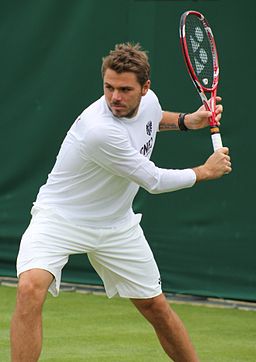
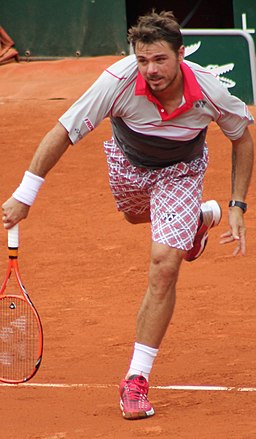
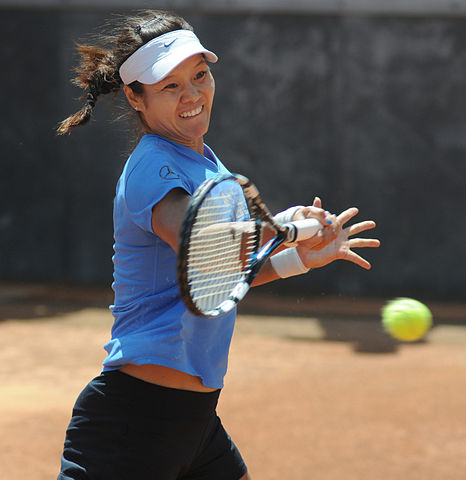
A ball is about to be obliterated.
Credit: si.robi

In 2022, I’m counting down the 128 best players of the last century. With luck, we’ll get to #1 in December. Enjoy!

* * *

Stan Wawrinka [SUI]
Born: 28 March 1985
Career: 2005-present (17+ seasons)
Plays: Right-handed (one-handed backhand)
Peak ATP rank: 3 (27 January 2014)
Peak Elo rating: 2,146
Major singles titles: 3
Total ATP singles titles: 16
 

* * *

Stan Wawrinka has played 842 tour-level matches in his career. More than one in ten have come against Novak Djokovic, Roger Federer, Andy Murray, or Rafael Nadal. He’s run into the Big Four in 13 of his 30 ATP finals–including, of course, all four of his grand slam championship matches.

No one outside of the quartet themselves has played the Big Four more often at majors than Wawrinka has. No other man has faced all four at least 20 times. Tomas Berdych tops the list of most total matches against the famous foursome–with Wawrinka a single match behind him.

The most important number for the perennial Swiss #2 reflects what actually happened in those meetings. He beat members of the Big Four 21 times, more than any other outsider. Richard Gasquet, Tommy Haas, and Gilles Simon combined for the same number of victories–and they collectively needed 53 more chances to do so.

* * *

Wawrinka was 27 years old at the close of the 2012 season. The ATP computer ranked him 17th, behind fellow 27-year-olds Berdych, Gasquet, Jo-Wilfried Tsonga, Nicolas Almagro, and John Isner. In eight years on tour, he had won three titles, all 250s, one of them a victory by retirement in the final against Djokovic. He had reached only two grand slam quarter-finals in 31 tries.

By that time, most of us had given up hope that Berdych, Tsonga, or Gasquet–or anyone else–would finally break the Big Four stranglehold and start winning majors. Even among that group, Wawrinka was an afterthought. He had lost 36 of his last 39 meetings with the Big Four, a run dating back to 2007.

Whatever he did to prepare for the 2013 season, it worked. He kicked off the campaign with a five-hour battle in the Australian Open fourth round, where he fought Djokovic all the way to 10-10 in the fifth set. He wouldn’t finally beat the Serbian until the following year in Melbourne, and he would endure another eight losses in ten meetings with the Big Four before the end of 2013. But he won 70% of matches that season for the first time in his career, battled Djokovic to another fifth set in New York, reached his first Masters final, and ascended to a new career-best ranking of #8, leapfrogging Tsonga and Gasquet and nearly closing the gap with Berdych.

Some of the credit belongs to his partnership with coach Magnus Norman, a former major finalist who joined his team in April of that year. Norman came on board after the breakthrough in Melbourne that year, but the uptick in Wawrinka’s fortunes coincides closely with the Swede’s arrival by Stan’s side. As early as November of that year, Wawrinka credited his new coach with both tactical assistance and–just as important–the tools necessary to stick with those tactics in tough matches.

In January of 2014, it all came together. Wawrinka beat Djokovic and Nadal to win his first major title, at the Australian Open. He was the first man outside the Big Four to win a slam since Juan Martin del Potro in 2009, and the first in Melbourne since Marat Safin in 2005. By the end of 2016, he had increased his grand slam tally to three, equalling Murray and making him one of only 20 men in the Open Era to win so many.

What changed? How did a man ranked as the fifth-best 27-year-old at the midpoint of his career become one of the best players of the last century?

* * *

I want to say it was the backhand, the sexy, overpowering one-hander that makes Gasquet look like an elderly coach feeding balls to a beginner.

It wasn’t the backhand–at least, it wasn’t a major improvement in the backhand. Coach and commentator Patrick Mouratoglou recently called Wawrinka’s shot “the most powerful backhand on the circuit,” while pointing out that it’s been a notable weapon since Stan was a junior. The backhand has improved as he has gotten stronger, but that doesn’t explain such a meteoric–and belated–rise.

The history of tennis is riddled with underachievers who couldn’t assemble a complete game to accompany one brilliant shot. Plus, if you’re going to build your game around one otherworldly stroke, a backhand isn’t the one to pick.

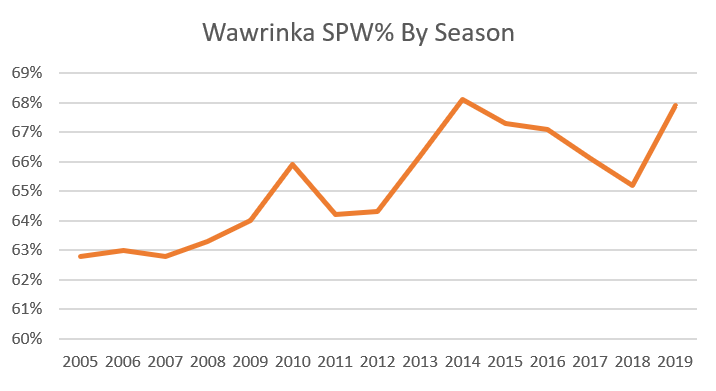
Instead, Wawrinka massively improved the effectiveness of his serve. Take a look at his year-by-year percentage of serve points won (SPW):

From a mark below 65% in 2011 and 2012, Stan improved to 68% in 2014. His career average through 2012 was below 64%, and his career average since is close to 67%.

Three percentage points might not sound like much. Yet it’s an enormous difference. Every tour player of consequence sits in the range between 60% and 70%, with the occasional exception of a monster server who creeps into the low 70s. In 2021, three percentage points was the difference between the devastating serve of Daniil Medvedev and the middling one of Pablo Carreno Busta.

It’s a good thing Wawrinka developed his serve when he did, because after the 2013 season, his return game went the other way. After breaking serve between 24% and 25% of the time from 2010 to 2013, his break rate fell to 21% in 2014 and 2015. Apart from a small bounce back in 2016, it has never recovered.

A good serve trumps terrible fashion.
Credit: si.robi

Some of the return-game downturn is a mirage. Thanks to his improved results, he faced a tougher mix of opponents. Perhaps his return stayed roughly the same, while his results reflected the more challenging competition. If so, his leap in service effectiveness, against that same set of elite opponents, is all the more impressive.

It’s clear what improved as Wawrinka went from an outsider to the man who forced people to say “Big Five.” But why?

* * *

In 2014, Wawrinka hit aces like he never had before. He tallied free points at a rate around 8% until 2013, so his 2014 mark of 10.7% represented a huge step forward. He aced Djokovic 10% of the time at the 2014 Australian Open, compared to 7.5% at the same tournament the year before. And his first serve played a key role in his first major championship match, when Nadal failed to get a racket on nearly one in five of his offerings.

Yet the serve itself doesn’t tell the whole story. Since 2014, his ace rate has settled in around 9%, only a modest improvement on what came before.

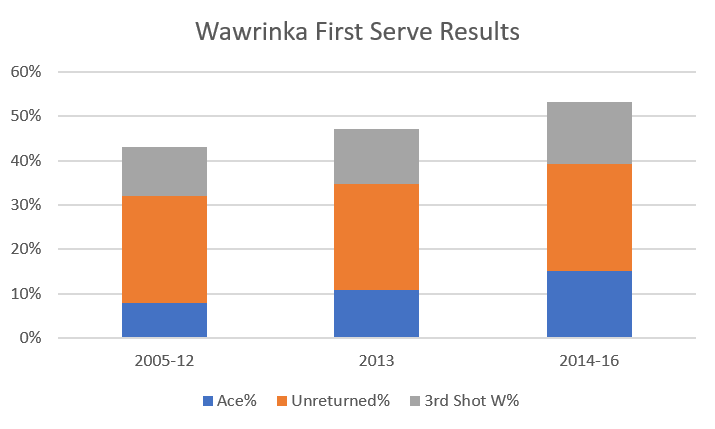
Using data from the Match Charting Project, let’s see how Wawrinka won first serve points before 2013, in 2013, and in his three peak seasons from 2014-16:

Charted matches aren’t the complete record, nor are they a purely random sample, so the ace rates don’t match the overall numbers I mentioned above. For some reason, we chose to chart a lot of Wawrinka’s best ace days in his peak years, so the blue part of each bar shows a significant improvement in ace rate.

The orange portions reflect non-aces that still weren’t returned. That percentage stayed almost the same in each phase.

The gray segments at the top of each bar show points that Stan won with the third shot of the rally–his second swing–either by hitting a winner or inducing a forced error from his opponent. That number steadily increases, from 11% up to 2012, to 12.5% in 2013, to 14% in 2014-16.

The improvement in his second shots is even more noticeable when you consider that fewer balls came back in his peak years. You can’t hit a serve-plus-one winner if the serve doesn’t come back! If we consider how often he ended the point with his second swing as a percentage of opportunities, it’s 16% from 2005-12, 19% in 2013, and 23% during his three-year peak.

Wawrinka explained his change in tactics at the end of 2013: “I don’t wait for the other player to miss.” Against the defensive capabilities of Djokovic, Murray, and Nadal, all of whom had an annoying tendency not to miss, it was really his only option.

And it was more than just a tactical shift. A year after joining Team Wawrinka, Magnus Norman weighed in: “Technically, it’s his forehand that progress is the most significant. His margin over the net is now larger, and he now has more confidence in [it]. … Stan has always had an incredible ball hit.”

The forehand is a crucial part of the serve-plus-one game. For a player already armed with an elite backhand, it was the remaining weapon with the most potential.

* * *

Once again, these percentage-point increases–16% to 19%, 19% to 23%–may seem insignificantly small. But we have to remember that the difference between a top-20 player and a top-five slam contender is itself tiny.

The evidence here suggests that Wawrinka steadily became more aggressive on the first two shots of his first serve points in the exact time frame when his results went from good to great. It worked, and he’s never gone back.

Best of all, it works against everybody. Unlike Berdych or David Ferrer, Wawrinka never thrived in the year-long grind of second-tier events, so his ranking required that he show up against the biggest guns. Even before his breakthrough, Stan wasn’t overawed by his supposed betters. He pushed Murray to five sets at Wimbledon in 2009, then beat him at the US Open in 2010. He took at least a set from Djokovic on five different occasions before 2012, and won more than half the points they played in a two-tiebreak match in 2009.

By 2013, it was obvious that no one could beat Djokovic or Murray at their own game. Unable to out-grind the grinders, Wawrinka went hard in the other direction. From 2007 until April of 2013, he lost 38 of 41 matches against the Big Four. Since clobbering Murray at Monte Carlo in 2013, he’s beaten the quartet 14 times in 46 tries, and split 18 meetings at majors.

It’s rarely so impressive to emerge from the pack just to become the fourth or fifth best player in the game. Yet to accomplish what Wawrinka did in the mid-2010s, scoring his biggest victories over one all-time great after another, sets him apart from the fifth-bests that came before him. The sexy backhand is just icing on the cake.

The Tennis 128: No. 128, Beverly Baker Fleitz

In 2022, I’m counting down the 128 best players of the last century. With luck, we’ll get to #1 in December. Enjoy!

* * *

Beverly Baker Fleitz [USA]
Born: 13 March 1930
Died: 29 April 2014
Career: 1946-1959 (14 seasons)
Plays: Ambidextrous (two forehands; served right-handed)
Peak rank: 3 (1954, 1955, 1958)
Peak Elo rating: 2,204 (2nd place, 1955)
Major singles titles: 0 (1955 Wimbledon finalist)
Total singles titles: 60
 

* * *

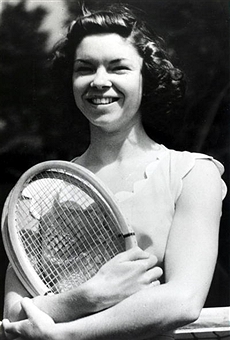
If you know one thing about Beverly Baker Fleitz, it’s probably that she was ambidextrous, hitting forehands off both wings. If you didn’t know that, boy am I excited to be the one to tell you. One of the best players never to win a major, this Californian won the 1948 national girls’ championship, beat Mo Connolly eight times, and reached the 1955 Wimbledon final as a mother, all without a backhand.

* * *

Baker Fleitz was, to some extent, naturally ambidextrous. The young Beverly Baker (Fleitz was her married name) threw righty and wrote lefty, so when she first picked up a racket, it came easily for the tiny 10-year-old to use her left hand on what would typically be her backhand side. A couple generations later, she would’ve been a natural proponent of the increasingly popular two-handed backhand, but developing her game in the 1940s, a double-hander would’ve been just as weird as her pair of forehands.

It wasn’t completely unprecedented to play with two forehands. The Australian Davis Cup player John Bromwich was a natural lefty who served right-handed, and he would hit one- or two-handed strokes at various times from both wings. He was part of the Aussie squad that traveled to Los Angeles for the Pacific Southwest tournament in 1938 and 1939, and he won the tournament the latter year.

The example of Bromwich, well-known to tennis aficionados in Southern California, may have given her father and coach, Frank Baker, the assurance to let Beverly do things her own way. It worked: She hit both forehands hard and deep. The only drawback of her unorthodox technique showed up at the net, where it took too long to switch hands. But like most of her peers, she was content to stay back, and her game thrived.

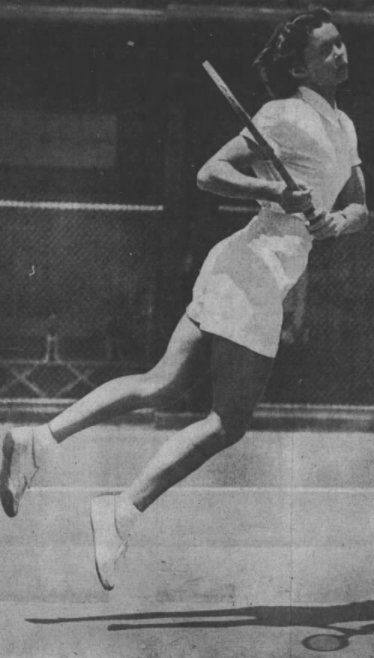
A 1949 shot of Baker switching from one forehand grip to the other

The novelty itself made life more difficult for opponents. She won the 1947 Los Angeles Metropolitan tournament before her 17th birthday and made her first trip East that summer. At the prestigious Eastern Grass Court Championships in Orange, New Jersey, she reached the final four before falling to the reigning Wimbledon champion, Margaret Osborne (later Osborne duPont), and won two matches at the national championships at Forest Hills.

Osborne’s 6-2 6-3 victory was hardly a close shave, but the veteran recognized her opponent’s potential. She described Baker as one of the game’s “coming players” and said, “Her ambidextrous style can be so confusing that at times you don’t know which way the ball is coming from.” While Osborne would win their next three meetings, Baker turned the tables when they clashed in a 1951 Wimbledon quarter-final.

The 17-year-old solidified her status as a player to watch in the fall of 1947, grabbing the title at the Pacific Southwest, the same event where the similarly unorthodox Bromwich had triumphed eight years earlier. Reigning national champion and SoCal product Louise Brough skipped the event due to illness, so it was left to the rest of the strong West Coast contingent to stop the teen with two forehands. They failed. In the final, Beverly lost only five games to top-tenner Pat Canning Todd.

As Baker’s results improved, the media quickly recognized the teen as more than a novelty act. Her small stature, at 5-foot-4 and under 120 pounds, left onlookers shocked by her power. Columnist Braven Dyer was awestruck by Baker’s performance against Todd: “Wham! How she socked home her drives, first with the right and then with the left.” Two years later, a writer for American Lawn Tennis claimed that he couldn’t recall a female player hitting harder than Beverly did.

One late-career assessment would’ve fit the young player just as well: “Her service is weak, her volleying indifferent and her overhead a chore that she shirks at all costs. She doesn’t need them. … The formula [is] simple: rifle the ball down a sideline and if it dared to come back, slam it down the other.”

* * *

Baker arrived on the American scene at a tough time for would-be stars. Brough’s 1947 Forest Hills title was the first of her six majors, and Osborne won the second of her own half-dozen at Wimbledon that year. The seemingly endless supply of elite American women would win Wimbledon and the US Nationals every year from 1938 to 1958, tacking on nine French Championships and four Australian titles in the same span.

The woman who would finally displace Brough, Osborne, and Doris Hart was still a few years away from her peak, but Baker spent the summer of 1948 getting a sneak preview of the future, facing off repeatedly against 13-year-old Maureen Connolly.

Baker and Connolly were among the small group of Californians sent to tour the West that summer. They played state and regional events in Salt Lake City, Denver, Tacoma, Seattle, and Vancouver. Baker won all five tournaments, and as Connolly also outclassed the provincial competition, Beverly and Little Mo met in a semi-final and four finals. (After the first stop in Salt Lake City, no one else made the mistake of seeding them in the same half of the draw.) While Connolly would eventually surpass her elder, Beverly remained a thorn in her side for years.

Baker went East again in 1948, winning the national junior title and excelling in adult tournaments, losing only to Brough and the now-married Osborne duPont. She reached the final again at the hometown Pacific Southwest, this time losing to a healthy Brough.

Her season tally of at least 48 wins against 9 losses was good for a national ranking of #5. My Elo ratings concur, placing her behind Brough, Osborne duPont, Hart, and Todd. In 1948, the top five Americans were all better than anyone the rest of the world had to offer.

With another decade to run on Beverly’s career, she had already nearly reached her peak. The cast of characters would shift, but she would remain a few rungs from the top.

* * *

There’s no shame, of course, in slotting in behind the likes of Brough, Hart, and Connolly. That’s particularly true for a person like Beverly Baker, who refused to let amateur tennis dominate her life.

As she ascended the ranks in early 1948, she told a reporter, “Tennis means everything to me right now, except school. So long as I’ve started playing, I want to reach the top, or as close to it as I can get, before anything else.” That included romance–a resolution that lasted barely a year.

In late 1949, she eloped to Las Vegas with Scotty Beckett, a fellow Southern Cal student and former child star from films such as “Our Gang.” Less than six months later, Baker filed for divorce, citing mental cruelty and bodily injury. She testified at trial that Beckett was “insolent, arrogant, abusive, belligerent and jealous.”

Her tennis bounced back from the ordeal. In the second half of 1950, she went 27-4, losing only to Hart and Osborne duPont. Baker didn’t sour on marriage, either. She wed John Fleitz in 1951, and the couple would have two children within five years.

* * *

After a 1951 season that included a trip abroad, a Wimbledon semi-final, nearly 100 singles matches, and six titles, family life slowed down Beverly Baker Fleitz’s playing schedule. In the amateur era, most women hung up their rackets upon their first pregnancy, and many quit as soon as they walked down the aisle. Beverly couldn’t see why: she missed less than a year for the birth of her first child, and sat out only 14 months for the second.

Between layoffs, she played the best tennis of her career. From her comeback in June 1953 to Wimbledon in 1956, when she withdrew due to her second pregnancy, she racked up 112 wins against only 6 losses, conceding defeat only to Doris Hart (twice), Louise Brough, Shirley Fry, Dorothy Knode and Barbara Breit. While she stuck close to home, playing the majority of her tennis in Southern California, she nonetheless piled up victories over the best of her peers: Connolly, Hart, Brough, Osborne duPont, Althea Gibson, and Darlene Hard.

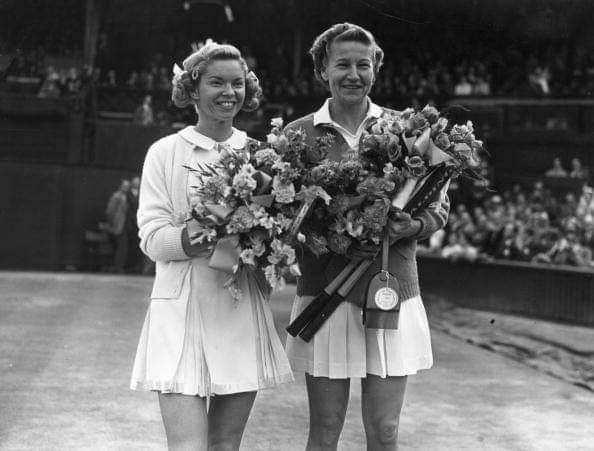
Baker Fleitz (left) with Louise Brough before the 1955 Wimbledon final

The highlight came at Wimbledon in 1955. She cruised to the final with the loss of only 21 games in 6 matches, including a 6-3 6-0 dismantling of Hart. Baker Fleitz finally upset her old nemesis, winning the last nine games in a row. In the championship match, she faced Brough, who Beverly had beaten four times since her comeback, including once on grass.

Thanks to her performance in the semis and the recent results between the two women, Baker Fleitz entered her first major final as the favorite. She very nearly lived up to the billing. Brough was forced to deploy every trick she knew, occasionally suffering through passages like Beverly’s 10 consecutive points won early in the second set.

Baker Fleitz pushed her long-time rival to the limit, finally losing serve at 5-5 in the first set, allowing Brough to take it, 7-5. Both of Beverly’s forehands were firing, while her opponent barely had the stamina to survive another long set. Finally, with Baker Fleitz serving at 6-6, Brough secured a break with the shot of the match, a lunging stop-volley winner. Six points later, the former champion lifted the trophy again, defeating the woman with two forehands, 7-5 8-6.

The runner-up didn’t dwell on the defeat. She blitzed the field at the Irish Championships the next week in Dublin, then rushed home to take her daughter Kimberley to the beach.

* * *

Baker Fleitz retired from top-level tennis at the end of 1959, though the mother of two had hardly lost a step. She departed the scene as the two-time defending champion at the Pacific Southwest, having beaten top seed Maria Bueno in her final match at that event, two months after defeating British stars Angela Mortimer and Christine Truman in Wightman Cup.

Even then, she wasn’t quite done unleashing her power on the Los Angeles tennis elite. At the Southern California Sectional Championships in 1966, she entered the mother-daughter doubles with Kimberley and the wife-husband event with John. She and Kimberley won a match before losing in the quarters. With her spouse, she did a bit better.

You might have heard of their opponents in the final: Billie Jean King and her husband Larry. It wasn’t easy, but the Fleitzes came out on top, 5-7 8-6 6-3. I can only suspect that the husbands faced the brunt of the abuse that day. Beverly’s two forehands had been too much for a generation of women on tour. Larry King didn’t stand a chance.

Podcast Episode 109: Joe Posnanski on the Australian Open and GOAT Lists

The podcast returns for 2022 from a long layoff to welcome back Joe Posnanski, author of the Baseball 100 and many other wonderful books. Joe covers all sports on Substack, where you can subscribe, even if he doesn’t write about tennis as much as he ought to.

We start by talking about all things Australian Open–what it means for Rafa’s case as the greatest of all time, if we’ll ever forget about the saga that kept Djokovic out of the tournament, how Daniil Medvedev stacks up against the rest of the field, whether Ashleigh Barty is pulling away from the WTA pack, and which other women we’re expecting to see emerge to challenge her.

We also dive into the general subject of Greatest-of-All-Time lists, the subject of Joe’s book, his current American football project, and my just-launched Tennis 128. We consider how tennis greatness differs from that of other sports, how to handle career gaps such as wars and injuries, and balancing algorithms with gut feelings. We wrap up by giving Joe a speed round of tennis GOAT questions, one toughie after another asking him to untangle the trickiest debates in the sport’s history.

Thanks for listening!

(Note: this episode is about 91 minutes long; in some browsers the audio player may display a different length. Sorry about that!)

Click to listen, subscribe on iTunes, or use the feed to get updates on your favorite podcast software.

Music: Everyone Has Gone Home by texasradiofish (c) copyright 2020. Licensed under a Creative Commons Attribution Noncommercial (3.0) license. Ft: spinningmerkaba

This image has an empty alt attribute; its file name is tap_script_square-1-150x150.png

Introducing The Tennis 128

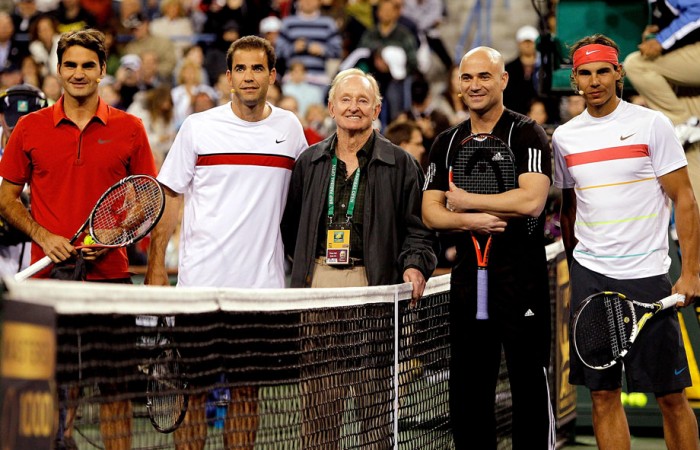
A few contenders for the top spot, posing with the husband of another contender

Scroll down or click here for the list of players published so far.

* * *

You know what tennis really needs? More arguments about the greatest players of all time.

Really! I could take or leave the Djokovic-Federer-Nadal debate, and I don’t need to read another word about Serena versus Margaret Court. But the quest for greatness is what defines elite athletics, and the appreciation of elite performance is an essential part of what it means to be a fan.

Too much of tennis history has been lost, forgotten, or caricatured. The 150-year story of lawn tennis is full of larger-than-life figures, underrated champions, and local heroes. I don’t know about you, but I want to know a lot more about those players. I wish I had a deeper understanding of earlier eras, especially those that came before the dawn of the Open Era in 1968.

That’s why I’m writing the Tennis 128.

* * *

In a couple of days, I’ll begin counting down the 128 greatest tennis players of all time. The list includes men and women, and it takes into account more than a century of play, from 1919 to the present. I’ll publish an essay about each one. We’ll dive into who they were, what they accomplished, and how they fit into the overall arc of tennis history. 

(Why 1919? It’s a convenient starting point. It was the first full season after World War I, and it gives us about 100 years to work with. There were great players before the war, of course, and there’s no clear dividing line between pre-modern and modern tennis. But the game has changed so much that while I can just manage a comparison of Helen Wills to Billie Jean King or Serena Williams, it’s a much bigger stretch to somehow consider Lottie Dod.)

This may all sound familiar. In 2020 and 2021, Joe Posnanski wrote a similar series for baseball, counting down his top 100 players. He published it a few months ago as a giant book, The Baseball 100, which you should buy. Joe’s project is the inspiration for this one. I’m not as good a writer as he is, so I’m giving you 28% more players to make up for it.

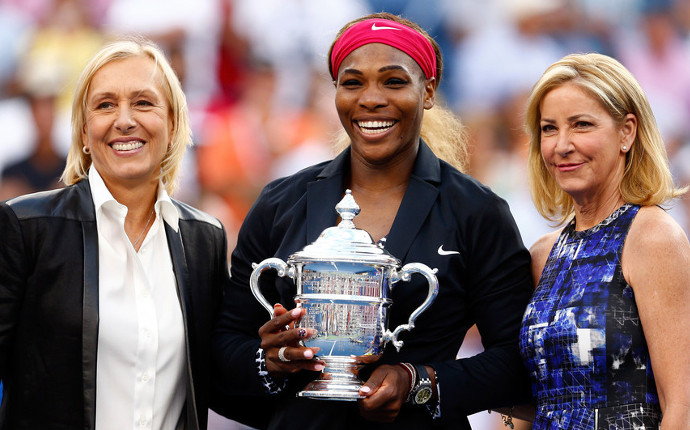
A few more all-time greats we’ll be talking about

If you think it’s audacious to the point of silliness to try to rank 100 years’ worth of tennis players, you’re right. It’s ridiculous. There are short careers and long careers, number ones with no slams and multi-slam winners who never reached number one. There’s the amateur era and the Open Era, and there were separate professional tours during the amateur era that meant some of the best players on earth went a decade without playing each other. There are at least 20 players with some plausible case for the #1 spot.

* * *

Any best-of-all-time list is subjective. Still, I tried to make mine as objective as possible. The ranking is primarily based on an algorithm that incorporates three things: a player’s peak, their five best years, and their entire career. Those components are measured by Elo ratings. I only considered seasons above a fairly high threshold, and there are no negative values for bad seasons. I’m interested in how good players were at their best, not whether they stuck around for too many seasons at the end.

The ranking is almost entirely based on singles performance. Doubles used to be more prominent than it is now, but greatness has always been defined primarily as excellence on the singles court. In a few instances, I’ve broken ties in favor of the better doubles player. I’ve also moved a (very small) handful of players toward the top of the list because of their off-court contributions to the game.

In general, I follow Roger Federer’s edict that you can only compare players to their own eras. Objectively speaking, today’s players are better than those of the past. They take advantage of personalized training and nutrition, technologically advanced rackets and strings, high-quality coaching from younger ages, and all the tactical knowledge developed by their predecessors. In that sense, Novak Djokovic is unquestionably better than Bill Tilden, and so is Adrian Mannarino. That’s not a very interesting way of approaching the problem, though. The Tennis 128 reflects the fact that there have been strong eras and weak eras, but the ultimate test of any player is how they performed against their peers.

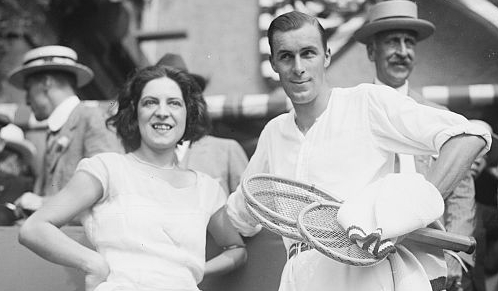
Suzanne Lenglen and Bill Tilden, pretending not to despise each other

The ratings for amateur-era players rely on the exhaustive women’s tennis database I’ve assembled that goes back to the 1910s, as well as the impressive records put together at TennisArchives.com and in Chris Jordan’s book, The Professional Tennis Archive. These datasets aren’t perfect, nor are they complete, especially for men’s tennis before World War II. But they are more than enough to allow us to compare the greatest players of all time.

Some details you might wonder about: Several active players made it on the list, which I finalized before the 2022 season began. However, if someone has a great year before I unveil their ranking, I will move them up to reflect that. Something to keep in mind when Andy Murray wins the next three majors.

A few notable players don’t fit neatly into a pre-1919 or post-1919 bucket. If their post-1919 performance gets them on the list, I use their entire career to give them a ranking. If they weren’t good enough after World War I, they’ll have to wait for another list.

Many players lost years’ worth of opportunities to World War II. I’ve made minor adjustments in some of those cases, but in general, players are rated based solely on what they accomplished on court. It isn’t quite fair to those who hit their peak years in the early 1940s, but it’s hard enough to accurately measure players based on what they did achieve, let alone what they could have done. The same reasoning applies to injuries that altered or ended careers, unfair as many of them were.

It’s engrossing–at least for me–to dig into the mechanics and edge cases of rating systems, but I don’t want to distract from the main purpose here. There are several dozen more outstanding players who missed the cut and wouldn’t be out of place on the list. If your favorite player doesn’t show up, don’t fret: It’s not because he or she isn’t good enough, it’s just because I personally dislike you. There’s not much of a difference between #97 and #127, or between #50 and #80. The closer we get to the top, the more likely that a single place on the list really means something, but even there, differences between eras–not to mention men and women–allow for no final answer.

* * *

Ready? I’ll unveil #128 on Thursday. The plan is to reach #1 in December. If all goes well, it’ll be December of 2022. You can expect three new players each week, usually on Tuesdays, Thursdays, and Saturdays.

I can’t remember the last time I was so excited to embark on a new project. I hope you’ll join me and follow along.

* * *

128. Beverly Baker Fleitz

127. Stan Wawrinka (podcast)

126. Jean Borotra

125. Li Na

124. Betty Nuthall

123. Michael Stich (podcast)

122. Ashley Cooper

121. Angela Mortimer

120. Kei Nishikori

119. Adrian Quist

118. Bill Johnston

117. Darlene Hard

116. Ted Schroeder

115. Rosie Casals (podcast 1 | podcast 2)

114. Andrea Jaeger

113. Karel Koželuh

112. Shirley Fry

111. Goran Ivanišević (podcast)

110. Frank Kovacs

109. Anita Lizana

108. Molla Mallory

107. Jim Courier (podcast)

106. Sarah Palfrey Cooke

105. Petra Kvitová

104. Vinnie Richards

103. Tony Roche

102. Jadwiga Jędrzejowska

101. Ashleigh Barty

100. Dorothy Round

99. Tom Okker

98. Zina Garrison

97. Frank Parker

96. Elena Dementieva

95. Vitas Gerulaitis

94. Kitty McKane Godfree

93. Simona Halep

92. Gottfried von Cramm

91. Ann Jones

90. Caroline Wozniacki

89. Michael Chang

88. Mary Joe Fernández

87. Juan Martín del Potro

86. Margaret Osborne duPont

85. Svetlana Kuznetsova

84. Lleyton Hewitt

83. Jack Crawford

82. Maria Esther Bueno

81. Budge Patty

80. Andy Roddick

79. David Ferrer

78. Simonne Mathieu

77. Henri Cochet

76. Pam Shriver

75. Virginia Wade

74. Lew Hoad

73. Elizabeth Ryan

72. Stan Smith

71. Tony Trabert

70. John Bromwich

69. Nancy Richey

68. Manolo Santana

67. Mary Pierce

66. Vic Seixas

65. René Lacoste

64. Bobby Riggs

63. Ora Washington

62. Amélie Mauresmo

61. Ilie Năstase

60. Frank Sedgman

59. Evonne Goolagong

58. Pancho Segura

57. Louise Brough

56. Tracy Austin

55. Roy Emerson

54. Jana Novotná

53. Hilde Krahwinkel Sperling

52. John Newcombe

51. Hana Mandlíková

50. Mats Wilander

49. Helen Jacobs (Part 1 | Part 2)

48. Arthur Ashe

47. Jennifer Capriati

46. Victoria Azarenka

45. Conchita Martínez

44. Jaroslav Drobný

43. Guillermo Vilas

42. Althea Gibson

41. Doris Hart

40. Stefan Edberg

39. Kim Clijsters

38. Andre Agassi

37. Fred Perry

36. Maria Sharapova

35. Pauline Betz

34. Ellsworth Vines

33. Justine Henin

32. Boris Becker

31. Gabriela Sabatini

30. Martina Hingis

29. Andy Murray

28. Billie Jean King

27. Arantxa Sánchez Vicario

26. Lindsay Davenport

25. Jack Kramer

24. Jimmy Connors

23. Alice Marble

22. Don Budge

21. Pete Sampras

20. Ivan Lendl

19. Maureen Connolly

18. Margaret Court

17. Richard González

16. Venus Williams

15. Ken Rosewall

14. Suzanne Lenglen

13. John McEnroe

12. Björn Borg

11. Monica Seles

10. Helen Wills

9. Chris Evert

8. Rafael Nadal

7. Bill Tilden

6. Serena Williams

5. Roger Federer

4. Novak Djokovic

3. Martina Navratilova

2. Steffi Graf

1. Rod Laver

20 > 21 > 20

Rafael Nadal has finally nosed his way into the lead. With his Australian Open title yesterday, he became the first man to 21 major singles titles, breaking away from the three-way tie at 20 with Novak Djokovic and Roger Federer.

For some people, leading the all-time grand slam race is enough to cement a player as the greatest of all time. A different crowd considers this year’s Australian Open tainted because Djokovic was not allowed to play. Still others think that Federer played some beautiful tennis, and they considered the matter concluded at least five years ago.

I belong to a fourth camp, which I can summarize with two positions:

  1. The grand slam race isn’t everything.
  2. If you do focus on grand slams, you must adjust the major count for the quality of opponents each player faced.

I’ve written about this before, first at The Economist, and then here at the blog. When I checked in 18 months ago, Nadal’s 20 majors were worth a bit more than Djokovic’s 17, which were themselves more impressive than Federer’s 20. The margins have always been slim between these three, and properly adjusting for quality of opponents makes things even tighter.

The update

Here’s how the adjustment works. For each slam that a player won, we take the Elo rating of all of his opponents, and work out the probability that the average Open Era grand slam winner would beat all of them. Once we have that number–which centers around 23%–we normalize it so that the value of an “average” major is 1.0.

When a major title requires facing down a lot of tough opponents, its rating is higher than 1.0, while a relatively easy one rates below 1.0. In the last few years, the numbers have drifted downward, because while the familiar names keep winning quite a bit, they haven’t needed to face each other as often as they used to.

You might disagree with the methodology, and that’s fine. But I find that most people end up making some sorts of adjustments, even if they shy away from stats or only tweak the totals when it favors their idol. Some Djokovic fans want to downplay Nadal’s recent win, and it’s true that Novak’s absence lowered the quality of the draw. But surely Rafa’s title isn’t worth zero. He beat many excellent players, and there was no guarantee that Novak would advance through the draw–or that Rafa would lose if they met.

This approach allows us to avoid specific minefields and answer all the analogous questions about every slam. Considering the seven opponents that Nadal faced, his Melbourne title rates at 0.84, weaker than average, but more difficult than seven of his prior titles. Djokovic has not enjoyed as many “easy” paths to major titles, but his Wimbledon victory last summer rates at a mere 0.60, the second-weakest of his career and lower than all but one of Rafa’s. Sometimes players just get lucky, with or without a geopolitical brouhaha.

Nadal’s 21st title rates only a bit lower than Djokovic’s two other titles last year: 0.90 at the Australian and 0.93 at the French.

Here are the updated rankings for “adjusted slams,” along with a table showing how many easy, medium, and hard paths that the Big Three have endured:

Player    Slams  Avg Score  Total  
Nadal        21       0.95   19.9  
Djokovic     20       1.01   20.1  
Federer      20       0.89   17.9  
                                   
Player     Easy     Medium   Hard  
Nadal         8          8      5  
Djokovic      6          7      7  
Federer       9         10      1

As if 21 and 20 weren’t close enough, this approach gives Djokovic 20.1 adjusted slams to Nadal’s 19.9. Again, you don’t have to agree with every step of my approach here to accept that we often think in terms of these kind of adjustments, and that Djokovic has–on average–faced tougher roads to titles than Nadal, while Federer had it easier than both of them.

Players can’t control who they face, but as fans, we can appreciate who worked the hardest to achieve near-equivalent feats. Fingers crossed that both Novak and Rafa excel at Roland Garros, so they can fight it out on the court, not in some random guy’s spreadsheets.

Commercial or Political

You’ve probably heard: If you go to the Australian Open wearing a shirt that says, “Where is Peng Shuai?,” you’ll be asked required to change clothes or leave.

Surely Tennis Australia isn’t against raising awareness about a famous tennis player who accused a high-ranking political figure of sexual assault, was immediately censored, and has only been spotted in obviously scripted scenes witnessed by Chinese state media, right?

Of course not. Tennis Australia has a policy:

“Under our ticket conditions of entry we don’t allow clothing, banners or signs that are commercial or political”

This is arrant nonsense. I’m sure a more thorough statement of this policy is buried somewhere in the ticket terms and conditions that no one ever reads. I’m equally sure it is almost never enforced. And that’s the problem.

First off, most clothing is commercial. Every player on the court wears athletic gear with a (usually prominent) logo on it. Thousands of fans do the same. No, the clothing doesn’t explicitly say, “Buy Adidas!” But it doesn’t have to. Just like the slogan, “Where is Peng Shuai?” doesn’t explicitly say, “The Chinese Communist Party is detaining or censoring someone because they dared to accuse someone of a crime. They shouldn’t do that!”

And let’s face it, a whole lot of clothing is political. You don’t have to believe that everything is political to accept this. Is anyone at Melbourne Park wearing a “Black Lives Matter” shirt or hat? How about the H&M tee in my kid’s wardrobe that says, “There is No Planet B?” Neither statement sets out a policy recommendation, but both are closely associated with political positions. Just like “Where is Peng Shuai?” is inoffensive unless you know why her whereabouts are unknown.

Has anyone been kicked out of the Happy Slam for wearing a BLM shirt or for a gentle nudge toward climate awareness? You know the answer to that as well as I do.

The point is, a sweeping prohibition like Tennis Australia’s is so broad as to be meaningless. It gives them political cover when there’s a slogan they want to remove, but they ignore their own rule 99% of the time. It’s only when a sponsor complains, or when they fear controversy, that the rule is enforced.

The spokesperson I quoted above continued:

“Peng Shuai’s safety is our primary concern. We continue to work with the WTA and global tennis community to seek more clarity on her situation and will do everything we can to ensure her well-being.”

Tennis Australia has now proven that this statement is false. “Commercial or political” messages are fine, except in the rare instances when they don’t approve, or they fear the backlash. Apparently “Where is Peng Shuai?” crosses the line. Don’t be fooled by the claim that this is just routine enforcement of a bland policy.

The WTA has been forceful and consistent in their handling of Peng Shuai’s disappearance, and the organization deserves great credit for that. Tennis Australia’s actions have shown just how easy it is to cave to pressure and become complicit with human rights abuses. We must hold the organization to a higher standard.

Picking 32 Qualifiers

Australian Open qualifying starts in just a few hours. 128 men and 128 women stand three wins away from a spot in a grand slam main draw. Only 16 of each will remain at the end of the week.

Forecasting is particularly tricky during qualifying. Unlike most tournaments, when the top seeds far outrank the field, there’s little difference between a player on the fringes of the top 100 and one in the middle of the 200s. Andrej Martin, the top seed in the men’s qualifying draw, has the lowest hard-court Elo rating of the eight players in his section!

Let’s run through the 32 eight-player sections. I’ve posted pre-tournament forecasts for men and women. Keep in mind that these numbers don’t (yet) include any results from the week of January 3rd. For most players it doesn’t matter. For a few, like Melbourne semi-finalist Qinwen Zheng, it misses a major ranking boost.

To make things more interesting, let’s compare Elo’s preferences to those of two guys who pay more attention to Challenger-level tennis than I do, Alex Gruskin* and Damian Kust. At the end of the week, we’ll see how the experts fared against the machine. Unless, of course, they make the machine look bad, in which case I’ll delete this post and deny this ever happened.

Men’s qualifying draw

  1. Mikhail Kukushkin. Elo likes the veteran, giving him a 22.9% chance of qualifying. Damian picks NCAA star and 2021 breakout Nuno Borges (Elo: 13.7%), while Alex prefers big-hitting American Ernesto Escobedo (Elo: 16.9%, which will be higher after the algorithm includes EE’s challenger win this week.) Top seed Andrej Martin could hardly be a longer shot.
  2. Mats Moraing (23.9%). Both of our experts like Dominic Stricker (10.8%), the 19-year-old Swiss. Damian acknowledges a bit of wishful thinking here.
  3. Maximilian Marterer (29.6%). Elo prefers alliterative German names. Damian agrees, while Alex goes with the high seed in the section, #3 Daniel Galan (12.7%).
  4. Gilles Simon (34.1%). Gilles Simon is playing grand slam qualifying! Damian and Alex are both too young to remember Simon’s prime, which explains their pick of Tomas Machac (23.4%).
  5. Joao Sousa (31.7%). Damian agrees. Alex boldly picks Geoffrey Blancaneaux (5.7%), the fifth favorite in the section according to Elo.
  6. Jiri Lehecka (23.9%). Another vote of confidence from Damian. Alex picks Michael Mmoh (11.7%) for the first-round upset of the higher-ranked Lehecka.
  7. Salvatore Caruso (28.2%). Shockingly, Alex is finally on board with an Elo pick. Damian prefers the top seed in the section, #7 Taro Daniel (23.2%).
  8. Quentin Halys (21.6%). The most even section we’ve seen so far. Damian concurs, calling him “underrated,” while Alex goes with Yannick Hanfmann (18.1%).
  9. Damir Dzumhur (27.9%). Both of our experts go with Rinky Hijikata (1.1%). Rinky is the hipster pick, but he did get broken four times by Maxime Cressy this week.
  10. Christopher Eubanks (30.5%). I really thought we’d see Alex agree with Elo here, since the algorithm finally picked an American. But no, Gruskin goes with the formerly mulleted JJ Wolf (25.1%). Damian prefers Roman Safiullin (5.8%), the surprise star of Russia’s ATP Cup squad. It worked for Aslan Karatsev
  11. Hugo Grenier (31.8%). Damian agrees, while Alex goes with Juan Pablo Varillas (4.6%), a man who last won a main draw match on hard in 2019 at an ITF M15 in Cancun. Another “bold” pick from the intrepid podcaster.
  12. Jason Kubler (29.9%). We all agree!
  13. Frederico Ferriera Silva (23.4%). Alex goes with basically-tied-as-favorite Mitchell Krueger (23.1%), and Damian goes with a personal fave in Nicola Kuhn (6.8%).
  14. Alexandre Muller (24.1%). Both experts pick Jurij Rodionov (23.7%), the top seed in the section and practically a co-favorite per Elo.
  15. Cem Ilkel (20.6%). Damian correctly pegs this as a very balanced section–Ilkel is the least Elo-favored pick of the 16. Both Damian and Alex go with Zizou Bergs, a likeable player by humans, but apparently not by the machine (8.3%).
  16. Alejandro Tabilo (32.0%). We all agree! I’m guessing both experts were tired at this point, so we all just went with the top seed.

We all agreed on two picks, and we all picked different players in three sections. Of the rest, Damian and Alex voted the same way five times, Damian went with the Elo pick five times, and Alex agreed with Elo once.

Women’s qualifying draw

Damian focuses on the men’s game, so here we have only two sets of forecasts: Elo and Alex Gruskin’s picks, along with a few of my personal preferences where they differ from the algorithm.

The gap between the seeds and field is much greater in the women’s game, hence the much higher probabilities that many of the top seeds (and/or Elo’s choices) reach the main draw.

  1. Anna Kalinskaya (63.8%). Everyone’s on the same page here, even Nick Kyrgios.
  2. Martina Trevisan (47.6%). Alex picks the clear second favorite, Olga Govortsova (27.0%).
  3. Lin Zhu (45.6%). Again, Alex goes with the second fave, Anna Blinkova (25.5%).
  4. Nina Stojanovic (42.2%). I’ll be cheering for Caty McNally (27.7%), even if wouldn’t put my money against Elo. Alex picks another American, Hailey Baptiste (8.4%).
  5. Mariam Bolkvadze (26.1%). Sometimes it seems that Elo is trolling us, like this pick of an unseeded Georgian. Alex goes with Bolkvadze’s first-round opponent, Irina Maria Bara (9.8%), so at least one of the choices will be eliminated quickly.
  6. Lesia Tsurenko (54.7%). Alex agrees. My sentimental fave, as always, is Kathinka von Deichmann (3.7%), who I know better than to actually pick.
  7. Katie Boulter (40.6%). And sometimes it feels like Gruskin is trolling us. In a section with Boulter and Christina McHale (26.8%), he goes with Francesca Di Lorenzo (5.1%).
  8. Kateryna Bondarenko (26.0%). A balanced section, where Alex goes with the top seed, Kamilla Rakhimova. If Damian had projected this draw, he’d surely make a wishful pick of Victoria Jimenez Kasintseva (6.4%), 16-year-old runner-up in Bendigo this week.
  9. Rebeka Masarova (32.8%). I can only assume Alex is drinking heavily by this point, as he picked Kurumi Nara (13.0%) over both Masarova and top seed Sara Errani (28.7%). My only pick is that Errani reaches at least double digits in underhand serves.
  10. Mihaela Buzarnescu (30.3%). Alex picks Jule Niemeier, who at 30.0% is Elo’s co-favorite. I’d love to see Miki launch a comeback in 2022, but she has a tricky first match against Bendigo champ Ysaline Bonaventure, and Niemeier is clearly the rising star here.
  11. Harriet Dart (44.7%). Alex agrees, and in an uninspiring section, I’m guessing some of Harriet’s competitors do too.
  12. Dalma Galfi (35.2%). The second-favorite is Stefanie Voegele (30.3%), and that’s the player both Alex and I expect to see playing in the main draw.
  13. CoCo Vandeweghe (35.0%). It’s an absolute blockbuster of a first-round match (by qualifying standards, anyway) between Vandeweghe and Qinwen Zheng (16.8%). As noted above, Zheng reached the semis in Melbourne, so Elo will think more highly of her as soon as those results are included. It probably won’t swing things all the way in her favor, though–CoCo also reached a semi at the ITF W60 in Bendigo. Meanwhile, Alex is now doing vodka shots and picks Mai Hontama (13.9%).
  14. Aleksandra Krunic (26.3%). Another very even section. Alex goes with Cristina Bucsa (17.2%), while to me it looks like it’s Anna-Lena Friedsam’s (19.3%) main-draw spot to lose.
  15. Elisabetta Cocciaretto (36.7%). Every once in a while someone tries to explain to me how players could manipulate Elo ratings, if it matters. I don’t really buy the argument, but if anyone could game the system, it’s Cocciaretto. She seems to be doing it already. I don’t understand why she’s the favorite here, and I’m not sure I would even pick her in the first rounder against Lara Arruabarrena. Alex goes with the safe pick here, top seed Nao Hibino (20.7%).
  16. Aliona Bolsova (30.2%). Tons of talent in the bottom section, with Viktoria Kuzmova (24.6%), last year’s discovery Francesca Jones (12.1%), and local slugger Destanee Aiava (2.4%). Alex takes the top seed here, Anastasia Gasanova (12.6%).

Qualifying really is anybody’s game. According to my traffic logs, Alex visits my Elo ranking pages even more often than the Russian spambots do, and we still only agree on 3 of 16 picks.

Thanks to Damian and Alex for letting me including their picks here.

* Full disclosure: Alex and I are both members of the board of directors of the Serena Williams Power Tennis Country Club. As tennis insiders, it’s only natural that we have a conflict of interest.

Nine Degrees of Spencer Gore

In many ways, the early days of tennis seem impossibly ancient. It was a time of long skirts, wooden rackets, and underhand serves that were in no way tactical. Sometimes, though, the century and a half of lawn tennis feels like almost nothing.

After stumbling across a mention of a 1951 professional match between Bill Tilden and Pancho Gonzales, I took to Twitter:

The path from Tilden to Federer–or one of many other active players–requires only three intermediate steps.

If we expand the types of links we’re willing to consider, the connections are almost overwhelming. From the 1931 men’s champion of Black tennis, forbidden from entering the US National Championships, you can get to Svetlana Kuznetsova in only three steps:

If we stick to women’s singles, the paths are a bit longer, because fewer women played for as long as the likes of Tilden and Gonzales, especially in the amateur era. Yet it still only takes five steps to travel from 1908 US champion Maud Barger-Wallach to Venus Williams:

If you’ve ever played Six Degrees of Kevin Bacon, you know how addicting this kind of thing can be. And you can guess how productive I was at work today while mulling the kinds of paths that can be constructed between early tennis and the present.

But wait, there’s math!

Is my path from Tilden to Federer the optimal one? Could we construct a smaller set of connections between Barger-Wallach and Venus Williams? Like many pursuits that start out as time-wasters, this is a math problem that we can solve.

In a different domain, the Oracle of Bacon offers just that sort of solution, calculating the shortest path between Kevin Bacon and any actor, where each step is a film that “connects” any pair of cast members. For example, Serena Williams has a “Bacon number” of 3:

Academics have “ErdÅ‘s numbers” and you can see how baseball players are connected with the Oracle of Baseball at baseball-reference.com.

These solutions come from the field of graph theory, which includes many algorithms that address this sort of problem. (As well as real problems that are relevant to the real world.) Checking every possible path between actors, academics, or baseball players is extremely computationally intensive, so different techniques take varying approaches to trimming the number of paths worth investigating. One of these algorithms, breadth-first search, is efficient enough that it can identify the shortest route from a half-million tennis matches on my laptop in a few seconds.

Gore to Djokovic

Let’s see what this Oracle of Tennis can tell us. The first Wimbledon champion, in 1877, was Spencer Gore. He was no Pancho–he played The Championships only one more time. The Oracle will have some work to do to get from Gore’s corner of the graph to the modern era.

It turns out that the shortest path from Gore to Novak Djokovic–the first Wimbledon winner to the reigning titleholder–takes nine steps:

Spencer Gore vs Montague Hankey (1877 Wimbledon)

Hankey vs Charles Lacy Sweet (1883 Cirencester Park)

Sweet vs George Lawrence Orme (1884 Sussex County)

Orme vs Max Decugis (1901 French Covered)

Decugis d Coco Gentien (1924 Coupe de Noel)

Gentien vs Pancho Gonzales (1949 Roland Garros)

Gonzales vs Jimmy Connors (1971-73, 4 meetings)

Connors vs Fabrice Santoro (1992 Vienna)

Santoro vs Novak Djokovic (2007-08, 2 meetings)

That isn’t the only nine-step path from Gore to Djokovic, but there are none shorter. Many of the most efficient routes involve the same players. Gore didn’t give us many opponents to choose from, so the relatively(!) long career of Montague Hankey is a common first step. And the final sequence of Pancho-to-Connors-to-Santoro-to-Djokovic (and many other present-day stars) is tough to beat.

Sutton to Raducanu

Historical women’s tennis data isn’t in quite as good of shape as men’s–yet. Thanks to TennisArchives.com, we can scan hundreds of thousands of men’s results from the amateur years in addition to the usual Open Era records. I’ve pushed my dataset of historical women’s results back to 1917–a huge improvement over the state of affairs a year ago, but missing the first few decades of tournaments.

We can still reach quite far back. Two-time Wimbledon champ and winner of the 1904 US National Championships, May Sutton Bundy was part of a Southern California tennis dynasty and one of the greats of her era. After giving birth to four kids in the 1910s, she returned to competitive tennis and won singles titles as late as 1928.

So even though we don’t yet have her entire career record in the database, we can use the Oracle to link her to the present. It takes only seven steps to get from Sutton to 2021 US Open champ Emma Raducanu:

May Sutton Bundy vs Marion Zinderstein Jessup (1921 Seabright)

Jessup vs Betty Rosenquest Pratt (1943 Wilmington)

Pratt vs Christine Truman (1957-59, 3 meetings)

Truman vs Martina Navratilova (1973 Wimbledon)

Navratilova vs Ai Sugiyama (1993 Tokyo)

Sugiyama vs Stefanie Voegele (2006 Fed Cup)

Voegele vs Emma Raducanu (2021 US Open)

I don’t know what else to add–this was a weird day.

The Underserved First Point

Not all points are created equal. Ask around, and you’ll get a variety of opinions as to which points are most important. Break points, obviously, are key. Pundits are fond of 15-30.

Then there’s the first point of the game. It’s been conventional wisdom for a long time that the opening points holds disproportionate weight. In a previous study, I disproved that. Of course it’s valuable to move from 0-0 to 15-0, and no one likes to start a game by dropping to 0-15. But the first point doesn’t have any magical effect on the outcome of the game beyond simply adding to one or the other player’s tally.

Yet here I am, talking about the first point again. While there still isn’t any magic, the first point is going to the returner too often. With a slight change in tactics or focus, this is a rare analytical insight that pros may be able to use to win a few more service games.

Point by point

The balance between the server and returner varies a great deal depending on the point score. In men’s singles matches at the US Open between 2019 and 2021, servers won 63.6% of points in non-tiebreak games. Yet at 40-love, the server won 67.7%, and at ad-out, the server won only 59.6%.

The point scores that generated such extremes hint at what’s going on here. If a game has reached 40-love, the server is probably a good one. It’s not always the case, but if you look at all the 40-love games in a large dataset, you’ll get far more John Isner holds than Benoit Paire holds. The opposite applies to ad-out, a score that Isner rarely faces. Thus, the difference in point-by-point serve percentage isn’t (entirely) because of the point score–it’s because of the servers who get there.

Other differences are more prosaic. On average, servers win more deuce-court points than ad-court points. In the same three-year dataset, the difference was 64.2% to 62.9%. There’s no selection bias component here. The typical ATPer is simply stronger in that direction. Some players–particularly left-handers–break the mold, but most will favor the deuce side. Both Novak Djokovic and Roger Federer, for instance, win nearly two percentage points more often when serving to that court.

Unbiasing

Because scores like 40-love and ad-out aren’t randomly distributed among servers, we need to do a bit more work to figure out which scores really do favor the server. The trick here is to compare each service point to the rest of the server’s points in the same match. A point like 40-love has a ton of Isners and Opelkas in it, so we’ll end up comparing it to a lot of other Isner and Opelka points. And in fact, the average player who reaches 40-love wins 65.0% of their service points and 64.3% in the ad court, two numbers that are well above average.

Working through the same exercise for every point score gives us a list of “actual” serve points won, “expected” serve points won, and differences. The “actual” column tells us what really happened at that score, bias and all; “expected” tells us how often that particular set of players won service points during the entire matches in question; and the difference gives us a first look at where servers are over- or under-performing.

The following table shows these numbers for each point score:

Score  Actual  Expected  Difference  
40-AD   59.6%     61.4%       -1.8%  
0-0     63.3%     64.6%       -1.3%  
15-0    62.7%     63.3%       -0.6%  
40-30   61.6%     62.2%       -0.6%  
15-30   62.3%     62.7%       -0.4%  
30-0    64.7%     65.1%       -0.3%  
40-40   62.6%     62.8%       -0.1%  
0-15    63.2%     63.3%       -0.1%  
                                     
Score  Actual  Expected  Difference  
40-15   64.6%     64.5%        0.0%  
30-15   62.8%     62.7%        0.1%  
AD-40   61.6%     61.4%        0.2%  
30-30   64.0%     63.6%        0.4%  
0-30    65.9%     65.2%        0.8%  
15-15   64.8%     64.0%        0.8%  
30-40   63.6%     62.2%        1.4%  
0-40    66.1%     64.7%        1.4%  
15-40   66.9%     64.5%        2.4%  
40-0    67.7%     64.3%        3.4%

The scores at the top of the table are the ones where we would expect servers to win more points. At the bottom of the list are those where the server seems to overperform.

Some of the results lend themselves to easy narratives. Servers really focus at 0-40 and 15-40, while returners know they have more break chances coming. 40-AD (ad-out) seems like a stressful time to serve, and the numbers back that up. Other results are a bit more baffling–shouldn’t 30-30 and 40-40 be the same, since they are logically equivalent? Why are servers performing so well at 30-40 if they ultimately struggle at 40-AD?

And to today’s topic: What about the first point? It ranks second only to 40-AD in how much the server underperforms, despite no obvious reason why it should lean one way or the other.

Second to none

When we consider a few more factors, this first-point underperformance has an even greater impact.

One useful way to measure the importance of a point is with win probability. Given any point score (or set/game/point score), combined with the likelihood that the server will win any given point, you can calculate the probability of a hold (or a match victory). If we assume that the server wins 64.2% of points, he’ll hold 81.6% of the time, so his win probability at the beginning of the game is 81.6%.

* 64.2% was the rate in non-tiebreak games at the 2021 US Open, while the overall rate for this 2019-21 dataset is a bit lower.

The next concept is volatility. A point’s volatility is determined by how much the result could swing the win probability. By winning the first point, the server’s win probability rises to 89.7%, the figure for such a server at 15-love. If he loses, it falls to 67.2%. The difference–22.5%–tells us how much is at stake in that single point.

In volatility terms, the first point isn’t particularly crucial. A 22.5% swing far outstrips, say, the 9.3% volatility at 30-love, but it pales next to the 76.3% volatility at 30-40. When the server faces break point, one swing of the racket can determine whether win probability drops to zero (because he loses the game), or bounces back north of 50% (because he gets back to deuce).

What the first point of the game gives up in volatility, it wins back in volume. The stakes are never higher than at 40-AD, but at the US Open in the last few years, barely one-fifth of games ever get that far. By contrast, there’s a love-love kickoff in every single game.

By combining volatility and volume with the degree to which servers under- or over-perform, we can put together a top-level view of what players are gaining or losing at each point score.

Multipliers gone wild

In a tour de force of mathematical derring-do, I’m going to take these three numbers and multiply them together.

The “difference” from the previous table tells us how much better or worse players are serving at a specific point score, compared to their overall performance. If two differences are similar, the one that matters more is the one with higher volatility, right? So we multiply by volatility. And all else equal, the more often a situation occurs, the greater its impact on the end result. So we multiply by the number of occurrences in the dataset.

The final tally is volatility * occurrences * difference, cleverly dubbed “V*O*D” in the table below. The product of three percentages is tiny, so I’ve multiplied those figures by 10,000 to make the results easier to read.

Here are the results:

Score  Volatility  Occurrences  Difference  V*O*D  
40-AD       76.3%          22%       -1.8%  -29.9  
0-0         22.5%         100%       -1.3%  -29.2  
15-30       44.9%          34%       -0.4%   -5.8  
15-0        16.5%          50%       -0.6%   -4.9  
40-30       23.8%          26%       -0.6%   -3.6  
40-40       42.5%          43%       -0.1%   -2.6  
0-15        33.2%          50%       -0.1%   -2.3  
30-0         9.3%          27%       -0.3%   -0.9  
                                                   
Score  Volatility  Occurrences  Difference  V*O*D  
40-15        8.5%          24%        0.0%    0.1  
30-15       20.7%          34%        0.1%    0.6  
AD-40       23.8%          22%        0.2%    1.1  
40-0         3.0%          16%        3.4%    1.7  
30-30       42.5%          32%        0.4%    5.9  
0-40        31.4%          16%        1.4%    7.1  
0-30        40.0%          27%        0.8%    8.2  
15-15       29.4%          46%        0.8%   11.0  
30-40       76.3%          25%        1.4%   26.3  
15-40       49.0%          24%        2.4%   28.2

With all factors taken into account, we see that servers are giving up about as much on the first point of the game as they are when faced with nerves at 40-AD. Two point scores also stick out at the other end of the spectrum, where 30-40 puzzlingly continues to be a time when servers find their best stuff.

Exploiting the mundane

The exact V*O*D numbers are far (far!) from natural laws, but when I ran the same algorithm on data from other grand slams, the contours were nearly the same. In the 2017 and 2018 US Opens, for instance, 40-AD and 0-0 were again the standout “underperforming” points, and 0-0 was the one that topped the list.

* I took a rudimentary look at this topic very early in the blog’s history, using data from 2011. 0-0 didn’t stick out to the same degree, but I didn’t control for the deuce/ad difference, as I have today. When accounting for deuce-court strength, 0-0 performance looks relatively worse.

All of which is to say: I can’t explain why this is a thing, but it sure looks like it’s a thing. And if it’s a thing, it looks like an opportunity for savvy players and coaches.

I’m perfectly happy to accept that servers struggle to maintain their focus (and perhaps their ability to surprise) at 40-AD. More importantly, I’m sure that players and coaches are very aware of the necessary mental gymnastics so deep in a game.

On the other hand, there’s no good reason that servers should underperform at the start of every game. In fact, I’d be more ready to accept the idea that servers would have the edge. The opponent hasn’t seen a serve for a few minutes (or more), and the server’s arm is (relatively) fresh. While it’s not a recipe for domination, it sounds like a recipe for a tiny edge that the server can build on.

That’s why I believe there’s something to be exploited here. Perhaps players–or at least some of them–are taking a bit off their first-point first serves, using the opening salvo as a mini-warmup. Maybe they are more willing to hit their second-best serve, or aim to the returner’s stronger side, as a tactical move to set up more effective serves later in the game. As I’ve said, I don’t know why the numbers are turning up this underperformance, but it’s clear there’s a gap to be closed.

There’s no magic in the first point, but there’s an awful lot of value. Players who serve up their best stuff at the beginning of the game are getting an edge that their peers ought to be developing, too.

100 Years of Women’s Tennis History

Exactly one year ago, I updated Tennis Abstract with some missing 1970s and 1980s WTA tournaments. I tweeted this progress report:

https://twitter.com/tennisabstract/status/1332072224858255363

I didn’t know it then, but it was the beginning of an all-engrossing project to massively increase the amount of historical women’s tennis data available–not just on TA, but in any organized, easily-accessible form.

In the last year, TA has gained nearly a quarter of a million women’s singles match results going back a full century, to 1921. We all now have the ability to browse through the results of players from the 1920s the same way that we do players of the 2020s. It’s incredibly cool, and it constitutes a huge step toward a better understanding of tennis history.

The state of play

Until last November, Tennis Abstract’s database of women’s results was built on a combination of what I was able to find from the WTA and ITF websites. For contemporary players and their predecessors from the last few decades, that was enough. But as my tweet indicates, it didn’t even encompass the 80 matches of the greatest rivalry in tennis history. The WTA site still doesn’t display records of many top-tier events from the 1970s.

With Evert-Navratilova squared away*, I went to work on the remainder of the Open Era. Thanks to the Blast From the Past forum and John Dolan’s book, Women’s Tennis 1968-84, I was able to add results for the entire Open Era, including qualifying rounds and challenger-level events.

* I now have 81 of the 80 Evert-Navratilova matches, including one exhibition.

Of course, top-flight women’s tennis didn’t begin out of nowhere in 1968, and once you can look at a few thousand matches from 1968 and 1969, curiosity begins to take hold. Margaret Court and Billie Jean King began their careers in the early 1960s, so wouldn’t it be nice to know exactly what they were up to for the better part of the decade?

The amateur era

However incomplete the historical record was for the 1970s, it was considerably worse before 1968. Wikipedia has grand slam draws and not much else. The heroes of the next phase are the contributors to tennisforum.com’s Blast From the Past section.

Blast contains extensive results for the entire history of women’s tennis, accumulated over two decades. It’s a truly incredible project, the sort of thing that no single person could’ve accomplished on their own. The year-by-year forum entries have complete singles draws for notable events (and many minor ones), and doubles and mixed doubles finals for most tournaments. To give you an idea of just how serious an undertaking this is, the forum topic for 1930 has over 5,000 singles match results from that season alone. A small group of tireless contributors typed all those up.

The downside of typed-up results is that they are very cumbersome to search. There are other issues, like inconsistent player names, since a single player might go by a maiden name, a married name, abbreviations or initials, and nicknames over the course of her career. (Not to mention typos!) To address those inherent limitations, you need a proper database.

247,000 singles matches

That database is what I’ve been doing for the last year. Working backwards one year at a time, I’ve pushed the dataset back to 1921, which–incidentally–gives us almost the entire career of Helen Wills. The project has involved hundreds of hours of proofing, player matching (all those name variations I mentioned), and lots of good old-fashioned data entry. While I’ve developed some automated tools to speed things up, there’s a limit to how much a process like this can be accelerated.

In the process, I’ve jumped over to the newspaper-research side of things, filling in the gaps of the Blast From the Past forum’s extensive coverage. My best estimate is that I’ve added about 20,000 results to the dataset, mostly for North American events before World War II. It’s fascinating if occasionally mind-numbing, and looking at old newspapers can be distracting enough to threaten my progress entirely.

All told, from 1921 to the mid-1990s, the Tennis Abstract database has gained almost a quarter of a million matches since that tweet last year, and it now encompasses a reasonably complete view of the final 47 years of the amateur era.

How you can dig in

Amateur-era players are shown on Tennis Abstract in a nearly identical manner to that of current players. In addition to Wills, here are links for Althea Gibson, Maureen Connolly, and Simonne Mathieu. You can find most of these players using the search box or via the exhaustive yearly summary pages, like these for 1925, 1945, or 1965.

Player and yearly summary pages show Elo ratings for women who played a certain number of matches. There’s a ton of information beyond the simple list of results.

For those of you who would like to do your own calculations, ratings, or other data exploration, I’m also releasing all the raw data on GitHub. Releases of new seasons usually happen several weeks later than the results first hit the TA website, so the GitHub repo currently goes back to 1927. The format is the same from 1927 to the present, so if you’ve worked with my data before, you’ll find the historical results to be in a familiar format.

Black tennis

An interest that has grown into a sizable side project is the history of segregated tennis. In most histories, Black tennis starts with Althea Gibson. Yet the American Tennis Association and various local outfits created a thriving tennis scene for Black players as early as the 1910s, long before the USLTA (now USTA) integrated their events.

Beyond contemporary newspaper writeups, results from Black tournaments have rarely been published. Using sources such as the Chicago Defender, the New York Amsterdam News, and the Baltimore Afro-American, I’ve been able to reconstruct draws, discover forgotten tournaments, and start to piece together career records for women who weren’t allowed to compete elsewhere.

One fascinating place to start is the player page for Ora Washington, the greatest Black player of the pre-Althea era. She spent her winters playing basketball so well that she’s now a member of that sport’s Hall of Fame. Based on her record as a tennis player, the folks in Newport ought to honor her tennis exploits as well.

Challenges and caveats

This is the sort of project that, quite simply, will never be finished. Yes, we can close the door on certain tournaments, such as most majors and certain other events with top-flight competition. But there’s no clear line between amateur era tournaments worth including and worth skipping, so there’s always more to hunt down. And even some of the events of the greatest historical interest–like the national tournaments of the aforementioned American Tennis Association–are poorly represented in the dataset, simply because I can’t find more than a few match results.

Another central challenge has to do with names, and it gets worse the further back we go. Newspapers often identified players only by their last name, sometimes including a first initial. Is this “M Smith” in a London-area draw in the 1920s the same as that “M Smith” in a different London-area draw in the 1920s? I have no idea! There are hundreds of questions like this, and I can’t imagine we’ll ever answer even a fraction of them. Newspapers also made lots of mistakes. Even an august publication like the New York Times would occasionally mix-and-match the first names of players. “Madelon Westervelt” is surely the same as “Madeleine Westervelt,” but is “Margaret Westervelt” the same person? (In this case, probably, but you get the idea.)

When you combine spotty source data, hand-made tools to help automate things, and the bleary-eyed researcher that I often am, you end up with bugs. Lots and lots of bugs. If you poke around the site for long, you’ll surely find some. When you do run across something that looks wrong, feel free to let me know, and please be patient. I want to resolve known bugs, but I also want a more exhaustive dataset. Balancing those two goals–along with other aims such as not alienating my family–often results in long wait times for bugfixes.

Thanks for reading all this far. I’ll be writing more about pre-Open Era topics in 2022, and when I’m not doing that, I’ll be pushing back in the 1910s and beyond.