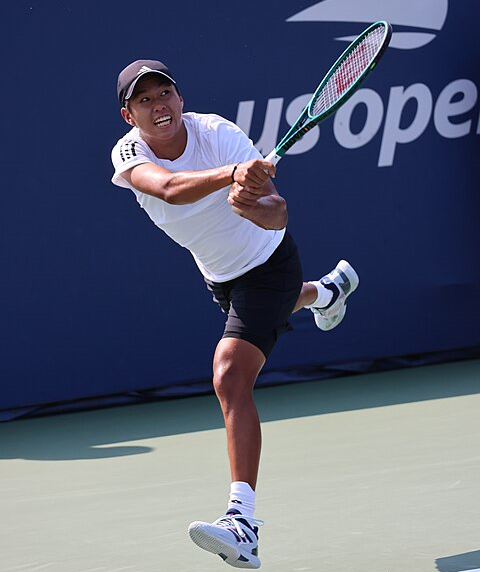
This post is dedicated to the memory of Damian Kust, tennis journalist and honorary Challenger warrior. He died this month at the age of 26.
Whatever it is that makes the Challenger tour compelling, it isn’t just the rising stars. Sure, when a Sinner or a Fonseca tears through the ranks, we tune in. Challenger-level competition is a litmus test, and we want to know whether the buzz is justified. But tomorrow’s all-world stars are just passing through. Fonseca played all of 56 matches at the level, and he’s already top-30. Sinner played 42. Federer played one.
If you’re the sort of person who is attracted to Challenger-level tennis, I suspect that the struggle is part of the appeal. Three-hour marathons, qualifying cuts, third-set cramps, tough losses to teenagers and aging veterans alike. We’re drawn to the sort of player who slogs away on Court 2 long after the rising-star top seed advances on Center.
Maybe this is something that can’t be quantified. But hey, what am I here for if not to stick numbers where they don’t belong?
Hence, the Challenger Warrior Index.
Challenger warriors are the guys who win matches the hard way. (If they could do it the easy way, I’m sure they would, but then they’d be playing bigger events.) The trick, when it comes to ranking “warrior-ness,” is to balance winning with fighting. The Index gives credit for victories and ranking improvements, yet it also boosts players for showing up often, especially when they push their opponents to the brink.
Here’s how it works. For the entire previous season, players get points for each of the following at Challengers and slam qualifying:
3 points per match, plus 2 points for each match win;
2 additional points for a three-setter, another 2 points if they win it;
1 point for each tiebreak, an extra two points if it’s a deciding TB, a bonus three points if they win it;
2 extra points per match that hits the three-hour mark;
5 points for reaching a final, another 5 points per title;
1 point per ranking place gained over the season, up to a maximum of 100;
20 point bonus for a year-end ranking inside the top 100 (AO main draw!)
The various 3-set bonuses are doubled for five-set matches in slam qualifying.
I don’t claim that this is the final word: I tinkered, and I’m making it up as I go along. Like I said, this isn’t the sort of thing that is meant to be quantified. Your personal Index would probably weight things differently.
2025 warriors
Here are the official, indefatigable warriors of the 2025 Challenger tour:
CWI  Player                    Matches  Titles  Rkg Gain
588  Francesco Maestrelli           72       3       103
586  Eliot Spizzirri                65       2       139
560  Emilio Nava                    67       4       124
542  Liam Draxl                     66       1       114
539  Joao Lucas Reis Da Silva       77       1       194
520  Roman Andres Burruchaga        71       3        51
519  Ignacio Buse                   64       2       132
516  Marco Cecchinato               72       1       147
510  Viktor Durasovic               58       1       176
509  Juan Carlos Prado Angelo       70       1        78
Maestrelli and Spizzirri come out in a near tie. Fittingly, the Italian triumphs by virtue of playing a few more matches.
The points-weighting, however arbitrary, works out nicely, rewarding differently playing styles and surface preferences. Everyone near the top of the list enjoyed a significant ranking boost over the course of the year, partly because of the points it earns, and partly because ranking boosts tends to go hand-in-hand with playing and winning a lot of Challenger matches.
As if on cue, Maestrelli is delivering on his warrior status this week, with two victories so far in Melbourne qualies. Even more appropriately, Draxl has done the same, thanks to a third-set tiebreak victory over Vitaliy Sachko to finish today’s session.
Here is the CWI roll of honor, going back another decade:
Year  CWI  Player                   Matches  Titles  Rkg Gain
2024  587  Tristan Boyer                 71       3       135
2023  589  Facundo Diaz Acosta           66       4        96
2022  603  Matteo Arnaldi                80       1       229
2021  634  Benjamin Bonzi                69       6       101
2020  357  Aslan Karatsev                38       2       177
2019  583  James Duckworth               71       4       134
2018  601  Cristian Garin                71       3       227
2017  660  Blaz Kavcic                   75       2       120
2016  590  Gerald Melzer                 66       4        98
2015  632  Daniel Munoz De La Nava       70       3       131
Arnaldi’s 80-match campaign was an impressive effort, the last one to merit a Warrior Index over 600. But the overall champion is Blaz Kavcic. In 2017, he played a whopping 32 three-setters, winning an even more eye-popping 25 of them. Five of the third sets went to a tiebreak, and he won them all. While none of those matches crossed the three-hour mark (Marco Cecchinato was the 2017 champ in that category), there’s no doubt that Kavcic showed up ready for battle, all year long.
There are more ways to measure Challenger success than future fame and fortune. I hope the Warrior Index points at some of the reasons these players deserve our admiration, no matter what their career peak ranking turns out to be.
Tomas Martin Etcheverry, three-set marathon expert
I run a lot of queries, and people often ask me arcane trivia questions. Has this ever happened before? Is that a record? My beat seems to be the super-niche stuff that no one would ever bother to include in the official media notes.
The Trivia Notebook is my attempt to put more of the answers in one place. I’m thinking I’ll do one of these every two or three weeks. If you have a question or topic you think would fit well here, please send it. No promises–most of my ideas don’t end up making the cut.
It’s a new year, so we’re all bursting with energy to start new projects. Most of them are long gone by April, and odds are the same thing will happen to this one. But hey, you never know, right?
In this first installment, we’ll look at 100-point ranking leaps, marathon man Tomas Martin Etcheverry, seedless quarter-final lineups, and single-country duos that conquered a tournament.
100-spot ranking leaps
Joao Fonseca ended 2024 ranked 145th in the world. My Elo ratings put him 45th, and after the Canberra title last week, his place on that list climbed to 27th.
As with many trivia questions, we’ll need to be a bit more specific. Tons of players move up 100 places each year, but going from 845th to 745th–while impressive!–is presumably not the sort of thing we’re looking for. Same thing with injury recoveries. While Pablo Carreno Busta finished 2024 ranked 196th, it won’t be momentous if the former top-tenner bounces back to the top 100.
A narrower question, then: Which players have jumped at least 100 ranking places in a single year, ending with their first year-end top-100 finish?
Here are the biggest single-year improvements that ended with a top-100 debut:
Player               Year  Prev YE  New YE  Jump
Kenneth Carlsen      1992      835      69   766
Leonardo Lavalle     1985      745      87   658
Guillermo Coria      2000      722      88   634
Pablo Carreno Busta  2013      654      64   590
Marco Chiudinelli    2009      605      56   549
Jacob Fearnley       2024      645      99   546
Josef Cihak          1987      613      77   536
Andreas Vinciguerra  1999      633      98   535
Andre Agassi         1986      618      91   527
Alex Michelsen       2023      599      97   502
Arnaud Di Pasquale   1998      572      81   491
Radek Stepanek       2002      542      63   479
Ben Shelton          2022      573      96   477
Fritz Buehning       1979      555      81   474
Jannik Sinner        2019      551      78   473
Pablo made it! A few other names there you might recognize, too.
If Fonseca skips forward 100 spots, he’ll do something that sets him apart from everyone on that list: He’ll leap into the top 50. Still, a 100-spot move is hardly historic:
Player               Year  Prev YE  New YE  Jump
Marc Rosset          1989      474      45   429
Ronald Agenor        1985      418      49   369
Goran Ivanisevic     1989      371      40   331
Vincent Van Patten   1979      374      43   331
Sergi Bruguera       1989      333      26   307
Juan Carlos Ferrero  1999      346      42   304
Jim Courier          1988      346      43   303
Horst Skoff          1986      299      42   257
John McEnroe         1977      264      18   246
Ulf Stenlund         1986      274      34   240
Mark Philippoussis   1995      274      38   236
Peter Lundgren       1985      265      31   234
Ricardo Cano         1975      274      42   232
Jack Draper          2022      265      42   223
Mel Purcell          1980      245      27   218
About 80 players have made a 100-plus-spot jump into the top 50. It’s harder to do so now than it was in the days of McEnroe or Courier, but men still manage it with some regularity. Fonseca will have to settle for breaking other records.
Marathon men
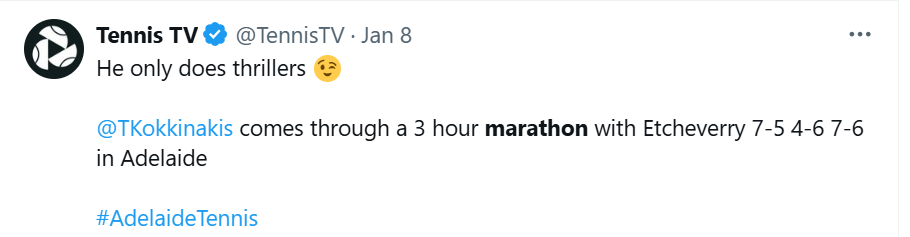
This was the Adelaide second round. Thanasi Kokkinakis decided this was enough for his Australian Open prep, as he withdrew from the quarters. Headlines about this match tended to focus on Thanasi’s penchant for marathons. He’s well-known for his 5h45 battle with Andy Murray two years ago in Melbourne. Last year, he went 3h15 against Aleksandar Kovacevic in Houston, then 3h29 a week later at the Sarasota Challenger against Gabriel Diallo.
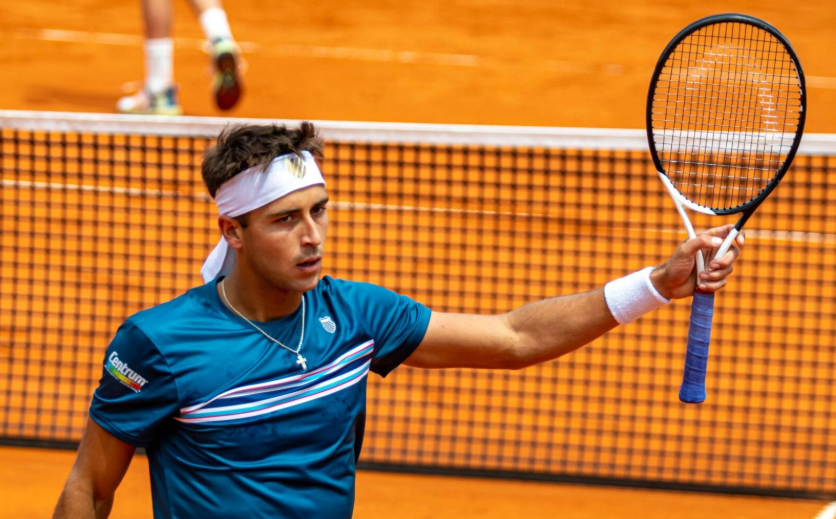
But… the name that caught my eye was Tomas Martin Etcheverry. While he doesn’t have a marquee marathon to his name like the Murray tilt, he spends a lot of time on court. Just three months ago, he muscled through three hours and 43 minutes to beat Botic van de Zandschulp in Shanghai.
Etcheverry doesn’t have a ton of slam experience, and the best-of-five format lends itself to memorable marathons. But in best-of-three matches, the Argentinian has now crossed the three-hour mark more than any other active player:
Rank  Player                   Bo3 Marathons
1     Tomas Martin Etcheverry             27
2     Albert Ramos                        26
3     Novak Djokovic                      25
4     Pedro Martinez                      24
5     Carlos Taberner                     23
6     Thiago Monteiro                     22
7     Roberto Carballes Baena             20
8     Mikhail Kukushkin                   19
8     Timofey Skatov                      19
8     Juan Pablo Varillas                 19
8     Thanasi Kokkinakis                  19
12    Lorenzo Giustino                    17
13    Jordan Thompson                     16
13    Alessandro Giannessi                16
13    Marton Fucsovics                    16
This is an imprecise measure, because it’s really “three-hour matches I know about.” It includes tour-level matches back to 1991, tour qualies and Challengers going back a decade, and Challenger qualies for the last few years. So it’s biased a bit toward younger players, who have played more in the “Jeff knows about their match times” era. Still, it’s an impressive tally for Etcheverry–and he’s only 25 years old.
The Kokkinakis match also tied Etcheverry for first place on the all-time list with Nicolas Massu. Here’s that leaderboard, again with the caveat that older players do not have Challenger matches counted:
Rank  Player                    Bo3 Marathons
1     Tomas Martin Etcheverry              27
1     Nicolas Massu                        27
3     Albert Ramos                         26
3     Carlos Berlocq                       26
5     Novak Djokovic                       25
5     Rafael Nadal                         25
5     Andy Murray                          25
8     Pedro Martinez                       24
9     Carlos Taberner                      23
10    Thiago Monteiro                      22
10    Paolo Lorenzi                        22
12    Adrian Menendez Maceiras             21
13    Roberto Carballes Baena              20
14    Mikhail Kukushkin                    19
14    Timofey Skatov                       19
14    Juan Pablo Varillas                  19
14    Thanasi Kokkinakis                   19
18    Gilles Simon                         18
Legends one and all. It’s continually amusing to me that Djokovic, Murray, and Nadal have landed on the same number. Roger Federer, for his part, only reached three hours in six of his short-form matches.
Seedless quarter-finals
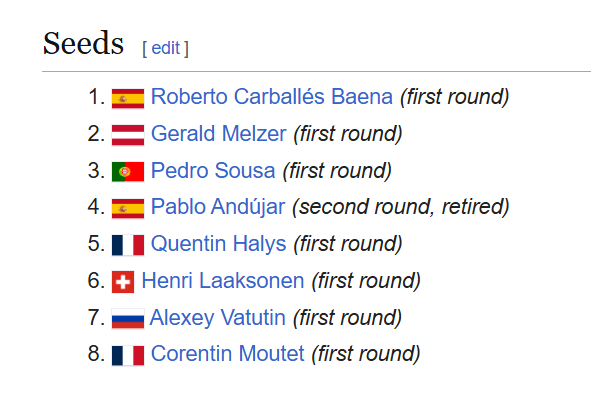
At the Nonthaburi Challenger this week in Thailand, the quarter-finals featured a wild card, two qualifiers, and an alternate… but no seeds. One of the seeds withdrew, five lost in the first round, and the remaining two fell in the second.
Let’s say it together: Has that ever happened before?
In fact, there were seedless quarter-finals five times at Challenger level last year, including once in Nonthaburi! Altogether, there have been more than 80 such tournaments in Challenger history. Even “two seeds in the second round” isn’t that special–it happened at Amersfoort last year.
What about one seed in the second round? For that, we have to go back to 2018 in Lyon, where a 17-year-old Felix Auger-Aliassime defended his title. Gotta love the Wikipedia summary of how things went for the seeds:
As far as I can tell, that’s the closest we’ve come to a Challenger with no seeds in the second round. Credit to Pablo Andujar, he did his best.
Lonely countrymen
Last one, this time from the archives. Last year at the Dobrich Challenger, two Dutchmen–Jelle Sels and Guy den Ouden–met in the final. It isn’t unusual to have players from the same country in a Challenger final, even outside their home country. What was odd about Dobrich is that Sels and den Ouden were the only Dutch men in the main draw.
You know the drill: Has that ever happened before?
I should know by now: Ask that question about the varied history of the Challenger tour, and the answer is almost always yes. It happened again in September, when two Japanese men met for the Columbus final. It also arose twice in 2023. Two Bosnians played for the championship in Sibiu, and the San Benedetto title match was contested between Benoit Paire and Richard Gasquet, the only Frenchmen in the draw.
Altogether, there have been 32 such Challengers. There were none in the first decade of the tour, but they’ve clicked off about once per year since. My favorite of the bunch is the 1998 Fürth Challenger, where Christian Ruud and Jan Frode Andersen saw off all of their non-Norwegian foes.
This scenario has also come up about as often at tour level. More than half of them were before 1980, and they’ve gotten progressively rarer. But we got one in 2024! Arthur Fils and Ugo Humbert were the only two Frenchmen in the Tokyo draw, and they were the last two men standing. That was the first such tournament in a decade, since Monte Carlo in 2014, where Stan Wawrinka upset Roger Federer for the title.
That, I think, is enough tennis trivia for one day. We’ll have some more–maybe!–in a couple weeks.
* **
Subscribe to the blog to receive each new post by email:
Learner Tien at the 2024 US Open. Credit: Hameltion
Learner Tien has done little in 2024 except win. He reeled off a 28-match streak from May to late July, collecting five titles, including his first at the Challenger level. He reached the quarter-finals at the tour event in Winston-Salem. After picking up two more Challenger crowns and another final, the young American opened his NextGen Finals campaign yesterday with a victory over top-50 player Jakub Mensik, 21st on the Elo list.
If you don’t follow prospects, you can be forgiven if you’ve only recently learned the name. Tien is only two weeks removed from his 19th birthday. He opened the year only barely inside the top 500. There were plenty of reasons to expect big things from the young man–a national 18s title at 16, two junior slam finals–but it would have been foolish to predict so much, so soon.
One reason to moderate expectations is simply age. For those not named Alcaraz or Sinner, it takes time to develop into a top player. Only one man under the age of 21–the cutoff for this week’s event in Jeddah–is ranked inside the top 40. Before Tien turned 19 this month, he was the top-ranked 18-year-old in the world, even with a triple-digit number next to his name.
The climb to the top is even more challenging for youngsters who can’t rely on pure power. Mensik, the highest-ranked teenager, is six feet, four inches tall, with weapons that make him seem bigger. Novak Djokovic recently called him “one of the best servers we have in the game.” The Czech has plenty to learn, and he will surely continue to refine his game. But to compete at the top level, he doesn’t have to.
Tien doesn’t have that luxury. He stands five inches shorter than Mensik. While he may have a bit more growth coming, five-eleven is near the bottom edge of what can be managed on the ATP tour. Only 15 members of the top 100 stand less than six feet, and even that list is skewed toward clay-court specialists. Sebastian Baez is the only five-foot-anything ranked above 45th.
The playing styles available to shorter athletes are limited, especially on hard courts. Tien has already demonstrated his mastery of many of those tactics. He can use his left-handedness to swing serve after serve wide, to a righty’s backhand. He is sturdy from the baseline, and you can take that literally: He’s unafraid of claiming territory right up to the line itself, taking advantage of both his quickness and raw speed. Fearless counterpunching has paid dividends for smaller stars from Olivier Rochus to Kei Nishikori to Alex de Minaur. As a lefty, the American has options those men didn’t.
Still, Tien’s transition from the Challenger tour to the big leagues could be rocky. Good defense and well-executed tactics are enough to clean up against top-200 competition. The combination was (just barely) sufficient against Mensik yesterday. But a full-time spot on the ATP tour requires more.
The game plan
For such a middling server, Tien wins a remarkable number of serve points. He ranks among the top quarter of Challenger tour regulars by serve points won, though his number is helped a bit by spending the entire year on hard courts. He does even better–64.6% compared to a tour norm below 62%–when aces and double faults are taken out of the equation. When the returner gets a racket on the ball, only ten players were better on hard courts.
It’s not surprising, then, that Tien excels on return. Among Challenger players with at least ten matches at the level in 2024, only two men–Dalibor Svrcina and his fellow American in Jeddah, Nishesh Basavareddy–topped Learner’s 42.5% clip. Tien is particularly effective converting second-serve return points.
He’s even better–or at least, he has been better this season–with more on the line. His rate of return points won rises to nearly 47% on break point chances, and he’s just as clutch on the other side of the ball. He saved 65.6% of the break points he faced, second at Challenger level to Mikhail Kukushkin. Here, he has already learned how to use the lefty serve, alternately forcing opponents far out wide and sticking them with uncomfortable body serves when he catches them leaning left for the slider.
The overall package is something between those of two other left-handers, Adrian Mannarino and Cam Norrie. Mannarino, also a sub-six-footer, throws the kitchen sink at opponents, keeping them off balance to compensate for his own lack of power. Norrie is considerably taller and has more firepower at his disposal. But he, too, refuses any rhythm to the man across the net. He alternates a loopy forehand with a flat backhand–except when he doesn’t, if you ever think you’ve found a groove.
Tien serves like Mannarino out of necessity. Even if he doesn’t get taller, the American will surely get stronger, so his 90-mile-per-hour first serves from this year’s US Open probably won’t tell the story of his entire career. But at the moment, he relies on angles and variety. Mannarino has overcome his limitations to the tune of a top-20 peak ranking. On the other hand, his playing style (and the comically loose string tension it relies on) is so unique he hardly provides an example to follow.
In the Las Vegas Challenger final back in September, Tien looked particularly like Norrie. Fighting the wind, he spun forehands and zinged backhands, a combination that made it impossible for the bigger-hitting Tristan Boyer to get comfortable. In other settings, though, the youngster is increasingly using his forehand as a (flatter) weapon, building points one sharp angle at a time.
The most instructive element of these comparisons, though, is the way in which the American differs from his fellow lefties. Mannarino reached Tien’s current ranking when he was 21, after more than 250 pro matches. Norrie–who ultimately peaked inside the top ten–played three years of college tennis and didn’t approach the top 100 in the world until he was 22. Tien, by contrast, is clearing all these hurdles on the first try. Deploying a brainy playing style that normally takes years to refine, the American is making it look natural.
The projection
Aside from size and serve speed, Tien’s future looks bright. The 19-year-old has won 61 of 73 matches across all levels this year. Within a few months, he is likely to crack the top 100. At Challenger level, his serve hasn’t held him back: As we’ve seen, he wins more service points than most of his peers, despite gaining fewer free points with the serve itself.
The question, then, is what effect Tien’s attributes have on career trajectory. Everyone wins fewer points at tour level than at Challengers–the competition is better, so it would be weird if it were otherwise. But the ratio isn’t uniform. Mannarino has won about 7% fewer serve points at tour level than he did in hard-court Challenger matches, while Marcos Giron (another sub-six-footer) lost less than 1% in the transition.
These Challenger-to-tour conversions offer some insight into Learner’s future. Since he has played almost all of his pro matches on hard courts, we’re going to calculate something a bit quirky. How do serve and return win rates change from hard-court Challenger matches to all tour-level matches? That’s what we want to know for the 19-year-old: He’ll need to play on all surfaces soon, probably starting in 2025. This transition he’s about to make–how did it go for other players?
The first-pass answer is that pros are able to retain something like their hard-court Challenger serve win percentage, seeing that number drop by 2%. But they lose a lot against tougher competition on return, winning 7.1% fewer return points. The following table shows those numbers (“Conv%”), along with Tien’s career record at hard-court Challengers (“Tien CH”), along with what the conversion factors suggest for his tour-level win rates (“Tien Adj”):
        Conv%  Tien CH  Tien Adj
Serve   98.0%    63.3%     62.0%
Return  92.9%    42.3%     39.3%
Those are awfully respectable numbers. 62% serve points is marginal for a tour regular, but combined with 39.3% return points, it’s enough. The combination is about what Francisco Cerundolo managed this year, and he’s ranked 30th in the world.
A word of caution: This type of conversion is not suggesting that Tien’s level is the same as Cerundolo’s now. The calculation involves taking each active player’s career records in tour and Challenger main-draw matches. That probably underestimates Tien’s potential, because most men play the majority of their Challenger matches after their 19th birthday. But a player’s career numbers will include their peak, which typically comes much later. At the very least, these numbers suggest Tien could reach Cerundolo’s level (or better) eventually.
The (other) adjustments
That’s just a first-pass number, because we haven’t gotten to height and handedness. Taking those into account does not help Learner’s case.
Lefties, it turns out, have a rougher transition than right-handers do. Here are the serve and return conversion factors, separated by hand:
Not a huge difference, but hey, the margins in tennis are small. I suspect it is slightly harder for left-handers to move up a level for two reasons. First, the less experienced the opponent, the more valuable it is to be unusual, and lefties are certainly that, making up barely one-tenth of the player pool. At tour level, the novelty is gone: ATP regulars generally know how to handle left-handers.
Second, lefties are more likely to get by with what we might call “crafty” tennis, rather than power. (That’s related to the first reason: They’ve reached Challenger level because they’ve outsmarted inexperienced opponents thus far.) Craftiness might be enough against #180 in the world, but against, say, the Hurkacz serve, all craftiness gets you is a few more tuts of approval in the press box.
Whatever the reason, Tien’s left-handedness means we need to update our tour-level forecast:
    (L) Conv%  Tien CH  Tien Adj
Serve   97.3%    63.3%     61.6%
Return  92.1%    42.3%     39.0%
Not a huge hit, but ~0.4% of total points won is roughly equivalent to four places in the rankings. A small number here ultimately translates to much bigger ones when denominated by tour-level prize money.
And then, size. Here are the conversion factors for players in three height categories: under six feet, from six feet to six-foot-three, and above six-foot-three:
        under 6'0  6'0 to 6'3  over 6'3
Serve       97.0%       97.9%     99.0%
Return      92.0%       93.4%     92.6%
Again, craftiness doesn’t convert. Players under six feet tall lose the most points between hard-court Challengers and tour level. The tallest players remain almost as effective on serve, while the middle category retains the most of their return effectiveness.
Here’s the Tien update, using the sub-six-feet conversion rates:
        (< 6') Conv%  Tien CH  Tien Adj
Serve          97.0%    63.3%     61.4%
Return         92.0%    42.3%     38.9%
Not much of a difference from the left-handed numbers, though we keep going down. This is increasingly the profile of a clay-court specialist, and we might be outside the top 40 now.
Of course, Learner is both left-handed and (relatively) small. My mini-study of active players doesn't give us a big enough pool of data to extrapolate from the small group of small lefties. Instead, a back-of-the-envelope combination of the two factors gives us conversion factors of 96.3% for serve and 91.3% for return:
        (L&Sm) Conv%  Tien CH  Tien Adj
Serve          96.3%    63.3%     61.0%
Return         91.3%    42.3%     38.6%
For the first time, the adjusted versions of Tien's Challenger-level stats are underwater, summing to less than 100%. Winning 61% of service points would rate fourth-worst in the current ATP top 50, just ahead of Sebastian Baez. 38.6% on return is respectable, though not enough to consistently challenge for titles when combined with such a mediocre serve.
The exact numbers are not important: For one thing, we don't have enough recent data to know exactly how size and handedness interact. Maybe it's not quite that bad. Suffice it to say that both lefties and undersized players are more likely to struggle in the transition from Challengers to the full tour. A player who fits both categories should not expect a smooth trip up the ladder.
For Tien to beat these projections, all he has to do is improve more than the average pro does. As noted above, he already has something of an edge: He posted most of his excellent Challenger numbers as an 18-year-old. That's Alcaraz territory. At the same age, Mannarino was struggling at Futures level, and future top-tenner Norrie was headed off to college. If for some reason Tien plays a lot of Challenger matches in 2025, his stats will probably look better, and the tour-level predictions would change as well.
As Learner and his team are undoubtedly aware, those improvements need to center on the serve. The youngster probably already has what it takes to break serve once or twice a set on tour. But without a bigger first-strike weapon, he'll struggle to get those opportunities. Yesterday he withstood Jakub Mensik's event-record 24 aces, winning in a fifth-set tiebreak despite losing 14 more total points than Mensik did. The American played brilliant tennis, yet it took luck and brilliant timing to pull out the victory. For a five-foot-eleven left-hander among the giants of the professional game, it's not the last tightrope he'll have to walk.
* *
Subscribe to the blog to receive each new post by email:
I’ve just revised my published Elo ratings (men, women) to better reflect the performance of players who mostly compete at the (men’s) ATP Challenger and (women’s) ITF levels. Previously, my Elo ratings used only tour-level main-draw matches. For top players, it makes very little difference–not only do Novak Djokovic and Simona Halep play no matches at the lower levels, they rarely encounter opponents who spend much time there. But for the second tier of players, the effect can be substantial.
The Elo system rates players according to the quality of their opponents. Beat a good player with a high rating, and your own rating will jump by a healthy margin. Beat a weakling, and your rating will inch up a tiny bit. Essentially, Elo looks at each result and asks, “Based on this new result, how much do we need to adjust our earlier rating?” When Bianca Andreescu upset Caroline Wozniacki in Auckland last week, the system responded by upping Andreescu’s rating by quite a bit, and by penalizing Wozniacki more than for the typical loss. After a more predictable result, like Djokovic’s defeat of Damir Dzumhur, ratings barely move.
It’s important to understand the basic mechanics of the system, but the main takeaway for most fans is that Elo just works. The algorithm generates more accurate player ratings (and resulting match forecasts) than the official ATP and WTA rankings, among other attempts to rank players. Now, you can see Elo rankings for a much wider range of players.
Of of my main uses of Elo ratings is identifying players whose official rankings haven’t caught up to reality. For instance, a few months ago I noted when Daniil Medvedev moved into the Elo top ten, even though he has yet to crack that threshold on the official list. Most players who reach the top ten on the Elo table eventually do the same in the ATP or WTA rankings. Another two current examples are Aryna Sabalenka and Ashleigh Barty, considered by Elo to be two of the top three women on tour right now, even though neither is in the top ten of the WTA rankings. That may be too aggressive, and the margins at the top of the women’s list are tiny right now, but it is a clear signal that these women’s results bear watching. (We talked about this on the most recent Tennis Abstract podcast.)
Now that we have unified Elo lists that cover more players, let’s dig deeper. For each tour, let’s find the players current outside the official top 100s who are rated the highest by the more sophisticated formula. First, the ATP:
Player                  ATP Rank  Elo Rank
David Ferrer                 124        36
Thanasi Kokkinakis           145        62
Miomir Kecmanovic            126        66
Jack Sock                    105        77
Reilly Opelka                102        84
Ricardas Berankis            107        86
Marcos Baghdatis             122        87
Gilles Muller                137        88
Daniel Evans                 190        89
Viktor Troicki               201        90
Horacio Zeballos             182        92
Jared Donaldson              115        94
Mikael Ymer                  196        95
Egor Gerasimov               157       100
Lloyd Harris                 119       102
Tommy Paul                   195       104
Guillermo Garcia Lopez       101       106
Felix Auger Aliassime        106       108
Alexei Popyrin               149       109
Dudi Sela                    240       114
One thing that pops out from the list is the number of veterans. Elo ratings are “stickier” than ATP rankings, since the official system works with only 52 weeks worth of results. Elo ratings make constant adjustments, but quality performances–even when they are more than 52 weeks old–continue to affect current ratings for some time. David Ferrer has had a hard time staying healthy enough to compete at his former level, but according to Elo, he remains fairly dangerous when he is able to take the court.
Part of the reason why so few prospects appear on this list is because of my decision to exclude ITF $25Ks. For example, up-and-coming 18-year-old Kaja Juvan, who knocked out Yanina Wickmayer in Australian Open qualifying today, hasn’t played nearly enough matches at higher levels to appear on my Elo list. But last year, she was 29-7 at ITF $25Ks, and won her last ten matches at that level.
Another issue is that the most promising women tend to climb into the top 100 more quickly. Another 18-year-old, Dayana Yastremska, rocketed up the rankings with a tour-level title in Hong Kong last fall. She sits at No. 59 on the WTA table, but after 13 top-100 wins in 2018, Elo is even more optimistic, placing her at No. 27, just ahead of Maria Sharapova and Venus Williams.
I’ll continue to update these expanded Elo ratings weekly and use them to generate forecasts for every tour-level and Challenger event. Enjoy!
What is the gap between the top-level ATP Tour and the lower-level ATP Challenger Tour? Some players pile up trophies in the minor leagues yet have a hard time converting that success to match wins on the big tour, while others struggle with the week-to-week grind of the challengers but excel when given opportunities on the larger stage.
Let’s take a look at a method that measures the difference between the skill level on the two tours. Once we can translate stats between levels, we can identify those players who are much better or worse than expected when they have the chance to compete against the best.
The algorithm I’ll use is almost identical to the one baseball analysts have used for decades to determine league equivalencies. For instance, we might find that a batting average of .300 in Triple-A (the highest minor league) is equivalent to .280 in the majors, meaning that, if a player is batting .300 in Triple-A, we’ll expect him to bat .280 in the majors. In tennis terms, it may be that a 10% ace rate in challengers is equivalent to a 8% ace rate on the main tour. Not every player will exhibit that precise drop in performance–some may even appear to get a little better–but on average, a league equivalency tells us what to expect when a player changes levels.
Here is the algorithm for league equivalencies, as applied to men’s tennis:
Pick a stat to focus on. I’ll use Total Points Won (TPW) here.
Neutralize that stat as much as possible. In baseball, that means controlling for the difference in parks; in tennis, it means controlling for competition. For the following, I’ve adjusted for each player’s quality of competition using a method I described about a year ago. Most players’ numbers are about the same after the adjustment, but a particularly easy or tough schedule means a bigger shift. For instance, Denis Shapovalov posted a TPW of 49.8% on the big tour last season, but because he played such high-quality competition, the adjustment bumps him up to 52.1%, 18th among tour regulars.
Identify players who competed at both levels, and find their adjusted stats at each level. Shapovalov played 18 tour-level matches and 30 challenger-level matches last year, with adjusted TPW numbers of 52.1% and 54.4%, respectively.
Calculate the ratio for each player. For Shapovalov last year, it was 1.044 (54.4 / 52.1).
Finally, take a weighted average of every player’s ratio. The weight is determined by the minimum number of matches played at either level, so for Shapovalov, it’s 18. Using the minimum means that a player like Gleb Sakharov (1 ATP match, 37 challenger matches) can be included in the calculation, but has very little effect on the end result.
Here are the results for the last six full seasons. Each ratio is the relationship between challenger-level TPW and tour-level TPW:
Year  Ratio
2017  1.086
2016  1.086
2015  1.098
2014  1.103
2013  1.100
2012  1.100
The average of these yearly equivalency factors is roughly the difference between a 52.5% TPW at challengers and a 48.0% TPW on the main tour. The shift from 2012-15 to 2016-17 may reflect the injuries that have sidelined the elites. With fewer elite players on court, the gap between the two tours narrows.
Now that we know the difference between the levels, we can find the players who defy the usual patterns. Of the 100 players with the most “paired” matches–that is, with the most matches at both levels in the same years–here are the 20 with the lowest ratios. Low ratios mean less difference in performance between the two levels, so these guys are either overperforming at tour level or underperforming at challengers:
Player              ATP M  CH M  Min M  Ratio
Matthew Ebden          62   140     39  0.982
Jared Donaldson        68    78     37  1.030
Jack Sock              81    45     38  1.039
James Duckworth        53   156     53  1.042
Andrey Rublev          56    79     42  1.047
Vasek Pospisil         96    76     60  1.047
Thiemo De Bakker       48    87     44  1.048
Samuel Groth           84   133     58  1.049
Michael Berrer         59   107     56  1.050
Ruben Bemelmans        41   178     41  1.052
Dustin Brown          120   173    111  1.055
Benoit Paire          295    53     53  1.059
Peter Gojowczyk        46   132     44  1.059
Michael Russell        58    78     58  1.061
Marius Copil           58   180     58  1.063
Taylor Harry Fritz     59    44     41  1.065
Jordan Thompson        38    88     38  1.066
Illya Marchenko        56   116     37  1.066
Tatsuma Ito            65   179     65  1.066
Ryan Harrison         124    84     59  1.068
The middle columns show the total number of ATP matches, challenger matches, and “paired” matches between 2012 and 2017 (“Min M”) for each player. (The last number gives an indication of just how much data was available for the single-player calculation.) Aside from a few big-serving North Americans near the top of this list, I don’t see a lot of obvious commonalities. There are some youngsters, some veterans, more big servers than not, but nothing obvious.
(Shapovalov doesn’t have enough paired matches to qualify, but his overall ratio is 1.035, good for third on this list.)
Here is the opposite list, the quintile of 20 players who have overperformed at challengers or underperformed on tour:
Player               ATP M  CH M  Min M  Ratio
Florian Mayer          152    45     45  1.180
Mikhail Youzhny         91    38     38  1.169
Aljaz Bedene           144   121     80  1.160
Filippo Volandri        62   101     62  1.158
Robin Haase            194    71     71  1.157
Tobias Kamke           102   144     73  1.155
Adrian Mannarino       234   115     86  1.155
Filip Krajinovic        36   167     36  1.148
Albert Ramos           111    67     62  1.144
Paul Henri Mathieu     147    96     82  1.141
Kenny De Schepper       77   196     77  1.140
Facundo Bagnis          45   197     45  1.136
Pablo Cuevas           127    52     43  1.136
Ivan Dodig              76    48     41  1.135
Santiago Giraldo       146    70     56  1.135
Paolo Lorenzi          204   191    124  1.135
Thomaz Bellucci        162    44     44  1.134
Albert Montanes        113   109     70  1.130
Rogerio Dutra Silva     57   210     57  1.130
Lukas Lacko            122   181    108  1.129
There are more clay-courters here than on the first list, and the very top of the ranking includes veterans who have mastered the challenger level, even if they still struggle to maintain a foothold on the main tour. I’ve had to exclude one player who belongs on this list: Gilles Muller broke my algorithm with his 45-9 challenger season in 2014. When I took him out of the 2014 calculations, the overall numbers changed very little, but it means no Muller here. Whatever his exact ratio, I can say that his tour-level performance hasn’t matched that 2014 run at challengers.
The bottoms of the two lists indicate that there isn’t that much variation between players. The middle 60% of players all have ratios between about 1.07 and 1.13, while the yearly averages hover around 1.09 and 1.10. Some players under consideration here have fewer than 50 “paired” matches over the six seasons, so a difference of a couple hundredths is far too little to draw any conclusions.
This algorithm, beyond suggesting what to expect from players when they move up from challengers to the main tour, could apply the same reasoning to other pairs of levels, such as ITF Futures and challengers, or women’s ITFs and the WTA tour. It could even compare narrower levels, such as ITF $10,000 events with ITF $15,000s, or ATP 250s with ATP 500s. The method is a staple of analytics in other sports, and it has a place in tennis, as well.
With three ATP tour-level events on the slate this week, Benoit Paire considered his options and elected to play none of them. Instead, the world #23 is the top seed at the Brest Challenger, making him the highest ranked player to enter a challenger this year–by a wide margin.
Top-50 players may only enter challengers if they are given a wild card, and top-ten players may not enter them at all. Still, since 1990, a top-50 player has played a challenger just over 500 times, at a rate of about 20 per year. (Some of these players didn’t need a wild card, as entry is determined by ranking several weeks before the tournament, during which time rankings rise and fall.)
Many of the high-ranked wild cards fall into one of two categories: Players who lose early in Slams, Indian Wells, or Miami; and clay-court specialists seeking more matches on dirt. Paire’s decision this week–like the Frenchman himself–doesn’t follow one of these common patterns.
Anyway, here are the top-ranked players to contest challengers since 1990, along with their results. A result of “W” means that the player won the title, while any other result indicates the round in which the player lost.
Year  Event           Player               Rank  Result
2003  Braunschweig    Rainer Schuettler    8     R16
1991  Johannesburg    Petr Korda           9     SF
1994  Barcelona       Alberto Berasategui  10    W
1994  Graz            Alberto Berasategui  11    R16
2008  Sunrise         Fernando Gonzalez    12    QF
2004  Luxembourg      Joachim Johansson    12    W
2011  Prostejov       Mikhail Youzhny      13    QF
2008  Prostejov       Tomas Berdych        13    QF
2003  Prague          Sjeng Schalken       13    W
2005  Zagreb          Ivan Ljubicic        14    W
2004  Bratislava      Dominik Hrbaty       14    F
2004  Prostejov       Jiri Novak           14    QF
2003  Prostejov       Jiri Novak           14    R32
2007  Dnepropetrovsk  Guillermo Canas      15    SF
2002  Prostejov       Jiri Novak           15    F
1998  Segovia         Alberto Berasategui  15    QF
1997  Braunschweig    Felix Mantilla       15    F
1997  Zagreb          Alberto Berasategui  15    W
(Schuettler and Korda were outside the top ten a couple of weeks before their respective challengers.)
A look at this list suggests that Alberto Berasategui entered challengers as a top-fifty player more than anyone else. He’s close–with 12 such entries, he’s tied for second with Jordi Arrese. The player who dropped down a level the most times is Dominik Hrbaty, who played 17 challengers while ranked in the top 50. (The active leaders are Jarkko Nieminen with ten and Andreas Seppi with nine.)
Despite all those attempts, Hrbaty wasn’t particularly successful as a high-ranked challenger player. He won only 2 of those 17 events, reaching only one other final. Top-50 players aren’t guaranteed to win these titles, of course, but in general, they have outperformed Hrbaty, winning 18% of possible titles. Here are top-50 players’ results broken down by round:
Result       Frequency
Title            18.1%
Loss in F         9.3%
Loss in SF       11.3%
Loss in QF       17.1%
Loss in R16      22.0%
Loss in R32      22.2%
Paire is a better player than this sample’s average ranking of 37. Combined with a favorable surface, he gets a much more optimistic forecast from my algorithm, with a slightly better than one-in-three chance of winning the title. With a futures title, an ATP trophy, and a pair of challenger triumphs already in the books this year, it seems fitting that Benoit would add another oddity to his wide-ranging season.
This afternoon at the ATP Meerbusch Challenger in Germany, all eyes were definitely not on a first-round match between Dutchmen Boy Westerhof and Antal Van Der Duim. Both are ranked outside the top 250, neither has ever cracked the top 200, and both are in their late twenties.
It appears that the two players assumed no one would be watching. Before the match, the markets on Betfair were very suspicious:
Here was the script before the match. First set to Westerhof and a VdD comeback. The final score was 4-6, 6-3, 6-3… pic.twitter.com/jyRcUCifYH
For those of you not accustomed to parsing betting markets, here’s a summary of what the market thought was going to happen:
Van Der Duim’s chances of winning the match were between 75% and 80%.
Van Der Duim’s odds of winning the first set were roughly 35%.
There was a better than 50/50 chance that Van Der Duim would win the match in three sets. The odds of any other specific outcome (e.g. Westerhof wins in three) were minuscule in comparison.
The match odds in themselves might have raised a few eyebrows, but could be written off as owing to Westerhof’s recent run of poor play, or perhaps some information gathered on site about a nagging injury. When combined with the other markets, however, it’s clear that something very fishy was going on.
The match went precisely according to script. After Westerhof took the first set, 6-4, the market got more and more confident about Van Der Duim winning the second set:
They are asking for 1.25 for van der Duim to win the second set….
Van Der Duim remained the favorite even after going down an early break in the second set. Shortly thereafter, with no cameras watching, Westerhof seems to have decided not to waste any more time:
In the end, Van Der Duim beat Westerhof, 4-6 6-3 6-3. No one following the betting markets was at all surprised.
Nor should we be shocked that this sort of thing happens. With the middling prize money on offer at Challenger events–Westerhof will get about $500, and if Van Der Duim loses in the next round, he’ll be awarded about $800–there’s more money to be made by losing matches than winning them.
While we don’t know how often matches are fixed, something was very wrong about this one. Because the markets so blatantly telegraphed the fix, it poses an important question to the sport’s governing bodies. If they don’t take this opportunity to act, it will send a very clear message to Challenger-level players that match-fixing is acceptable practice.
(Thanks to the three Twitter users quoted above, who brought this match to my attention.)
When Nick Kyrgios lost the Wimbledon quarterfinal to Milos Raonic yesterday, he was playing his 50th career match at the Challenger level or above. Round numbers invite big-picture analysis, so let’s see how Kyrgios stacks up to the competition at this early milestone.
When Monday’s rankings are released, Nick will debut in the top 100, all way up to #66. Only Rafael Nadal (61), Gael Monfils (65), and Lleyton Hewitt (65) have been ranked higher at the time of their 51th Challenger-or-higher match. Roger Federer was #93, Novak Djokovic was #128, and Jo Wilfried Tsonga was #314. Of the current top 100, only ten players reached a double-digit ranking by their 51st match.
The wealth of ranking points available at Grand Slams have played a big part in Kyrgios’s rise, but they don’t tell the whole story. He has won 36 of his first 50 matches, equal to the best of today’s top 100. Nadal went 36-14, and next on the list is Djokovic and Santiago Giraldo (who played almost all Challengers) at 34-16. Most of Nick’s wins before this week came at Challengers, and he has won four titles at the level.
No other active player won four Challenger titles in his first 50 matches. Eight others, including Djokovic, Tsonga, Stanislas Wawrinka, and David Ferrer, won three. All of them needed more events at the level to win three titles than Kyrgios did to win four.
Nick’s short Challenger career is another indicator of a bright future. He has only played nine Challenger events, and with his ranking in the 60s, he may never have to play one again. As I’ve previously written, the best players tend to race through this level: Federer, Nadal, and Djokovic all played between eight and twelve Challengers. It’s a rare prospect that makes the jump in fewer than 20 events, and when I researched that post two years ago, more than half of the top 100 had played at least 50 Challengers.
One category in which the Australian doesn’t particularly stand out is age. When he plays his 51st match, he’ll a couple of months past his 19th birthday. Roughly one-quarter of the current top 100 reached that match total at an earlier age. Nadal, Richard Gasquet, and Juan Martin del Potro did so before their 18th birthday, while Djokovic, Hewitt, and Bernard Tomic needed only a few more weeks beyond that.
Without knowing how Kyrgios would’ve performed on tour a year or two earlier, it’s tough to draw any conclusions. His 36-14 record at 19 certainly isn’t as impressive as Rafa’s equivalent record at 17.
As predictive measures go, Nick’s Wimbledon performance–built on his poise under pressure–is the best sign of them all. Only seven active players have reached a Grand Slam quarterfinal as a teenager, and four of them–Fed, Rafa, Novak, and Lleyton–went on to reach #1. (The other three are Delpo, Tomic, and Ernests Gulbis.)
For a player with only fifty matches under his belt, that’s excellent company.
Because so much less separates players at this level (compared to those at last year’s World Tour Finals), my forecast stops just short of throwing its hands up in dismay. Coming into the event, Italian clay specialist Filippo Volandri was the favorite, with a 15.5% chance of winning the event. He lost today to Alejandro Gonzalez, making it much less likely that he’ll progress out of the round-robin stage.
Today’s other winners were top seed Teymuraz Gabashvili, Oleksandr Nedovyesov, and Jesse Huta Galung. My numbers now consider Huta Galung the favorite, with a better than 20% chance of winning the title. The situation in Grupo Verde will become much more clear after tomorrow’s night match between Gabashvili and Nedovyesov.
(My algorithm doesn’t implement the details of the number-of-sets-won tiebreaker, so Guilherme Clezar, the only loser today to win a set, probably has a slightly better chance of advancing than these numbers give him credit for.)
And if you’re really into this stuff–Challengers and/or charting–here are my stat reports from yesterday’s first-round matches in Champaign between Ram and Giron and Sandgren and Peliwo.
Top seeded or not, Lu seems to really like Challengers. When other players at his level are contesting ATP 250s or Masters-level qualifying draws, the Taiwanese #1 is demonstrating his dominance of the minor leagues. And it’s working: In large part thanks to titles in places such as Shanghai, Ningbo, Seoul, and Singapore, he has kept his ranking in the top 100 for about three years.
Lu’s combination of consistency near the top and Challenger preference is unusual but not unique. He is one of 14 players who, since 2007, have played at least 20 Challenger events while ranked inside the top 100. He is, however, the most extreme member of the group. This week’s Guadalajara event will be his 40th Challenger as a member of the top 100. Dudi Sela, also in Guadalajara but currently outside the top 100, has played 31 while part of that more elite club.
Almost every week of the season, there is some tour-level event, and usually, anyone in the top 100 would make the cut for qualifying, if not necessarily the main draw. But for Lu, the ATP option isn’t always so inviting. He hates clay, with only two career wins on the surface, one of which was twelve years ago in a Davis Cup Group 2 tie against Pakistan. (No, not against Qureshi. He lost to Qureshi.) Despite five entries and a valiant effort in a fifth-set, 11-9 defeat against Jeremy Chardy last year, he has never won a match at Roland Garros.
While Sela has a longer track record (and a bit more success) on dirt, his current preferences are very similar. Given the choice between a hard-court Challenger and anything on clay, and he’ll take the Challenger. While there aren’t as many tour-level events on clay as Rafael Nadal might like, there are enough to keep Lu and Sela on the lower circuit for several months of the year.
Most of the other players who rack up extensive Challenger records while ranked in the top 100 have the opposite preference. Filippo Volandri and Ruben Ramirez Hidalgo are the most extreme. While ranked that high, each has only played three ATP qualifying events, despite entering 29 and 27 Challenger events, respectively, since 2007. (RRH’s career figures are higher; I’m using the time span since 2007 because my qualifying database only goes back that far.)
Here’s the list of all players who have contested 20 or more Challengers while ranked in the top 100 since 2007, along with the number of ATP qualifying draws they entered while in the top 100 and the rate at which they chose Challengers out of these two options.
Player                 CHs  Qs  CH+Qs  CH/CH+Q
Yen Hsun Lu             38  10     48      79%
Dudi Sela               30   6     36      83%
Filippo Volandri        29   3     32      91%
Carlos Berlocq          29   5     34      85%
Michael Russell         28  25     53      53%
Ruben Ramirez Hidalgo   27   3     30      90%
Frederico Gil           26  12     38      68%
Daniel Gimeno Traver    26  21     47      55%
Nicolas Mahut           22   7     29      76%
Oscar Hernandez         22   8     30      73%
Pere Riba               22  11     33      67%
Tobias Kamke            22  18     40      55%
Diego Junqueira         21   2     23      91%
Olivier Rochus          21  11     32      66%