First Look: Francis Tiafoe

Last night at the Citi Open in Washington, Francis Tiafoe played his first tour-level main draw match. For a 16-year-old with almost no professional experience, he put on a good show, making Evgeny Donskoy work hard for his 6-4 6-4 victory.

Tiafoe is one of a few young American men viewed as rising stars. He doesn’t have the professional experience of Stefan Kozlov or Jared Donaldson, but he has nonetheless racked up some impressive feats in the last eight months, claiming the title at the Orange Bowl in December and another big win at the Easter Bowl in April.

His game, as viewers discovered last night, is a work in progress. He lit up the radar gun with both serves and forehands, but neither was steady enough to avoid getting broken by Donskoy three times. His backhand, the less showy but more consistent half of his ground game, was sufficiently solid to keep him in points, but it aside from a couple of down-the-line bullets, it was rarely enough to win them.

Both serve and forehand are, at this stage of his development, very complicated shots. His serve is a bit jerky, and his second serve is particularly erratic. A more offensive kick serve would do wonders for his service game–he won barely 40% of second-serve points yesterday.

The forehand is an even bigger problem. It’s easy to get fooled by the occasional big winner–he did hit some sensational shots from that wing last night. The bigger picture, though, is that his big, not-very-fluid windup prevents him from hitting the effective rallying shots that are absolutely necessary to compete at this level. Compared to top-100 players, Donskoy is not a particularly tough test, and Tiafoe hit 19 unforced errors from that side alone. That’s 20% of his total forehands in the match–double the tour-average rate of forehand unforced errors. They also accounted for one-third of all the points he lost.

It could have been worse. Donskoy, whether because he feared the forehand or because he stuck with familiar patterns, tended to rally back to Tiafoe’s backhand. That shot is far smoother, simpler, and much, much more consistent. While he didn’t try for nearly as much off that wing, he did hit four winners–and only four unforced errors.

He tended to play far behind the baseline, so it was a rare point that displayed other aspects of his game. In the second set, he opted for a few more slice backhands, a shot he seemed to have a decent feel for. He hit one very slick backhand drop shot for a winner, but more often when he ventured inside the baseline, he didn’t appear to have a natural sense for smart, reasonably-high-percentage plays.

It’s important to keep all this in perspective, though. Tiafoe is the youngest man to play an ATP main-draw match this year–nine months younger than Alexander Zverev, for instance. Donskoy was his first top-300 opponent and last night was only his 15th professional match. If he didn’t look particularly poised rushing between points, I think we can let it slide.

As strong a player as Tiafoe is for his age, the inconsistency of both serve and forehand will likely keep him out of the spotlight for another few years. Unlike Zverev and Borna Coric, he won’t be challenging top-50 players before his 18th birthday. Still, there are a lot of good qualities to build on, and when he hits his twenties, he could well be part of the next great generation of American players on the ATP tour.
Premier or International? Balancing Rewards and Draw Quality

This week, WTA players had a choice of tournaments: a Premier event in Stanford or an International in Washington. Stanford offers far more ranking points–470 to Washington’s 280 for the winner–and an even bigger difference in prize money–$120,000 to $43,000.

For the very best players, it’s an easy choice to head for the event with the biggest rewards. But further down the rankings, it’s not so clear cut. If enough top contenders gather at one tournament, there may be easier points (and dollars) for the taking elsewhere.

The pairing of Stanford and Washington provides a neat natural experiment that allows us to analyze players’ scheduling decisions. Both tournaments are in the same country and played on the same surface. The only major difference is the package of available rewards.

(Of course, for any particular player, there may be other strong reasons to choose one event or the other, such as local ties, previous success at the event, sponsorship commitments, or appearance fees. Also, some players might opt for Washington because of its closer proximity–and lack of time zone changes–to upcoming events in Montreal, Cincinnati, and New York. For the purpose of this analysis, though, we’ll have to ignore personal considerations.)

Lucie’s choice

Let’s start with an example: Lucie Safarova. The 17th-ranked Czech is the top seed in Washington. Before the draw was released, a simple ranking-based projection would’ve given her a 14% chance of winning the title, making her the favorite. Had she entered Stanford, she would’ve been the 8th seed, and a similar forecast would’ve given her a 3% chance of winning the title.

Advantage Washington? If Lucie wants prestige, a trophy, and more time on court, yes. But if she prefers ranking points and cash, she still should have gone to California.

That 14% chance of winning the Citi Open title, combined with her pre-tournament odds of reaching each preceding round, gives Safarova a weighted forecast of 87 ranking points and $11,800 in prize money. Had she opted for Stanford, her weighted expectation would be 95 ranking points and $21,170.

Safarova’s comparison is indicative of what we find with many more players in action this week. Even with a higher chance of advancing to the final rounds in Washington, the ranking point balance tilts in Stanford’s favor, and the prize money difference is even more extreme.

California cash

The contrast between the two events is much starker in terms of dollars than in points. As we’ve seen, the champion in Stanford receives almost three times as much as her fellow trophy-winner in Washington, but not even twice as many ranking points.

Because the prize-money pot is so much bigger in Stanford, every direct-entry player in the draws of both tournaments would have expected a bigger check from Stanford. The differences run from the extreme–Agnieszka Radwanska could have expected only 38% as much prize money in Washington than in Stanford–to the less outrageous–Ekaterina Makarova, the Citi Open #2 seed, can expect 67% as much cash in DC as she would have expected in Stanford.

Still, every single player with the option to enter either event could have expected a bigger paycheck had they chosen Stanford.

Ranking point decisions

When it comes to WTA ranking points, Stanford holds much less of an edge. Of the 48 direct-entry players in the two tournaments, 11 of them can expect more ranking points in Washington than in Stanford, including Makarova, whose expected points haul is 15% greater in DC than it would’ve been at Bank of the West.  Most of the players who would’ve done better in Washington would be seeded in DC but not in Stanford, giving them the likelihood of a much easier early-round draw at the east-coast event.

Still, for the majority of players, the bigger rewards in Stanford outweigh the difficulty of the competition. 37 of the 48 direct entries would be expected to earn more points in Stanford, and for 15 of them, their expected points in Washington would be less than 80% as much as the comparable number in California. Nine of those 15 are playing Washington. In fairness, a few of those players were ranked below the cut for Stanford, so they didn’t have a choice.

On average, players in action this week could expect 15% more ranking points in Stanford than in Washington, along with double the prize money.

Smart choices

Not every player is going to maximize her chances of winning money and racking up points every week. But it does seem extreme that, given the choices that players made this week, the balance between risks (crashing out early to a great player) and rewards (points and cash) seems so out of whack.

It may be that secondary concerns, like proximity to other events, hold more importance that I am giving them credit for. It could be that, in the run-up to higher-stakes events next month, some players are interested in playing more matches. The Citi Open does offer the likelihood of that.  Also, some players commit to one event or the other before knowing much about the relative field strength–there is the possibility that players underestimated the quality of this year’s Washington draw, which has not always been so strong.

Still, it is striking to find little evidence that players made optimal choices. On average, the players who chose Stanford could expect 16% more ranking points than if they had played Washington. The players who opted for DC could have expected 14% more ranking points in Stanford–basically the same as their colleagues on the other coast.

With this much at stake, many players could’ve improved their lot simply by thinking through their options a little better. In general, if you’re likely to be seeded at one tournament and not the other, go where the seed is. If you will be seeded at both or unseeded at both, go where the higher stakes are.

For more detail on methodology, keep reading.

Continue reading Premier or International? Balancing Rewards and Draw Quality

Event History Pages at Tennis Abstract

If you like tennis records and trivia, you’d better clear your calendar. I knew I was on to something when I kept getting distracted from my own project by all the cool stats it was spitting out.

The project: Event history pages at TennisAbstract.com. Think of them as almanacs for every stop on the ATP tour. For each tournament, you’ll find a chronological list of winners, finalists, and final scores. Then come the leaderboards–132 of them per tournament, at last count. That’s where the fun really begins.

In addition to the basics, like most matches won, most quarterfinal appearances, and the like, you’ll find tiebreak records, bagel records, the youngest titlists (and finalists, and more), the oldest titlists (and finalists, and more), and the lowest ranked titlists, finalists, and semifinalists.

Then come the match-level stats records (all links head to the Washington event’s page as an example). These are broken down into four categories:

  • Single-match records (combined): Longest and shortest matches, most aces, most breaks of serve, longest tiebreaks, and much more.
  • Single-match player records: Most aces by a single player, highest and lowest first-serve percentage, highest and lowest first-serve winning percentage, most break points earned and saved, and lots more.
  • Single-tournament player records: Marks set by players at a single year’s event, including most time spent on court, most points won, highest rate of points won, aces, double faults … you get the idea.
  • Event player records: Best all-time performances at the tournament over multiple years, including most of the same stat categories from the other sections.

Player names are linked to each guy’s own page, and years are linked to a page with each individual tournament’s results.

The links above all go to the Washington tournament’s page. Here are links to this week’s ATP events:

(I’d love to have equivalent WTA pages, and I hope to add them soon. It’ll take quite a bit more work, however, and without the 24-year history of matchstats that is available for ATP events, the resulting pages will be much less thorough.)

While I’ve put a ton of work into these this week, you’ll still probably some bugs. That’s one of the downsides of leaderboards–they have a knack for uncovering mistakes in the database. I’ve been able to add several checks to the process to avoid matches with obviously incorrect stats (e.g. impossibly short match durations), but I’m sure we’ll keep discovering more.

Enjoy!

Nick Kyrgios and the First Fifty Matches

Italian translation at settesei.it

When Nick Kyrgios lost the Wimbledon quarterfinal to Milos Raonic yesterday, he was playing his 50th career match at the Challenger level or above. Round numbers invite big-picture analysis, so let’s see how Kyrgios stacks up to the competition at this early milestone.

When Monday’s rankings are released, Nick will debut in the top 100, all way up to #66. Only Rafael Nadal (61), Gael Monfils (65), and Lleyton Hewitt (65) have been ranked higher at the time of their 51th Challenger-or-higher match.  Roger Federer was #93, Novak Djokovic was #128, and Jo Wilfried Tsonga was #314. Of the current top 100, only ten players reached a double-digit ranking by their 51st match.

The wealth of ranking points available at Grand Slams have played a big part in Kyrgios’s rise, but they don’t tell the whole story. He has won 36 of his first 50 matches, equal to the best of today’s top 100. Nadal went 36-14, and next on the list is Djokovic and Santiago Giraldo (who played almost all Challengers) at 34-16. Most of Nick’s wins before this week came at Challengers, and he has won four titles at the level.

No other active player won four Challenger titles in his first 50 matches. Eight others, including Djokovic, Tsonga, Stanislas Wawrinka, and David Ferrer, won three. All of them needed more events at the level to win three titles than Kyrgios did to win four.

Nick’s short Challenger career is another indicator of a bright future. He has only played nine Challenger events, and with his ranking in the 60s, he may never have to play one again. As I’ve previously written, the best players tend to race through this level: Federer, Nadal, and Djokovic all played between eight and twelve Challengers. It’s a rare prospect that makes the jump in fewer than 20 events, and when I researched that post two years ago, more than half of the top 100 had played at least 50 Challengers.

One category in which the Australian doesn’t particularly stand out is age. When he plays his 51st match, he’ll a couple of months past his 19th birthday. Roughly one-quarter of the current top 100 reached that match total at an earlier age. Nadal, Richard Gasquet, and Juan Martin del Potro did so before their 18th birthday, while Djokovic, Hewitt, and Bernard Tomic needed only a few more weeks beyond that.

Without knowing how Kyrgios would’ve performed on tour a year or two earlier, it’s tough to draw any conclusions. His 36-14 record at 19 certainly isn’t as impressive as Rafa’s equivalent record at 17.

Cracking the top 100 at 17 or 18 is a much better predictor of future greatness than doing so at 19, but as the tour ages, 19 may be the new 16. Grigor Dimitrov didn’t enter the top 100 until he was three months short of his 20th birthday, while Dominic Thiem and Jiri Vesely were still outside the top 100 on their 20th birthdays. Among his immediate cohort, Kyrgios stands alone: No other teenager is ranked within the top 240.

As predictive measures go, Nick’s Wimbledon performance–built on his poise under pressure–is the best sign of them all. Only seven active players have reached a Grand Slam quarterfinal as a teenager, and four of them–Fed, Rafa, Novak, and Lleyton–went on to reach #1. (The other three are Delpo, Tomic, and Ernests Gulbis.)

For a player with only fifty matches under his belt, that’s excellent company.

Nick Kyrgios, Young Jedi of the Tiebreak

Italian translation at settesei.it

At Wimbledon this year, 19-year-old rising star Nick Kyrgios has shown himself to be impervious to pressure. In his second round upset of Richard Gasquet, he tied a Grand Slam record by surviving nine match points. Against Rafael Nadal, he withstood perhaps the best clutch player in the game. Despite Nadal’s stature as one of the best tiebreak players in the game, the Australian won both of the tiebreaks they contested.

As I’ve shown in other posts, tiebreaks are–for most players–toss-ups. Better players typically win more than 50% of the tiebreaks they play, but that’s because they’re better players, not because they have some tiebreak-specific skill. Only a very few men–Nadal, Roger Federer, and John Isner are virtually alone among active players–win even more tiebreaks than their non-tiebreak performance would indicate.

Kyrgios is making a very strong case that he should be added to the list. In his career at the ATP, ATP qualifying, and Challenger levels, he’s won 23 of 31 tiebreaks, good for an otherworldly 74% winning percentage. Isner has never posted a single-season mark that high, and Federer has only done so twice.

Nick isn’t playing these matches against weaker opponents, and he isn’t cleaning up in non-tiebreak sets. (Too many scores like 7-6 6-1 might suggest that he shouldn’t have gotten himself to 6-6 in the first place.) Based on Kyrgios’s serve and return points won throughout each match, a tennis-playing robot would have had a 52% chance of winning each tiebreak.

Given those numbers, it’s extremely likely that Kyrgios is one of the outliers, a player who wins many more tiebreaks than expected. There’s only a 1% chance that his excellent winning percentage is purely luck. We can be 95% sure that a tiebreak winning percentage of 58% or better is explained by skill, and 90% sure that his tiebreak skill deserves at least a winning percentage of 62%.

Either one of these more modest figures would still be excellent. Milos Raonic, his quarterfinal opponent and a player who represents an optimistic career path for Kyrgios’s next few years, has posted a 58% tiebreak winning percentage at tour level. Tomorrow’s match won’t be enough to prove which player is better in these high-pressure moments, but given each man’s playing style, it’s almost certain that we’ll see Kyrgios tested in another batch of tiebreaks.

Unbroken Grand Slam Quarterfinalists

Italian translation at settesei.it

Through the first four rounds at Wimbledon, Roger Federer‘s serve has not been broken. In that span, he has faced nine break points, including only four in his last three matches.

Since 1991–the first year for which match stats are available–this is only the 8th time a player reached the quarters of a men’s major without losing serve. Only Federer in 2004 and Ivo Karlovic in 2009 have done so at Wimbledon. Federer and Nadal are the only players to have done so more than once. (Fed was also unbroken through four matches in Melbourne last year, and Rafa accomplished the feat  at the 2010 and 2013 US Opens.)

Roger’s nine break points faced are a bit less impressive. More than 5% of the 752 Grand Slam quarterfinalists since 1991 have allowed fewer, including Federer himself on several occasions. He allowed only three break points at Wimbledon in 2007, and only four at three other majors.

Dominant as such a performance is, it’s less clear whether it has any predictive value. A major confounding factor is quality of competition–would anyone expect Paolo Lorenzi or Santiago Giraldo to break Federer on grass? While he built on these superb serving performances and went on to win the title at Wimbledon in 2004 and 2007, he failed to do so at the three majors when he allowed only four break points through this stage of the tournament.

Without accounting for player quality, there is a weak negative correlation between matches won at the event and break points (and breaks) allowed. (For instance, for matches won and break points allowed in the first four matches, r = -0.25. Excluding Roland Garros, r = -0.27.) In other words, if all you know about two players is how many break points they faced in the first four rounds, bet on the guy who faced fewer.

But it’s a weak relationship, and when player quality is taken into account, it vanishes to almost nothing. Eight of the 24 players who were broken one or fewer times in the first four rounds went on to win the title, but I suspect that has more to do with the prevalence of Rafa, Roger, and Pete Sampras–the best players are most likely to go unbroken, and the best players are most likely to go deepest at Slams.

When the best players struggle on serve in early rounds, it’s hardly a death knell for their title chances. Only four times in Fed’s 31 previous hard- and grass-court Slam quarterfinal runs has he been broken more than six times before the quarters, and he won the tournament one two of those four occasions. He’s surely happy to be into the quarterfinals this week with a minimum of fuss, but the fuss level only says so much about how happy he’ll be come Sunday.

Teenagers, Thirty-Somethings, and Americans at Grand Slams

I’ve put together a few reports showing how age distributions and US presence have changed over the years at Grand Slams.  Let’s start with player age.

The average age of players in the Wimbledon men’s singles draw is 27.7 years, which is just short of the all-time record, 27.8, set at Roland Garros last month, and equal to last year’s figure at Wimbledon. There are two teens in the draw (up one from last year), and 34 thirty-somethings, which is tied for third-most since 1982.

This report shows the complete year-by-year breakdown for the last 30 years’ worth of men’s slam draws.

The average age in the Wimbledon women’s draw is also very high by historical standards.  At 25.2 years, it’s tied with this year’s French Open and 2012 Wimbledon for the highest ever.  43-year-old Kimiko Date Krumm moves the needle all by herself; without her, the average would be 25.0, still considerably higher than any other pre-2010 slam.

There are ten teenagers in the draw, which is very low for the WTA, but safely above the all-time low of 7, set at Wimbledon two years ago. The total of 16 players aged 30 or over is good for third-most of all time, behind this year’s and last year’s French Opens.

Here’s the WTA report showing these numbers for each slam in the last 30 years.

(All of the figures above for 2014 Wimbledon could change slightly if more lucky losers are added to the draw.)

I also put together a couple of reports showing the number of Americans in each slam draw, broken down by direct entrants, qualifiers, lucky losers, and wild cards, along with the top seed, the number of seeds (and top 16 seeds), plus the number of Americans in each round:

Enjoy!


The Effect of 32 Seeds

Italian translation at settesei.it

In the middle of 2001, the Grand Slams doubled the number of seeds in the draw from 16 to 32, a change “designed to protect star players and satisfy clay and grass specialists.”

The intended beneficiaries of the change were, of course, all seeded players. Those in the top 16 no longer had to worry about facing a fellow top-32 player until the third round. Those ranked from 17-32, who before the change may have faced a top 16 player in the first round, now received the same protection.

The costs of the 32-seed system are borne by two groups: unseeded players, who are now more likely to face a top-ranked player early; and first-week fans, who would like to see more “compelling” early-round matches. While it’s easy to point to shock upsets like Serena Williams’s exit today as a counterpoint, the first two rounds at Slams often feel like warm-up matches for the biggest stars, with fringe players as their hapless foils.

On the other hand, it’s tough to get an intuitive sense of just how much is at stake here. It may not be as much as you think. From 1989 to 2000, men’s seeds were upset 263 times in the first two rounds of slams. Only 51 of those losses were to players in the top 32. In other words, more than 80% of those upsets would have occurred even with a 32-seed format, and presumably, some of the remaining 51 matches would still have resulted in upsets.

From the perspective of the top 16 seeds, there may not be that much difference between opponents ranked in the next 16 and those ranked lower still. To cherry-pick just one example, there are many seeded players Stanislas Wawrinka would have rather faced this week than Guillermo Garcia Lopez.

For top-four women, it hasn’t made a difference at all. In the twelve years before the switch, they reached the third round in 176 of 190 attempts. In the twelve years after the format change, women seeded 1-4 no longer risked facing a top-32 player in the first two rounds, and reached the third round in 178 of 191 attempts.

In fact, for top-16 women’s seeds in general, the 32-seed format has not helped. From 1989-2000, women’s seeds reached the third round 77.6% of the time, the fourth round 63.5% of the time, and the quarterfinals 40.8% of the time. From 2002-13, with lower-ranked early-round opponents, the corresponding numbers were 78.2%, 60.1%, and 37.1%.

It’s likely that some of the differences have to do with the increasing depth of the women’s game, but it’s hardly the case that the 32-seed format has drastically changed the nature of the majors, at least for the players who have been seeded all along. Men’s top-16 seeds have benefited, reaching the third, fourth, and quarterfinal rounds about 10% more often since the switch to 32 seeds, but even here, we’re not seeing radically different second weeks.

The real change, as you might suspect, appears when we consider the balance of power between the new seeds (17-32) and the rest of the field. From 1989-2000, when there were only 16 seeds and those two groups were treated the same way, men’s players ranked 17-32 reached the third round about twice as often (35% to 17%) as their lower-ranked competitors. Women in the 17-32 range held a wider advantage of 39% to 15%.

Now that there are 32 seeds and the 17-32 group is protected, those gaps have substantially grown. From 2002-13, men seeded outside the top 16 have reached the third round 53% of the time, compared to 12% for unseeded players. Seeded women in the 17-32 range have reached the third round 49% of the time, while unseeded women have equaled their male counterparts at 12%.

These differences, big as they are, aren’t going to affect most fans’ enjoyment of the majors. The format change means that Rafael Nadal faces a player ranked 60th in the world in the second round and a player ranked 30th in the third round. He’ll almost always win both matches, so the end result is the same. A surprise run to the quarterfinals isn’t much different if it’s made by world #25 than by #50.

However, the 32-seed format does amplify the gap between tennis’s haves and have-nots. Yes, he Grand Slams have massively increased prize money in the last few years for all main-draw competitors–first-round losers in Paris earn more than $32,000 for their efforts. But players who reach the third round are able to triple that money.

As we’ve seen, the format change has made it much more likely that #32 reaches the third round (and takes home a nearly six-figure purse) at the expense of everyone ranked lower–despite having little effect on the makeup of the field in the fourth round and beyond.  Plus, the ranking points on offer at Slams mean that third-rounders are that much more likely to earn a seed at the next major, starting the next round of the same cycle.

Seeding 32 players instead of 16 doesn’t have much of an effect on the fates of top players, especially on the women’s side. It can, however, lessen interest in the first several days of play, and it certainly supports an arbitrary middle tier of players at the expense of the rest of the field.

If the 32-seed era were to end here, there’s little reason for tennis fans to miss it.

Erratic Results and the Fate of Jerzy Janowicz

When Jerzy Janowicz defeated Victor Estrella in the first round at Roland Garros on Sunday, it was the Pole’s first win since Februrary, breaking a string of nine consecutive losses. Janowicz’s results have been rather pedestrian ever since his semifinal run at Wimbledon last year, yet the 720 points he earned for that single performance have kept his ranking in the top 25 and given him a seed at the Grand Slams.

As we’ve discussed many times on this site, occasional greatness trumps consistent mediocrity, at least as far as ranking points are concerned. The system rewards players who bunch wins together–Janowicz current holds about 1500 points, barely double what he earned from that single event last year.

In the short term, bunching wins is a good thing, as Janowicz has learned. But from an analytical perspective, how should we view players with recent histories like his? Does the Wimbledon semifinal bode well for the future? Does the mediocre rest of his record outweigh a single excellent result? Does it all come out in the wash?

It’s a question that doesn’t pertain only to Janowicz. While 48% of Jerzy’s points come from Wimbledon, 49% of Andy Murray‘s current ranking point total comes from winning Wimbledon. Another reigning Slam champion, Stanislas Wawrinka, owes 34% of his point total to a single event.  By contrast, for the average player in the top 50, that figure is only 21%. Rafael Nadal and Novak Djokovic are among the most consistent on tour, at 16% and 10%, respectively.

Since 2010, there has only been one top-40 player who earned more than half of his year-end ranking points from a single event: Ivan Ljubicic, whose 1,000 points for winning Indian Wells dominated his 1,965 point total. His top-16 ranking at the end of that year didn’t last. He didn’t defend his Indian Wells points or make up the difference elsewhere, falling out of the top 30 for most of 2011. Of course, he was in his 30s at that point, so we shouldn’t draw any conclusions from this extreme anecdote.

When we crunch the numbers, it emerges that there has been no relationship between “bunched” ranking points and success the following year. I collected several data points for every top-40 players from the 2010, 2011, and 2012 seasons: their year-end ranking, the percentage of ranking points from their top one, two, and three events, and the year-end ranking the following year.  If bunching were a signal of an inflated ranking–that is, if you suspect Janowicz’s abilities don’t jibe with his current ranking–we would see following-year rankings drop for players who fit that profile.

Take Jerzy’s 2012, for example. He earned 46% of his points from his top event (the Paris Masters final), 53% from his top two, and 57% from his top three.  (Corresponding top-40 averages are 21%, 34%, and 44%.)  He ended the year with 1,299 ranking points. At the end of 2013, his ranking no longer reflected his 600 points from Paris. But unlike Ljubicic in 2010, Janowicz boosted his ranking, improving 24% to 1,615 points.

The overall picture is just as cloudy as the juxtaposition of Ljubicic and Janowicz. There is no correlation between the percentage of points represented by a player’s top event (or top two, or top three) and his ranking point change the following year.

For the most extreme players–the ten most “bunched” ranking point totals in this dataset–there’s a small indication that the following season might disappoint. Only three of the ten (including Janowicz in 2012-13) improved their ranking, while three others saw their point total decrease by more than 40%. On average, the following-year decrease of the ten most extreme player-seasons was approximately 20%. But that’s a small, noisy subset, and we should take the overall results as a stronger indication of what to expect from players who fit this profile.

There’s still a case to be made that Jerzy is heading for a fall. He hasn’t racked up many victories so far this year that would offset the upcoming loss of his Wimbledon points. And his Wimbledon success was particularly lucky, as he faced unseeded players in both the fourth round and the quarterfinals. Even if he is particularly effective on grass, it’s unlikely the draw will so heavily favor him again.

But however a player earns his disproportionately large point total, the points themselves are no harbinger of doom. On that score, anyway, Janowicz fans can expect another year in the top 25.

Custom Filters and Head-to-Heads on TennisAbstract.com

There are a couple of cool new features on TennisAbstract.com that I’d like to share with you. I’ve added another way to search for player head-to-head records, and I’ve also added even more filtering functionality to WTA pages.

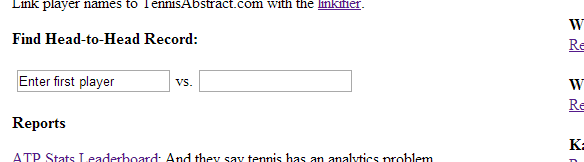
Let’s start with the H2H. There have always been a variety of ways to find head-to-head records on the site, and now I’ve made it easier than ever, right on the front page:

521-1

Start typing, and you’ll get a drop-down menu of possible players. Choose one, select another player in the field to the right, and you’ll go straight to a list of career matches between the pair.

For quite some time, there have been other ways of getting H2H results, and sometimes those methods are quicker still. First, for any upcoming match at a current tournament:

521-2

The record shown for each matchup is the career H2H record. Click on it for the list of matches.

Next, there’s a one-click route from player pages. For any listed match on a player page, the “d.” (for “defeated”) is a link. Click on that link and you get the career head-to-head record of the two players involved in that match:

521-3

Finally, you can use the “Head-to-Head” filter in the left-hand column.

521-4

It takes a few more keystrokes than the other methods outlined here, but it’s a quick way to get any H2H with a particular player. Also, for power users, you can use that filter to generate a list of matches with multiple opponents:

521-5


Custom filters

Also new today is the addition of custom date and rank filters for WTA pages. These custom filters have been available on ATP pages for several months, though I suspect many of you have yet to discover them. They work exactly the same way for men’s and women’s pages.

Let’s say, for instance, you wanted to look at Serena Williams‘s record and results since she returned to the #1 ranking last February. Click on “Time Span” in the left hand column. You’ll see a long list of years. At the bottom of the list, click on “Custom” and use the drop-down menus to select specific start and end dates:

521-6

As an added bonus, the URL changes every time you use one of these custom filters, so once you’ve generated your list showing Serena’s 89-6 record since her return to the #1 spot, you can easily share it.

You can also get custom results for opponent ranking (the “vs Rank” filter). Let’s say you wanted to know Tomas Berdych’s record in the last year against players ranked inside the top 50, but outside the top 10:

521-7

Enjoy!