What Do We Make of Sofia Kenin These Days?

Sofia Kenin in her run to the Tokyo final last year

Is Sofia Kenin back? Was she ever gone? Was she ever there in the first place? Has any player so persistently defied categorization?

Big questions aside, Kenin is suddenly more relevant than she has been in at least 18 months. This time last year, she was suffering through a nine-match losing streak. She would add another bad patch in the summer and fall out of the top 150 before reaching last October’s Tokyo final. Since then, she has lost only one first-round match (when she drew Coco Gauff in Melbourne) and made another 500-level final in Charleston. Kenin had set point on Sunday to force Jessica Pegula into a third set before the veteran summoned her mysterious forces and finished the job.

This is all a far cry from 2020, when the American bracketed the pandemic pause by winning the Australian Open and reaching the French final. But her Charleston showing moves her ranking back up to 34, the highest it has been since late 2023. Her Elo rating is even better, good for 25th on tour.

What is working again for Sonya? Is she back in the top 40 to stay?

Oh, those groundstrokes

When the Kenin game is clicking, it is a joy to watch. She is one of the most versatile players on tour, with the ability and willingness to deploy just about every shot in the book. She tried ten drop shots in the Charleston final against Pegula and sent both forehand and backhand slices across the net. I’ve even seen her win points with moonballs.

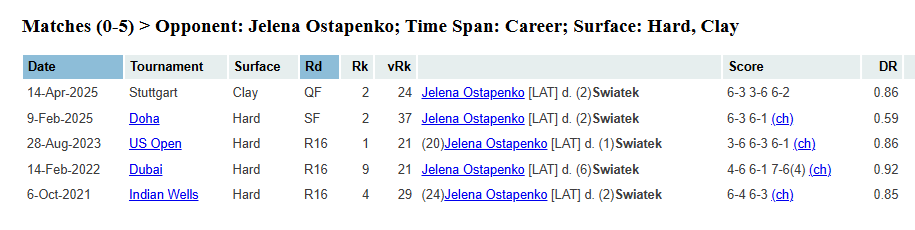
In the 2020s WTA, though, versatility can only be the icing, not the cake. Fortunately for the 26-year-old, both her forehand and backhand are among the game’s best. By my Forehand Potency (FHP) metric, she ranks 16th on tour over the last 52 weeks, in between the fearsome weapons of Iga Swiatek and Amanda Anisimova. Her backhand is the signature shot, and it rates even better, coming in 9th.

Combined, she gets more value from her groundstrokes than almost anyone else. Here is the top ten, based on charted matches since this time last year:

Player                 FHP/100  BHP/100  Combined  
Jelena Ostapenko          18.7     11.0      29.7  
Amanda Anisimova           9.2     14.1      23.3  
Aryna Sabalenka           13.0      9.3      22.3  
Ekaterina Alexandrova     13.6      8.5      22.1  
Danielle Collins          12.7      9.0      21.7  
Linda Noskova             14.1      7.4      21.5  
Iga Swiatek               10.0      9.0      19.0  
Madison Keys              11.3      7.5      18.8  
Sofia Kenin                9.4      7.8      17.2  
Jessica Pegula             8.3      8.0      16.3

For all the heavy hitters on that list, Kenin is more like Pegula than the rest. She attempts to dictate with placement, not power. Give her an opening, and she’ll rarely squander it. She’ll miss as much as some of these sluggers, but that’s because she relentlessly aims for the lines. The overall tally tilts in her favor.

She falters when she doesn’t have enough space to work with. Pegula, boasting perhaps the best anticipation of anyone on tour, consistently cut down the angles Kenin had to work with on Sunday. Sonya doesn’t have the patience to wait for the next opportunity, so she aimed for narrower and narrower spaces. The result, predictably, was a giant pile of unforced errors. She committed 33 of them off the ground–nearly one in four points.

Speaking of patience: That’s one category where she resembles the power hitters on that last list. Her average point in the past year has averaged just 3.4 shots, the same as Madison Keys and Ekaterina Alexandrova, fewer than Clara Tauson or Donna Vekic. A bit of a paradox is emerging here: Kenin has an impressive range of all-court and defensive skills, but she doesn’t play like it.

Is she a… servebot?

The American doesn’t seem like a weak returner. Aggressive, yes. Too aggressive, maybe. But any woman with such an effective backhand should be able to post decent numbers against the serve.

Yet: It is a constant struggle to break serve. The typical player in the WTA top 50 breaks 37% of the time. Swiatek grades out at 45.5%, and several more women top 42%. Pegula stands at 38.5%. Kenin, at 30.3%, ranks 48th of 50. Here are her peers at the wrong end of the list:

Player                Break%  
Lulu Sun               19.7%  
Linda Noskova          28.4%  
Sofia Kenin            30.3%  
Katie Boulter          30.8%  
Clara Tauson           31.2%  
Magda Linette          31.5%  
Xin Yu Wang            32.0%  
Donna Vekic            32.6%  
Ekaterina Alexandrova  32.9%  
Barbora Krejcikova     33.1%

Judging by some of these names, Kenin might be able to sneak into the top 20 with this return game. Vekic is 20th on the WTA points table. Tauson is 21st.

If there’s one characteristic that ties many of these players together, it is that their results run hot and cold. Krejcikova has won two slams but often struggled to get past early rounds. Noskova is a nightmare for Iga but manageable for others. Low break rates mean that the margins will always be narrow: Good for upsets and the occasional hot streak, bad for any semblance of consistency.

Kenin essentially takes the racket out of her own hands. Of players with at least ten matches in the charting database over the last year, only Danielle Collins puts fewer returns in play:

Player                  RiP%  RiP W%  
Danielle Collins       61.9%   55.7%  
Sofia Kenin            62.5%   54.0%  
Ekaterina Alexandrova  63.2%   58.3%  
Amanda Anisimova       64.3%   58.9%  
Alycia Parks           65.9%   59.6%  
Linda Noskova          66.4%   53.9%  
Liudmila Samsonova     66.9%   56.6%  
Barbora Krejcikova     67.3%   53.9%  
Bianca Andreescu       67.4%   54.4%  
Madison Keys           68.1%   57.6% 

A lot of these names are starting to look familiar. As with the FHP/BHP lists, Kenin shares space with some of the game’s biggest hitters, even if I wouldn’t think of her that way. Maybe she disagrees: She certainly takes chances on return as if she does.

Yet the results aren’t there. The rightmost column, winning percentage on returns in play, shows that Kenin trails Collins, Alexandrova, Anisimova, and most of the rest by a healthy margin. She is roughly equal to Noskova and Krejcikova, though the Czechs get more balls back to start with. It’s fine to win 54% of points if the denominator is big enough–to take one example of many, Paula Badosa stands at 52%–but Sonya loses too many points without forcing the server to hit even one more ball.

As for the question in my subhead: No, Kenin isn’t really a servebot. Her serve itself ranks in the middle of the pack. But alas, her return stats are better suited to someone with a much more powerful first strike.

Same as the old Kenin?

It is tempting to conclude that Sonya’s 2020 was a remarkable streak of luck. She won the Australian Open after sneaking past Ashleigh Barty in the semi-final, winning fewer than 51% of points. She picked up the Lyon title a month later with four three-setters and five tiebreaks. She reached the Covid Roland Garros final even though Samsonova won more points than she did in their first-round encounter.

On the other hand, Kenin is a fundamentally different player than she was five years ago. One indicator is her now-languishing break rate:

Year  Break%  
2018   34.0%  
2019   34.0%  
2020   34.7%  
2021   33.9%  
2022   23.3%  
2023   31.5%  
2024   28.3%  
2025   30.9%

34% or 35% isn’t great, but it’s worlds apart from where she is now. Rybakina, while off her own peak lately, gets by with just 36%.

Back then, the American wasn’t so quick to pull the trigger. Based on the 17 matches we have in the charting database, her average point in 2020 lasted 4.1 strokes, another sharp contrast to her 3.4 of the last 52 weeks. 4.1 is at or above tour average, equal to Coco Gauff’s usual mark.

A big part of the difference is that she put more returns in play. In those 2020 matches, she got 71.7% of serves back, nearly ten percentage points higher than her current rate. She also won more of those points:

Span      RiP%  RiP W%  
2020     71.7%   55.0%  
Last 52  62.5%   54.0%

By just about every metric I have, Kenin is more aggressive now than she was at her best, and the strategy isn’t paying off. Perhaps she feels that she has to hit harder–or at least adopt tactics that mimic her more powerful peers–to keep up. Maybe she has lost a bit of quickness: Ankle and foot injuries sidelined her for much of 2022.

2020-era Sonya, then, is not back. Her form over the last six months suggests she might have landed on something that will work, if not anywhere near her peak level. The stats keep telling us she’s just like Alexandrova, and the risk-taking Russian has spent years in the top 30, picking up a title every year or so and making trouble for her higher-ranked peers. Kenin is on track to do the same.

Yet unlike Alexandrova, Anisimova, and the rest, Kenin is a former slam champ, with memories of an entirely different level of tennis. Performances like Tokyo and Charleston suggest she is getting closer to recapturing that magic. If she starts getting more serves back, then it’s time for the rest of the tour to worry.

* * *

Subscribe to the blog to receive each new post by email:
 

Trivia Notebook #4: Number Ones, Past and Future

Would Medvedev now settle for this?

Previous: Trivia Notebook #3

Welcome back for some more trivia! Again, thanks to all those who have suggested topics. Feel free to drop them in the comments here, on Twitter, etc.

Today we’re going to look at Daniil Medvedev’s high ranking sans finals, revisit what would make a good year-end showing for Joao Fonseca, and see who has beaten multiple number ones (past, present, or future) in the same tournament.

Daniil’s Drought

Daniil Medvedev hasn’t won a title since 2023; he hasn’t reached a final since Indian Wells in 2024. He won plenty of matches last year–Wimbledon semi, US Open quarter–so when he lost at Indian Wells last month, he was still ranked sixth in the world. He has now fallen out of the top ten, but for a fortnight, he was a top-tenner without a single final in the previous 52 weeks.

That is unusual:

Since 1982, the beginning of my reliable week-by-week ATP rankings data, only a few dozen players have held a place in the top 30 without the points from a single final.

Only nine have clung to a spot in the top 20. (I’m not counting Roger Federer, who remained in the top ten after the Covid-19 pause and held on to a top 20 place for a long time because of the pandemic adjustments to the ranking rules.)

Medvedev is not the first top-tenner, but his ranking in Miami is the “best” of all-time:

Rank  Player                 Date  
8     Daniil Medvedev    20250317  
10    Fernando Gonzalez  20100301  
19    Goran Ivanisevic   20020701  
19    Lucas Pouille      20191014  
20    John McEnroe       19921026  
20    Gaston Gaudio      20060731  
20    Andrei Medvedev    20000529  
20    Petr Korda         19990125  
20    Mardy Fish         20120813

(Each player is listed only once, with their best ranking. Most of them spent multiple weeks in the top 20 without the points from a final.)

Gonzo had seven semi-finals to his credit, including Rome and Roland Garros. His final-less ranking position is the only one that comes close to what Medvedev has (not) achieved lately.

Fonseca’s company

In the first Trivia Notebook, I looked at big ranking leaps into the top 100. The goal was to find some context for Joao Fonseca, who started the year at #145 and had already reached an Elo rating in the top 50. Sure enough, his position on the official table has quickly followed. He’s up to 59th, and he doesn’t have many points to defend for the rest of the year.

And he’s up to 11th on my Elo list. That’s not a guarantee he’ll climb so high on the ATP table, but it suggests he won’t be 59th for long.

A one-hundred point leap into the top 50, as it turned out, wouldn’t be all that historic. Eric J followed up to ask:

How high would he have to get from his starting position for it to be a historically interesting result?

Let’s say that the reference class for Fonseca consists of players who finished a year ranked between 120 and 180. Again going back to the early 80s, here are the players from that group who reached the best rankings in the following year:

Player               Year  YE-Rk  Next YE  Gain  
Goran Ivanisevic     2000    129       12   117  
Mikael Pernfors      1985    165       12   153  
Andy Roddick         2000    156       14   142  
Paradorn Srichaphan  2001    120       16   104  
Fernando Gonzalez    2001    139       18   121  
Henrik Holm          1991    131       19   112  
Nicolas Jarry        2022    152       19   133  
Jan Lennard Struff   2022    150       25   125  
Jan Siemerink        1990    135       26   109  
Milan Srejber        1985    121       27    94  
Claudio Mezzadri     1986    138       28   110  
Bohdan Ulihrach      1994    142       28   114  
Dmitry Tursunov      2012    122       29    93  
Francisco Cerundolo  2021    127       30    97  
Tommy Robredo        2000    131       30   101  
Michael Chang        1987    163       30   133

(“Year” refers to the season with the ranking between 120 and 180: The breakthrough came the following season.)

No one has ever gone from a ranking in this range to the top ten. Fonseca has a chance to be the first.

Perhaps more to the point is how the Brazilian would stack up against other teens. Most of the players on that list are young, but the whole notion of “ranking leaps” can distract us from what really matters.

Fonseca will be 19 at the end of the year. Here are the last ten teenagers to finish a season in the top 20:

Player           Year  YE Rank  
Carlos Alcaraz   2022        1  
Holger Rune      2022       11  
Novak Djokovic   2006       16  
Andy Murray      2006       17  
Rafael Nadal     2005        2  
Richard Gasquet  2005       16  
Andy Roddick     2001       14  
Lleyton Hewitt   2000        7  
Andrei Medvedev  1993        6

Pretty good company. Again, there’s a lot to do in the next seven months or so. Elo is a good forecasting tool, but the exact timeline is much tougher to get right. If Fonseca does live up to expectations on schedule, he’ll be in elite company.

Defeats of past and future

In the February roundup, I linked to full match video of Andy Murray’s 2005 US Open match against Arnaud Clement. Edo took the cue and charted the match (he’s now past the 1,700 mark!), and he observed that in the same tournament, Clement beat Murray–then a future number one–and former top dog Juan Carlos Ferrero.

Pretty good run for the 91st-ranked Frenchman, especially in retrospect. Alas, he lost to Nicolas Kiefer in the third round.

It turns out that a lot of players have beaten multiple (past, present, or future) number ones in the same tournaments. It’s especially common in eras where several men have cycled through the number one position: Not only are number ones comparably weaker, there are more opportunities.

Let’s strengthen the parameters to make it more interesting. How many players have done the same as Clement, beating a former number one and a present or future number one at the same event, while ranked outside the top 50 himself?

Clement is one of 25 men to accomplish the feat. But the Frenchman is an even more unique case. He is one of just two players–Slava Dosedel is the other–to have done it twice! A year after his US Open run, he beat Lleyton Hewitt, Marat Safin, and Murray again (also charted by Edo) to win the Washington title.

Dosedel is the only man to have done this on multiple surfaces. He won the 1996 Munich title with wins over Boris Becker and Carlos Moya on clay. Then he defeated Jim Courier and Pat Rafter at the 1999 Adelaide event, before–get this–losing to Hewitt.

Clement and Dosedel both came along in the right era for this: 24 of the 27 instances took place between 1995 and 2006. The only example since 2006: the 2018 Australian Open, when Hyeon Chung knocked out both Novak Djokovic and Daniil Medvedev.

Most impressive of all is a run you’ve surely heard about before. Goran Ivanisevic claimed the 2001 Wimbledon title as a wild card, with wins against former number ones Moya, Rafter, and Safin, plus a victory over future number one Andy Roddick. That single tournament–not to mention Goran himself–continues to be the trivia answer that keeps giving.

See you next time!

* * *

Subscribe to the blog to receive each new post by email:
 

Monthly Roundup #3: March 2025

The “under-the-hill gang,” pictured in the March 1975 issue of Oui magazine.

Previous: February

Off we go…

1. One of the Miami quarter-finals pitted two guys who I have recently highlighted as having weak still-developing second serves, Arthur Fils and Jakub Mensik. Mensik advanced, yet neither one showed much progress in that problematic category:

For Mensik, 50% isn’t bad.

2. Electronic Line Calling (ELC) is here, and it is quickly spreading to the lower levels of tennis. Colette updates us on the status of ELC in college tennis, where players previously called their own lines.

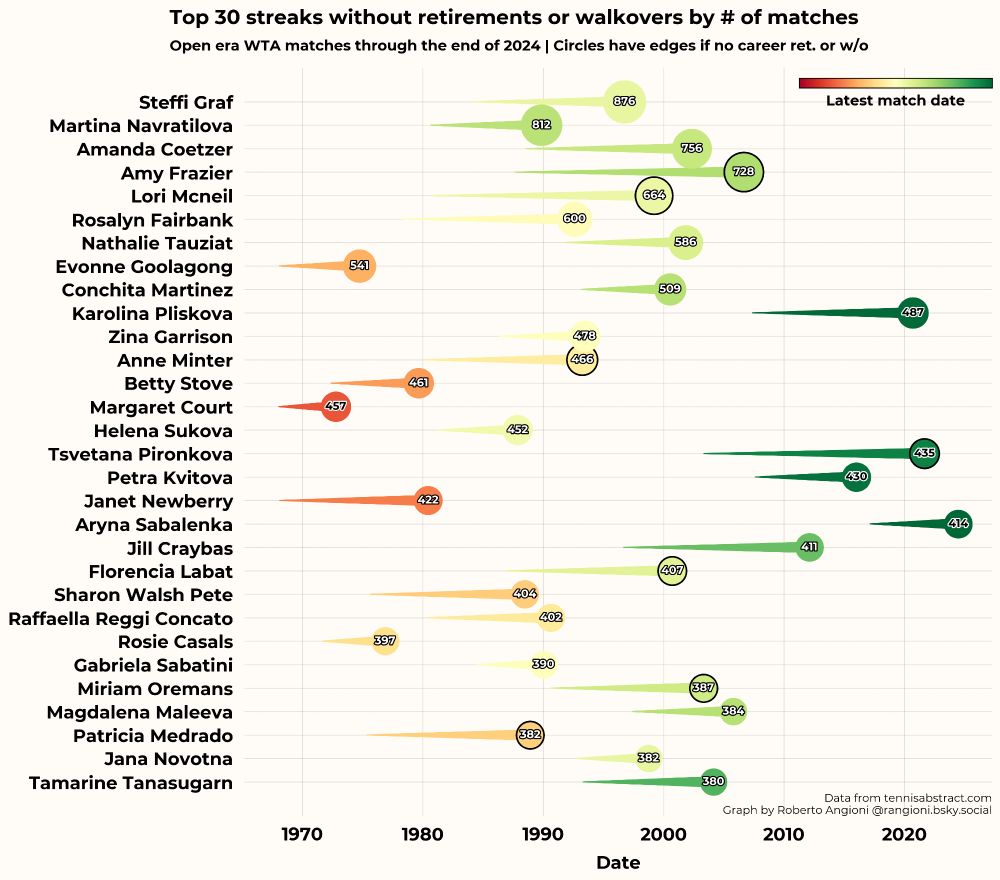
3. Roberto made a nice graphic of the longest non-retirement streaks in WTA history:

There’s a men’s version, too.

4. RIP Yola Ramirez, the greatest Mexican tennis player in history. She was twice a French Open finalist and picked up two doubles major crowns.

My records, which are not 100% complete, give her a career singles record of 376-144, spanning the era from 1951 to 1972. She amassed at least 51 career titles, almost all on clay. In five of them, she defeated women who made my Tennis 128 list: Maria Bueno, Darlene Hard, Ann Jones, and Nancy Richey.

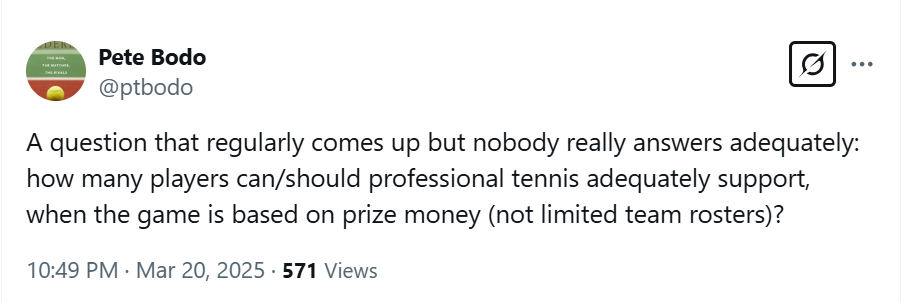
5. The PTPA filed a lawsuit against various tennis bodies, and it raised the usual crop of questions and takes about tennis finances. I appreciate Pete Bodo for framing at least part of it so clearly:

Tennis has sometimes tried to manage the number of players considered to be pros, for instance by limiting the number of tournaments/round that grant ranking points. But as Pete hints, that isn’t the issue. If there’s a pot of gold for top players, there will be an endless supply of aspirants, whether those aspirants are globetrotting juniors, college players, ITF warriors, or Challenger tour regulars. Enough people out there have federation or family support that they can chase their dreams without earning anything like a living wage (or in some cases, anything at all).

In practice, the answer is “the number of players who make grand slam qualifying cuts.” But even that is too vague, because players don’t necessarily stay at that threshold for long. All this is to say: People who lobby for a different financial structure should start with these questions. How many players should earn a living wage from tennis? And then, what changes would be necessary to make that happen?

5. Patrick Ding writes about women’s tennis like no one else does, often covering players you haven’t heard of. Here he is on the scheduling decisions of Tereza Valentova.

6. There’s a tennis element in the new BBC series, Towards Zero, based on an Agatha Christie novel. Simon Briggs looks into the true story behind the fiction:

On the tennis court, Strange and Goold were each renowned for their “killer” backhands – a detail which becomes a key plot point in the book. And if Christie has transposed the drama from the French Riviera to the English one, that is probably because of her own upbringing in Torquay.

7. Ben Marrow built a tennis twist on a basketball dataviz I included in last month’s roundup:

He also made a slick interactive version.

8. If you’re not reading Andrea Petkovic, well … maybe this, about Monica Niculescu will finally get you started?

She was an immensely talented player who did everything she could to mess with your technique and I’m not afraid to admit that it worked. I got my revenge once we were older and I was taller and stronger and didn’t have a complete meltdown every time she hit a slice. But the panic reared its ugly head until the very end of my tennis player’s days whenever I saw Moni Niculescu near me in the draw. Some things fade, some things are forgotten but Monica Niculescu remains forever.

Great stuff about Aga Radwanska and others in the same article.

9. Alison Riske is up and running on Substack, too. Her first update is about all things Charleston.

10. RIP Juan Aguilera, 1990 Hamburg champion. He peaked at #7 in the world, scored seven top-ten wins, and never made the trip to Australia.

11. This month’s match video is the 2004 US Open third-rounder between Venus Williams and Chanda Rubin:

Venus wasn’t playing her best tennis–she lost in the next round to Lindsay Davenport–but it was a good effort from Chanda nonetheless. I happened to see one of Rubin’s earlier-round matches that year on a side court. All I remember is one of the few other fans, with a thick Caribbean accent, incessantly shouting “Go Chanda!”

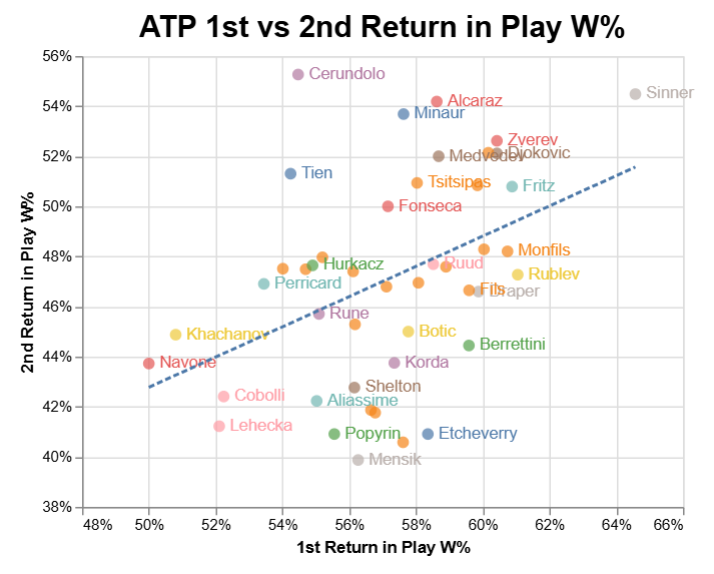
12. I almost scratched this monthly roundup so I could write about Francisco Cerundolo today instead. I can’t stop thinking about his position on this graph from my Mensik post:

Cerundolo is even more of an outlier than Mensik, just in the opposite direction. He’s a bit below average in putting first serves away when the return comes back, but he’s better at converted in-play second serves than anyone else on tour.

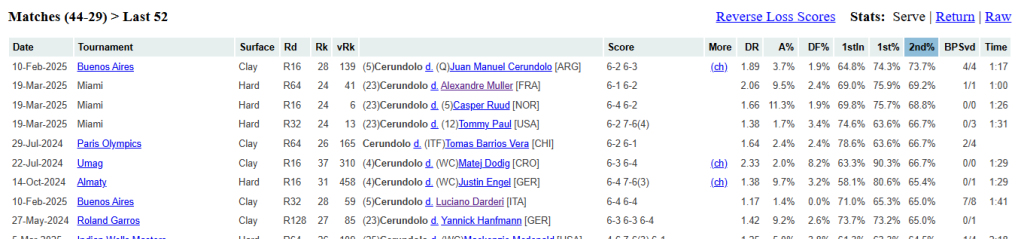
This isn’t exactly the same as second-serve winning percentage, but it’s closely related. The Argentinian blew everybody away in the more standard category in Miami:

The streak lasted even a bit longer: Cerundolo won 70% of second-serve points in the first set of his quarter-final against Grigor Dimitrov. Alas, he finally came back to earth–37% in the final two sets–though he nearly won the match anyway. If he can keep this up away from the South American Slam, it will merit a longer treatment.

13. Here’s some new (in English) research into the Sumarokov-Elstons, the first family of pre-Soviet Russian tennis.

14. One more that we lost this month: RIP John Feinstein. He was better known as a golf and basketball writer, but he covered tennis as well, including the 1991 book Hard Courts. Pete Bodo wrote a nice remembrance, and I enjoyed this thread from a colleague.

15. Now that Alexandra Eala has ignited tennis mania in the Philippines, how long until we get a WTA event in Manila? There has been some tennis in the islands for more than 100 years, and competitive women’s tennis back to at least 1935. Eala is surely the best from the country so far, though I did notice that early champ Minda Ochoa upset visiting American Helen Marlowe–a two-time national junior finalist–in 1936.

16. Forgot this one last month: In her WTA debut in Austin, Malaika Rapolu got called for a time violation on return. I know it’s not unprecedented, but it’s rare enough to be a harsh welcome to the tour. Now, umpires just need to apply the same standards to players inside the top 500.

17. Tennis execs are surely paying attention to the TGL, an indoor, team-based, simulator-driven golf tournament that just wrapped up. With an eleven-week season, it requires more buy-in than any tennis upstart is going to get; in that sense, it more closely resembles 1970s-era World Team Tennis. The high-tech approach seems to have worked, deviating from the traditional version of the sport more than any tennis exhibition ever has.

18. One more non-tennis note: I recently read James Astill’s The Great Tamasha, about Indian cricket from its beginnings to the (then–the book was published in 2014) new Indian Premier League. Another example of a sport ramping up fan engagement and shortening formats, and succeeding.

This, though, is what will stick with me:

[Bengali sociologist Ashis] Nandy shook his head. ‘I don’t see much of cricket in this IPL business. It is simply a degraded form of the game. What is the point of it? Is it an effort to catch up with other sports? Why? So many sports are so similar. Why can they not allow us to have one game to be different?’ He paused, and gazed into space. He looked bereft.

19. Someone complained about the lack of music last month, so here ya go:

* * *

Subscribe to the blog to receive each new post by email:
 

Jakub Mensik, Giant Killer

Watch out

On Saturday, Jakub Mensik did it again. Jack Draper was coming off an Indian Wells title, the fortnight of his career, but Mensik was a little bit better. Both sets went to tiebreaks, and twice, at six-all, the 19-year-old Czech took his serving to a new level. He won 14 of 19 tiebreak points and sent the Brit home early.

After such an assured performance, Mensik’s third-rounder felt like a gimme. Roman Safiullin gave him two looks at break points, and that’s all he needed. Behind another monster serve barrage, the Czech waltzed into the fourth round, 6-4, 6-4.

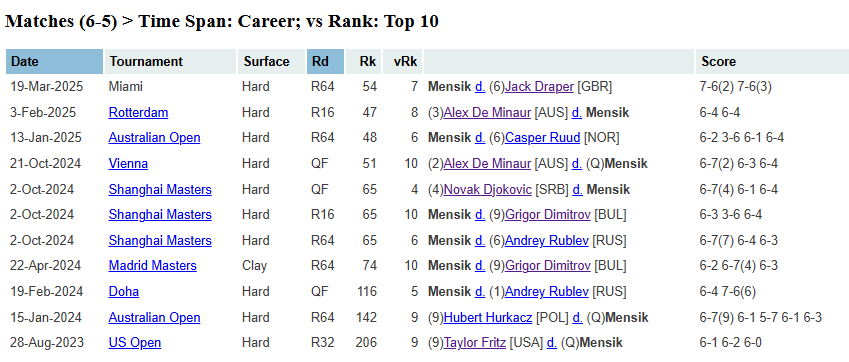
Mensik currently stands outside the top 50, but his ranking doesn’t tell the full story. For one thing, he made his top-50 debut late last year, and his Miami points will almost certainly be enough for him to return. Beyond that, he has proven that he fears no one on tour. Draper was his 6th top-ten win in 11 tries. What’s more, Mensik won a set in three of the five losses, including a meeting in Shanghai last fall with Novak Djokovic.

Djokovic called him “one of the best servers we have in the game.” Indeed, since the US Open last year, the six-foot, four-inch Mensik is cracking aces on more than 15% of his serve points. Only Giovanni Mpetshi Perricard and Quentin Halys rate better among tour players. He has taken things to a new level in Miami. In each of his three matches–against Roberto Bautista Agut, Draper, and Safiullin–he has hit an ace on at least 26% of his serve points. That’s Reilly Opelka-level serve dominance, and even Opelka hasn’t posted three straight ace rates like that since 2022.

Mensik is one of the most exciting prospects on tour, yet Joao Fonseca-mania doesn’t leave much attention to anyone else. What do we make of those top-ten wins… and the non-top-ten losses that have kept him on the edge of the top 50? How should we rate the rest his game–you know, those occasions when he doesn’t end the point with a first serve? Let’s dig in.

Proof of concept

Here is the top-ten record:

Pretty good for someone with another five months left in their teens.

Draper wasn’t the first top-tenner that Mensik overpowered. In the six wins, the Czech held serve 90% of the time, winning three-quarters of first serve points. Djokovic and Alex de Minaur figured out how to neutralize the serve, but lesser returners (read: most other humans) have not.

Even before the Miami upset, Mensik was just the 21st player since the beginning of the ATP rankings to win at least five of his first ten meetings with top-tenners. (I’m excluding players who were already established in 1973, when the points table debuted.) He’s just the 12th ever to win six of eleven. Here’s the full list:

Player               First 10  First 11  
Alberto Mancini           7-3       7-4  
Miloslav Mecir            7-3       7-4  
Fernando Gonzalez         6-4       7-4  
Marc Kevin Goellner       6-4       7-4
Lleyton Hewitt            6-4       6-5  
Jakub Mensik              5-5       6-5  
Ugo Humbert               5-5       6-5  
Marcos Baghdatis          5-5       6-5  
Marat Safin               5-5       6-5    
Carlos Moya               5-5       6-5  
Chris Woodruff            5-5       6-5  
Magnus Larsson            5-5       6-5  
Boris Becker              5-5       6-5  
Fabian Marozsan           5-5       5-6  
Aslan Karatsev            5-5       5-6  
Matteo Berrettini         5-5       5-6  
Reilly Opelka             5-5       5-6  
Mardy Fish                5-5       5-6  
Nicolas Kiefer            5-5       5-6  
Henrik Holm               5-5       5-6  
Greg Holmes               5-5       5-6

It’s a strong list, if a bit scattershot. We have all-time greats, plus Aslan Karatsev and Greg Holmes, who apparently upset both Mats Wilander and Jimmy Connors. The playing styles might tilt a bit toward heavy hitting and big serving, but not overwhelmingly so.

I mention playing styles because rocket serves, like Mensik’s, have a way of turning matches into coin flips. If the serves aren’t coming back, it doesn’t matter how well the guy returns. Other skills fall by the wayside: We’re headed for a tiebreak. Apart from a pair of early breaks, that’s what happened in the Draper match. John Isner won three of his first ten top-ten encounters, and Opelka earned a spot on this list.

Everything else

When the serves do come back, though, it’s anybody’s ballgame, top-ten opponent or not. For Mensik, just about everything apart from the first serve is a relative weakness. In the last 52 weeks, he has won just 47.4% of his second-serve points, worse than 49 of the top 50 players. (Pedro Martinez is the one guy with a sub-Mensik number.)

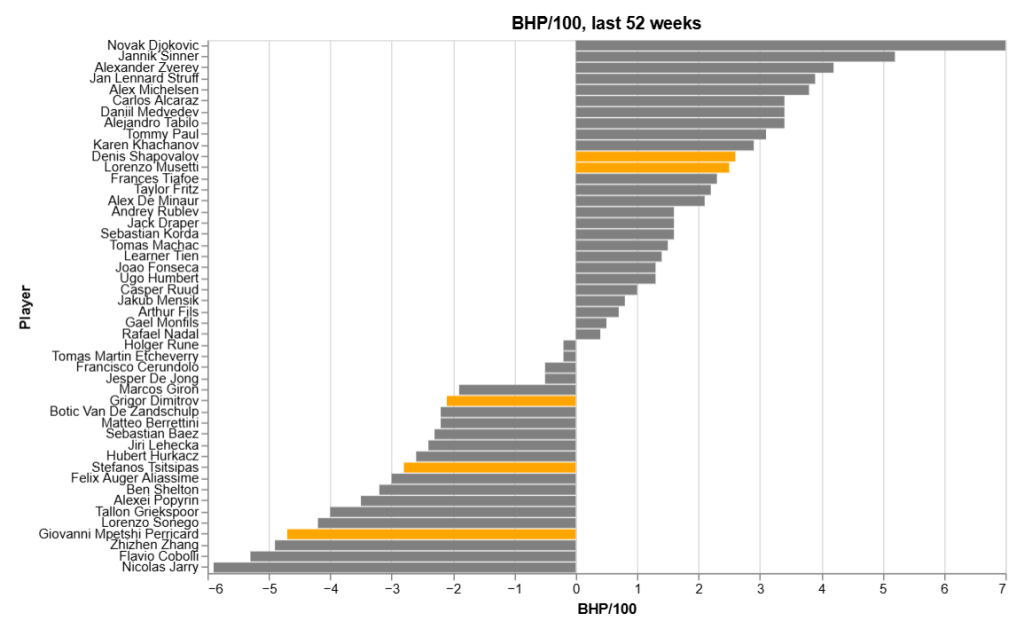
The Czech has gotten accolades for his backhand, but it’s not really a weapon. While it doesn’t hold him back, it rates about tour average by my Backhand Potency (BHP) metric. His Forehand Potency is the real issue. At just +1.1 per 100 forehands, he ranks ahead of only a few of his colleagues, including Opelka, Mpetshi Perricard, and Hubert Hurkacz. Hurakcz has proven that it’s possible to hang around the top of the game without much help from the forehand, but it’s a narrow path to follow.

All this adds up to some painful numbers in rallies. I was going to say “long rallies,” but Mensik starts to see a disadvantage about as soon as the word “rally” comes into play. In eleven charted matches over the last 52 weeks (not counting the Draper upset), here are how his results shake out by rally length:

Length      Win%  
1-3 shots  52.2%  
4-6 shots  45.3%  
7-9 shots  41.9%  
10+ shots  42.0%

52% on short points is great! That was enough to crack the top ten list when I looked at the same category last week in the context of Draper’s excellence. Since these stats encompass both serve and return, it tells us that he’s cleaning up more of his own quick points than his opponents can manage of their own.

The rest of the story, though, is bleak. He ranks near the bottom in all three of the other categories. If we lump them together, he win the fewest points of anyone with at least ten charted matches in the last year:

Player              1-3 W%  4+ W%  
Jakub Mensik         52.2%  43.8%  
Mpetshi Perricard    51.6%  43.8%  
Zhizhen Zhang        48.5%  44.1%  
Jiri Lehecka         51.8%  44.2%  
Ben Shelton          50.5%  44.7%  
Hubert Hurkacz       55.0%  45.4%  
Lorenzo Sonego       52.5%  45.5%  
Tallon Griekspoor    49.8%  46.1%  
Flavio Cobolli       44.9%  46.6%  
Alexei Popyrin       50.4%  46.8%  
…                                  
Jack Draper          53.3%  48.8%  
…                                  
Stefanos Tsitsipas   50.5%  50.6%  
…                                  
Alexander Zverev     53.0%  53.1%  
…                                  
Novak Djokovic       53.7%  54.9%  
Carlos Alcaraz       52.5%  55.8%  
Jannik Sinner        54.4%  57.0%

Somehow, it gets even worse. With enough short points, weak long-rally skills are survivable. Yet Mensik plays more long points than most of these guys in the bottom ten. The 1-to-3-shot category accounts for less than 63% of his points, while it makes up more than 70% of Mpetshi Perricard’s. Even Jiri Lehecka, hardly an extreme case like GMP, comes in at 66%.

Second to last

Mensik is hardly an elite returner, but he is good enough for now. He has won about 37% of his return points over the last 52 weeks, a rate that–coupled with strong serving–is sufficient to get him into the top ten. Despite his relatively low ranking, he has posted those numbers against high-quality competition. His median opponent has been stronger than those faced by Stefanos Tsitsipas or Casper Ruud.

The immediate concern for the Czech is his second serve. I mentioned earlier that he wins barely 47% of those points. Ben Shelton, who wins exactly as many first-serve points as Mensik does, converts 55% of his seconds. While that’s unusually good, nearly every player in the same first-serve territory wins at least 51% behind the second serve.

This is a good time to remember that Mensik is 19. He hasn’t been six-foot-four for long. It’s possible that his second serve will look entirely different in two years than it does today. He’ll certainly hope so. He misses more than 12% of his seconds, a double-fault rate that would be acceptable only if he were taking chances and reaping the rewards of those risks. At the moment, he’s just struggling.

The second-serve weakness is more than enough to flip the outcome of a match. In the last year, when Mensik has landed at least 60% of his first serves, his record is 16-5. Under 60%, it’s 12-17.

The root of the problem is what happens when the second serve comes back. The Czech’s second delivery isn’t yet strong enough to generate many easy plus-one opportunities, and his ground game isn’t sturdy enough to make up for it. When his first serves come back, his results are close to tour average. But when the second serve comes back, he ranks at the very bottom of the table.

This scatterplot shows every player with at least ten charted matches over the last year. It compares each player’s win rate when their first serves come back with their results when second serves come back. Guys below the dotted line see relatively worse outcomes behind their second serve:

There’s no single limitation that is depressing Mensik’s second-serve results. The positive spin on that is that he has a lot of areas with room to improve. Even an average second serve–seemingly a reasonable goal for a man with such an imposing first–would probably make him a top-20 player.

The way forward

Nothing makes it easier to dream about a big future in tennis than a monster serve. Any list of overrated youngsters is going to be littered with powerful teens who remained too one-dimensional to convert all their aces into tournament victories.

That, I think, is the low-end forecast for Jakub Mensik. If he simply keeps doing what he’s doing, he could be a top-40 or top-50 player for a long time. His first serve is that good, and the rest of his game is adequate. He probably wouldn’t continue to win half of his top-ten meetings, since the game’s top players would have more time to figure him out.

On the other hand, again, he’s 19! The difference between his first- and second-serve results is a statistical oddity, which could mean either that he is uniquely one-dimensional, or that he has plenty of room to develop. The latter seems more likely. He may remain limited on return, but a second serve to match his first would make him near-unbreakable. That’s the recipe for a lot more top-ten wins, and possibly for a single-digit ranking of his own.

* *

Subscribe to the blog to receive each new post by email:
 

Are Second Serves Mostly Useless?

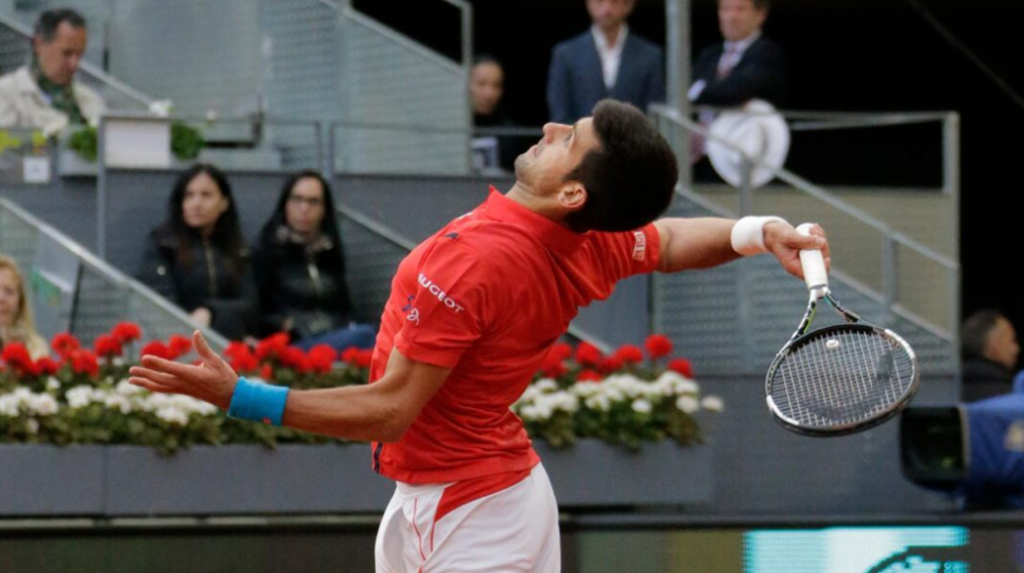
Novak Djokovic loading up for some topspin

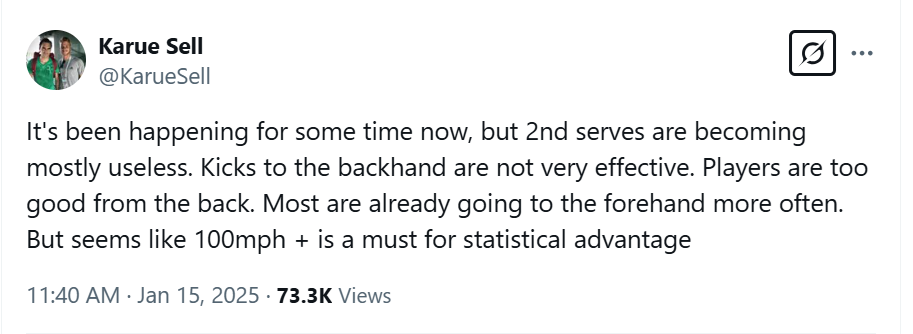
During the Australian Open, Challenger player (and Youtube star) Karue Sell made a bold statement:

Thank you, Karue, for posting this: It is always valuable to get specific claims about the game from the people who are trying to figure out how to win. Right or wrong, testable propositions like these help nudge our understanding in the right direction.

Now: Right or wrong?

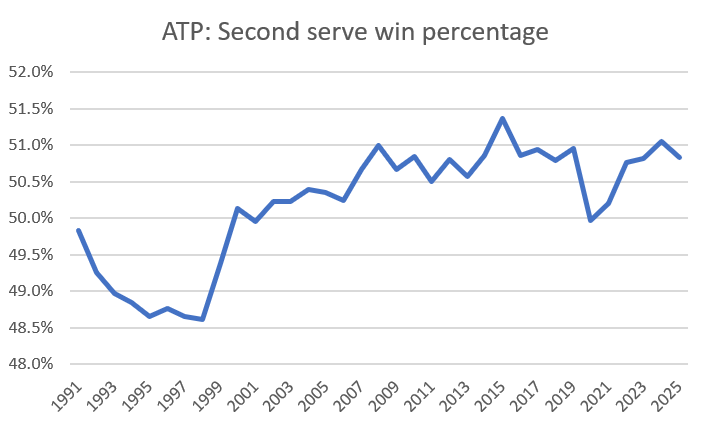
Are second serves becoming mostly useless? A first look at the data says no–or, at least, they aren’t becoming any more useless than they were before. Here is second serve win percentage for tour-level matches since 1991:

The important thing here isn’t the trend. It’s the narrowness of the values. The difference between the lowest and highest ticks on this graph is only three percentage points, and half of that happened before the century turned. Strength and strategy may be different–we’ll get to that–but the results aren’t. If anything, second serves have become (modestly) less useless.

This trend holds up even when we tweak the parameters. Yes, the surface mix of the tour has changed since the 1990s. But if we look only at hard-court matches, there’s an even tighter range of yearly averages, between 48.9% and 51.2%. At Sell’s Challenger level, I only have data back to 2010. In that span, hard-court second-serve win rates have drifted less than a single percentage point, between 49.7% and 50.6%.

I can’t help but notice that Sell’s own Challenger-level second-serve win percentage is a healthy 52%. I’m sure it sometimes feels useless: The last match he played before making the comment was a qualifying-round loss in which he salvaged less than 40% of second-serve points. But despite his relatively small stature, he won more main draw second-serve points last year than Matteo Berrettini did–albeit against weaker competition.

Risk and reward

No one wants to settle for historical average. Inevitably, someone brought up the notion of two first serves:

No, two first serves are not the way. But Sell recognizes what might work. At least in theory, players should take more risk on second serves (and perhaps on firsts, as well), hitting bigger and winning more points at the cost of more doubles.

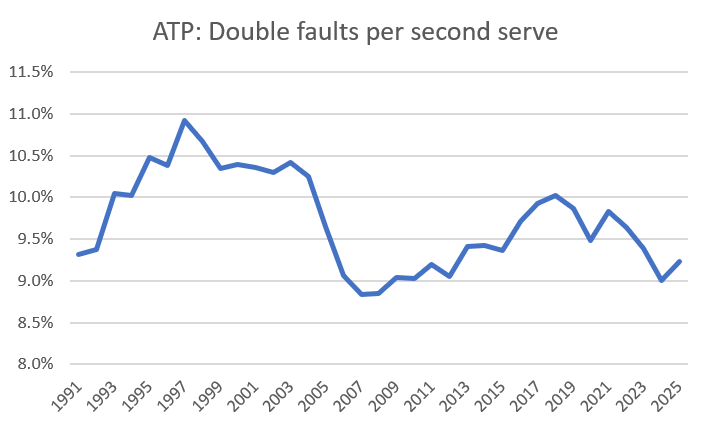
If tennis trends proceeded by opinion poll, I think we’d already see evidence of this. I certainly never see anyone argue that players should be more conservative with the second ball, unless they’re talking about a particular struggling player. But all that matters is what happens on court, and there’s no sign there of more double faults:

Again, the framing doesn’t matter. The numbers are about the same regardless of surface, and Challenger players have moved in the same direction. In fact, the 2025 Challenger rate so far is 9.8%, the first time that the minor leaguers have dipped below double digits.

To be clear, I wouldn’t expect any sudden moves here. A generation of players grows up learning certain serves and tactics, and there’s only so much they can do to change them. An equation might spit out that someone would win, say, 56% of second-serve points in exchange for accepting a 12% double-fault rate. But do athletes really have such fine-grained control of the risks they take? I suspect not, which means another generation may go by before we see a true “1 and 1.5” strategy.

Is 100 miles per hour a must?

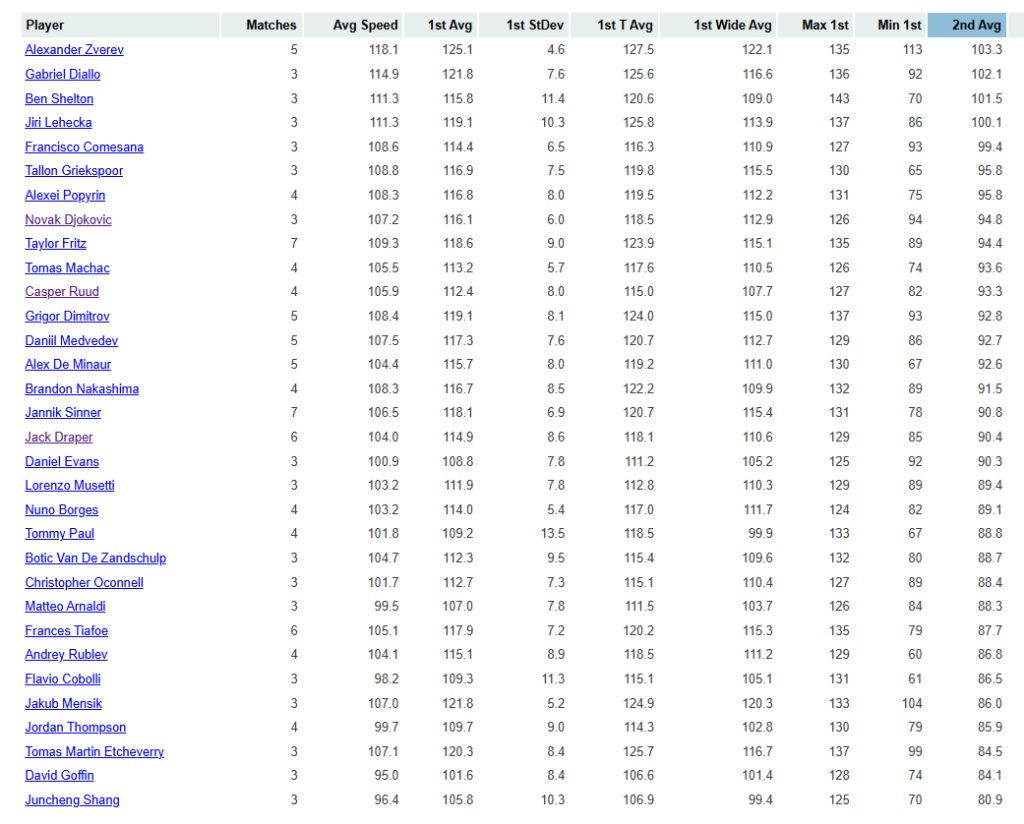
How fast do second serves need to be? While I can’t imagine any player would turn down a triple-digit average, we’re nowhere near that level. The rightmost column shows the average second-serve speeds at the 2024 US Open for every player who reached the third round:

Only 4 of 32 averaged triple digits. Just five posted a mark at or above 96 miles per hour. The dominant tournament winner, Jannik Sinner, barely topped 90.

It’s possible that the sensors (or the balls, or the humid conditions, or pick your variable) resulted in low readings: US Open speeds are typically several miles per hour lower than Wimbledon speeds, even for the same players. But the gap isn’t enough to push more than a quarter of these guys over the magic number.

Still, Sell could be correct on the trend, if not on the detail. Maybe second serves are getting faster, or slower second serves are more likely to end in a point lost.

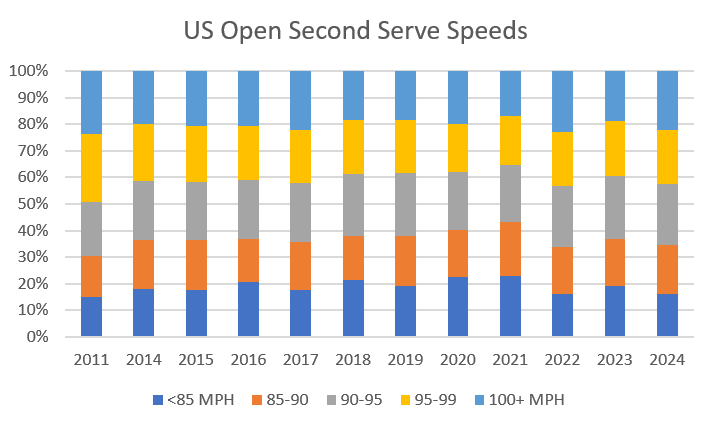
US Open data, though, suggests that second serves have stayed about the same. I have relevant data back to 2014, plus 2011. Splitting second serves into buckets of 100-plus miles per hour, 95-99, 90-94, and so on, it’s tough to find much of a trend:

(In case you’re wondering, the 2012-13 data has serve speeds, but no indication of first or second serves. Not very helpful here!)

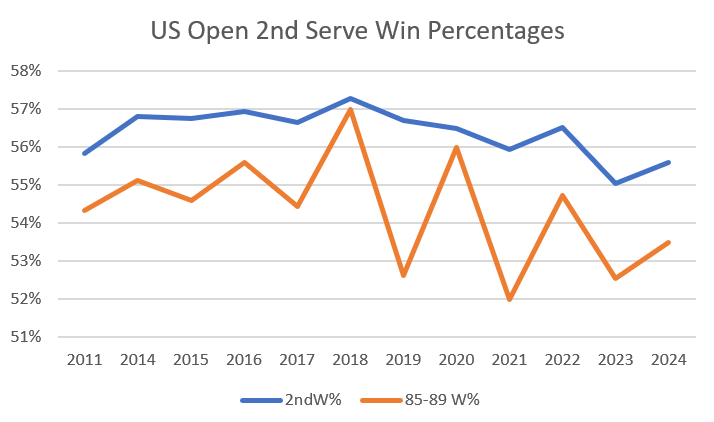
Same story with win rates. As with the tour in general, the US Open has seen a steady percentage of second-serve points won. The next graph shows year-by-year win rates both overall and for the 85-89 mile-per-hour bucket, on the theory that if returners were feasting on relatively weak seconds, it would show up there:

While the 85-89 mph results are noisy, there’s not much to see here. The overall win rate in 2024 is almost identical to what it was 13 years earlier. There’s a bit of space between 85-89 mph second serves in 2011 and 2024, but still not much.

It’s certainly true that harder is better, and that hasn’t changed. At every one of these US Opens, the win rate of 100-plusses exceeded the win rate of sub-85s by at least five percentage points, and the gap rose as high as ten points at the 2020 Covid event. But we’ve yet to find much evidence for the notion that second serve speeds or results are any different than they were 10, 13, or even 30 years ago.

Are servers going to the forehand more often?

Finally, we can say… maybe?

I pulled all hard court matches since 2014 between right-handers from the Match Charting Project database. (Hard court, because it’s so much easier to run around second serves on clay; 2014, because that’s when the project started, so there’s not as much bias toward big-name players and matches; right-handers, because lefties, while fascinating, make things way more complicated.)

The charts classify serves into three categories: Wide, body, and T. Second serves to the “body” usually aren’t good: Those are serves that didn’t find a corner. In the men’s game, that’s 35-40% of seconds. It’s tough to tell from the chart–and sometimes even when watching a match–exactly which side the server targeted, because it is so easy for the returner to take a step or two around it and hit a forehand.

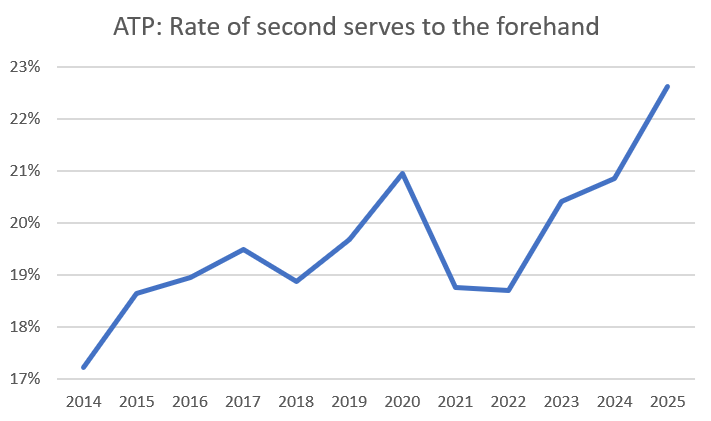
Servers are indeed more likely these days to find the forehand corner:

This isn’t an enormous move, but it seems like a real thing. If we throw out the 2020 Covid season, it would look like an even more dramatic shift just in the last few years.

However, more second serves to the forehand corner does not mean fewer second serves to the backhand corner. These extra forehand-targeted serves are coming at the expense of the mediocre “body” seconds. Servers drill the backhand corner 30% to 35% of the time, and that range hasn’t budged over the last decade.

I’d more inclined to say, then, that players have gotten a bit better. And they’ve chosen to use that improvement to keep returners off balance, aiming a few more second serves to the forehand side.

Are players too good from the back?

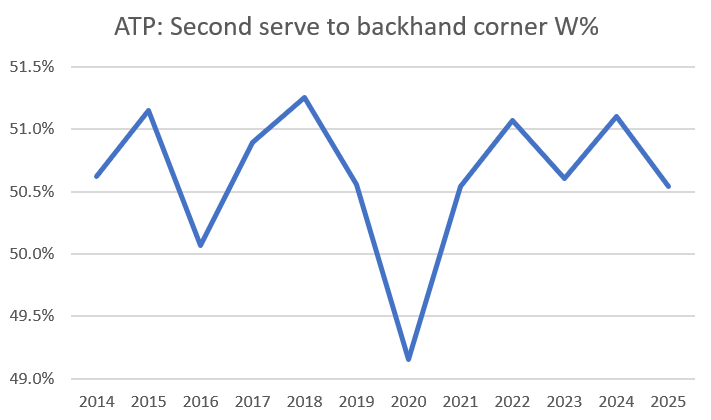
Sell’s theory is that more second serves are targeting the forehand, because the backhand is no longer such a weak side. We can use the same subset of MCP data to check how (right-handed) returners have fared against second serves to their backhand corner:

Again, 2020 is weird; other than that, we’re just looking at noise. (Or, possibly, the signature of a drunk blue M&M.) The long-term average of this stat is 50.6%, and in ten of the twelve seasons, the single-year number was within half a percentage point of that.

Backhand returns may have gotten stronger, but if so, serves are advancing at the same rate.

What gives?

Why would Karue identify trends that, for the most part, have so little evidence to support them?

First, the tour is getting stronger, at backhand returns and everything else. Some serves that would’ve gone unreturned in 2005 or 2015 are coming back today. As we’ve seen, servers are maintaining a balance. But it’s easy to suffer a few bad results and conclude that drastic changes have taken place.

Second, Karue himself played his best tennis last year. He cracked the top 300 for the first time and played a dozen Challenger main draws. That meant he faced stronger competition than ever. The Challenger tour is full of baseline battlers with sturdy backhands; there isn’t a huge gap between the return skill that Sell faces these days and the elite-level returning we watch on TV. Moving up from ITFs to Challengers means that some weapons don’t work anymore, and–especially for smaller guys–new tactics are needed.

I’d love to see Sell, or anyone else, give a serious trial to the “1 and 1.5” serve strategy. Hit seconds harder, attack the forehand more often, and accept more double faults. Karue might be right about what the future of second serves will look like, but we’re not there yet.

* * *

Subscribe to the blog to receive each new post by email:
 

Trivia Notebook #3: Indian Wells Upset Edition

Belinda Bencic in 2023. Credit: LHC88

Previous: Trivia Notebook #2

Thanks to all who have suggested trivia topics — you’ve sent me some good ones. Keep them coming. Today I’ve got tidbits on three winners from Indian Wells: Belinda Bencic, Tallon Griekspoor, and Camila Osorio.

Better Belinda Bencic

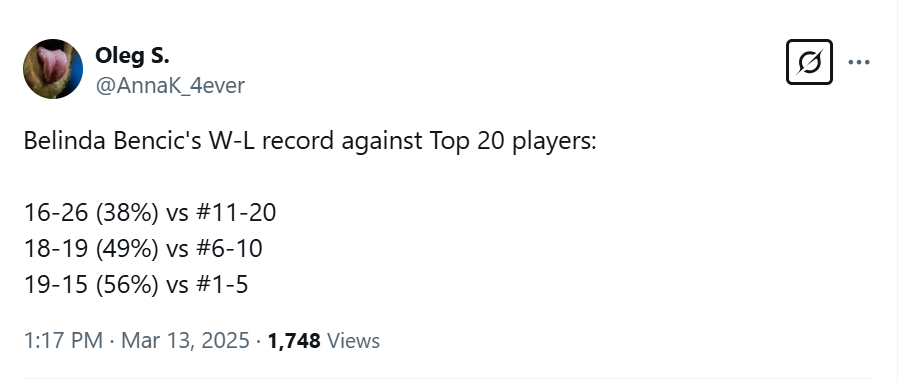
Great dig from Oleg:

Those numbers include Bencic’s upset of Coco Gauff, but not her loss yesterday to Madison Keys. So the current top-five tally is 19-16, still comfortably better than her record against the next five, or the next ten after that.

The top five typically does not allow things like this. Since 1984, when my week-by-week ranking data begins, the WTA top five has won 79% of matches. That’s a healthy margin ahead of 69% for players ranked 6-10 and 64% for 11-20.

So, is Bencic alone? We’re looking for players with plenty of meetings against each of the three groups. She has 35 or more against each; let’s set the bar lower, at 20. I found 151 such players. Of those, we want to find those who have a better winning percentage against the top five than against the next five, and a better winning percentage against 6-10 than versus 11-20.

No dice. Belinda is the only one. 18 women managed a better record against the top five than the next five:

Player                    W% v1-5  W% v6-10  
Serena Williams             76.5%     62.7%  
Belinda Bencic              54.5%     48.6%  
Karolina Pliskova           46.0%     39.5%  
Jelena Ostapenko            44.8%     37.0%  
Maria Sakkari               41.2%     39.4%  
Kristina Mladenovic         40.9%     33.3%  
Daria Kasatkina             40.5%     24.2%  
Donna Vekic                 37.5%     20.0%  
Flavia Pennetta             37.2%     28.6%  
Marion Bartoli              30.2%     29.7%  
Samantha Stosur             29.0%     26.4%  
Elise Mertens               25.0%     19.0%  
Iva Majoli                  23.9%     22.6%  
Katarina Srebotnik          23.8%     20.0%  
Barbora Strycova            17.9%      9.7%  
Marianne Werdel Witmeyer    17.4%     13.0%  
Karina Habsudova            17.2%     11.1%  
Raffaella Reggi Concato     17.2%      5.9%

(All of these numbers, including Bencic’s, exclude Indian Wells.)

Comparing records against “next five” and “ten after that” is a bit odd in isolation, so instead, let’s compare top-ten and next-ten records. That’s an even more limited group:

Player               W% v1-10  W% v11-21  
Belinda Bencic          51.4%      35.0%  
Kiki Bertens            47.9%      38.2%  
Anett Kontaveit         40.4%      40.0%  
Kristina Mladenovic     37.0%      34.0%  
Donna Vekic             27.8%      26.8%  
Tsvetana Pironkova      25.0%      17.2%  
Katarina Srebotnik      21.7%      20.8%

Lots of these margins are close; Belinda’s is not. Maybe this explains the recent downward ranking moves of Elena Rybakina and Jasmine Paolini. They fear their colleague from Switzerland, so they’ve fled the top five so as to give her less motivation.

Tallon Griekspoor is no Bencic

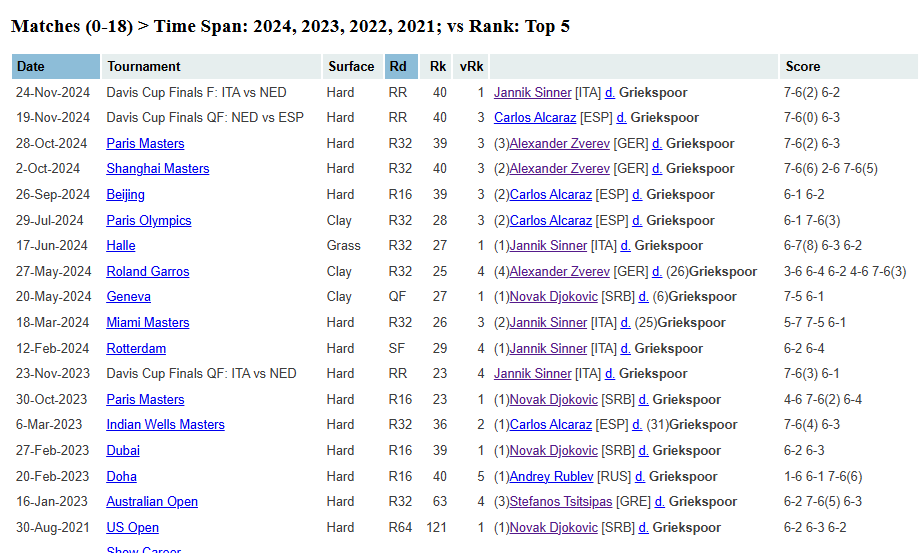
Heading to the desert, Tallon Griekspoor held a 0-18 career record against the top five:

Some good fights in there, but a zero is a zero. That changed last Friday, when the Dutchman outlasted Alexander Zverev in a third-set tiebreak. Zverev has given several men a top-five victory in the last few weeks, but it still counts.

We have a few questions, then:

  1. Is Griekspoor’s top-five losing streak the longest ever to start a career?
  2. Is it the longest to be broken?
  3. How does it compare to top-five losing streaks, including those that don’t start a career?

Losing your first 18 matches against top-fivers gets you into the conversation, but Griekspoor stopped five defeats short of the record. These numbers all go back to 1982, the first year for which I have week-by-week ATP rankings. Here’s the all-time list:

Player             Losses  Broken?  
Fabio Fognini          23      Yes  
Jeff Tarango           23       No  
Jarkko Nieminen        23      Yes  
Simone Bolelli         22      Yes  
Diego Schwartzman      22      Yes  
Francisco Clavet       21      Yes  
Potito Starace         20       No  
Tomas Carbonell        20      Yes  
Victor Hanescu         19       No  
Tallon Griekspoor      18      Yes  
Leonardo Mayer         18       No  
Ryan Harrison          18       No  
Alex De Minaur         18      Yes 

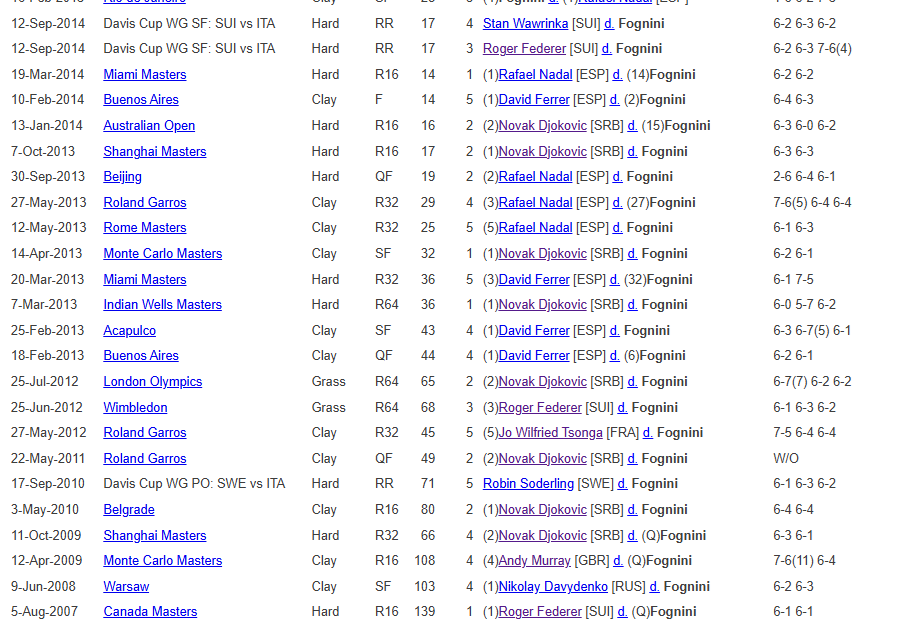
It’s easy to dunk on Fabio Fognini, but in fairness, he came up at a very difficult time to score a top-five win. Check out the list of opponents for those 23 losses:

And yes, after all that, Fognini ended the string by beating Nadal. On clay. Twice.

I also need to mention Tomas Carbonell. He ended his 20-match losing streak with an upset of 5th-ranked Jonas Bjorkman … and that was it! He finished his career on at least one winning streak.

What about top-five losing streaks, not limited to those at the beginning of a career? Here are the longest runs of top-five futility, again going back to 1982:

Player                 Streak     
Andreas Seppi              32     
Viktor Troicki             28     
Philipp Kohlschreiber      27     
Jeff Tarango               23  *  
Fabio Fognini              23  *  
Jarkko Nieminen            23  *  
Jimmy Connors              23     
Eliot Teltscher            22     
Simone Bolelli             22  *  
Diego Schwartzman          22  *  
Andres Gomez               22     
Marin Cilic                22     
Gilles Muller              22     
Francisco Clavet           21  *

(Starred players are those from the previous list.)

Before we get to Seppi, Teltscher deserves an honorable mention here. His 22-loss streak started in early 1982, right after he upset John McEnroe at the season-ending Masters event. Had he lost that match, the string would have extended to 34, since the McEnroe upset broke a separate 11-loss streak.

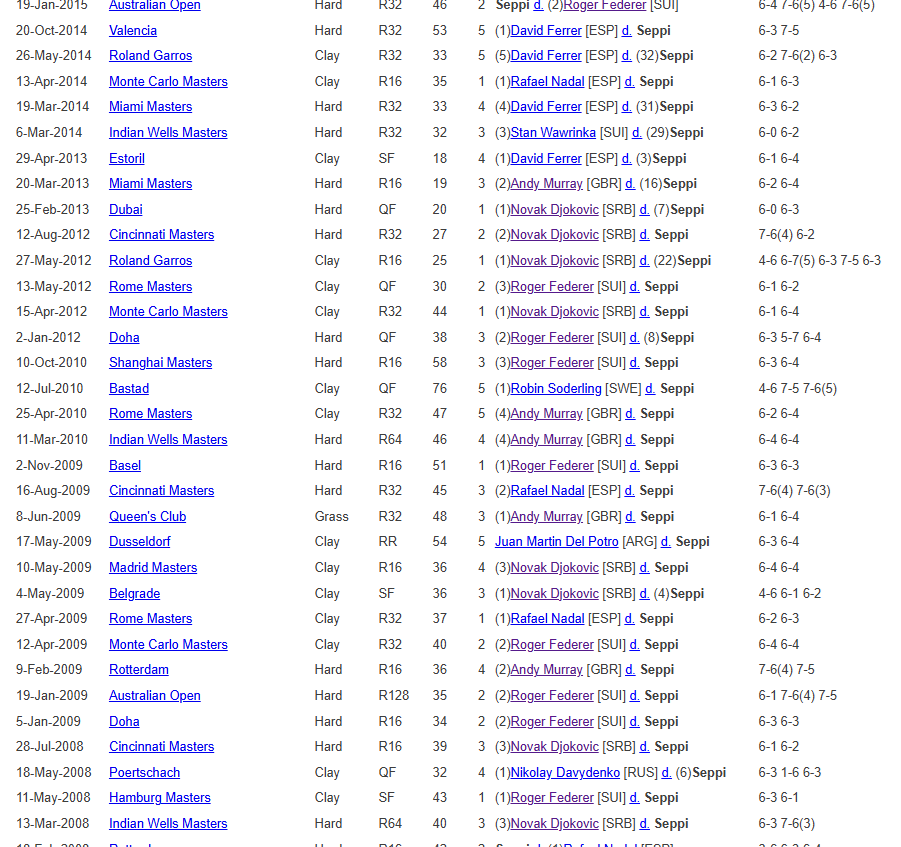
Seppi’s long run of frustration would have been hard to predict: He had beaten Lleyton Hewitt and Nadal before he broke into the top 40 himself. But the 2008 victory over Rafa would be his last top-five win for nearly seven years:

As with Fognini, not an easy time to knock out anybody in the top five.

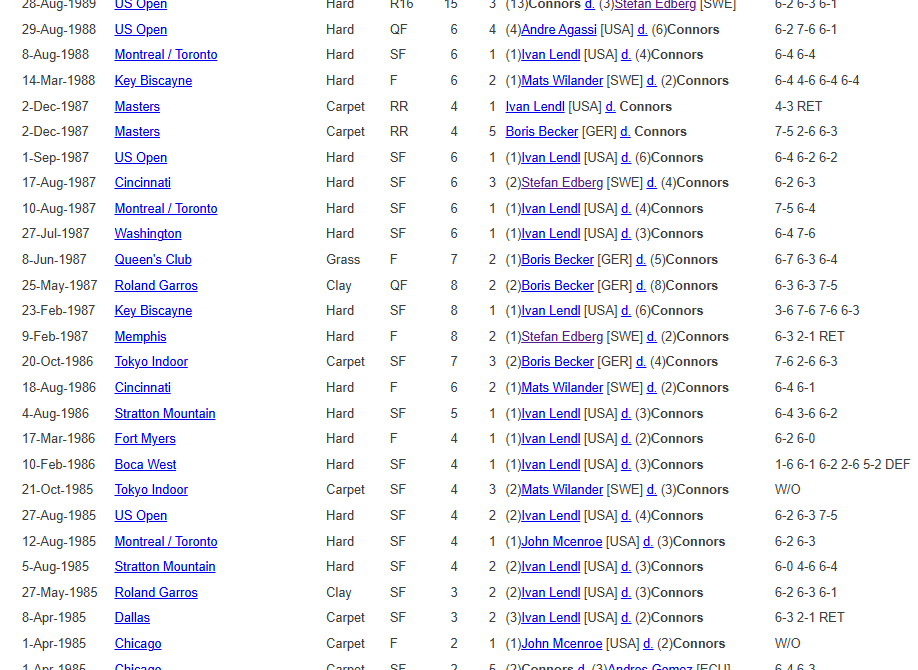
Finally, did you notice Jimmy Connors on the list? He is by far the greatest player to suffer such a long losing streak, and it was all the more notable because it began when he was a top-two player himself. He was responsible for 15 of Teltscher’s losses, but by 1985, things turned south for Jimbo:

Connors was 32 years old when the streak began, so it didn’t entirely come out of the blue. Still, that’s a tough run for a top-ten player.

Defeats of former number ones

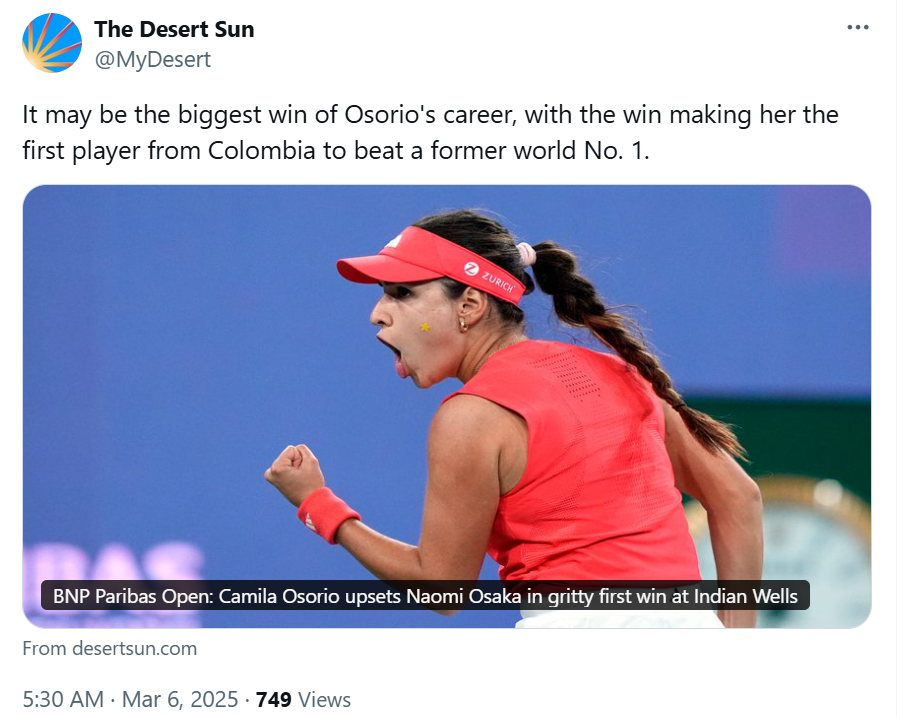
Camila Osorio opened her Indian Wells campaign with a straight-set win over Naomi Osaka. It wasn’t exactly a shock, as Osorio is ranked slightly above Osaka. But here’s a different spin on it:

Is this something we’re doing now? I mean, great for Camila and Colombia–I’m always happy to see a tennis non-powerhouse getting attention. But “former number one” spans a fair few players, some of whom have stuck around long after they fell from the top of the list. Victoria Azarenka alone has lost over 100 matches since she first dropped out of the top ten in 2014.

Still, what the hell, let’s play.

Going back to 1984, there have been 27 WTA number ones. I’m going to count wins against the current number one as well–presumably those are at least as noteworthy as beating a former top player. Since the beginning of my week-by-week ranking data, current or former number ones have lost 2,587 matches.

Here are the stars who have handed out the largest number of noteworthy(?) victories. Unlike some loss leaderboards, this isn’t necessarily a bad thing. Azarenka is a good example: Inclusion here says more about longevity than anything else. So, losses after first reaching the number one ranking:

Player                   Losses  
Venus Williams              219  
Jelena Jankovic             205  
Caroline Wozniacki          192  
Arantxa Sanchez Vicario     168  
Ana Ivanovic                162  
Victoria Azarenka           142  
Karolina Pliskova           131  
Maria Sharapova             130  
Serena Williams             116  
Angelique Kerber            114

Osorio represented Osaka’s 49th such loss. Venus Williams has allowed 108 different women to put “beat a former number one” on their CV, and Osaka is already up to 33.

All told, 369 women have now beaten a current or former number one in the last four decades. They represent 52 different countries, now including Colombia.

It really isn’t that elite of a group. Osorio has better achievements to brag about, including–to bring us full circle–a top-five win, one that took her far fewer than 18 tries to accomplish.

* * *

Subscribe to the blog to receive each new post by email:
 

The Inscrutable Magic of Jessica Pegula

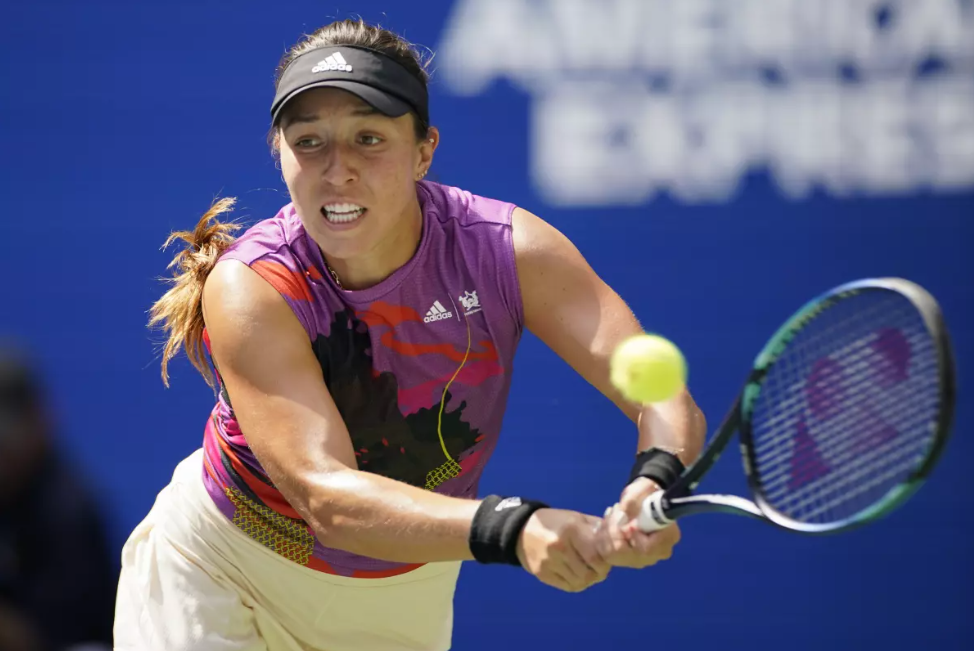
Jessica Pegula playing defense at the 2022 US Open

Alright, alright, alright.

When I started writing these player-themed pieces more than a year ago, Jessica Pegula was at the top of my list. One of my goals is to demystify the factors that cause each player’s success, or lack thereof. Pegula has had plenty of success, but compared to her peers at the top of the game, it is difficult to say exactly why.

There’s no obvious calling card that intimidates opponents. Pegula doesn’t serve very hard, ranking in the middle of the pack at least year’s US Open with an average serve speed around 92mph and first serves at 99mph. She doesn’t hit many aces. She ranks just outside the top ten in hold percentage, largely because she cleans up on second serves. That’s her one standout, top-line stat: In the 52 weeks leading up to Indian Wells, she won 51% of second-serve points. Only four women have topped 50%, and only Iga Swiatek wins more.

Pegula’s return numbers are even more anonymous. She ranks 20th among the WTA top 50 in break percentage. Top 20 on both sides of the ball is outstanding and unusual, but again, hardly intimidating. Whether serving or returning, she isn’t particularly effective on break points. Not that she’s bad in that department, but clutch play doesn’t help us understand all the match wins.

But win matches she certainly does. The American has held a place in the top ten since June 2022, much of that time in the top five. She has won seven tour-level titles and reached finals at both the US Open and the year-end championships. Off a title in Austin, she’s on a seven-match winning streak going into today’s match against Elina Svitolina. Elo isn’t quite as excited about her performance, but even that metric places her seventh, only 16 points behind fifth-place Qinwen Zheng.

What, then, is Pegula doing so right? When a player gets better results than her tools seem to suggest, I tend to fall back on difficult-to-quantify assets like movement, anticipation, and the blackest box of all, tennis IQ. Pegula excels in all those categories. But can we do better?

Second thoughts

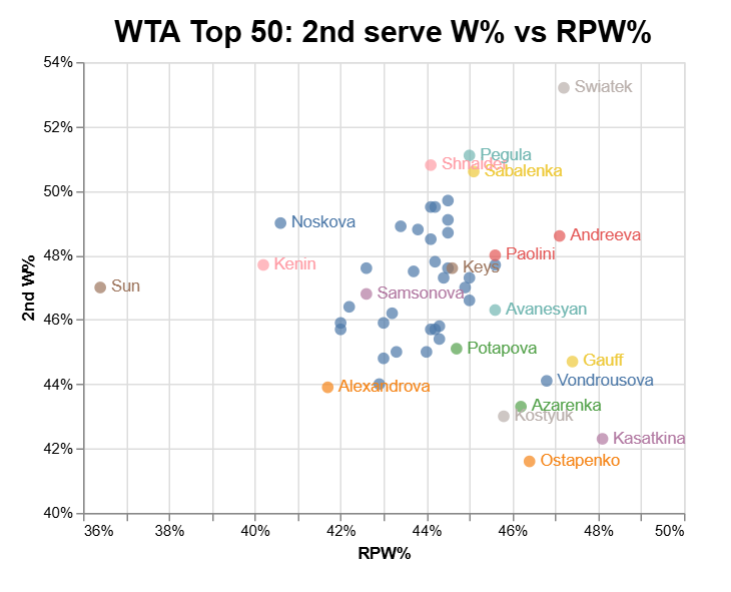
Let’s start with the second serves. Here’s a generic theory for you: second-serve win percentages are related to success rates on return. Few women have dominant second serves–remember that Pegula is one of only a handful who win more than half of those points–so especially if the returner puts the ball in play, the server is already on defense.

Indeed, there’s something of a relationship, though not a statistically strong one. This plot shows the WTA top 50 in both categories:

jpeg.jpg

Here’s a sentence I didn’t expect to write: Pegula and Sabalenka are almost identical in this pair of metrics. To go a step further, the cluster of players extending from Alexandrova in the lower left, to Sabalenka, then to Swiatek in the upper right, is disproportionately made up of big hitters. (The finesse players, along with the always unpredictable Jelena Ostapenko, are in the lower right.)

Yet by the standards of women’s tennis in the 2020s, Pegula is not a big hitter. It’s natural enough that she would equal Sabalenka’s return results, even if they get there in different ways. But second serves, too?

After watching Pegula’s quick dismissal of Xinyu Wang on Sunday, I thought I had the answer. While her second serves aren’t fast (79mph on average at last year’s US Open), they are precise. She doesn’t tee them up down the middle, and she manages to hit targets close to the service line. Location can be as valuable as raw speed, so that might explain how she gets the results of a bigger server.

Except… I can’t prove that she does any of that on a consistent basis. US Open scorers classify serve depth as “close to the line” or “not close to the line. Pegula merited a “close to the line” designation on 15% of her second serves, compared to a tournament average of 18%. She was slightly below average on first serves, too.

As for serve direction, it’s the same story. The Match Charting Project classifies each serve as one of three directions: wide, body, or down-the-tee. The average server hits one of the corners (wide or tee) with about 80% of their second serves. Pegula’s number is 74%. That’s not in itself bad–Venus Williams sports the same number–but it certainly doesn’t support my theory.

If there’s a quantifiable reason why Pegula wins all those second-serve points, it doesn’t look like we’ll find it in the second serve itself.

The match and the territory

Another eye-test hypothesis about Pegula: She doesn’t wait for the game to come to her. She stands as close to the baseline as she can get away with, both returning serve and in rallies. She doesn’t back up when faced with a deep drive or a high bounce. Depending on the shot, she’ll pick it up on a short hop or reach above her shoulder.

Not everyone is able to do this. For those who can, the advantages are clear. The earlier you hit the ball, the faster it gets back in your opponent’s court–and the less time they have to react. It’s power tennis for women without overwhelming power.

This style of play is particularly effective against opponents who aren’t particularly aggressive. Pegula’s losses this year have come against Madison Keys, Olga Danilovic, Ekaterina Alexandrova, and Linda Noskova: a quartet of heavy hitters who end points fast. Pegula lost just two matches on North American hard courts last summer, both to Aryna Sabalenka.

Against less free-swinging foes, the American takes away chances. Pegula doesn’t hit an overwhelming number of winners: 6% of her groundstrokes go untouched, in line with tour average. But her opponents do worse. In the Austin final, McCartney Kessler scored winners on just 2% of her shots from the baseline, half her usual rate. Pegula applied the same pressure to Xinyu Wang Sunday, slashing the Chinese player’s groundstroke-winner rate to 4% from a career average of 7%.

Again, these are stats that invoke parallels with a different style of player. The best way to prevent winners is to hit winners of your own, or at least end the point trying. That’s the Keys/Alexandrova/Ostapenko/etc playbook. Yet by Aggression Score, a metric that puts those ball-bashers on top, Pegula is below average, keeping company with the likes of Emma Navarro and Mirra Andreeva.

Deep research

Maybe you’re convinced that this explains a lot of Pegula’s success. She hugs the baseline, cuts off angles, and takes away opportunities for all but the most aggressive players to find openings of their own.

Still, I’d like more support from the numbers. Positioning is tricky to quantify, so I want to focus on one specific situation. What happens when the American is faced with a very deep service return?

Deep returns essentially erase the server’s advantage, neutralizing the point with one swing. The server usually needs to take a step or two back, and unless it’s a perpetual gambler like Ostapenko, she won’t try anything flashy for at least one more shot. Pegula doesn’t aim to end the point, either, but she’s less likely to concede territory. While that doesn’t allow her to seize the advantage, she’s careful not to hand too much of an edge to the returner.

Yet… nope. The next table shows how the ten players with the most hard-court data since 2022 handle deep second-serve returns: How often they get the next ball back in play (“3rd-inPlay”), how often those balls in play result in points won (“inPlay W%”), and how often they win points against deep returns, even considering the ones they didn’t get back (“vsDeep W%”).

Player            3rd-inPlay  inPlay W%  vsDeep W%  
Iga Swiatek            84.2%      59.8%      50.4%  
Aryna Sabalenka        77.5%      63.5%      49.2%  
Karolina Muchova       84.2%      56.3%      47.4%  
Paula Badosa           84.2%      54.6%      45.9%  
Elena Rybakina         79.5%      57.5%      45.7%  
Daria Kasatkina        85.5%      52.2%      44.6%  
Coco Gauff             83.6%      53.2%      44.5%  
Jasmine Paolini        82.7%      53.7%      44.4%  
Jessica Pegula         81.9%      53.2%      43.6%  
AVERAGE                81.8%      53.0%      43.4%  
Qinwen Zheng           76.5%      52.6%      40.2%

Pegula is almost exactly average, which makes her less effective against deep second-serve returns than most other top players. (The average considers all players, not just those listed, which is why it’s so close to the bottom.) Sticking to the baseline might still be the best solution for her, but it doesn’t win her an unusually high number of points.

This is a lot of negative results for one post. Pegula is close to the best in the business at turning her second serve into points won. But it’s not because she hits her seconds deep, or because she keeps the ball away the returner, or because she handles deep returns unusually well.

So we’re more or less back where we started. The American does a lot of things well, or at least well enough that they are not liabilities. Among top 50 players, she is average or better in nearly every category, close to the top ten in a few. By my groundstroke potency metrics, FHP and BHP, she does even better: She ranks among the top 20 in both, one of the few players to do so.

That, apparently, is good enough for a place in the top five. With better, finer-grained stats, we might be able to isolate how Pegula turns court position into victory. For now, we can appreciate how she holds her own against opponents with more fearsome weapons. Her personal brand of flexible shotmaking is certainly working, whether we understand it or not.

* * *

Subscribe to the blog to receive each new post by email:
 

Is the Stefanos Tsitsipas Backhand Back?

One hand might be enough.

On Saturday in Dubai, Stefanos Tsitsipas won his first 500-level title. Just about everything about this was unexpected. He had lost his last eleven finals at ATP 500s. He had dropped four of six matches coming into the event, including three against opponents outside the top 70. He barely deserved to be in the final at all, coming through a quarter-final against Matteo Berrettini in which he won a mere 47% of total points.

Most of all, the Greek shocked fans with the way he won. For the first time in years, his backhand was a weapon. He took big swings, especially on return of serve. The one-hander was suddenly so fearsome that Felix Auger-Aliassime, his opponent in the final, stopped attacking it. According to my backhand potency (BHP) metric, Tsitsipas’s performance in the semi-final against Tallon Griekspoor was his best on a hard court in more than two years.

For me, this is exciting. How often does a player–in his mid-20s, no less–just, out of nowhere, fix their biggest weakness?

One immediate cause is clear: Tsitsipas swapped out his Wilson racket for a stiffer-framed Babolat Aero. I’ll leave it to the gear experts to dissect exactly how much of a difference that has made. But given the Greek’s tactical shift this week, I have to think that the new racket offered a small boost. More importantly, it provided an excuse for Stef to make some long-overdue changes.

Let’s take a closer look at the new-and-improved Tsitsipas game.

Back(hand) from the brink

I wrote about Tsitsipas a year ago, after he crashed out of Indian Wells to Jiri Lehecka. I focused on Stef’s utter helplessness against first serves to his backhand. No one expects ATPers to win a lot of points against the first serve, but this was dire.

The Greek won just 12% of first-serve return points when Lehecka aimed at his backhand. His ten-match rolling average had fallen as low as 16% in that category, compared to career rates around 23%. At the 2023 Tour Finals against Jannik Sinner, Tsitsipas went oh-for-21 when the Italian first-served to his weaker side.

Of course, this was no secret. Most players mix up their serve direction evenly, rarely hitting more than 60% in either direction. In Acapulco last spring, Alex de Minaur hit 90% of his first serves to the Tsitsipas backhand. Most opponents didn’t go that extreme, but it must have been nice to know that there was a weak point to poke under pressure.

Until about a week ago, nothing had changed. Last fall in Basel, the Greek won barely 10% of first-serve return points when Arthur Fils aimed at his backhand. In Doha just two weeks ago, he salvaged only 15% against Hamad Medjedovic. Griekspoor nearly ousted him in Rotterdam by hitting 71% of his first serves in that direction. So the new look is truly sudden:

Match             1st to BH  inPlay  Pts Won  
Prev 10               56.5%   57.7%    23.2%  
QF vs Berrettini      67.7%   57.1%    19.0%  
SF vs Griekspoor      66.0%   54.8%    29.0%  
FI vs FAA             64.7%   72.7%    31.8% 

The “previous ten” matches are those indexed by the Match Charting Project, and they run between Tokyo last year through the Medjedovic match. That span looks a bit better than early in 2024, when Tsitsipas’s win rate on these points nearly fell below 20%, but some of that is because he faced weaker servers. Apart from Fils, the span includes two matches against Alex Michelsen and one against Mattia Bellucci.

The Berrettini result doesn’t look like much of an improvement (and again, he won only 47% of points in that match), but it is Matteo Berrettini we’re talking about. Against two more strong servers, Tsitsipas not only leapt beyond his own recent rates, he exceeded tour average. The typical player wins 28% of these first-serve return points. Stef did better.

The Auger-Aliassime result is particularly telling. While Stef has now won seven of ten meetings, Felix has piled up some impressive serve numbers over the years. In Marseille in 2022, the Greek won only 12% of first-serve return points on his backhand side. Back in 2019 when the pair met at Indian Wells, Auger-Aliassime sent 21 first serves in that direction, and Tsitsipas won the point only once.

Back(hand) up

The challenge for every returner is to find a balance between swinging big and playing it safe. Tsitsipas, with his fluctuating confidence in the topspin backhand, sometimes leans too hard on his slice. Slice returns aren’t themselves bad–a deep slice return can instantly snatch the advantage away from the server–but Tsitsipas is rarely the stronger baseliner on court. Settling in for a baseline rally is, for him, a losing proposition.

Surprisingly, Stef’s three matches in Dubai do not reflect a change in overall shot selection. From the time I wrote about his backhand struggles last year, he began hitting more and more topspin first-serve returns. Since the European indoor swing last fall, the rate has drifted back down again, though not as far as its low point, which was probably driven by injury.

This graph shows how often Tsitsipas chose to hit topspin backhand returns (as opposed to chips or slices) against first serves. It shows a ten-match rolling average on hard courts, across more than 130 charted matches since 2018:

The current rate is almost exactly at his career average of 56%. Perhaps that understates his current approach a bit–as noted, he faced some big servers in Dubai, and he’ll always end up hitting more slices to defend against players of their caliber.

This was the biggest surprise for me in the numbers. Tsitsipas looked like a completely different player last week. His backhand returns may well have been qualitatively different. But he didn’t try to attack more of them than usual. The same was true in rallies. His career backhand slice percentage (compared to all backhands) is about 20%, and he continued to land in that range for the final three rounds in Dubai.

Back(hand) in black

This is where I get to say that, yes, the margins in tennis are small. Stef’s one-hander racked up points against Griekspoor, rating 5.5 on my BHP scale. (His average over the last 52 weeks is negative, and no one consistently scores as high as Tsitsipas’s rating in that match.) But against Berrettini, his BHP was slightly negative, and against Auger-Aliassime, it was neutral.

The backhands generated by the Greek’s blacked-out racket made for glittering highlight reels. Yet they do not fully explain the title run. Tsitsipas survived the quarters by the slimmest of margins. He dropped 53% of points and probably would’ve lost the match had it not been for a miraculous half-volley winner at 4-all in the decider. The semis, yes, credit to the backhand in all its glory. The final: unusually steady backhand returns that led a flummoxed Auger-Aliassime to target the Tsitsipas forehand instead.

Assuming Stef adopts his new stick and continues to swing freely with it, the best-case scenario is probably a backhand that is … well, average. Average is not a bad thing! Tsitsipas is one of the elite servers on tour, peaking at an 89% hold rate in 2023. His forehand is a reliable weapon. A year ago, it looked like he was becoming a one-dimensional servebot. He may now be able to avoid that fate.

Where, then, is the equilibrium? Opponents have long feasted on the Tsitsipas backhand, and they won’t give up so easily. Expect servers to push him out wide, where he’ll be stuck continuing to slice. Baseliners will test him to see if they can break the shot down. After years of backhand struggles, both mental and physical, I don’t expect he’ll come through unscathed.

But he doesn’t need to transform into Novak Djokovic. The Greek’s backhand has long been among the bottom third on tour. A step up to average would be worth a point or two per match, something that, at the margin, is the difference between a berth at the Tour Finals and another year-end ranking outside the top ten. Tsitsipas has said he wanted to inspire more youngsters to hit one-handed backhands. Winning more matches would be an excellent way to do that.

* * *

Subscribe to the blog to receive each new post by email:
 

Monthly Roundup #2: February 2025

At the White House, May 10, 1922. Second from left is Molla Mallory; fourth is President Warren Harding; fifth is Marion Zinderstein Jessup.

Previous: January

February did not go as planned here at the blog — illness and the day job intervened. March should be better.

Anyway, here’s this month’s grab bag of links, historical tidbits, and trivia.

1. Newmark dug up the fantastic photo that makes this month’s header. A little research turns up that the picture dates from May 10, 1922, when President and Mrs. Harding invited several players for exhibition matches on the White House lawn. There had been a similar exhibition, including Bill Tilden, a year earlier.

Molla Mallory, then the six-time U.S. champion, was the headliner, but she lost a one-set contest with Marion Zinderstein Jessup. She then partnered Watson Washburn and dropped another set to Jessup and R. Norris Williams. The President stayed for about 90 minutes of tennis, including both of those sets.

2. Not explicitly tennis, but applicable to the sport: Speed thrills: why are so many sports getting faster?

Due to genetic constraints, athletes generally can’t improve their speed as easily as other physical attributes like endurance or strength. This means recruiters are likely to prioritise fast athletes in a spiralling pace race.

Tennis will never be entirely about speed, but speed and quickness make everything else (excepting the serve) easier and more efficient.

3. Last month we celebrated 15,000 matches in the Match Charting Project database. This month we crossed the threshold of nine million shots.

4. Denis Shapovalov beat Taylor Fritz in a deciding-set tiebreak in Dallas. It was his first deciding-set tiebreak win in thirteen tries:

Oddly enough, the 2019 win against Berrettini improved his record at the time to 7-1 at tour-level, 12-2 in all pro matches. It’s tempting (and possibly correct) to look at his recent losing streak and infer that something was going on, but on the other hand, in a decade of pro tennis, Shapo has ended up about even, as most players should be in deciding-set TBs.

5. Congratulations to Simona Halep on a wonderful career. As a long-time fan, I’m choosing to ignore the last couple of years. We’ll probably never know exactly what she took, what she knew, and so on. It would have been great to get another few healthy, uncomplicated seasons, but it was a good run. Simona ranked 93rd on my Tennis 128 list, and as a part of a longer essay, I wrote then:

She remains unclassifiable. Her serve has developed into a weapon as her baseline game has drifted back toward more cautious counterpunching. The New Yorker called her “no one’s idea of a grass court player,” and she hoisted a Wimbledon trophy. Known as something of a choker, she has ascended to the highest peaks of the sport.

6. Again non-tennis, again applicable: I love this visualization from Mike Beuoy:

This is a great way of showing both peak and longevity on the same plot. I’d love to find some ways to represent tennis careers along these lines.

7. Another glorious career comes to an end: Diego Schwartzman is hanging up his racket. He went out in front of the home crowd in Buenos Aires, even winning a match against Nicolas Jarry. There may be no greater outperformer-of-expectations in the history of the sport.

I wrote about Schwartzman for The Economist back in 2017:

Predictably, Mr Schwartzman is weakest on his serve. He hits the lowest share of aces (2.5%) and wins the lowest share of service games (63%) of any top-50 player. He compensates for this with deadly returning. In fact, so potent is El Peque in rallies that if tennis had evolved with an underhand serve—as is the case with badminton—he would probably have become a hallowed occupant of the Hall of Fame. In 2017, coming into the US Open, he had won 44% of his return points, better than anyone else on tour, and just ahead of Mr Nadal, Mr Murray, and Mr Djokovic. Against first serves, he is third best; facing second serves, he once again leads the pack.

The “deadly returning” link goes to a post I wrote the same year, in which I attempted to adjust return points won for the level of competition he faced. That metric made his already-sterling RPW% look even better.

I’m also reminded that, back in 2012, I had some very strong feelings about wild cards. I tried to illustrate how much they matter by comparing Jack Sock–recipient of several free passes as the then-golden boy of American tennis–to the unfavored Argentinian:

It’s an open question whether Sock or Schwartzman had the more impressive year.  Some might prefer the American’s challenger title and handful of top-100 scalps; others would prefer Schwartzman’s 30-match winning streak at the Futures level.

But here’s the kicker: While Sock made $137,000 and raised his ranking to #164, Schwartzman made $17,000 and is currently ranked #245.  By showing up at the Indian Wells Masters and losing in the first round, Sock made about as much money as Schwartzman did by winning six tournaments.

Schwartzman won in the end, and not just because he doesn’t play pickleball.

8. Mirra Andreeva’s Dubai title moved her up to 4th in the Elo ratings:

Adam pointed out a quirk of the top four: Sabalenka is three years older than Swiatek, who is three years older than Gauff, who is three years older than Mirra. And Madison Keys is three years older Sabalenka.

9. Speaking of Keys, here’s something I forgot to include last month. By saving match point against Swiatek in the Australian Open semis, she joined the short list of women who had come from the brink to win a major title. Only two players did so in the first three decades of the Open era, though it has become more common since.

My favorite entry on the list is Muriel Robb, who won the 1902 Wimbledon final in straight sets, yet saved a match point to do so:

1902: [WIMBLEDON] Muriel Robb d. Charlotte Sterry 7-5 6-1 in the Challenge Round. The previous day, the match had been interrupted at 4-6 13-11, after Robb saved mp when Sterry led 6-4 5-4 40-30. The match was replayed from the beginning.

10. The best match video I came across this month: Andy Murray and Arnaud Clement at the 2005 US Open:

11. How to quantify the gap between Jannik Sinner and… you?

This is fascinating. The Elo-rating gap that implies a 90% chance of winning is about 390 points. So Sinner has a 90% chance of beating #15 Gael Monfils, who has a 90% chance of beating #228 Coleman Wong, who has a 90% chance of beating #483 Leonardo Aboian. My Elo ratings only consider Challengers and Challenger qualifying, so I can’t go beyond that, and guys like Aboian may not be properly rated.

Still, that’s three levels between Sinner and a guy who has won some ITF titles. There’s at least one more level to the bottom of the pro ranks, maybe two.

After that, it gets tougher to measure. UTR could probably help us here. It also depends on how you define “weekend” tennis player. My gut reaction is that Agustin’s estimate of 12 levels is a bit too high, but 9 or 10 seems reasonable. I might just be thinking in terms of a stronger “weekend” player. Either way, the broader point holds, that the range between a recreational player and the world’s best tells us something about the sport–both its age and how compelling it is to play and watch.

12. Steve Tignor revisits Arthur Ashe’s 1975 Wimbledon victory:

To say that Jimmy Connors was the overwhelming favorite coming into Wimbledon in 1975 was an understatement. The 22-year-old was the defending champion and ranked No. 1, and he was playing with a viciousness unseen before in this previously polite sport. In 1974, he had gone 99-4, and there was talk, even among his rivals, of how he would “go on winning everything for years.”

A few years ago I wrote about the same match, evaluating Ashe’s post-match claim that Connors had choked. He probably didn’t, at least not the way Arthur thought he did.

13. From my email, Samuel writes:

Hitting a great “first serve” is like having a great fastball. If that is all you have and all you hit, you won’t last long. I’d be interested to see what would happen if someone truly approached serving like pitching and threw out the old way of thinking in terms of two speeds/serves.

I am always here for tennis-baseball comparisons. I think there are various reasons why tennis serving is less about variety:

a. For kids and rec players, serving consistently is hard. That’s enough of a hurdle for most people.

b. Even for much better players, disguising intentions is a challenge. A pitcher can move a (concealed) finger or two, twist their wrist a bit differently, and throw a breaking pitch. For all but the best servers, mixing things up means tossing in a different place and/or using a different service motion–both things that are visible to an attentive returner.

c. There’s much less value in “offspeed” serving than in pitching. A baseball changeup functions broadly like a curveball: It upsets the batter’s expectations and he swings over it. That might be a swing-and-a-miss, or it might mean weak contact. But the analogy doesn’t hold in tennis, because rackets are so much more forgiving than baseball bats. Miss the sweet spot by a fraction of an inch, and you can still get the ball back in play. And then, if the offspeed serve isn’t well-disguised, it’s just mediocre. And we know what happens to mediocre serves in 2025.

That said, pros do think in terms of a range of serves, even if it doesn’t rival, say, the pitch arsenal of Yu Darvish. With a much wider target, placement trumps movement. The very best servers–think Federer or Barty–can overcome (b) and (c) and do pretty much whatever they want.

I suspect that the next big shift in serving strategy will be about a different sort of variety: risk levels. The math doesn’t recommend “two first serves,” but it does suggest that players should take more chances with second serves and accept more double faults. I’ll have more about that in an upcoming post.

14. In my notes, I have reminders to mention Jannik Sinner’s suspension, the the evisceration of US Open mixed doubles, and the potential switch of the Golden Swing to hard courts–or its eventual disappearance in favor of a Saudi Masters.

But… you probably know about these things. I can’t get myself too worked up about any of them. In a few months, Sinner will be back, he’ll win lots of matches, and we’ll all mostly forget this ever happened. The purist in me hates the new exhibition-style US Open mixed, but honestly, was I going to watch any of it either way? (Were you?) And as for the Golden Swing: It will continue to struggle, given its spot on the calendar and its geographical position in a Europe-dominated sport. The rise of Joao Fonseca will save it, for now.

15. RIP Gene Hackman. Hoosiers is the best sports movie ever made. How did Hackman end up in Young Frankenstein? Tennis, of course:

* * *

Subscribe to the blog to receive each new post by email:
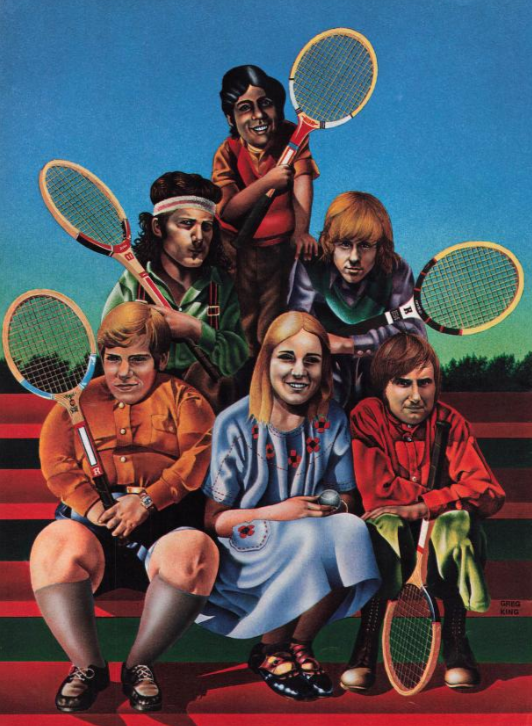
 

Carlos Alcaraz and the Fruits of Shot Tolerance

Carlos Alcaraz making it look easy

Tennis people increasingly talk about “shot tolerance.” What does it mean?

There’s no standard definition. A Google summary settles on this: “a player’s ability to get to and return a given ball as desired.” Other definitions focus more on avoiding unforced errors: How long can a player stay in a rally without making a mistake?

I think of it like defense, in a very broad sense. Usually when we talk about defensive skills, it’s a lunging Andy Murray, recovering balls that nearly end the point, like big serves or would-be winners. In pro tennis, though, nearly every shot has an offensive component. That is to say, almost every shot tests the defensive skill–or resourcefulness, or shot tolerance–of the other player. A heavy Jannik Sinner forehand right at the feet, a Novak Djokovic backhand angled wide: Can you handle that and keep the point alive?

Another way to conceptualize shot tolerance is to imagine a win probability stat that updates with each shot. When Sinner hits that heavy forehand, his chances of winning the point against an average opponent increase to, say, 70%. A player with high shot tolerance will somehow save more than 30% of those points. A player with low shot tolerance will fail to get as many back (or hit weaker replies), and he’ll win fewer than 30% of those points.

We don’t have that all-knowing win probability stat, so we can’t measure shot tolerance so directly. Because the concept is fuzzy, I don’t imagine we’ll land on a fully satisfying way to quantify shot tolerance. But it’s worth the attempt, and it will help us explain how Rotterdam champ Carlos Alcaraz works his magic.

Long rallies

Start with the basics. Players with high shot tolerance should win more long rallies, right?

I drew the line at six shots, including rallies where the sixth stroke was an unforced error. I don’t want to muck things up by mixing surfaces, so we’re sticking with hard courts today. Based on Match Charting Project data, here are the men who have won the most of these “long” rallies on hard courts since the beginning of 2024:

Player            6+ W%  
Jannik Sinner     56.1%  
Carlos Alcaraz    55.6%  
Alex de Minaur    55.1%  
Grigor Dimitrov   55.1%  
Joao Fonseca      55.0%  
Learner Tien      54.5%  
Andrey Rublev     54.2%  
Novak Djokovic    53.7%  
Daniil Medvedev   53.7%  
Alejandro Tabilo  53.2%

The top of the list is as expected: Sinner and Alcaraz can outlast most opponents and have the ability to end the point. Fonseca and Tien probably won’t sustain these numbers, since they haven’t played the same level of competition as the others. Tabilo’s position is dicey, too, as we don’t have as many charted matches of his. Alexander Zverev is next on the list, if you’d like to promote him in Tabilo’s place.

Complicating matters is how these points end. The goal isn’t to sustain the longest rally possible. At some point shot tolerance gives way to power and calculated risk-taking. Some players are particularly strong on the pure shot-tolerance side of things, avoiding unforced errors in these long rallies:

Player            6+ Rally UFE%  
Casper Ruud               15.8%  
Bu Yunchaokete            17.9%  
Lorenzo Musetti           18.5%  
Daniil Medvedev           19.5%  
Alex Michelsen            19.5%  
Frances Tiafoe            20.0%  
Karen Khachanov           20.2%  
Alejandro Tabilo          20.4%  
Learner Tien              20.7%  
Novak Djokovic            21.0%

There’s some overlap between the two lists, but not much. Sinner’s error rate is better than average, at 22.3%, while Alcaraz’s is worse, at 24.1%. In the Rotterdam first round against Botic van de Zandschulp, Alcaraz committed unforced errors on 40% of points that reached the sixth shot. He still somehow won half of the long points.

There’s a relationship between win rate and error rate on long points–there pretty much has to be, since errors are points lost. But error rate explains less than 30% of the variation in long-rally winning percentage. Alcaraz, for one, breaks the mold by committing a lot of errors yet winning the majority of the points:

Alcaraz’s errors don’t usually expose a weakness of shot tolerance. They reflect a gamble. (Sinner is similar, though his groundstrokes are so imposing that he can do more damage with less risk.) We can’t just count errors and create a shot-tolerance metric, but we also don’t have the ability to ask players what they were thinking when they attacked every shot. Isolating shot tolerance requires a different approach.

Accepting errors

Let’s shift from points to shots. Again for hard-court matches since the start of last season, I tallied each player’s baseline strokes starting from the fourth shot of each rally. Shot tolerance is useful for serve returns and plus-ones, but those shots are so often out of a player’s control. And since most points are short, returns and plus-ones end up dominating the data. To get a sample of shots that reflect what we think of as “rallying,” we need to discard those.

(The word “baseline” is doing a ton of work here. Shot tolerance isn’t usually about making volleys or smashes, or about executing passing shots. So I’ve excluded every shot at the net, as well as every shot when the opponent is at or approaching the net.)

As with the long rallies, we can start by getting a sense of the shot-tolerant all-stars, the guys who are best at avoiding unforced errors:

Player                UFE/Shot %  
Learner Tien                7.4%  
Alexander Shevchenko        7.9%  
Lorenzo Musetti             8.2%  
Alejandro Tabilo            8.2%  
Tommy Paul                  8.7%  
Frances Tiafoe              8.9%  
Carlos Alcaraz              9.2%  
Jannik Sinner               9.2%  
Matteo Arnaldi              9.2%  
Casper Ruud                 9.7%

Musetti, Paul, and Ruud are names you’d probably expect to see here. Alcaraz and Sinner are more bracing. They don’t stand out as error-avoiders when we look at long rallies, but on a per-shot basis, they do.

In general, there’s a predictable trade-off. Players who hit more winners (and force more errors) commit more unforced errors. But the relationship between the two numbers is not the same for everyone. Here’s the same UFE-top-ten list, with winner rates added:

Player                UFE%  W+FE%  
Learner Tien          7.4%   7.3%  
Alexander Shevchenko  7.9%   9.1%  
Lorenzo Musetti       8.2%   9.1%  
Alejandro Tabilo      8.2%  10.6%  
Tommy Paul            8.7%  11.1%  
Frances Tiafoe        8.9%   8.0%  
Carlos Alcaraz        9.2%  10.1%  
Jannik Sinner         9.2%  14.1%  
Matteo Arnaldi        9.2%   8.3%  
Casper Ruud           9.7%  11.1%

Holy Sinner! The typical ATP regular hits slightly more winners than UFEs at these stages of the rally. Tien, Tiafoe, and Arnaldi are on the wrong side of the scale. Tabilo, again, is probably favored by a limited (and biased) sample. And Sinner … well, you need to go 15 more players down the list before you find anyone who cracks as many winners as he does, and Karen Khachanov coughs up a quarter more errors to accomplish the feat.

Here’s the full scatterplot:

This is a tighter relationship than the one pictured earlier. The player-to-player variation in winner rate explains half of the difference in error rate. Yet again, some players defy the usual tradeoff. The closer they are to the upper left corner of the graph, the more risk-free their aggression.

Controlled (for) aggression

It feels weird to quantify shot tolerance by considering winners, but that’s exactly what we’re going to do.

As a simplification, imagine that we put every shot into one of two categories: aggressive or defensive. Aggressive shots really aren’t about shot tolerance. Unless the aggression is just a last-ditch effort from a hopeless position, it’s a shot that the player more or less knows he can make. He hits hard, aims for the line, and it ends the point one way or the other.

Shot tolerance isn’t about the unforced errors that come from that kind of risk. We’re interested in how steady a player is on every other shot.

To get there, we’re going to string together some assumptions. You’ll probably disagree with some of them, and you’ll almost definitely disagree with some of the results. But bear with me for a minute anyway.

Say that the “cost” of winners (and forced errors) is half as many unforced errors. The usual ratio is closer to 1:1, but that doesn’t count forced errors, and it counts the kind of “bad” errors that come from low shot tolerance. So the 2:1 ratio means that if a player is going to hit two winners, the cost of doing business is one unforced error. For Alcaraz, his 10.1% winner rate implies that even if he’s playing flawlessly in non-aggressive situations, he’ll still have an error rate of about 5%.

From there, we come up with a “non-aggressive” error rate. Since Alcaraz’s total error rate is 9.2% and we’re writing off 5% as the cost of his aggression, that leaves us with 4.2%. We’ll divide that by the number of non-aggressive shots–that is, 100% of his shots, minus his winners, minus the 5% of aggressive errors. So: 4.2% divided by (100% – 10.1% – 5% =) 84.9%. Punch it into the calculator, and we get a non-aggressive error rate of 4.9%.

In more positive terms, that’s a “shot tolerance” of 95.1%. That is, when he has a reasonable chance of making a shot (meaning his opponent didn’t hit a winner or generate a forced error), and he doesn’t go big, he makes the shot 95.1% of the time. Average among tour regulars is 93.7%. Here are the top ten, excluding the names like Tien and Tabilo that I quibbled with above:

Player           ShotTol  
Jannik Sinner      97.3%  
Tommy Paul         96.2%  
Lorenzo Musetti    95.7%  
Andrey Rublev      95.4%  
Carlos Alcaraz     95.1%  
Grigor Dimitrov    95.0%  
Casper Ruud        95.0%  
Daniil Medvedev    94.9%  
Frances Tiafoe     94.5%  
Alex de Minaur     94.4%

So, do you agree that Alex de Minaur doesn’t have the shot tolerance of Rublev, Dimitrov, or Tiafoe? What about leaving Djokovic out of the top ten entirely? (His figure over the last 13 months is a below-average 93%.) Of course you don’t. That’s what I’m here for.

Djokovic is easy enough to explain. His last 13 months have been rocky. If we expand the time frame back to 2020, his number shoots up to 97.1%.

Dimitrov is higher than expected because of his reliance on the slice. Dan Evans did well by this metric, too. Slices are a good way to keep balls in play, even if they don’t generate a lot of offensive opportunities. I hesitate to exclude slices from the metric, but some kind of adjustment is probably in order.

De Minaur may expose another limit of this approach. One of the assumptions I strung together is that everyone’s winners come at the same cost. But the Aussie is relatively small: He can’t just wave a magic wand and generate winners like Sinner can. He needs to take more risks to end points. His winner/error ratio for this set of shots is 10.7% to 10.0%. My model assumes that a bit more than half of his errors are aggressive shots that missed the mark. But what if it’s more? In the bizarro world where players really did register their intention before every shot, we might find that many more of de Minaur’s errors fall in that category.

Or, maybe, he’s not quite as sturdy as we think he is. Either way, it’s something to watch next time you tune into a match of his.

Return to Alcaraz

Why, then, is Carlitos’s name in the headline? Sinner (or Tien, or Ruud) is better by most of these metrics.

What fascinates me about shot tolerance is what it doesn’t explain. If shot tolerance determines anything, it should tell us who’s going to win long rallies. And to some extent it does: Sinner tops the shot tolerance list, and he wins more long rallies than anybody else. (Though that doesn’t prove much: Sinner is better at just about everything, related or not.)

Yet Alcaraz isn’t far behind in long rallies. The Spaniard comes in second with room to spare. Tommy Paul does better on my shot tolerance metric, yet he wins only 51% of long rallies.

The X-factor, I think, is that shot tolerance is instrumental. You can win some points by out-shot-tolerancing your opponent, because yes, eventually they will miss. But nearly as often, you will keep the rally alive, even slightly in your favor, and they’ll take a risk that pays off. If that opponent is Sinner, that’s the most likely outcome. Just ask de Minaur, who has lost all ten of his career meetings with the Italian.

Alcaraz’s long-rally magic doesn’t fully show up in the shot tolerance metric because it isn’t confined to the baseline. The signature Carlitos point is a ten-stroke rally that he puts away at the net or polishes off with a drop shot. His baseline prowess isn’t quite a match for Sinner, and his net skills probably rank behind those of Federer or Nadal. But has there ever been a player who could go from gutbusting rally to all-court acrobatics with such success?

The Spaniard approaches the net half-again as often as Sinner does. He wins nearly three-quarters of points when he does so. In today’s game, a mid-rally net approach has to be earned, and many strong forecourt players don’t have the baseline skills to create those chances.

Shot tolerance, then, is necessary but not sufficient. (And that’s even ignoring short points. Impregnable rallying doesn’t count for much when the serve is unreturnable.) Sinner earns his point-ending chances with sturdy baseline work, then converts them from the same position. Alcaraz is nearly as good at keeping the point alive, and he has more options than anybody when it comes to finishing it.

* * *

Subscribe to the blog to receive each new post by email: